
Judge, 1912-03-02 · page 17 of 24
Judge — March 2, 1912 — page 17: what you’re looking at
What you’re looking at
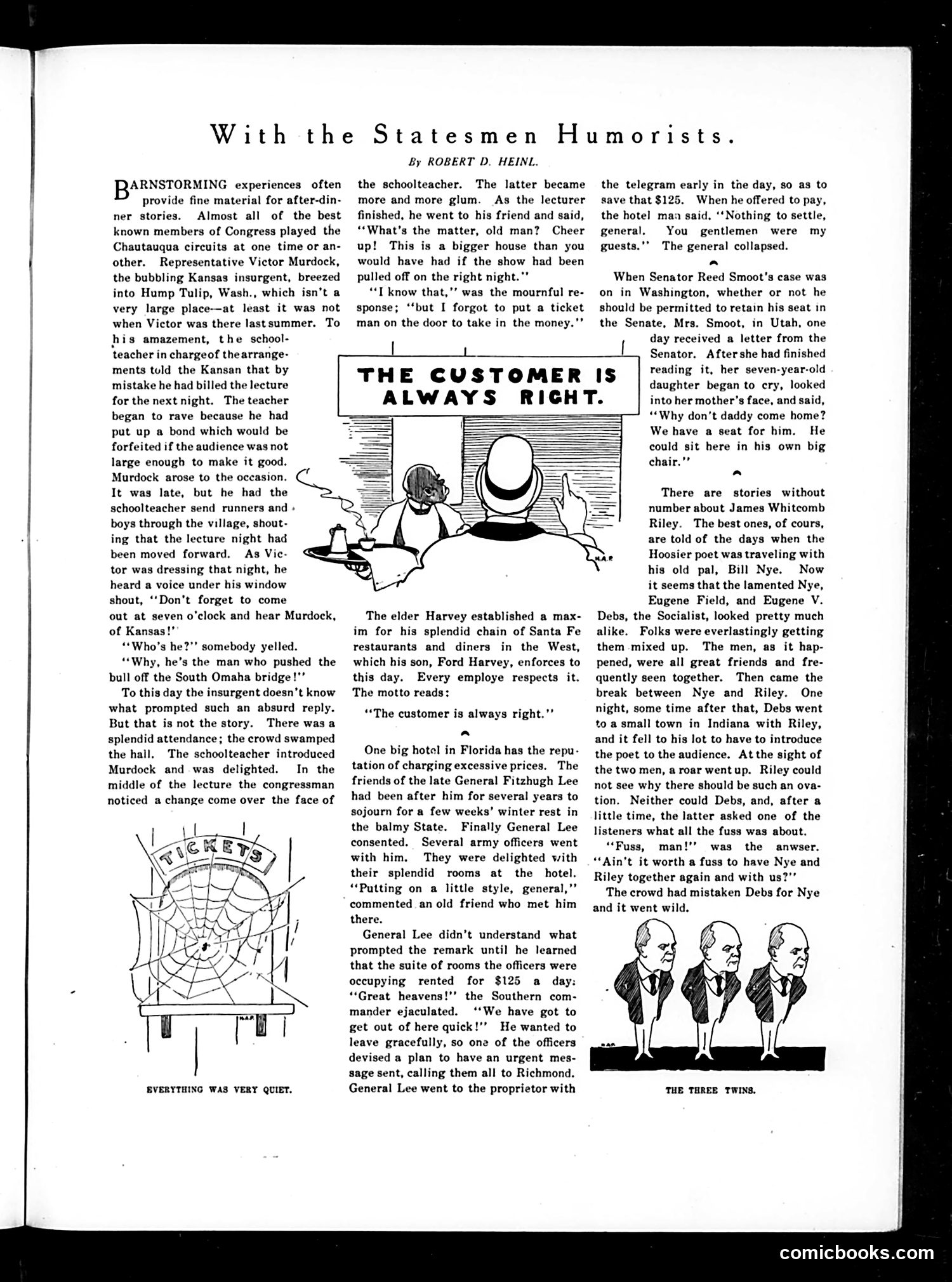
This humorous article collects anecdotes about American politicians and public figures, illustrating their wit and character through barnstorming and social encounters. The main cartoon (center) shows the Harvey restaurant chain's motto: "THE CUSTOMER IS ALWAYS RIGHT"—a business principle enforced by founder Fred Harvey and his son. The text includes stories about Representative Victor Murdock (Kansas "insurgent"), Senator Reed Smoot (whose polygamy case was debated in Congress), and General Fitzhugh Lee (post-Civil War figure). Each anecdote plays on the tension between politicians' public personas and practical realities—missed lecture logistics, family longing during political scandal, and embarrassment over expensive hotel bills. The three-figure sketch at bottom ("THE THREE FINDS") appears to depict politicians or statesmen, though the reference is unclear from the visible text. The humor targets politicians' hypocrisy, pretension, and disconnect from ordinary life, typical of Judge's satirical approach.
📄 Transcribed text from this page (OCR, searchable)
Machine-transcribed from the original scan — historical spelling and the odd misread are preserved.
] | With ARNSTORMING experiences often provide fine material for after-din- ner stories. Almost all of the best known members of Congress played the Chautauqua circuits at one time or an- other. Representative Victor Murdock, the bubbling Kansas insurgent, breezed into Hump Tulip, Wash., which isn’t a very large place—at least it was not when Victor was there lastsummer. To his amazement, the school- teacher in chargeof thearrange- ments tuld the Kansan that by mistake he had billed the lecture for the next night. The teacher began to rave because he had put up a bond which would be forfeited if the audience was not large enough to make it good. Murdock arose to the occasion. It was late, but he had the schoolteacher send runners and + boys through the village, shout- ing that the lecture night had been moved forward. As Vic- tor was dressing that night, he heard a voice under his window shout, ‘‘Don’t forget to come out at seven o'clock and hear Murdock, of Kansas!’ “‘Who’s he?"’ somebody yelled. “Why, he’s the man who pushed the bull off the South Omaha bridge!"’ To this day the insurgent doesn’t know what prompted such an absurd reply. But that is not the story. There wasa splendid attendance; the crowd swamped the hall. The schoolteacher introduced Murdock and was delighted. In the middle of the lecture the congressman noticed a change come over the face of BVERYTHING WAS VERY QUIET. the Statesmen Humorists. By ROBERT D. HEINL. the schoolteacher. The latter became more and more glum. As the lecturer finished, he went to his friend and said, “What's the matter, old man? Cheer up! This is a bigger house than you would have had if the show had been pulled off on the right night."* “I know that,’’ was the mournful re- sponse; ‘‘but I forgot to put a ticket man on the door to take in the money.’ | L the telegram early in tne day, so as to save that $125. When he offered to pay, the hotel maa said, ‘‘Nothing to settle, general. You gentlemen were my guests." The general collapsed. a When Senator Reed Smoot's case was on in Washington, whether or not he should be permitted to retain his seat in the Senate, Mrs. Smoot, in Utah, one day received a letter from the I Senator. Aftershe had finished THE CUSTOMER ALWAYS RIGHT. 1S reading it, her seven-year-old daughter began to cry, looked into her mother’s face, and said, “Why don’t daddy come home? We have a seat for him. He could sit here in his own big chair.’” a There are stories without number about James Whitcomb The elder Harvey established a max- im for his splendid chain of Santa Fe restaurants and diners in the West, which his son, Ford Harvey, enforces to this day. Every employe respects it. The motto reads: “The customer is always right.”’ a One big hotel in Florida has the repu- tation of charging excessive prices. The friends of the late General Fitzhugh Lee had been after him for several years to sojourn for a few weeks’ winter rest in the balmy State. Finally General Lee consented. Several army officers went with him. They were delighted with their splendid rooms at the hotel. “Putting on a little style, general,” commented an old friend who met him there. General Lee didn’t understand what prompted the remark until he learned that the suite of rooms the officers were occupying rented for $125 a day: “Great heavens!’’ the Southern com- mander ejaculated. ‘‘We have got to get out of here quick!’’ He wanted to leave gracefully, so one of the officers devised a plan to have an urgent mes- sage sent, calling them all to Richmond. General Lee went to the proprietor with Riley. The best ones, of cours, are told of the days when the Hoosier poet was traveling with his old pal, Bill Nye. Now it seems that the lamented Nye, Eugene Field, and Eugene V. Debs, the Socialist, looked pretty much alike. Folks were everlastingly getting them mixed up. The men, as it hap- pened, were all great friends and fre- quently seen together. Then came the break between Nye and Riley. One night, some time after that, Debs went to a small town in Indiana with Riley, and it fell to his lot to have to introduce the poet to the audience. At the sight of the two men, a roar went up. Riley could not see why there should be such an ova- tion. Neither could Debs, and, after a little time, the latter asked one of the listeners what all the fuss was about. “Fuss, man!’’ was the anwser. n't it worth a fuss to have Nye and Riley together again and with us?” The crowd had mistaken Debs for Nye and it went wild. THE THREE TWINS, comicbooks.com