
Judge, 1912-03-02 · page 16 of 24
Judge — March 2, 1912 — page 16: what you’re looking at
What you’re looking at
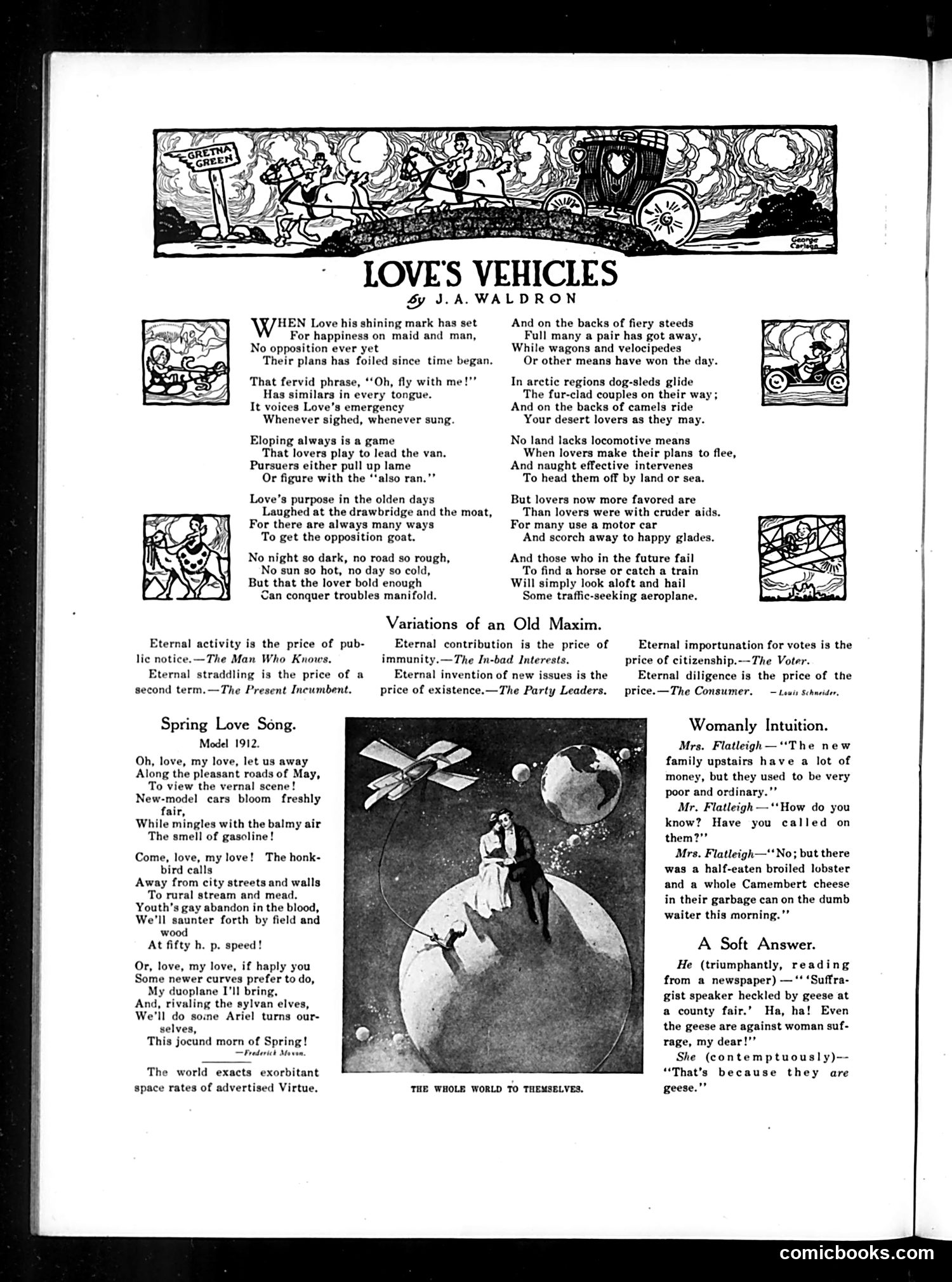
This page satirizes early 20th-century courtship and elopement through multiple pieces: **"Love's Vehicles"** (main poem by J.A. Waldron) humorously catalogs how lovers throughout history have fled together—from horseback and carriages to the modern motorcar and, looking forward, aeroplanes. The satire updates the romantic "elopement" trope for the 1912 automotive age, suggesting lovers now have unprecedented technological means to escape parental opposition. **"Spring Love Song"** parodies Victorian romantic poetry by replacing pastoral imagery with automobile and aviation references—"fifty h.p. speed," "duoplane," "gasoline"—mocking how modernity has infiltrated even love and courtship. The remaining items ("Variations of an Old Maxim," "Womanly Intuition," "A Soft Answer") are brief satirical quips on politics, gender dynamics, and the suffrage debate—Mrs. Flatleigh's deduction from garbage revealing newly-wealthy neighbors, and the exchange mocking anti-suffrage sentiment by having a woman outwit a man's anti-women's-rights jab. The overall theme: mechanization and modern life have transformed even romance and social observation.
📄 Transcribed text from this page (OCR, searchable)
Machine-transcribed from the original scan — historical spelling and the odd misread are preserved.
Sy J.A.WALDRON HEN Love his shining mark has set For happiness on maid and man, No opposition ever yet Their plans has foiled since time began. That fervid phrase, ‘‘Oh, fly with me!"’ Has similars in every tongue. It voices Love’s emergency Whenever sighed, whenever sung. Eloping always is a game That lovers play to lead the van. Pursuers either pull up lame Or figure with the ‘‘also ran.”’ Love’s purpose in the olden days Laughed at the drawbridge and the moat, For there are always many ways To get the opposition goat. No night so dark, no road so rough, No sun so hot, no day so cold, But that the lover bold enough Can conquer troubles manifold. And on the backs of fiery steeds Full many a pair has got away, While wagons and velocipedes Or other means have won the day. In arctic regions dog-sleds glide The fur-clad couples on their way; And on the backs of camels ride Your desert lovers as they may. No land lacks locomotive means When lovers make their plans to flee, And naught effective intervenes To head them off by land or sea. But lovers now more favored are Than lovers were with cruder aids. For many use a motor car And scorch away to happy glades. And those who in the future fail To find a horse or catch a train Will simply look aloft and hail Some traffic-seeking aeroplane. Variations of an Old Maxim. Eternal contribution is the price of immunity.—The In-bad Interests. Eternal invention of new issues is the price of existence.—The Party Leaders. Eternal importunation for votes is the price of citizenship.--The Voter. Eternal diligence is the price of the price.—The Consumer, Eternal activity is the price of pub- lic notice. —The Man Who Knows. Eternal straddling is the price of a second term.—The Present Incumbent. = Lewis Schneider, Spring Love Song. Model 1912. Oh, love, my love, let us away Along the pleasant roads of May, To view the vernal scene! New-model cars bloom freshly fair, While mingles with the balmy air The smell of gasoline! Come, love, my love! The honk- bird calls Away from city streets and walls To rural stream and mead. Youth’s gay abandon in the blood, We'll saunter forth by field and wood At fifty h. p. speed! Or, love, my love, if haply you Some newer curves prefer to do, My duoplane I'll bring, And, rivaling the sylvan elves, We'll do soine Ariel turns our- selves, This jocund morn of Spring! —Frederich Moven. The world exacts exorbitant space rates of advertised Virtue. THE WHOLE WORLD TO THEMSELVES. Womanly Intuition. Mrs. Flatleigh—‘‘The new family upstairs have a lot of money, but they used to be very poor and ordinary. Mr. Flatleigh —‘‘How do you know? Have you called on them?”’ Mrs. Flatleigh—‘* No; but there was a half-eaten broiled lobster and a whole Camembert cheese in their garbage can on the dumb waiter this morning."” A Soft Answer. He (triumphantly, reading from a newspaper) — ‘‘ ‘Suffra- gist speaker heckled by geese at a county fair.’ Ha, ha! Even the geese are against woman suf- rage, my dear!”’ She (contemptuously)— “That's because they are geese."” comicbooks.com