
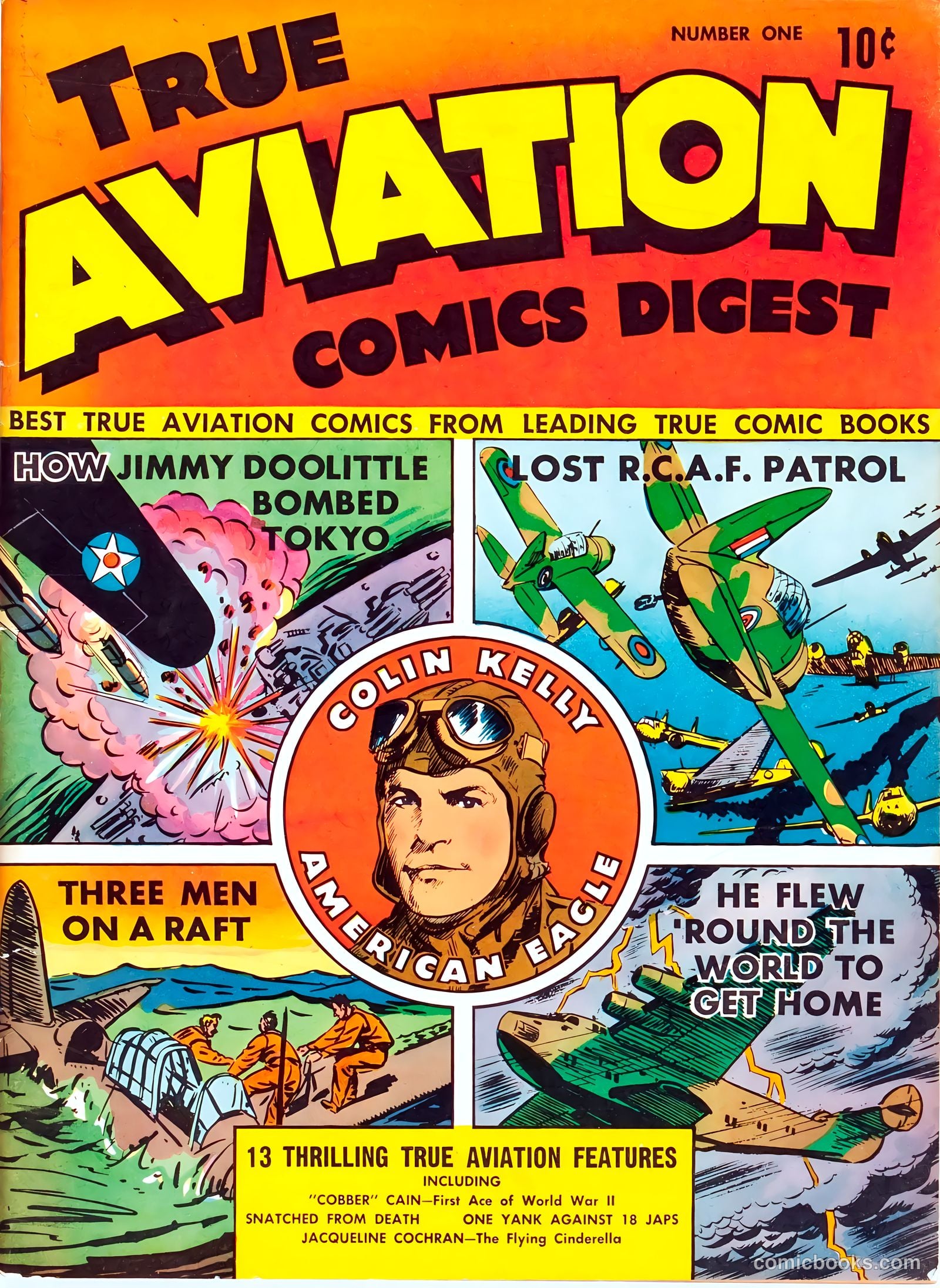
True Aviation Comics Digest #1
☆ Be the first to review + Add to your collection — Join freeAn anthology of thirteen true aviation stories, this issue features "How Jimmy Doolittle Bombed Tokyo," depicting the famous 1942 raid; "Three Men on a Raft," in which shipwrecked sailors are rescued after 33 days adrift; "Lost R.C.A.F. Patrol," following a missing aircraft; and "He Flew 'Round the World to Get Home," chronicling a pilot's journey. The collection also includes stories of Captain Colin Kelly, an American Eagle who sank a Japanese battleship in December 1941 before being killed in combat, and other true accounts of wartime aviation heroism.
General James Doolittle led the daring raid that brought the war home to Japan's doorstep on April 18, 1942—the first bombing of Tokyo itself. Flying low over the city with volunteer crews who knew the odds were stacked against their return, Doolittle and his pilots targeted factories, shipyards, and military installations while navigating enemy fire and their own aircraft's limits. It was a feat of flying skill and nerve that would earn Doolittle the Congressional Medal of Honor.
When a U.S. Navy bomber loses its mother ship in a South Pacific squall, pilot Harold S. Dixon and his crew—Anthony Pastula and Gene Aldrich—are forced to ditch their plane with almost nothing but a life raft and the clothes on their backs. What follows is a harrowing 34-day survival ordeal on open water, where the three men must improvise with makeshift tools, battle sharks and storms, and scavenge whatever the sea offers them. This is the true account of three sailors pitted against the elements in one of the Pacific War's most remarkable tales of endurance.
Jacqueline Cochran rose from an orphanage childhood to become one of aviation's most accomplished pilots, combining her grit and determination with an unstoppable drive to break records and barriers in a male-dominated field. Through crashed planes, engine failures, and skeptics who doubted women belonged in the cockpit, she racked up world speed records, won major air races, and earned recognition as the outstanding woman flier in the world. Now, as war looms over Europe, her skills and courage are called upon for a dangerous mission that could change everything.
When a parachutist becomes dangerously tangled during a training jump at San Diego Navy Base, Lieutenant William W. Lowrey springs into action to attempt a daring aerial rescue. Racing against time and turbulent skies, Lowrey must use every trick in his arsenal to save the man from a fatal plunge. This true account of valor in the air showcases the split-second decisions and nerve that define naval aviation heroism.
Lieutenant L. H. Moorer and his seaplane crew face desperate odds when Japanese bombers attack their patrol flight over Northern Australia, forcing them to ditch near a remote island. With no immediate rescue in sight and supplies running low, Moorer devises a bold plan to signal passing aircraft, hoping to bring help to his stranded men.
Peggy Lennox, a former model with a passion for aviation, trades her fashion career to become a flight instructor at Rhode Island State Airport, joining the war effort to train pilots for Uncle Sam's defense program. Skeptical students quickly learn that her skill in the cockpit matches her determination to prove that flying is far from a man's-only job. As she guides her trainees toward their wings, Peggy proves that any job becomes a woman's work when service to the country is on the line.
Squadron Leader L.J. Birchall and his R.C.A.F. patrol crew spot a massive Japanese fleet maneuvering in the Indian Ocean in April 1942, and Birchall immediately radios the alarm to Ceylon base. With Allied fighters scrambled to intercept, a fierce aerial battle unfolds as the defending forces clash with the enemy bombers and fighters—but Birchall's vigilance comes at a cost that shadows the victory.
Captain Colin P. Kelly's rise from West Point cadet to pioneering B-17 pilot is cut short when Japan attacks in December 1941—but in his final moments, the young officer proves himself a true hero by targeting a Japanese battleship before sacrificing himself so his crew can escape. This 1942 tribute celebrates Kelly's courage and the nation's gratitude for his service in the war's opening days.
When the Pacific Clipper departed San Francisco on December 2, 1941, Captain Robert Ford expected a routine hop to Los Angeles—but the attack on Pearl Harbor five days later forced an extraordinary change of plans. With war declared and normal Pacific routes cut off, Ford and his crew faced an unprecedented challenge: fly a giant commercial seaplane the long way around the world to reach New York, navigating enemy territory, suspicious Allied forces, and some of the worst weather imaginable. This is the true account of how the Pacific Clipper became the first commercial aircraft to circle the globe, proving that sometimes the longest route home is the only safe one.
Father Hubbard, the "Glacier Priest," sets out with aviator Frank Dorbandt and his mechanic Herb to explore Aniakchak, Alaska's largest active volcano, landing inside the crater itself—a daring first. When their fuel runs dangerously low during the expedition, Frank devises an unconventional solution using the volcano's own power to escape. This 1942 account captures a true aviation adventure in one of the world's most extreme and unforgiving environments.
ComicBooks.com Value
Show all 17 grades ▾
Find on ebay
Read it digitally
Sell my copy
Have this issue — or a whole collection? Get a fair offer from us, skip the marketplace fees and the hassle.
We Buy Collections ▸Reprints
↩ Reprints Calling All Girls #2 (1941), Real Heroes #2 (1941), True Comics #8 (1942), Real Heroes #3 (1942), True Comics #11 (1942), True Comics #15 (1942), Real Heroes #6 (1942), True Comics #16 (1942), True Comics #17 (1942)
Reprinted in Take That, Adolf!: The Fighting Comic Books of the Second World War #[nn] (2017)
Reviews
Reader reviews
No reader reviews yet.