
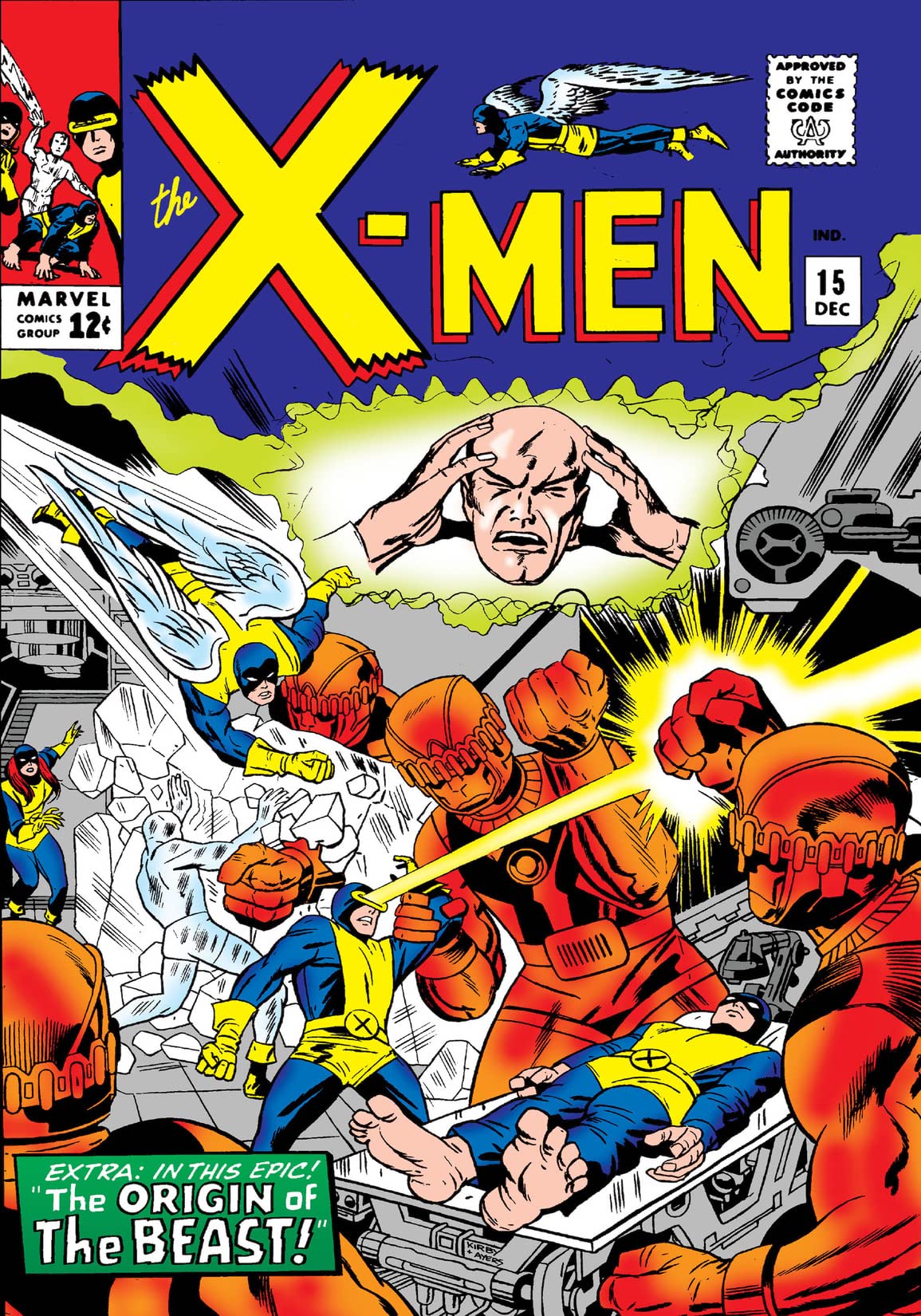
The X-Men #15
The X-Men #15 delivers the first appearance of Master Mold — the colossal Sentinel factory designed by Dr. Bolivar Trask to mass-produce mutant-hunting robots — cementing the Sentinels as the X-Men's most enduring institutional antagonists and giving physical form to the series' allegory of state-sanctioned oppression of a minority group. It is the pivotal middle chapter of the three-part 'Among Us Stalk the Sentinels!' arc (issues #14–16), the storyline credited with launching the X-Men's identity as a civil-rights-era metaphor in earnest: commentators have noted that the Sentinels were introduced at the same moment television audiences were watching Black Americans brutalized by police, making the mutant-hunting robots resonate with unusual cultural weight. The issue also delivers the origin of Beast — the first substantial backstory given to any of the original five X-Men — showing Hank McCoy's childhood persecution and Professor X's recruitment of him, a narrative template that would be repeated for decades. Together, these elements mark issue #15 as the point where the X-Men stopped being merely a superhero team and became a comic genuinely grappling with prejudice, technology, and the consequences of fear.
In "Prisoners of the Mysterious Master Mold!", the X-Men storm an underground Sentinel stronghold only to be captured, setting off a chilling confrontation with the enigmatic Master Mold. Written by Stan Lee and brought to life with dynamic art by Jack Kirby, Jay Gavin, and Dick Ayers, this pivotal 1965 issue sees Beast subjected to a mind probe while Master Mold reveals his grand design. The cover by Jack Kirby and Dick Ayers captures the tension perfectly—this is a defining moment in the early X-Men saga, with a 12-cent price tag that’s a small price for a landmark comic.
ComicBooks.com Value
Show all 22 grades ▾
This exact issue on ebay
CGC 7 ▾ $290–$300 2 listings
CGC 5 ▾ $130–$222 3 listings
CBCS 7 ▾ $345–$350 2 listings
Raw — NM ▾ $3.99–$9.99 4 listings
Raw — VF ▾ $4.5–$1,300 5 listings
Raw — FN/VF ▾ $150–$350 2 listings
Raw — FN ▾ $129–$167 2 listings
Raw — VG+ ▾ $79.95–$225 4 listings
Raw — VG ▾ $59.99–$160 9 listings
Raw / ungraded ▾ $1.49–$3,851 36 listings
More listings for this title
Read it digitally
Sell my copy
Have this issue — or a whole collection? Get a fair offer from us, skip the marketplace fees and the hassle.
We Buy Collections ▸History
The issue was written by Stan Lee, with Jack Kirby providing layouts and Werner Roth — working under the pseudonym 'Jay Gavin' — supplying finished pencils, inked by Dick Ayers; the cover was by Kirby and Ayers, lettered by Artie Simek. The Kirby/Roth split-penciling arrangement, with Kirby's plot notes literally written in pencil in page margins, was typical of the book at this stage as Kirby's workload across Marvel demanded he hand off full execution to Roth. This arc also coincided with the series moving from a bi-monthly to a monthly publishing schedule, a production shift that signaled renewed editorial investment in the title even as it lagged in sales behind other Marvel books. Stan Lee served as both writer and editor-in-chief throughout.
Trivia · 9 facts
- First appearance of Master Mold (issues #15–16, Dec. 1965 – Jan. 1966), the giant Sentinel super-computer created by Dr. Bolivar Trask to manufacture additional Sentinel robots; created by Stan Lee and Jack Kirby.
- Second appearance of the Sentinels and Dr. Bolivar Trask, both of whom debuted in The X-Men #14 (Nov. 1965).
- Origin of the Beast: through a psycho-probe wielded by Master Mold, Hank McCoy's backstory is revealed — childhood bullying due to his anthropoid physique, a high-school football career that exposed his powers, and Professor X's subsequent recruitment of him; also marks the first appearances of Hank's parents Norton McCoy and Edna McCoy (in flashback).
- Credits: script by Stan Lee; layouts by Jack Kirby; finished pencils by Werner Roth (as 'Jay Gavin'); inks by Dick Ayers; letters by Artie Simek; cover by Kirby and Ayers. Stan Lee also served as editor.
- The issue is the second chapter of the three-part 'Among Us Stalk the Sentinels!' arc, continued from #14 and concluded in #16, which is widely regarded as the arc where the X-Men's mutant-as-persecuted-minority allegory became fully explicit.
- The story's origin sequence for Beast — showing Xavier visiting Hank's parents and offering to train him — established a recurring recruitment storytelling template used throughout X-Men history.
- The issue was reprinted in The X-Men #68 (Feb. 1971) and later appeared in international editions including the British anthology Fantastic! (#28–29, 1967) and various European editions; it has also been collected in Marvel Masterworks: X-Men Vol. 2.
- Master Mold's concept — an AI that subverts its creator's intent to 'protect' humanity by deciding to dominate it — directly seeded later stories including 'Days of Future Past' (Uncanny X-Men #141–142) and multiple subsequent Sentinel storylines across the Marvel Universe.
- Note on a continuity discrepancy flagged by the Marvel Database: the Beast origin told here (Professor X recruits Hank directly from high school/college) contradicts a later retelling in X-Men #49–52, which inserted an encounter with the villain the Conquistador into Hank's backstory before Xavier's recruitment.
Cast · 10 characters
Full credits
Reprints
Reprinted in Fantastic! #28 (1967), Fantastic! #29 (1967), The X-Men #68 (1971), Strange #15 (1971), The Super-Heroes #27 (1975), The Super-Heroes #28 (1975), Hulk #32 (1976), Spidey #31 (1982), The Official Marvel Index to the X-Men #1 (1987), Marvel Masterworks #7 (1988), X-Men: The Early Years #15 (1995), Marvel Special #6 (1996), Essential Uncanny X-Men #1 (1999), Marvel Klassik #9 (2000), Essential Uncanny X-Men #1 [Third Printing] (2003), Marvel Masterworks: The X-Men #2 (2003), Marvel History #[8] (2007), The X-Men Omnibus #1 (2009), Marvel Masterworks: The X-Men #2 (2009), X-Men Epic Collection #1 (2014), X-Men: Children of the Atom #[2] (2019), Mighty Marvel Masterworks: The X-Men #2 (2022), X-Men (Penguin Classics Marvel Collection) #[nn] (2023), Marvel Masterworks: The X-Men #2 [Third Edition] (2024) + 3 more
Key issues in The X-Men

Variants (1)
Reviews
Reader reviews
No reader reviews yet.