
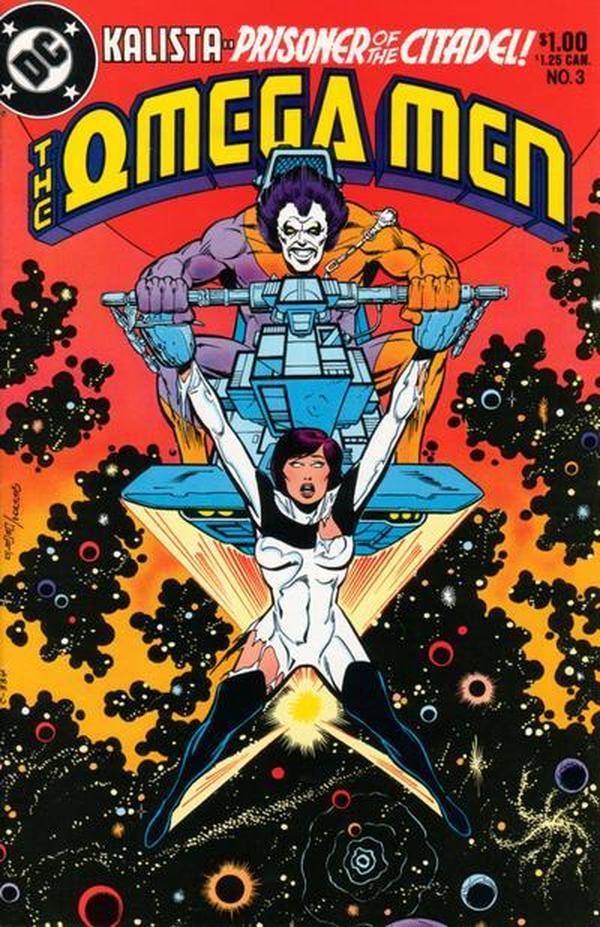
The Omega Men #3
The Omega Men #3 holds a permanent place in DC history as the debut of Lobo, one of the most culturally resonant characters to emerge from the Bronze Age — a figure who began as a throwaway antagonist and grew into one of DC's defining anti-heroes of the 1990s. Writer Roger Slifer and artist Keith Giffen conceived the character as a pointed satire of the hyper-violent, grim anti-hero archetype then dominating comics — Giffen himself later described him as "an indictment of the Punisher, Wolverine, bad ass hero prototype" — yet readers embraced exactly what the creators were mocking, and the character took on a life far beyond what anyone intended. The issue also serves as the second chapter of the "Citadel War" story arc, grounding Lobo's introduction within a mature, politically inflected space-opera narrative that writer Slifer used to allegorize real-world geopolitical conflicts of the early 1980s. That a character introduced so casually — as muscle for hire boarding a crippled starship — would eventually anchor his own franchise of miniseries, ongoing titles, and a major film appearance speaks to the unpredictable alchemy of comics storytelling.
In "Citadel War, Chapter Two: Assault on Euphorix!", Kalista leads the Omega Men to her homeworld, believing it’s under siege by the Citadel—only to find herself ambushed by the brutal bounty hunters Lobo and Bedlam, who capture her before the real conflict unfolds. Written by Roger Slifer and illustrated by Keith Giffen, with inks by Mike DeCarlo and colors by Anthony Tollin, this 1983 DC issue delivers a tense, high-stakes escalation in the Omega Men saga, all framed by Giffen and DeCarlo’s dynamic cover art.
ComicBooks.com Value
Show all 15 grades ▾
This exact issue on ebay
CGC 9.8 ▾ $84.95–$1,235 27 listings
CGC 9.6 ▾ $110–$250 26 listings
CGC 9.4 ▾ $83.99–$270 12 listings
CGC 9.2 ▾ $80–$135 4 listings
CGC 9 ▾ $99.95–$140 5 listings
CGC 8.5 ▾ $135–$150 2 listings
CGC 8 ▾ $96–$120 2 listings
Raw — MINT ▾ $89.88–$139 2 listings
Raw — NM+ ▾ $5–$155 3 listings
Raw — NM ▾ $34.99–$200 17 listings
Raw — VF/NM ▾ $64.95–$180 8 listings
Raw — VF ▾ $80–$120 4 listings
Raw — FINE ▾ $84.96–$99.95 2 listings
Raw / ungraded ▾ $25–$500 74 listings
Read it digitally
Sell my copy
Have this issue — or a whole collection? Get a fair offer from us, skip the marketplace fees and the hassle.
We Buy Collections ▸History
The Omega Men series grew out of Marv Wolfman and Joe Staton's creation of the team in Green Lantern (vol. 2) #141 in June 1981, with the group tested in Green Lantern, Action Comics, and The New Teen Titans before earning their own ongoing title in April 1983. Wolfman remained as editor on the ongoing series but handed scripting duties to Roger Slifer, who collaborated with penciller Keith Giffen and inker Mike DeCarlo — the same team that would produce Lobo's debut just three issues in. The series was notable for being part of DC's early-1980s push into direct-market, Baxter-paper prestige publishing — distributed primarily through specialty shops, printed without a Comics Code Authority seal, and intended for a more adult readership willing to engage with genuine depictions of the violence and moral ambiguity of interstellar war. It was within that deliberately boundary-pushing editorial environment that Slifer and Giffen introduced Lobo in issue #3, titled "Citadel War, Chapter Two: Assault on Euphorix," published with a June 1983 cover date.
Trivia · 8 facts
- First appearance of Lobo, the intergalactic bounty hunter — created by writer Roger Slifer and penciller Keith Giffen — cover-dated June 1983.
- First appearance of Bedlam, the robot bounty hunter who accompanies Lobo on the mission and whom Lobo later kills; the issue also marks Lobo's original race as Velorpian (an origin later retconned to Czarnian in the 1990 miniseries Lobo: The Last Czarnian).
- Story titled 'Citadel War, Chapter Two: Assault on Euphorix' — scripted by Roger Slifer, pencilled by Keith Giffen, inked by Mike DeCarlo, with cover art by Giffen and DeCarlo; edited by Marv Wolfman.
- Lobo's visual design in this first appearance was markedly different from the bulky space-biker identity he would later become — described by contemporary sources as resembling a KISS band member rather than the iconic figure reshaped by artist Simon Bisley in the early 1990s.
- Giffen stated in a 2006 Newsarama interview that he designed Lobo as a satirical critique of violent anti-hero archetypes like Wolverine and the Punisher — a parody that audiences took entirely at face value, inadvertently making Lobo the very thing Giffen meant to lampoon.
- Lobo remained largely dormant after his Omega Men appearances until a career-redefining run in Justice League International (issues #18–21) relaunched his popularity, leading to the L.E.G.I.O.N. series (1989) and his own standalone publishing franchise in the 1990s.
- The issue has been reprinted multiple times: in Lobo's Greatest Hits (DC, 1992), in a French-language Arédit-Artima edition (1985), in an Eaglemoss DC Comics Graphic Novel Collection hardcover, and as a full DC Facsimile Edition published August 1, 2023 — with a regular cover and a foil variant — to mark Lobo's 40th anniversary.
- The series in which this issue appeared carried no Comics Code Authority seal and was printed on higher-quality Baxter paper, part of DC's early direct-market prestige initiative aimed at specialty-shop readers seeking more mature content.
Full credits
Reprints
Reprinted in Omega Men #2 (1985), Lobo's Greatest Hits #[nn] (1992), DC Comics Graphic Novel Collection #25 (2015), Omega Men 3 (Facsimile Edition) #[nn] (2023)
Reviews
Reader reviews
No reader reviews yet.