
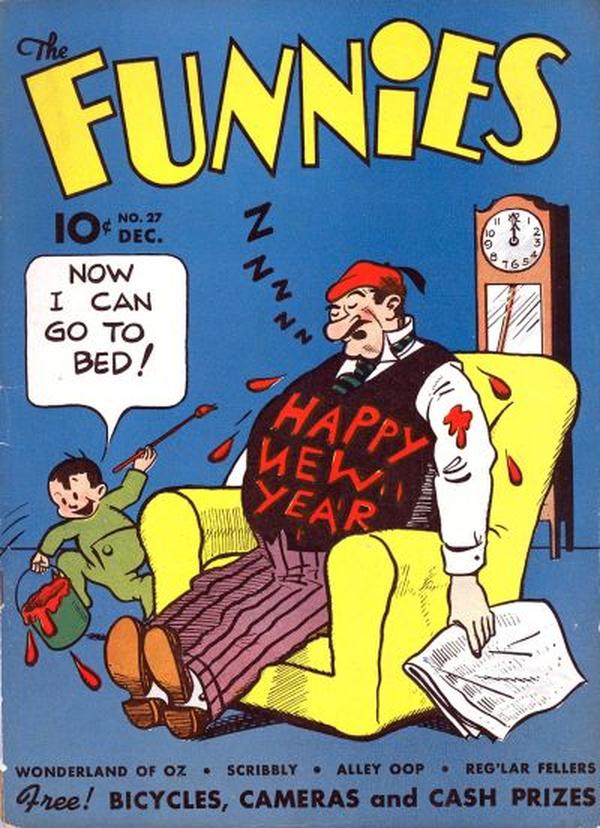
The Funnies #27
☆ Be the first to review + Add to your collection — Join freeThe Funnies #27 occupies a modest but genuine place in early Golden Age history as part of Dell's second run of The Funnies (1936–1942), one of the foundational newspaper-strip reprint anthologies that helped establish the standard American comic-book format. Packaged under the editorial stewardship of Max Gaines and Sheldon Mayer, the series was a direct competitor to Eastern Color's Famous Funnies and served as an early laboratory for blending syndicated strip reprints with gradually expanding original content. Issue #27 is specifically notable as the final installment of A.W. Nugent's long-running single-page puzzle-and-game feature 'Home Magic'/'Everybody's Playmate,' which had appeared continuously since the series' first issue. As a representative issue from late 1938, it also reflects the transitional moment when the title was cautiously adding original features — B-movie Western adaptations and the true-crime strip 'The Crime Busters' — alongside its established NEA-syndicate reprint lineup.
In "The Deserted City!", Professor Twitchel, steamed over being passed over for a role, teams up with former actor Roscoe T. Rooney, who blames Bernie von Goldstein for losing his job. Together, they plot to launch a new film company and take down the man who ruined their careers. Written and illustrated by Sheldon Mayer, this 1938 Dell comic delivers a sharp, early slice of comic strip satire with a classic behind-the-scenes twist. Cover by Sheldon Mayer.
Captain Colorful reluctantly agrees to dinner at the Jibbet household, only to panic when Bernie von Goldstein shows up—mistaking his old nemesis for a threat and making a hasty, flustered escape out the window. With Mrs. Jibbet watching, Dinky Jibbet wide-eyed, and Scribbly Jibbet barely containing his laughter, the evening takes a turn no one saw coming.
Scribbly Jibbet gets a surprisingly earnest letter from his little brother Dinky, who declares he’d “go soak his head” if he couldn’t draw cartoons as well as Scribbly—leaving the older brother both touched and mildly alarmed by the kid’s dramatic flair.
In this brief 1938 humor tale from *The Funnies #27*, Captain Colorful’s escape attempt is halted by Bernie von Goldstein, who has a surprising proposition: turning the flamboyant hero into a movie star. When Captain Colorful hears he’ll be working with glamorous actresses, his enthusiasm — and his escape plans — take a sudden turn.
Professor Twitchel is fuming after being rejected as an actor, but when he meets Roscoe T. Rooney—another former performer cast aside by Bernie von Goldstein—they hatch a plan to start their own movie company and take down the man who ruined their careers.
In a quiet moment of urgency, Scarecrow leads Tip, Jack Pumpkinhead, and the Wooden Sawhorse across the fields toward the land of the Winkies, seeking help from their old friend, the Tin Woodsman, as the shadow of Jinjur’s forces looms ever closer.
ComicBooks.com Value
Find on ebay
Read it digitally
Sell my copy
Have this issue — or a whole collection? Get a fair offer from us, skip the marketplace fees and the hassle.
We Buy Collections ▸History
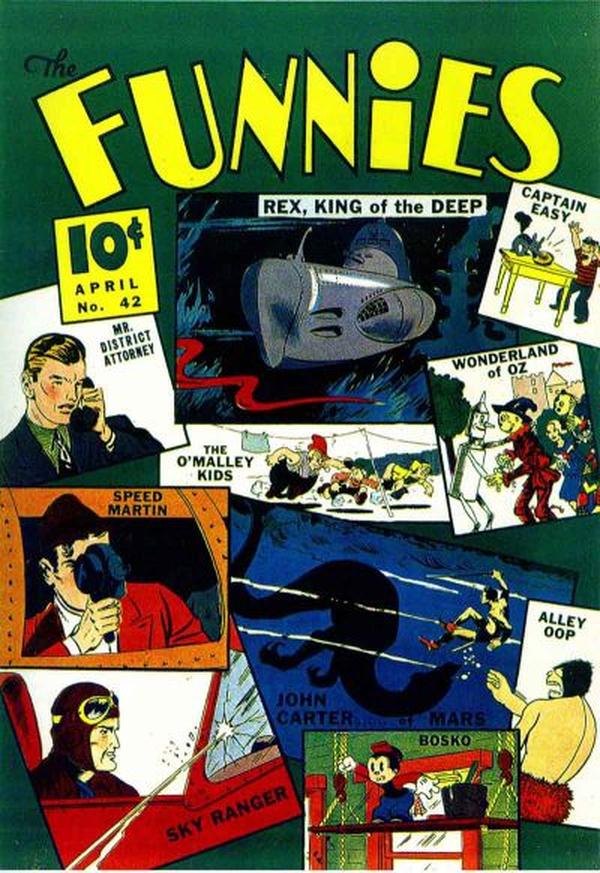
Dell's second The Funnies series launched in October 1936, packaged and edited through an arrangement between Dell and the McClure Syndicate, with Max Gaines overseeing the titles and Sheldon Mayer serving as editor. The book largely reprinted NEA-syndicate strips — Alley Oop, Captain Easy, Mutt and Jeff, Tailspin Tommy, and others — while Mayer introduced original content starting with his own Scribbly feature, about a boy cartoonist, styled to resemble a Sunday newspaper page. By the time issue #27 appeared (late 1938), Dell had also entered into its landmark agreement with Western Publishing, which would eventually reshape the company's entire production structure, though The Funnies itself remained under the Gaines/Mayer editorial arrangement until Gaines departed in 1939 to help found All-American Publications.
Trivia · 8 facts
- The Funnies (1936 series) ran 64 issues (October 1936 – May 1942), packaged by Max Gaines and edited by Sheldon Mayer through the McClure Syndicate.
- Issue #27 (approximately December 1938) contains the final installment of A.W. Nugent's single-page puzzle-and-game feature 'Home Magic'/'Everybody's Playmate,' which had run continuously since issue #1.
- Recurring features in this era of the title include Sheldon Mayer's original strip 'Scribbly' (about a boy cartoonist), V.T. Hamlin's 'Alley Oop,' Roy Crane's 'Captain Easy, Soldier of Fortune,' and Fred Harman's 'Bronc Peeler' — Harman's western cowboy strip that preceded his creation of Red Ryder.
- Beginning with issue #20 (May 1938), the title introduced six-page adaptations of B-movie Westerns, and the true-crime feature 'The Crime Busters,' drawn by Al McWilliams, was added shortly after — both features appear in the #27 era lineup.
- Issue #27 falls within the run still under the Gaines/Mayer/McClure Syndicate editorial arrangement; Gaines departed in 1939 to co-found All-American Publications, after which the title shifted toward more original content.
- The series competed directly with Eastern Color's Famous Funnies and drew primarily from the NEA (Newspaper Enterprises Association) syndicate, distinguishing its reprint pool from Tribune-syndicate rivals like Popular Comics.
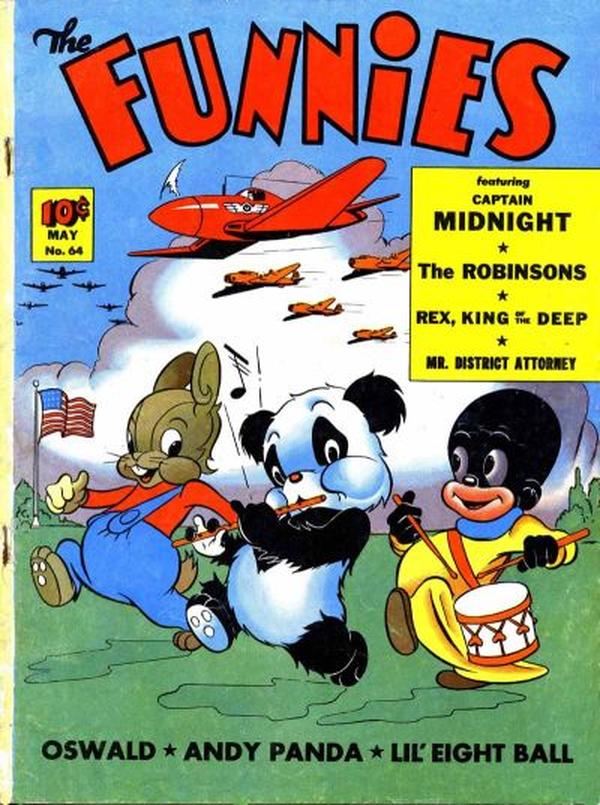
- The title eventually transformed into New Funnies with issue #65 (July 1942), pivoting away from newspaper reprints toward all-original children's and cartoon-character content including Woody Woodpecker.
- No character first appearances or unique story milestones have been documented specifically for issue #27 across available historical sources — its significance is primarily as part of the serialized run and as the end-point of Nugent's multi-year puzzle feature.
Full credits
Key issues in The Funnies
Reviews
Reader reviews
No reader reviews yet.