
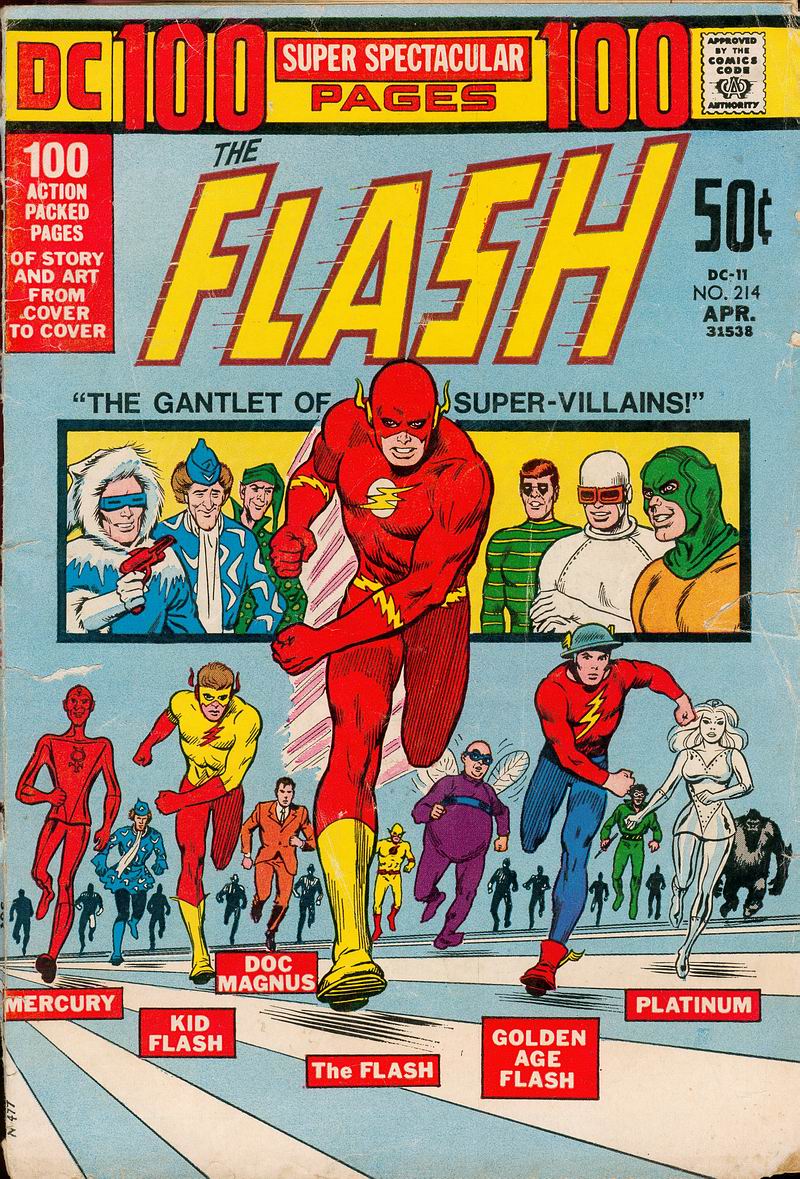
The Flash #214
The Flash #214 is one of the most content-rich entries in DC's early-Bronze-Age experiment with oversized anthologies, functioning simultaneously as a Flash showcase and a cross-character history lesson. Its greatest editorial coup is the full reprint of the Metal Men's debut from Showcase #37 (1962), giving an entirely new generation of readers their first encounter with Robert Kanigher and Ross Andru's robot heroes in an era before trade paperbacks existed. The issue also published, for the very first time anywhere, a previously unseen Golden Age Flash story originally prepared for Flash Comics — making it, unusually for a reprint package, a genuine first publication of new-to-readers material. As DC-11 in the 100-Page Super Spectacular line, it exemplifies how editor E. Nelson Bridwell used the format to curate DC's Silver and Golden Age archives into an accessible, ad-free reading experience that introduced decades of history to Bronze Age kids.
In "The Gantlet of Super-Villains!", Flash faces an all-new kind of threat when Gorilla Grodd hijacks the body of a zoo gorilla and unleashes a wave of Barry Allen’s greatest enemies in a twisted bid to seize his mind. Written by John Broome and brought to life with dynamic art by Carmine Infantino and Joe Giella, this 1972 classic pits the Fastest Man Alive against a relentless parade of foes in a battle that tests his will as much as his speed. The cover, a striking portrait by Nick Cardy, captures the intensity of the moment.
In "The Gantlet of Super-Villains!", Flash [Barry Allen] faces a mind-bending challenge when Gorilla Grodd hijacks his body by switching places with a zoo gorilla, then unleashes a rogues' gallery of his greatest enemies—The Top, Captain Boomerang, Heat Wave, Pied Piper, Captain Cold, Mirror Master [Sam Scudder], and even the unlikely J. M. Leach (tailor)—in a twisted test of wills. With Solovar and Pola caught in the chaos, Barry must outthink not just his foes, but the very minds behind them, before Grodd seizes full control.
In "The Wasp," a disgraced inventor armed with mechanical wings and a deadly stinging syringe seeks revenge against two corrupt businessmen who betrayed him. As the web of greed and retribution tightens, the line between justice and madness blurs—until one final, fatal mistake seals his fate.
Johnny Quick and Tubby Watts stop by a Paul Bunyan festival, where a towering statue of the legendary lumberjack stands guard. When thieves strike the gate, Johnny channels the mythic spirit of Paul Bunyan—using sheer speed and clever stunts reminiscent of the giant’s legendary feats—to outwit the crooks and bring them to justice.
In "The Flaming Doom!", the Metal Men—Platinum, Gold, Lead, Iron, Mercury, and Tin—face a monstrous, otherworldly manta creature threatening the coast, its eyebeams scorching everything in its path. With Colonel Henry Caspar urging caution and Dr. Will Magnus rallying the team, the heroes use every trick in their arsenal: Gold’s stretch, Iron’s strength, Mercury’s flight, Platinum’s web-spinning, and Lead’s shielding, all pushing to stop the beast before it’s too late. But victory comes at a cost, and as the creature falls, so do the Metal Men—leaving only their models behind in Dr. Magnus’s hands.
ComicBooks.com Value
Show all 19 grades ▾
This exact issue on ebay
More listings for this title
Read it digitally
Sell my copy
Have this issue — or a whole collection? Get a fair offer from us, skip the marketplace fees and the hassle.
We Buy Collections ▸History
The DC 100-Page Super Spectacular line was launched in 1971 as a deliberate strategy to monetize DC's deep archive of previously-published material while competing for shelf space during a difficult period for the direct market. E. Nelson Bridwell, DC's resident comics historian and continuity editor, assembled the reprint selections, and Nick Cardy — who served as the line's primary cover artist — produced the issue's distinctive wraparound cover. The issue went on sale February 3, 1972, with a cover date of April 1972, and was formatted as a squarebound, 96-page package with no internal advertising, priced at fifty cents — a format DC used across the whole DC-7 through DC-13 run of the series.
Trivia · 8 facts
- Published April 1972 (on-sale February 3, 1972) as The Flash Vol. 1 #214; simultaneously designated DC 100-Page Super Spectacular #DC-11 and Flash Giant #10.
- Cover art by Nick Cardy; wraparound format, squarebound, 96 pages, no advertisements — consistent with the format DC used for the entire middle run of the Super Spectacular series.
- Reprints the complete origin and first appearance of the Metal Men from Showcase #37 (March–April 1962), written by Robert Kanigher and drawn by Ross Andru — the only widely available reprint of that story at the time.
- Contains 'The Tale of the Three Tokens,' a Golden Age Flash story scripted by Robert Kanigher with art by Carmine Infantino and Bernard Sachs that had never been published before this issue — originally prepared for Flash Comics.
- Reprints 'The Gauntlet of Super-Villains' from The Flash #155, a John Broome/Carmine Infantino story featuring Gorilla Grodd orchestrating a Rogues' Gallery assault on Barry Allen.
- Reprints a Kid Flash story ('The Face Behind the Mask') from The Flash #122, a Quicksilver (the Quality Comics speedster, later reinvented as Max Mercury) story from National Comics #67, and a Johnny Quick story from Adventure Comics #179.
- Edited by E. Nelson Bridwell, DC's in-house comics historian, who assembled the reprint content across the full Super Spectacular line.
- The Quality Comics character Quicksilver appears via reprint — a character DC would eventually reintroduce to continuity as Max Mercury, a significant figure in later Flash mythology.
Full credits
Reprints
↩ Reprints National Comics #67 (1948), Adventure Comics #179 (1952), Showcase #4 (1956), The Flash #122 (1961), Showcase #37 (1962), The Flash #145 (1964), The Flash #150 (1965), The Flash #155 (1965)
Reprinted in Flits Classics #2627 (1972), البرق [Al-Barq Kawmaks / Flash Comics] #45, Top Comics Blitzmann #120
Key issues in The Flash
Reviews
Reader reviews
No reader reviews yet.