
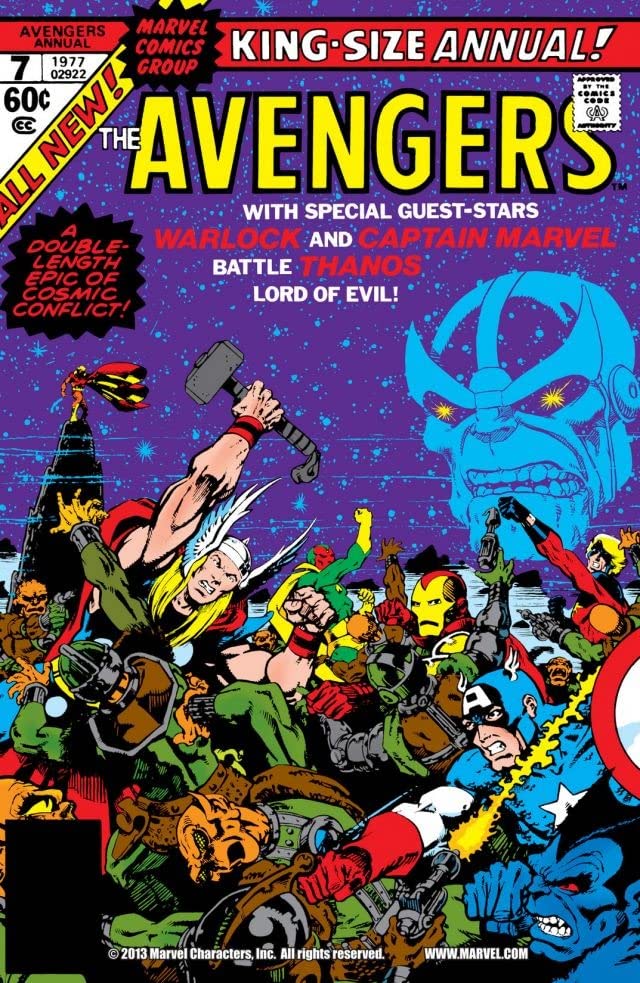
The Avengers Annual #7
☆ Be the first to review + Add to your collection — Join freeAvengers Annual #7 — titled 'The Final Threat' — stands as the capstone of Jim Starlin's landmark Bronze Age cosmic saga, delivering the apparent deaths of Adam Warlock, Gamora, and Pip the Troll in a single oversized issue and providing narrative closure to storylines that had been abruptly cut short when the Warlock series was cancelled. Most consequentially for the future of the Marvel Universe, it is the first story in which all six Soul Gems (later renamed the Infinity Gems, and later still the Infinity Stones) appear together and are treated as a coherent set of cosmically dangerous artifacts — a foundational concept that Starlin would develop fourteen years later into The Infinity Gauntlet and that the Marvel Cinematic Universe would ultimately adapt across more than two dozen films. Its pairing with Marvel Two-in-One Annual #2 that same summer constitutes what Bronze Age critics have called the concluding masterpiece of the 1970s Marvel cosmic era, a two-part story that gave Thanos his first truly universe-scale threat and established the template for every large-scale Marvel cosmic event that followed.
ComicBooks.com Value
Show all 20 grades ▾
This exact issue on ebay
CGC 9.8 ▾ $420–$1,092 3 listings
CGC 9.6 ▾ $170–$249 4 listings
CGC 9.2 ▾ $106–$200 2 listings
Raw — VF+ ▾ $35–$49.99 2 listings
Raw — FINE ▾ $19.99–$50 2 listings
Raw — FN ▾ $4.98–$64 4 listings
Raw / ungraded ▾ $14.99–$100 33 listings
Read it digitally
Sell my copy
Have this issue — or a whole collection? Get a fair offer from us, skip the marketplace fees and the hassle.
We Buy Collections ▸History
Jim Starlin had walked away from Marvel after editorial disputes with incoming editor-in-chief Gerry Conway led to unauthorized changes to the art on Warlock #14, leaving his Thanos-versus-Warlock saga unfinished when the solo Warlock title was cancelled with issue #15. The assignment to resolve those dangling threads came about by chance: Starlin ran into editor Archie Goodwin at a party, and Goodwin — who had become EIC after Conway's brief tenure — invited Starlin back to wrap up the story in the annual format; when the material outgrew one book, a second slot was arranged in Marvel Two-in-One Annual #2. Starlin handled the breakdowns and cover art himself, with Joe Rubinstein providing finished penciling and inking, Petra Goldberg (Scotese) coloring, and Tom Orzechowski lettering, under Goodwin's editorship — a tight, trusted team that the Bronze Age Babies blog noted produced some of Starlin's finest-looking pages of the entire saga.
Trivia · 8 facts
- Written, laid out, and cover-penciled by Jim Starlin; finished art by Joe Rubinstein; colors by Petra Goldberg; letters by Tom Orzechowski; edited by Archie Goodwin. On-sale August 1977, cover-dated November 1977.
- First story in which all six Infinity Gems (then called Soul Gems) appear together as a unified set — the foundational concept behind The Infinity Gauntlet (1991) and the MCU's Infinity Stones. Specifically the first appearances of the Space Gem, Mind Gem, and Reality Gem as distinct objects.
- Features the apparent deaths of Adam Warlock, Gamora, and Pip the Troll; Warlock and Gamora's souls are absorbed into Warlock's Soul Gem, where they are reunited in a bittersweet afterlife — a resolution Starlin had originally planned for the cancelled Warlock solo series.
- Thanos's scheme here is stellar genocide: he has built a giant synthetic Soul Gem aboard his flagship Sanctuary II to extinguish stars, threatening all life in the universe.
- Part 1 of a two-issue story concluded in Marvel Two-in-One Annual #2 (1977), also written and laid out by Starlin; the story is set in continuity between Avengers #166 and Avengers #167.
- Starlin's return to Marvel after his departure was brokered entirely by editor Archie Goodwin; without that chance meeting, the Thanos-Warlock saga would have remained permanently unresolved.
- The issue has been reprinted in numerous collected editions, including Marvel Masterworks: The Avengers Vol. 17 (2017), Warlock by Jim Starlin: The Complete Collection (2014), the Adam Warlock Omnibus (2022), the Thanos Wars: Infinity Origin Omnibus (2019), the Avengers Epic Collection Vol. 9: The Final Threat (2013), and the Folio Society's The Avengers (2023), reflecting its recognized importance across decades of Marvel publishing.
- The issue is a king-size square-bound format (52 pages total, 34-page main story), which makes spine condition a persistent concern for collectors of physical copies.
Cast · 30 characters
Full credits
Reprints
Reprinted in Etranges Aventures #61 (1979), Anual 80 #2 (1979), Marvel Superheroes [Marvel Super-Heroes] #373 (1981), Warlock #5 (1983), Warlock #6 (1983), Grandes Heróis Marvel #1 (1983), Strange Spécial Origines #244 hors série (1990), Warlock #5 (1992), Warlock #6 (1992), The Greatest Battles of the Avengers #[nn] (1993), Marvel Masterworks: Warlock #2 (2009), Essential Avengers #8 (2012), Essential Warlock #1 (2012), Marvel Gold. Warlock: La amenaza de Thanos #[nn] (2012), Thanos: The Final Threat #1 (2012), Avengers vs. Thanos #[nn] (2013), Avengers Epic Collection #9 (2013), Warlock by Jim Starlin: The Complete Collection #[nn] (2014), Marvel Masterworks: Captain Marvel #5 (2014), Guardians of the Galaxy Solo Classic Omnibus #[nn] (2015), Gamora: Guardian of the Galaxy #[nn] (2016), Marvel Masterworks: The Avengers #17 (2017), Marvel Gold. La Saga de Thanos #[nn] (2018), Marvel. Официальная коллекция комиксов #117 (2018) + 11 more
Key issues in The Avengers Annual
Reviews
Reader reviews
No reader reviews yet.