
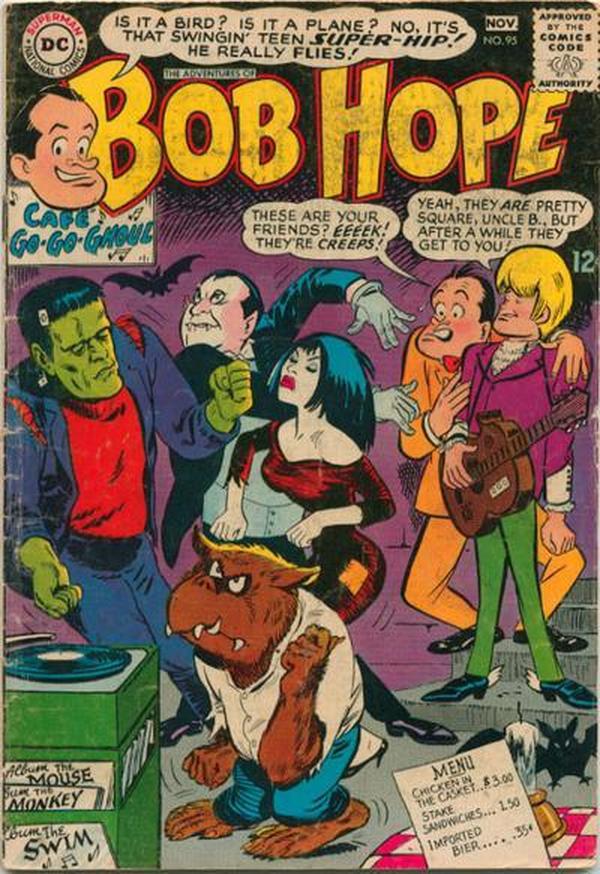
The Adventures of Bob Hope #95
☆ Be the first to review + Add to your collection — Join freeAdventures of Bob Hope #95 marks the first appearance of Super-Hip (Tadwallader Jutefruce), a gonzo Silver Age creation who became significant enough to outlast the licensed series that spawned him — DC owns the character outright, even though it cannot reprint the Bob Hope stories themselves. The issue stands as a rare instance of a celebrity humor title actively cross-pollinating with DC's superhero continuity: Super-Hip's Silver Age cameo in Doom Patrol #104 (scripted by the same writer) placed him at the wedding of Elasti-Girl and Mento, and modern-era revivals in Batman: The Brave and the Bold #15 and Doom Patrol #20 confirm the character's stubborn staying power. It also captures a precise cultural moment — DC editors deliberately fusing Beatle-era youth culture, Universal Monster imagery, and superhero tropes inside a flagging licensed comedy book, a creative pivot that extended the series' life by several years.
ComicBooks.com Value
Show all 13 grades ▾
Find on ebay
Read it digitally
Sell my copy
Have this issue — or a whole collection? Get a fair offer from us, skip the marketplace fees and the hassle.
We Buy Collections ▸History
By the mid-1960s, The Adventures of Bob Hope had been running since 1950 as a licensed National Periodical Publications title, but readership was eroding badly. Writer Arnold Drake — simultaneously co-creating the Doom Patrol and, within months, Deadman — took over the book and diagnosed the problem bluntly: the real Bob Hope was simply not of his young readers' era. His solution was to inject Universal Monster-style horror and mod youth-culture superheroics, building a supporting cast that included nerdy teen ward Tadwallader Jutefruce, his alter ego Super-Hip, a talking dog named Harvard-Harvard, and a faculty of monster-teacher archetypes. Editor Murray Boltinoff oversaw the title, and GoCollect's credits list additional writing contributions from Henry Boltinoff and Jack Schiff alongside Drake for this issue. Artist Bob Oksner, who had been the series' penciler since issue #61, illustrated the lead story with a clean, caricature-friendly style that reviewers have consistently praised for balancing comedy cartooning with superhero visual energy.
Trivia · 8 facts
- First appearance of Super-Hip (real name Tadwallader Jutefruce), written by Arnold Drake and drawn by Bob Oksner — cover-dated October–November 1965.
- The lead story is titled 'Super-Hip, the Sickest Super-Hero of 'em All'; Super-Hip's transformation is triggered when the mild-mannered Tad loses his temper, in a Dr. Jekyll/Mr. Hyde structure where Tad retains no memory of his alter ego.
- Super-Hip's abilities include shape-shifting into oversized household objects (electric razor, ice cream scoop, vacuum cleaner, etc.), flight via a 'Super-Guitar,' and a weakness to Lawrence Welk's music, which functions like kryptonite.
- The issue also introduces Benedict Arnold High School, whose faculty are each parodies of Universal Horror monsters: Dr. Van Pyre, Heinrich Von Wolfmann, and Franklin Stein, among others.
- Although the Bob Hope character is a licensed property DC does not own, DC does retain ownership of all original characters debuted in the series, including Super-Hip and Harvard-Harvard III.
- Super-Hip's sole Silver Age crossover appearance outside the Bob Hope title was Doom Patrol vol. 1 #104 (June 1966), where he attended the wedding of Elasti-Girl and Mento — also scripted by Arnold Drake.
- Super-Hip appeared continuously in Adventures of Bob Hope from issue #95 through #107, with a final appearance in #109; the editorial staff had reportedly planned to retitle the series The Adventures of Super-Hip and phase out Bob Hope, but the book was cancelled with #109 before those plans were executed.
- The issue's letterer, Stan Starkman, is credited under the pseudonym 'Stan Quill' in the DC Database.
Cast · 1 character
Full credits
Key issues in The Adventures of Bob Hope
Reviews
Reader reviews
No reader reviews yet.