
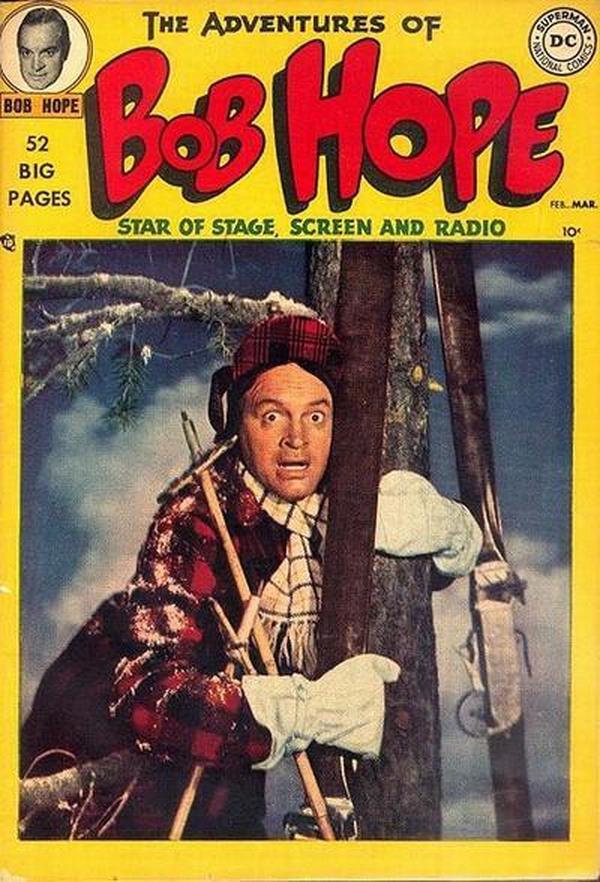
The Adventures of Bob Hope #1
☆ Be the first to review + Add to your collection — Join freeThe Adventures of Bob Hope #1 (Feb–Mar 1950) marks the launch of one of DC's most durable celebrity-licensed titles, running a full 109 issues across 18 years — a testament to how deeply the publisher leaned into real-world pop culture as a counterweight to declining superhero sales at the dawn of the 1950s. It established a storytelling formula — Hope cast as the wisecracking, cowardly everyman of his Road pictures, thrust into escalating misadventures — that held the series together through multiple creative teams and editorial overhauls. The issue also demonstrates how seamlessly DC wove its superhero universe into non-superhero books: a Batman and Robin public-service announcement advocating for an African-American athlete appears right alongside the comedy filler, signaling the publisher's early willingness to use its marquee characters to carry social messaging. As the first installment of a celebrity-comics line that also spawned titles for Dean Martin & Jerry Lewis and Alan Ladd in the same season, #1 is a concrete artifact of the industry's pivot toward humor and licensed entertainment that would shape DC's output for the entire decade.
ComicBooks.com Value
Show all 17 grades ▾
This exact issue on ebay
CGC 2 ▾ $325–$390 2 listings
Raw / ungraded ▾ $195–$386 3 listings
Read it digitally
Sell my copy
Have this issue — or a whole collection? Get a fair offer from us, skip the marketplace fees and the hassle.
We Buy Collections ▸History
With superhero sales softening as 1950 approached, National Periodical Publications negotiated licenses to publish comics based on celebrities including Bob Hope, Jerry Lewis, Dean Martin, and Alan Ladd, betting that radio and film stardom would translate to newsstand traffic. Issue #1 was written by Cal Howard — a veteran animation writer who had worked at Warner Bros. and later supplied scripts to DC's entire stable of humor-celebrity books — and drawn by Owen Fitzgerald, a former Disney and Fleischer animator whose 'bigfoot' cartoon style translated naturally to Hope's exaggerated screen persona. The book was edited by Whitney Ellsworth, DC's longtime Hollywood liaison, giving it a polished, studio-adjacent sensibility from the outset. Because the stories were produced under a licensing agreement, DC never owned the Bob Hope character itself, though original creations introduced later in the run — such as the superhero Super-Hip — did become DC intellectual property.
Trivia · 8 facts
- Cover-dated February–March 1950; published by National Periodical Publications (DC Comics); cover price 10 cents; 54 pages, full color.
- First issue of a series that ran continuously for 109 issues through February–March 1968 — an 18-year run.
- Written by Cal Howard (uncredited in the issue), drawn and inked by Owen Fitzgerald; edited by Whitney Ellsworth. Story credits did not appear in the book; Cal Howard attribution comes from later scholarship.
- Features a photograph cover using a film still of Bob Hope — a format maintained through the first four issues before switching to illustrated covers.
- Contains a 'Batman and Robin Stand Up for Sportsmanship!' one-page public-service announcement scripted by Jack Schiff, penciled by Win Mortimer, and inked by Stan Kaye, in which Batman defends an African-American athlete.
- Includes a two-page 'Introducing Doris Day' celebrity profile illustrated by Bob Oksner, and a biography of actress Rhonda Fleming — Hope's co-star in the 1949 film The Great Lover — establishing the Hollywood tie-in filler format used throughout the run.
- The fictional Bob Hope character depicted here is based on the cowardly, wiseguy persona Hope played across his Road picture films; the DC Multiverse later assigned this series' stories to Earth-Twelve (per Absolute Crisis on Infinite Earths, 2006).
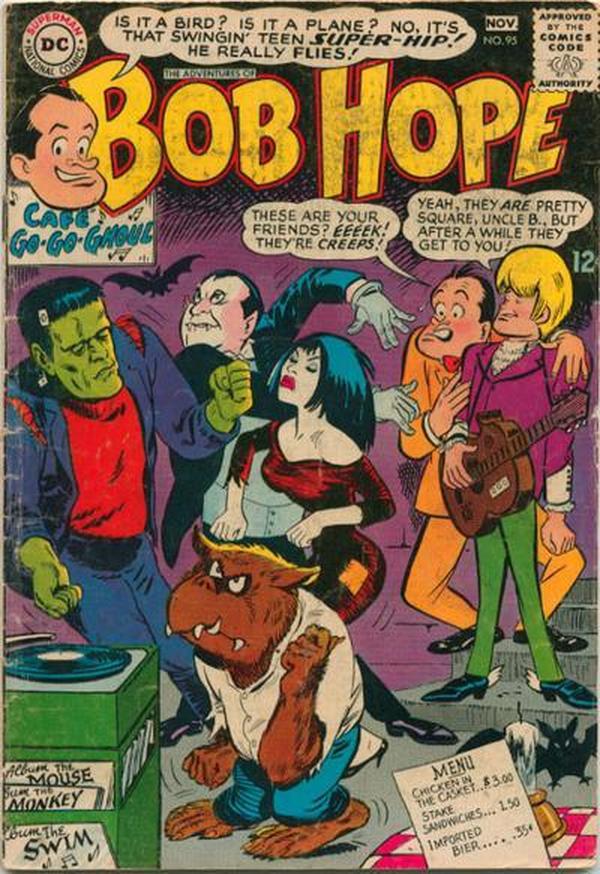
- Because it was a licensed title, DC Comics does not own the Bob Hope stories or character; however, original characters created later in the run — including nephew Super-Hip (first appearing in issue #95) and talking dog Harvard Harvard III — are owned by DC.
Full credits
Reprints
Reprinted in The Adventures of Bob Hope #1 (1950), Detective Comics #215 (1955), The Adventures of Dean Martin & Jerry Lewis #18 (1955), Detective Comics #218 (1955), Superman's Pal, Jimmy Olsen #6 (1955)
Key issues in The Adventures of Bob Hope
Reviews
Reader reviews
No reader reviews yet.