
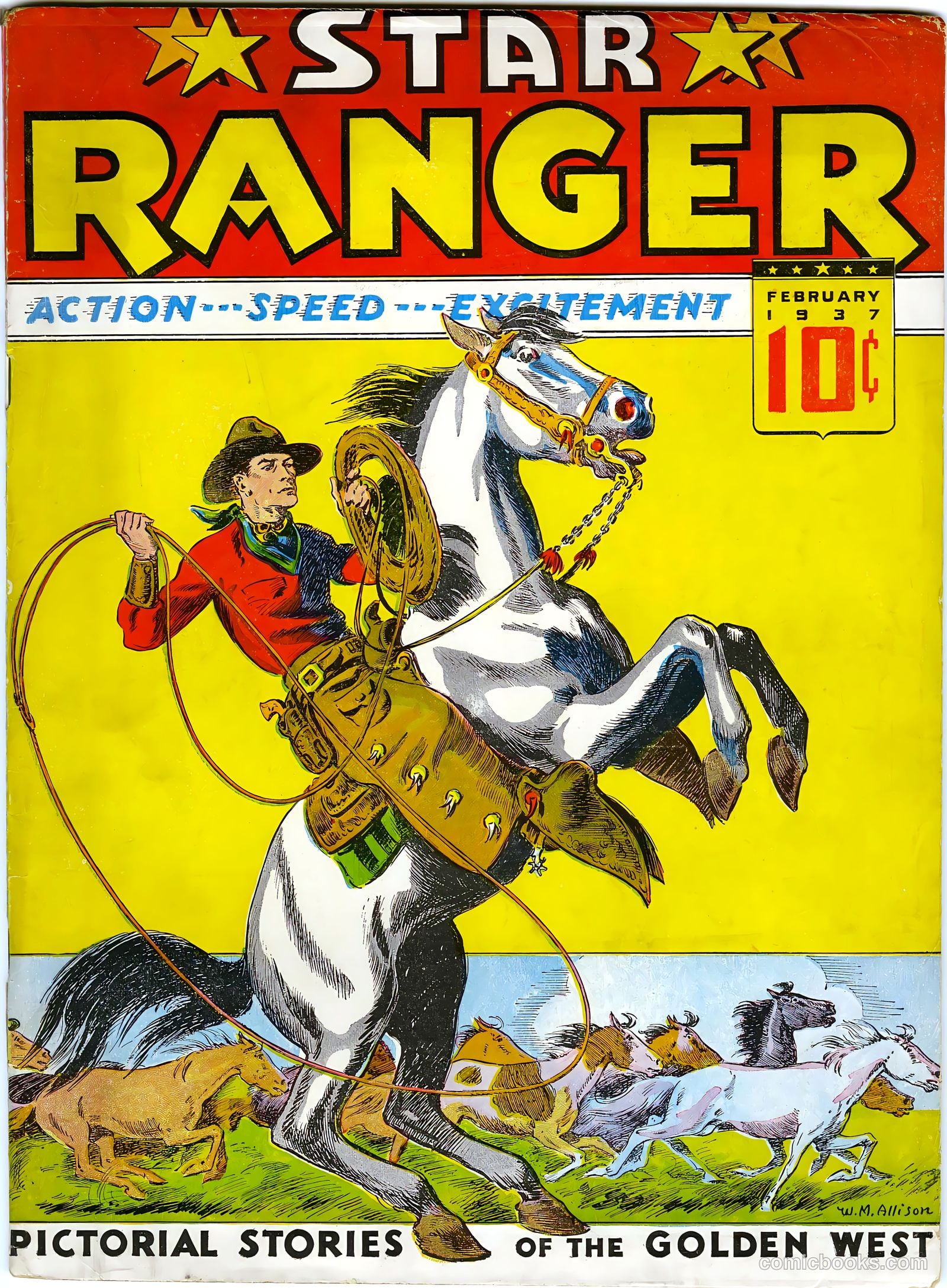
Star Ranger #1
☆ Be the first to review + Add to your collection — Join freeStar Ranger #1 (cover-dated February 1937) holds a co-equal place in comics history as one of the first two all-Western comic books ever published — the other being Western Picture Stories #1, which arrived on newsstands the same month, more than a year before Action Comics #1 introduced the superhero age. By devoting an entire issue exclusively to Western material at a moment when the pulps were at the height of their Western output, Star Ranger demonstrated that a single genre could sustain a standalone comic book title and directly set the template for the genre explosion that dominated the late 1940s and 1950s. The series also arrived as a product of the Chesler Shop, comics' first-ever packaging studio, making it a founding artifact of the industrial structure that would define the Golden Age. Its long publishing life — running through multiple owners and two title changes before concluding as Star Ranger Funnies in October 1939 — confirmed that an audience existed for Western comics a full decade before the format became commercially dominant.
This anthology issue contains pictorial stories of the Golden West. In "Wanted Men," a diminutive cowboy named Pee Wee Thomas pursues the Bradley gang after they steal his horse, tracking them through the Apache Range and ultimately cornering them with the help of local cowboys. "The Joker" by Tom Curry features a character seeking revenge on Blackjack for a past shooting, leading to a confrontation in a saloon where the joker gives Blackjack a fair chance before taking him down.
Bob Horne returns to the western frontier after years away studying radio engineering back east, only to be forced at gunpoint into a dangerous scheme to pass counterfeit bills at the local bank. Using his knowledge of radio signals, Bob devises a clever way to alert the cashier to his predicament and call for help from the authorities. It's a tense test of wits and nerve as Bob navigates a tight spot with quick thinking and an unexpected skill.
Texas Ranger Lee Trent is ordered to track down the Ghost Riders, a mysterious outlaw gang that strikes banks across the state and vanishes like phantoms—but this time, Trent has set a trap, planting word of a big cash haul to draw them in. When the gang hits the bait and flees town, Trent pursues them to an abandoned shack, where a startling discovery about their method of escape begins to unravel the mystery of how they've eluded capture for so long.
In this humor tale, a duel between two gunslingers in a field of honor spirals into chaos when one contestant pulls an unexpected trick—only to have his opponent counter with an even more audacious move. By the time the dust settles, a victor emerges to claim the title of Public Enemy Number One, and the whole affair plays out with the anarchic energy you'd expect from a 1937 comic strip.
Kidnapped at gunpoint and forced into servitude, the brilliant scientist Montgomery Barnard discovers he's been taken to a remote mining operation where other Americans are imprisoned—and failure to locate gold with his specialized instrument means death. Trapped in the "Valley of Living Death" with brutal captors watching his every move, Barnard must decide whether to comply with his captors' demands or risk the fate that's already claimed so many others.
A fugitive on the run with only one bullet left flees a pursuing posse, only to cross paths with a prospector whose seemingly empty gun holds a secret worth far more than either man realizes. In this 1937 western tale, a desperate gamble at the border reveals that empty cartridges aren't always what they seem—and neither are the stakes of a frontier chase.
A deputy rushes to the town hall after hearing a gang plans to hang the mayor, eager to finally prove his worth by catching them red-handed. His heroic expectations take a humorous turn when he discovers what's actually going on at the scene.
A gunslinger known as the Joker returns from the city with plans for a practical joke on his pal Shorty, but instead finds himself face-to-face with Red McGraw, a vengeful outlaw bent on retrieving blood money and avenging his fallen partner. When Red makes his play for the reward and the Joker's life, a quick draw and a clever quip turn the tables—and land the Joker another bounty to claim.
Dave and Billy pursue the outlaw Pecos Slim to recover stolen gold that threatens their outfit's survival, tracking him through a bandit camp where Slim has gone undercover in disguise. When Dave's sharp eyes and quick gun work corner the fugitive, a clever detail about Slim's weighted cape reveals where the stolen fortune has been hidden all along.
ComicBooks.com Value
Show all 13 grades ▾
Find on ebay
Read it digitally
Sell my copy
Have this issue — or a whole collection? Get a fair offer from us, skip the marketplace fees and the hassle.
We Buy Collections ▸History
Star Ranger #1 was conceived and assembled by Harry 'A' Chesler, the entrepreneur behind the first comic-book packaging studio in the industry's history, a Manhattan operation that supplied finished features and complete books to publishers testing the new medium. Chesler published the title under his own Chesler Publications imprint for the first six issues (February–September 1937), producing it as an oversized format book; he then sold the venture to Ultem Publications — formed by I. W. Ullman and Frank Z. Temerson — which continued the title in a standard format while retaining Chesler as packager and editor. Ultem itself was acquired by Centaur Publications in early 1938, which continued the run through further numbering and title changes. The issue was assembled by a staff of journeyman artists and writers drawn from Chesler's shop, including cover artist W. M. Allison and interior contributors such as Creig Flessel, Fred Schwab, Irving Frisch, Norman Daniels, Dick Ryan, Frank Gruber, and Tom Curry.
Trivia · 8 facts
- Cover-dated February 1937 (on-sale date registered with the U.S. Copyright Office, registration number B 320037); published under the Chesler Publications Inc. imprint.
- Recognized by historians as one of two co-equal 'first Western comic books' — tying with Western Picture Stories #1, which also carried a February 1937 cover date.
- The issue predates Action Comics #1 by approximately 15 months, establishing the Western as a standalone comic-book genre before the superhero genre even existed.
- Published in an oversized large format (approximately 8.5 × 11.5 inches), 68 pages, priced at ten cents — the standard for early Golden Age comics.
- Cover art by W. M. Allison; interior contributors on issue #1 include Creig Flessel, Fred Schwab, Irving Frisch, Norman A. Daniels, Dick Ryan, Frank Gruber, LaRue Edwards, Omar Gwinn, Tom Curry, and W. C. Miller.
- Fred Schwab's two-page humor strip 'Tenderfoot Joe' — about a city greenhorn's comic misadventures in the West — appears in this issue and is documented as his first known credited comic book work.
- The series ran under three publisher imprints (Chesler, then Ultem from issue #7, then Centaur from issue #10) and two additional title banners (Cowboy Comics for issues #13–14; Star Ranger Funnies from issue #15), concluding in October 1939.
- Star Ranger #1 is a product of the 'Chesler Shop,' the industry's first comic-book packaging studio — the model later followed by operations such as Eisner & Iger and Funnies Inc., making it a foundational artifact of the Golden Age production system.
Full credits
Reprints
Reprinted in Dynamic Comics #9 (1944), Dynamic Comics #20 (1946), Fugitives from Justice #4 (1952), Action! Mystery! Thrills! Comic Book Covers of the Golden Age: 1933-45 #[nn] (2011), Lurid Little Nightmare Makers #6 (2016)
Reviews
Reader reviews
No reader reviews yet.