
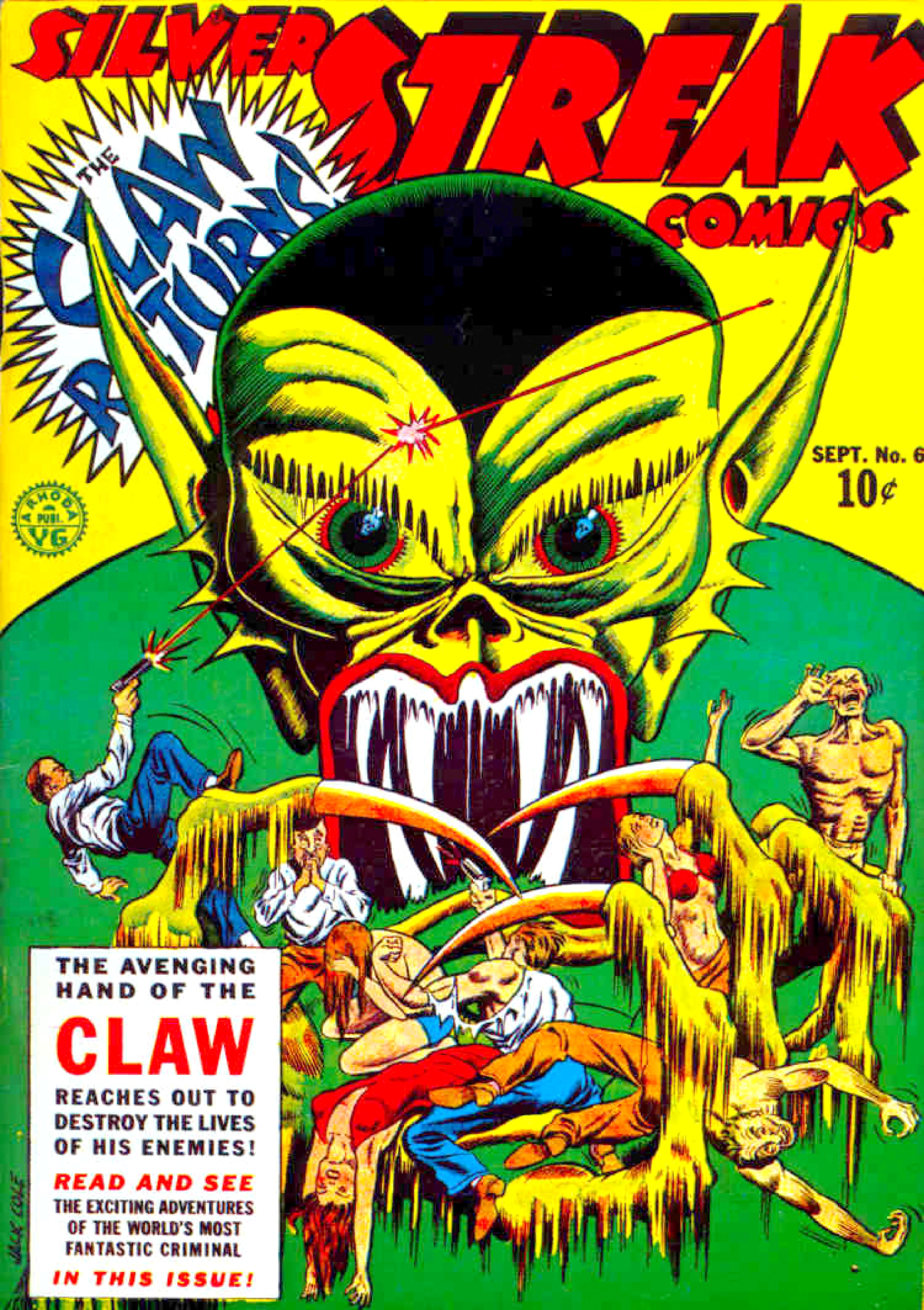
Silver Streak Comics #6
☆ Be the first to review + Add to your collection — Join freeSilver Streak Comics #6 (September 1940) marks the debut of the Golden Age Daredevil — Bart Hill — one of the most consequential first appearances produced outside the Big Two's ecosystem during the Golden Age. The character arrived as an eight-page backup feature rather than a headliner, yet his impact on the young publisher was immediate: editor Jack Cole recognized him as the perfect heroic foil for the title's existing power-villain, the Claw, and the pairing launched a five-issue serialized battle beginning in #7 that transformed Daredevil into a star and eventually earned him his own long-running title. The issue also showcases a Jack Cole cover featuring The Claw in full menacing glory, widely regarded as one of the most striking covers the Golden Age produced, and it introduces 'The Green Claw' — a distinct story incarnation of the villain rising from the dead — adding another narrative thread to the Claw mythology. Taken together, the issue represents a pivotal editorial pivot: a villain-led anthology discovering its true heroic engine.
In "The Flying Dragon," young Dickie, determined to help his family after a plane crash destroys his father's business, channels his ingenuity into building a magnetic-powered aircraft. With the help of his friend Zip, he pitches the invention to the powerful President of the Zepher Aeroplane Factory—only to find himself pursued by a ruthless man who wants the design at any cost. Written and illustrated by Jack Cole, this 1940 adventure blends early sci-fi wonder with high-stakes peril, all rendered in Cole’s distinctive, dynamic style, with the cover by Jack Cole capturing the moment’s tension in bold, expressive lines.
In "null," the Streak faces off against Sir Cedric in a globe-spanning race that takes them from London to the Middle East, with the Streak dodging Nazi agents, rescuing a girl from an evil sheik, and protecting a group of American travelers en route to Maskat—each challenge testing his speed and resolve in this thrilling 1940 adventure.
In "The Flying Dragon," Sky Wolf confronts a rogue gang wielding a mysterious, high-tech aircraft to terrorize the skies and evade justice. When the gang captures him and offers a dangerous alliance, Sky Wolf refuses—only to be imprisoned before making a daring escape and turning the tables with his own plane.
In "null," the Green Claw returns from the grave, forcing Carl Durrant to uncover the truth behind its resurrection. As the Claw unleashes hypnotic control, Durrant is shrunk and imprisoned in a box, while the villain prepares a robotic army to dominate Earth.
In "null," Daredevil confronts Joe Ripper, a bank robber who meets his end at the hero’s hands, only to uncover a clue that leads him into a deeper web of crime. With the Ricco Gang on the move and a rival gang in their crosshairs, Daredevil races to stop a violent showdown before it erupts.
In the wilds of 1940’s jungle frontier, Lance ventures beyond the city’s ruins to confront ivory raiders, only to find himself drawn into a tense standoff when he rescues a young boy from a prowling lion. What begins as a rescue quickly spirals into a dangerous encounter at the raiders’ hidden cabin, where survival hangs in the balance.
In "The Spook Strikes Back," Ace races against time when he discovers that Panther Man has been murdered—just as the Spook, the mysterious killer, stands over the body. With the Skeleton Men blocking his path, Ace must fight through their deadly ranks to stop the Spook before he vanishes again.
In "The Starfish Men of the Water Planet," Captain Keen and Nirma investigate a mysterious planet that leaves the duo disoriented—until they dive beneath its surface and encounter the Star-Fish Men, whose leader claims Keen can lead their aquatic world on a path of conquest across the stars.
In "The Sky Bug," young Dickie, determined to save his family’s struggling business after a plane crash destroys it, channels his ingenuity into building a strange flying machine powered by repelling magnets. When he pitches his invention to the president of the Zepher Aeroplane Factory, his hopes are met with greed—Crawley wants the design, and he’ll stop at nothing to claim it, even if it means silencing Dickie and his friend Zip.
ComicBooks.com Value
Show all 21 grades ▾
This exact issue on ebay
Read it digitally
Sell my copy
Have this issue — or a whole collection? Get a fair offer from us, skip the marketplace fees and the hassle.
We Buy Collections ▸History
At the time of publication, the comic's indicia listed the publisher not yet as 'Lev Gleason' but as Rhoda Publications / Your Guide Publications Inc. — the company was still in the process of consolidating its identity under Gleason's name. The Claw himself had been conceived by Jack Cole while working for the Will Eisner studio, which supplied content to Gleason's fledgling anthology when Silver Streak Comics launched in December 1939; by issue #6, Cole had taken on an editorial role and saw in the newly conceived Daredevil character — drawn and signed by Jack Binder, with the debut story scripted by Don Rico — an ideal nemesis for his existing creation, setting up the celebrated multi-issue clash that would define both characters. Daredevil's origin as presented here was later officially revised in Daredevil Comics #18, meaning this issue preserves the character's only 'original' continuity telling.
Trivia · 8 facts
- First appearance and origin of the Golden Age Daredevil (Bart Hill), created by Jack Binder, debuting as an eight-page backup feature — not the cover feature.
- Daredevil's costume in this issue is a symmetrically divided pale yellow and dark blue bodysuit; it was redesigned to red and blue beginning with the very next issue, making this the sole appearance of the original color scheme.
- The issue contains a separate story featuring 'The Green Claw' — a distinct incarnation of the Claw villain who literally rises from the dead, uses hypnotic powers, and deploys an army of robots in a bid to conquer Earth's armies.
- The Claw (a Jack Cole creation first appearing in Silver Streak Comics #1, December 1939) reappears on the cover and in the interior; his confrontation with Daredevil, set up here, begins in full in issue #7 and runs through issue #11.
- The cover was drawn by Jack Cole and is among the most reproduced Golden Age images, featuring The Claw's enormous hand reaching across the composition.
- At publication, the book was produced under the Rhoda Publications / Your Guide Publications Inc. imprint — the company had not yet formally adopted the 'Lev Gleason Publications' name.
- Daredevil's origin as told in this issue was later officially retconned and revised in Daredevil Comics #18.
- The issue has been reprinted at least nine times across major archival projects, including Flashback #27 (DynaPubs, 1974), The Golden Age of Comic Books (Random House, 1977), Supermen! The First Wave of Comic Book Heroes (Fantagraphics, 2009), and both volumes of Silver Streak Archives Featuring the Original Daredevil (Dark Horse, 2012) — testimony to its sustained historical recognition.
Cast · 2 characters
Full credits
Reprints
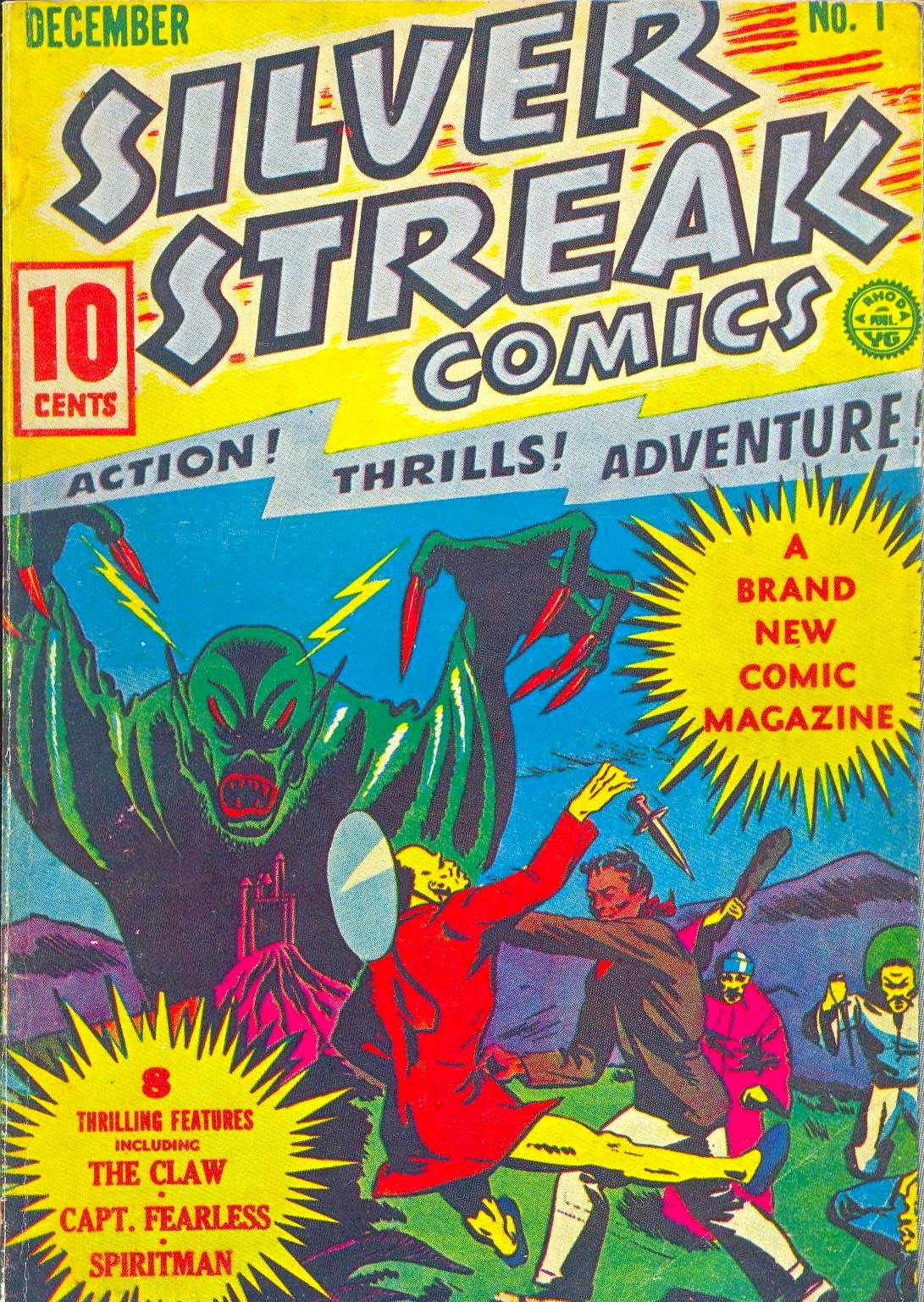
Reprinted in Captain Battle Jr. #2 (1944), Silver Streak Comics #[22] (1946), Flashback #27 (1974), Comic Reprints #[8] (1975), The Golden Age of Comic Books #[nn] (1977), The Golden Age Review #[nn] (1978), Magnificent Superheroes of Comics Golden Age #1 (1979), Supermen! The First Wave of Comic Book Heroes 1936-1941 #[nn] (2009), Action! Mystery! Thrills! Comic Book Covers of the Golden Age: 1933-45 #[nn] (2011), Silver Streak Archives Featuring the Original Daredevil #1 (2012), Silver Streak Archives Featuring the Original Daredevil #2 (2012), Futura #4 (2016), Tops: The Complete Collection of Charles Biro's Visionary 1949 Comic Book Series #[nn] (2022), L'âge merveilleux des Comics #2
Key issues in Silver Streak Comics
Reviews
Reader reviews
No reader reviews yet.