
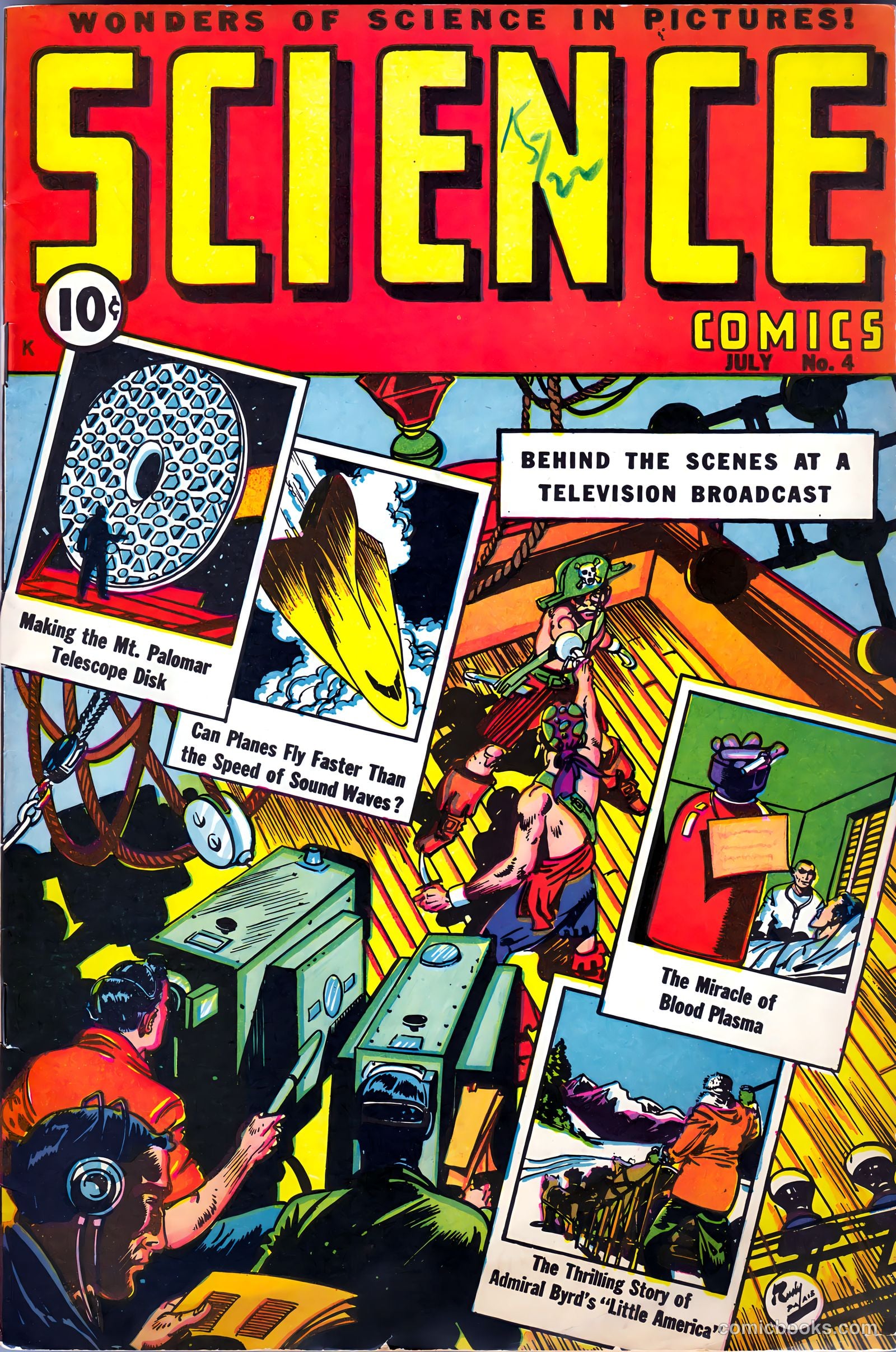
Science Comics #4
☆ Be the first to review + Add to your collection — Join freeThis anthology issue contains several science-focused stories, including "Making the Mt. Palomar Telescope Disk," which documents the industrial process of manufacturing a large glass disk through annealing and precise temperature control. Another featured story, "The Miracle of Blood Plasma," details the scientific advancement of centrifuging and preserving blood plasma in sterile bottles under ultraviolet light, then freezing and drying it for medical use, particularly for soldiers. Additional stories examine "Can Planes Fly Faster Than the Speed of Sound Waves?" and "The Thrilling Story of Admiral Byrd's 'Little America.'"
High atop Mount Palomar in California, the Corning Glass Works faces an unprecedented challenge: manufacturing a 200-inch telescope disk—the largest single piece of glass ever attempted—for the California Institute of Technology. Follow the scientists and engineers as they design an innovative ceramic mold using hexagonal geometry to manage weight and stress, pour molten glass under exacting conditions, and carefully cool the massive disk over months of precise temperature control. Once completed, this optical giant will help astronomers unlock secrets of the universe in ways previously impossible.
Science Comics presents a fascinating examination of one of aviation's greatest challenges: can aircraft ever break the sound barrier? Through clear diagrams and expert analysis, this nonfiction feature explores the aerodynamic obstacles that stand in the way of supersonic flight, from the behavior of pressure pockets around wings to the breakdown of air layers at extreme speeds, and considers the innovative design solutions that engineers are developing to overcome them. Drawing on material from *Flying Age* magazine, the story lays out the technical possibilities and requirements that future aircraft designers will need to master.
Oil has been capturing and storing the sun's energy since prehistoric times—through ancient plants and animals that became buried, compressed, and chemically transformed deep beneath the earth. This story traces how that "buried sunlight" becomes the oil we pump from the ground today, and explains the geological journey from fossilized life to the fuels and lubricants that power our modern world.
A collection of common misconceptions about the animal kingdom gets the truth-telling treatment in this straightforward nature article. From debunking the legend of the elephant's memory to explaining why snake charming has nothing to do with music, this 1946 piece separates zoological fact from popular myth with clear, accessible explanations.
This Science Comics story traces the complete journey of blood plasma—from the Red Cross donation bank through rigorous laboratory processing to its delivery to wounded soldiers worldwide during the Second World War. Readers follow a doctor and nurse explaining the science behind why plasma proved so vital: it requires no refrigeration, needs no blood typing, and its proteins deliver life-saving benefits without the red and white corpuscles that complicate whole-blood transfusions. Based on factual research supplied by pharmaceutical pioneer Sharpe & Dohme, the story shows how American medical innovation transformed battlefield medicine and saved countless lives.
Rear Admiral Richard E. Byrd left the Navy to pursue his true calling: exploring the polar regions with scientific precision and an eye toward humanity's future. This story traces the highlights of his extraordinary career, from a daring rescue during his early service through his groundbreaking expeditions to Antarctica, where he established "Little America" and became the first person to fly across the South Pole. Byrd's vision of the frozen continents as strategically vital territories drove him to undertake multiple expeditions and make crucial discoveries about the resources hidden beneath the ice.
ComicBooks.com Value
Show all 16 grades ▾
Find on ebay
Read it digitally
Sell my copy
Have this issue — or a whole collection? Get a fair offer from us, skip the marketplace fees and the hassle.
We Buy Collections ▸Full credits
Reviews
Reader reviews
No reader reviews yet.