
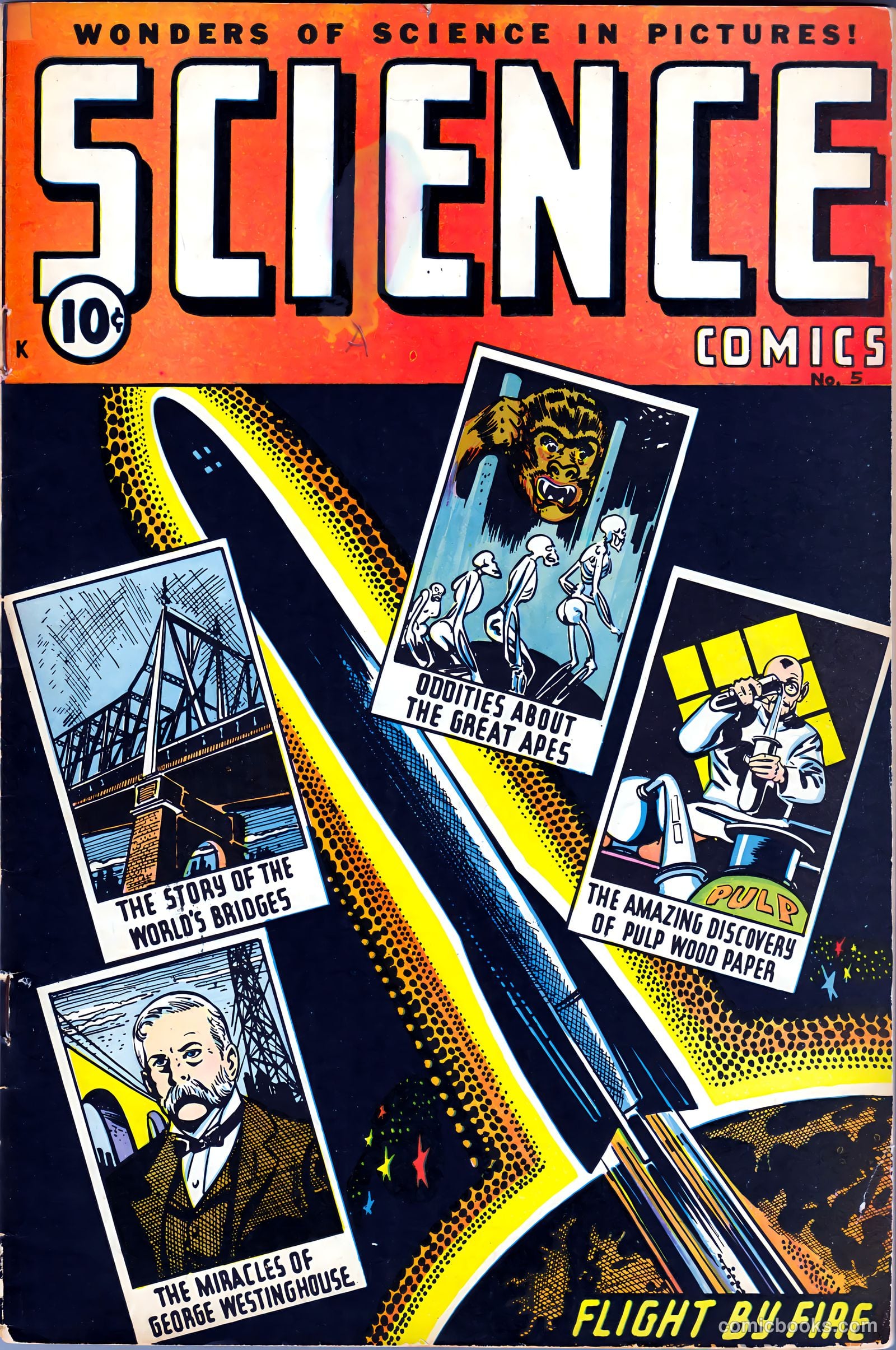
Science Comics #5
☆ Be the first to review + Add to your collection — Join freeScience Comics #5 is an anthology featuring educational science stories illustrated in comic form. "The Story of the World's Bridges" traces the history of bridge engineering from ancient suspension bridges through Roman wooden structures to Emperor Caligula's famous boat bridge across the Bay of Bair. "Oddities About the Great Apes" explains how King Alfred invented a fire clock using candles marked in bands to measure time, and details the workings of a Chinese water clock that used a paddle wheel mechanism. "Scientific Serendipities" recounts accidental discoveries including William Henry Perkin's invention of the first aniline dye in 1856 while attempting to extract quinine, and Becquerel's discovery of radioactivity through uranium's effect on photographic plates.
This non-fiction tale traces the surprising history of rocket and jet propulsion, from its ancient origins in Alexandria through centuries of military applications, to its pivotal role in World War II aviation. Following the thread from early steam-powered experiments to Isaac Newton's work and beyond, the story chronicles how scientists transformed these principles into the jet engines and rockets that powered modern warfare—and sets the stage for what might come next. A fascinating journey through time showing how yesterday's impossible dreams became today's revolutionary weapons.
Travel back to 1842 Scotland, where inventor Alexander Bain demonstrates his groundbreaking electrical facsimile transmitter to a potential investor—a machine that can send pictures and words across distances using synchronized pendulums and electrical impulses. The story then leaps forward to show how modern facsimile transmission revolutionized news delivery, from the dramatic example of the Hindenburg disaster reaching newspapers worldwide in minutes, to the technical innovations of radiophoto scanners and recorders that operate on principles similar to television. Science Comics explores both the ingenious mechanics behind this remarkable communication technology and its real-world impact on how the world receives breaking news.
This 1946 educational feature explores the fascinating differences among great apes—gorillas, chimpanzees, and orangutans—examining how their physical adaptations, from foot structure to arm strength, shape where and how they live, and comparing their skeletal similarities to humans. The story also highlights remarkable experiments in ape intelligence and behavior, including a chimpanzee raised alongside a human child and studies showing how chimps can learn to understand value and reward. It's a clear-eyed look at these remarkable primates that challenges common misconceptions while revealing just how sharp their minds really are.
Bruce and his Uncle Fred take a fascinating journey through the history of timekeeping, visiting recreations of humanity's most important methods for measuring time—from ancient sun-dials and candles to water clocks, pendulums, and finally the portable watch. Along the way, they discover how ingenious inventors like Henry de Vick and Christian Huygens solved the mechanical problems that made accurate timekeeping possible. It's a non-fiction tour through one of civilization's most overlooked but essential inventions.
In the late 1800s, Theobald Smith tackled one of agriculture's most baffling mysteries: a deadly disease killing northern cattle when shipped south, while southern cattle seemed immune. Working with his assistant Kilborne at the Bureau of Animal Industry, Smith conducted meticulous laboratory and field experiments—examining diseased tissue, studying fresh organs, and ultimately testing whether the countless ticks infesting southern herds held the key to the riddle. His systematic investigation would reveal the true culprit behind Texas Fever and establish him as a pioneering microbe hunter.
From primitive vine bridges to soaring suspension spans, this illustrated history traces humanity's mastery of the bridge—from fallen tree trunks and stone slabs through the grand Roman arches, all the way to modern wire-cable engineering. Witness the ambitions and disasters that shaped bridge design: Caligula's audacious boat bridge across the bay, the revolutionary arch invented by Apollodorus, the rigid strength of the truss, and the hard-won lessons learned from catastrophic failures like the Tay Bridge collapse. It's a story of civil engineering written in stone, wood, iron, and steel—each era's innovation building on the triumphs and tragedies of those before it.
Science Comics #5 takes on the myths and tall tales we tell about the natural world, debunking everything from whale vision to moth appetites with straightforward facts that'll surprise you. This 1946 feature corrects some of the most stubborn misconceptions about the creatures and giants around us—turns out nature's even more interesting than the folklore suggests.
Born in 1846, George Westinghouse patented inventions at a remarkable pace—one every 45 days for 48 years, totaling 361 patents that would transform American life. This story follows his journey from a young inventor in 1865, starting with a rotary steam engine and a device for replacing derailed railroad cars, through the challenges of developing his most ambitious creation: a compressed air brake system that could stop trains safely from a central control point. Witness how a magazine article about Alpine tunnel construction sparks the solution to a problem that has plagued railroads and nearly costs Westinghouse everything when his system faces its most critical test.
After the Civil War, when paper prices skyrocket and resources grow scarce, General Benjamin Tilghman sets out to solve the shortage with a bold chemical experiment. When sulphurous acid unexpectedly transforms a wooden stick into pulp, Tilghman and his brother realize they may have discovered the secret to making cheap paper from wood—a breakthrough that could transform the nation's printing industry.
A collection of fascinating scientific tidbits ranging from the curious biology of white cats to the geological wonders of Africa's Diamond Coast, paired with surprising facts about everyday comparisons and animal anatomy. Each entry delivers a quick, genuine nugget of science—from why smiling takes less effort than frowning to the shocking smoothness of glass—that reminds you how much wonder is hiding in plain sight.
In 1910, inventor Charles F. Kettering took on a challenge that would transform the automobile forever: developing an electric starter to replace the dangerous hand crank that was injuring drivers left and right. Working frantically in his Dayton barn, Kettering and his team race against the clock and their competitors to design a starter small enough to fit into a Cadillac's chassis before the manufacturer's deadline slips away. Through countless failed attempts, late nights, and one crucial discovery, they engineer a solution that will make starting a car as simple as pressing a button.
ComicBooks.com Value
Show all 9 grades ▾
Find on ebay
Read it digitally
Sell my copy
Have this issue — or a whole collection? Get a fair offer from us, skip the marketplace fees and the hassle.
We Buy Collections ▸Full credits
Reviews
Reader reviews
No reader reviews yet.