
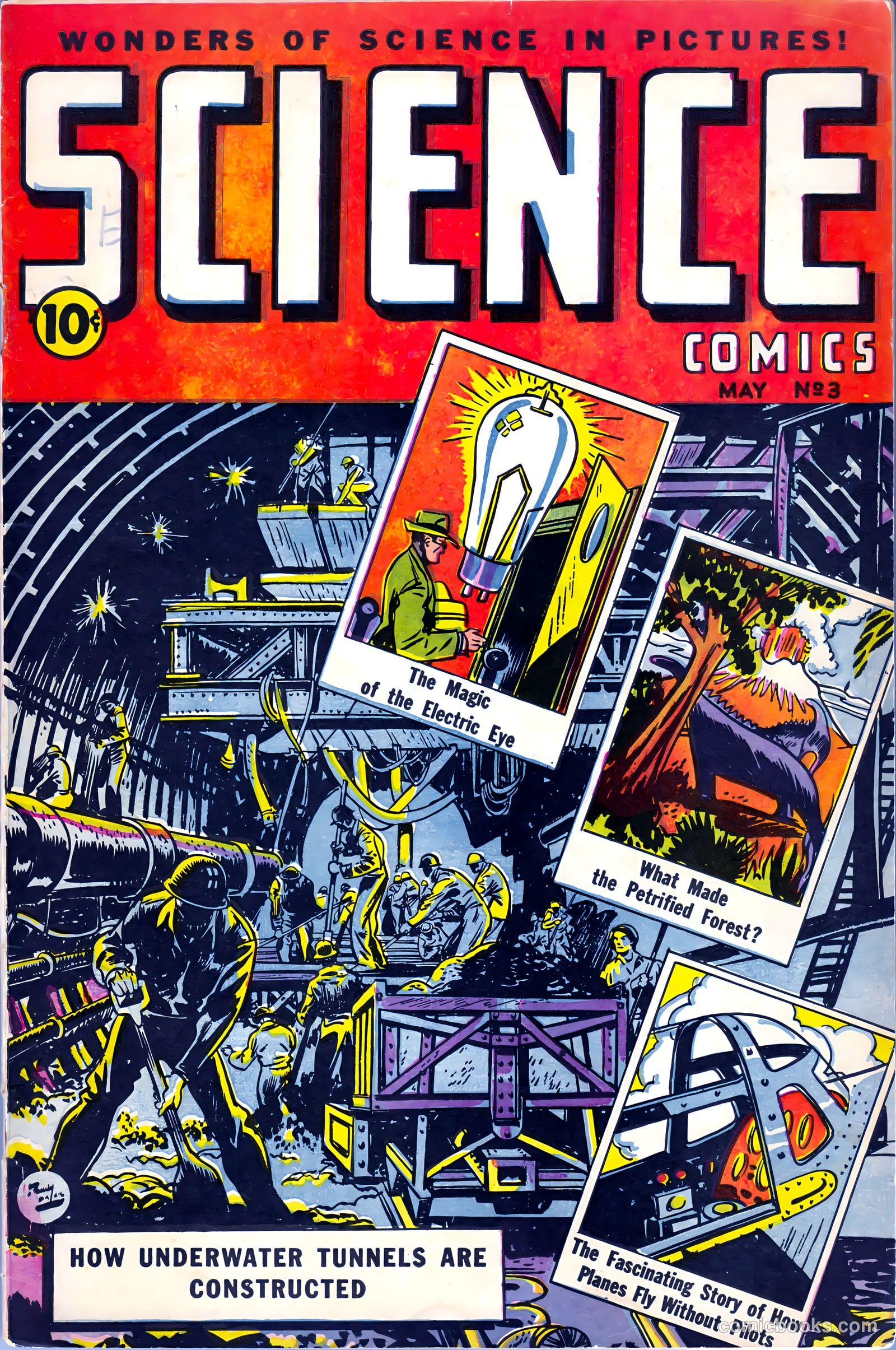
Science Comics #3
☆ Be the first to review + Add to your collection — Join free# Science Comics #3 (May 1946) This anthology issue presents multiple science-themed stories alongside educational articles. Featured stories include "The Magic of the Electric Eye," depicting the testing of a new model aircraft with remote control apparatus; "What Made the Petrified Forest?"; "How Underwater Tunnels Are Constructed"; and "The Fascinating Story of How Planes Fly Without Pilots." The issue also contains an article titled "Science and" by Joseph discussing post-war technological advances in electronics, plastics, and television, including concepts like transport planes serving as television relay stations and early color television demonstrations. Additional content includes a historical narrative about Horace Wells and the development of anesthesia in medicine, crediting Dr. W.G.T. Morton and others who continued Wells's work.
At a U.S. Army training center in 1941, engineers at Wright Field face a challenge: how to improve aerial gunnery practice when slow target planes make poor training subjects. Their solution is the "Pilotless Plane"—a radio-controlled aircraft that can be guided through complex maneuvers from the ground using a device nicknamed the "Beep Box," sending signals that operate the plane's control surfaces. After proving the concept works, the technology is adapted for larger aircraft and peacetime cargo operations, where a single pilot in a "mother ship" can control an entire squadron of unmanned planes across the country.
Born a sickly child in Stockholm, Alfred Nobel showed an early passion for engineering and chemistry that would lead him to a fateful discovery. When tragedy strikes his family's nitroglycerin plant, Nobel becomes obsessed with finding a safer way to handle the volatile explosive—a quest that leads him to an unexpected solution and the invention of dynamite. This is the story of how one man's determination to master a dangerous force transformed both industry and warfare, while haunting him with the consequences of his creation.
Millions of years ago, volcanic eruptions repeatedly buried forests beneath molten ash in what is now Yellowstone National Park—a cycle that played out again and again as new growth returned only to be entombed anew. When a river eventually carved through the buried plateau, it exposed the ancient woods, their original structure perfectly preserved through mineralization into stone. This is the true story behind one of nature's most remarkable geological wonders.
In 1846, Connecticut dentist Horace Wells witnesses a traveling exhibition of nitrous oxide's peculiar effects and realizes the gas might eliminate surgical pain—leading him to attempt the first painless tooth extraction. Wells' bold experiment succeeds brilliantly, but a failed public demonstration in Boston threatens to undo his breakthrough, though the underlying principle proves sound and later scientists build on his pioneering work to transform medicine forever.
Discover how the phototube—the "Electric Eye"—harnesses electrons to put invisible beams of light to work in the real world. This non-fiction story walks you through the ingenious mechanics behind automatic doors, burglar alarms, and industrial safety systems, showing how a simple interrupted beam can trigger everything from motors to sirens that protect both property and human lives.
ComicBooks.com Value
Show all 22 grades ▾
Find on ebay
Read it digitally
Sell my copy
Have this issue — or a whole collection? Get a fair offer from us, skip the marketplace fees and the hassle.
We Buy Collections ▸Full credits
Reviews
Reader reviews
No reader reviews yet.