
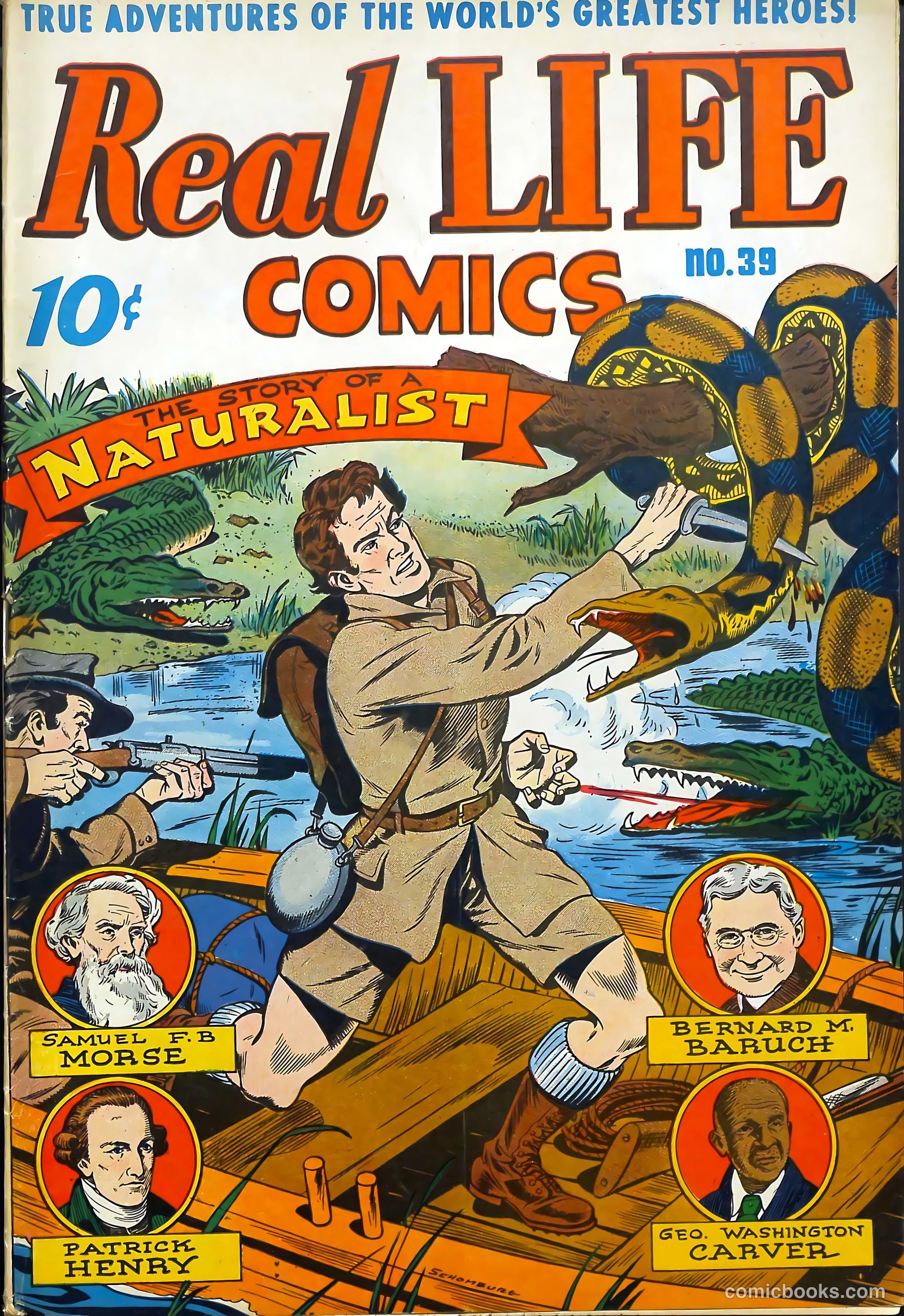
Real Life Comics #39
☆ Be the first to review + Add to your collection — Join freeThis anthology issue features "The Story of Patrick Henry," which depicts Henry's journey from young farmer in Eastern Virginia through various professions—storekeeper and lawyer—before his emergence as a colonial leader who inspired the fight for American independence. The issue also includes "This Mechanical World: The Story of the Telegraph," chronicling the invention and development of telegraph technology from Samuel F.B. Morse's work, enabling rapid long-distance communication across continents and oceans. Additionally, the issue presents an adventure narrative featuring explorers who journey through the Amazon rainforest and Andes Mountains, eventually reaching the Pacific coast after five years, with their account inspiring youth toward new scientific frontiers.
A baseball injury derails young Bernard M. Baruch's military aspirations, setting him on an unexpected path into finance and public service. From his rapid rise as a Wall Street wizard to his pivotal role steering America's industrial might through two world wars, this biography traces how a man committed to facts and the human element became an indispensable advisor to presidents—and a steadfast voice for common sense in the nation's most critical hours.
From a sixteen-year-old Indiana farm boy who enlisted in the Marines to a decorated war hero and air commander, William Kepner's journey spans two world wars and beyond. This biographical portrait follows his evolution from a single-handed capture of an enemy gun position in World War I, through his pioneering work as a balloon expert breaking altitude records, to his command of Eighth Air Force squadrons over Europe in World War II. After the war, with the respect of the military establishment behind him, Kepner makes an unexpected personal decision that speaks volumes about the man beneath the uniform.
In 1947, Real Life Comics presented the biography of Patrick Henry, the fiery orator who transformed from failed farmer and reluctant storekeeper into a champion of colonial resistance against British tyranny. When the House of Burgesses seemed ready to accept the unjust Stamp Act, Henry's thunderous speeches ignited a spark of defiance that rallied Virginia—and soon the thirteen colonies—toward the cause of independence. From his early legal victories to his pivotal role in the Continental Congress and his service as Governor, Henry emerged as a driving force in America's fight for freedom.
From the distant past when man was barely more than tree-dwelling ape to a far-flung future of enormous-brained weaklings or super-powered titans—this lighthearted romp explores the wild possibilities of human evolution across a million years. Through vivid vignettes of prehistoric survival, modern-day routine, and speculative far-future societies, the story weighs fantastical transformations against what science actually predicts about humanity's slow march forward. A fun, thought-provoking jaunt through deep time that reminds us evolution moves at its own patient pace.
From slavery to scientific triumph, George Washington Carver rose from a sickly boy ransomed as an infant to become one of history's most brilliant agricultural chemists—a man who taught himself through relentless study and humble work, eventually joining Booker T. Washington at Tuskegee Institute. There, with little more than scraps and determination, he built a laboratory and experimental station that transformed Southern farming, convincing skeptical planters to abandon depleted cotton fields for new crops like peanuts. His genius lay not just in research, but in finding practical solutions—over 300 uses for a single crop—that lifted entire communities and earned him recognition worldwide, yet never swayed him from his true mission: helping farmers and the land itself.
In 1947, this five-page history traces how Samuel F.B. Morse transformed from a painter fascinated by electricity into the inventor of the telegraph, sparked by witnessing how slowly news traveled during wartime. Through an official demonstration in Washington and a series of dramatic real-world applications—from catching a jewel thief to spreading news of Lincoln's election—the story shows how telegraph lines gradually wove the nation together, culminating in the triumph of the first transatlantic cable linking Ireland and Newfoundland in 1866. From those early dots and dashes to modern wirephoto and teletype machines, the telegraph became the technology that made the world smaller and faster.
Alexander von Humboldt began his life as a curious boy in Prussia and grew into an insatiable naturalist driven by a simple creed: if you would know, find out. From coal mines to mountain peaks to the steaming rivers of South America, Humboldt and his fellow explorer Bonpland undertook a legendary five-year expedition starting in 1799, collecting specimens and observations across continents and climbing heights no European had reached before. His meticulous records and travels inspired a lifetime of scientific writing and teaching that shaped how generations understood the natural world.
ComicBooks.com Value
Show all 10 grades ▾
Find on ebay
Read it digitally
Sell my copy
Have this issue — or a whole collection? Get a fair offer from us, skip the marketplace fees and the hassle.
We Buy Collections ▸Full credits
Key issues in Real Life Comics
Reviews
Reader reviews
No reader reviews yet.