
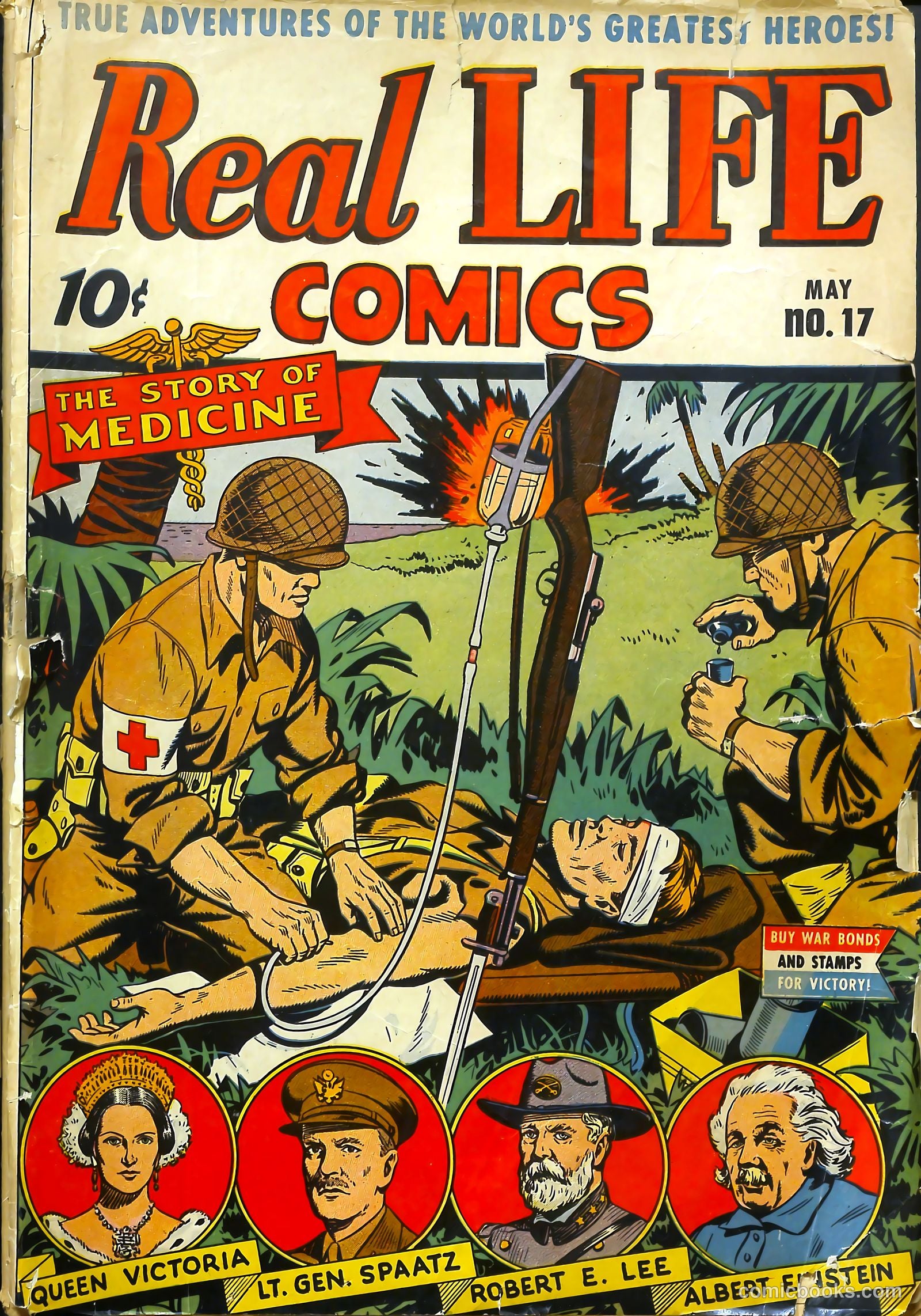
Real Life Comics #17
☆ Be the first to review + Add to your collection — Join freeReal Life Comics #17 (May 1944, Pines/Nedor) is a representative artifact of one of the Golden Age's most distinctive and underappreciated genres: the non-fiction biographical anthology. At a moment when superhero titles dominated newsstands, this series demonstrated that comics could be a legitimate vehicle for history and biography, placing historical figures ranging from Walt Whitman to Juan Ponce de León alongside contemporary Allied heroes in a format aimed at wartime young readers. The issue's blend of WWII-era current events — including a profile of recently fallen submarine commander Howard W. Gilmore — with timeless historical biography made it a genuine educational product that stretched the medium's perceived boundaries. The series as a whole, including this issue, influenced later educational and promotional comics and stands as evidence that the Golden Age was creatively richer than its superhero reputation alone suggests.
Real Life Comics #17 is an anthology featuring "The Story of Medicine," which depicts medical advances in wartime, and "Alfred the Great," a historical adventure in which the Saxon king rallies his people against invading Danes. The issue also includes a war story in which Swedish pilot Swede Swenson engages Japanese torpedo planes attacking a U.S. carrier, shooting down multiple enemy aircraft in aerial combat. Additional content features biographical and historical profiles of notable figures including Queen Victoria, General Spaatz, Robert E. Lee, and Albert Einstein, alongside patriotic war bond appeals.
One of America's first three combat-trained pilots, Lieutenant General Carl A. Spaatz rose from a daring young aviator in World War I to become the war's commanding air strategist, leading his squadrons to dominance across North Africa and Europe. This account traces his evolution from a determined flyer who refused to leave the front without a kill, through record-setting peacetime missions, to his pivotal command of air operations that turned the tide against the Axis forces. Spaatz's relentless coordination of thousands of combat sorties and tactical innovations proved decisive in securing air superiority for the Allies.
From ancient Egypt's misguided remedies to the dark alleys of medieval superstition, this ten-page chronicle traces medicine's painful journey from ignorance to science. Follow pioneers like Ambroise Paré and Vesalius as they challenge deadly traditions and unlock the secrets of the human body, while an ambitious anatomist in 1788 New York faces a mob's fury for daring to dissect cadavers in pursuit of knowledge that will one day transform surgery forever.
When the Danish invasions threaten to consume Britain, King Alfred must transform from a desperate fugitive hiding in the marshes of Athelney into a military strategist cunning enough to outmaneuver his enemies—infiltrating their camps, rallying his fractured forces, and ultimately driving the invaders back. But Alfred's true greatness emerges not on the battlefield: after securing peace, he becomes a visionary ruler who builds fortifications and a navy, establishes a code of law tempered with mercy, and brings learning and scholarship to an island once considered barren and illiterate. This biography traces how a warrior-king became known as the Great by choosing to build civilization as fiercely as he fought to defend it.
This five-page biography traces Robert E. Lee's journey from a boy inspired by his father's service to America through his rise as a distinguished military engineer and commander, following his ambitions from West Point through campaigns in Mexico and Texas. When the nation fractures into civil war, Lee faces an agonizing choice between his love for America and his loyalty to his native Virginia—a decision that shapes the rest of his life. After the war, he dedicates himself to rebuilding the South and reuniting the divided nation through education, believing young Americans must remember they are part of one great country.
This biographical story chronicles the life of Queen Victoria, who ascended to England's throne as a young princess and wielded her power with wisdom and devotion for over six decades. From her early days facing public doubt about a female ruler, through her marriage and the challenges of her reign—assassination attempts, continental upheaval, and personal tragedy—Victoria shaped the destiny of the British Empire with her steady hand and commitment to her people's welfare. The tale celebrates how her benevolent stewardship transformed England into a beacon of hope and prosperity during what became known as the Victorian Era.
Lieutenant Stanley "Swede" Vejtasa, a 27-year-old Navy pilot, takes to the skies in a series of fierce aerial encounters with Japanese forces across the Pacific theater—from the Marshall and Gilbert Islands to the waters off New Guinea and the Santa Cruz Islands. Through raids on enemy harbors, attacks on carriers, and desperate dogfights against overwhelming odds, this Montana flier proves himself a fearless combat veteran. His courage and marksmanship under fire earn him recognition as one of the war's most formidable airmen.
A biography of General Charles George Gordon, a military officer whose exceptional ability to lead men across different cultures earned him the nickname "Chinese" Gordon. The story traces his rise from the Crimean War through his transformative service in China, Egypt, and the Sudan, where he used both combat skill and diplomacy to suppress the slave trade and stabilize regions under imperial rule. His unwavering dedication to duty—even in the face of overwhelming odds—cemented his legacy as a beacon of courage for future generations.
Albert Einstein's scientific genius and journey from modest German professor to celebrated theorist unfolds in this biographical account, tracing how his revolutionary work in relativity earned him worldwide renown—until Nazi persecution forced him to flee his homeland. When America welcomed him in 1934, Einstein found in Princeton's quiet university town the freedom and equality to continue his groundbreaking contributions to science as an American citizen.
ComicBooks.com Value
Show all 13 grades ▾
Find on ebay
Read it digitally
Sell my copy
Have this issue — or a whole collection? Get a fair offer from us, skip the marketplace fees and the hassle.
We Buy Collections ▸History
Real Life Comics launched in September 1941 under Better Publications (part of publisher Ned Pines' interlinked Standard/Nedor/Better imprint family), with scripts in the debut issue credited to Richard Hughes — who, according to multiple sources, also served as the series' actual editor throughout its run, even as Pines was listed on the indicia as editor-president. Hughes, born Leo Rosenbaum, had been writing for Pines' Standard Comics line since around 1940 and simultaneously edited a broad swath of the company's output. By issue #17 in mid-1944, the series was a well-established bimonthly, with some Canadian distribution under the alternate title Real Life Picture Magazine. Individual story art credits for issue #17 have been partially identified by volunteer indexers ('Saltarella' attribution method), though comprehensive pencil and ink credits for this specific issue remain sparse in public databases.
Trivia · 7 facts
- The Grand Comics Database places issue #17 in the May 1944 slot of the series' bimonthly schedule, with #18 following in July 1944 — though some retailer databases list identical story contents under both issue numbers, suggesting a possible indexing error (flagged separately).
- Contents included biographical stories on Walt Whitman ('Bard of Democracy'), Juan Ponce de León (his quest for the Fountain of Youth and discovery of Florida), Catherine the Great, and author Jack London.
- The issue also featured 'Commander Howard W. Gilmore,' a profile of the U.S. Navy submarine commander posthumously awarded the Medal of Honor for sacrificing himself to save his crew aboard USS Growler in February 1943 — an act of heroism only months old at publication.
- 'Blitz-Buster' dramatized the real-world story of Soviet tank driver Kalimulla Khabibulin, who reportedly held off a vastly larger German force — reflecting the series' wartime practice of covering Allied figures from multiple nations.
- A text article, 'Tito the Magnificent' by Kerry McRoberts, profiled Yugoslav partisan leader Josip Broz Tito, illustrating the series' unusually wide geopolitical scope for a 1944 American comic.
- Richard E. Hughes — who edited Standard's Real Life Comics throughout the run — is identified by multiple biographical sources as the title's actual editorial driving force, operating under Ned Pines' nominal publisher credit.
- The series ran from September 1941 through approximately 1952, totaling 59 issues, and some issues were distributed in Canada under the title Real Life Picture Magazine.
Full credits
Key issues in Real Life Comics
Reviews
Reader reviews
No reader reviews yet.