
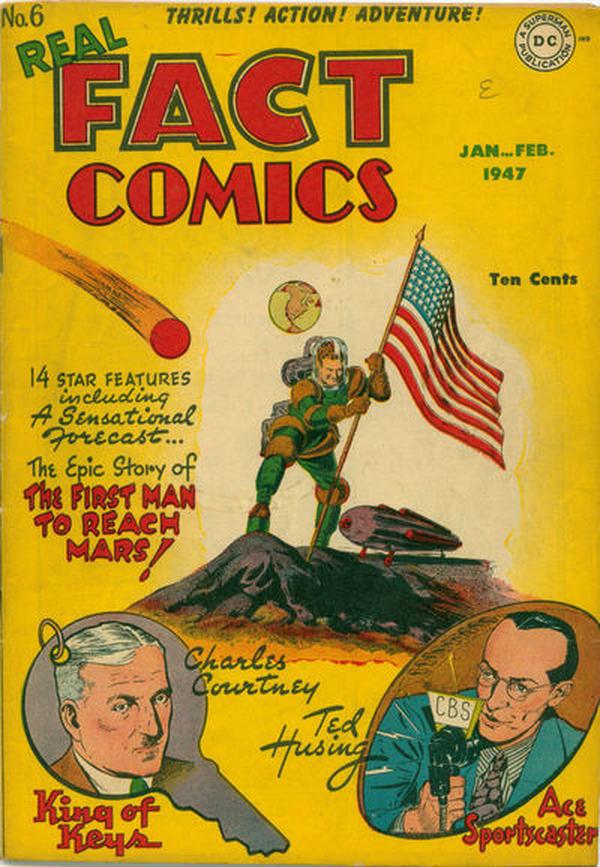
Real Fact Comics #6
☆ Be the first to review + Add to your collection — Join freeReal Fact Comics #6 marks the debut of Tommy Tomorrow in the story titled 'Columbus of Space,' making it the origin point of DC's longest-running Golden Age science fiction hero — a character who would anchor Action Comics as a backup feature for over a decade before moving on to World's Finest and Showcase. The issue is a genuine crossroads of comics history: it introduced a space-explorer archetype built on optimism about human spaceflight at a moment when the rocket age was just dawning, planting a seed that grew into 16 years of continuous publication across multiple titles. As an added footnote of literary history, the same issue's letters column carries what is documented as the earliest known published writing of Harlan Ellison — a single-sentence reader letter from the then-twelve-year-old future science fiction author — giving the issue an unlikely dual significance that extends well beyond the comics medium.
ComicBooks.com Value
Show all 17 grades ▾
This exact issue on ebay
Read it digitally
Sell my copy
Have this issue — or a whole collection? Get a fair offer from us, skip the marketplace fees and the hassle.
We Buy Collections ▸History
Real Fact Comics was DC's attempt at the educational-anthology format that had gained traction in the mid-1940s as a response to public criticism of violent and lurid comics content. Jack Schiff served as the actual editor of the series (with Whitney Ellsworth credited on the indicia), and the Tommy Tomorrow story in issue #6 was scripted by Schiff, George Kashdan, and Bernie Breslauer, with art by Howard Sherman and cover illustration by Virgil Finlay, who was primarily known as a pulp illustrator. The concept behind the Tommy Tomorrow strip in its earliest Real Fact appearances was to frame speculative future scenarios — such as a human mission to Mars — as plausible 'just imagine' visions rather than pure fantasy, fitting the series' non-fiction brand; only when the character migrated to Action Comics in 1948 did he crystallize into the fully fictional Planeteers continuity he is remembered for today.
Trivia · 8 facts
- First appearance of Tommy Tomorrow in the story titled 'Columbus of Space' (Real Fact Comics #6, cover date January 1947; GCD on-sale date November 11, 1946).
- Tommy Tomorrow was created by Jack Schiff, George Kashdan, Bernie Breslauer, and Howard Sherman (artist); Virgil Finlay contributed cover art and also produced interior art for the series.
- In his debut story, Tommy applies to Rocket College in 1954, earns top marks, is selected for 'Operation Mars,' blasts off in August 1960, and becomes the first person to set foot on another world — a near-future framing that was later contradicted and treated as apocryphal once the character was rebooted in Action Comics.
- The letters column of this issue contains what multiple sources identify as the earliest known published writing of future science fiction writer Harlan Ellison, then approximately twelve years old.
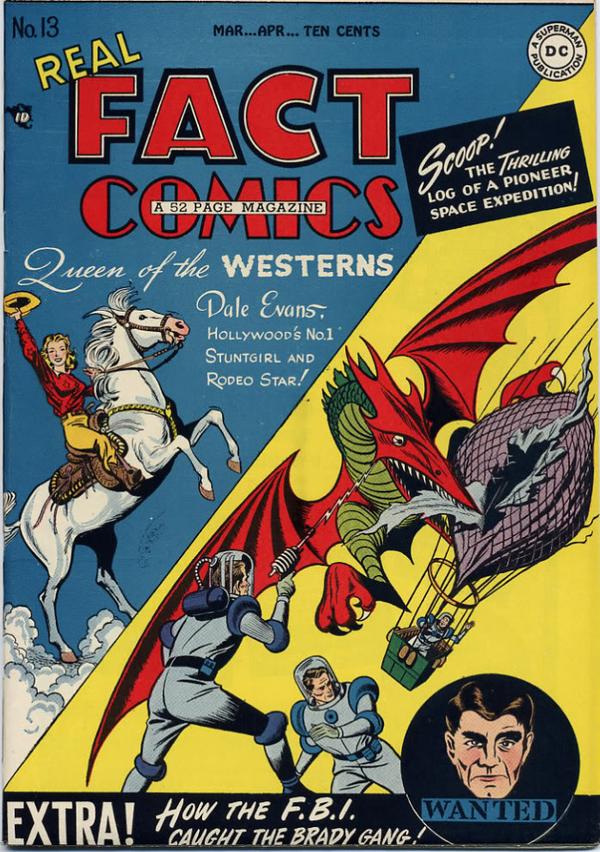
- Tommy Tomorrow appeared in three additional issues of Real Fact Comics (#8, #13, #16) before graduating to a long-running backup feature in Action Comics #127–251 (1948–1959).
- The first three Real Fact Comics Tommy Tomorrow stories (issues #6, #8, and #13) are considered apocryphal relative to the later Action Comics continuity, as their near-future setting and premise contradict all subsequent stories.
- The debut story from this issue was reprinted in Mysteries in Space: The Best of DC Science Fiction Comics (Simon and Schuster, 1980) and again in Pulp Fiction Library: Mystery in Space (DC, 1999).
- Real Fact Comics was DC's only foray into educational anthology comics, running 21 issues (1946–1949) and edited in practice by Jack Schiff and Murray Boltinoff, though Whitney Ellsworth held the credited editorial title.
Cast · 1 character
Full credits
Reprints
Reprinted in Adventure Comics #158 (1950), Star Spangled Comics #110 (1950), Star Spangled Comics #112 (1951), Strange Adventures #5 (1951), Mystery in Space #1 (1951), Mysteries in Space: The Best of DC Science Fiction Comics #[nn] (1980), Pulp Fiction Library: Mystery in Space #[nn] (1999)
Key issues in Real Fact Comics
Reviews
Reader reviews
No reader reviews yet.