
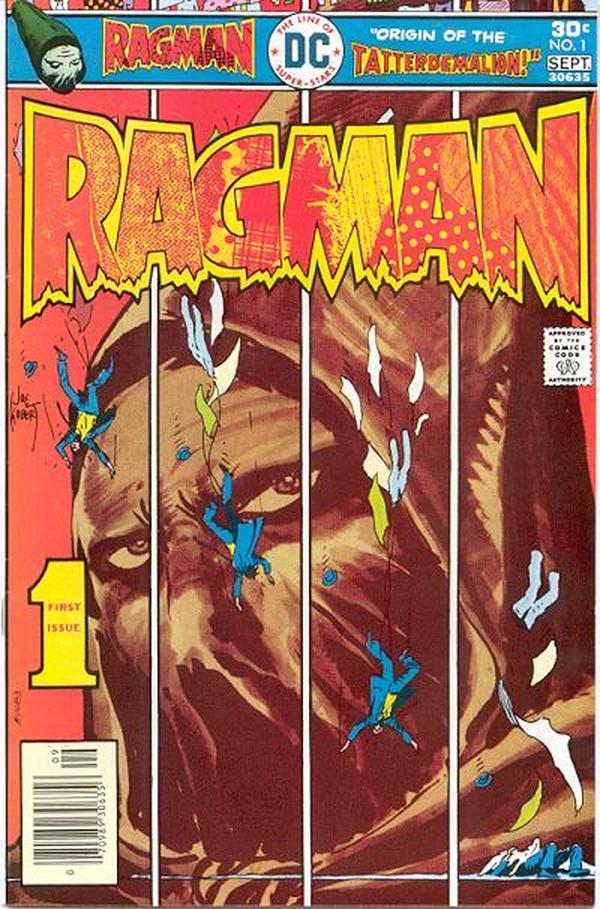
Ragman #1
☆ Be the first to review + Add to your collection — Join freeRagman #1 marks the first appearance and complete origin of Rory Regan — a Vietnam War veteran and Gotham pawn-shop owner whose patchwork costume gives him the combined strength and skills of the men who died passing them to him — making it one of the Bronze Age's most distinctive street-level debuts. The issue arrived squarely within comics' 1970s social-conscience wave, planting a hero who was genuinely working-class and economically marginalized at a time when DC was experimenting with grittier, community-rooted protagonists. The Kubert-designed costume, a tattered layering of rags, also prefigured the idea of a 'living' or personality-imbued costume that later writers would deepen into the celebrated 'Suit of Souls' mythology. Although the original run lasted only five issues, this first issue seeded a character resilient enough to be reimagined multiple times across decades and eventually adapted for live-action television.
ComicBooks.com Value
Show all 18 grades ▾
This exact issue on ebay
CGC 9.6 ▾ $120–$150 2 listings
Raw / ungraded ▾ $20–$24.99 2 listings
More listings for this title
Read it digitally
Sell my copy
Have this issue — or a whole collection? Get a fair offer from us, skip the marketplace fees and the hassle.
We Buy Collections ▸History
Writer Robert Kanigher and artist/editor Joe Kubert conceived the character as a deliberate departure from the dominant superhero template — a hero defined by poverty rather than wealth or accident-born power. Kubert handled cover art and layouts while the brothers Nestor and Frank Redondo (credited as Redondo Studios) executed interior pencils and inks; Kubert's specific layout contribution was not publicly acknowledged until the letters page of issue #5. Executive editor Joe Orlando oversaw the book, with Bob Rozakis also listed in an editorial capacity, and the issue shipped on or around May 10, 1976, carrying a September 1976 cover date. The series was conceived as an ongoing title but folded after only five bi-monthly issues, a casualty of the broader mid-1970s contraction that claimed several DC launches of the era.
Trivia · 8 facts
- First appearance and full origin story of Ragman (Rory Regan), titled 'Origin of the Tatterdemalion,' published by DC Comics with a cover date of September 1976 (on-sale approximately May 10, 1976).
- Created by writer Robert Kanigher and artist/editor Joe Kubert; interior art executed by Redondo Studios (brothers Nestor and Frank Redondo), with Kubert providing layouts — a credit not confirmed in print until the Ragman #5 letters page.
- Rory Regan is introduced as a Vietnam War veteran (specifically, a former U.S. Marine) who operates a Gotham pawn shop called Rags 'n' Tatters; his father Gerry Regan and three associates die in the issue, passing their collective physical abilities to Rory through an electrocution event.
- The lead story also introduces supporting characters Bette Berg and establishes the Rags 'n' Tatters shop as Rory's civilian base — both fixtures throughout the short original run.
- A text backup story, 'A Rag and a Bone and a Bag of Gold,' by E. Nelson Bridwell also appears in the issue.
- The original character was conceived as Irish-American — a fact confirmed on the Ragman #3 letters page — before the 1991 Giffen/Fleming/Broderick mini-series revised his heritage to Jewish and transformed the costume into the mystical 'Suit of Souls' rooted in the Golem of Prague legend.
- The original five-issue series (1976–77) was the character's only solo ongoing for over a decade; after a cameo in Crisis on Infinite Earths, Ragman received an 8-issue post-Crisis mini-series in 1991 (vol. 2) followed by the 6-issue Ragman: Cry of the Dead in 1993.
- Ragman appeared in the live-action Arrowverse series Arrow (Season 5, 2016–2017), portrayed by Canadian actor Joe Dinicol, bringing renewed attention to the character's 1976 debut issue.
Full credits
Reprints
Reprinted in Le Manoir des Fantômes #7 (1977), Batman Classics #98 (1978), Lepakkomies #4/1978 (1978), Läderlappen #7/1978 (1978), Lynvingen #6/1978 (1978)
Reviews
Reader reviews
No reader reviews yet.