
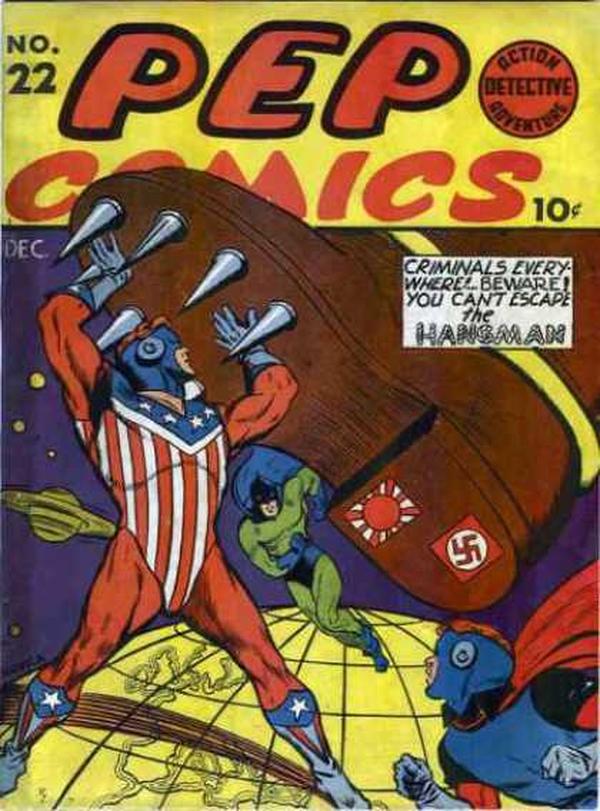
Pep Comics #22
☆ Be the first to review + Add to your collection — Join freePep Comics #22 is one of the most consequential single issues in American comics history: tucked away as a backup feature in a 68-page superhero anthology, a six-page humor strip quietly introduced Archie Andrews, Betty Cooper, and Jughead Jones to the world — characters who would go on to define teen-comedy comics for over eight decades and eventually displace the very superheroes that dominated this issue's cover. The debut fundamentally redirected MLJ Magazines, a company built on patriotic and crime-fighting heroes, toward humor and slice-of-life storytelling, a pivot so complete that MLJ eventually renamed itself Archie Comics Publications. Beyond corporate history, the issue proved that a relatable, non-powered everyman teenager could command just as loyal a readership as any caped crusader, establishing a template for teen ensemble comedy that would influence everything from newspaper strips to network television.
"Death of a Double" in Pep Comics #22 (1941) delivers a gripping wartime adventure as the Sky Pirates face a sudden reassignment, only to prove their unity in a high-stakes dogfight that saves London from a Nazi bombing raid. Written by Joe Blair and illustrated by Ed Smalle, this story sees the Sky Pirates earn their official status as the Jolly Roger Squadron after flying together in defiance of orders. The cover by Irv Novick captures the daring spirit of the moment, a striking image of aerial combat that perfectly frames the issue’s bold, action-packed tone.
When orders split the Sky Pirates across separate squadrons, their bond is tested—until a fierce dogfight over London forces them to fly together again. Their instinctive teamwork turns the tide, earning them a new mission: officially forming the Jolly Roger Squadron under the R.A.F.
In this lighthearted 1941 tale from Pep Comics #22, Archie tries to impress Betty, the new girl in town, by boasting he can do anything. When a carnival comes to town and a tightrope walker is needed, Betty remembers Archie’s claim—and volunteers him with delightfully chaotic results.
ComicBooks.com Value
Show all 17 grades ▾
This exact issue on ebay
More listings for this title
Read it digitally
Sell my copy
Have this issue — or a whole collection? Get a fair offer from us, skip the marketplace fees and the hassle.
We Buy Collections ▸History
Publisher John L. Goldwater conceived Archie Andrews as a deliberate counterpoint to MLJ's superhero lineup, drawing inspiration from the enormously popular Andy Hardy film series starring Mickey Rooney, whose wholesome small-town teenager resonated with American audiences. Goldwater collaborated with writer Vic Bloom and artist Bob Montana to realize the character, with Montana reportedly sketching early versions of the gang in Haverhill, Massachusetts — the town where he attended high school and which many scholars believe was the real-world model for Riverdale. The issue was edited by Abner J. Sundell and went on sale October 15, 1941, with a cover date of December 1941; notably, a promotional advertisement cameo for Archie and his parents appeared five days earlier in Top Notch Comics #22, making that issue a minor footnote in the character's publication history. The cover itself, illustrated by Irv Novick, featured the Shield and Hangman in a World War II-themed image with no hint of the teenage newcomer inside.
Trivia · 8 facts
- First full comic-story appearance of Archie Andrews (Archibald 'Chick' Andrews), Betty Cooper, and Jughead Jones (Forsythe P. Jones), written by Vic Bloom and drawn by Bob Montana.
- A promotional advertisement cameo featuring Archie and his parents appeared five days earlier in Top Notch Comics #22, per U.S. Copyright Office catalog records — though this is not universally treated as a true 'first appearance.'
- The Archie story runs only six pages and occupies a backup slot; the Shield, Hangman, and Dusty the Boy Detective dominate the War-themed cover, painted by Irv Novick.
- Published by M.L.J. Magazines Inc. under editor Abner J. Sundell; official on-sale date was October 15, 1941, per the U.S. Copyright Office Catalog of Copyright Entries.
- The issue is a 68-page anthology containing stories for The Shield & Dusty (script: Harry Shorten, art: Irv Novick), The Hangman (script: Joe Blair, art: Paul Reinman), Danny in Wonderland (script: Harry Shorten, art: Lin Streeter), Sergeant Boyle (art: Carl Hubbell), Jolly Roger (script: Joe Blair, art: Ed Smalle), Kayo Ward (script: Harry Shorten), and Bentley of Scotland Yard (script: Joe Blair).
- Only Fred Andrews is named in the Archie story; the other family members' names (including Archie's mother, referred to here as 'Edna') would be retconned over subsequent issues.
- The inaugural Archie story has been reprinted multiple times, including in Best of Archie Americana #1 – Golden Age 1940s–1950s (2017), Best of Archie Comics Volume 1, and Gwandanaland Comics #3093 – Pep Comics: Volume 6 (2021).
- Archie received his first solo cover appearance on Pep Comics with issue #36 (February 1943), and by issue #51 (December 1944) he was the sole cover feature — a trajectory that led MLJ to rename itself Archie Comic Publications in 1946.
Cast · 18 characters
Full credits
Reprints
Reprinted in Super Comics #1 (1941), Super Comics #4 (1944), Three Ring Comics #3 (1946), The Best of Archie #[nn] (1980), Archie Americana Series #1 (1991), Archie: His First 50 Years #[nn] (1991), Archie Comics Digest #236 (2007), Archie Firsts #1 (2010), Archie Archives #1 (2011), The Best of Archie Comics #[1] (2011), Archie (Jumbo Comics) Double Digest #260 (2015), Archie #1 (2015), The Best of Archie Comics: 75 Years 75 Stories #[nn] (2015), Best of Archie Comics #1 (2016), Archie Spotlight Digest: Archie 75th Anniversary Digest #3 (2016), Take That, Adolf!: The Fighting Comic Books of the Second World War #[nn] (2017), Best of Archie Americana #1 (2017), Archie 80th Anniversary Jumbo Comics Digest #1 (2021), Gwandanaland Comics #3093 (2021), Archie 80th Anniversary Jumbo Comics Digest #5 (2022)
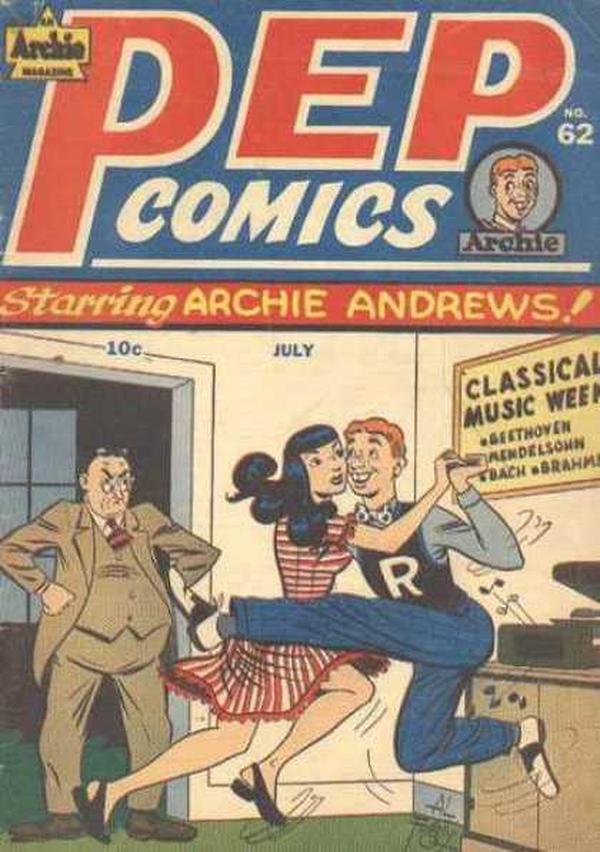
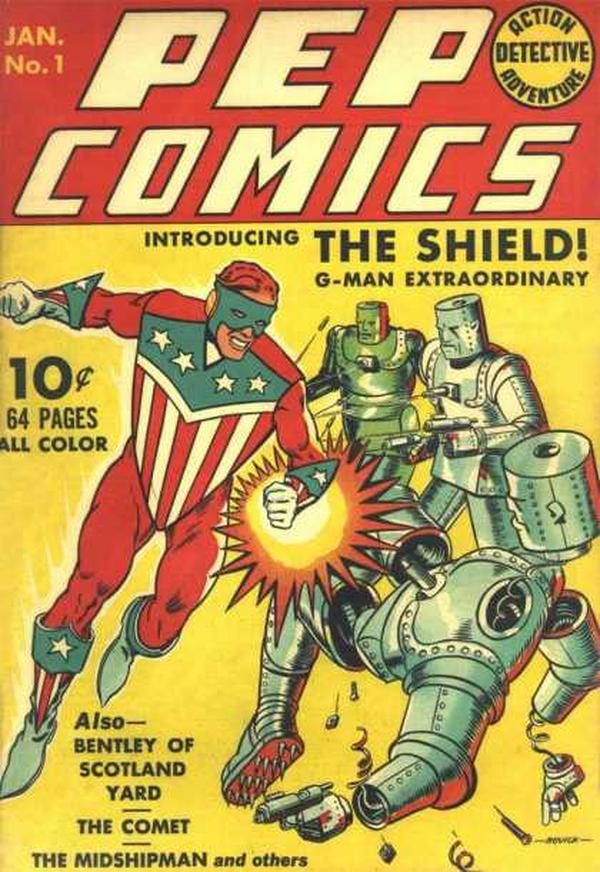
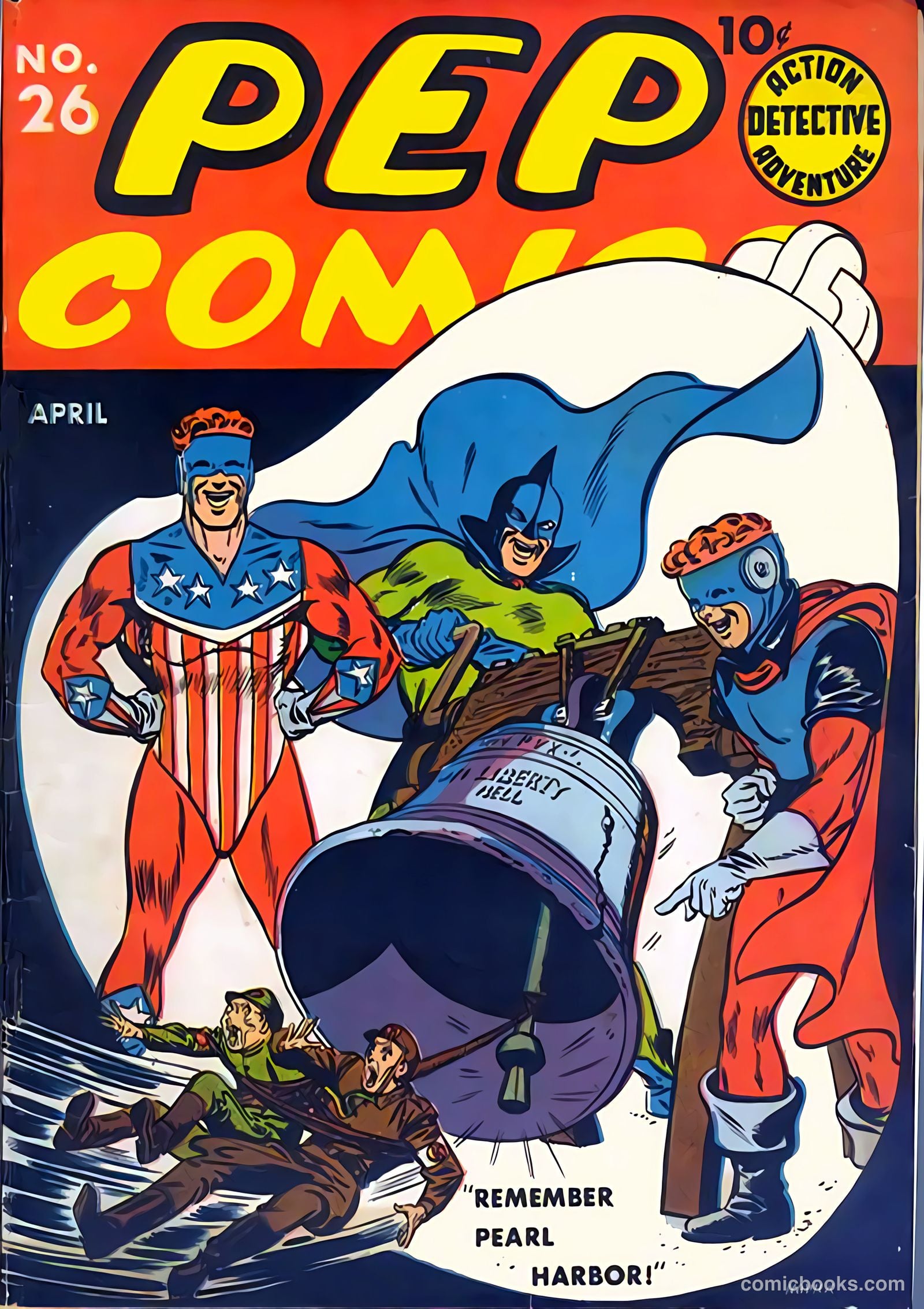
Key issues in Pep Comics
Reviews
Reader reviews
No reader reviews yet.