
Our Army at War #113
☆ Be the first to review + Add to your collection — Join freeOur Army at War #113 earns its place in comic-book history primarily through the debut of Jackie Johnson, who is widely recognized as one of the very first non-stereotypical African-American characters in mainstream American comics. Writer Robert Kanigher and artist Joe Kubert deliberately made no mention of Jackie's race within the story itself, allowing him to exist as simply another soldier — equal in every respect to his white comrades — at a time when real-world U.S. Army units remained effectively segregated and the Civil Rights Movement was intensifying. The issue simultaneously introduces the fan-favorite Easy Company member Wildman, expanding the colorful ensemble that made the Sgt. Rock feature the gold standard of Silver Age war comics. Together, these two debuts mark a turning point in how mainstream superhero-adjacent comics could approach diversity and moral purpose without abandoning the genre's action-driven storytelling.
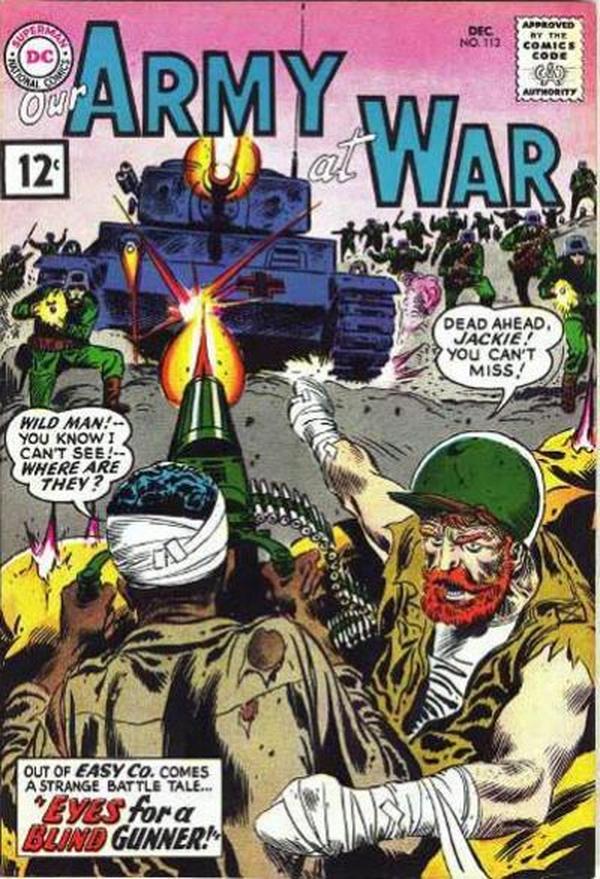
In "Eyes of a Blind Gunner," two wounded soldiers—Jackie, now blind from a grenade blast, and Wild Man, whose hands are shattered—must rely on each other to survive the brutal aftermath of battle. As Jackie guides Wild Man through the wreckage with his sharp instincts, Wild Man becomes Jackie’s hands, fighting to keep them both alive.
ComicBooks.com Value
Show all 18 grades ▾
This exact issue on ebay
Raw / ungraded ▾ $39.99–$100 3 listings
Read it digitally
Sell my copy
Have this issue — or a whole collection? Get a fair offer from us, skip the marketplace fees and the hassle.
We Buy Collections ▸History
The issue carries a cover date of December 1961 (on-sale date confirmed by copyright registration as October 3, 1961) and was edited by Robert Kanigher, who also scripted the lead Sgt. Rock story 'Eyes of a Blind Gunner.' Joe Kubert handled both pencils and inks on that lead feature, with lettering by Gaspar Saladino on the cover story and Ira Schnapp on the cover itself — credits confirmed from Julius Schwartz's editorial records provided by DC Comics. The two back-up stories ('Target of the Black Ace!' by Bob Haney and 'Big Bazookaman!' by Hank Chapman) were both drawn by Jack Abel. Scholars and critics have noted that Kanigher and Kubert were consciously responding to the escalating civil rights crisis in the American South when they created Jackie Johnson, choosing a war-comics setting — where notions of shared sacrifice carried particular moral weight — as a vehicle for an understated argument about racial equality.
Trivia · 8 facts
- First appearance of Jackie Johnson, an African-American ex-heavyweight boxing champion and Easy Company soldier, scripted by Robert Kanigher and drawn by Joe Kubert.
- First appearance of Wildman (real name Harold Shapiro, a mild-mannered history professor in civilian life), whose fierce combat persona became one of Easy Company's most recognizable recurring characters.
- The lead story, 'Eyes of a Blind Gunner,' never once mentions Jackie Johnson's race, presenting him as fully equal to his fellow soldiers — a deliberate creative choice by Kanigher and Kubert in response to the Civil Rights Movement.
- Jackie Johnson was conceived as an amalgamation of real-world barrier-breaking athletes, primarily Jackie Robinson and Joe Louis, both of whom had also served during World War II.
- Jackie Johnson is broadly cited as DC Comics' only African-American character before 1970, predating Marvel's Gabe Jones (Howling Commandos #1, May 1963) as the first non-stereotypical Black supporting character in mainstream Silver Age war comics.
- The issue contains three stories: the lead Sgt. Rock feature by Kanigher and Kubert, 'Target of the Black Ace!' by Bob Haney and Jack Abel, and 'Big Bazookaman!' by Hank Chapman and Jack Abel.
- The lead story was reprinted in DC Special #5 (October–December 1969), Sgt. Rock Special #8 (June 1990), The Sgt. Rock Archives Vol. 3 (September 2005), and Showcase Presents: Sgt. Rock Vol. 1 (2007/January 2008).
- Published under the National Periodical Publications imprint, approved by the Comics Code Authority, at the then-standard cover price of twelve cents for 36 pages.
Full credits
Reprints
Reprinted in DC Special #5 (1969), Sgt. Rock Special #8 (1990), The Sgt. Rock Archives #3 (2005), Showcase Presents: Sgt. Rock #1 (2008)
Key issues in Our Army at War
Reviews
Reader reviews
No reader reviews yet.