
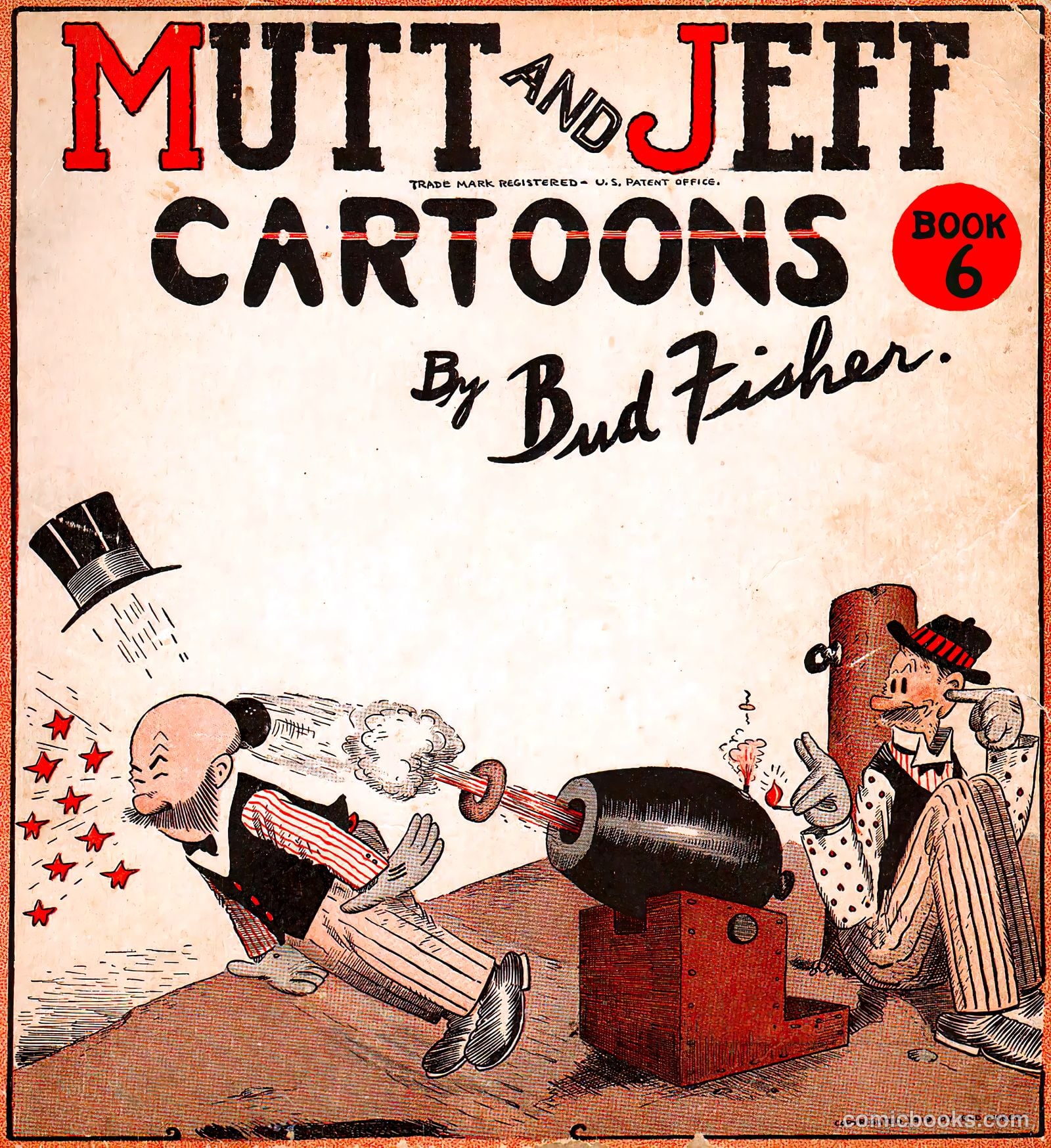
Mutt and Jeff #6
☆ Be the first to review + Add to your collection — Join freeMutt and Jeff #6 (September 1919, Cupples & Leon) is a Platinum Age artifact built directly on top of what historians widely regard as the first successful daily comic strip — a format Bud Fisher pioneered when A. Mutt debuted in the San Francisco Chronicle on November 15, 1907, establishing the six-day-a-week, recurring-character strip that every subsequent daily comic would follow. This sixth volume in the Cupples & Leon softcover series represents the publisher's commitment to collecting newspaper dailies into standalone book form at a moment when that practice was still finding its commercial shape, helping prove that reprinted newspaper comedy could sustain its own publishing line independent of any single paper. The issue also captures the strip at a culturally charged inflection point: strips from this era document Mutt and Jeff being sent to the Western Front and through the chaos of a world just emerging from World War I, a topical storytelling engagement the strip was known for. As the opening installment of the Cupples & Leon run — that entire series spans 1919 to 1933, producing at least 18 volumes — issue #6 anchors one of the longest-running reprint programs of the Platinum Age.
This collection of Mutt and Jeff cartoons by Bud Fisher contains three separate stories. In the first, Jeff attempts to teach Mutt boxing by hitting him repeatedly, but Mutt ultimately gets the upper hand. In the second story, Dan Cupid tries to interest Jeff in marriage by presenting him with a proposition from an oil king willing to give substantial dowries—$10,000, $20,000, and $30,000—for each of his daughters, but Jeff becomes increasingly skeptical as the numbers grow. In the final story, Sid consults Jeff (an attorney at law) for legal advice regarding a breach of promise suit, and Jeff charges him three dollars for the advice, though Sid feels he has been overcharged.
Jeff hears an impressive tale about his friend Bill's narrow escape from a dangerous fall—Bill managed to grab a rope and save himself through quick thinking. But when Jeff reflects on what really matters in a crisis, he delivers a perfectly timed punchline that deflates all the admiration in the room.
Mutt and Jeff trade tales of miserly behavior in "Here's a Tip on How to Make a Fan Last Forever," with each trying to top the other's story of penny-pinching gone wrong. The punchline arrives when one character reveals the ultimate in thrift: a single fan that's lasted three generations because the family has figured out how to use it without actually wearing it out.
Mutt and Jeff swap complaints about the skyrocketing cost of groceries in 1919, with each item they discuss—eggs, chickens, turkeys, hogs, and cows—costing more than ever before. As the two trade observations about inflation's cruel march up the food chain, the prices keep climbing in absurdly escalating comparisons. It's a sharp-eyed comic jab at the economic strain hitting everyday shoppers right in the wallet.
Jeff lands what looks like a promising job opportunity, but his excitement about a new deal with a fellow named Brown over his previous contract with Jones suggests he might not have thought the numbers through carefully. When Mutt questions his reasoning, Jeff's shaky understanding of fractions threatens to undermine what he believed was a smart business move.
When Mutt accidentally swallows a five-dollar gold piece he'd been hiding, Jeff sees an opportunity to turn a profit—proposing an unconventional "extraction fee" rather than calling a doctor. What unfolds is a scramble over the coin and a scheme that lands Mutt at the lunch counter with newfound spending power.
When Mutt and Jeff discover their hats fit each other perfectly, Jeff seizes the moment to explain the difference between a miracle and a coincidence—and decides a practical demonstration is in order. What starts as a lesson in vocabulary quickly turns into a painful object lesson when Jeff's teaching method involves his boot.
Mutt and a companion settle in for a theater evening, but when Mutt discovers that two years pass between the first and second acts of the show, he sees an opportunity to break his recent smoking pledge without technically violating it. A droll bit of logic from the witty schemer in "My Goodness, How the Time Flies!"
Jeff boasts to Mutt about his recent stock market success—he's already seeing steady gains on his John Dee Oil shares—but when Mutt suggests he cash out while he's ahead, Jeff's confidence in bigger profits gets the better of him. What happens next when greed meets the unpredictable market makes for a classic lesson in overconfidence.
Mutt's small friend asks to borrow his umbrella on a clear day, and when Mutt questions why, the fellow explains his shrewd logic: he's borrowing it now because he knows that when rain actually comes, Mutt will want to keep it for himself. A clever bit of comic foresight from the little fellow!
When Jeff's cow is struck by a train, Mutt helps him fill out the railroad's claim report—but as Mutt asks what happened to the animal, Jeff's sentimental sniffling threatens to turn the paperwork process into an emotional ordeal. This 1919 Mutt and Jeff comic pairs bureaucratic comedy with Jeff's grief in classic form.
When a careless remark about Mutt's son inadvertently reveals his marital status to Yvette, she gives him the cold shoulder—prompting Mutt to corner his well-meaning but bumbling friend for an explanation. What starts as a heated confrontation quickly turns into a stubborn standoff neither man seems willing to break.
Mutt and Jeff debate the world's greatest fighters, with Jeff making a point about prayer giving courage to American, British, and Canadian soldiers—until Mutt's logic hilariously breaks down when confronted with the fact that Chinese soldiers pray too. It's a wartime comedy that captures the duo's classic dynamic of one character accidentally proving the other right, even as they're arguing about it.
Jeff struggles to write his diary entry, but his companion won't let it rest—insisting that the young man adopt more eloquent phrasing by comparing his daily rhythms to celestial bodies. As Jeff attempts to revise his language to match these lofty standards, the results become increasingly absurd, turning a simple account of his day into something that reads more like an astronomy lesson than a proper diary.
Jeff regales a skeptical listener with the tall tale of his hunting prowess—a moose he bagged last winter with a single, improbably angled shot that passed clean through the animal's hind foot and head simultaneously. The humor lies entirely in Jeff's increasingly absurd explanation for how such an impossible feat was possible, delivered with characteristic obliviousness to how ridiculous the whole story sounds.
When Jeff brings home an Abyssinian woodpecker named Woodrow as a pet, Mutt assures him the bird is no trouble—it only eats wood, after all. But the woodpecker has other ideas about what qualifies as timber, leading Jeff to a painful discovery about the limits of his persuasive powers.
When Mutt and Jeff return to a restaurant where they were once thrown out for not paying their bill a year earlier, Mutt calls over the manager to remind him of that embarrassing incident—just as the check arrives. Mutt hints he may be about to repeat history, setting up a classic comedic predicament in this 1919 humor strip.
Mutt hatches a scheme to make quick cash by having Jeff fake an injury from a streetcar accident and collect a settlement—but when Jeff demonstrates his supposed permanent disability to the company's adjuster, his story falls apart faster than his crooked plan deserves. It's a classic con gone wrong that shows why maybe Mutt should've thought through the details before sending his pal to commit insurance fraud.
When Jeff the sales manager sends Mutt on a business trip to check up on their Springfield representative, he hands over just twenty dollars for expenses—a sum that quickly proves woefully inadequate once Mutt starts tallying up train fare, hotel costs, and the inevitable expenses of being a "good fellow" on the road. Faced with the impossible math of stretching a pittance across lodging, transportation, and social obligations, Mutt finds himself at the ticket window trying to figure out which Springfield will at least cost him the least.
Jeff persuades his boss Bud to grant him a vacation after a grueling year, and the two set their sights on a getaway to a gay summer resort. Mutt, skeptical that the boss will approve, finds himself pleasantly surprised when Jeff emerges victorious from the negotiation. What should be a simple time off becomes anything but in this lighthearted 1919 tale.
Jeff riffs on reports that Martians have been trying to contact Earth, and when someone suggests they could simply send a message, Jeff offers a hilariously practical solution: they should send it collect and wait to see if we pay the bill. It's vintage early-20th-century humor wrapped around the space-age fascination of the era.
Jeff gets a lesson in human anatomy when his companion reads aloud about the body's water and sulphur content—which inspires Jeff to draw his own hilariously logical conclusion about what makes a good match. It's a quick-witted pun delivered with the kind of groan-worthy confidence only Jeff can muster in this 1919 humor strip.
When Cupid dangles the prospect of marriage to a wealthy oil king's daughters—complete with increasingly generous dowries—Jeff's enthusiasm shifts dramatically with each new financial incentive. The catch: the bigger the payout, the older the bride-to-be. Jeff's mercenary heart wrestles with his vanity in this quick-witted romp about fortune-hunting and the price of romance.
When Jeff visits a dentist and receives some dental work, he decides to test his new gold crowns with acid from the medicine cabinet—a decision that quickly proves disastrous. The mishap leaves the other characters amused at his expense, though the damage is decidedly not funny for poor Jeff.
Jeff desperately needs a break from the tedium of camp life, so he approaches the sentry for permission to slip into town for the day—but the soldier insists he needs the countersign first: "recognizance," a word so formidable that Jeff has never heard of it before. When faced with this linguistic hurdle, Jeff's escape plan hits an unexpected snag that leaves him scrambling for a dictionary.
When rain threatens, Mutt readies his tubs to catch soft water for his wife's weekly wash—but his friend has other ideas about both the weather and his domestic arrangements. What starts as simple storm preparation turns into a comedic clash of opinions about laundry day and what a cyclone finish might actually bring.
In this 1919 wartime comedy, Mutt and Jeff pack up and leave their trench to join a peace ship bound for Copenhagen, hoping to escape the horrors of combat for a nobler cause. The long journey ahead tests their patience as they make their way toward their destination—and things don't go quite as planned along the way.
A soldier seeks his discharge now that peace has been signed, only to find the draft board can't locate his hometown of Penasappa, California on any map—despite having had no trouble finding him when they needed to draft him. It's a wry jab at military bureaucracy that would've gotten a knowing laugh in 1919.
Mutt is desperate to learn Jeff's secret for ditching his uniform, and when he finally corners him, Jeff offers to spill the beans—for a price. It's a classic bit of 1919 humor that plays on the post-war scramble and a character's willingness to part with good money for a shortcut, only to discover the advice might be worth exactly what he paid for it.
Jeff seizes an opportunity to guide tourists around a World War I battlefield, regaling a visitor with tales of American military heroics at Chateau-Thierry. When his exhausted customer finally departs to rest and work on his book, Jeff discovers the hard way that not every tourist encounter pays out as expected.
Now that peace has been signed, Mutt and Jeff figure Uncle Sam no longer needs them in uniform, so they head to get their discharge papers—but when Jeff goes in first to request his, things don't go quite as smoothly as they'd hoped. This 1919 humor strip plays up the absurdity of military bureaucracy and the boys' attempts to shed their wartime service.
Jeff shares a story with Mutt about Percival Grey, a refined classmate from his California school days who was mocked as a "sissy" for his prim appearance and genteel habits—until the Great War revealed an unexpected truth about judging character by outward manners. It's a quick, wry reminder that sometimes the least likely person can surprise you when it counts most.
Jeff faces a booze-burying predicament when his pal Mutt warns him that authorities will search his safe after July 1st—and there's a quart of pre-war Scotch he needs to hide from the law. Following Mutt's advice, Jeff buries his prized bottle in the backyard "for medicinal purposes," confident his stash is safe from the feds. What could possibly go wrong with this foolproof plan?
A client visits Jeff's law office with concerns about a breach of promise suit, and Jeff offers reassuring counsel—for a fee. When the man produces a five-dollar bill as payment for the three-dollar advice, Jeff spots an opportunity and hastily revises his legal opinion, managing to extract the full amount. A sharp-witted look at how quickly a lawyer's confidence can shift when money's on the table.
Jeff accepts a poker rematch against the Czar, who offers to cover his losses with a personal check backed by the Russian government—but when Mutt and Jeff consult an almanac and discover Russia's staggering national debt, they decide the guarantee might not be worth the paper it's printed on. A sharp little comedy about the perils of trusting a bankrupt backer, no matter how powerful.
Mutt's wife is thrilled to report that her husband has finally landed a job—only to discover that his new position is collecting debts for a tailor. When Mutt tracks down a friend to settle an outstanding bill, the encounter takes an unexpectedly destructive turn.
A chauffeur sends a young kid across the street with a dime to buy cigarettes, but the shop won't sell to the boy because of his age—leaving the driver to take matters into his own hands in this slapstick one-pager from 1919. It's the kind of absurdist humor that made Mutt and Jeff a staple of early comic strips, where the punchline lands harder than any traffic accident.
Jeff schemes to trick his friend Mutt into thinking he's a war hero by staging a fake battle with a helper firing blank shells—but when the dust settles, Jeff discovers that pulling off a con isn't quite as simple as he'd planned. This 1919 one-pager serves up the kind of slapstick misfire that made Mutt and Jeff a comic staple, where even the best-laid schemes tend to backfire spectacularly.
Jeff devises what he's convinced is an unbeatable defensive strategy to use against his rival Jess come July Fourth—a foolproof stance that he's certain will leave his opponent too frustrated to land a single punch. The only problem? He hasn't quite thought through every possible angle of attack.
Mutt and Jeff attempt to reach Chicago by hitching a ride on a ship, but their plan hits a snag when they realize their mode of transportation makes no geographical sense—boats simply don't run from Texas to Chicago. What follows is a humorous commentary on the strip itself, as the characters grapple with the absurdity of their journey. This clever bit of fourth-wall humor makes for a delightfully meta adventure that pokes fun at the very logic of comic storytelling.
When Jeff reads a newspaper item claiming there never was a historical figure named Adam, he's thrown into a fit—convinced that next people will be denying the existence of Uncle Tom himself. A short, snappy bit of 1919 humor built on the collision between tall tales and stubborn certainty.
Jeff lands a job as a newspaper reporter and can't resist bragging about his newfound status to Mutt—but when Mutt challenges him to prove his writing skills by composing a sentence with the word "foregoing," Jeff's answer lands him in hot water with the law. This quick-witted humor strip plays on wordplay and the gap between Jeff's inflated confidence and his actual competence as a wordsmith.
ComicBooks.com Value
More listings for this title
Read it digitally
Sell my copy
Have this issue — or a whole collection? Get a fair offer from us, skip the marketplace fees and the hassle.
We Buy Collections ▸History
Bud Fisher created the strip in 1907 as A. Mutt, a sports-page feature about a racetrack gambler; Jeff, introduced on March 27, 1908 as a diminutive asylum inmate with delusions of being boxing champion Jim Jeffries, transformed the strip into the tall-and-short comedy duo that became a national sensation under Hearst syndication before Fisher moved it to the Wheeler Syndicate in 1915. By the time this issue appeared in September 1919, Fisher had already largely delegated drawing duties to studio assistants — including Billy Liverpool and Ed Mack — while retaining the copyright he had famously protected in his own name from the very first strip. Cupples & Leon, a New York publisher already known for juvenile fiction and comic-strip collections, launched its distinctive 10" × 10" softcover format for Mutt and Jeff starting in 1919, reprinting daily strips from the Wheeler Syndicate in black-and-white four-panel-per-page layouts at roughly 48–52 pages per volume; this issue's content, per surviving copies, features strips in which a notable portion of the material engages with Army and wartime scenarios reflecting the recent World War I period.
Trivia · 7 facts
- Published September 20, 1919 by Cupples & Leon Company, New York — the sixth entry in what would become an at-least-18-volume softcover reprint series running through 1933.
- Written and created by Bud Fisher, cartoonist of the strip universally credited as the first successful American daily comic strip, debuting November 15, 1907.
- Characters indexed: Mutt (Augustus Mutt, tall racetrack gambler) and Jeff (short, introduced March 27, 1908), whose mismatched pairing gave English-language popular culture the enduring idiom for any tall-and-short pair.
- Source material: reprints of daily strips distributed by the Wheeler Syndicate (later Bell Syndicate), to which Fisher had moved the strip in September 1915 after a successful legal dispute with Hearst's King Features over strip ownership.
- Roughly half of the surviving copies' content reportedly features Mutt and Jeff in Army or wartime scenarios, reflecting Fisher's use of the strip to engage with World War I — Fisher himself served as a censor in London for the Canadian Army during the war.
- The Cupples & Leon 10"×10" softcover format launched specifically with this Mutt and Jeff series in 1919 and was later adopted for other strips including Bringing Up Father, representing a distinct evolution from earlier Mutt and Jeff reprint formats (Ball Publishing's 1910–c.1914 horizontal hardcovers).
- Mutt and Jeff characters appeared on the cover of Famous Funnies #1 (1934), the first modern-format monthly comic book, and later received their own DC Comics series (1939–1958, 103 issues) — making the Cupples & Leon books early waypoints in a franchise with direct lineage into the mainstream comic-book era.
Cast · 2 characters
Full credits
Reviews
Reader reviews
No reader reviews yet.