
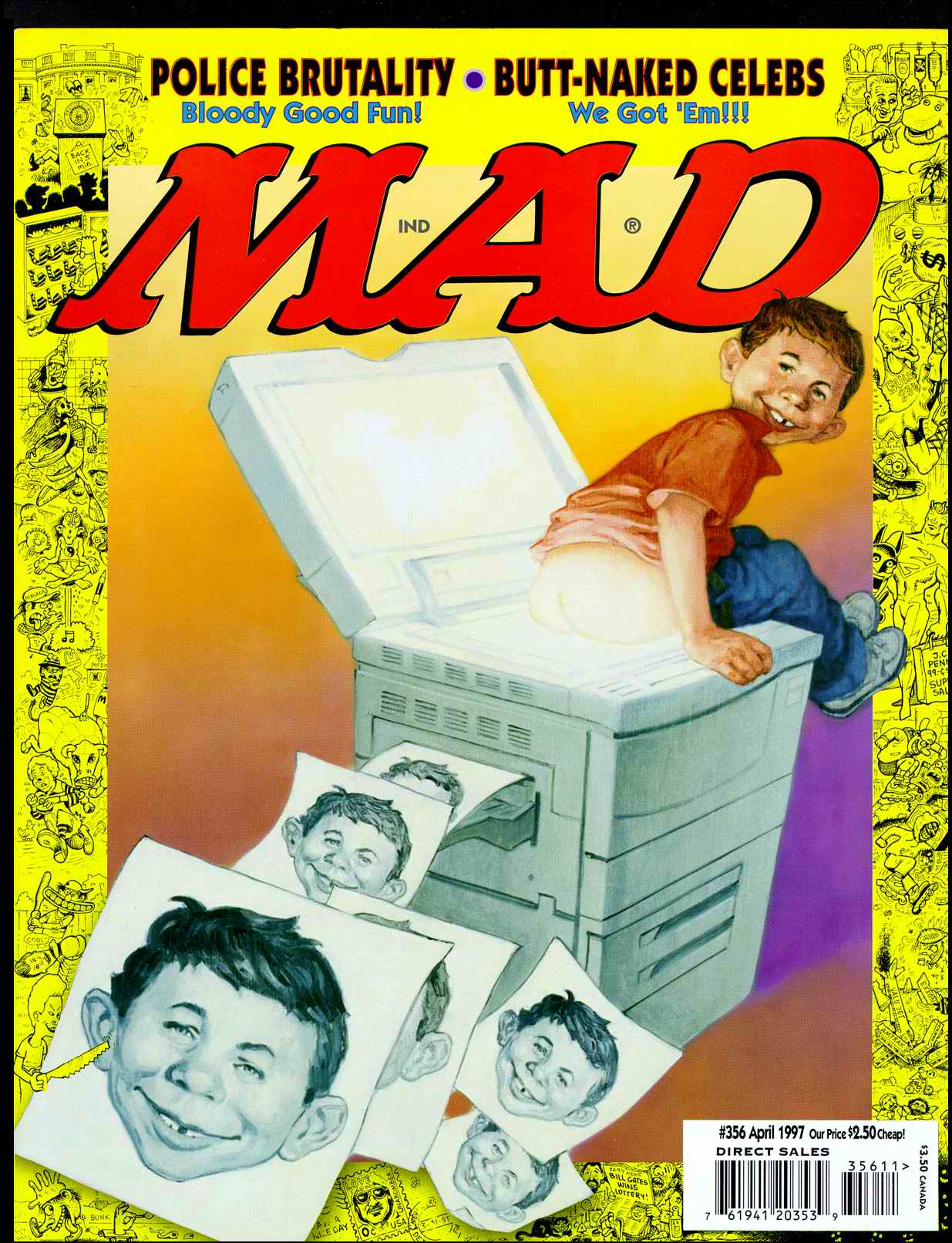
Mad #356
☆ Be the first to review + Add to your collection — Join freeMad #356 (April 1997) stands as the opening shot of the magazine's most deliberate creative reinvention since the Feldstein era: it is the first issue of Mad's newly attained monthly schedule to fully embody co-editors Nick Meglin and John Ficarra's drive to make the title 'edgier and riskier than ever.' Two landmark recurring features launched or were permanently handed off here — 'Monroe,' the strip about a hapless, angst-riddled teenager, debuted in these pages, running until 2010 and earning a genuine cult following; and Peter Kuper assumed full-time stewardship of 'Spy vs. Spy,' a role he would hold for decades and eventually color when the magazine went full-color in 2001. The distinctive Alfred E. Neuman butt-on-a-copier cover announced this tonal shift with characteristic bluntness, and the issue's table of contents — stacked with newer voices alongside Mad veterans — reads as a generational handoff that would define the magazine's late-1990s identity.
In "Kids' Classic Stories as Told by Famous People," Dave Berg delivers his signature satirical take on everyday life, skewering everything from office politics to therapy sessions through a series of wry, exaggerated tales. With his unmistakable wit and precise, clean artwork, Berg turns familiar scenarios into sharp, humorous commentary on modern quirks and social norms. The cover, a collaborative effort by Tom Bunk and Richard Williams, captures the story’s playful yet biting tone.
In "The Lighter Side of..." from Mad #356, a sharp, satirical glance at modern life unfolds across four pages of typeset letters, skewering everything from office politics to therapy sessions with deadpan humor. With a wink at the absurdities of everyday routines, it turns familiar frustrations into a parade of perfectly timed, quietly subversive jokes.
ComicBooks.com Value
This exact issue on ebay
Raw / ungraded ▾ $3.53–$50 28 listings
More listings for this title
Read it digitally
Sell my copy
Have this issue — or a whole collection? Get a fair offer from us, skip the marketplace fees and the hassle.
We Buy Collections ▸History
By early 1997 Mad had just achieved a full monthly publication schedule for the first time in its history, reaching that pace with #353 in January of that year after incrementally adding issues per year since 1994. Co-editors Meglin and Ficarra, operating under DC Comics' Time Warner umbrella, were charged with retooling the magazine to attract a younger and sharper readership without surrendering the ad-free, black-and-white format that defined Mad's identity. For the 'Monroe' strip specifically, artist Bill Wray — recruited by the editors in part because of his comic-book background, including his work on Ren & Stimpy — and writer Anthony Barbieri initially designed Monroe's mother as a haggard chain-smoking figure before editorial pressure reshaped her into a tidier housewife; Wray quietly redesigned her back to his original vision, with the editors apparently none the wiser. On the 'Spy vs. Spy' side of the ledger, Kuper's appointment brought a politically engaged, graphically bold sensibility to a strip that had passed through multiple hands since Antonio Prohías's retirement in the late 1980s.
Trivia · 8 facts
- Cover date: April 1997; publisher listed as EC (operating under DC Comics/Time Warner); one of the first issues produced under Mad's newly attained monthly publication schedule, which began with #353 (January 1997).
- First appearance of 'Monroe,' the ongoing comic strip about an unlucky, angst-filled teenager written by Anthony Barbieri and drawn by Bill Wray; the strip ran continuously until Mad #502 (January 2010).
- Peter Kuper debuted as the full-time, permanent writer-artist on 'Spy vs. Spy' with this issue, succeeding a rotating group of fill-in creators who had handled the strip since Antonio Prohías retired in the late 1980s.
- The cover — Alfred E. Neuman photocopying his backside, with his face emerging from the copier — was explicitly designed to signal the 'edgier' creative direction co-editors Nick Meglin and John Ficarra were pursuing in the late 1990s.
- Interior contributors to #356 include Kyle Baker, Desmond Devlin, R.J. Matson, George Woodbridge, Andrew J. Schwartzberg, Al Jaffee (Fold-In), and Greg Theakston, alongside the debut Barbieri/Wray strip.
- The issue featured multiple parodies of the long-running 'Absolut' vodka print-ad campaign — a staple Mad satire format — including pieces titled 'Absolut Kevorkian,' 'Absolut Liver,' 'Absolut O.J.,' and a back cover 'Absolut Winter.'
- Bill Wray was hired specifically for his comic-book art background; he personally edited and lettered the 'Monroe' strip himself rather than ceding that control to the editorial staff.
- Mad publicized the April 1997 issues as part of an alleged magazine 'revamp' aimed at an older, more sophisticated readership — an announcement that co-editor Nick Meglin framed as a reminder that the magazine was 'edgier and riskier than ever.'
Full credits
Reprints
Reprinted in Mad for Decades #[nn] (2007), Mad's Greatest Artists: Sergio Aragonès #[nn] (2010), Mad #17 (2021), Mad #47 (2026)
Key issues in Mad
Reviews
Reader reviews
No reader reviews yet.