
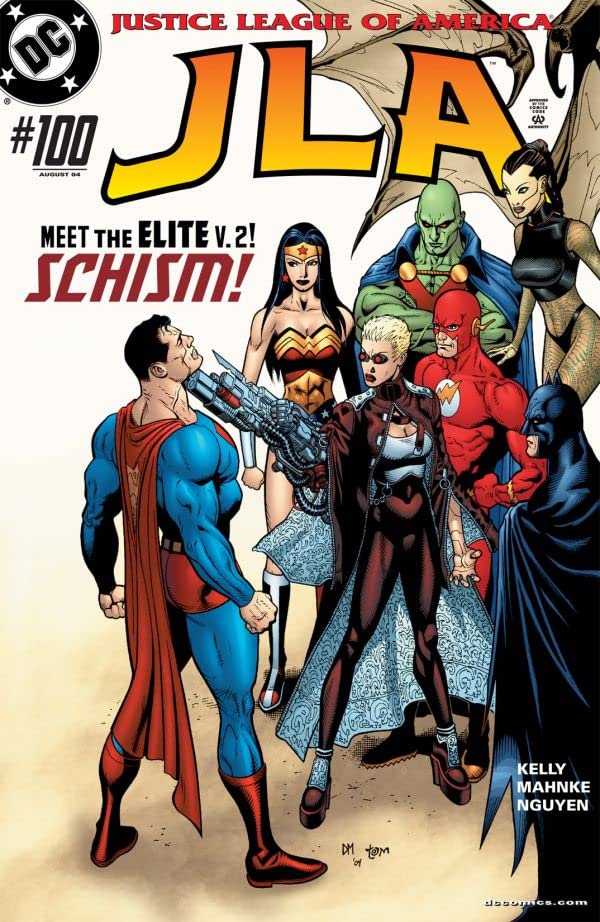
JLA #100
JLA #100 (cover date August 2004) marks the conclusion of Joe Kelly and Doug Mahnke's celebrated run on DC's flagship team book and serves as the direct launch pad for the Justice League Elite concept — a sanctioned black-ops offshoot of the League that pushed the superhero genre toward moral ambiguity and covert ethics in ways the main title could not. The issue introduces Sister Superior (Vera Lynn Black) and the second Menagerie (Sonja) in their first appearances, delivering two new characters who would anchor an entire 12-issue maxiseries. Thematically, it extends Kelly's long-running dialogue — begun in Action Comics #775 — about whether ends-justify-the-means heroics can coexist alongside the League's traditional idealism, giving the centennial issue a genuine philosophical weight rather than simple anniversary spectacle.
In "Elitism," Vera Black commands her Elite in a global crisis that forces them head-on into the Justice League, exposing deep rifts within the team itself. As the League grapples with whether to stand against Vera’s methods or question their own approach, the line between hero and authoritarian begins to blur. Written by Joe Kelly and brought to life by Doug Mahnke’s dynamic art, with inks by Tom Nguyen, colors by David Baron, and letters by Ken Lopez, the cover by Mahnke and Nguyen captures the tension of a world teetering on the edge.
ComicBooks.com Value
Show all 7 grades ▾
More listings for this title
- Nostalgia Zone Comic Books · Minneapolis, MN1 on eBay ↗
- The 616 Comics LLC · Mantua Township, NJ1 on eBay ↗
Read it digitally
Sell my copy
Have this issue — or a whole collection? Get a fair offer from us, skip the marketplace fees and the hassle.
We Buy Collections ▸History
Kelly and Mahnke had ended their regular JLA run at issue #93, but were brought back specifically for the milestone hundredth issue after incoming editor Dan Raspler, who had replaced Mike Carlin on the title, approached Kelly for a story idea; according to Kelly's own introduction in the 2005 Justice League Elite Vol. 1 trade paperback, Raspler suggested that incorporating The Elite would let Kelly finally realize a 'dark team' concept he had been developing. The result was an issue that functioned simultaneously as a celebratory landmark and as deliberate narrative scaffolding for Justice League Elite #1–12, with Kelly, Mahnke, and inker Tom Nguyen returning to the title after a nine-issue absence to deliver what was effectively a pilot for their next project.
Trivia · 8 facts
- First appearance of Sister Superior (Vera Lynn Black), Manchester Black's cybernetic sister, who becomes the leader of the reorganized Elite and the driving force of the Justice League Elite maxiseries.
- First appearance of the second Menagerie (Sonja), a Puerto Rican woman bonded to alien symbeasts; both Menagerie incarnations were created by Joe Kelly and Doug Mahnke.
- Written by Joe Kelly with pencils by Doug Mahnke and inks by Tom Nguyen — the same core creative team from Kelly's regular JLA run (#61–93) — returning after a nine-issue gap specifically for the centennial issue.
- The story, titled 'Elitism,' features the full Kelly-era JLA roster: Superman, Batman, Wonder Woman, Martian Manhunter, Wally West Flash, John Stewart Green Lantern, Atom (Ray Palmer), Plastic Man, Firestorm (Ronnie Raymond), Major Disaster, Manitou Raven, and Faith.
- The issue directly spins off into Justice League Elite #1 (2004), a 12-issue limited series by Kelly and Mahnke in which Flash, Green Arrow, Manitou Raven, and Major Disaster join Vera Black's covert team.
- On-sale date was June 30, 2004; Mike Carlin is listed as editor with Valerie D'Orazio as assistant editor on the GCD record, though editorial context sources indicate Dan Raspler had taken over the editorship and was the one who commissioned the story.
- The issue was reprinted twice: first in Justice League Elite Vol. 1 (2005, DC/Titan), which also collects Action Comics #775 and JLE #1–4, and again in JLA Vol. 8 (2016, DC).
- The story's premise — the Earth itself (Gaea) threatening to destroy humanity unless the nations of the world unite against a common threat — extends the mythic, planetary-scale storytelling register that defined the entire 1997–2006 JLA series.
Full credits
Reprints
Reprinted in Justice League Elite #1 (2005), JLA #8 (2016)
Key issues in JLA
Variants (1)
Reviews
Reader reviews
No reader reviews yet.