
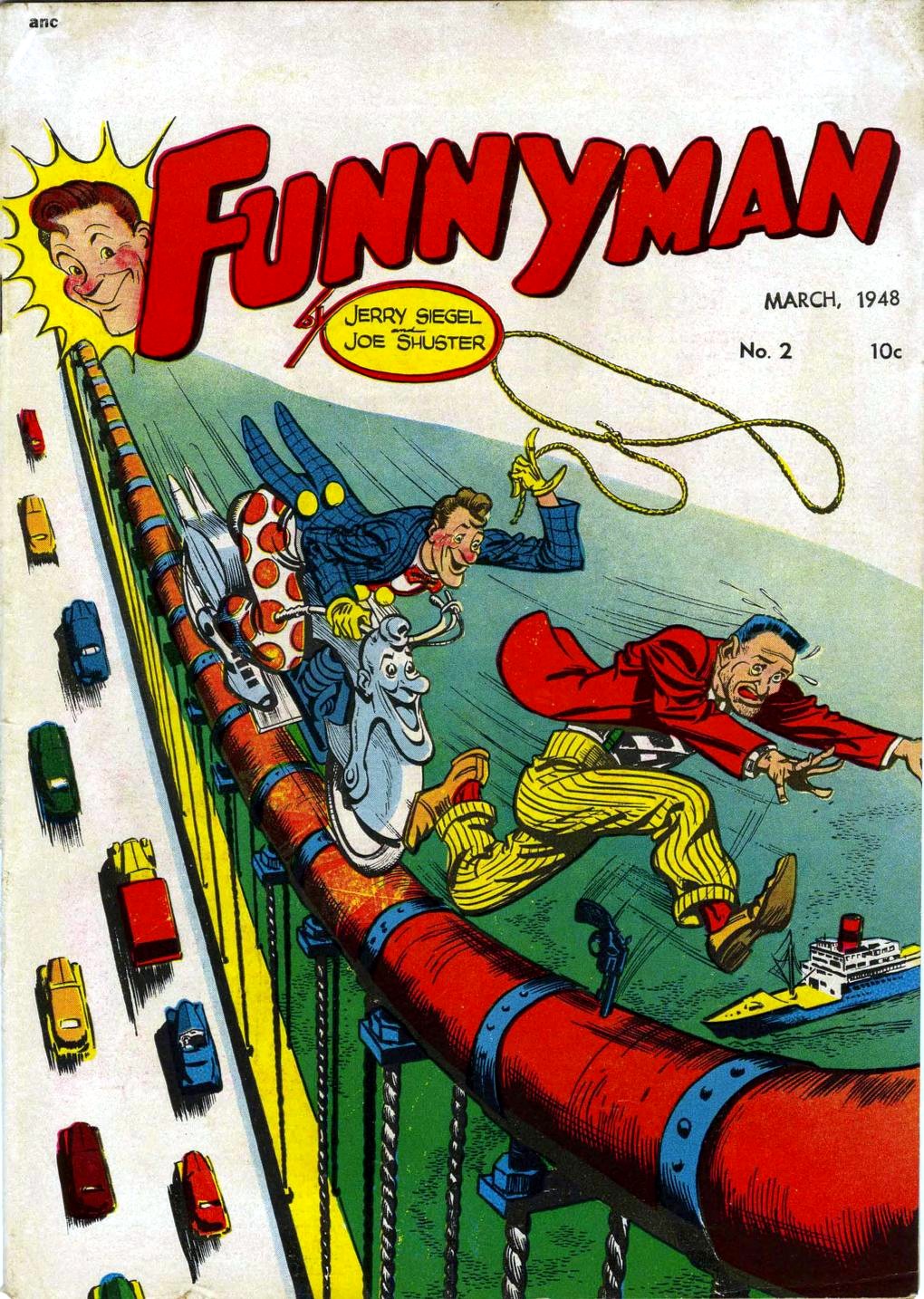
Funnyman #2
☆ Be the first to review + Add to your collection — Join freeFunnyman #2 is a key chapter in the post-Superman careers of Jerry Siegel and Joe Shuster, representing the duo's determined attempt to build a character they actually owned — a concept DC Comics had denied them with their most famous creation. The issue introduces three of the series' most recurring antagonists: the gadget-obsessed criminal Doc Gimmick, his henchman Torgo, and the Kute Knockout — a female robot used as a street-crime lure — making it the first appearance of what would become the series' signature villain trio. As one of only six issues in the entire run, every installment of Funnyman carries outsized weight as evidence of Siegel and Shuster's creative range beyond capes-and-tights heroics, blending vaudeville comedy, slapstick gadgetry, and genuine crime-fiction plotting in a way that had no real precedent in American superhero comics. Scholars and critics have further read the series — and this issue's Looney Tunes-inflected robot story in particular — as an expression of Jewish comedic tradition in the Golden Age, a dimension given sustained attention in the 2010 Feral House retrospective Siegel and Shuster's Funnyman: The First Jewish Superhero.
In "A Fool's Duel!", Funnyman steps in when a jealous suitor threatens a young woman, leading to a showdown that’s as absurd as it is daring. With a wooden sword and a heart made of red ink, the Daffy Daredevil faces off against the arrogant Charles Cheval in a duel that turns on wit and a well-placed slice. Written by Jerry Siegel and illustrated by Joe Shuster, this 1948 adventure from Magazine Enterprises delivers classic mischief with a dash of physical comedy. The cover, by Creig Flessel and Marvin Stein, captures the scene’s zany tension perfectly.
In "null," a mad inventor unleashes a high-tech car built for breaking into vaults and stealing from banks, turning the city into a racetrack of chaos. Funnyman answers with his trusty junkmobile, the Jet-Jallopy, and the two clash in a wild, high-speed showdown that turns streets into battlegrounds.
In "A Fool's Duel!", Funnyman steps in when a jealous suitor threatens a rival over a woman named Dolores, turning a tense standoff into a showdown of absurdity and wit. Armed with a wooden sword and a flair for the dramatic, Funnyman faces off against the arrogant Charles Cheval—only to reveal a clever trick that turns the duel into a humiliating lesson in manners.
In "Slippery Slim!", June and Larry attend a City Hall lecture by Sgt. Harrigan about catching crooks—just as the notorious Slippery Sam makes his escape. When the real Funnyman is knocked out, Sam swaps clothes and slips right past the crowd, leaving June to deliver a kiss that reveals the shocking truth: the hero she's been talking to isn’t the real deal. The chase is on, and the real Funnyman is soon on the case.
In "The Kute Knockout," a mad scientist unleashes a mechanical marvel designed to lure unsuspecting victims into alleyway traps—her charm as sharp as the mallet she swings. When a mysterious hanky drops to the pavement, the real danger isn’t the theft, but the robot girl who’s always one step ahead.
ComicBooks.com Value
Find on ebay
Read it digitally
Sell my copy
Have this issue — or a whole collection? Get a fair offer from us, skip the marketplace fees and the hassle.
We Buy Collections ▸History
After losing their landmark 1947 lawsuit against DC Comics over Superman's rights, Siegel and Shuster reunited with Vin Sullivan — the very editor who had shepherded the earliest Superman stories at National — at his independent company, Magazine Enterprises, where they retained the copyright to their new creation. Siegel modeled protagonist Larry Davis on the mannerisms and comic energy of Danny Kaye, aiming for a character who could outlast the postwar superhero contraction by leaning into humor. Interior art on the series was produced through the 'Shuster Shop' — a studio operation in which artists including John Sikela and the young Dick Ayers executed finished pages under Shuster's supervision, with Shuster himself contributing layout sketches and head studies; editor Vin Sullivan oversaw production, while a text story in this issue was scripted by Ray Krank (working under the pseudonym Ray Gardner). The simultaneous Anglo-American Publishing Company edition constituted a concurrent Canadian reprint, issued the same month.
Trivia · 8 facts
- First appearance of Doc Gimmick (villain), Torgo (Doc Gimmick's henchman), and the Kute Knockout (a female mugging robot) — the series' recurring gadget-villain trio — all debuting in the story 'The Kute Knockout!'
- First appearance of Sardonic Lazar, the inventor of the Crime-Car, who appears in the lead story pitting Funnyman's improvised Jet-Jalopy against Lazar's bank-busting vehicle.
- First appearance of Slippery Slim (listed in the catalog; the GCD identifies the character as 'Slippery Sam'), the 'World's Slyest Jailbreaker,' whose costume-switch scheme is only unmasked when June Farrell kisses the impostor and his false nose falls off.
- Written by Jerry Siegel and published March 1948 by Magazine Enterprises; the series — Siegel and Shuster's final collaboration — ran only six issues (January–August 1948).
- Interior art executed by the Shuster Shop (John Sikela on finished pencils for key stories, with Dick Ayers also contributing); according to artist Dick Ayers, Shuster himself would visit the studio to critique work and provide quick head sketches or expressions for the shop artists to follow.
- Cover artist disputed: the Grand Comics Database notes uncertainty between Creig Flessel and Marvin Stein for this issue's cover, with MyComicShop attributing it to Creig Flessel.
- The issue was simultaneously reprinted by Anglo-American Publishing Company Limited in a concurrent Canadian edition (March 1948).
- A partial reprint of the 'Kute Knockout' story appeared in IDW's *Super Weird Heroes* (2016), though that reprint contained a production error — Page 1 of the Crime-Car story was accidentally substituted for Page 1 of the Kute Knockout story.
Cast · 10 characters
Full credits
Reprints
Reprinted in Funnyman #2 (1948), Siegel and Shuster's Funnyman #[nn] (2010), Super Weird Heroes #[nn] (2016)
Key issues in Funnyman
Reviews
Reader reviews
No reader reviews yet.