
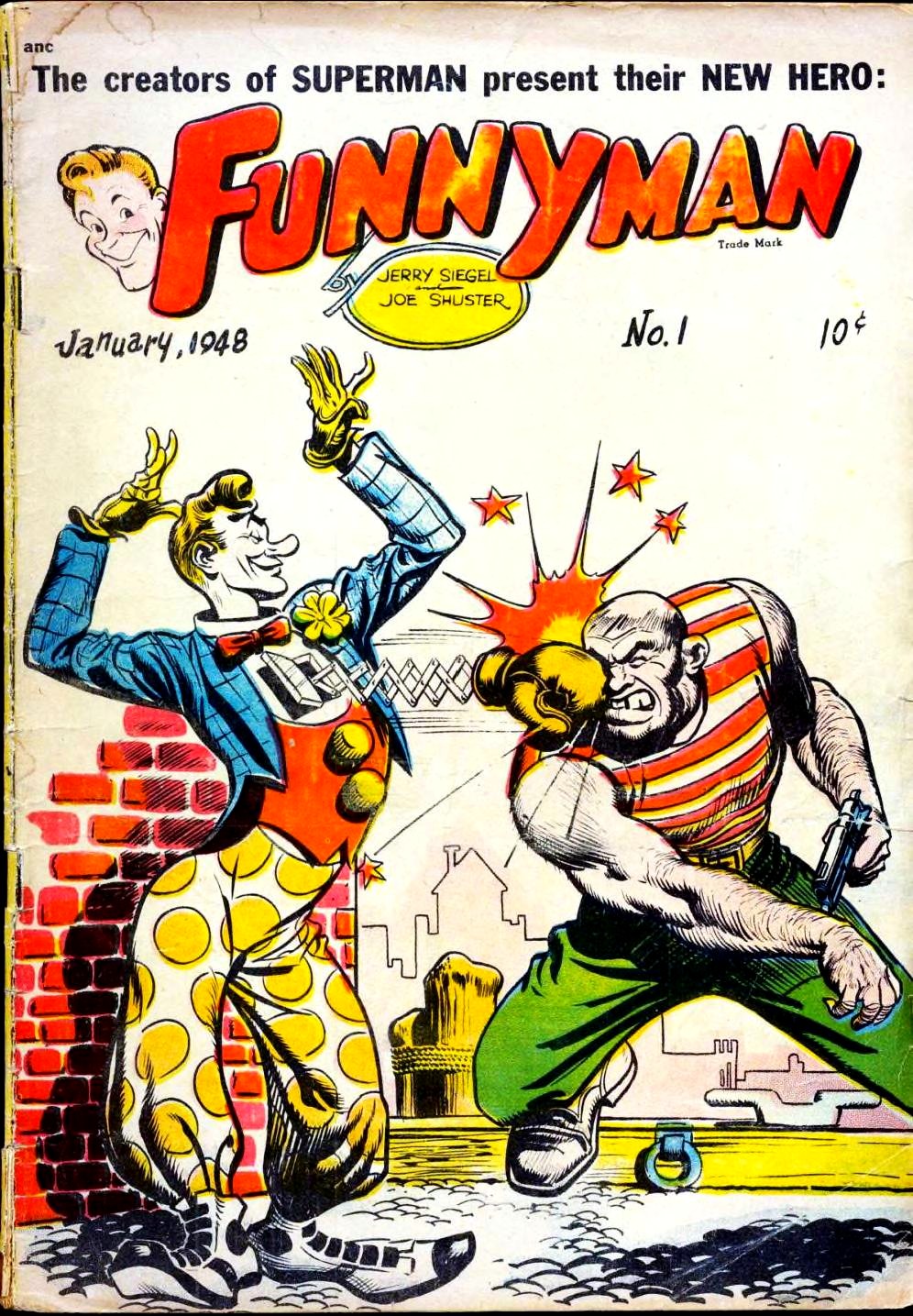
Funnyman #1
☆ Be the first to review + Add to your collection — Join freeFunnyman #1 is the sole original superhero comic produced by Jerry Siegel and Joe Shuster after their acrimonious split from DC Comics — making it a direct artifact of the Superman creators' attempt to reclaim their creative footing outside the publisher that had profited so enormously from their work. Rather than replicate Superman, Siegel deliberately built a comedy-first, powerless hero whose wit and slapstick gadgetry were the entire arsenal, a genuine structural departure from every dominant superhero formula of the Golden Age. The issue also contains one of comics' earliest meta-critiques of the superhero genre: the story 'Funnyman, Comicman, and Laffman' openly lampoons the flood of Superman imitators that had glutted newsstands, with Siegel and Shuster using their own character to mock the very cloning culture their original creation had spawned. Scholars Thomas Andrae and Mel Gordon have since argued that Funnyman represents the most direct expression of Jewish comedic sensibility — rooted in schlemiel tradition — to appear in American superhero comics up to that point, giving the issue a cultural-history dimension well beyond its brief commercial run.
In "The Teen-Age Terrors!", Jerry Siegel and Joe Shuster deliver a zany, kinetic adventure where a mischievous mechanical kangaroo becomes the unexpected center of a citywide chase. When June hides her diamond ring inside the toy, it sets off a wild pursuit across 1948’s streets, with Funnyman in hot pursuit—ink and junk in hand—until the culprit is caught. Marvin Stein’s cover captures the chaos perfectly, showing the kangaroo in motion against a backdrop of urban nightlife.
In a 1948 tale from *Funnyman #1*, TV comedian Larry Davis stumbles into heroics when a staged stunt to defeat a fake criminal—played by actor Happy—goes disastrously real. Impulsively embracing the role, Larry becomes Funnyman, the Comic Crimebuster, defending Empire City from genuine threats, all while keeping his identity a secret from only those who know the truth: his girlfriend and manager, June Farrell, and the man he accidentally bested, Happy.
In "The Teen-Age Terrors!", Funnyman tries to help two fans, Darlene and Hankie, after they're robbed by a group of overzealous admirers—only to lose his family heirloom watch to a swarm of autograph-hungry teens. When the watch turns up in the hands of Ants Pants and his gang, Funnyman follows the trail to Fencie Finnegan’s hideout, tracking the crooks through a web of teenage mischief and criminal fencing.
In a bustling 1948 New York, the fugitive Flathead Floogie makes a break for it at Grand Central Station, only to be pursued by a trio of unlikely heroes: the real Funnyman, and his two flashy imitators, Comicman and Laffman. As the chase unfolds across the station’s grand halls, the three costumed figures clash in a chaotic race to apprehend the slippery criminal—each with their own style, ego, and flair.
In "The Truant Toy," Larry’s new mechanical kangaroo takes an unexpected journey after June hides her diamond ring inside it, setting off a citywide chase. Funnyman, ever the vigilant hero, pursues the runaway toy through the streets, turning a simple theft into a wild, ink-splattered pursuit. When the dust settles, Larry’s love for mechanical wonders leads him to buy five more—this time, dogs.
ComicBooks.com Value
Show all 18 grades ▾
Find on ebay
Read it digitally
Sell my copy
Have this issue — or a whole collection? Get a fair offer from us, skip the marketplace fees and the hassle.
We Buy Collections ▸History
Siegel and Shuster conceived Funnyman while still employed at DC, anticipating a decline in conventional superhero popularity and betting that a comedy-hybrid character would have staying power; crucially, they were determined this time to retain copyright ownership, which DC refused, so the duo took the property to Magazine Enterprises, the company founded by Vin Sullivan — the same editor who had originally purchased Superman from them. The book was written by Siegel with layouts by Shuster, while the bulk of the finished penciling was handled by studio artists John Sikela and Marvin Stein; inking on the issue was done by a young, then-unknown Dick Ayers, who had come to the Shuster studio after meeting Joe Shuster at Burne Hogarth's Cartoonists and Illustrators School class in 1947, marking some of Ayers's earliest professional comics work. A black-and-white ashcan edition of Funnyman was produced the month prior to this issue's January 1948 cover date for copyright-registration purposes. The series ran only six issues (January–August 1948), and a subsequent syndicated newspaper strip debuted in October 1948 but was similarly short-lived, with the strip eventually dropping the title character altogether in mid-1949; after the series collapsed, Shuster's deteriorating eyesight effectively ended his career as an illustrator.
Trivia · 8 facts
- First appearance and origin of Funnyman (Larry Davis), a television comedian who accidentally foils a real robbery during a staged publicity stunt and resolves to fight crime using slapstick gadgetry and comedy — with no superpowers whatsoever.
- First appearance of June Farrell, Larry Davis's girlfriend and manager, who along with Happy is one of only two people who know Larry's secret identity as Funnyman.
- First appearances of supporting/recurring cast: Detective Sgt. Harrigan, Happy (the actor accomplice from Larry's publicity stunt), and villain-adjacent characters Comicman and Laffman — comedy-themed imitators of Funnyman who debut in the story 'Funnyman, Comicman, and Laffman,' which Siegel used to satirize the wave of Superman knock-offs crowding the Golden Age market.
- Written by Jerry Siegel with art layouts by Joe Shuster; finished pencils primarily by John Sikela and Marvin Stein; the cover of issue #1 is credited to Marvin Stein.
- Inking on all four Funnyman stories in this issue is attributed to Dick Ayers, who came to the Shuster studio after meeting Joe Shuster at Burne Hogarth's Cartoonists and Illustrators School — among his earliest paid comics work before he went on to become a foundational Marvel Silver Age artist and co-creator of the original Ghost Rider.
- Larry Davis's mannerisms were modeled by Siegel on real-life comedian Danny Kaye, grounding the character in a specific comedic idiom rather than in superhero archetypes.
- A black-and-white ashcan printing of Funnyman preceded this issue by one month, produced for copyright-registration purposes — part of Siegel and Shuster's deliberate strategy to retain ownership of the character, a right DC Comics had denied them on Superman.
- The series collected in the 2010 Feral House/Fantagraphics scholarly volume 'Siegel and Shuster's Funnyman: The First Jewish Superhero, from the Creators of Superman,' edited by Thomas Andrae and Mel Gordon, which reprints material from the comic run and newspaper strip alongside cultural analysis of the character's roots in Jewish humor tradition.
Cast · 8 characters
Full credits
Reprints
Reprinted in Funnyman #1 (1948), Siegel and Shuster's Funnyman #[nn] (2010), Super Weird Heroes #[nn] (2016), Alter Ego #10
Key issues in Funnyman
Reviews
Reader reviews
No reader reviews yet.