
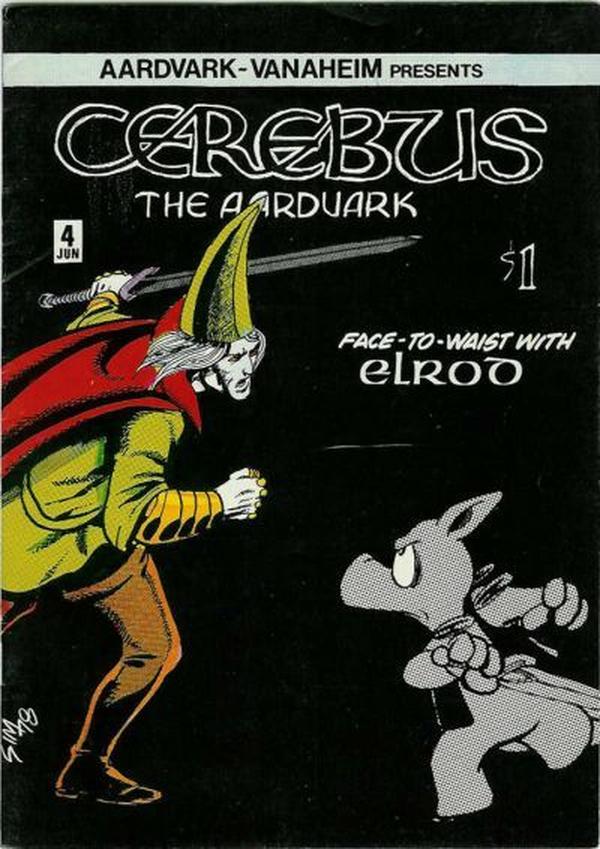
Cerebus #4
☆ Be the first to review + Add to your collection — Join freeCerebus #4 (cover-dated June–July 1978) marks the debut of Elrod of Melvinbone, one of the most enduring and beloved recurring characters in the entire 300-issue run — a pitch-perfect absurdist collision of Michael Moorcock's brooding albino swordsman Elric of Melniboné with the blustering speech patterns of the Warner Bros. cartoon rooster Foghorn Leghorn. The character's introduction demonstrated, just four issues in, that Dave Sim's early parody instincts ranged far beyond his initial Conan homage: he was already plundering literary fantasy, pulp horror (Death dispatches a Lovecraftian crawler in the same story), and American pop culture simultaneously. Elrod would return across dozens of subsequent issues, evolving from a one-off gag into a genuinely mythologized figure within the series' cosmology — later revealed in the 'Reads' arc to be an external projection of Cerebus himself — giving this debut issue lasting narrative weight well beyond its modest origins. The issue also marks the first appearance of Cerebus's iconic merchant vest, a small but persistent visual detail that signals Sim beginning to define and stabilize his protagonist's look.
In "Death's Dark Tread," Dave Sim’s Cerebus stumbles upon a fateful gem in Serrea, unaware it’s the Chaos Gem—wanted by Death itself. As monstrous forces converge on him, Cerebus fights back with stubborn resolve, only to find his path redirected through the unlikely and pompous Elrod of Melvinbone. With art and story by Dave Sim, and cover by Dave Sim, this 1978 issue blends dark whimsy and escalating dread in a tale where luck turns to peril and escape is only the beginning.
ComicBooks.com Value
Show all 12 grades ▾
This exact issue on ebay
CGC 9.4 ▾ $400–$475 2 listings
More listings for this title
Read it digitally
Sell my copy
Have this issue — or a whole collection? Get a fair offer from us, skip the marketplace fees and the hassle.
We Buy Collections ▸History
The issue was produced entirely by Dave Sim — script, pencils, inks, and lettering — under the Aardvark-Vanaheim imprint that he and his then-girlfriend and publisher Deni Loubert had founded to self-publish the series beginning in late 1977. The series was being published on a bi-monthly schedule at this stage, and Sim would later reflect on the issue in an introductory essay for the Swords of Cerebus Volume 1 trade paperback (which collected issues #1–4), acknowledging that not a great deal 'happens' plot-wise but that Elrod's arrival was the standout creative moment. Notably, Sim has stated he had never actually read a Moorcock Elric story at the time he created Elrod — the character grew out of a visual resemblance he conceived independently — a fact that surprised even Wendy Pini when Sim mentioned it.
Trivia · 8 facts
- First appearance of Elrod of Melvinbone (also called 'Elrod the Albino'), a parody of Michael Moorcock's Elric of Melniboné, who speaks with the vocal mannerisms of the Warner Bros. cartoon character Foghorn Leghorn.
- Elrod's rusted black sword — named Seersucker — is destroyed by Cerebus in this issue; the sword is a parody of Elric's soul-drinking blade, Stormbringer.
- Story title is 'Death's Dark Tread'; it features a personified Death as an antagonist attempting to use the cursed Chaos Gem (and then Elrod) to destroy Cerebus — a scheme that fails when Cerebus throws the gem down a well.
- This issue also marks the first appearance of Cerebus's merchant vest, noted by Sim himself in his Swords of Cerebus introductory essay.
- Script, pencils, inks, and lettering are all by Dave Sim; the issue is 24 pages, black-and-white, published by Aardvark-Vanaheim.
- Cover-dated June–July 1978; the series was being published on a bi-monthly schedule at this point.
- The issue was reprinted in Cerebus Bi-Weekly #4 (Aardvark-Vanaheim, January 13, 1989) and collected in Swords of Cerebus Volume 1 (which gathers issues #1–4) with a new introductory essay by Sim, and later in the flagship 'Cerebus' phonebook trade paperback collecting the first 25 issues.
- Elrod went on to appear across dozens of subsequent issues (including #7, #8, #12, #21–22, #33–35, #37–39, and into the 'Mothers & Daughters' arc), eventually being revealed in the 'Reads' storyline as a magical projection created by Cerebus's proximity to a gem.
Full credits
Reprints
Reprinted in Swords of Cerebus #1 (1981), Cerebus #1 (1987), Cerebus Bi-Weekly #4 (1989)
Key issues in Cerebus
Reviews
Reader reviews
No reader reviews yet.