
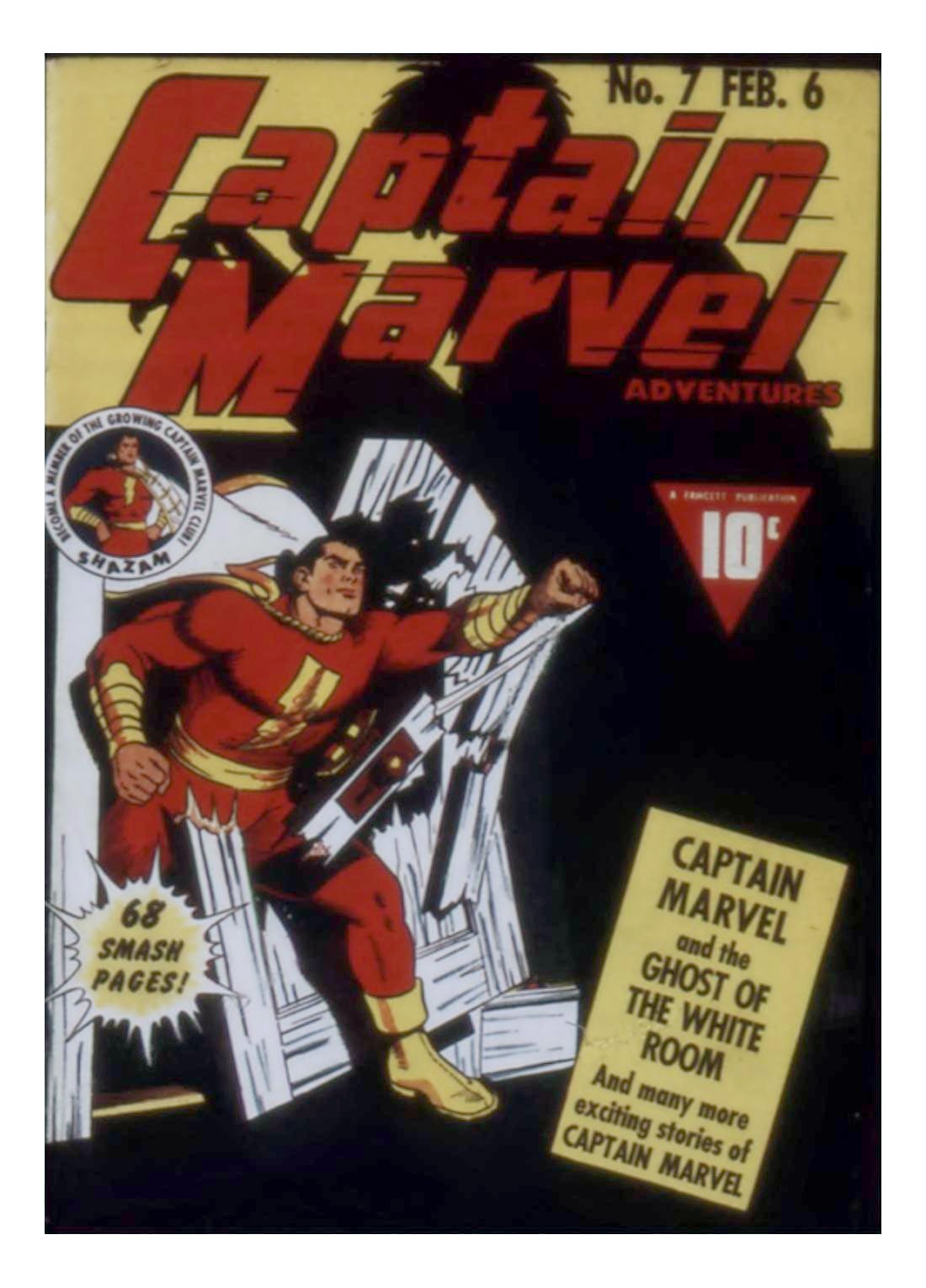
Captain Marvel Adventures #7
☆ Be the first to review + Add to your collection — Join freeCaptain Marvel Adventures #7 (cover-dated February 1942) sits at a genuinely pivotal moment in the series' growth: Fawcett's Captain Marvel title was rocketing toward the mass readership it would reach by mid-decade, and this issue represents the anthology format operating at full early-wartime momentum — multiple standalone Captain Marvel adventures per issue, each a self-contained showcase for Billy Batson's world. While #7 does not carry a headline first appearance of its own, it belongs to the tight early-run cluster that immediately precedes the landmark Otto Binder era and the debut of IBAC in issue #8, making it part of the creative runway that shaped one of the best-selling superhero comics of the Golden Age. Its historical value lies in that context: a document of Fawcett at the top of its game before the character mythology grew even more elaborate.
Captain Marvel battles a mysterious killer armed with a strange weapon that fires bursts of power and lightning, while also confronting a radio snoop named Billy Batson. The story then shifts to Captain Marvel encountering pirates at sea—including a freighter with a black flag symbol—whom he engages in combat. The narrative concludes with Captain Marvel's intervention in a snowy mountain setting where he confronts a large brute and shakes hands with allies before facing further danger.
When Billy Batson attends a lavish party at the Van Hoof estate, he discovers the mansion harbors a dark secret—the legendary White Room, where a curse claims any who enter will die. Billy transforms into Captain Marvel to investigate the ghostly terror haunting the party, but Mrs. Van Hoof's tale of a long-lost husband and a hidden treasure suggests the mystery runs far deeper than supernatural folklore. Can Captain Marvel uncover the truth behind the White Room before the curse claims another victim?
When a young criminal named Bruiser Brann stumbles into the laboratory of the brilliant Dr. Sarr seeking refuge from Captain Marvel, the mad scientist sees an opportunity—and a solution to his own ambitions. Through a shocking surgical procedure, Dr. Sarr transfers his own brain into Bruiser's powerful body, gaining the strength he's long coveted; but with it comes an unexpected hunger for greater power and darker pursuits. Now obsessed with obtaining Captain Marvel himself as a subject for experimentation, Dr. Sarr sets a trap for the world's mightiest mortal, determined to uncover—and exploit—the secret of his seemingly invulnerable physique.
Captain Kid confronts a mysterious ogre terrorizing the town of Swatsville and threatening to claim Betty Mae as his next victim—but the creature may not be quite what he seems. What starts as a supernatural scare becomes a battle over the town's hidden resources, with Captain Kid determined to save his sweetheart and uncover the truth behind the haunted mansion's threat.
When a twentieth-century pirate captain operating from a secret island begins preying on merchant ships with an eerie radio blackout, Billy Batson's aerial reconnaissance catches the submarines red-handed—but Captain Marvel's capture by the villain Captain Death leaves him in a deadly bind. Forced to choose between breaking free and detonating a bomb that would kill enslaved sailors, the hero must rely on cunning as much as strength to spark a slave uprising and reclaim the island.
Billy Batson's broadcast from Spook Mountain—a newly developed ski resort—is interrupted when a mysterious creature called the Wendigo begins terrorizing the slopes, attacking visitors and leaving destruction in its wake. Captain Marvel rushes to the rescue, but discovers that the Wendigo is far more than a simple beast: it explodes with violent force and seems connected to a sinister plot that runs deeper than anyone suspected. As Billy races to piece together the clues—strange bear traps, cryptic warnings from Big Chief Blackheart, and the Wendigo's explosive nature—he realizes this case is unlike anything he's faced before.
ComicBooks.com Value
Show all 22 grades ▾
More listings for this title
Read it digitally
Sell my copy
Have this issue — or a whole collection? Get a fair offer from us, skip the marketplace fees and the hassle.
We Buy Collections ▸History
The issue was published by Fawcett Comics with a cover date of February 1942 and went on sale in advance of that date, consistent with the series' then-monthly schedule. Cover and interior art was handled by C.C. Beck and Al Liederman, the core artistic team of the early run. Notably, at least one story — 'The Slayer on Skis' — was scripted by Alfred Bester, the writer who would later become one of science fiction's most celebrated novelists (The Demolished Man, The Stars My Destination); his early-1940s comics work for Fawcett and other publishers represents a little-documented but real chapter in his career. The issue predates the arrival of Otto Binder as the series' dominant writer, which began with issue #12 of the companion Whiz Comics line and shortly thereafter in Captain Marvel Adventures itself.
Trivia · 8 facts
- Cover date: February 1942; published by Fawcett Comics as part of Captain Marvel Adventures Volume 1.
- Cover pencils and interior art by C.C. Beck, with additional art by Al Liederman.
- Stories credited to Alfred Bester (who wrote 'The Slayer on Skis') and Al Liederman among others — Alfred Bester would later become a Hugo Award-winning science fiction author.
- Issue contents include four Captain Marvel stories: 'The Slayer on Skis,' 'The Ghost of the White Room,' 'The Science of Dr. Sarr,' and 'The Pirates of Port Peril,' plus a Captain Kid backup by Al Liederman.
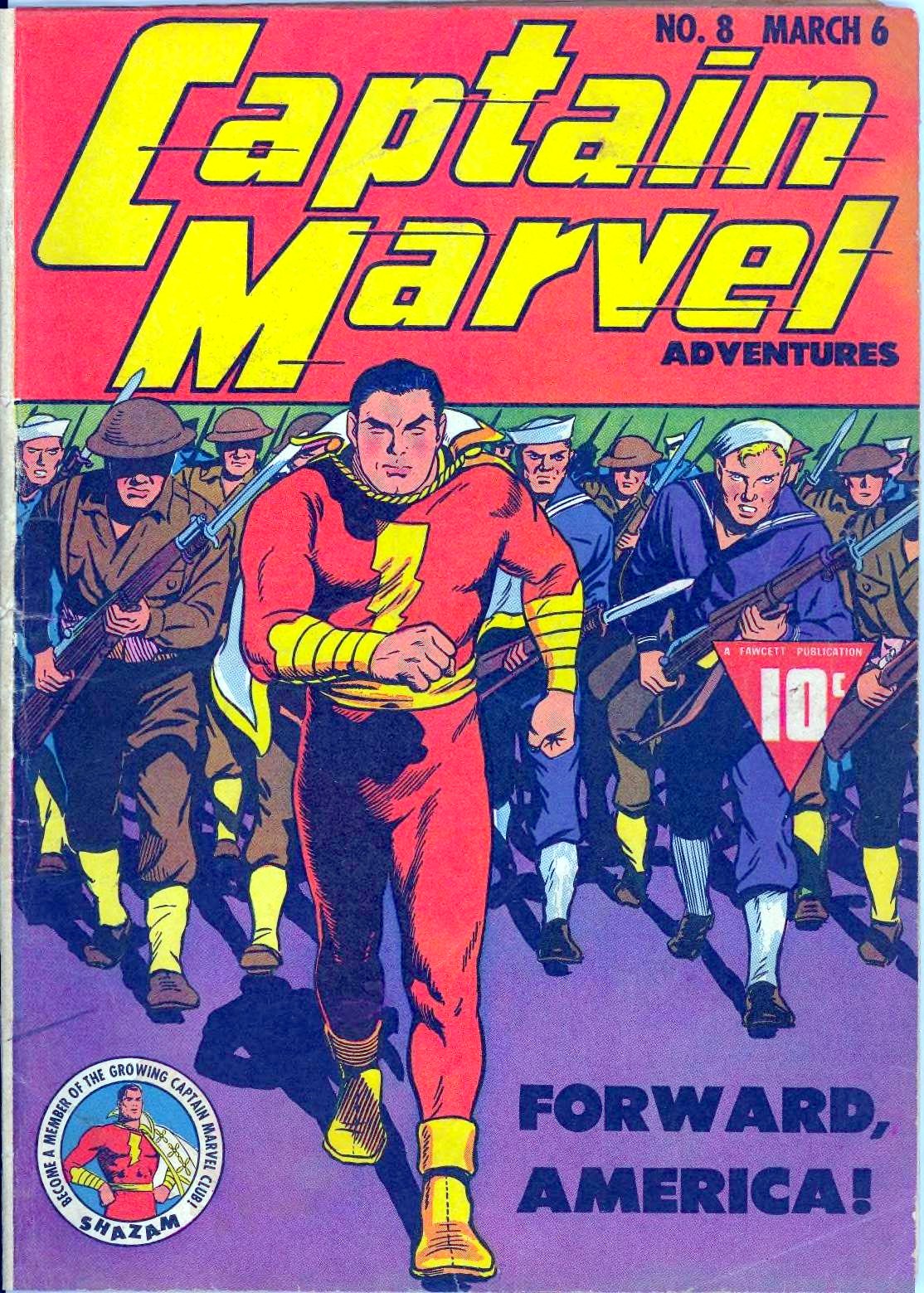
- No major first appearances occur in this issue; IBAC — the series' next major villain debut — appears in the following issue, #8 (March 1942), not in #7.
- The issue is part of the early pre-Binder run; Otto Binder, who would go on to write the vast majority of the series' stories (451 of 618 by one count), had not yet taken over scripting duties for Captain Marvel Adventures.
- Captain Marvel Adventures was at this time the best-selling superhero comic in America, with annual series circulation reaching over 6.4 million copies in 1942 and still climbing toward its 1944 peak.
- The 68-page, full-color issue carried a ten-cent cover price, standard for Fawcett's high-output Golden Age anthology format.
Full credits
Reprints
Reprinted in Gift Comics #1 (1942), Whiz Comics #1 (1943), Captain Marvel Adventures #2 (1946), Flashback #35
Key issues in Captain Marvel Adventures
Reviews
Reader reviews
No reader reviews yet.