
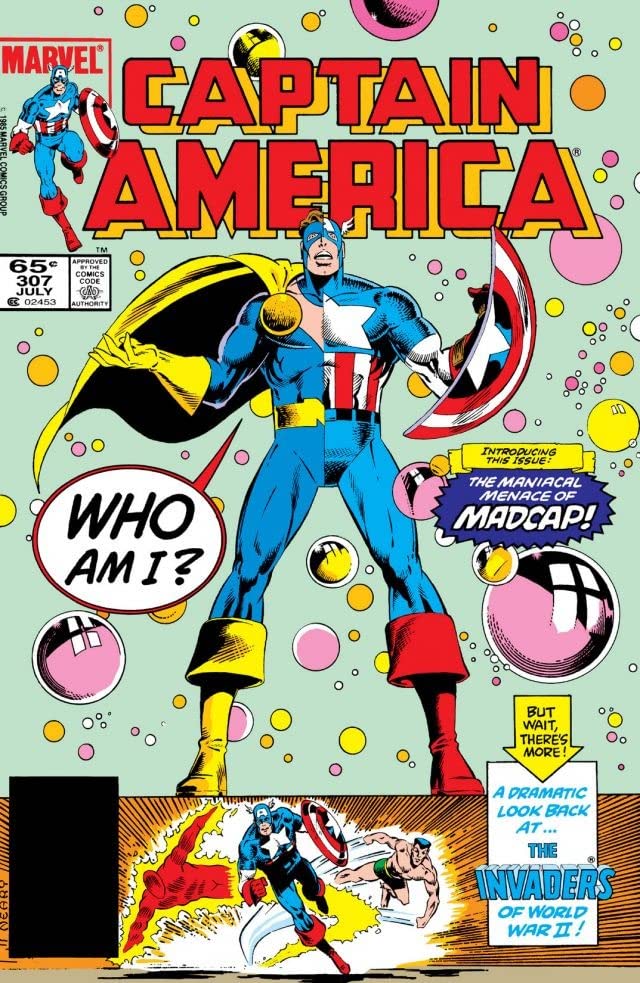
Captain America #307
☆ Be the first to review + Add to your collection — Join freeCaptain America #307 holds a dual significance: it marks the first appearance of Madcap, a nihilistic chaos-agent whose healing factor, madness-inducing gaze, and darkly comic philosophy made him one of the more enduring oddities in the Marvel Universe — later woven directly into Deadpool mythology — and it simultaneously opens Mark Gruenwald's celebrated decade-long run as series writer. Gruenwald's explicit intent was to build a rogues' gallery that mirrored real cultural anxieties: Madcap, his very first villain, was conceived as an embodiment of purposeless, disaffected youth, making the issue a deliberate statement about 1980s America filtered through superhero fiction. The issue is structurally unusual in that Steve Rogers barely appears, leaving Jack Monroe's Nomad as the protagonist — a bold choice for a debut chapter that signaled Gruenwald's ambition to explore the book's supporting cast as seriously as its title hero. That combination of a lasting first appearance and the opening chapter of one of Marvel's longest uninterrupted single-writer runs makes #307 a genuine hinge point in Captain America's publishing history.
In "Stop Making Sense," Captain America returns to the U.S. after a brief trip to London, only to find himself at a crossroads—literally and figuratively. Struggling to redefine his purpose, Jack takes a job as a bag boy, but his quiet routine shatters when the chaotic Madcap unleashes his brand of mayhem, forcing him to step back into the role of Nomad. Written by Mark Gruenwald and illustrated by Paul Neary, with inks by Dennis Janke and colors by Ken Feduniewicz, this 1985 issue captures a rare moment of personal uncertainty for the iconic hero, all framed by a striking cover by Neary.
ComicBooks.com Value
Show all 15 grades ▾
This exact issue on ebay
CGC 9.8 ▾ $124–$179 3 listings
CGC 9.4 ▾ $39.99–$40.24 2 listings
CGC 9 ▾ $39.99–$120 4 listings
Raw — MINT ▾ $9.93–$50 2 listings
Raw — NM- ▾ $14.95–$14.99 2 listings
Raw — VF ▾ $5.6–$32.3 14 listings
Raw — VERY FINE ▾ $12.95–$14.99 2 listings
Raw — FN/VF ▾ $5.99–$22 2 listings
Raw — FN ▾ $6.99–$18.75 3 listings
Raw / ungraded ▾ $4.25–$45 47 listings
More listings for this title
Read it digitally
Sell my copy
Have this issue — or a whole collection? Get a fair offer from us, skip the marketplace fees and the hassle.
We Buy Collections ▸History
Gruenwald arrived at the writer's chair through an internal swap: he had been serving as the book's editor, and writer Mike Carlin traded roles with him, with Carlin moving to the editorial desk and Gruenwald stepping up as scripter beginning with this issue. Gruenwald had been deeply immersed in the Captain America title since 1982 and came in with a clear creative agenda — most notably a drive to populate Cap's world with villains that were thematically specific to the character and reflective of contemporary American life, rather than generic adversaries. Penciler Paul Neary, inker Dennis Janke, and colorist Ken Feduniewicz completed the creative team for this first chapter, with the story titled 'Stop Making Sense' — a nod, intentional or otherwise, to the cultural moment.
Trivia · 9 facts
- First appearance of Madcap (real name unknown), a nihilistic, regenerating supervillain created by writer Mark Gruenwald and penciler Paul Neary.
- The story is titled 'Stop Making Sense' and is scripted by Gruenwald, penciled by Paul Neary, and inked by Dennis Janke — the opening chapter of Gruenwald's run that would span Captain America #307–443 (1985–1995), a stretch of approximately 137 issues.
- Madcap was deliberately designed by Gruenwald to symbolize disaffected, purposeless youth; Gruenwald described the character as representing 'the ultimate dropout generation.'
- Nomad (Jack Monroe) serves as the primary hero of the issue while Steve Rogers is en route home from England; Madcap's madness-inducing eye powers cause Nomad to hallucinate himself as 'half a Captain America.'
- Madcap's powers stem from exposure to Compound X07, an experimental A.I.M. nerve agent — the same chemical exposure that grants him his rapid healing factor and psionic madness induction.
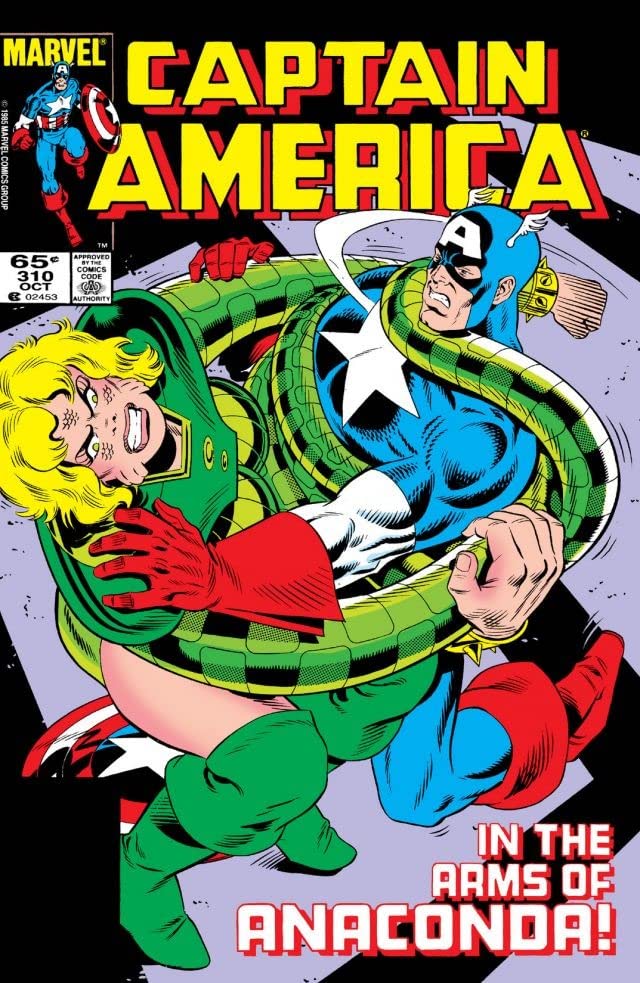
- A subplot features the Serpent Squad (Anaconda, Black Mamba, Death Adder) breaking into Sidewinder's home, seeding the arc that leads directly to the first appearance of the full Serpent Society in Captain America #310.
- Captain Britain makes a cameo appearance in the issue, a carryover from the preceding storyline set in England.
- The issue has been reprinted in: Captain America Epic Collection Vol. 12: Society of Serpents (2014, collecting #302–317); Marvel Tales: Captain America #1 (September 2019); and is included in the Captain America by Mark Gruenwald Omnibus Vol. 1 (2024).
- Madcap later became retroactively significant to Deadpool continuity — a Thor lightning strike fused the two characters, with Madcap revealed to be the source of the unexplained 'white dialogue box' voice in Deadpool's mind.
Cast · 13 characters
Full credits
Reprints
Reprinted in Capitán América #51 (1988), Captain America Epic Collection #12 (2014), Marvel Héroes #88 (2018), Marvel Tales: Captain America #1 (2019), Captain America by Mark Gruenwald Omnibus #1 (2024), Captain America #1
Key issues in Captain America
Variants (2)
Reviews
Reader reviews
No reader reviews yet.