
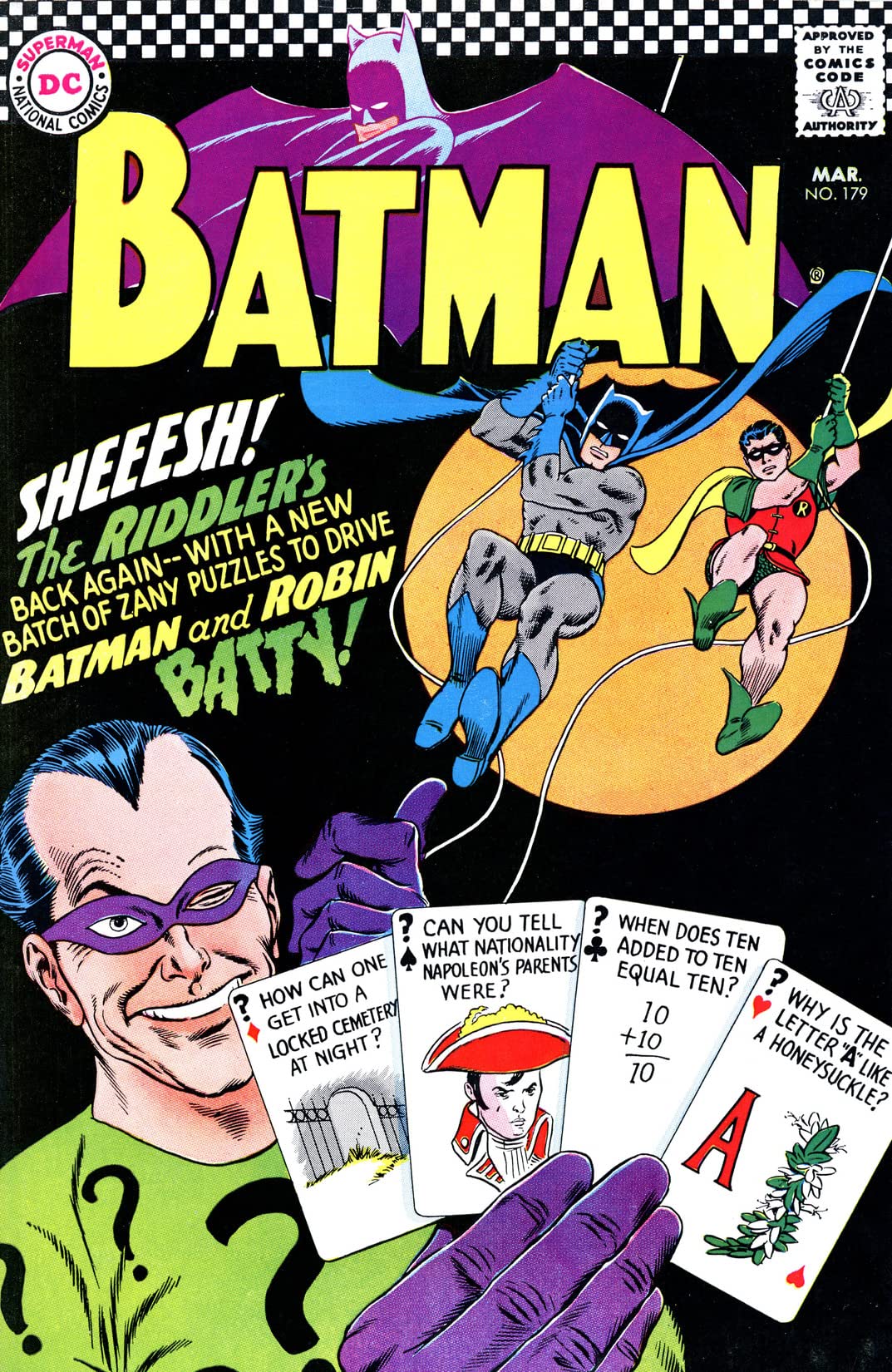
Batman #179
☆ Be the first to review + Add to your collection — Join freeBatman #179 holds a firm place in Silver Age history as the second Silver Age appearance of the Riddler — arriving just days after the ABC television series launched on January 12, 1966, with Frank Gorshin's electric debut making Edward Nygma a household name almost overnight. The Riddler had languished in near-total obscurity since his two Golden Age outings in 1948, and this issue's Gardner Fox–scripted lead story "The Riddle-Less Robberies of the Riddler" is one of only a handful of Silver Age comics to feature the character prominently, cementing his renewed place in the Batman rogues' gallery at the precise cultural moment Batmania was exploding. The story itself adds a psychological dimension to the Prince of Puzzlers that would echo through later interpretations: the Riddler attempts to overcome his compulsive clue-leaving through sheer willpower, only to discover his subconscious betrays him regardless — a character beat that speaks to an obsessive pathology rather than mere villainy. Its publication timing, coinciding with the peak of Batman's pop-culture saturation, made it one of the defining Riddler comics of the Silver Age.
In "Clay Pigeon for a Killer!", a shocking TV confession sets off a deadly game of cat and mouse, as an actor claims to have solved a murder—only to reveal his stunt was a trap to catch the real killer. With the stakes rising, Batman steps in, posing as the actor to protect the man’s life and expose the truth. Written by Robert Kanigher and illustrated by Sheldon Moldoff, with inks by Sid Greene and lettering by Gaspar Saladino, the cover by Gil Kane and Murphy Anderson captures the tension perfectly.
In "Clay Pigeon for a Killer!", a televised confession sets off a deadly game of cat and mouse when an actor claims to have solved a murder—only to reveal his ruse to Bruce Wayne, hoping to draw out the real killer. With Gotham’s streets tense and the stakes rising, Batman steps in, posing as the actor to protect the man and unravel the truth before the killer strikes again.
In "The Riddle-Less Robberies of the Riddler!", the Riddler’s latest spree leaves Batman puzzled—no riddles, no taunts, just a trail of cleverly hidden clues. With the Dark Knight tracking every twist, the criminal mastermind’s new silence becomes the biggest clue of all.
ComicBooks.com Value
Show all 22 grades ▾
More listings for this title
Read it digitally
Sell my copy
Have this issue — or a whole collection? Get a fair offer from us, skip the marketplace fees and the hassle.
We Buy Collections ▸History
Editor Julius Schwartz had already shepherded the Riddler's Silver Age comeback in Batman #171 (May 1965), betting — correctly — that the character's selection for the television series would reignite reader interest, and #179 was produced in that same commercial and creative momentum. The Riddler's lead story was written by veteran DC scripter Gardner Fox and drawn by Sheldon Moldoff, though per standard practice of the era the art was published under Bob Kane's signature — a ghost-art arrangement that DC's own editorial records, later made available to researchers, definitively confirm. The issue hit newsstands on January 20, 1966, eight days after the Batman TV pilot aired, carrying a cover date of March 1966; the creative team had no opportunity to be influenced by Gorshin's televised performance, meaning the comic's portrayal of a serious, psychologically conflicted Riddler was entirely the product of Fox's imagination rather than any adaptation of Gorshin's manic on-screen energy.
Trivia · 8 facts
- Second Silver Age appearance of the Riddler (Edward Nygma/Nigma), following his Silver Age debut in Batman #171 (May 1965) — the character had been absent from comics for 17 years before that revival.
- Published on newsstands January 20, 1966, with a cover date of March 1966 — eight days after the Batman TV series premiered on ABC on January 12, 1966, featuring Frank Gorshin as the Riddler.
- Cover penciled by Gil Kane and inked by Murphy Anderson; the cover displays four actual riddles on playing-card style panels surrounding Batman and Robin.
- Lead feature "The Riddle-Less Robberies of the Riddler" (12 pages) scripted by Gardner Fox, with interior art by Sheldon Moldoff published under Bob Kane's name and inks by Joe Giella; credits were confirmed via Julius Schwartz's editorial records.
- Second story, "Clay Pigeon for a Killer!" (approximately 11 pages), scripted by Robert Kanigher with Sheldon Moldoff pencils (again credited to Kane) and Sid Greene inks — the script credit was previously misattributed to Gardner Fox.
- The issue was edited by Julius Schwartz, who had taken over the Batman line in 1964 and introduced the 'New Look' era of Batman storytelling.
- "The Riddle-Less Robberies" has been reprinted multiple times, including in Batman: Featuring Two-Face and the Riddler (DC, 1995), Showcase Presents: Batman Vol. 2 (DC, 2007), and Batman Arkham: The Riddler (DC, 2015).
- The issue also appeared in international editions, including Norwegian (Lynvingen, 1967) and Arabic (Al-Watwat, 1966) printings, reflecting the global reach of Batman during the Batmania peak.
Full credits
Reprints
↩ Reprints Mr. District Attorney #51 (1956)
Reprinted in Superman Supacomic #85 (1966), Batman #348 (1966), Lynvingen #4/1967 (1967), Superman #4 (1967), Superman en Batman #4/1967 (1967), Lynvingen Stort Julenummer #1970 (1969), Batman Annual #[nn] (1970), Batman #14530 (1977), Batman: Featuring Two-Face and the Riddler #[nn] (1995), Batman in the Sixties #[nn] (1999), Showcase Presents: Batman #2 (2007), Batman Arkham: The Riddler #[nn] (2015), الوطواط [Al-Watwat / The Batman] #13
Key issues in Batman
 ★
★ ★
★ ★
★ ★
★ ★
★ ★
★ ★
★ ★
★Reviews
Reader reviews
No reader reviews yet.