
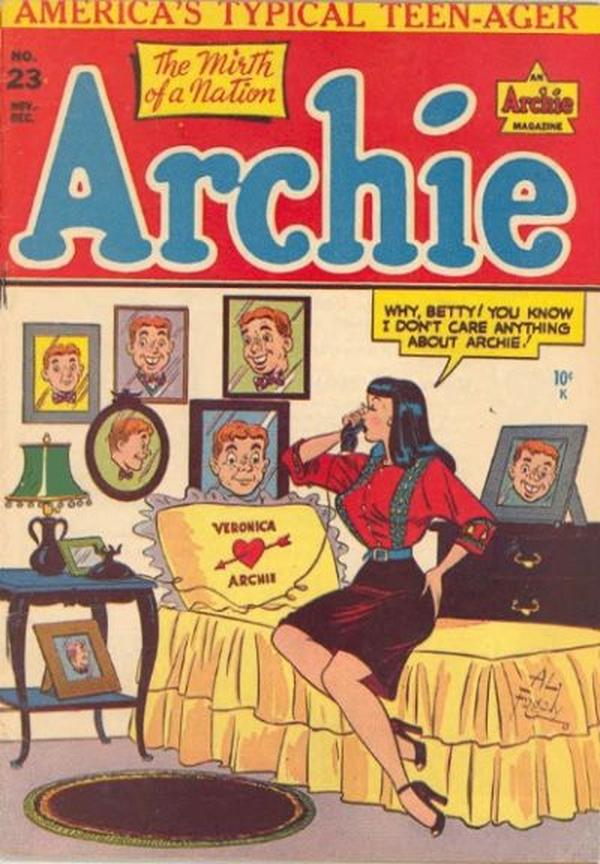
Archie Comics #23
☆ Be the first to review + Add to your collection — Join freeArchie Comics #23 (August 1946) sits squarely inside the transformative year that reshaped the entire publishing company: in 1946, MLJ Magazines formally renamed itself Archie Comics Publications, signaling how thoroughly the Riverdale teenagers had eclipsed the superhero line that originally defined the house. The issue appeared while the franchise was simultaneously expanding into a nationally syndicated newspaper strip — Bob Montana launched the daily strip in February 1946 and the Sunday strip in October 1946, reaching 700 papers — meaning the comic-book series and the strip were cross-pollinating audiences at an unprecedented scale for a teen-humor title. As a mid-run Golden Age installment of the flagship title, it embodies the fully realized anthology format — mixing Archie family strips with backup features and Hollywood celebrity filler — that would define the Archie house style for decades. The issue is also a representative artifact of the post-World War II optimism that made the Riverdale gang resonate so broadly with American readers returning to civilian life.
In "The Cabbie," Archie takes on a new job to make up for ruining Betty's dress, becoming a taxi driver for a mysterious magician. With Reggie's prank setting the whole thing in motion, Archie finds himself navigating the streets of Riverdale in a role far from his usual high school antics. The story unfolds with the usual mix of humor and chaos, all drawn with the crisp, expressive style of Bill Vigoda, while Al Fagaly’s cover captures the moment with a classic, lively touch.
Archie swaps his usual mischief for a more literal ride when he accidentally ruins Betty’s dress and must earn money to replace it—so he takes a job as a cabbie. Now he’s stuck driving a mysterious magician around Riverdale, with no idea what kind of trouble the man might bring.
ComicBooks.com Value
Show all 18 grades ▾
This exact issue on ebay
More listings for this title
Read it digitally
Sell my copy
Have this issue — or a whole collection? Get a fair offer from us, skip the marketplace fees and the hassle.
We Buy Collections ▸History
The Archie Comics title had been running since its Winter 1942 debut, with Bob Montana as the primary artistic voice; by 1946 the studio had expanded to a bullpen that included Bill Vigoda and Al McLean on interior art, with cover duties handled by Al Fagaly, the Golden Age Archie staff artist also known for creating Super Duck. Editor John L. Goldwater and managing editor Harry Shorten oversaw the line throughout this period, as confirmed by the GCD's Statement of Ownership records for October 1, 1946. Montana himself was simultaneously being pulled toward the new newspaper strip, so the comic-book issues of this era increasingly reflected a collaborative studio output rather than a single cartoonist's vision.
Trivia · 8 facts
- Published August 1946 by Archie Comics Publications (formerly MLJ Magazines, which formally adopted the Archie Comics name in 1946, the same year this issue appeared).
- Cover art by Al Fagaly, the Golden Age Archie staff artist and creator of Super Duck.
- Interior stories and art credited to Bob Montana, Bill Vigoda, Pen Shumaker, and Al McLean — a typical bullpen collaboration of the era.
- Story contents include 'Knots To You' (Archie's rope-trick mishap), 'The Happy Hunting Grounds' (Archie substituting for Jughead's father on a hunt), 'Crazy Over Horses' (Archie vs. Reggie in horsemanship), and the reprint 'Boat Ride Blues' featuring Mr. Weatherbee.
- The issue also contains short Hollywood celebrity filler articles — reported in Archie's voice — covering stars such as Ingrid Bergman, Gary Cooper, and Errol Flynn, a recurring editorial device that tied the comic to postwar pop-culture aspirations.
- This issue appeared the same year that Bob Montana began drawing the Archie daily newspaper strip for 700 papers, marking the franchise's peak Golden Age cultural reach.
- The Archie Comics title ran continuously from Winter 1942 through June 2015 (666 issues in Volume 1), making mid-1940s issues like #23 part of the unbroken foundational run of one of American comics' longest-lived series.
- Golden Age Archie comics from this period were printed on low-grade newsprint and widely circulated among young readers, making high-condition survivors from 1946 genuinely scarce as a class of material.
Full credits
Reprints
Reprinted in Archie Americana Series #1 (1991), Archie Archives #7 (2012), Best of Archie Comics Betty and Veronica #1 (2014), Best of Archie Americana #1 (2017)
Key issues in Archie Comics
Reviews
Reader reviews
No reader reviews yet.