
A complete issue · 36 pages · 1929
Life — January 25, 1929
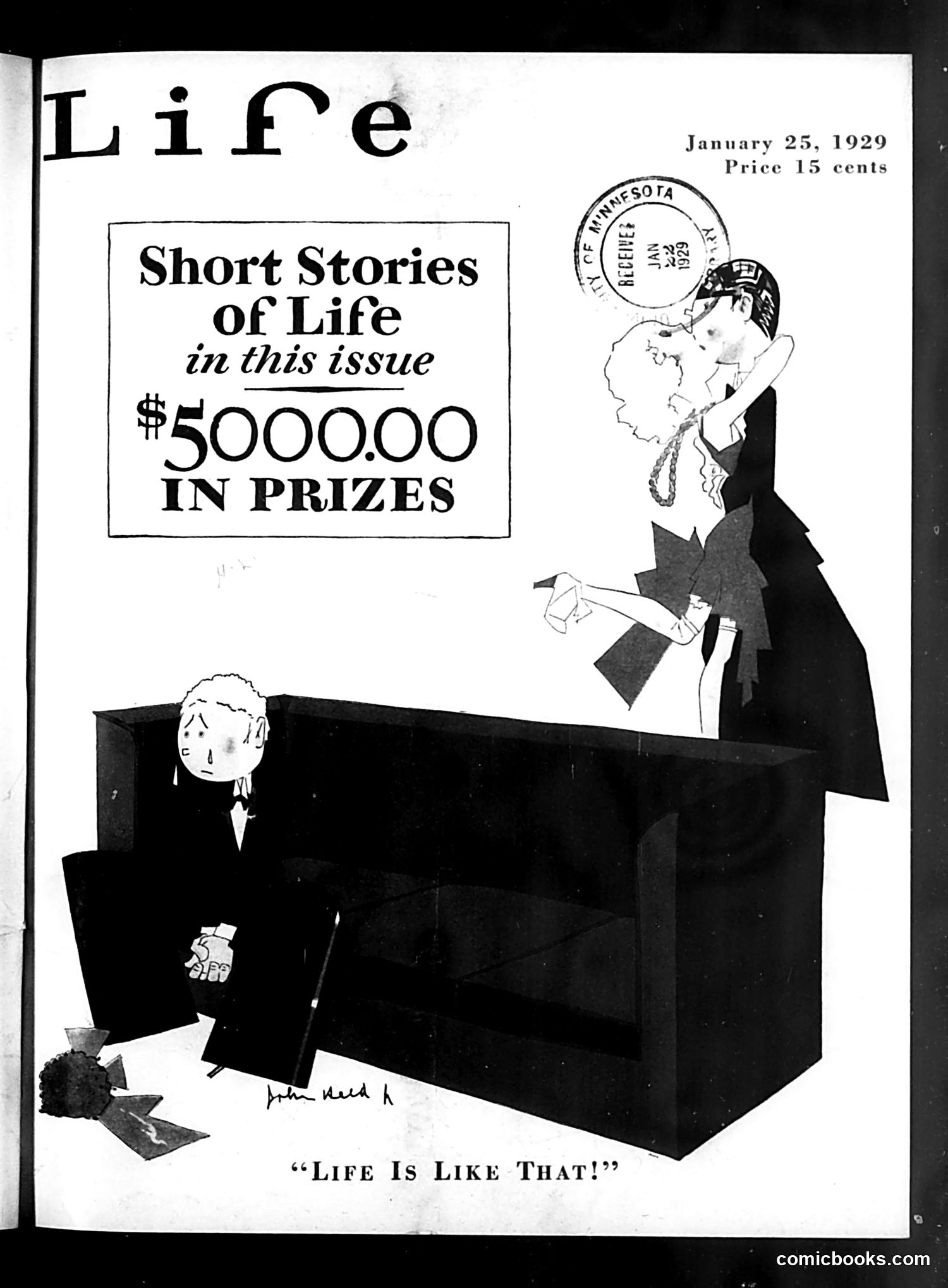
This cover depicts a satirical scene titled "Life Is Like That!" showing two figures at a desk—likely representing a boss and employee or authority figure and subordinate. The standing figure appears to be delivering bad news or dismissing the seated figure, who looks distressed while holding documents. The cartoon satirizes workplace dynamics and economic uncertainty. Published just months after the October 1929 stock market crash (though predating it slightly), the image captures contemporary anxieties about job security and financial instability. The promotion of "$5000.00 in Prizes" for submitted "Short Stories of Life" suggests Life magazine invited reader submissions about everyday hardships. The satirical point: ordinary people's lives are subject to sudden reversals and authority figures' whims—"life is like that."
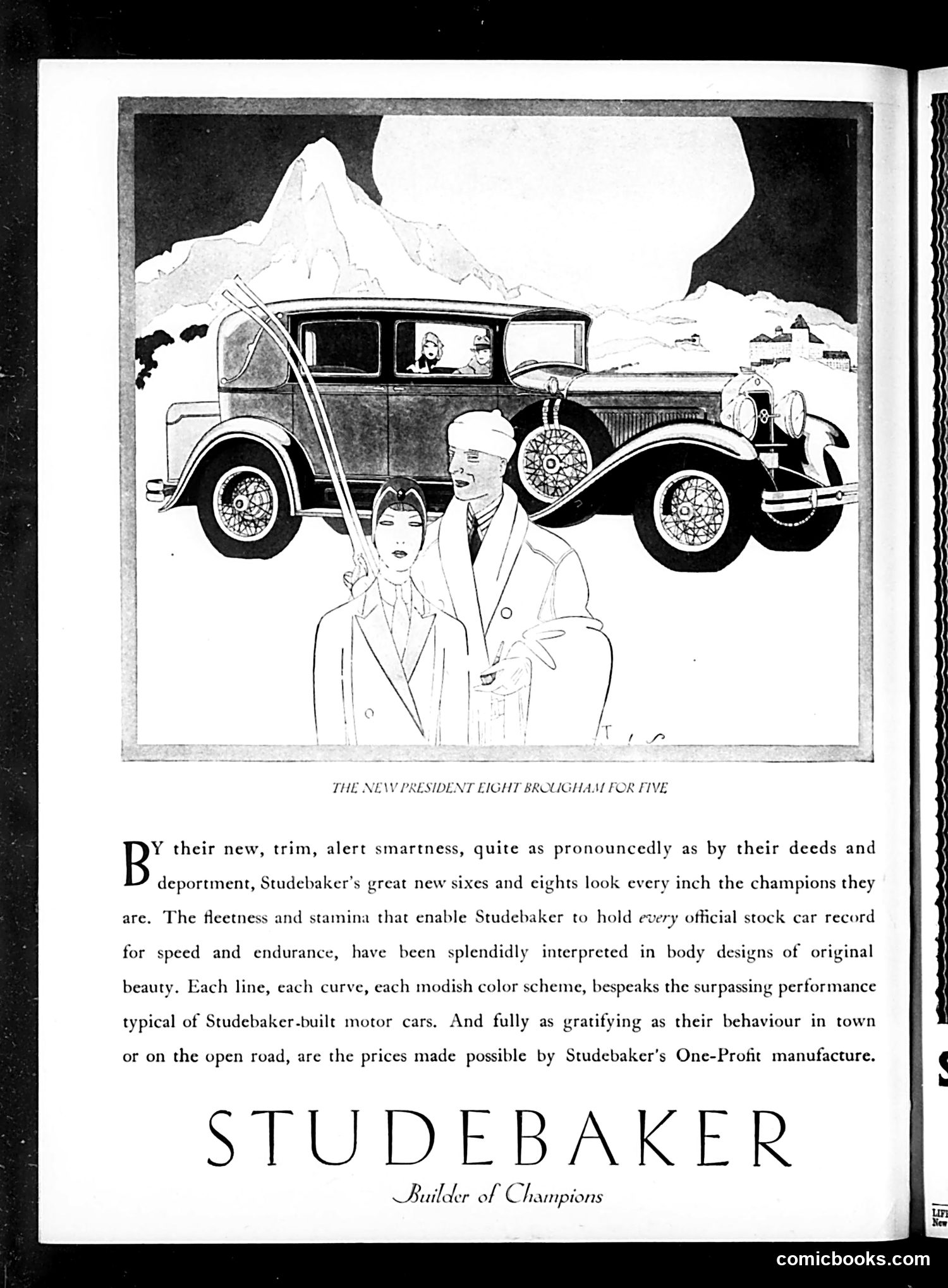
This is primarily a **Studebaker automobile advertisement**, not a political cartoon. The image depicts a stylized scene of well-dressed figures admiring Studebaker vehicles against a mountainous backdrop, with the tagline "The New President Eight Brougham for Five." The advertisement emphasizes Studebaker's performance credentials ("hold every official stock car record") and design sophistication ("original beauty"). The copy celebrates both the cars' athletic capabilities and their affordability through "One-Profit manufacture." The only potentially satirical element is the implicit social commentary: the illustration associates these automobiles with elegance, achievement, and aspirational lifestyle—a common 1920s advertising strategy targeting middle and upper-middle-class buyers. This is commercial promotion rather than political satire.

This is **not a political cartoon or satire** — it's a straightforward advertisement for St. Lawrence-Canadian Pacific shipping lines. The page promotes the company's 1929 fleet of 16 passenger ships traveling to Europe from Montreal and Quebec. It highlights their luxury liners: three "Empress" ships (first-class) and four "Duchess" ships (cabin-class with modern amenities). The aerial photograph shows multiple vessels in water. The decorative wheat stalks are purely ornamental design elements, not symbolic commentary. The ad emphasizes comfort, dining, electric operation, and frequent sailings as selling points for transatlantic travel. This represents typical 1920s advertising celebrating industrial achievement and oceanic travel during the pre-Depression era.
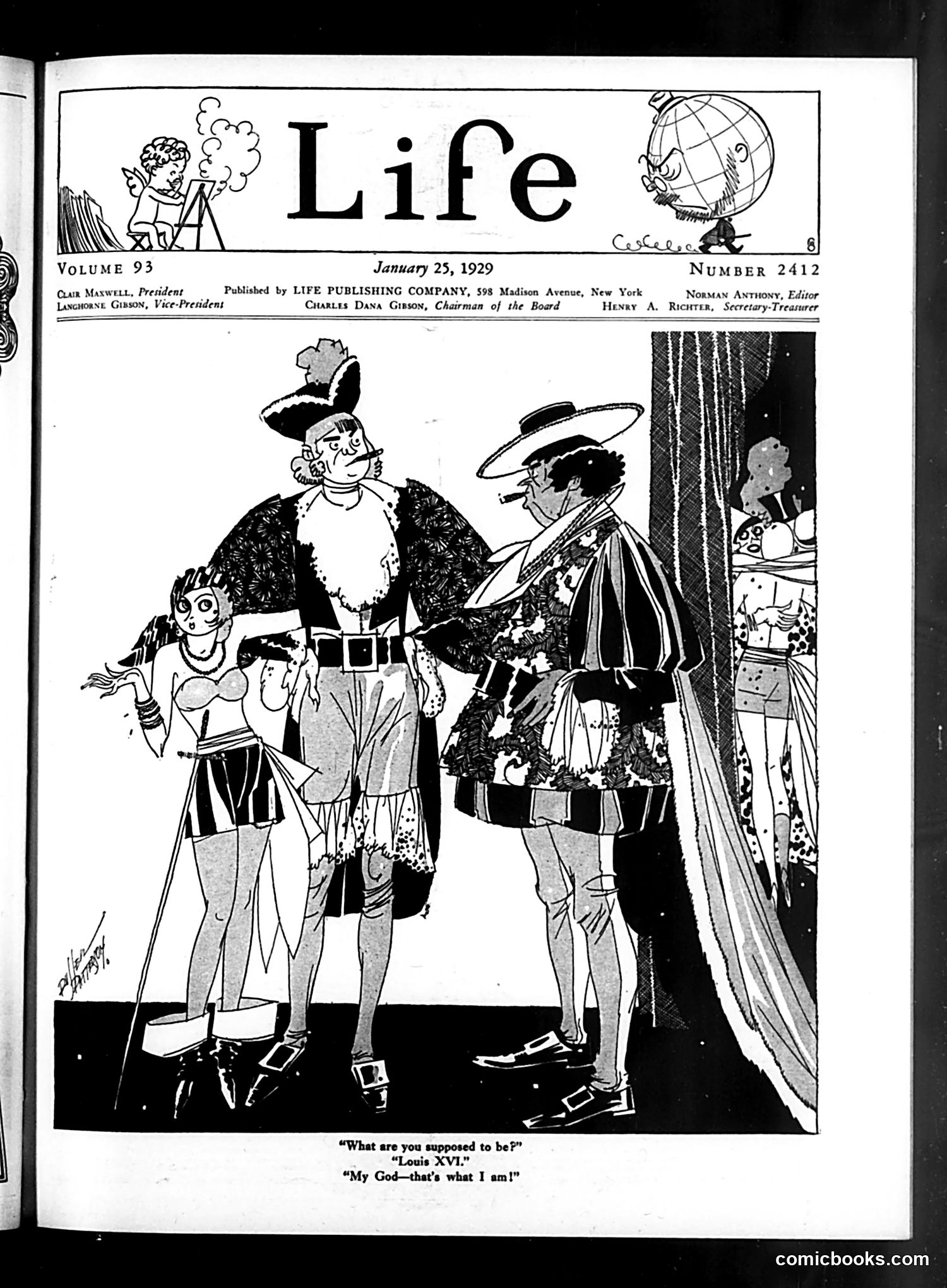
This satirical cartoon depicts what appears to be a costume ball or masquerade scene. Two figures in elaborate period dress (possibly meant to evoke 18th-century French aristocracy) converse with a child. The dialogue reads: "What are you supposed to be?" / "Louis XVI." / "My God—that's what I am!" The humor likely references the economic situation of 1929—just before the stock market crash in October. The joke appears to mock wealthy Americans who, despite their lavish costumes and pretensions to sophistication, are essentially living like doomed French royalty (Louis XVI faced the guillotine during the French Revolution). This suggests satirical commentary on the precarious position of the American wealthy elite and impending economic catastrophe.
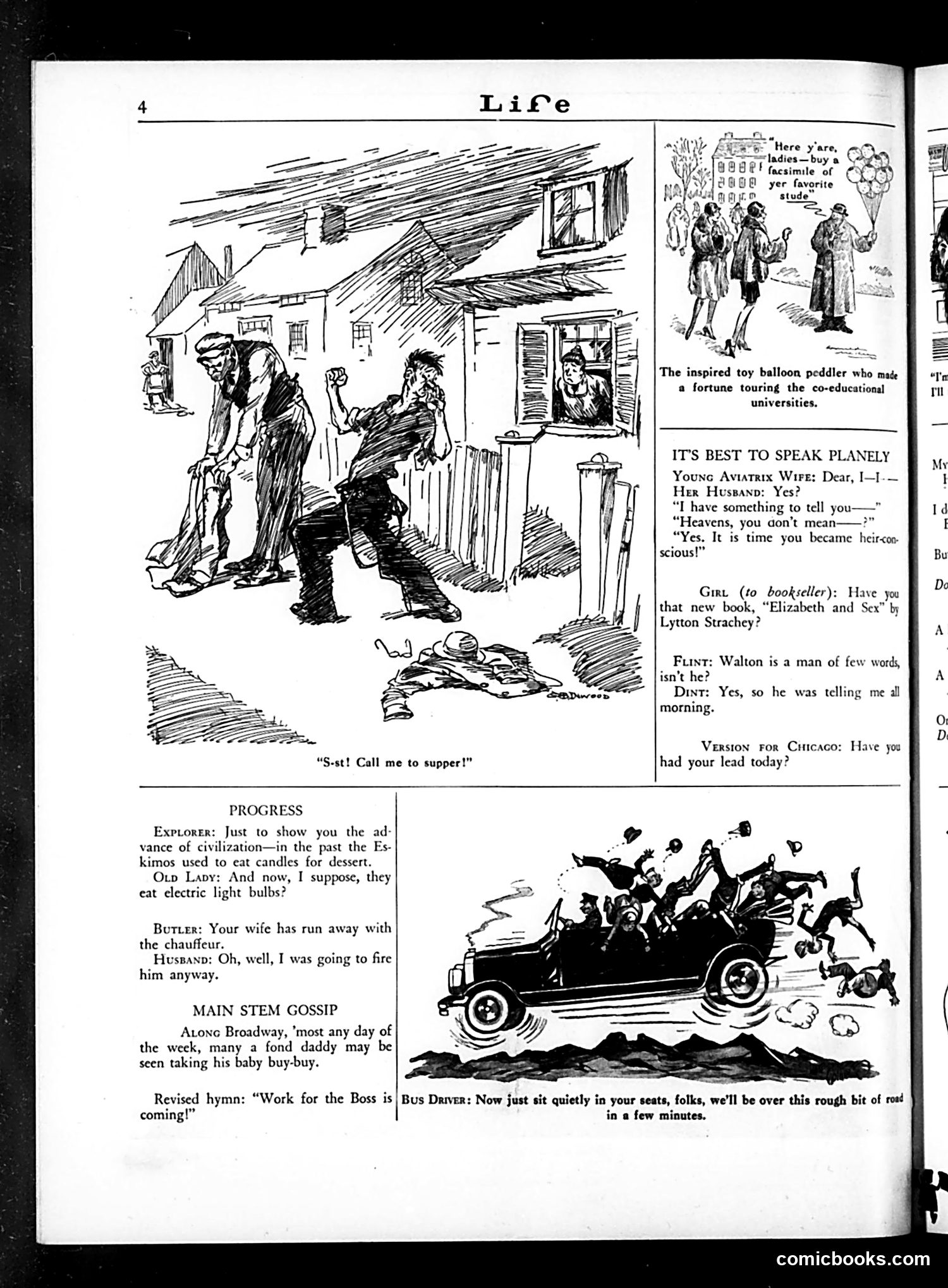
This page contains several brief satirical items typical of Life's humor format: **"Sit! Call me to supper!"** depicts a domestic scene where a man appears to be training his wife like a dog—satirizing marital power dynamics and the subservient role expected of wives in early 20th-century society. **"Progress"** mocks civilization's advancement through an exchange between an Explorer and Old Lady, suggesting modern conveniences (electric light bulbs) haven't fundamentally improved human nature. **"Main Stem Gossip"** jokes about wealthy fathers buying toys for illegitimate children on Broadway—commentary on urban vice and hypocrisy among the wealthy. **"Bus Driver"** shows a chaotic automobile ride, humorously warning passengers about rough roads ahead. The overall tone reflects Life's satirical stance on social conventions, class pretension, and modern life's contradictions.
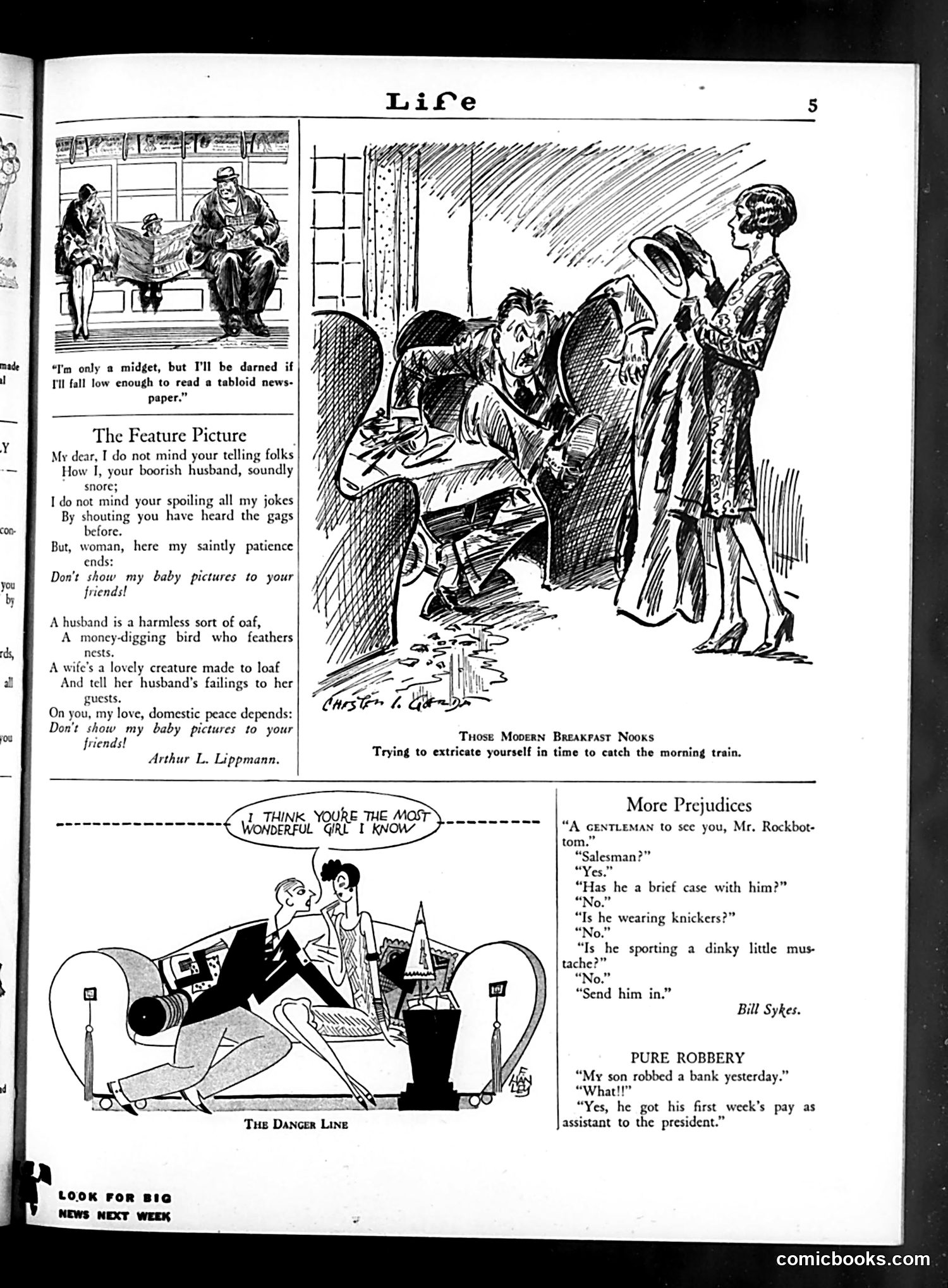
This page contains three satirical pieces from Life magazine (an early 20th-century humor publication): **"The Feature Picture"** is a poem by Arthur L. Lippmann mocking husbands who bore guests with baby photos. The accompanying illustration shows a man displaying pictures while others appear trapped and suffering. **"Those Modern Breakfast Nooks"** depicts a domestic scene where someone frantically tries to catch a morning train while family members remain casually seated—satirizing the rushed modern lifestyle and breakfast room culture. **"The Danger Line"** cartoon shows a couple on a couch; the man compliments the woman while she holds architectural models, presumably satirizing flattery in romance or courtship dynamics. **"More Prejudices"** and **"Pure Robbery"** are brief humor items poking fun at social attitudes and a joke about nepotism in banking. The overall theme targets domestic life and social pretensions of the era.
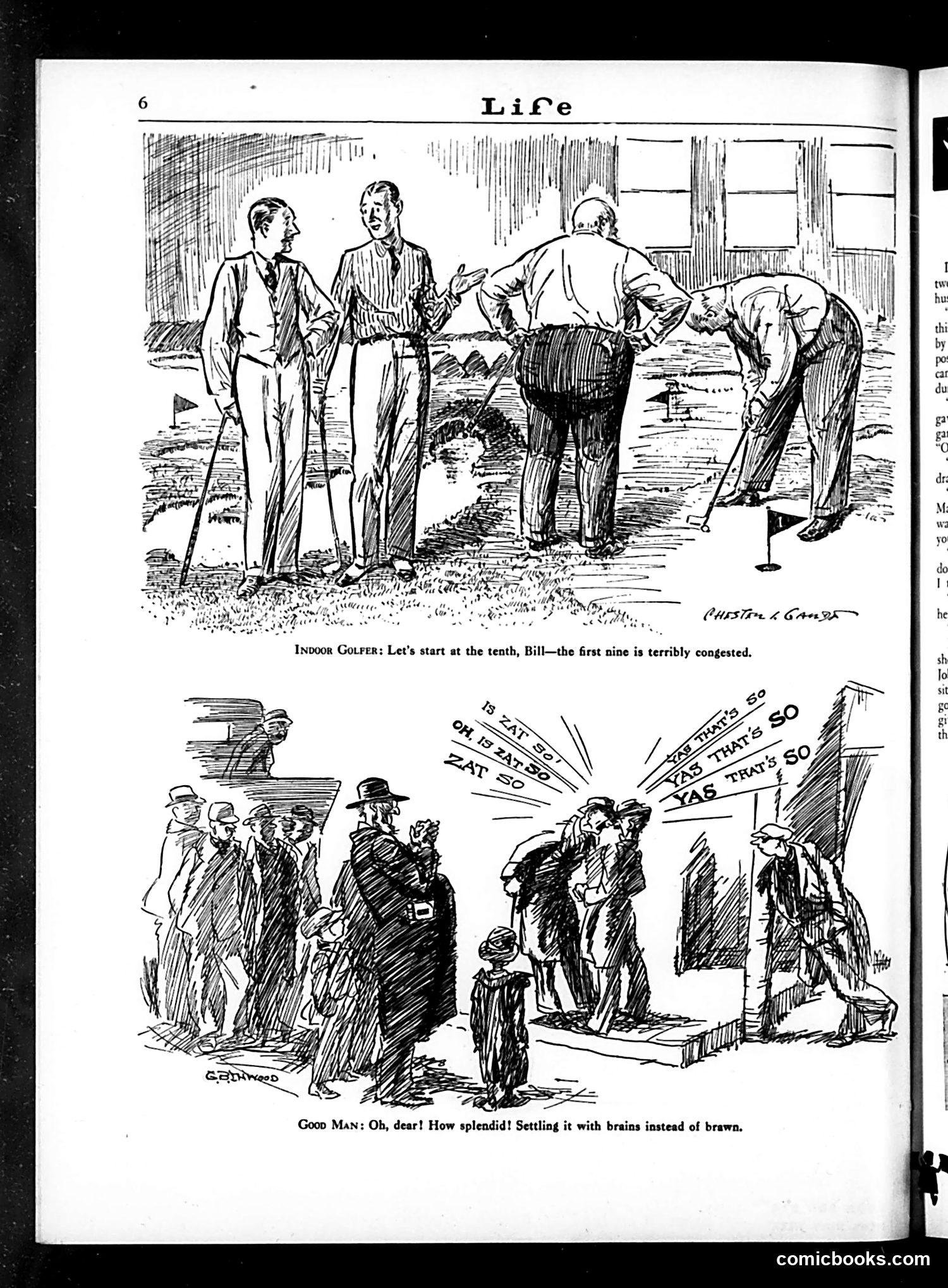
This page from *Life* magazine contains two satirical cartoons about golf and dining etiquette. **Top cartoon** ("Indoor Golfer"): Mocks the crowded conditions at golf courses, joking that even an indoor facility is congested. The humor relies on golf's popularity among affluent men. **Bottom cartoon** ("Good Man"): Uses a restaurant scene to satirize class pretensions. A diner is praised for "settling it with brains instead of brawn"—likely referring to resolving a dispute through intellect rather than physical confrontation. The repeated "Yas that's so" suggests mockery of affected speech patterns. This appears to comment on Victorian-era gentlemen's ideals of civilized behavior and proper decorum in social settings. Both cartoons target upper-class leisure activities and social conventions of the era.
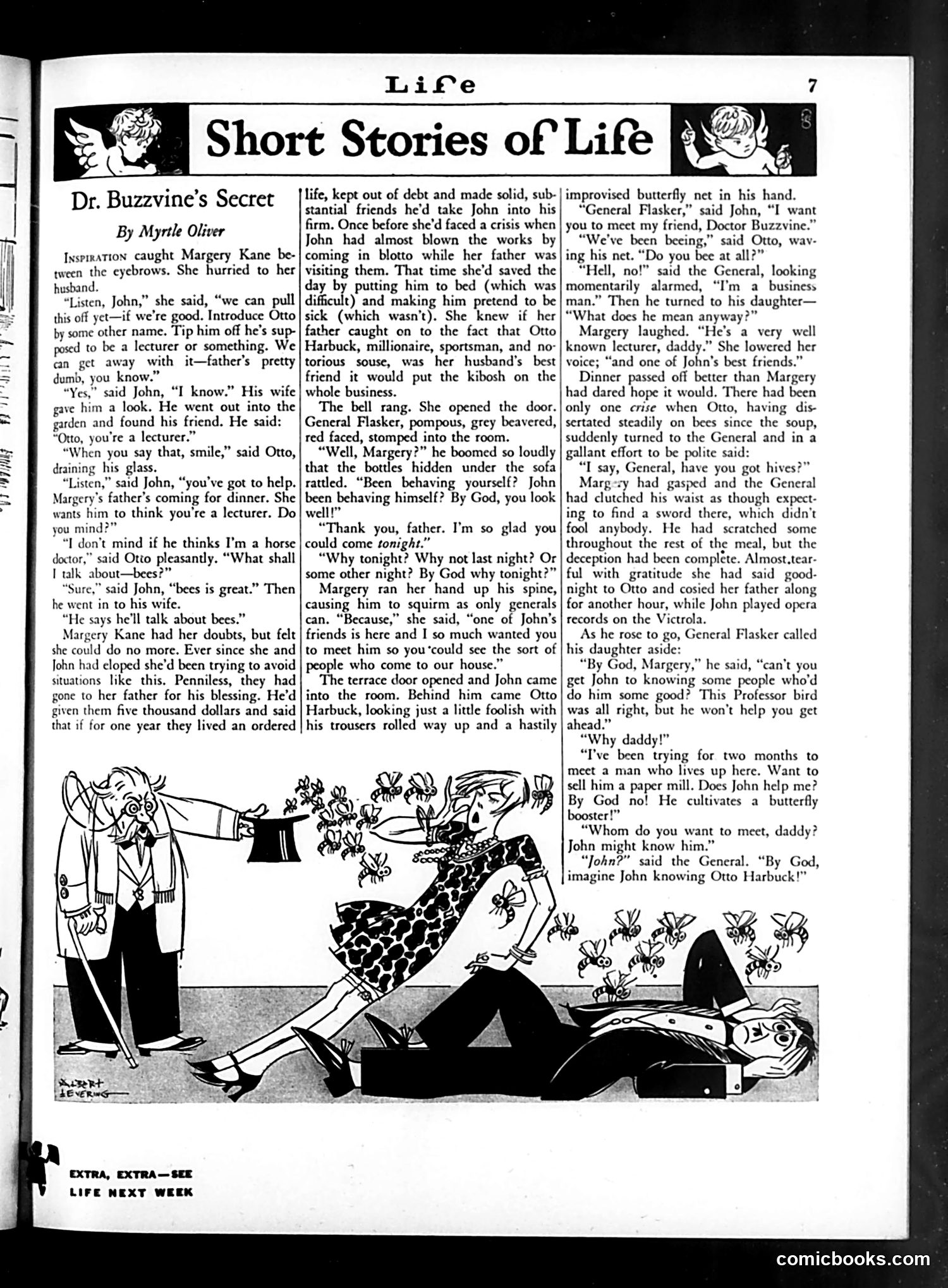
This short story satirizes social climbing and pretense among the upper-middle class. The plot concerns Margery Kane, who deceives her husband John by claiming to befriend a lecturer named Otto to gain social status. When John invites Otto to dinner, Margery is mortified to discover Otto is actually a common laborer her husband knew—not an intellectual at all. The cartoon illustration shows the comedic payoff: Margery's elaborate deception unravels when Otto arrives in work clothes, and her carefully constructed façade collapses. The story mocks how people fabricate false social connections to appear cultured and refined, exposing the gap between aspiration and reality among those obsessed with respectability.
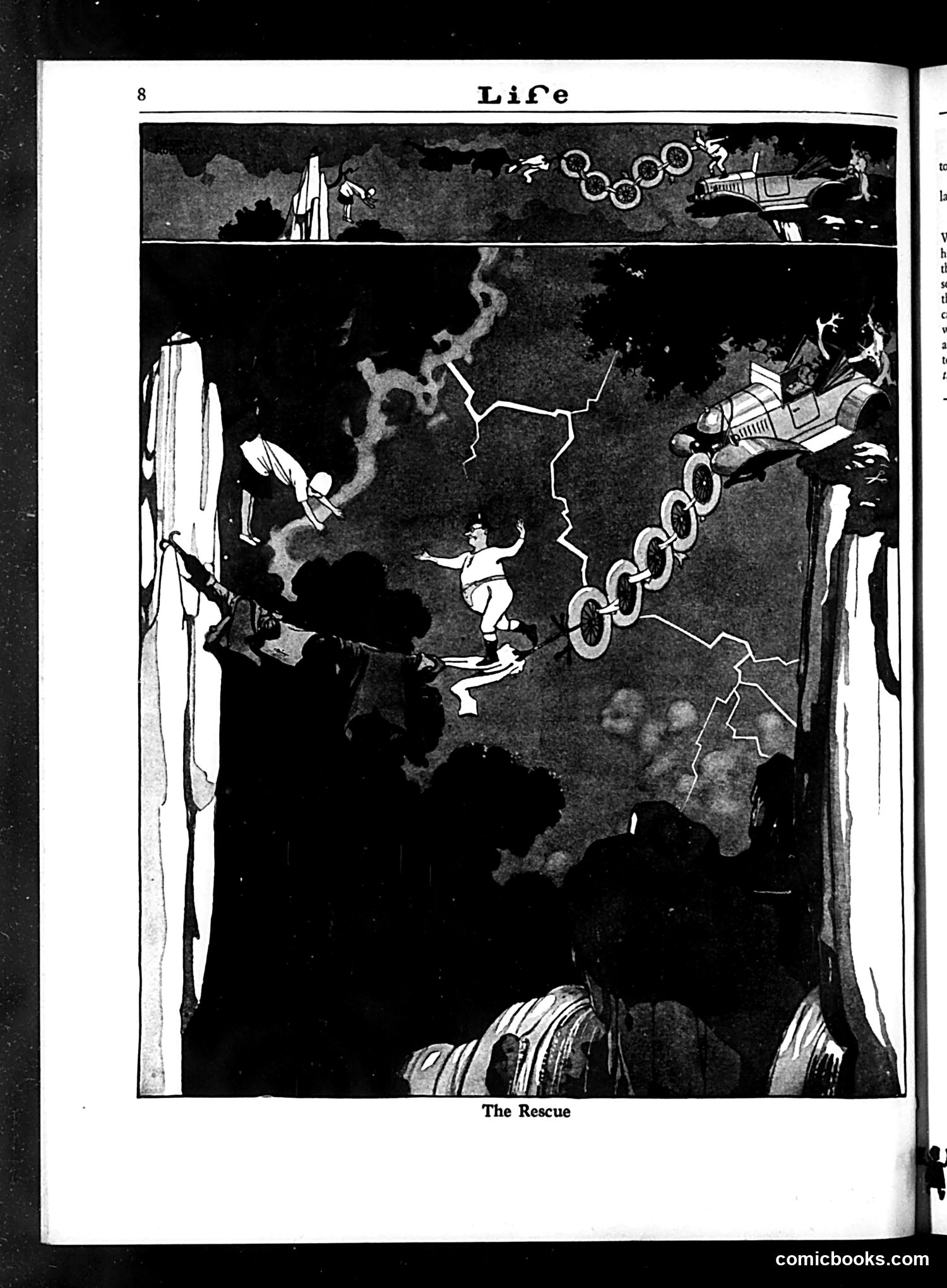
This cartoon depicts a surreal rescue scene titled "The Rescue." A figure in the center appears to be in distress or danger, suspended above what looks like a dark chasm or abyss. Two mechanical or robotic figures on either side (right and left) seem to be reaching toward the central figure with elongated, chain-like or coiled appendages. Additional figures appear in the top border panel. The cartoon's specific satirical meaning is unclear without additional context about the publication date and contemporary political events. The mechanical figures likely represent institutions, forces, or entities attempting intervention. The dark void suggests danger or crisis. However, the exact referent—whether social, political, or economic—cannot be determined from the image alone. More historical context would be needed to fully interpret the satire.
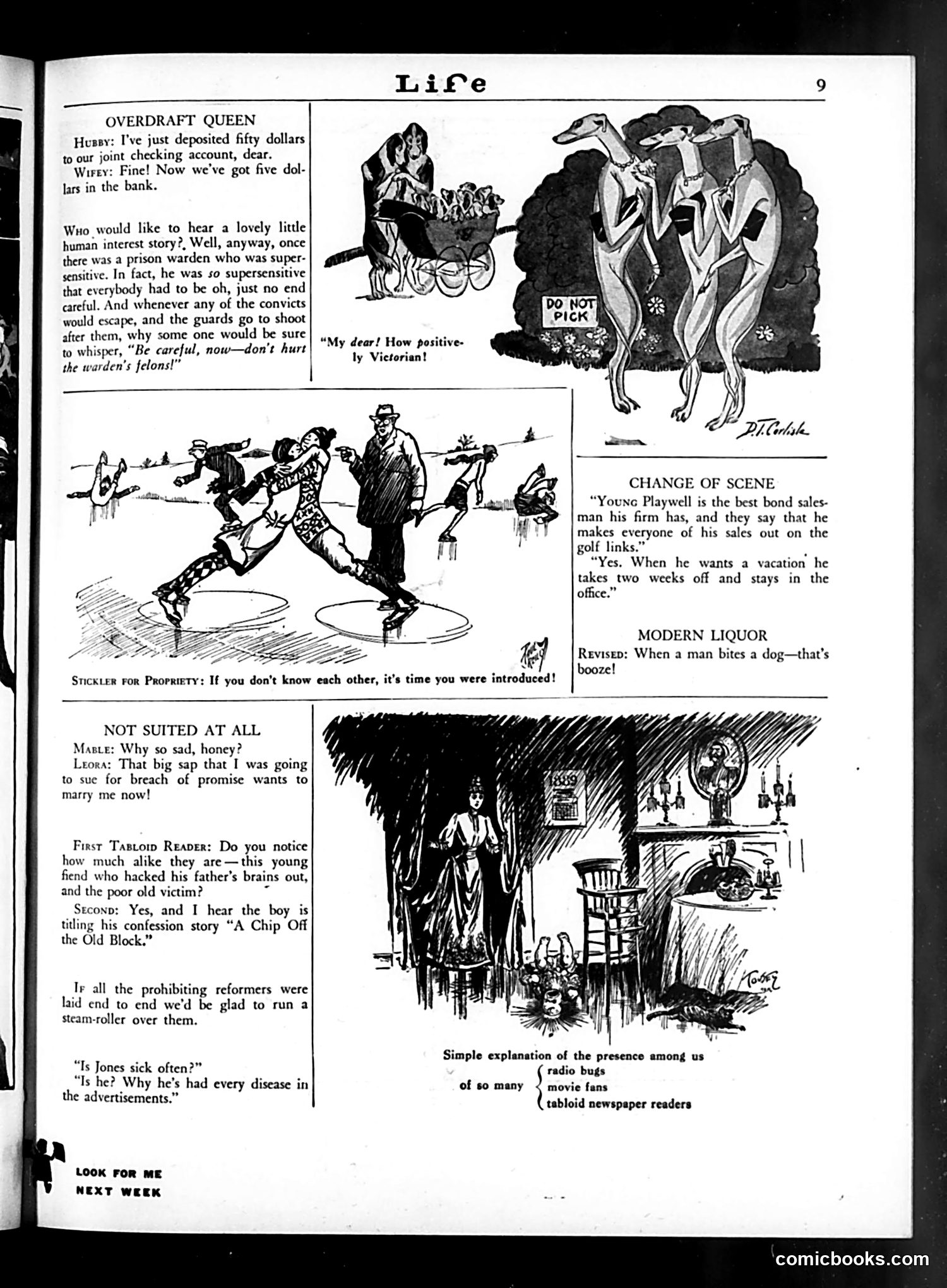
This page contains several short humor pieces typical of Life's satirical format: **"Overdraft Queen"** jokes about a couple's meager bank balance despite deposits. **"Stickler for Propriety"** depicts people being introduced while ice skating—satirizing formal social etiquette in informal settings. **"Not Suited at All"** mocks a woman named Leora who wanted marriage but her suitor hacked his father's brains out instead, referencing a sensational tabloid crime story ("A Chip Off the Old Block"). **"Change of Scene"** humorously contrasts a bond salesman's work ethic with his vacation behavior. **"Modern Liquor"** is a one-liner joke about dog bites and alcohol. The final cartoon satirizes the prevalence of "radio bugs, movie fans, and tabloid newspaper readers" in society, depicting ghostly figures in a domestic setting—mocking popular culture's omnipresence.
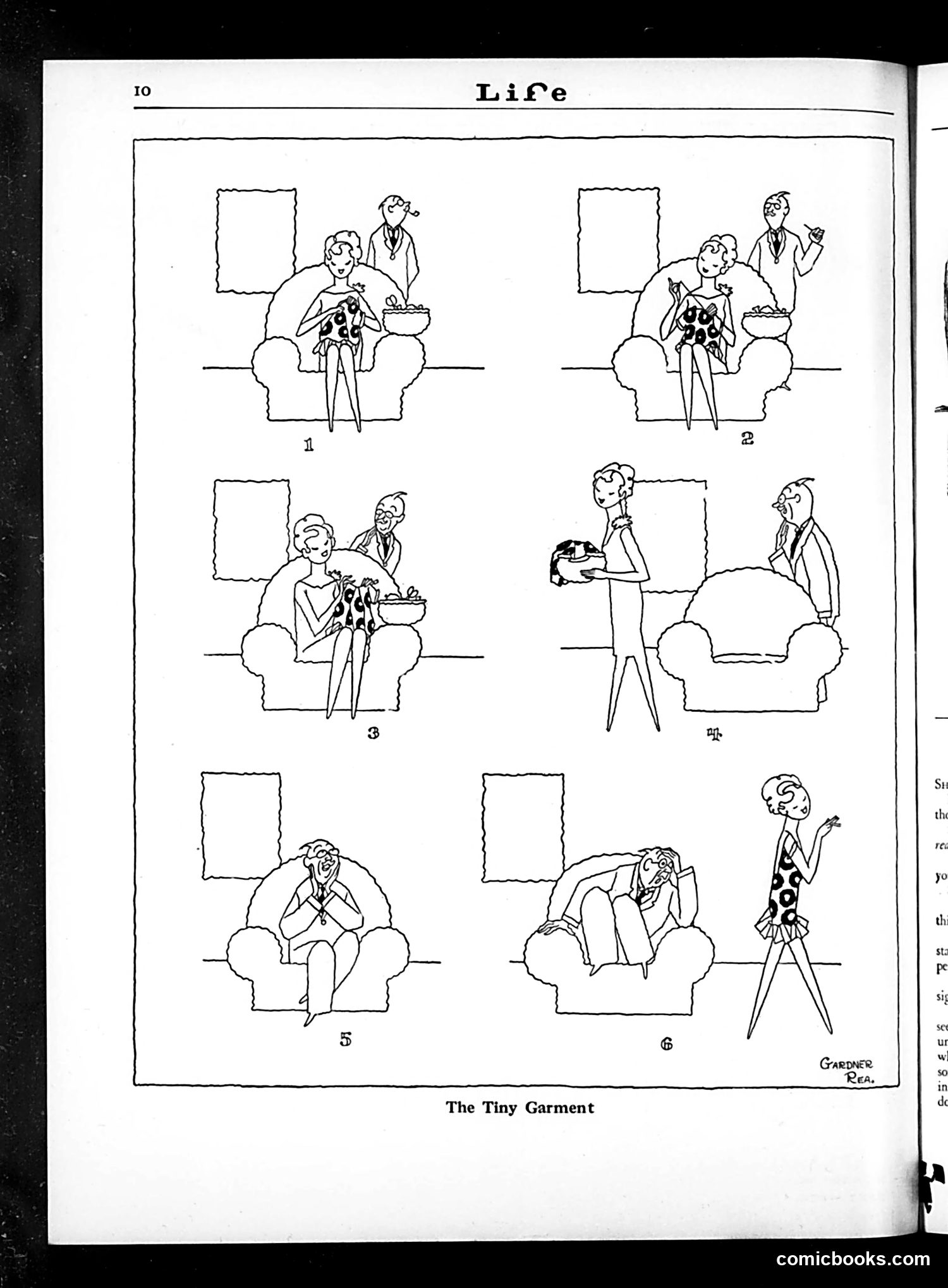
This six-panel comic by Gardner Rea depicts a domestic scenario involving a woman on a couch and two other figures (likely a husband and servant or visitor). The narrative appears to show the woman attempting to wear an increasingly small garment—progressing from panels 1-2 where she's seated normally, to panels 5-6 where she's struggling or reclining uncomfortably while trying to fit into the tiny clothing item. The satire likely targets women's fashion constraints or vanity—specifically the era's restrictive clothing standards or corsetry that forced women into uncomfortable, impractical garments for aesthetic purposes. The humor derives from the physical comedy of her deteriorating attempts to maintain composure while wearing something impossibly small, mocking both fashion industry demands and women's willingness to endure discomfort for appearance.
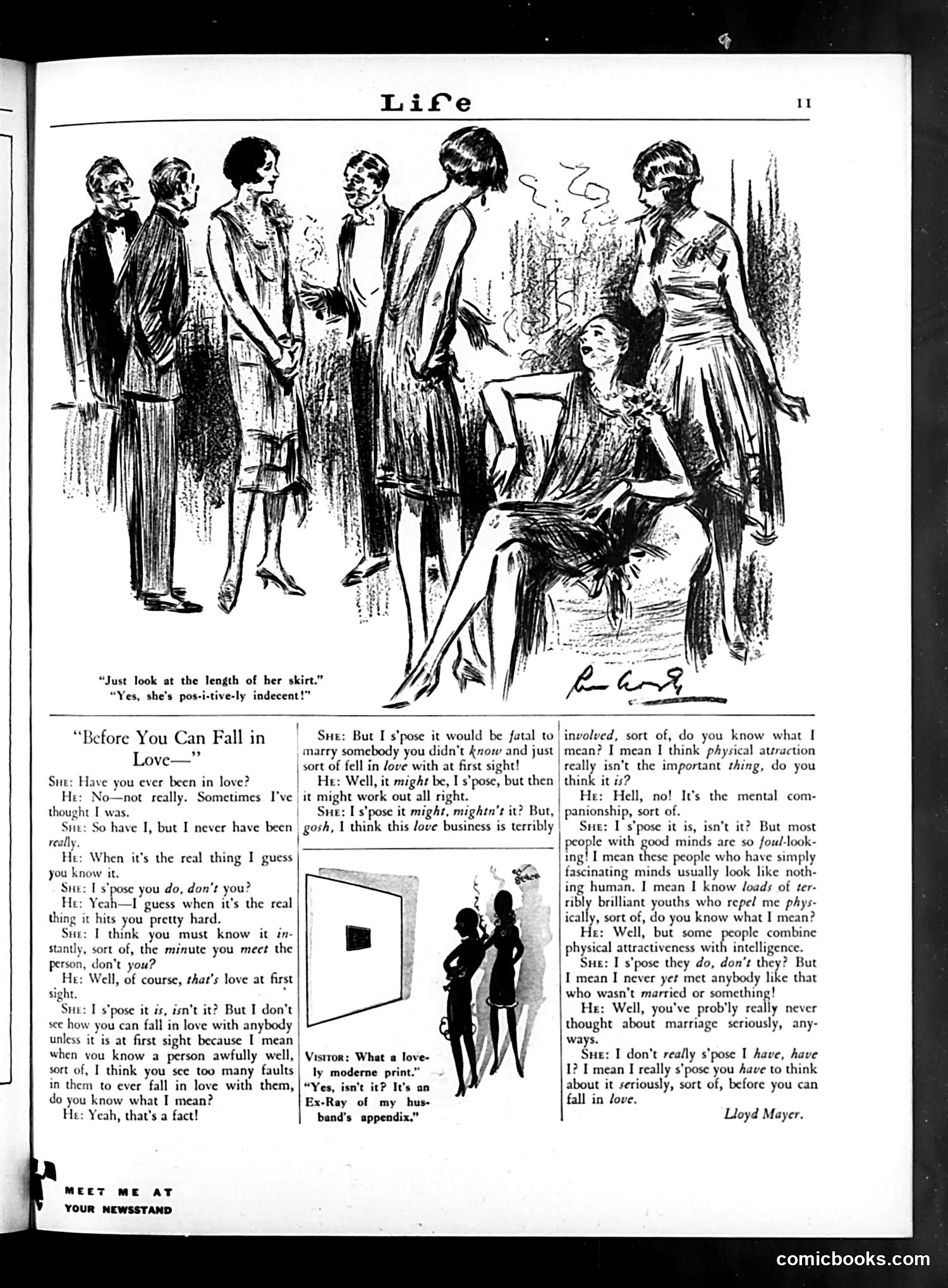
This page satirizes changing attitudes about romantic love and marriage in the 1920s. The dialogue between "She" and "He" mocks the era's emerging psychological and pseudo-scientific theories about attraction and compatibility. The satire targets: 1. **Modern dating discourse**: The characters debate whether love is "instantaneous" or develops gradually, reflecting contemporary debates about romantic compatibility. 2. **"Foul-looking" intellectuals**: She dismisses the notion that brilliant minds necessarily attract, suggesting attractive people with "good minds" are rare—mocking both physical elitism and intellectual pretension. 3. **Marriage skepticism**: Their discussion of whether one can "really" know someone before marriage reflects 1920s anxieties about modern courtship breaking from tradition. The cartoon illustrates fashionable 1920s figures, suggesting this satirizes how modern, urbane society discusses love through pseudo-philosophical frameworks rather than sentiment.
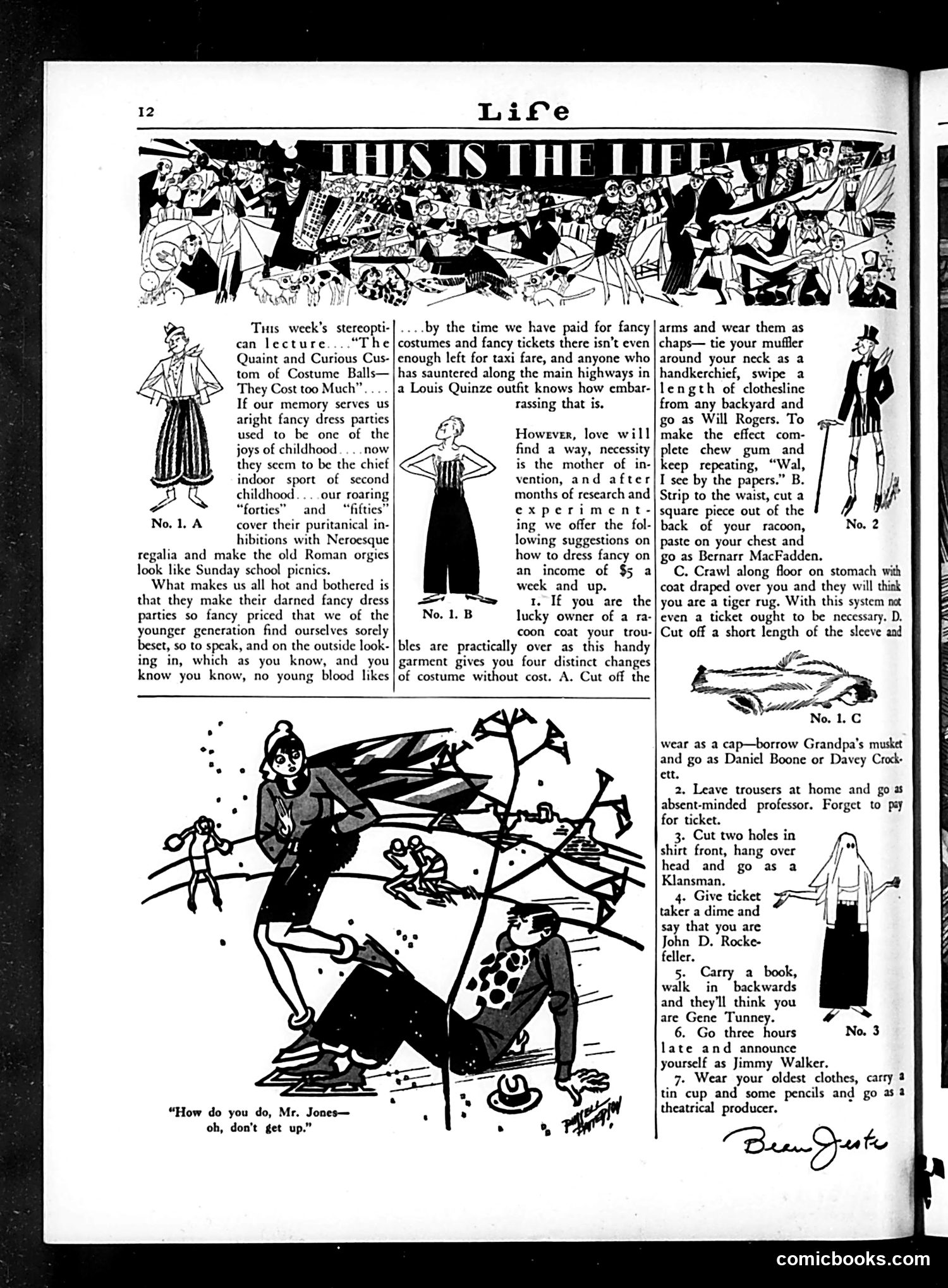
This page satirizes **cheap costume parties** for young people during the Depression era. The headline mocks the elaborate "fancy dress" parties that were fashionable but expensive. The main cartoon shows a woman in an exaggerated, impractical costume surrounded by chaos—she's tripping, losing her shoe, and causing mayhem. The caption ("How do you do, Mr. Jones—oh, don't get up") suggests social pretense collapsing into physical comedy. The accompanying list provides **seven humorous "budget costume" suggestions**: borrowing a grandfather's musket, going without pants as a "professor," cutting holes in a shirt as a "Klansman," and other absurd improvised disguises. The satire critiques both the expense of genuine costumes and the desperation of Depression-era youth trying to participate in fashionable entertainment on limited means.
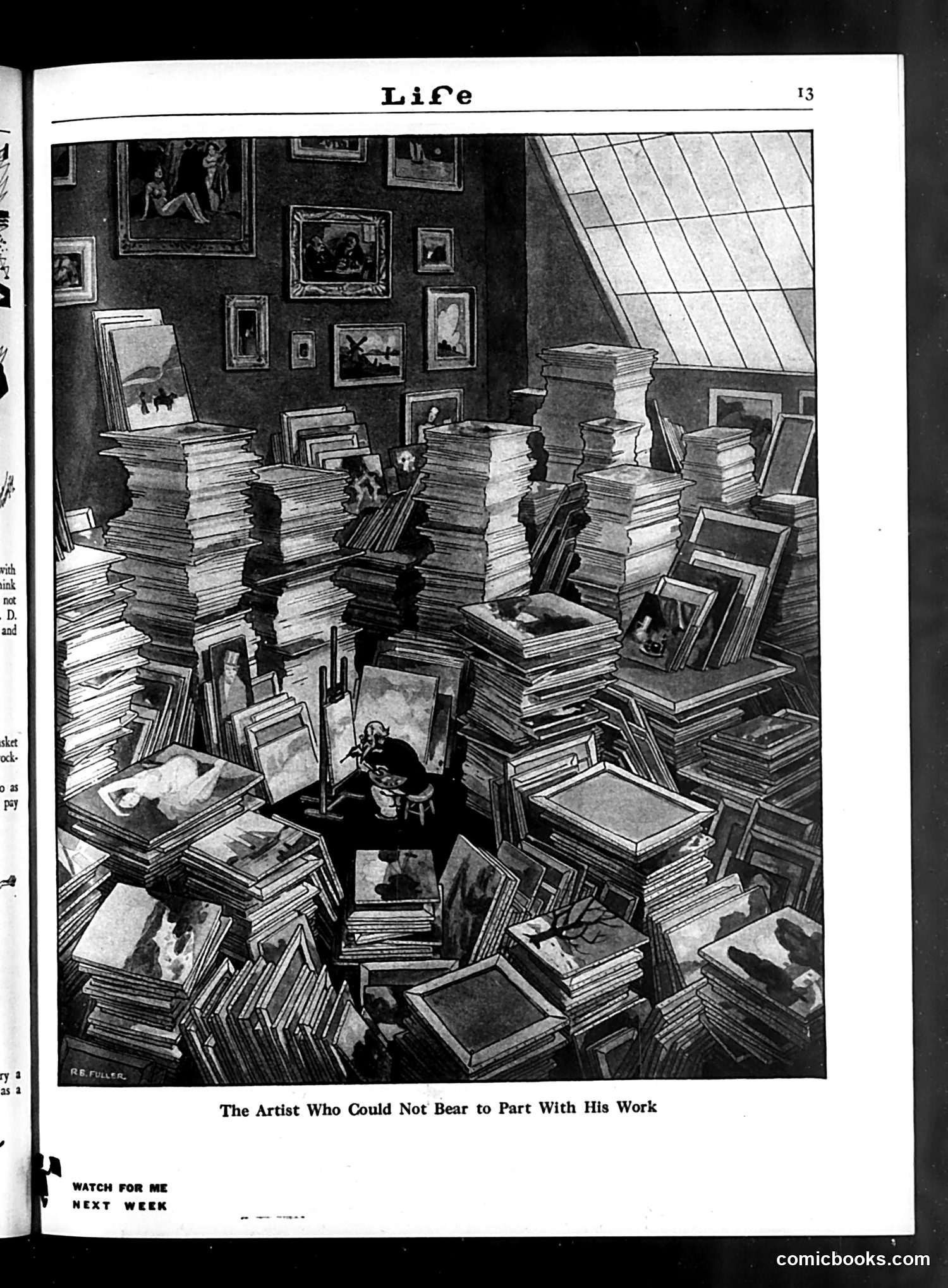
This illustration depicts a satirical commentary on artistic attachment and hoarding. A solitary figure sits surrounded by towering stacks of paintings and artwork filling an entire room—clearly an artist unable to sell or give away his creations. The piles are so excessive they dominate the space, suggesting obsessive accumulation rather than productive output. The satire targets artists (particularly common during the early 20th century) who became so emotionally invested in their work that they couldn't release pieces to the market or public, resulting in homes buried under unsold inventory. This reflects real anxieties about artistic failure, commercial viability, and the gap between an artist's self-assessment and market reception. The crowded composition visually reinforces the absurdity of the situation.
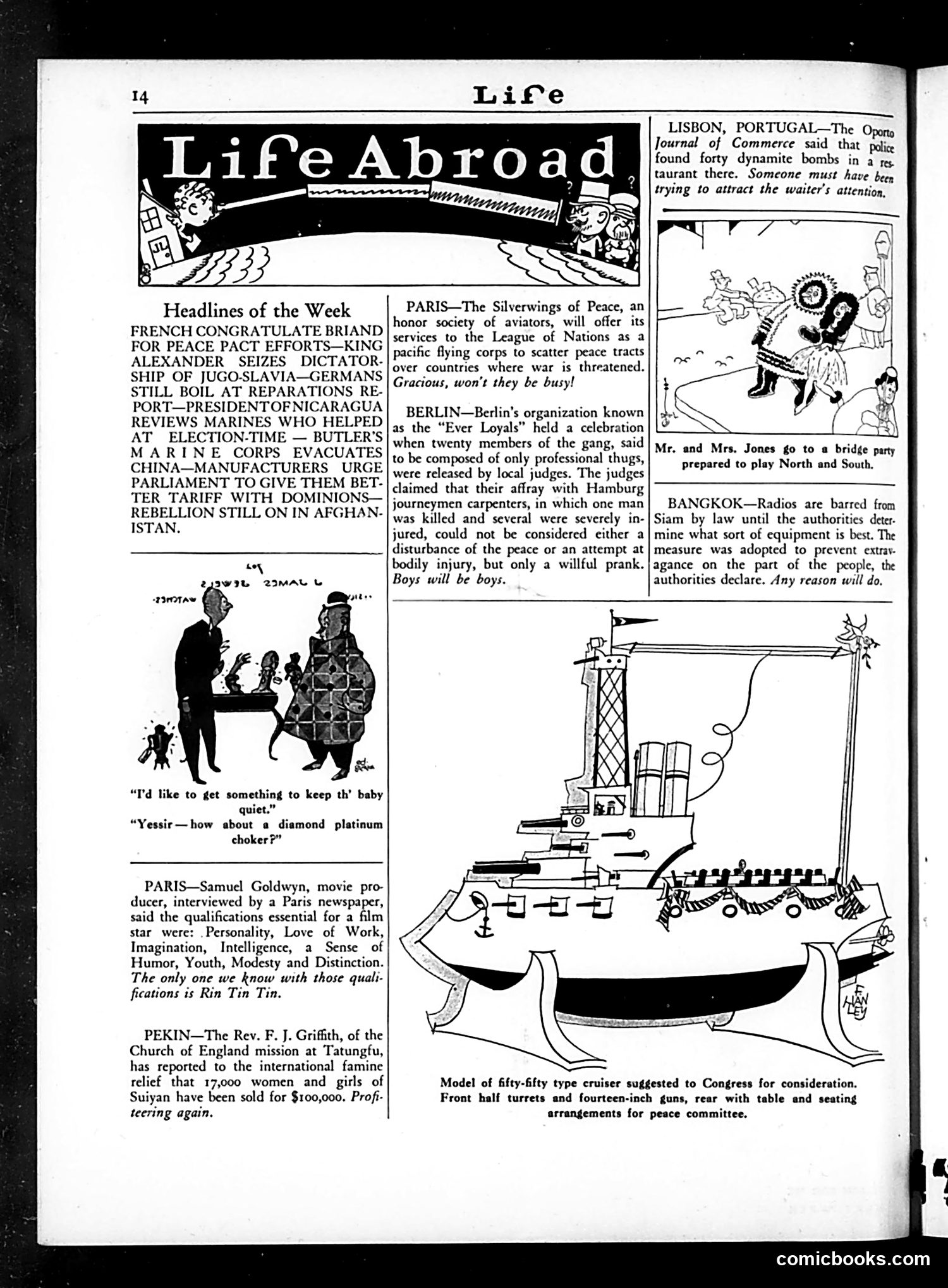
This page contains international news briefs with satirical commentary. The main cartoon shows a man and woman at what appears to be a jewelry counter—he's asking about a "diamond platinum choker" to keep a baby quiet. The satire mocks wealthy parents who use expensive gifts as substitutes for actual parenting. The "Life Abroad" section reports on various international incidents: a dynamite bomb at a Lisbon restaurant, Berlin's "Ever Loyals" organization releasing thugs who injured carpenters (dismissing it as a "prank"), and Bangkok authorities banning radios to prevent espionage. The humor derives from the absurdity and hypocrisy of these official explanations—treating serious crimes or security measures as trivial matters. A technical drawing shows a proposed "fifty-fifty cruiser" warship design for Congress, combining military and peacetime functions.
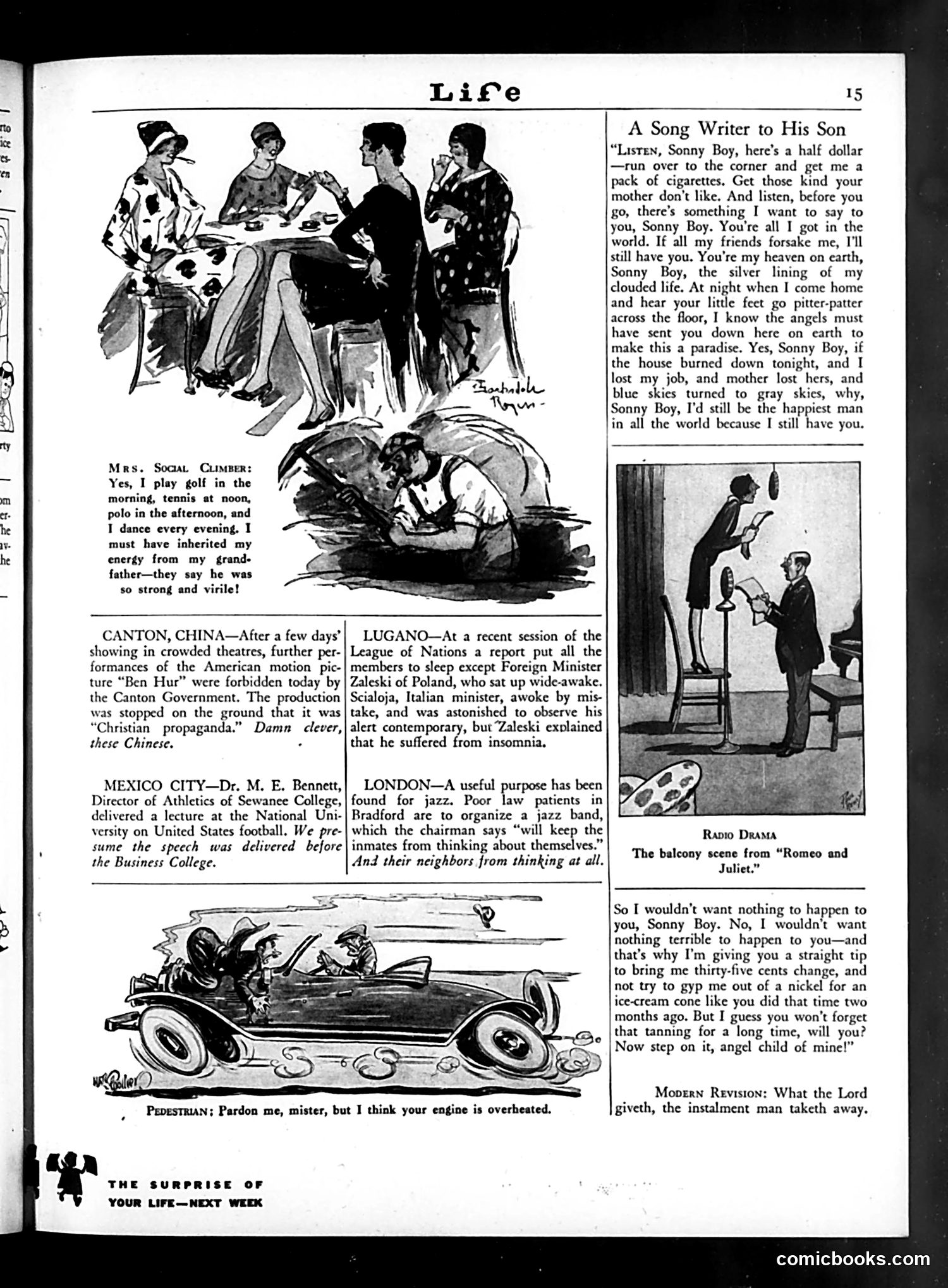
This page contains several satirical pieces targeting social behavior and current events: **Top cartoon**: "Mrs. Social Climber" mocks wealthy women who overextend themselves with constant activities (golf, tennis, polo, dancing), attributing their energy to inherited vigor from ancestors. **International news items**: Brief satirical reports from Canton (censorship of American films as "Christian propaganda"), Mexico City (a speech repeated verbatim), Lugano (Foreign Minister Zaleski's insomnia), and London (jazz bands for psychiatric patients). **Bottom cartoon**: A pedestrian tells an overloaded motorist his engine is overheated—likely satirizing the mechanical strain of modern automobiles or the absurdity of attempting to transport excessive passengers/cargo. **"A Song Writer to His Son"**: A sentimental piece reassuring a son of paternal love despite life's hardships, contrasting sharply with the page's satirical tone.
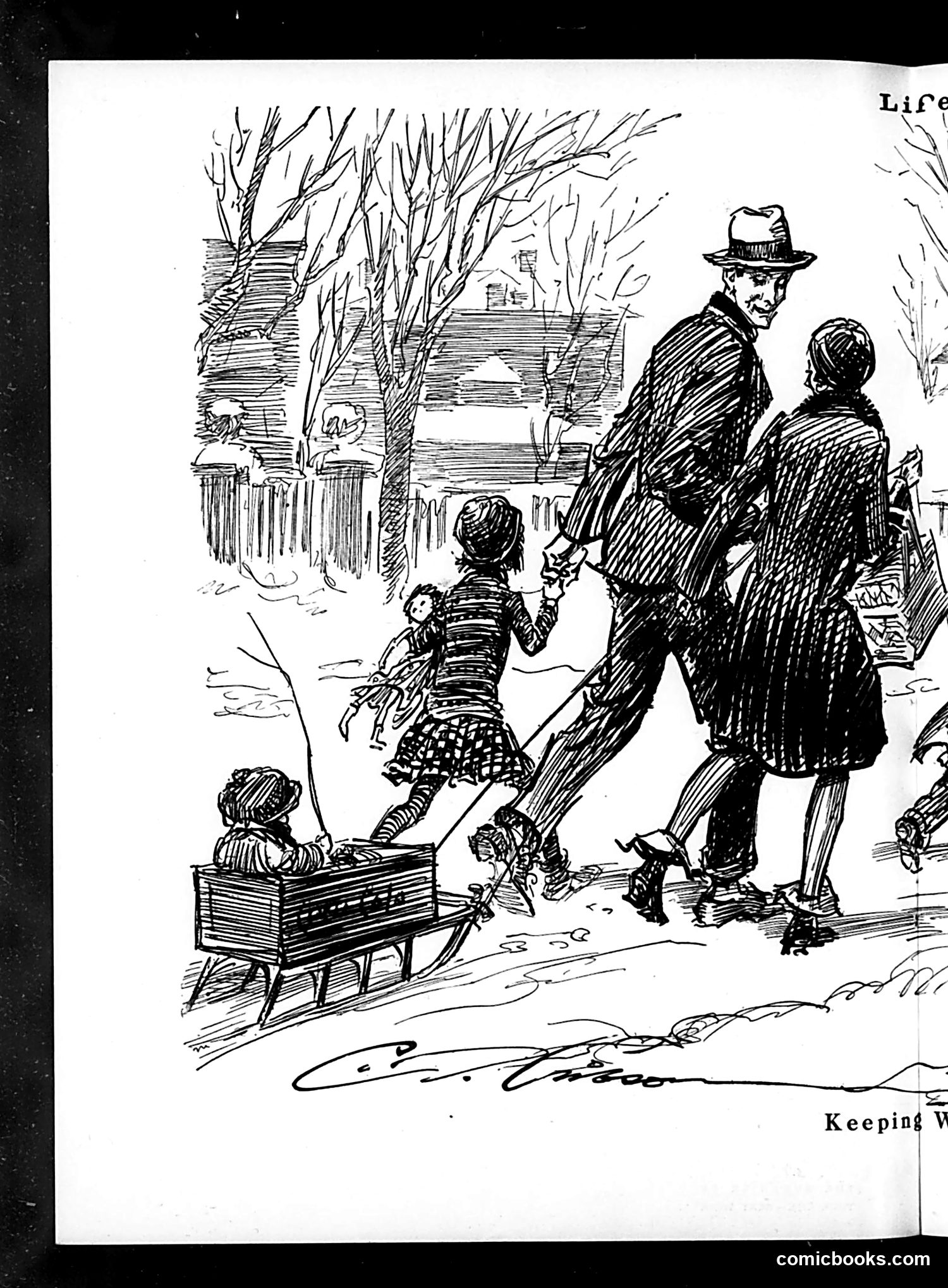
This appears to be a domestic winter scene rather than political satire. The illustration shows an adult man and woman with two children outdoors during winter. One child sits in a wooden sled or box while another stands nearby. Bare trees and snow are visible in the background, along with what appears to be a house. The title "Keeping W[arm]" (partially visible at bottom right) suggests the cartoon's subject is winter activities and family leisure. The artist's signature is visible at the bottom. Without additional context or visible text, the specific satirical message—if any—remains unclear. This may be a humorous domestic illustration about winter recreation rather than social or political commentary.
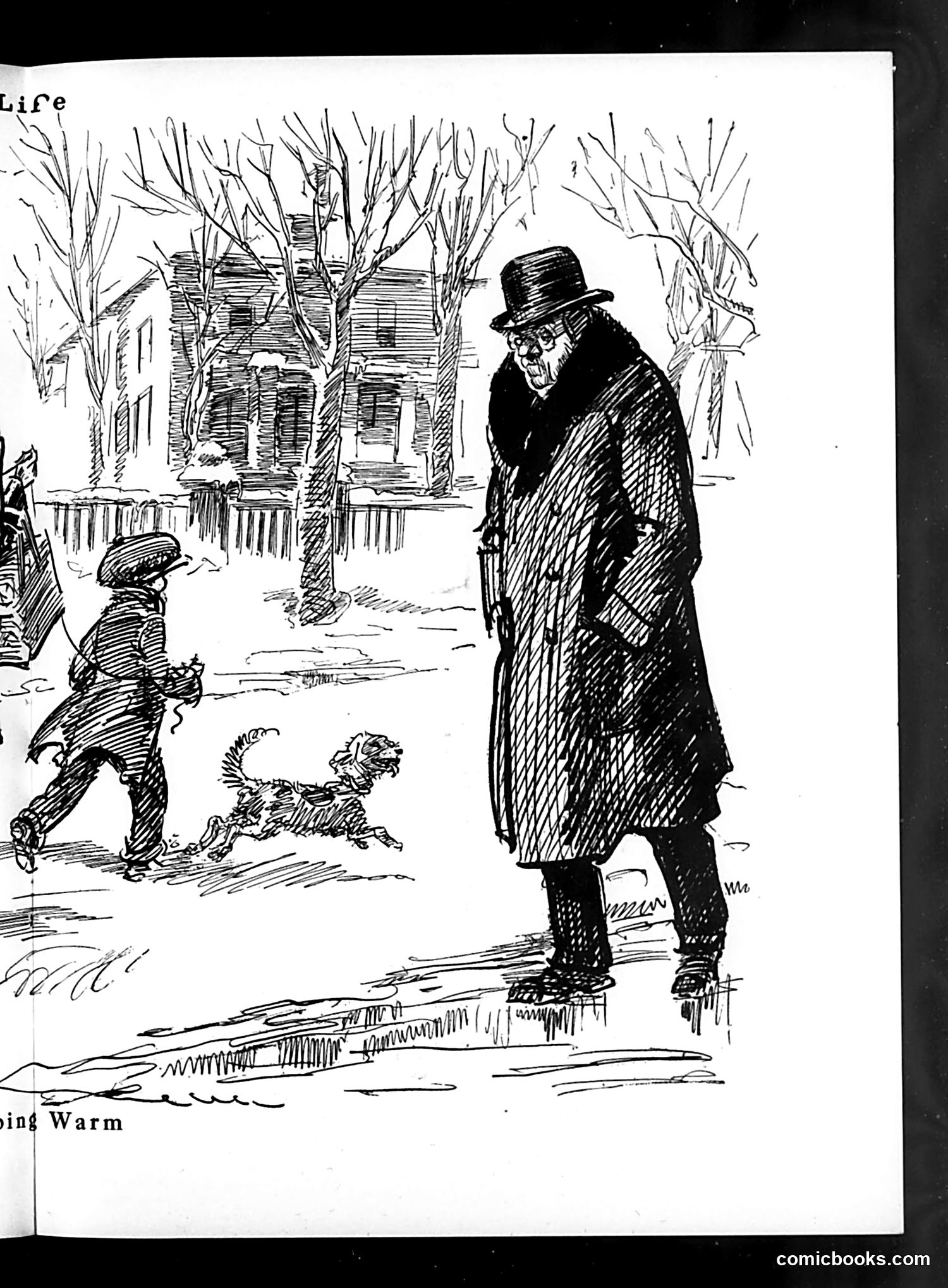
This illustration appears to be titled "Life" (visible at top left) and shows a winter street scene. An elderly man in a heavy overcoat and top hat stands observing a small boy playing with a dog on a snowy street. Bare winter trees and a modest wooden house are visible in the background. The partial text visible at bottom reads "...ing Warm," suggesting this may be part of a larger caption or title about keeping warm. Without the complete caption or title, I cannot definitively identify the specific political or social satire intended. However, the juxtaposition of the well-dressed, seemingly prosperous elderly gentleman observing a poor child and dog in winter conditions likely comments on **class inequality or indifference to poverty** — a common theme in early 20th-century satirical magazines.
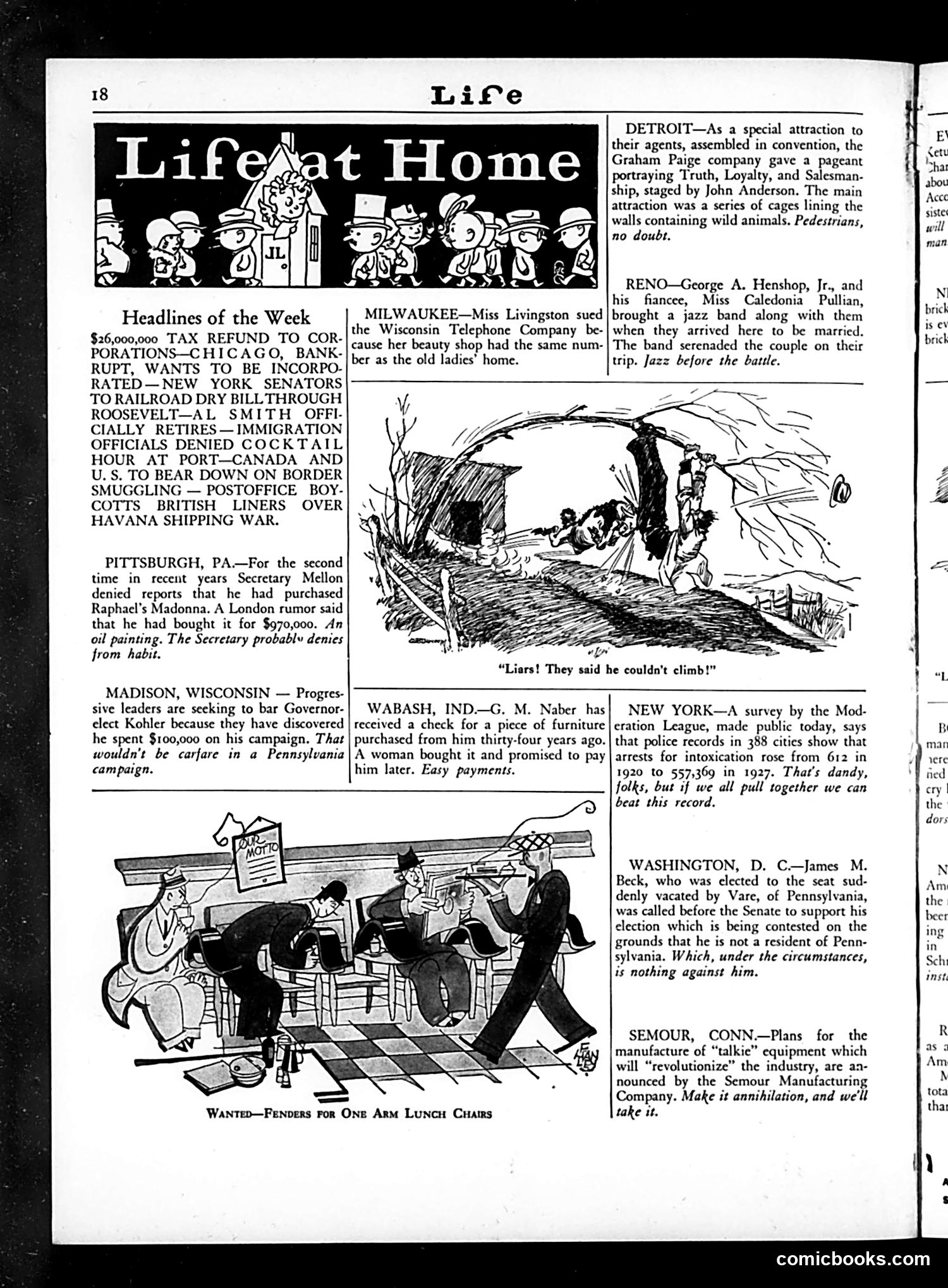
This page from *Life* magazine presents humorous news briefs mocking contemporary 1920s events and figures. The cartoons and jokes target: **Political absurdities**: A $26 million corporate tax refund while Chicago faces bankruptcy; Pennsylvania politicians spending lavishly on campaigns; Secretary of the Treasury Mellon repeatedly denying he bought a Raphael painting—satirizing his compulsive denials. **Social contradictions**: Prohibition's failure, with intoxication arrests rising from 612 (1920) to 557,369 (1927), yet *Life* sarcastically encourages "beating this record." A Pennsylvania politician (James M. Beck) faces election challenges over residency—*Life* quips this is "nothing against him," mocking such technicalities. **Modern absurdities**: A woman finally paying for furniture purchased 34 years prior on "easy payments"; a beauty shop suing the telephone company for sharing a number with an old ladies' home. The cartoons illustrate these contradictions visually, particularly one showing musicians playing instruments around furniture—likely mocking the "one-arm lunch chairs" mentioned in the caption, or business absurdity generally.
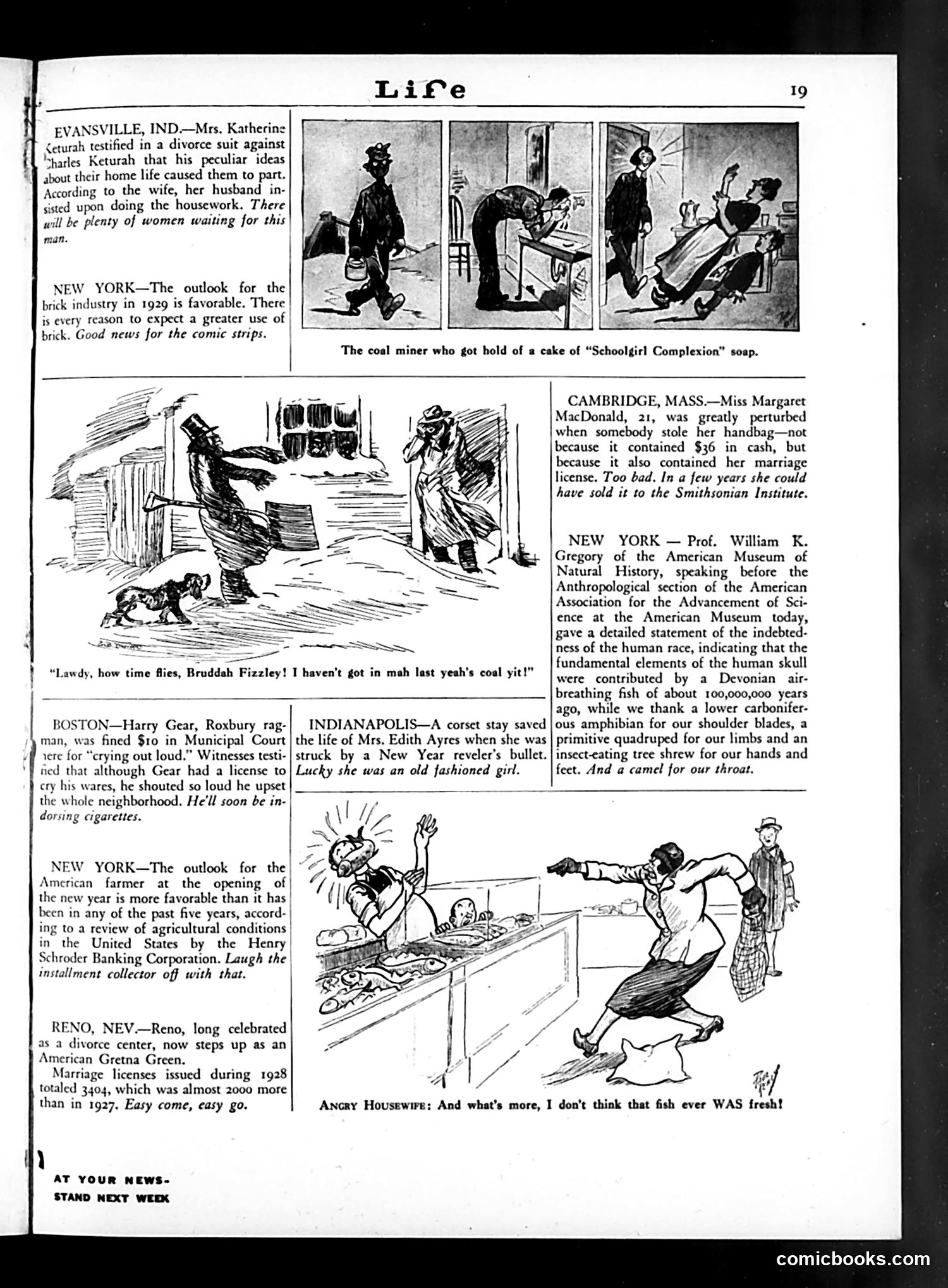
This page collects humorous brief news items and cartoons satirizing 1920s American life. Key points: **The "Schoolgirl Complexion" soap cartoon** mocks beauty product advertising by showing a coal miner using the soap—the joke being the absurd contrast between the product's delicate, feminine branding and a grimy worker. **The news briefs** use ironic humor: - A husband doing housework is presented as so unusual that women would "wait" for him—mocking gender role expectations - A rag man fined for "crying out loud" selling wares will soon "endorse cigarettes"—suggesting he'll become a commercial spokesperson - A woman's stolen marriage license as throwaway punchline about divorce culture **The bottom cartoon** shows an angry housewife rejecting her husband's fish dinner, captioning "I don't think that fish ever WAS fresh!"—a domestic complaint joke. **The Reno reference** satirizes Nevada's lenient divorce laws and booming marriage license business as mercenary ("Easy come, easy go"). Overall, the page mocks commercialism, gender roles, divorce culture, and consumer product advertising typical of 1920s America.
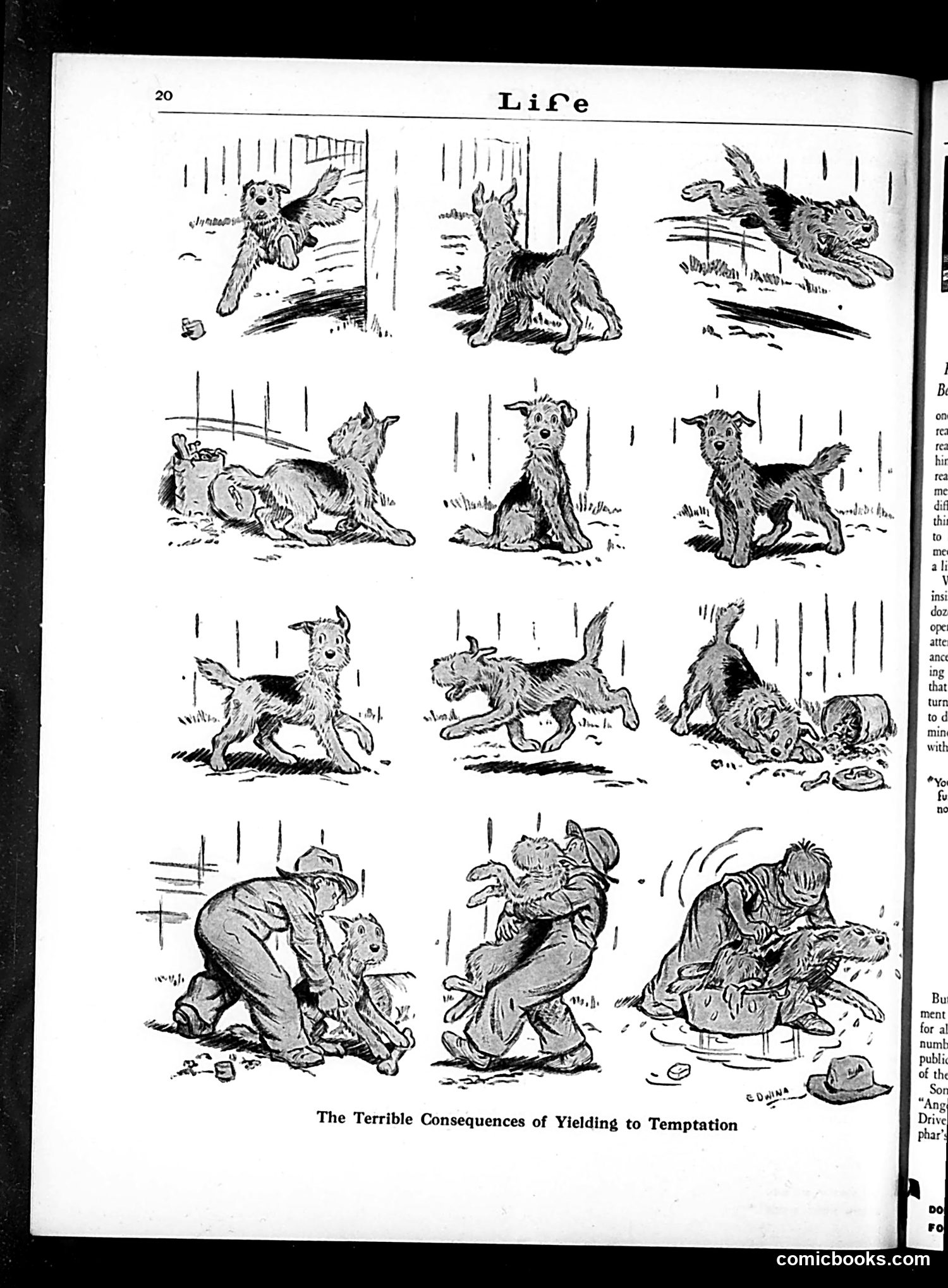
This is a sequential comic strip showing a dog's downfall. The narrative progresses from the top: a dog is initially tempted (appears to steal or take something), then shown in various states of mischief and trouble. The middle panels show the dog getting into increasingly worse situations—appearing guilty, chaotic, and destructive. The final row depicts the consequences: what appears to be a farmer or authority figure discovering the dog's misdeeds, resulting in punishment or abandonment in the rain. The satire uses animal behavior as moral instruction—a common Victorian/early 20th-century didactic approach. The strip warns against giving in to temptation by depicting escalating chaos and punishment, reflecting contemporary moralistic values about consequences and self-control. The anthropomorphized dog makes the lesson accessible and darkly humorous.
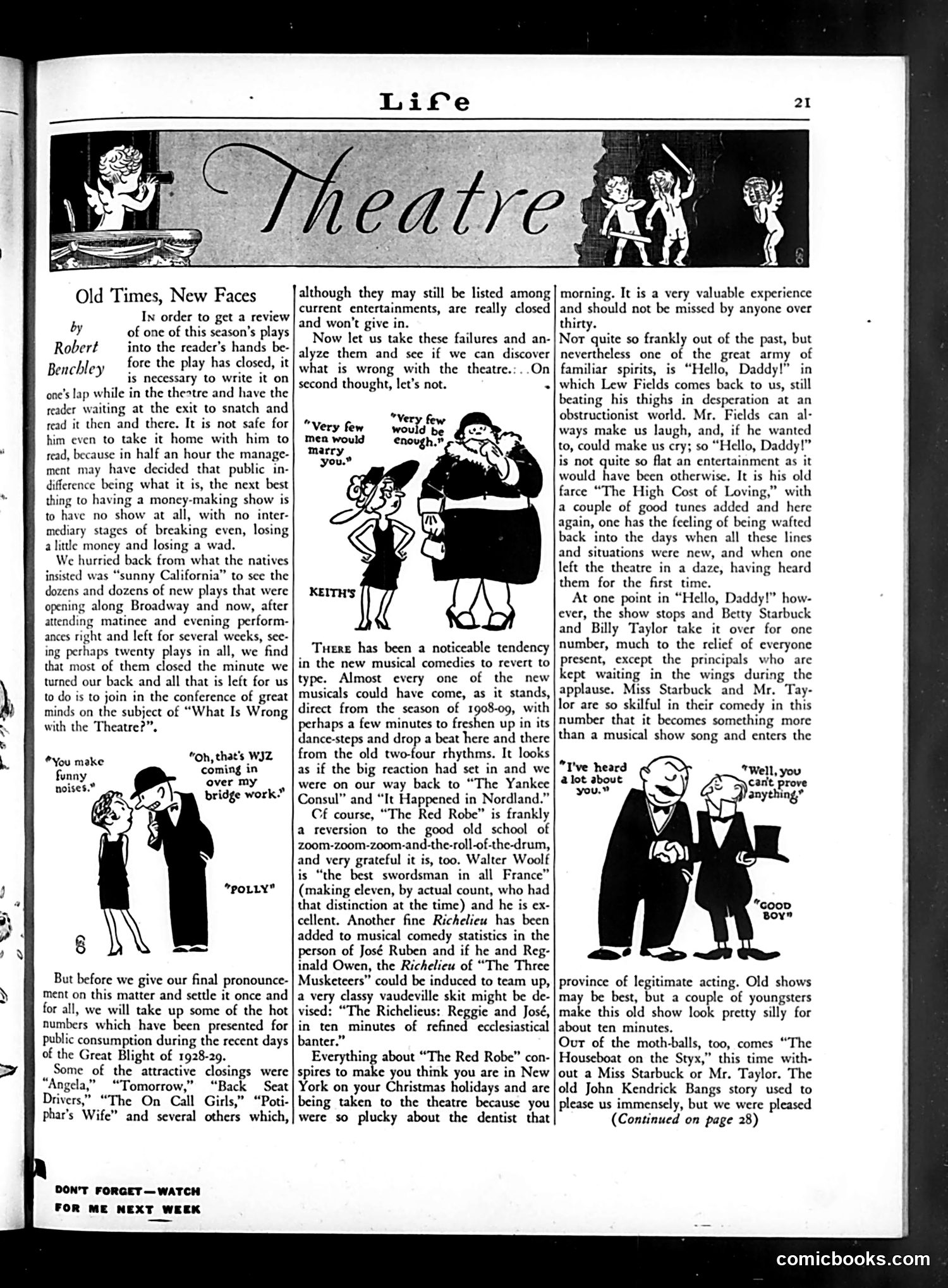
Robert Benchley satirizes Broadway's rapid turnover in 1928-29, complaining that plays close so quickly he must review them in the theatre itself rather than taking notes home. The piece mocks both the theatre industry's instability and critics' endless debate about "What Is Wrong with the Theatre?" The scattered cartoons illustrate conversational snippets—a couple discussing bridge-work interference, another about "funny noises"—representing overheard theatre chitchat that adds little insight. Benchley reviews several current shows, notably praising "The Red Robe" (starring Walter Woolf) as nostalgic spectacle reminiscent of early-1900s musical comedy, and "Hello, Daddy!" featuring veteran performer Lew Fields. He observes that modern musicals are simply revivals of outdated 1908-09 styles rather than innovative work, suggesting Broadway has creatively stalled while churning through productions at unsustainable speed.
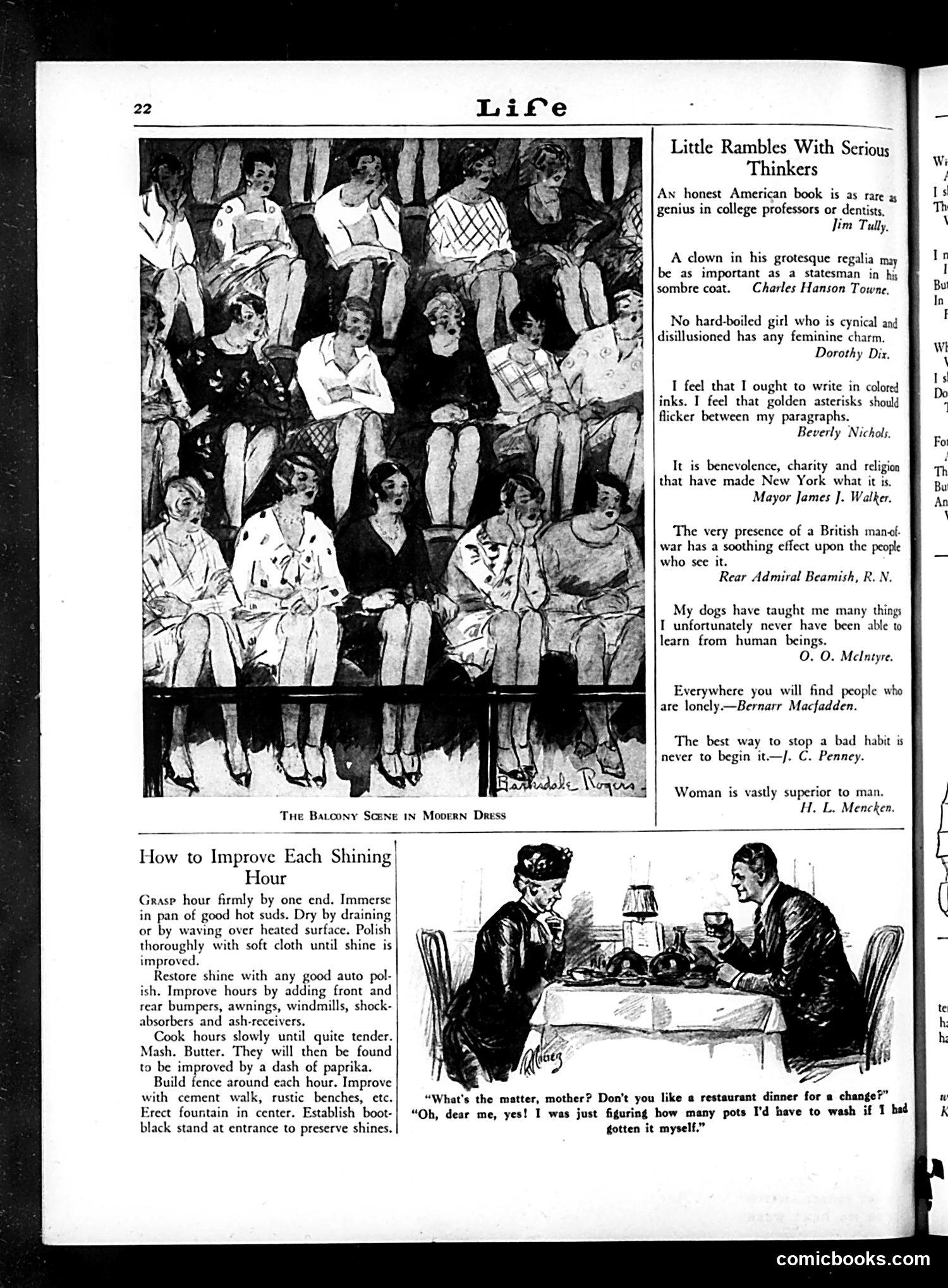
**Top Image ("The Balcony Scene in Modern Dress"):** A satirical illustration showing multiple women in 1920s dress seated together, mimicking the famous balcony scene from *Romeo and Juliet*. The joke critiques how contemporary women have replaced romantic drama with casual socializing—they're dressed fashionably but utterly unromantic, sitting like spectators at a show rather than experiencing passion. **"Little Rambles with Serious Thinkers":** A collection of quotations attributed to notable figures (Mayor Jimmy Walker, H.L. Mencken, Dorothy Dix, etc.). The satire lies in presenting these as profundities when many are obvious platitudes or contradictions (Mencken claims women are superior to men, yet the page's humor often mocks women). **"How to Improve Each Shining Hour":** Mock advice that absurdly applies domestic/automotive maintenance language to time itself—treating hours like shoes to polish or cars to upgrade. The satire mocks self-help culture's pretentious triviality. **Bottom Cartoon:** A housewife declines restaurant dining because she'd still need to wash pots at home. The joke satirizes women's endless domestic labor regardless of leisure opportunities.
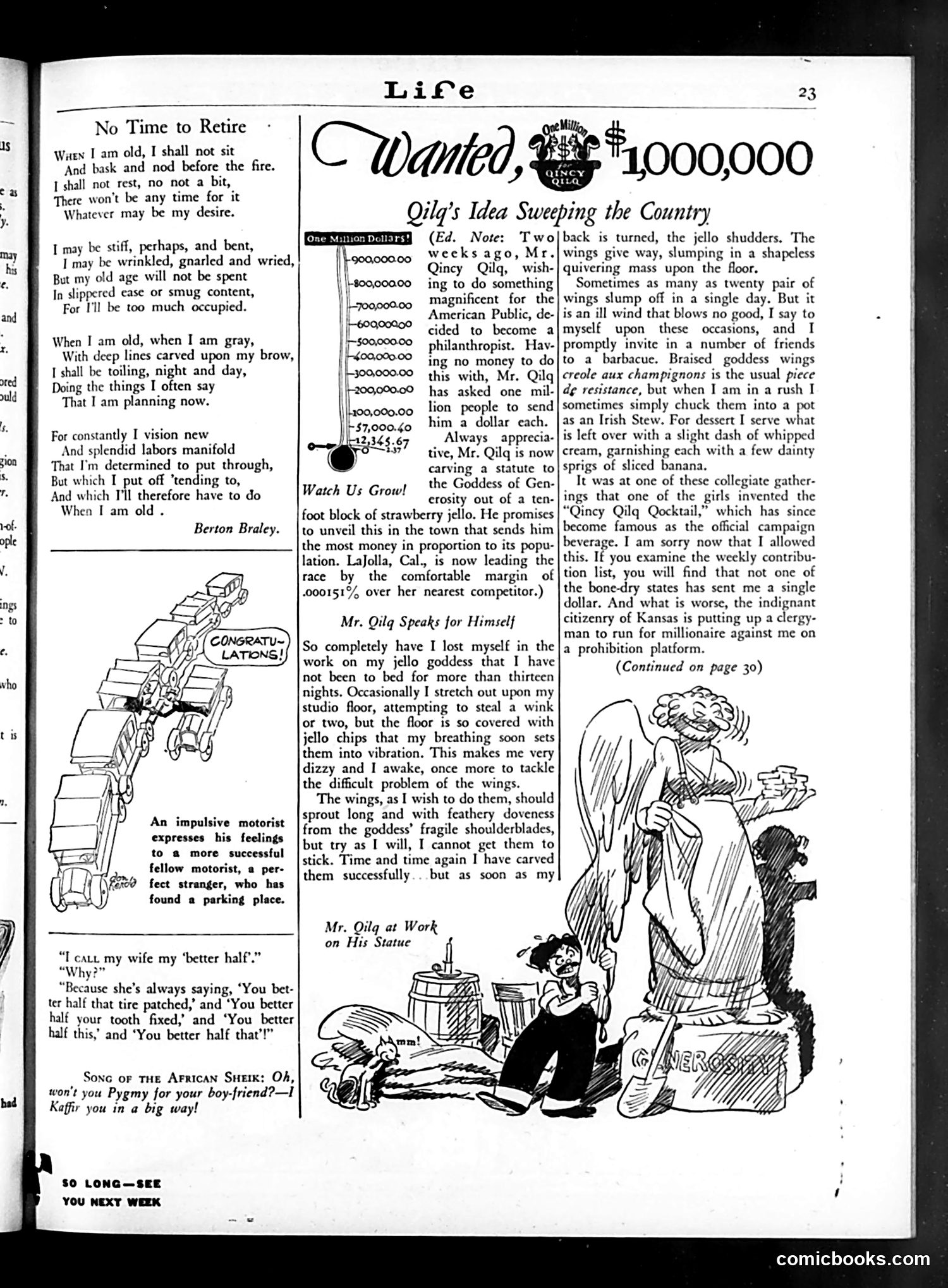
This page satirizes a contemporary craze called "Oilq's Idea"—a philanthropic scheme by an eccentric named Quincy Oilq who solicits one million dollars from the public to carve a statue of the Goddess of Generosity from strawberry jello. The satire mocks both Oilq's impractical vision (a jello statue that constantly collapses) and American gullibility toward grand charitable schemes. Towns compete by pledging money "in proportion to population," turning altruism into a contest. The joke deepens through Oilq's absurd description: he hasn't slept in thirteen nights, the jello chips make him dizzy, and failed wing-sculptures become barbecue for friends. The piece lampoons the era's tendency toward elaborate, wasteful "philanthropy" schemes and the public's eager participation in dubious fundraising. It's simultaneously a commentary on artistic pretension and capitalist excess dressed in charitable language.
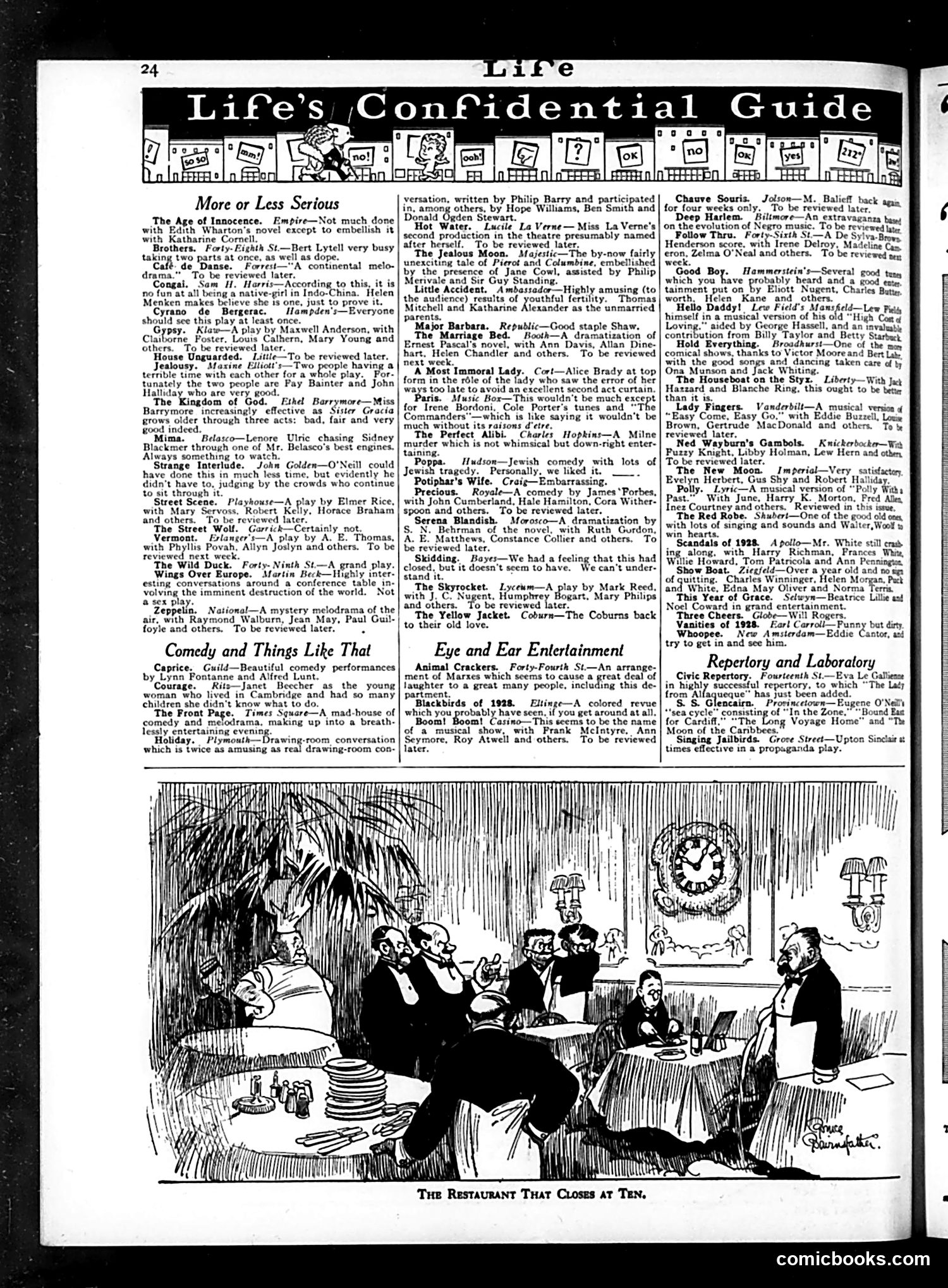
This page contains theater reviews typical of Life's satirical entertainment coverage. The top section offers brief, witty critiques of Broadway productions, mixing genuine assessment with sardonic commentary. Reviews praise strong performances (Ethel Barrymore in "The Kingdom of God") while mocking weaker productions with pointed brevity ("Zeppelin. National—A mystery melodrama of the air...To be reviewed later"). The cartoon at bottom, titled "The Restaurant That Closes at Ten," depicts diners at what appears to be an upscale restaurant. The humor likely satirizes wartime or post-war dining restrictions—possibly referencing early-closing mandates that were common during various periods. The crowded, slightly chaotic scene suggests patrons trying to enjoy themselves within imposed constraints, a typical Life satirical approach to social inconvenience.
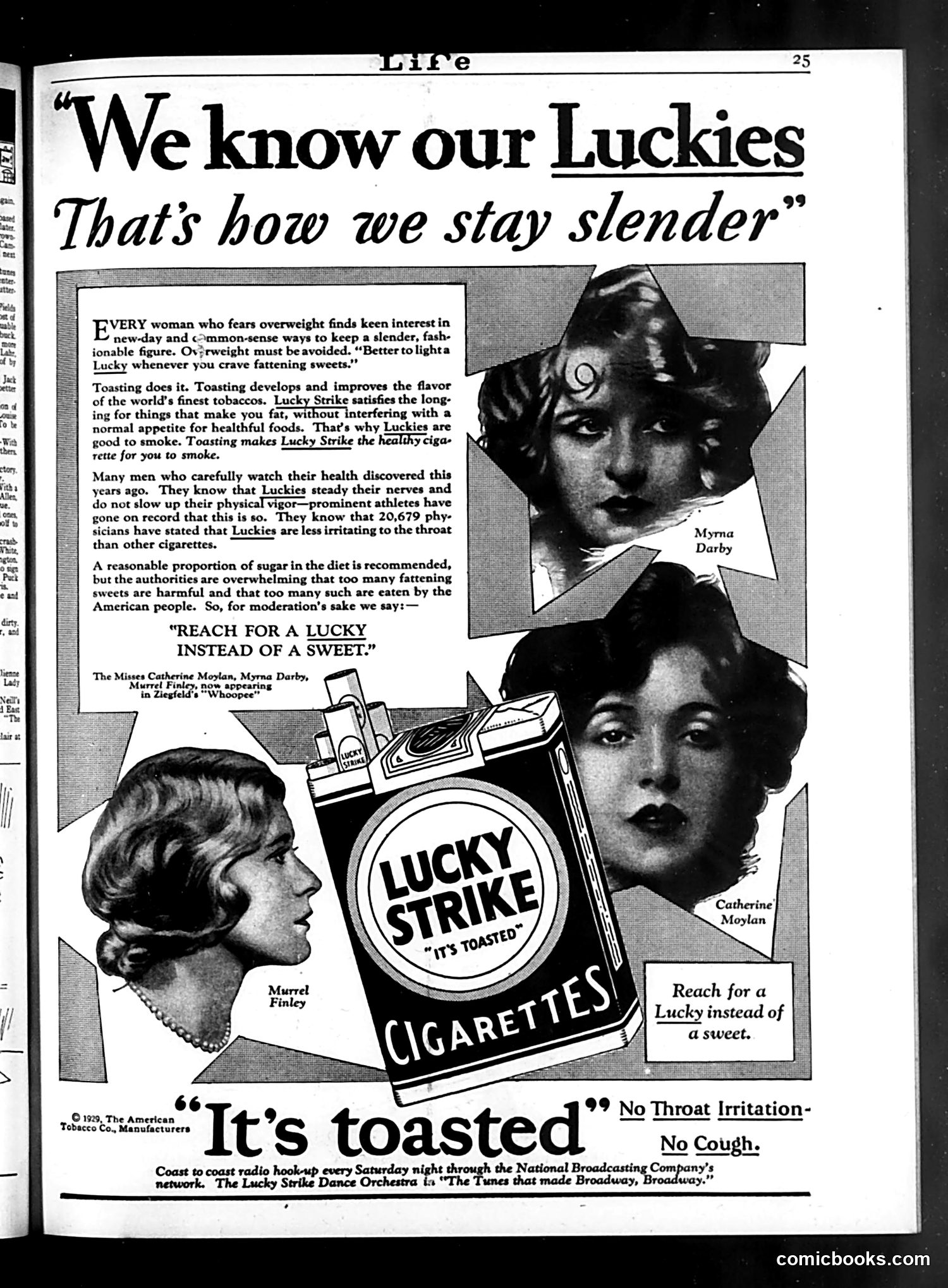
This is **not satire**—it's a straightforward cigarette advertisement disguised as health advice, featuring three actresses from the Ziegfeld theatrical production "Whoopee." The ad's core pitch: **smoke Lucky Strikes instead of eating sweets** to stay slim. It exploits 1920s anxiety about female weight and appearance by presenting cigarettes as a legitimate appetite suppressant and health product. The claims are medically fraudulent by modern standards: - "20,679 physicians" allegedly endorsed them as less irritating - Toasting supposedly makes them "healthy" - They "steady nerves" without harming "physical vigor" The tagline "Reach for a Lucky instead of a sweet" became one of advertising history's most notorious examples of using social insecurity (fear of weight gain) to market an addictive, harmful product to women. This reflects early 20th-century advertising's brazen health claims before FDA regulation and the eventual surgeon general's warnings on cigarettes.
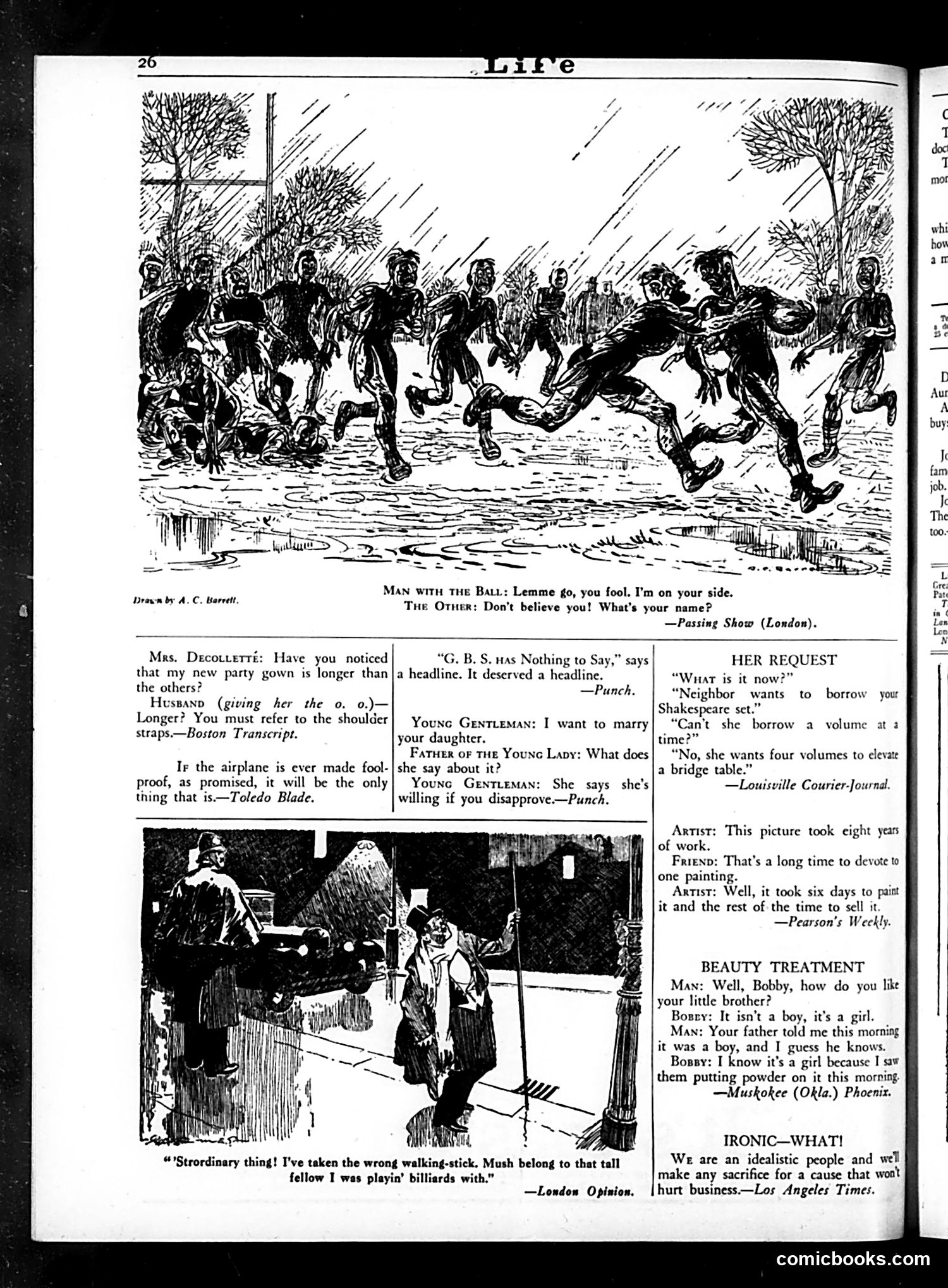
This page contains multiple satirical humor pieces typical of early 20th-century Life magazine: **Top cartoon** (by A.C. Barrett): Shows people in rain playing football/rugby. The joke depicts confusion during a chaotic game—one player protests he's on the same team, but others don't believe him without verification of his identity. It satirizes wartime paranoia or social suspicion (the reference to "sides" suggests a WWI-era context). **Scattered jokes** mock social pretension (a woman bragging about her longer dress), male indifference to fashion, courtship customs, and modern technology (airplane safety). **Lower cartoon**: A figure with a walking stick, captioning a mix-up over borrowed items—social awkwardness played for humor. The **final item** critiques American contradiction: claiming to be idealistic while refusing sacrifices that hurt business interests—a sharp jab at hypocrisy. These represent Life's characteristic blend of domestic comedy, social satire, and political commentary aimed at educated readers.
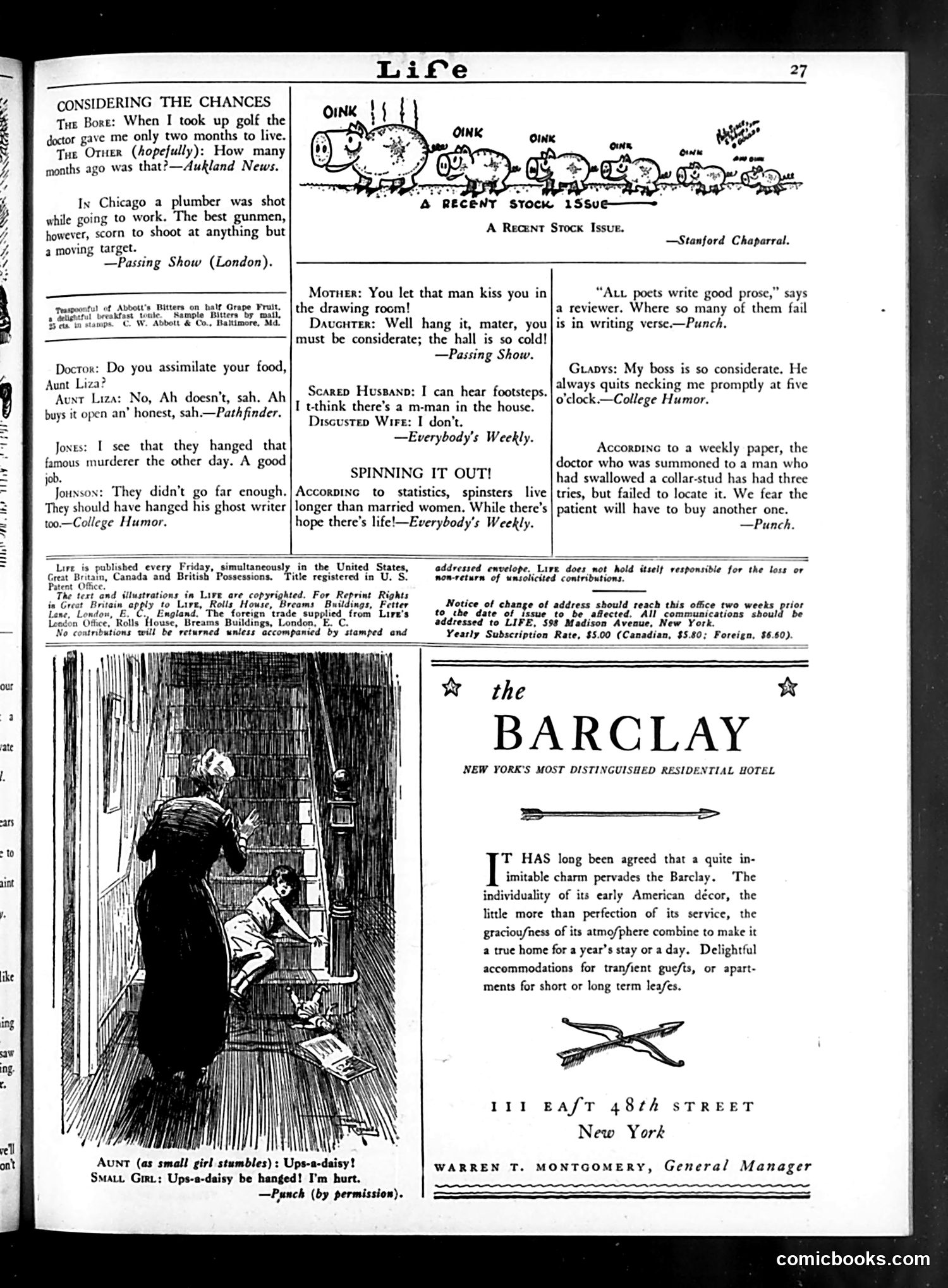
This page from *Life* magazine (a satirical weekly, not the photo magazine) collects brief jokes and quips mocking various social situations and human nature. Key targets include: **The humor relies on:** - **Contradiction/irony**: A golfer given two months to live by his doctor takes up golf anyway; a plumber is shot going to work, yet we worry about "moving targets" - **Class and dialect comedy**: "Aunt Liza" speaks in exaggerated African American vernacular; a scared husband and wife trade nervous banter - **Social pretense**: A daughter justifies allowing a kiss indoors because "the hall is so cold"—prioritizing comfort over propriety - **Gender stereotypes**: Spinsters live longer than married women because there's "hope" in remaining single; necking bosses and ghost writers merit hanging The accompanying **Barclay Hotel advertisement** offers upscale Manhattan lodging, contrasting sharply with the working-class and domestic scenarios in the jokes above. The cartoon shows an elderly woman and young girl on tenement stairs; the child's injury is dismissed with cheerful "ups-a-daisy," which she indignantly rejects—mocking sentimental adult condescension toward children's actual pain.
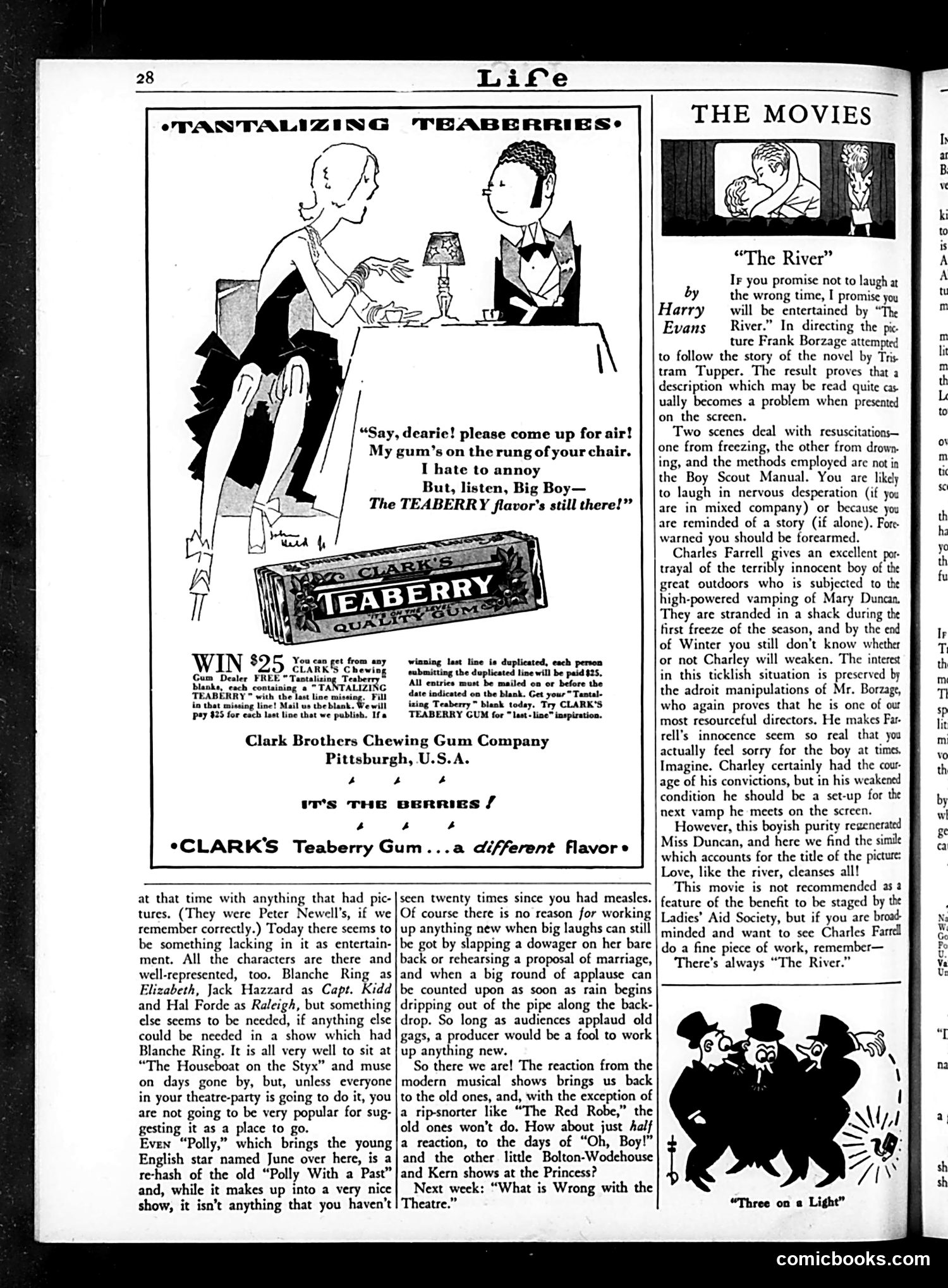
This page contains a **chewing gum advertisement** (left) and **movie reviews** (right). The cartoon depicts a flirtatious dinner scene where a woman playfully complains that a man's gum is stuck to her chair—a comedic setup for Clark's "Teaberry" gum brand. The ad includes a contest offering $25 for readers to complete the missing final line of the jingle. This represents early 20th-century interactive advertising, where companies engaged consumers through competitions. The right column reviews current films, including "The River" (directed by Frank Borzage, starring Charles Farrell). The reviewer critiques the film's attempt to adapt a novel for screen, noting two awkward resuscitation scenes that provoke unintended laughter. The review praises Farrell's innocent portrayal and the moral redemption plotline, where a woman's love "cleanses" the protagonist like a river cleanses. Both sections reflect 1920s entertainment culture and advertising strategies.
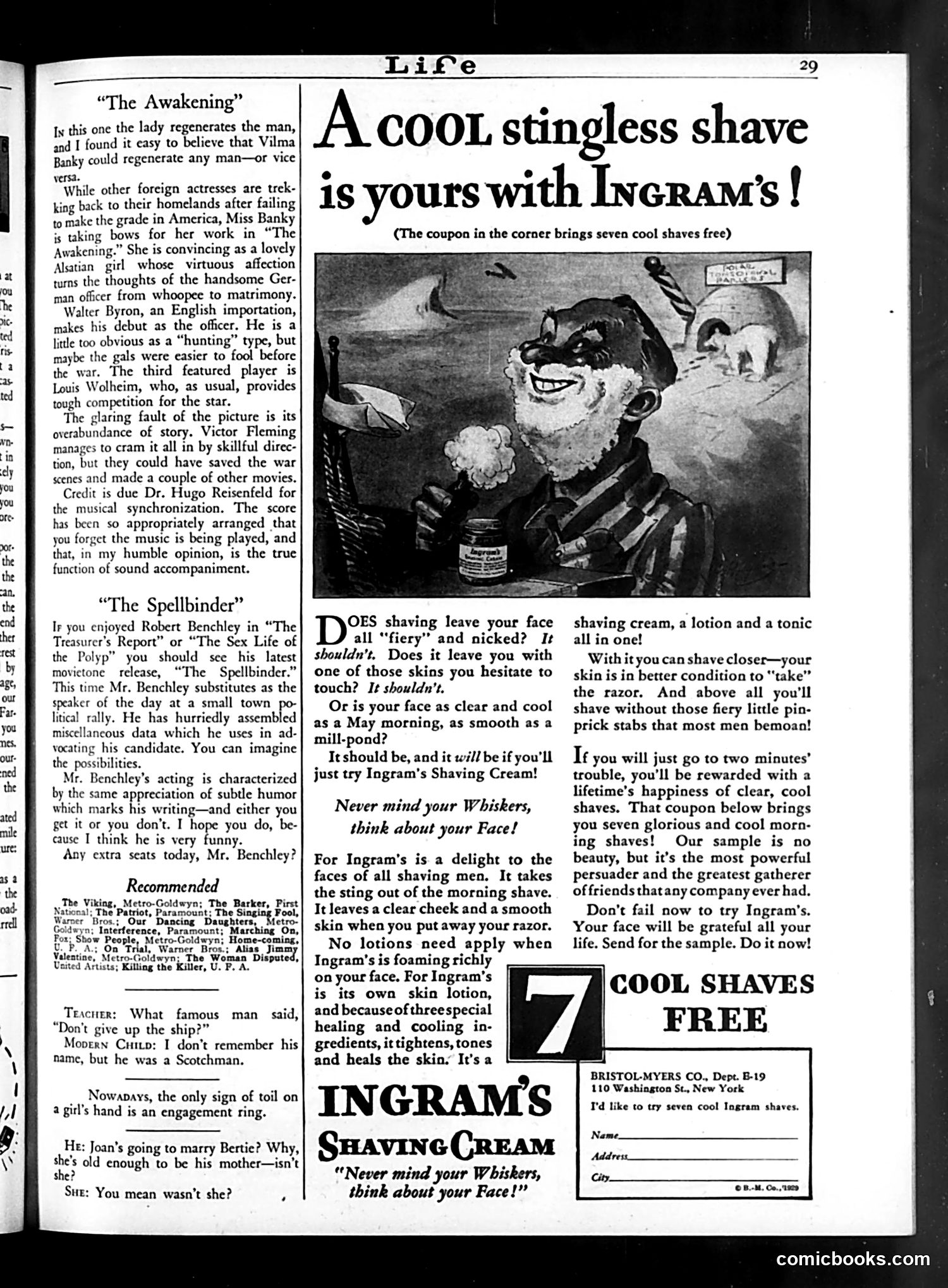
This page contains **film reviews** alongside a **vintage shaving cream advertisement**. The reviews discuss two 1928 films: "The Awakening" (featuring foreign actress Vilma Banky) and "The Spellbinder" (a comedy short with Robert Benchley). The critic praises Banky's performance in a romantic drama but criticizes plot excess; Benchley's humor is deemed subtle and personal. The **large advertisement for Ingram's Shaving Cream** dominates the right side. The illustrated caricature shows an exaggerated, grinning man's face—a typical period advertising style. The ad's tagline, "Never mind your Whiskers, think about your Face!" emphasizes that the product's real benefit is skin condition, not just shaving effectiveness. The ad promises smooth skin, reduced irritation, and offers seven free shaves via coupon. This reflects 1920s marketing: personal grooming advertisements targeting men through humor and aspirational imagery, treating shaving as a skincare routine rather than mere hair removal.
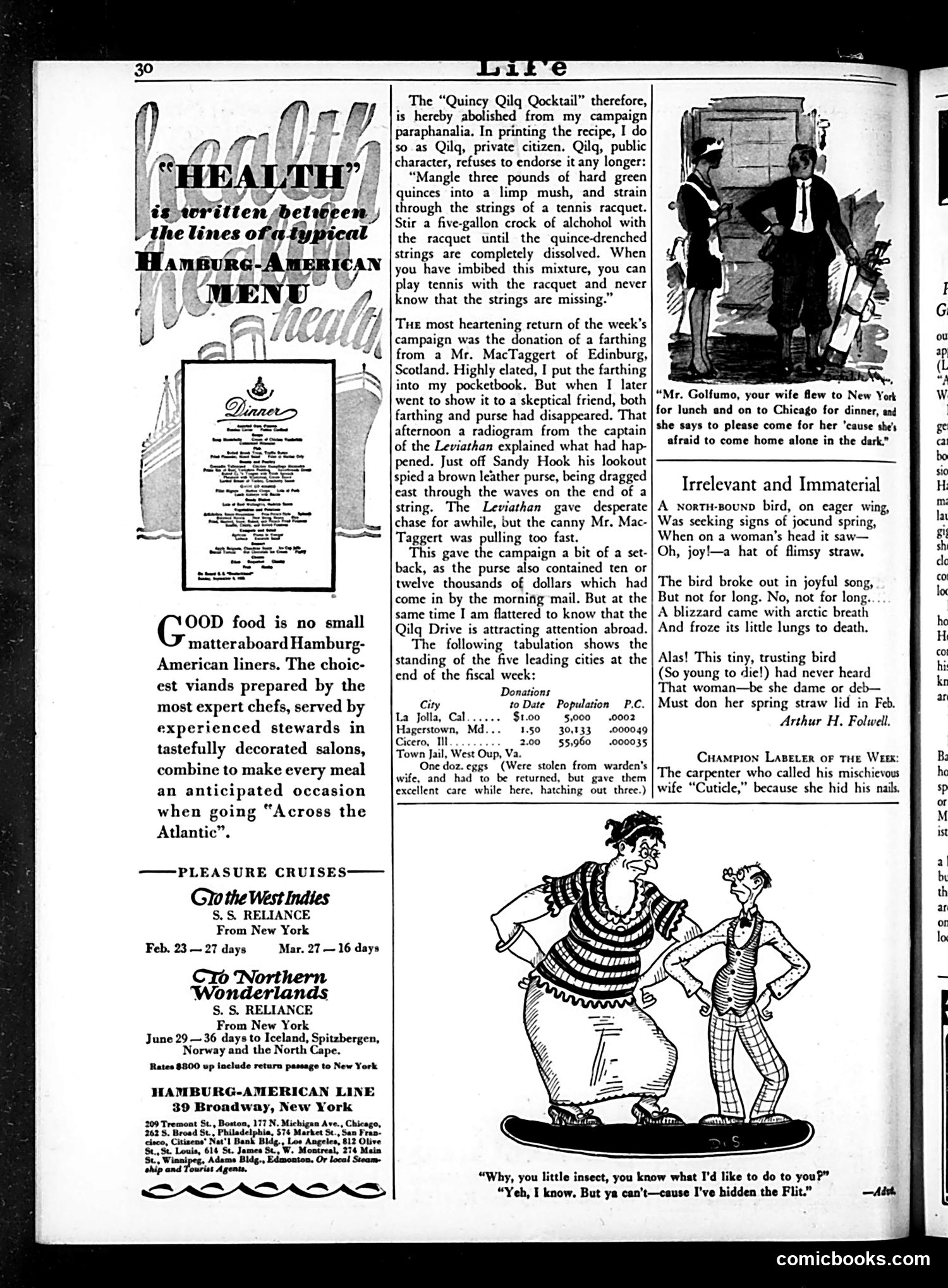
This page primarily showcases **advertising and humorous filler content** rather than political satire. The main elements are: **Hamburg-American Line ads** promoting luxury ocean cruises dominate the left side, emphasizing fine dining and trans-Atlantic travel—marketing to wealthy readers. **"The Quincy Qilq Cocktail"** appears to be a fictional campaign joke (likely satirizing Prohibition-era politics), where a character named Qilq distances himself from endorsing a ridiculous cocktail recipe involving tennis racquets and alcohol. **Minor humorous columns** fill the right side: a poem about a bird freezing on a woman's hat (mocking early spring hat fashion), and a joke about a carpenter whose wife hides his nails, with a final panel referencing "Flit" (a contemporary insecticide brand). The cartoon at bottom shows a large man and small insect, playing on the product placement punchline. **Overall context:** This is entertainment and advertising content aimed at affluent readers during the interwar period—no significant political commentary is present.
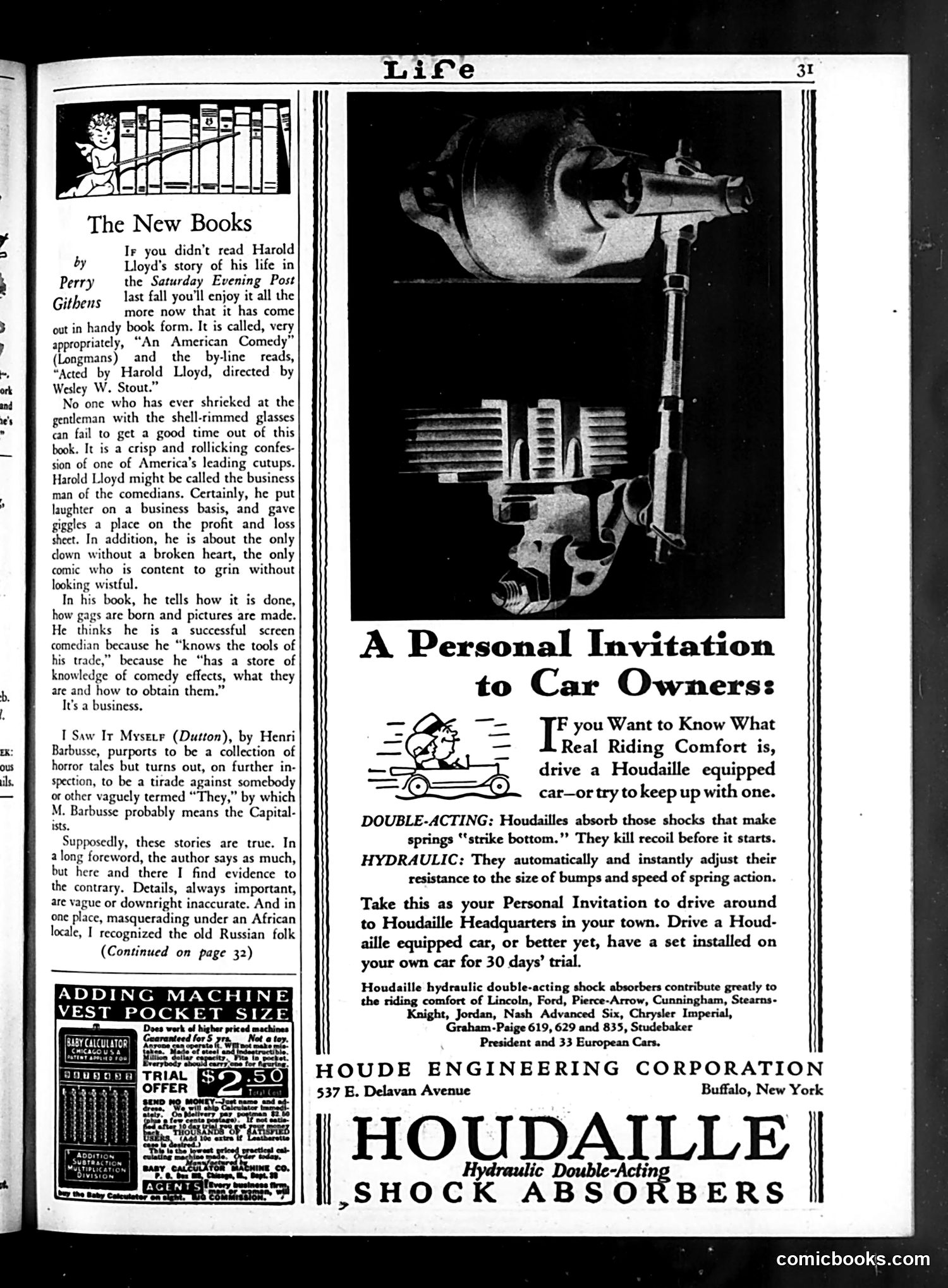
This page mixes book reviews with advertising, typical of 1920s Life magazine format. **Book Reviews Section:** Perry Gibhens reviews Harold Lloyd's autobiography "An American Comedy." Lloyd was a famous silent-film comedian known for his shell-rimmed glasses and physical comedy. The reviewer praises Lloyd as unique among comedians for treating humor as a business enterprise rather than pursuing the melancholy "broken heart" persona common in silent comedy. Lloyd's book allegedly explains his systematic approach to creating gags and film production—presenting comedy as a technical craft rather than inspiration. A second review discusses "I Saw It Myself" by Henri Barbusse, a collection allegedly presenting "horror tales" that functions as anti-capitalist propaganda attacking "They" (capitalists). The reviewer notes the author's historical inaccuracies. **Advertisements:** The page features a large Houdaille shock absorber advertisement targeting car owners, emphasizing the product's technical superiority and comfort benefits across multiple automobile brands.
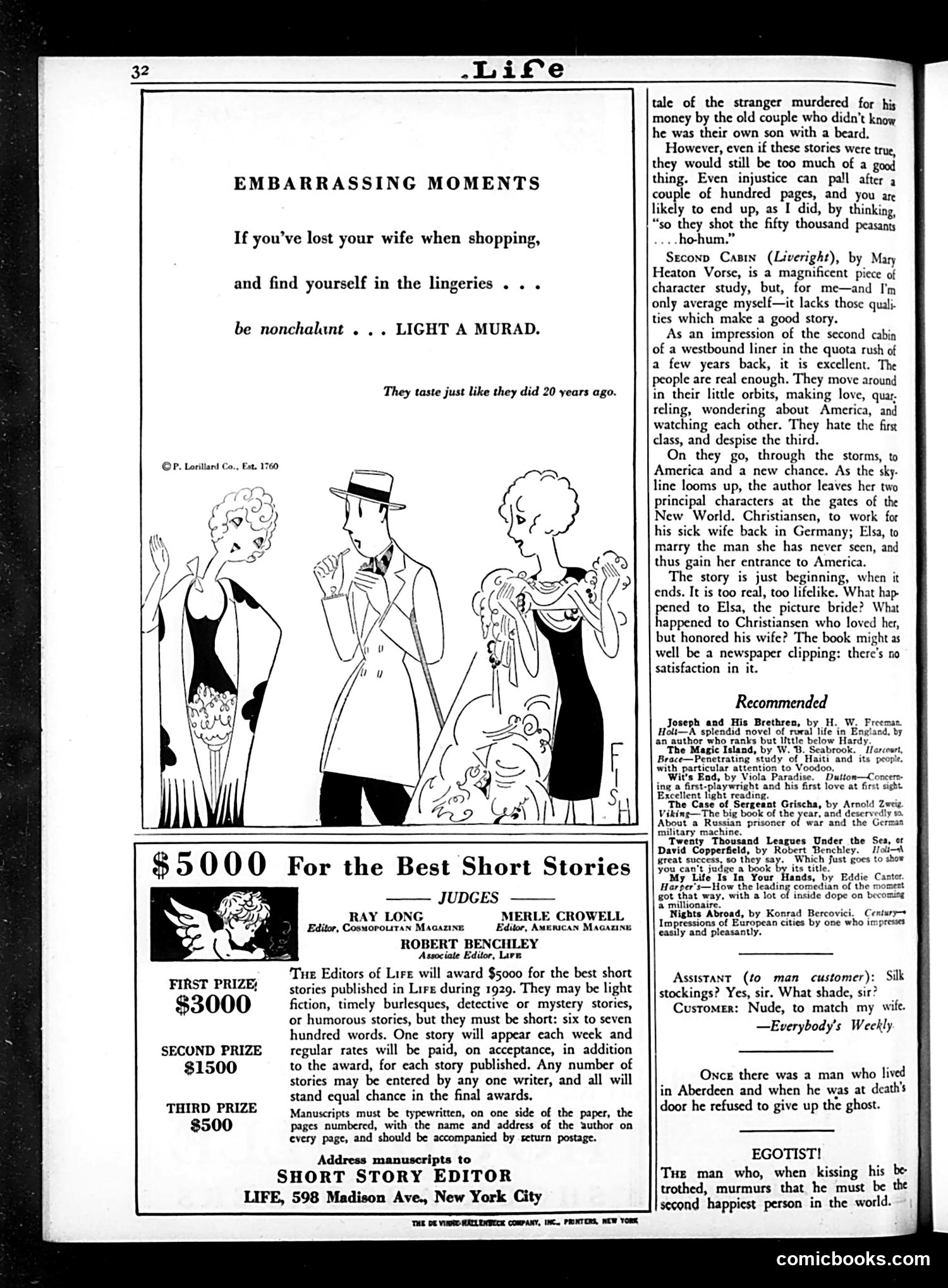
This 1920s advertisement masquerades as humor. The cartoon depicts a man awkwardly confronted by women while shopping in the lingerie section—a scenario considered mortifying for the era's standards of male modesty. The joke relies on gender embarrassment: a man in a women's intimate apparel department was considered deeply uncomfortable social transgression. The "solution" is to smoke a Murad cigarette and appear nonchalant—suggesting cigarettes convey casual sophistication and mask social awkwardness. The tagline "They taste just like they did 20 years ago" emphasizes product consistency. This represents early 20th-century advertising psychology: associating a commercial product with solving social anxiety and projecting masculine confidence. The humor now reads as period-specific gender anxiety rather than genuinely funny.
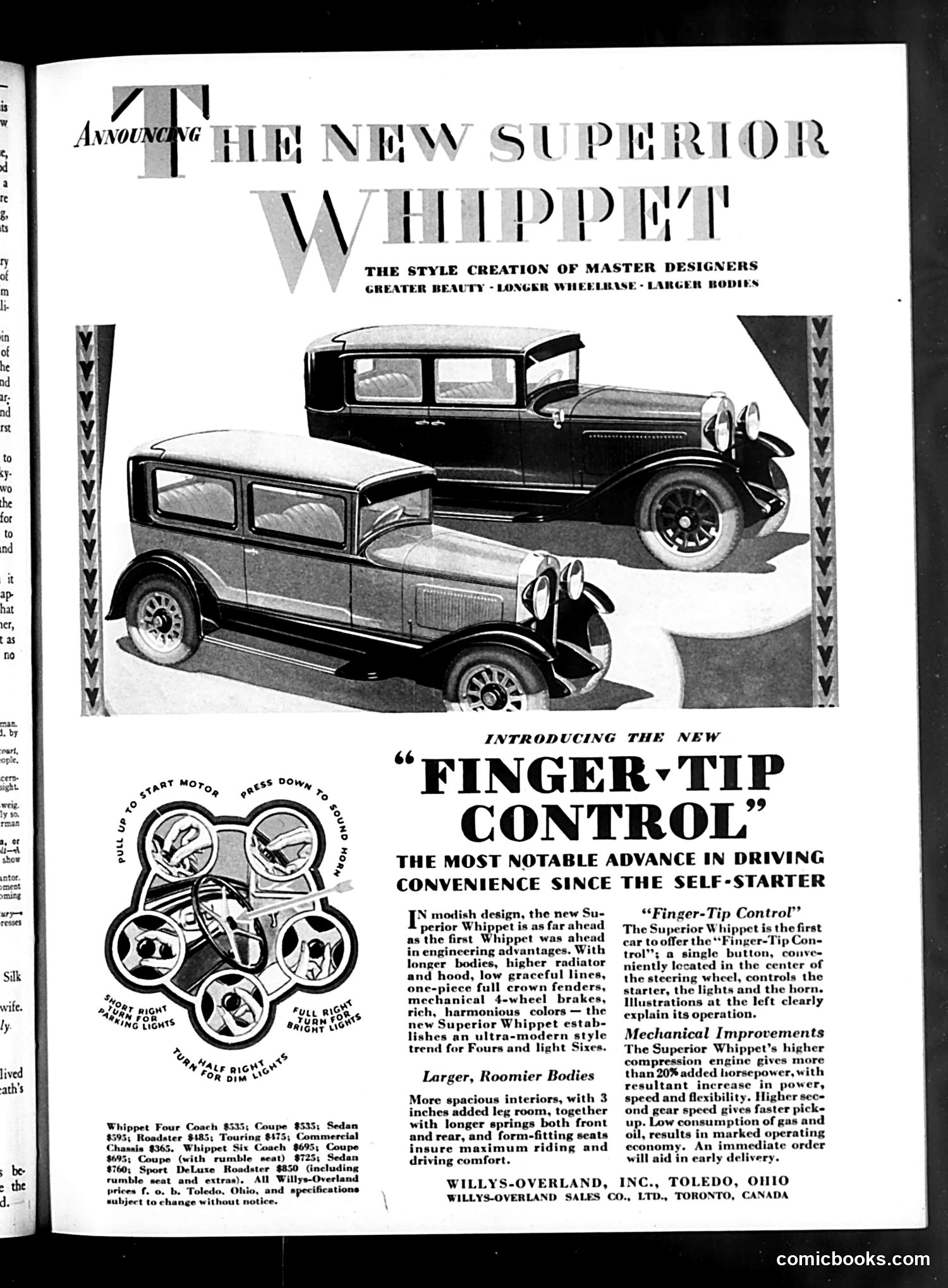
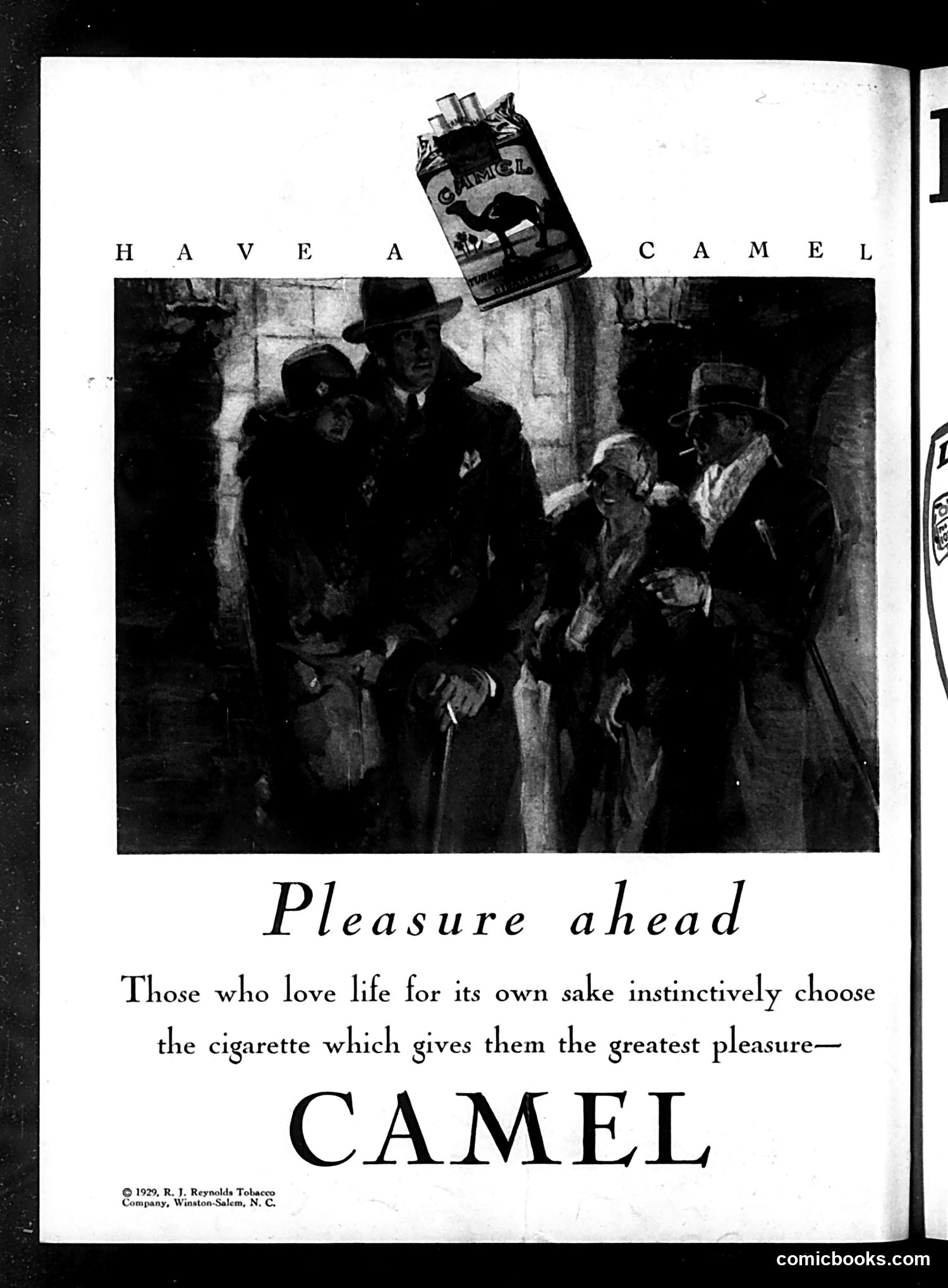
This is a **Camel cigarette advertisement**, not satire or political commentary. The 1929 ad uses an image of well-dressed men and children in what appears to be a street or alley scene to market cigarettes. The ad's slogan, "Pleasure ahead," and accompanying text claim that people who "love life" naturally choose Camel cigarettes for maximum enjoyment. **For modern readers**: This advertisement is striking because it openly markets cigarettes to general audiences (including apparent minors visible in the image) without health warnings—standard practice before mid-20th century tobacco regulations. The aspirational messaging linking smoking to a pleasurable lifestyle reflects pre-regulation advertising tactics now considered unethical. The casual inclusion of children in a cigarette advertisement would be illegal today.