
A complete issue · 44 pages · 1926
Life — June 3, 1926
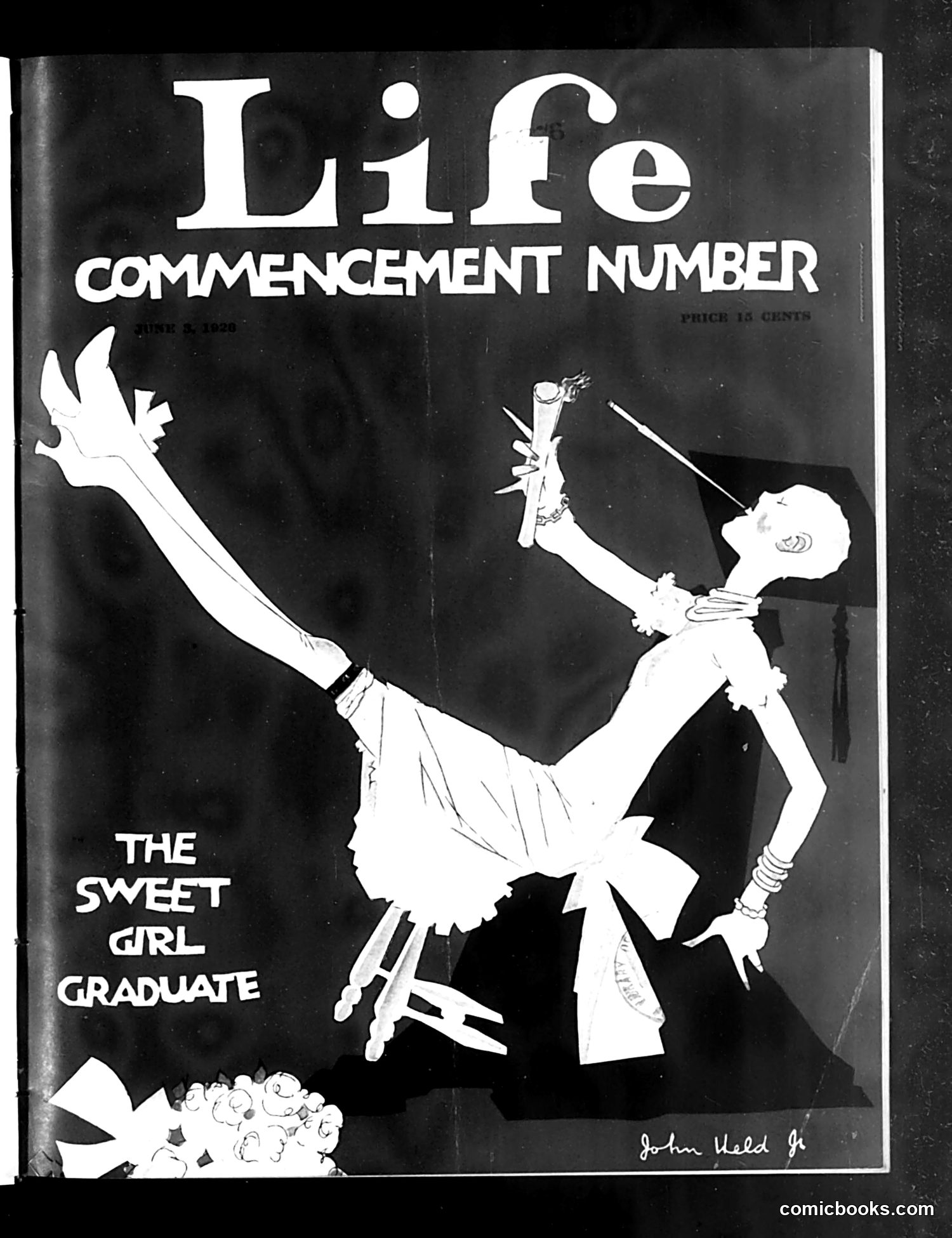
This is a **Life magazine cover** featuring an illustration titled "The Sweet Girl Graduate." The cover depicts a young woman in graduation attire (mortarboard and gown) in an exuberant celebratory pose—leg kicked up, holding a diploma and what appears to be a celebratory torch or torch-like object. The satire likely plays on contemporary anxieties about the "modern woman" of the 1920s Jazz Age. The flapper-style energy and uninhibited pose—particularly the raised leg—would have struck conservative readers as representing the "new woman" rejecting traditional feminine propriety. The commencement theme allowed Life to satirize changing gender roles and women's increased educational and social freedoms during this era. The price of 15 cents reflects the 1920s date.
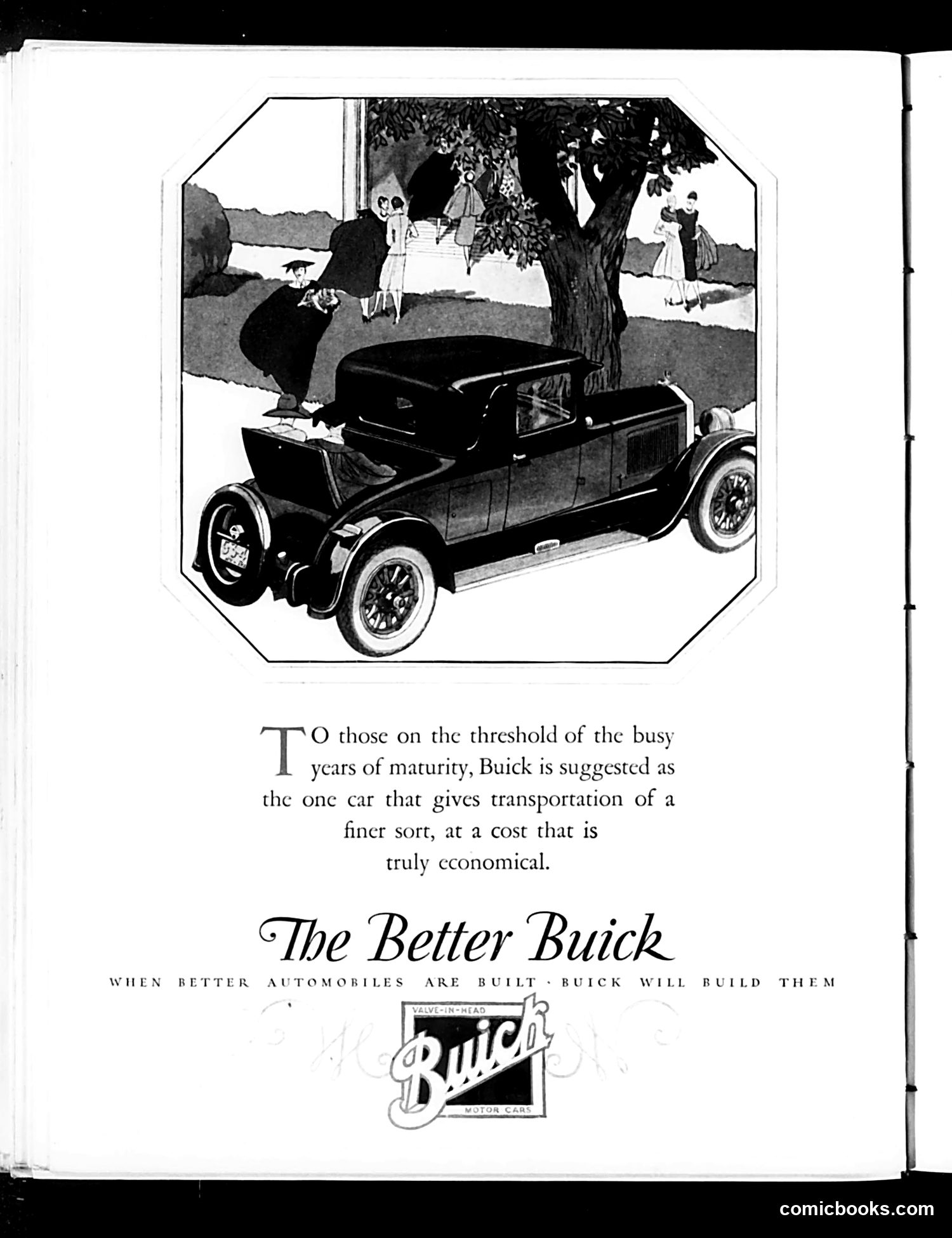
This is **not a political cartoon or satire**—it's a vintage **automobile advertisement** for Buick motor cars. The page shows a 1920s-era Buick automobile prominently displayed, with a domestic scene in the background featuring people and a large tree. The accompanying text targets middle-class consumers approaching their peak earning years, positioning Buick as offering "transportation of a finer sort, at a cost that is truly economical." The tagline "When Better Automobiles Are Built, Buick Will Build Them" was Buick's actual advertising slogan. This represents straightforward commercial marketing from the early automotive era, emphasizing affordability combined with quality—a common sales strategy as car ownership expanded beyond the wealthy.
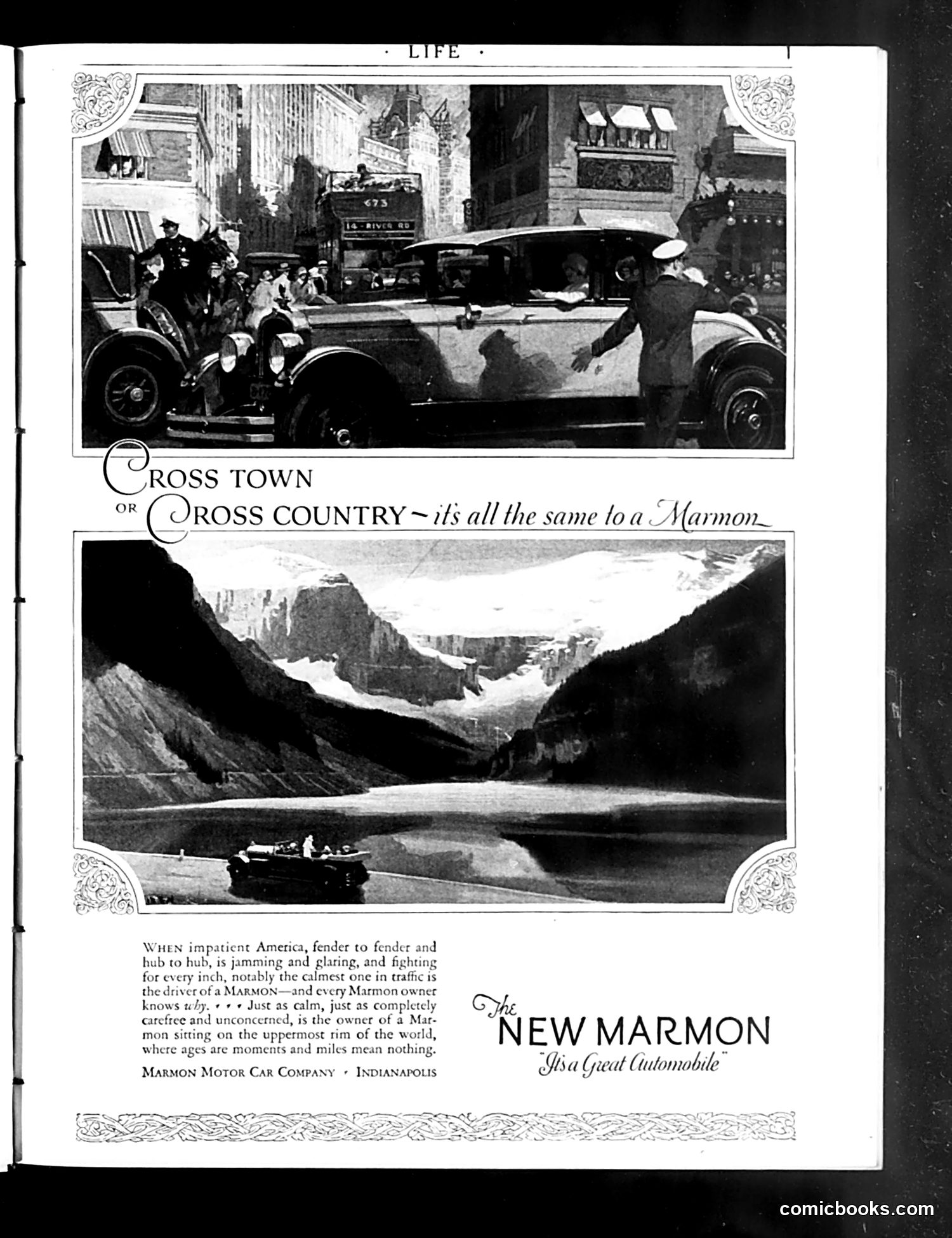
This page is primarily **advertising rather than satire or political commentary**. It's a Marmon Motor Car Company advertisement from *Life* magazine. The top image shows an urban street scene with a Marmon automobile amid city traffic and pedestrians—illustrating the car's reliability in crowded town conditions. The bottom image depicts a scenic mountain lake (appears to be Lake Louise or similar Rocky Mountain landscape), showing a boat on pristine water. The ad's headline—"Cross Town or Cross Country—it's all the same to a Marmon"—uses this visual contrast to suggest the vehicle's versatility across all terrain and conditions. The accompanying text emphasizes the Marmon's calm, reliable performance whether navigating urban congestion or remote wilderness. This is straightforward product marketing, not editorial satire.
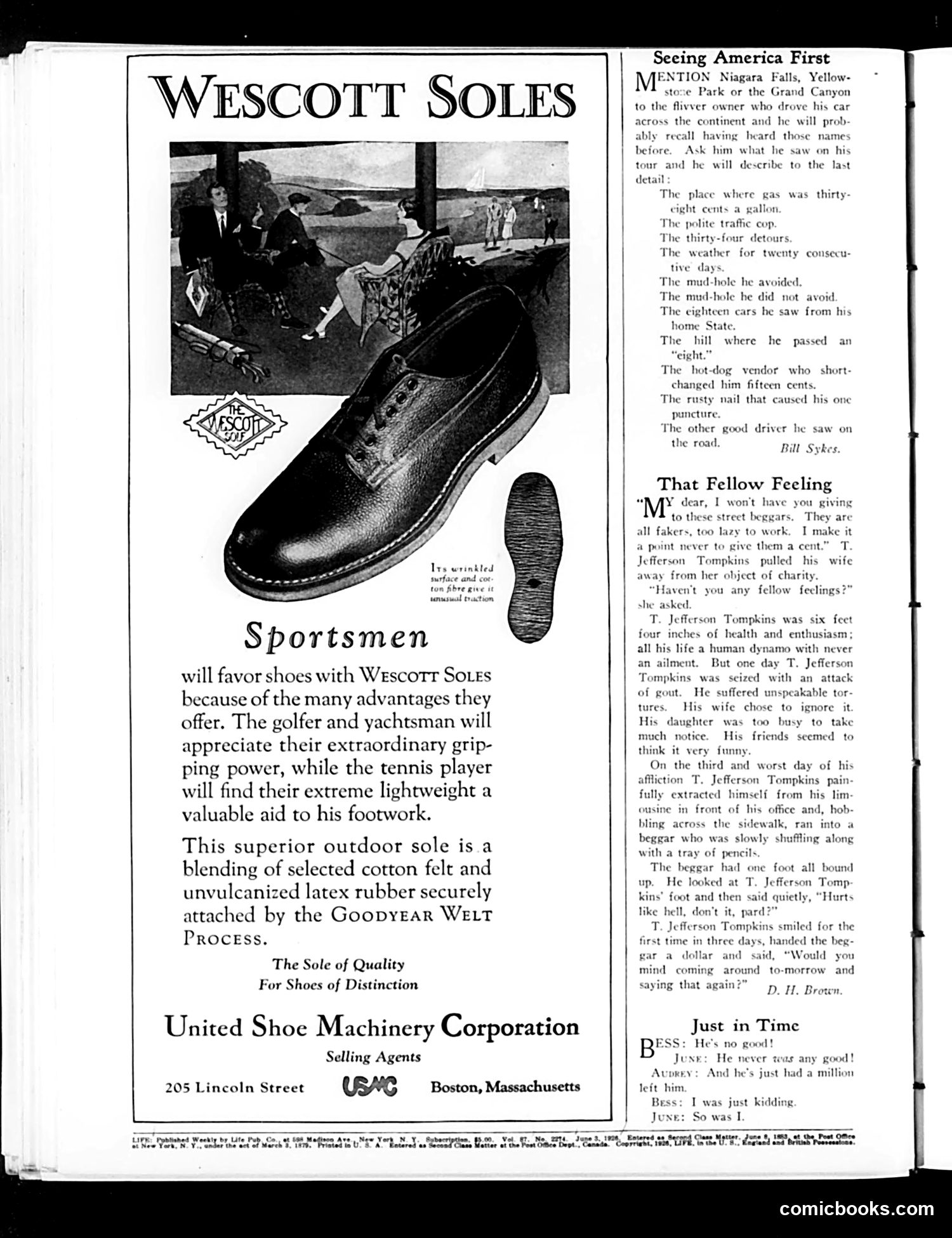
This page is **primarily advertising**, not political satire. The left half features a Wescott Soles shoe advertisement targeting sportsmen, emphasizing the shoe's grip and lightweight qualities for golf, tennis, and outdoor activities. The ad uses the Goodyear Welt Process as a selling point. The right side contains three separate short humorous pieces: 1. **"Seeing America First"** - A joke about a driver recounting mundane travel experiences (gas prices, traffic, mud holes) 2. **"That Fellow Feeling"** - A story about T. Jefferson Tompkins, a gout-afflicted man who condescendingly refuses to give money to street beggars, then ironically encounters one himself 3. **"Just in Time"** - A brief comedic dialogue These are light social humor pieces typical of Life magazine's satirical content, not political commentary.
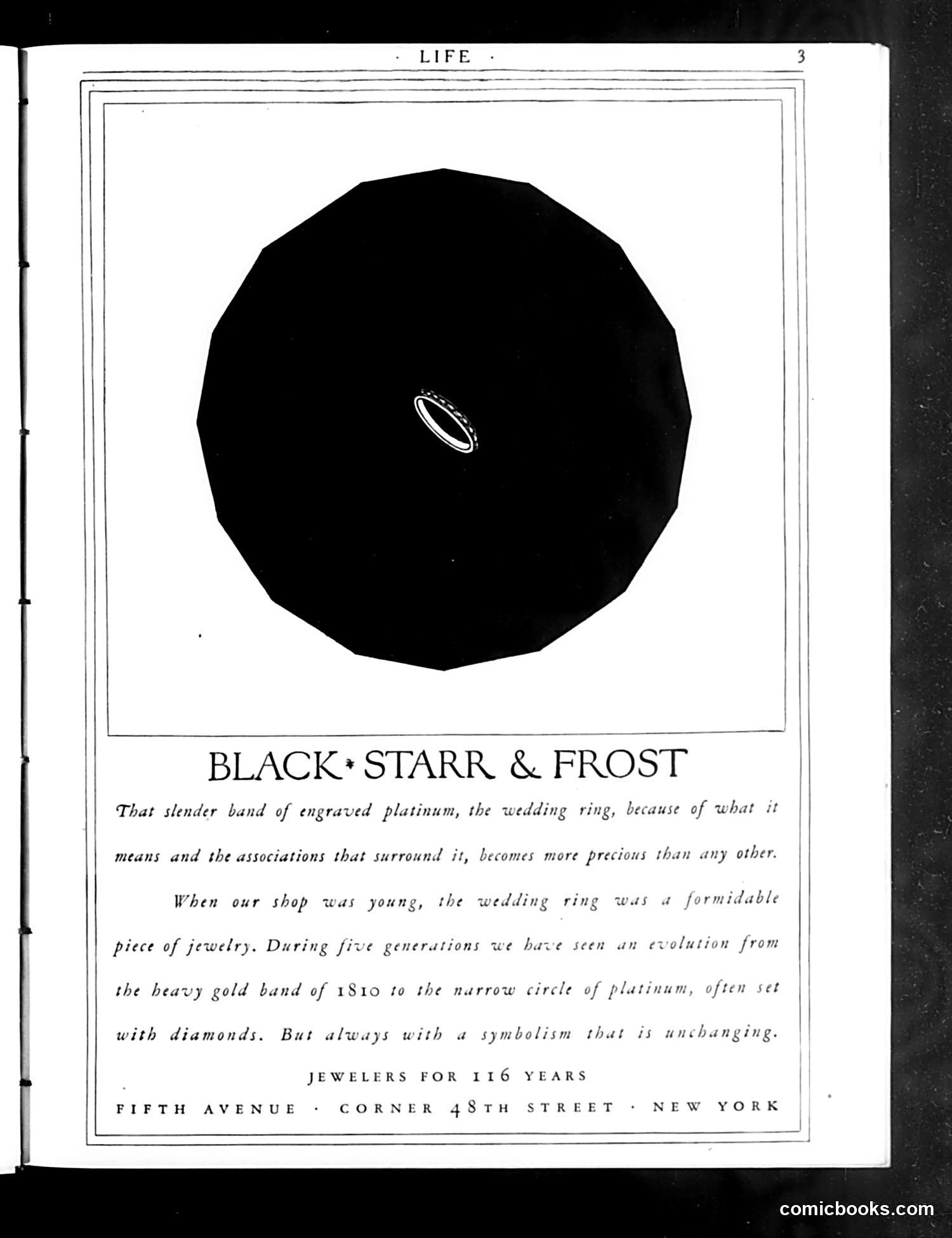
This is **not a cartoon or satire** — it's a luxury jewelry advertisement for Black, Starr & Frost, a high-end New York jeweler. The page appears in *Life* magazine as paid advertising. The image shows an elegant platinum wedding ring rendered as a simple black circle with a small engraved detail visible. The accompanying text appeals to emotional and traditional values, emphasizing the ring's significance across five generations and celebrating the evolution from heavy gold bands (circa 1810) to modern platinum designs, often set with diamonds. The ad positions the ring as a timeless symbol of commitment and family heritage, targeting affluent readers seeking prestigious jewelry. This represents typical early-to-mid 20th-century luxury marketing.
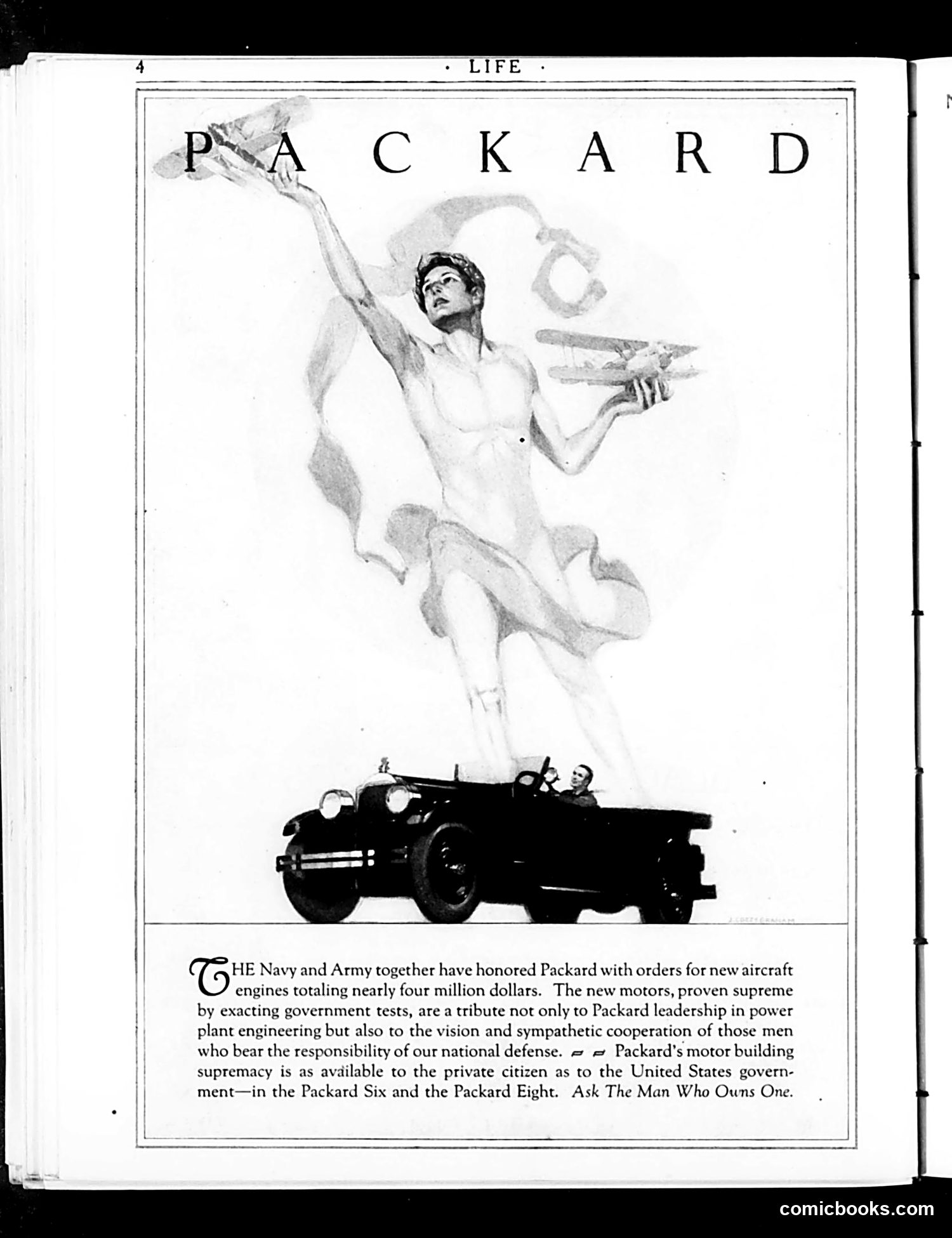
This is primarily a **Packard automobile advertisement**, not political satire. The page features an allegorical illustration of a winged female figure (representing Aviation or Progress) holding an airplane, positioned above a Packard automobile. The text celebrates Packard's receipt of government contracts worth nearly four million dollars for aircraft engines from the Navy and Army. It positions Packard as a patriotic company whose "motor building supremacy" serves both private citizens and national defense. The winged female figure is a common advertising trope of the era symbolizing progress, innovation, and aspiration. The juxtaposition of the airplane and automobile emphasizes Packard's technological leadership across multiple industries. This reflects early-20th-century corporate messaging linking commercial success with national security and patriotism.
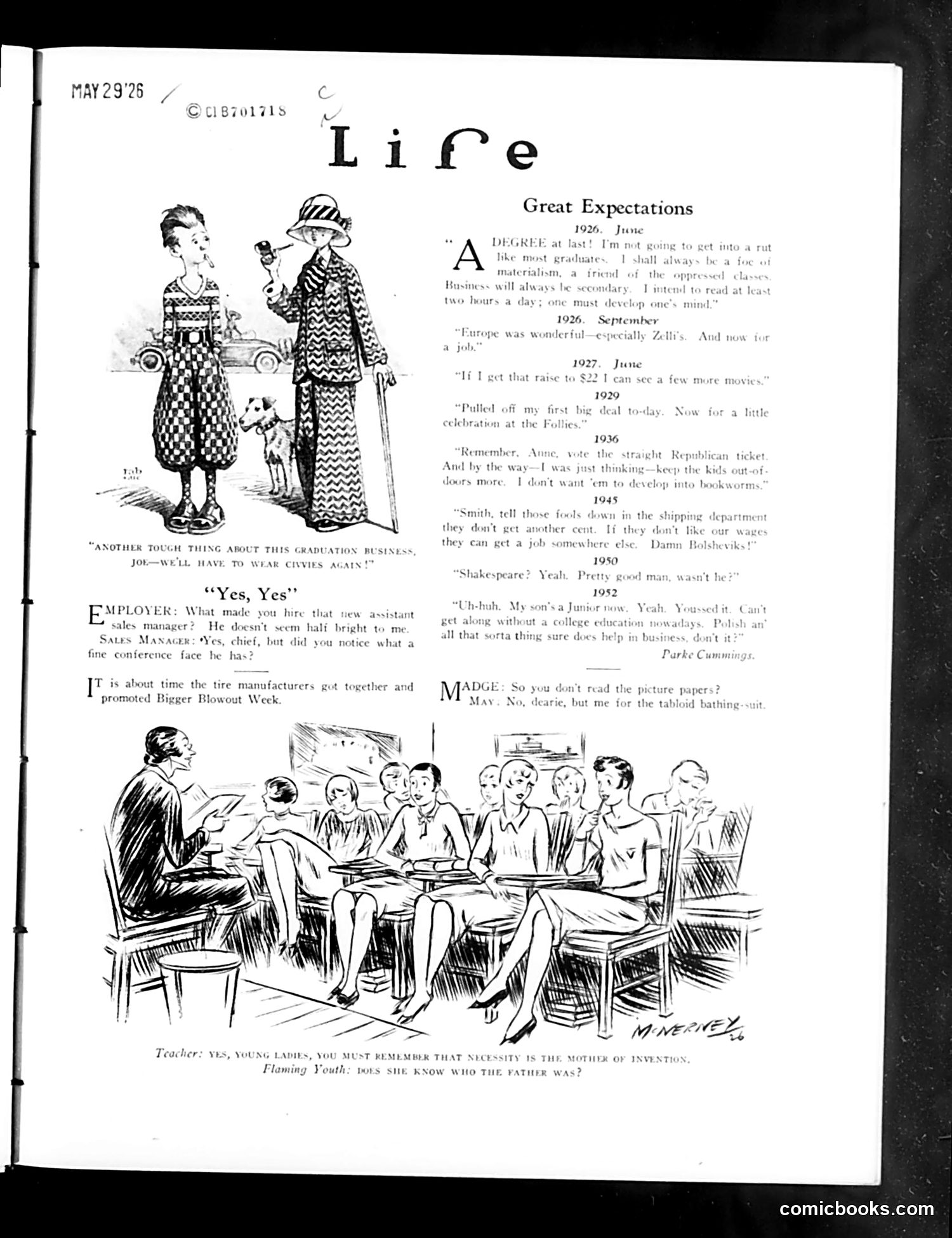
This page satirizes generational optimism versus reality. The top section traces a graduate's expectations from 1926 onward—expecting wealth, business success, and leisure—against actual outcomes: modest raises, movies as entertainment, and eventual mundane work. The "Yes, Yes" dialogue mocks an employer's superficial charm masking exploitation. He flatters a sales manager applicant while dismissing their qualifications. The lower cartoon depicts a classroom discussion where a teacher lectures young women about necessity driving invention, while a student interrupts asking paternity questions—satirizing the disconnect between idealistic education and young people's actual concerns. Overall, the page ridicules both naive graduate expectations and the gap between what society teaches versus what it actually offers young workers and women.
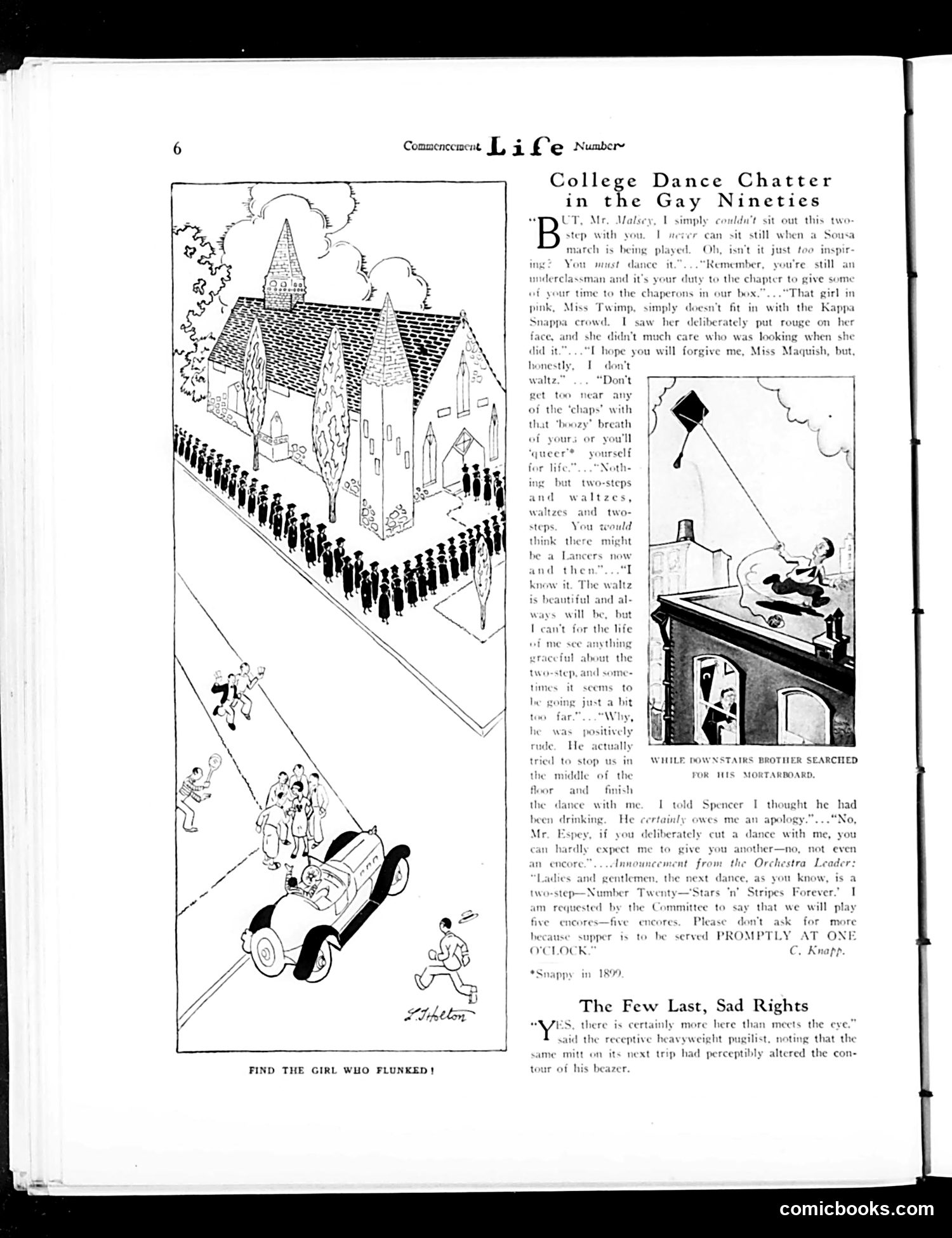
This page satirizes 1890s college social conventions, specifically debates about appropriate dance etiquette. The main cartoon ("Find the Girl Who Flunked!") depicts a college building surrounded by formally dressed students, with a car below—likely mocking the absurdity of modern automobiles intruding on traditional campus life. The text presents a dialogue where a student (Miss Tsump) refuses to waltz, citing concerns about propriety and the two-step being "too far." The humor lies in the excessive prudishness of 1890s social standards—characters fret that dancing might compromise morality. The "Snappy in 1899" byline indicates this is nostalgic satire about outdated attitudes toward young people's social behavior and courtship rituals.
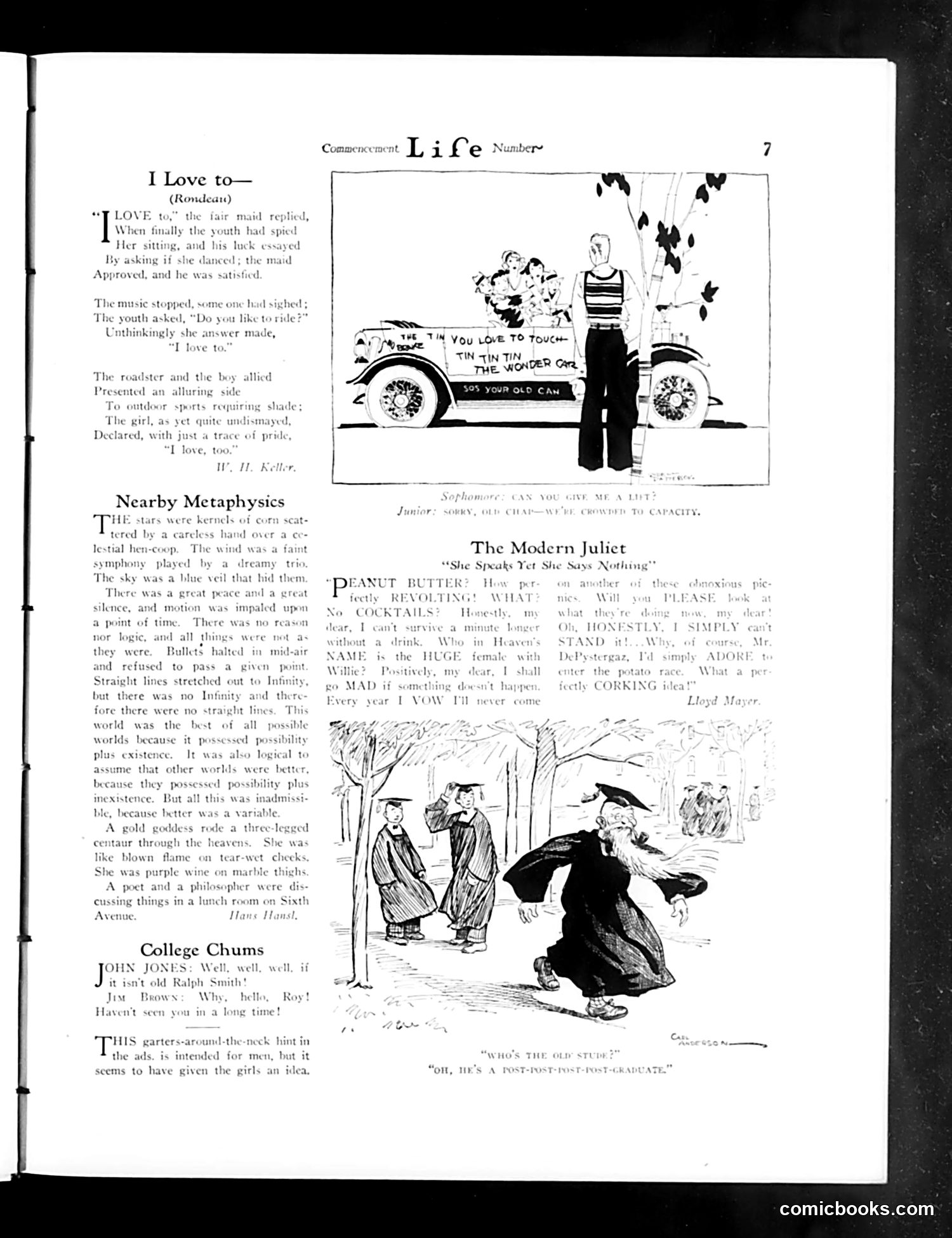
This page contains three satirical pieces: 1. **"I Love to—"**: A poem-and-cartoon about a young man asking a girl to dance. The illustration shows a car scene with the caption "Tin tin tin tin tin... the wonder car" and "In your old can"—satirizing 1920s automobile culture and courtship rituals. 2. **"Nearby Metaphysics"**: A philosophical prose piece mocking pretentious literary analysis, describing stars and existential concepts with exaggerated seriousness. 3. **"The Modern Juliet"**: A cartoon mocking modern women's independence. A woman loudly complains about her date in public ("PEANUT BUTTER! Honestly, dear, I can't survive a minute longer without a drink..."), while she deliberately ignores a pursuing man, satirizing changing gender dynamics and women's assertiveness in 1920s society. 4. **"College Chums"**: A brief joke referencing reconnecting with college acquaintances. The page reflects 1920s social commentary on dating, cars, and women's evolving roles.
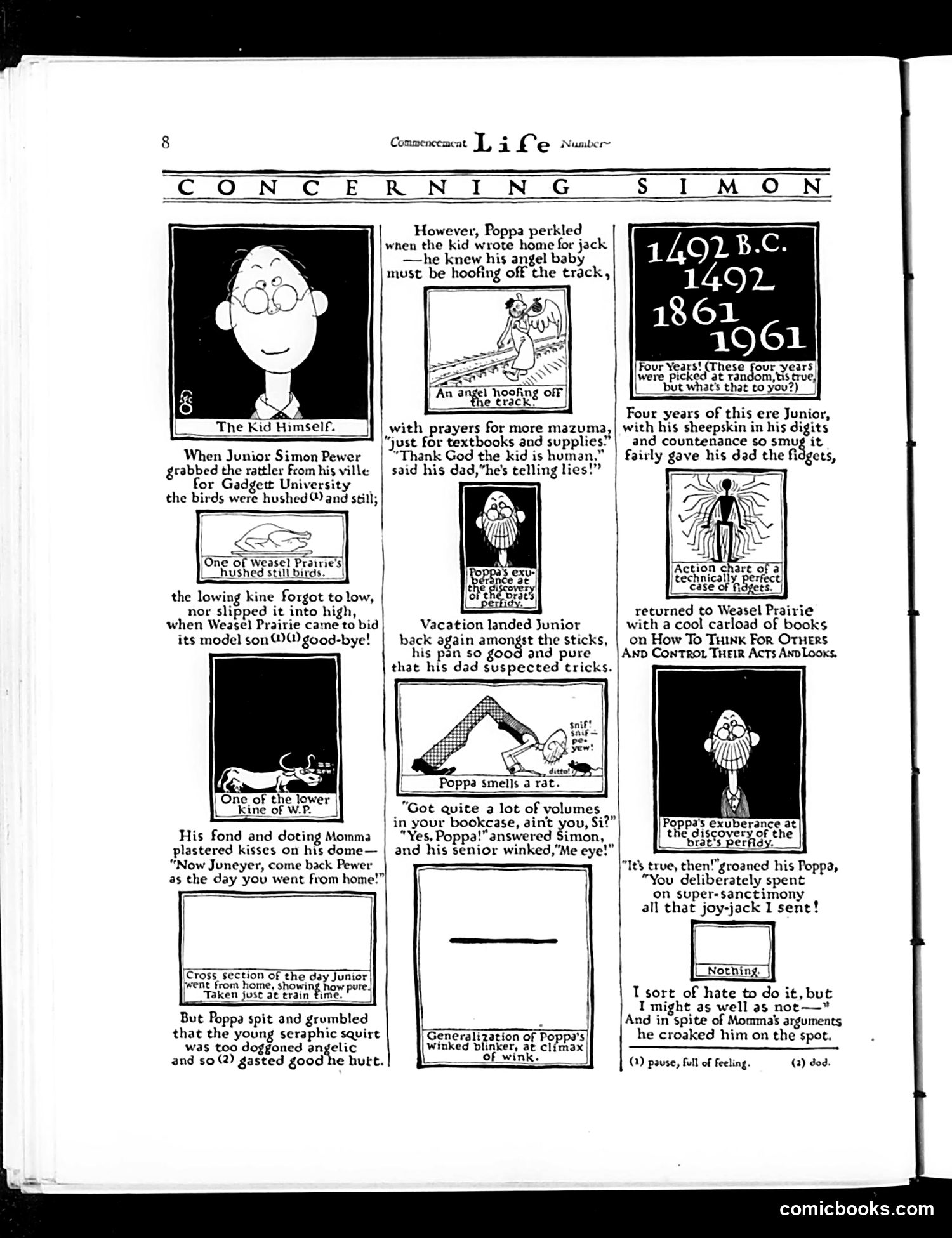
This satirical cartoon strip mocks Junior Simon Power, a student at Gadget University who returns home from school. The humor centers on his father Poppa's exasperation with Junior's behavior and academic struggles. The narrative shows Junior writing home claiming his "angel baby" is "hoofing off the track" (likely slang for misbehavior), while Poppa suspects he's lying. When Junior returns with a cartload of books on "How To Think For Others," Poppa becomes infuriated, accusing him of wasting money on "super-sanctimonious" self-help literature rather than practical education. The joke satirizes both pretentious academic pursuits and the generational conflict between a practical, hard-working father and an allegedly self-deluded son wasting family resources on dubious educational materials.
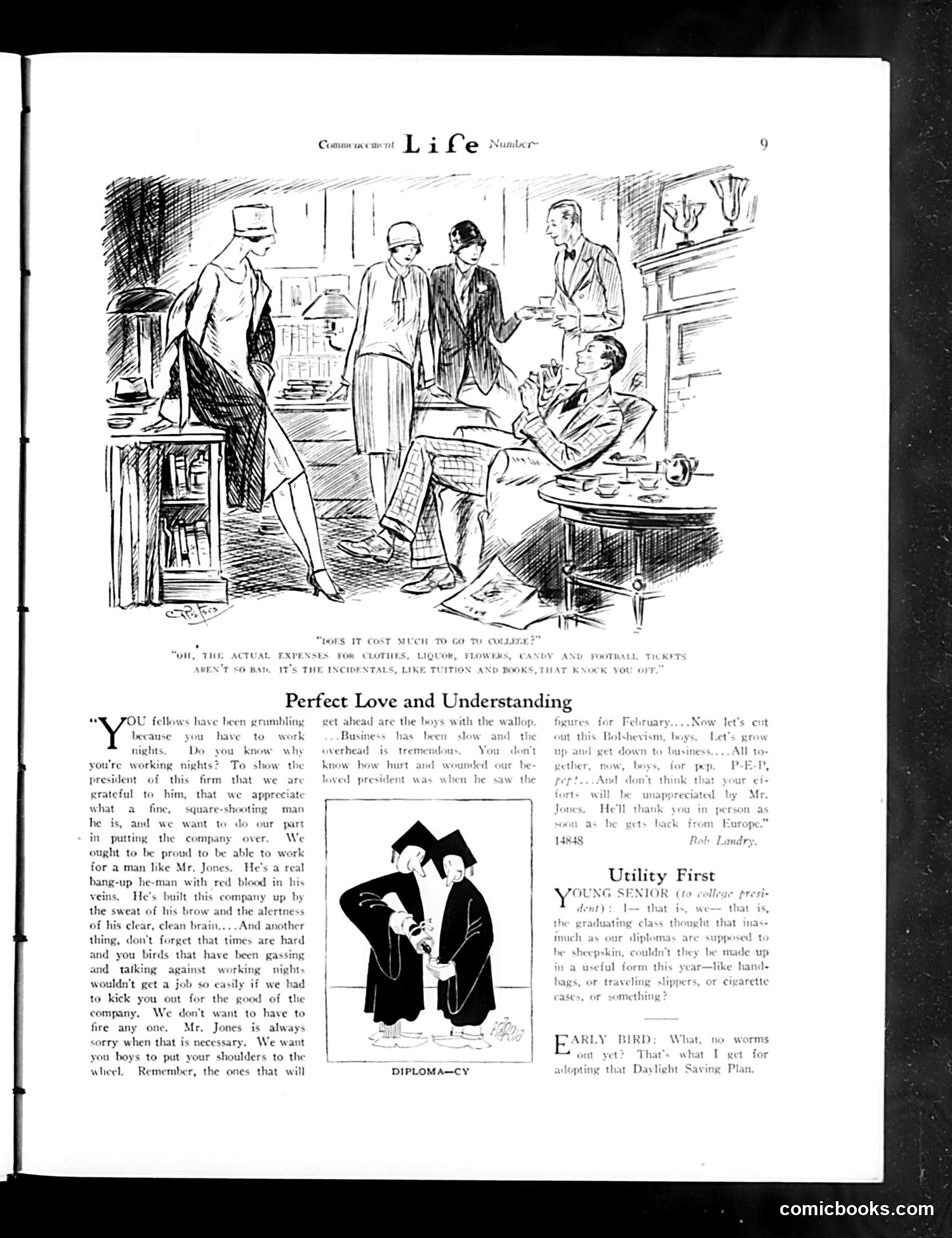
This page contains satirical commentary on 1920s corporate culture and student life. The top cartoon depicts an office scene where a businessman explains expense justifications to colleagues—the joke being that discretionary spending on "clothes, liquor, flowers, candy and football tickets" is justified as business necessities, while actual educational costs like "tuition and books" are considered wasteful "incidentals." The text sections below offer advice to young men: "Perfect Love and Understanding" addresses workplace loyalty and company hierarchy, while "Utility First" mocks college graduates' impractical education. The "Early Bird" snippet jokes about daylight saving time. The cartoon's satire targets both corporate expense rationalization and the perceived uselessness of traditional education for practical business life—reflecting post-WWI American anxieties about modernization and pragmatism.
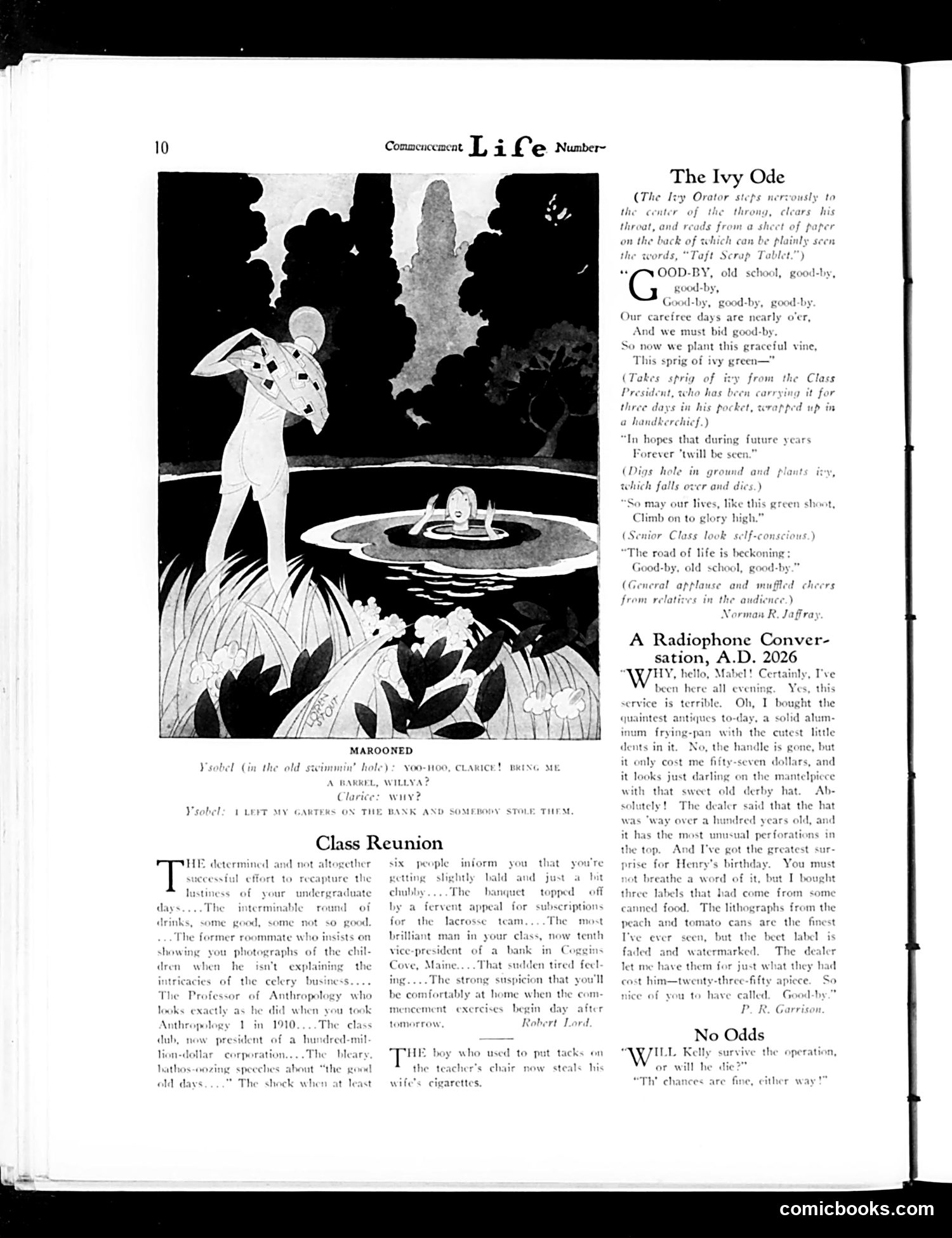
This page features a sentimental poem about an ivy plant being planted at a school's closing ceremony. The accompanying Art Deco illustration shows a young woman in classical dress planting ivy beside a pond, surrounded by silhouetted figures and foliage—evoking nostalgia for undergraduate days. The satire lies in the juxtaposition: *Life* mocks this earnest, romantic sentimentality about school traditions. The "Class Reunion" and "A Radiophone Conversation" sections below offer sharp, cynical commentary on graduates' mundane adult lives—petty financial concerns, aging, disappointing purchases—directly contrasting the idealized, poetic framing of college memories in the ode above. The magazine is satirizing the gap between youthful romantic idealism and disappointing reality.
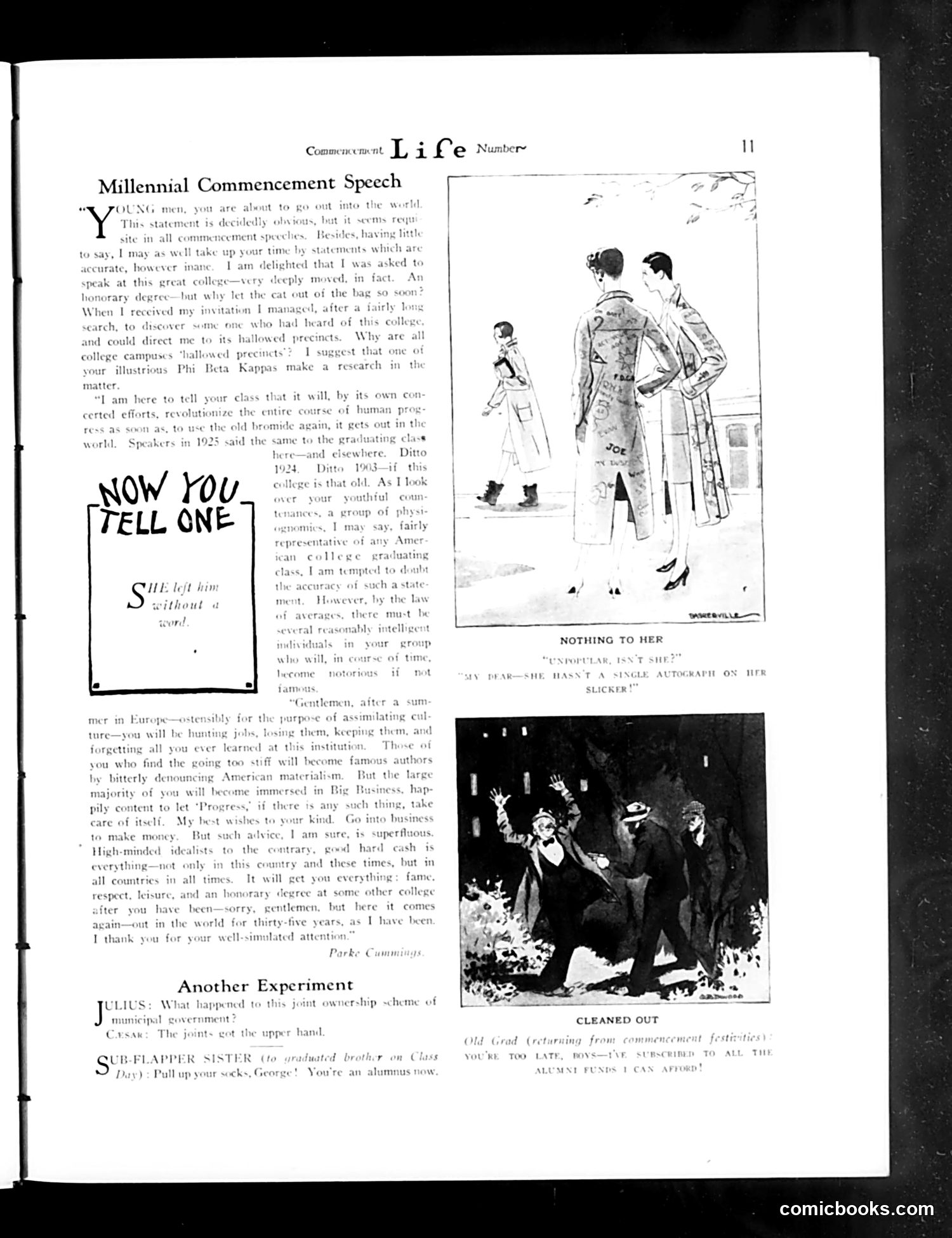
This page contains a **"Millennial Commencement Speech"** by Parke Cummings—a satirical piece mocking typical college graduation addresses. The speaker ironically warns young graduates that despite their education, they'll likely end up in mundane business jobs, not as famous authors or idealists. The satire targets the gap between commencement speakers' grandiose promises and graduates' actual futures. Two cartoon illustrations accompany the text: "Nothing to Her" depicts a young woman with a man discussing her lack of autographs on her jacket—mocking superficial social status. "Cleaned Out" shows graduates being exploited financially, suggesting alumni fund-raising schemes. The humor derives from deflating romantic notions about higher education and revealing its practical, sometimes disappointing realities.
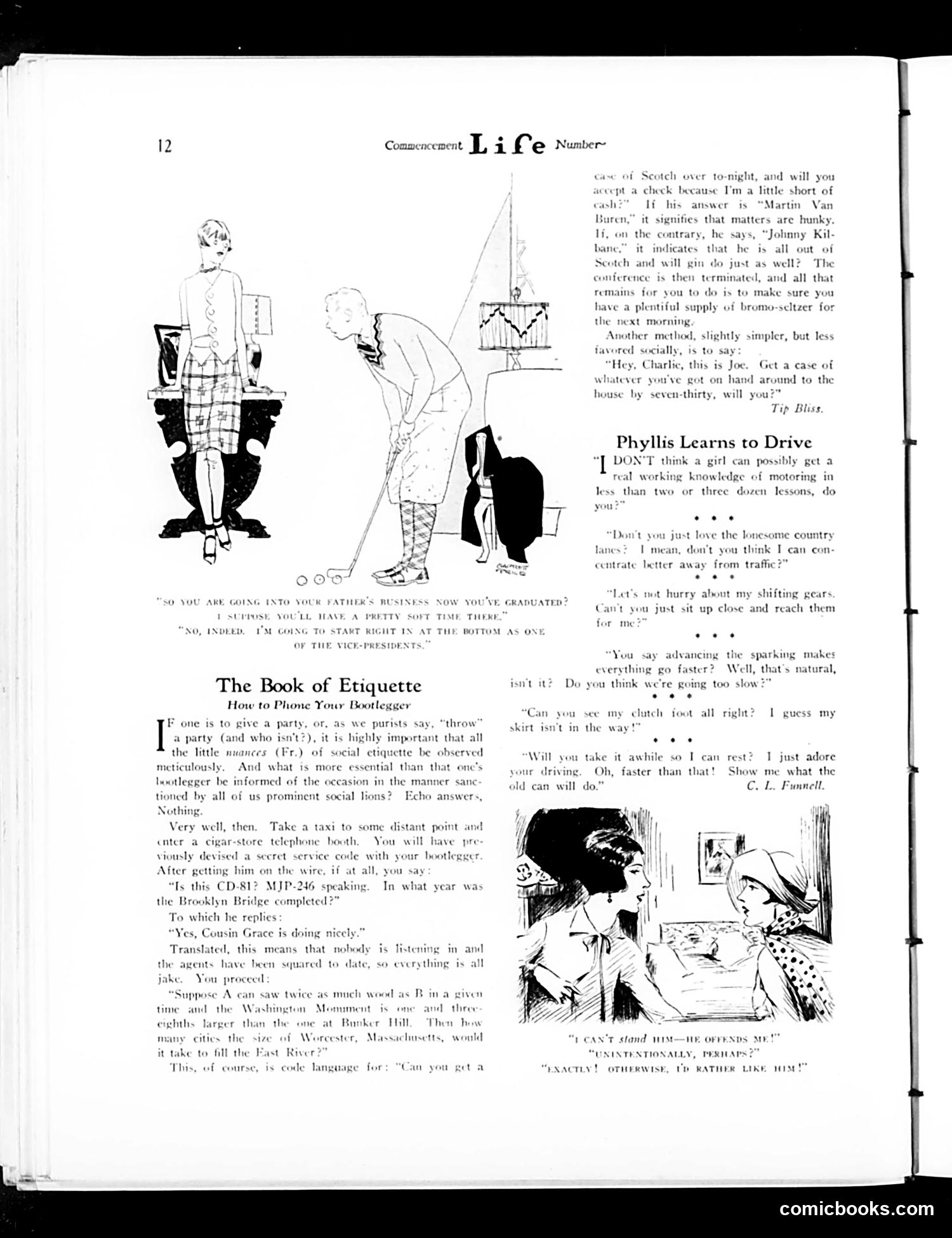
This page contains two distinct pieces of humor content from what appears to be the 1920s-1930s era. **"The Book of Etiquette: How to Phone Your Bootlegger"** satirizes Prohibition-era social customs. The joke mocks how Americans had to develop coded language to discuss illegal alcohol sales. The text describes absurd euphemisms and elaborate pretexts—phoning about "Scotch," discussing the "Brooklyn Bridge," or referencing fictional relatives—to disguise bootlegging transactions as ordinary social conversation. It's social satire on how Prohibition created a culture of deception that infiltrated everyday phone etiquette. **"Phyllis Learns to Drive"** humorously depicts a young woman receiving driving lessons, with quoted dialogue showing exasperation from both student and instructor about gear-shifting, traffic awareness, and speed control—typical period humor about women drivers as inexperienced and overly cautious. Both pieces reflect early 20th-century social anxieties: Prohibition and changing gender roles.
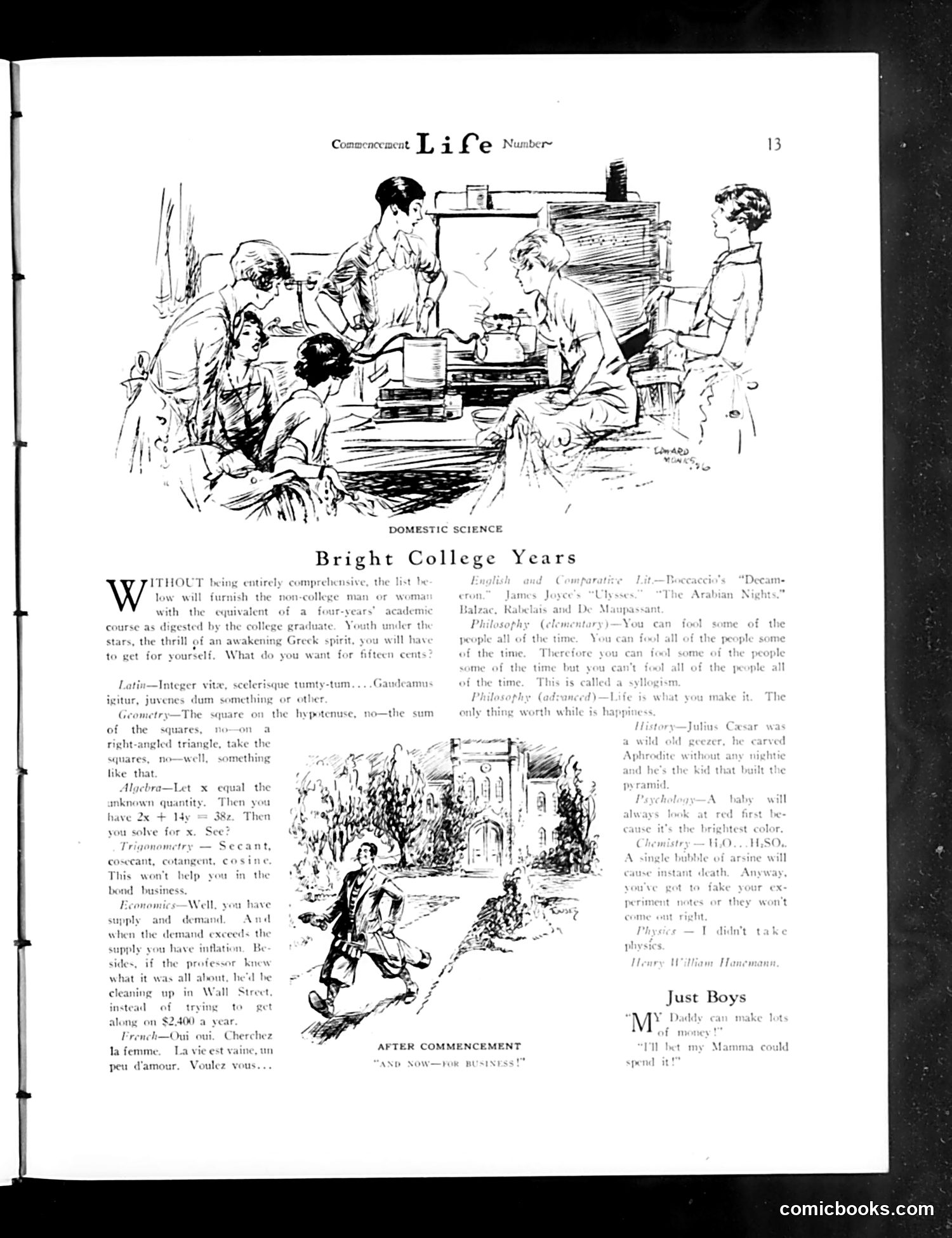
This page satirizes college education through humorous subject descriptions. The top illustration shows students gathered around what appears to be a cooking or domestic science lesson—connecting to the page's "Domestic Science" theme. The satirical course descriptions mock academic pretension by reducing subjects to absurdist definitions: Latin becomes "seriesquae tumulty-tum," Geometry involves nonsensical square calculations, and Economics is presented as useless unless one becomes a Wall Street insider. The humor suggests college courses are either impractical or serve only the wealthy elite. The bottom cartoon, titled "After Commencement—'And Now—For Business!'" depicts a graduate apparently struggling or falling, implying the disconnect between academic preparation and real-world employment prospects. The "Just Boys" section continues the satirical tone about post-college ambitions.
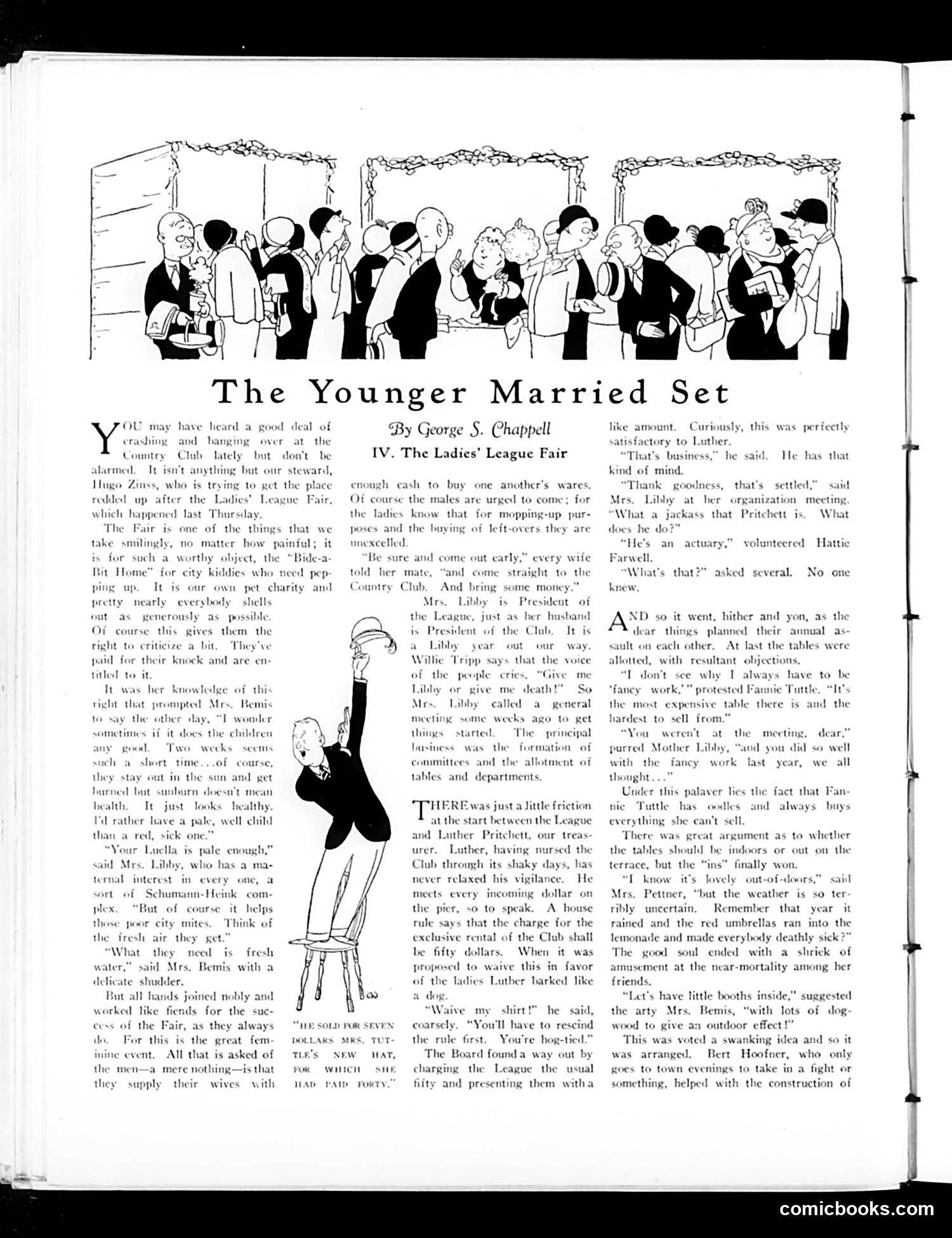
This satirical piece mocks the social pretensions of young married couples in the early 20th century. The cartoon shows well-dressed couples at what appears to be a country club charity event ("Ride-a-Bit Home" fair). The satire targets: - **Social climbing**: Characters obsessing over expensive purchases and club membership status - **Marital dynamics**: Husbands (like "Luther") controlling finances while wives organize charity events - **Class anxiety**: The tension between appearing wealthy and actual financial constraints - **Gender roles**: Women managing social obligations while men protect the purse strings The humor comes from characters' transparent attempts to maintain appearances despite financial strain, revealing the artificiality and insecurity underlying their social world.
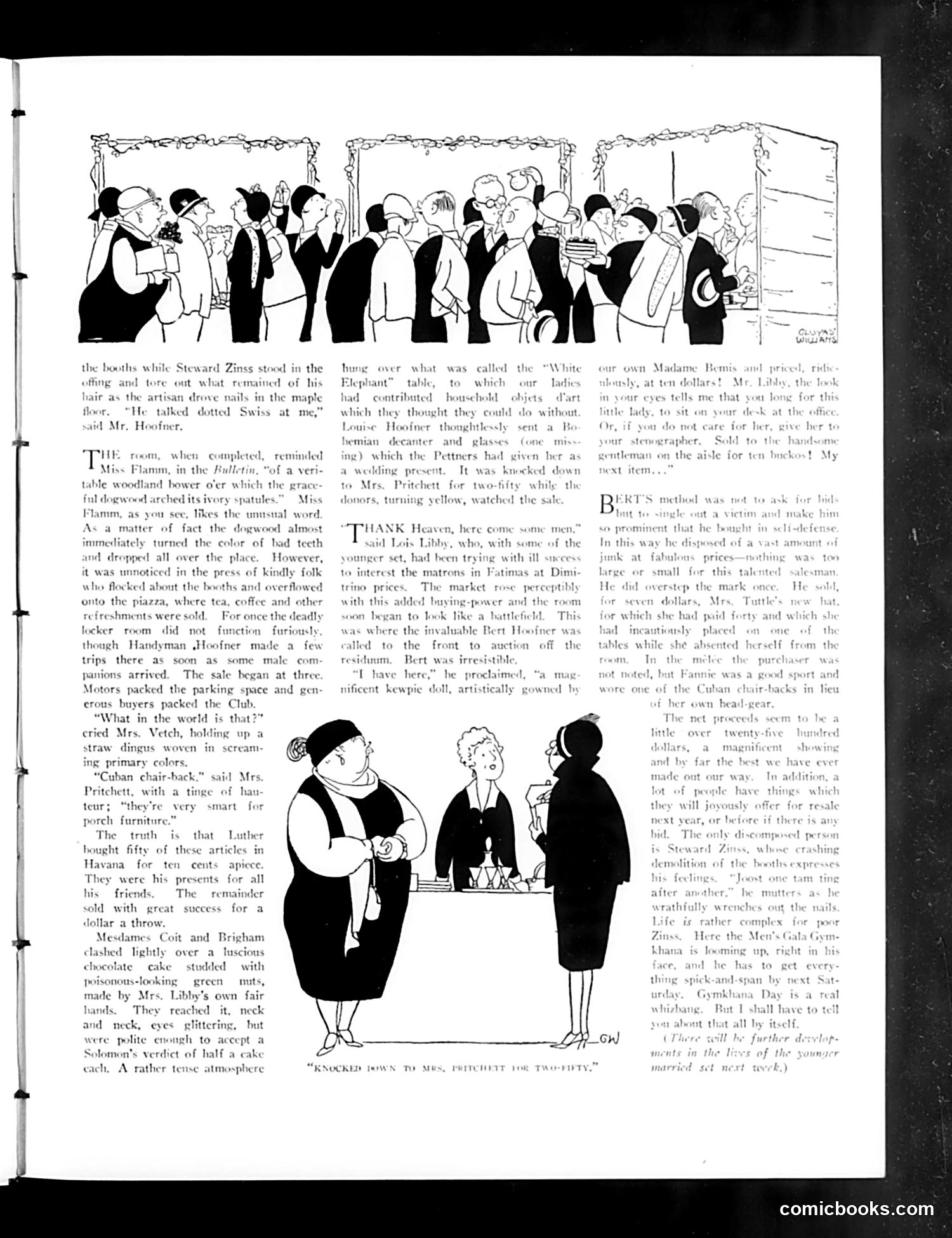
This page satirizes a wealthy society auction, likely from the 1920s. The top cartoon shows an elegant party viewing items for sale at what's called the "White Elephant" table—a social tradition where affluent people donated unwanted possessions to charity auctions. The text describes humorous bidding competition among socialites. The caption beneath the lower illustration reads "Knocked down to Mrs. Pritchett the two-fifty," indicating Mrs. Pritchett won an item for $250—substantial money at the time. The satire targets upper-class pretension: wealthy individuals disposing of their excess possessions while congratulating themselves for charity, with the implicit humor that one person's "trash" auction becomes another's prized acquisition. The cartoons mock both the conspicuous consumption and the social theater surrounding such events.
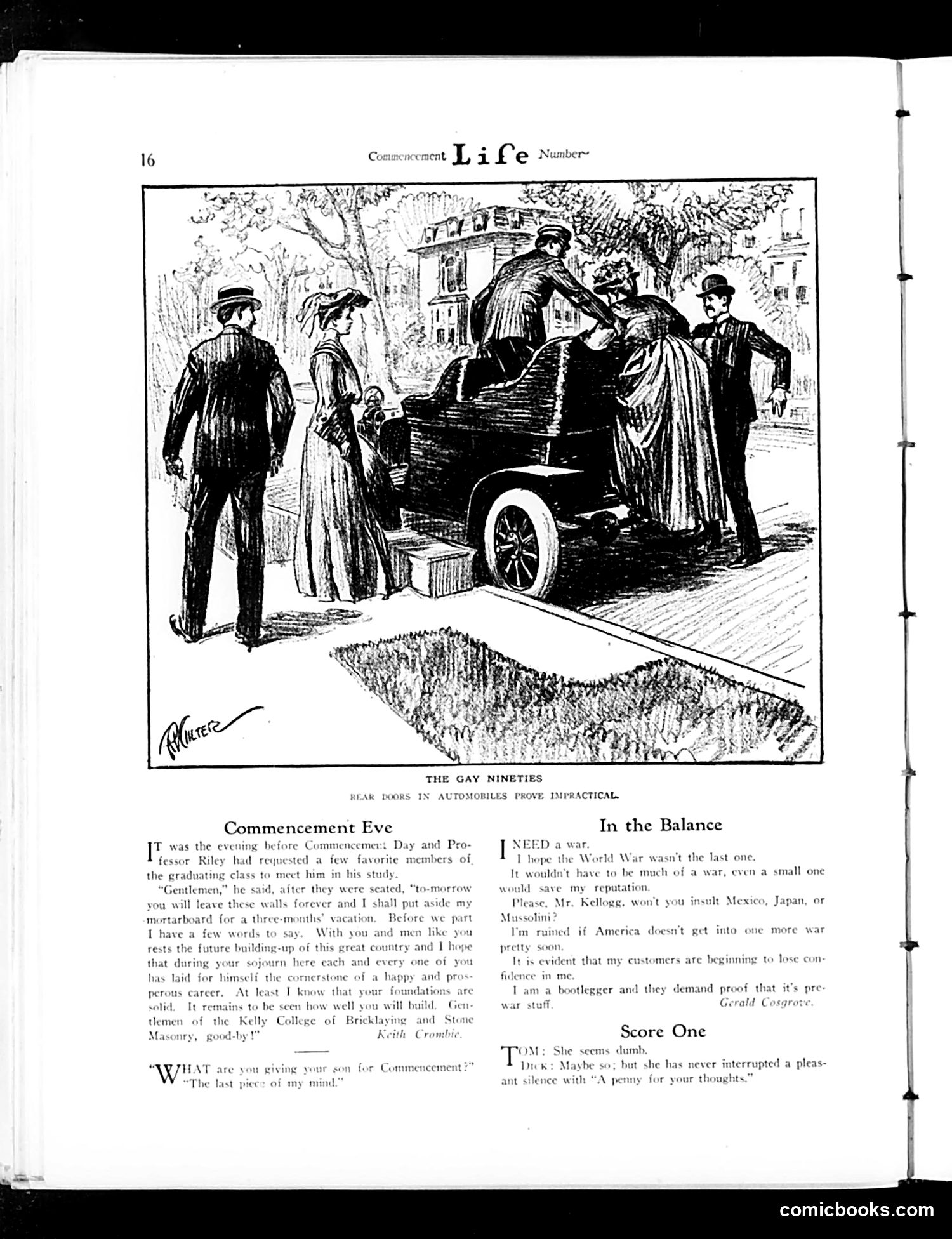
**Main Cartoon**: Titled "The Gay Nineties—Rear Doors in Automobiles Prove Impractical," this satirical sketch shows a well-dressed group gathered around an early automobile with its rear door open. The humor appears to target the impracticality of rear-opening car doors—a design feature that was apparently problematic or awkward in actual use, making the "modern" automobile less convenient than intended. **Text Content**: The page includes three short pieces: "Commencement Eve" (a sentimental speech), "In the Balance" (a satirical dialogue about war and reputation), and "Score One" (a brief joke about a woman's silence). These sketch-style humor pieces reflect typical Life magazine satirical commentary on social and political matters of the era.
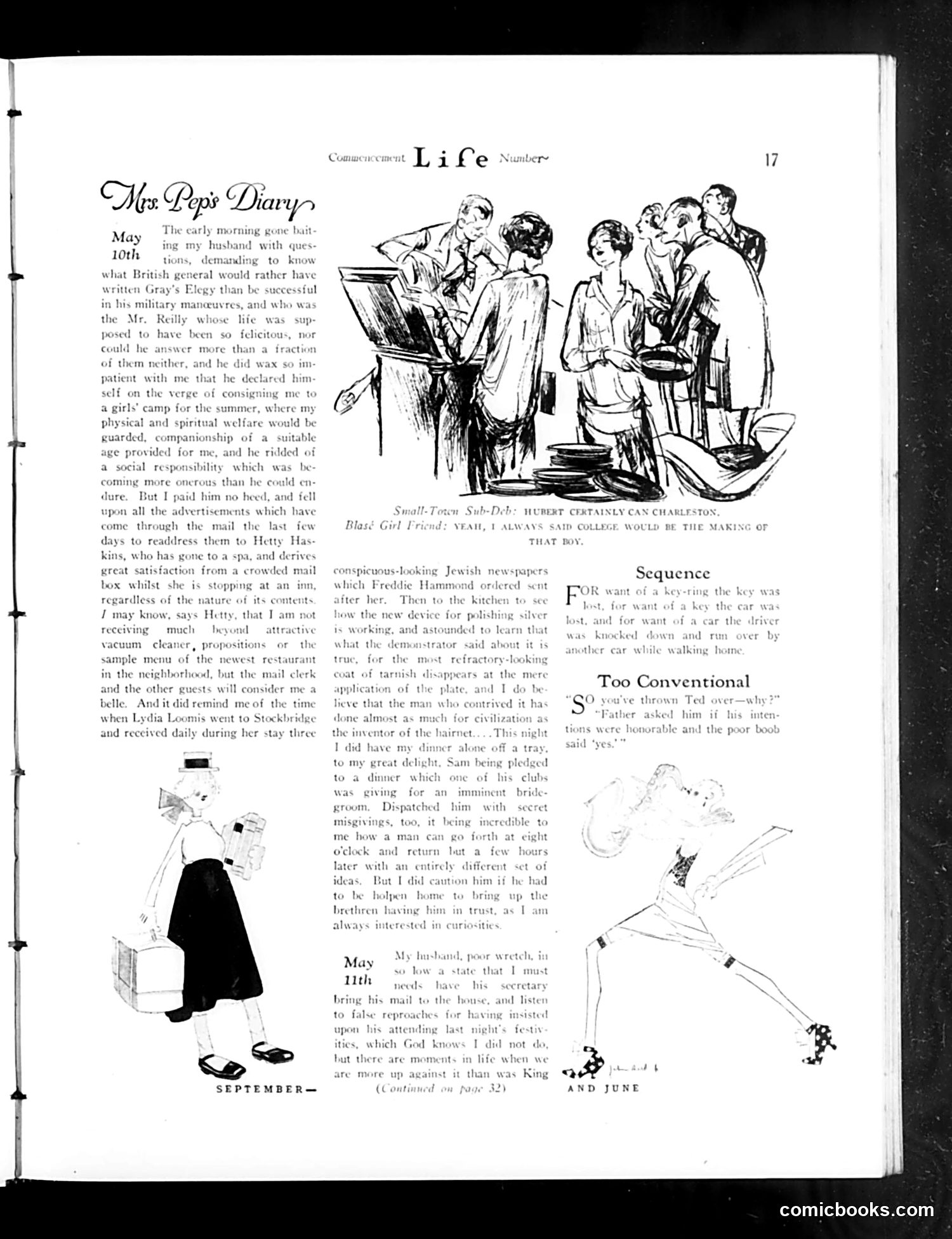
This is a domestic humor column written from a wife's perspective, satirizing early 20th-century middle-class married life. The diary entries mock the husband's predictable complaints and preoccupations: he fusses over trivial matters (advertising propositions, vacuums, restaurant recommendations) while remaining oblivious to his wife's actual concerns. The satire targets the conventional gender dynamics of the era—the wife's exasperated tolerance of her husband's self-importance and his disconnection from practical household matters. When she mentions his "false reproaches" about attending social events, the humor lies in her barely concealed irritation at his hypocrisy and double standards. The accompanying illustrations show domestic scenes: a woman managing household tasks while surrounded by men's chatter; a solitary figure in an elegant coat amid scattered items. The point: wives endured husbands' petty grievances with patient resignation, while their own frustrations went unheard—a commentary on marital inequality masked as light comedy.
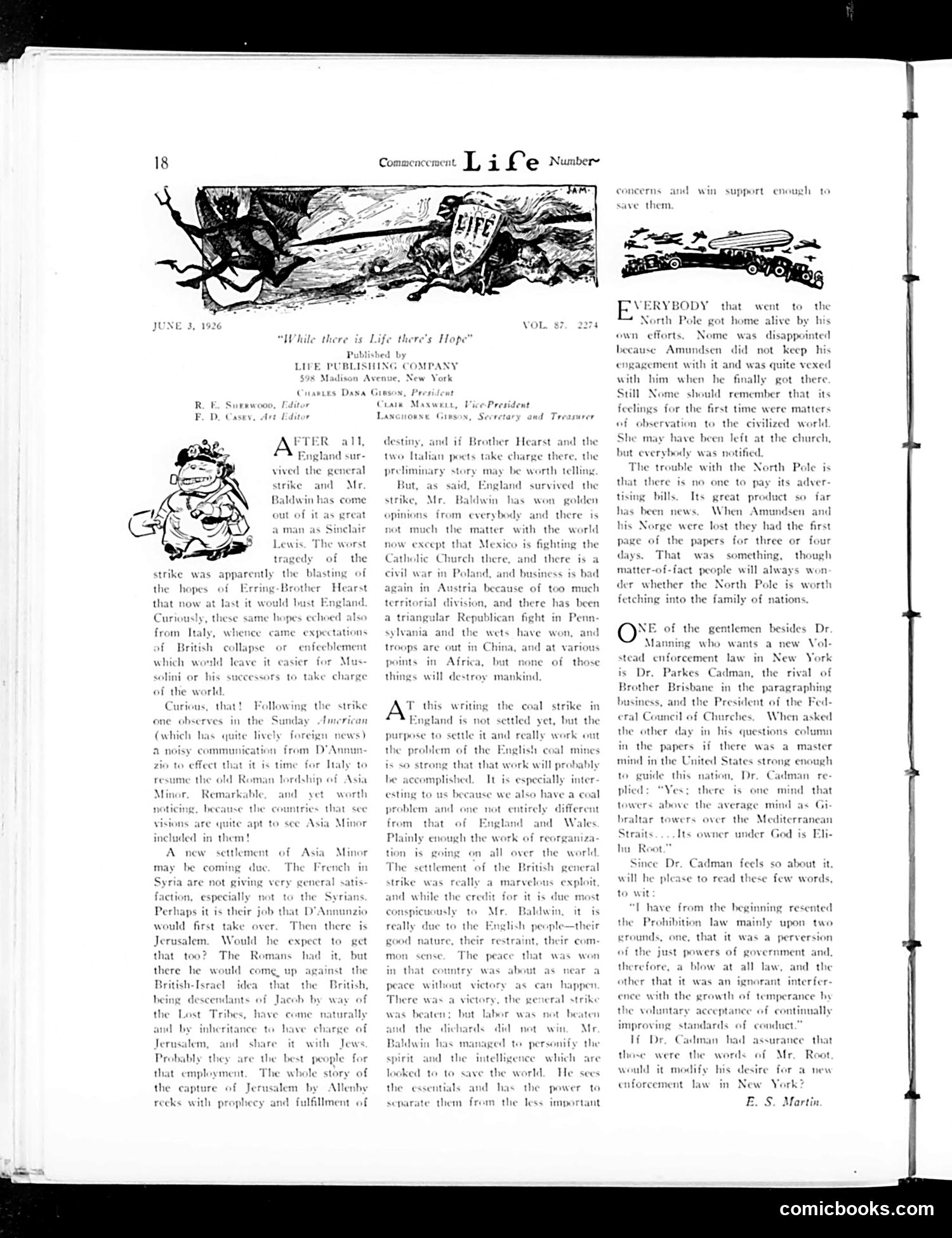
This page combines editorial commentary on several international crises with satirical cartoons. The main topics are: **The British Coal Strike**: The lengthy article discusses England's ongoing labor unrest and coal miners' strike, comparing it to other post-war instability (civil war in Poland, Austria's territorial disputes). The author credits British character and restraint for surviving the strike without collapse. **Roald Amundsen's Arctic Expedition**: A brief note mocks the public's disappointment that explorer Amundsen didn't keep his engagement to visit Nome, Alaska. The joke is that while the North Pole has "no one to pay its advertising bills," the press had covered his journey extensively, then dropped it when he disappeared (he was lost at sea in 1928). **Dr. Cadman's Letter**: The page includes correspondence from a clergyman responding to debates about Prohibition enforcement, arguing for voluntary moral standards rather than legal coercion. The overall tone reflects 1920s anxieties: labor unrest, post-war instability abroad, and disagreement over Prohibition's implementation at home.
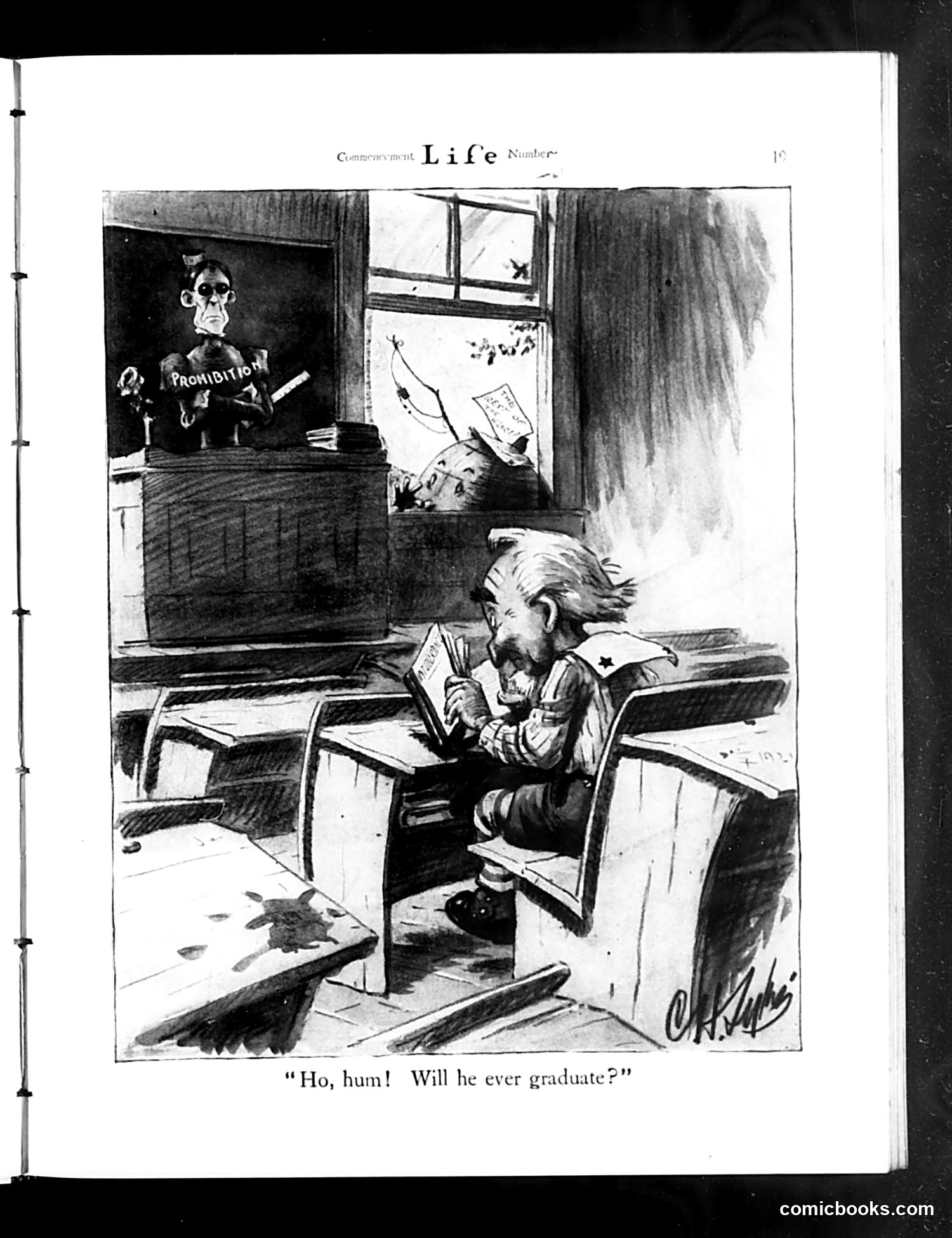
This single-panel cartoon depicts a schoolroom scene satirizing student struggles. A disheveled, long-haired student sits at a desk reading what appears to be a failing grade or report card, while looking dejected. Through the window behind him, a stern-faced figure labeled "PROHIBITION" watches disapprovingly—personified as an authority figure enforcing rules. The caption "Ho, hum! Will he ever graduate?" expresses resignation about the student's prospects. The satire likely comments on how strict regulations (represented by Prohibition, the alcohol ban in effect 1920-1933) or overbearing authority figures undermine education and student success. The cartoonist suggests that oppressive rules create apathy rather than achievement among youth.
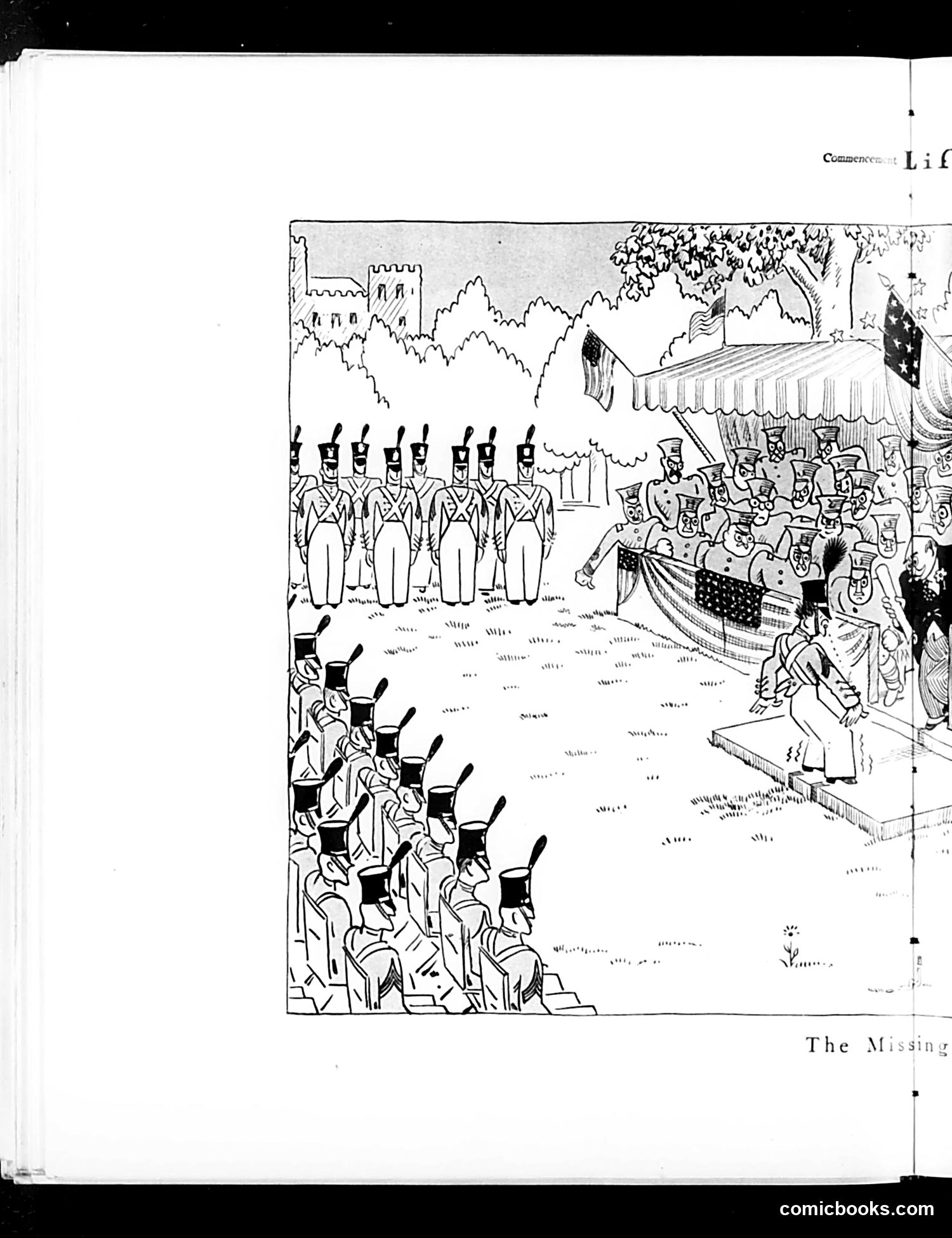
This appears to be a satirical cartoon titled "The Missing," though the OCR provides limited text context. The image depicts a military or formal ceremonial scene: uniformed soldiers in tall hats stand in formation on the left, while on the right, a crowd of civilians gathers under a tent with flags. A figure on an elevated platform appears to be addressing or reviewing the scene. The cartoon's title "The Missing" suggests commentary on absent military personnel or leadership during a formal occasion. Without additional context from Life magazine's publication date, I cannot identify the specific historical event, political figures, or military situation being satirized. The composition emphasizes the contrast between orderly military ranks and the civilian gathering, possibly critiquing military preparedness or command during a particular crisis.
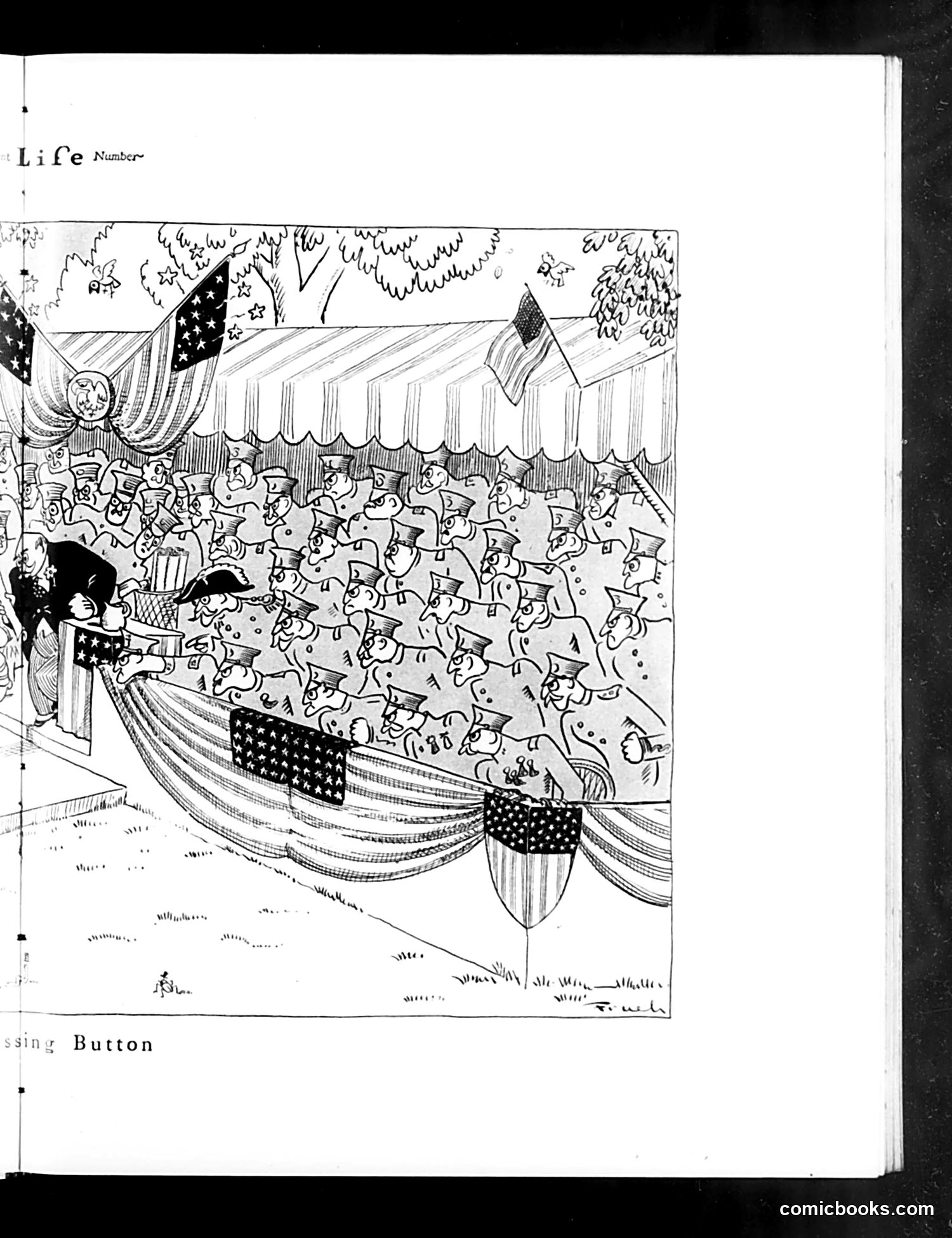
This page from *Life* magazine features a satirical cartoon titled "Life Number" (top) with a caption reference to "sing Button" (bottom, partially visible). The illustration depicts a large outdoor gathering under an American flag-decorated tent, with numerous caricatured figures seated and standing. A dignified figure on the left appears to be addressing or presiding over the crowd. The style suggests early-to-mid 20th century American political satire. However, the OCR text is too corrupted to definitively identify the specific political figures, event, or satirical point being made. The cartoon likely comments on a contemporary political gathering or public event, but **I cannot confidently specify which figures are caricatured or what particular political situation is being mocked** without clearer source information. The patriotic imagery and formal gathering setting suggest commentary on American political spectacle.
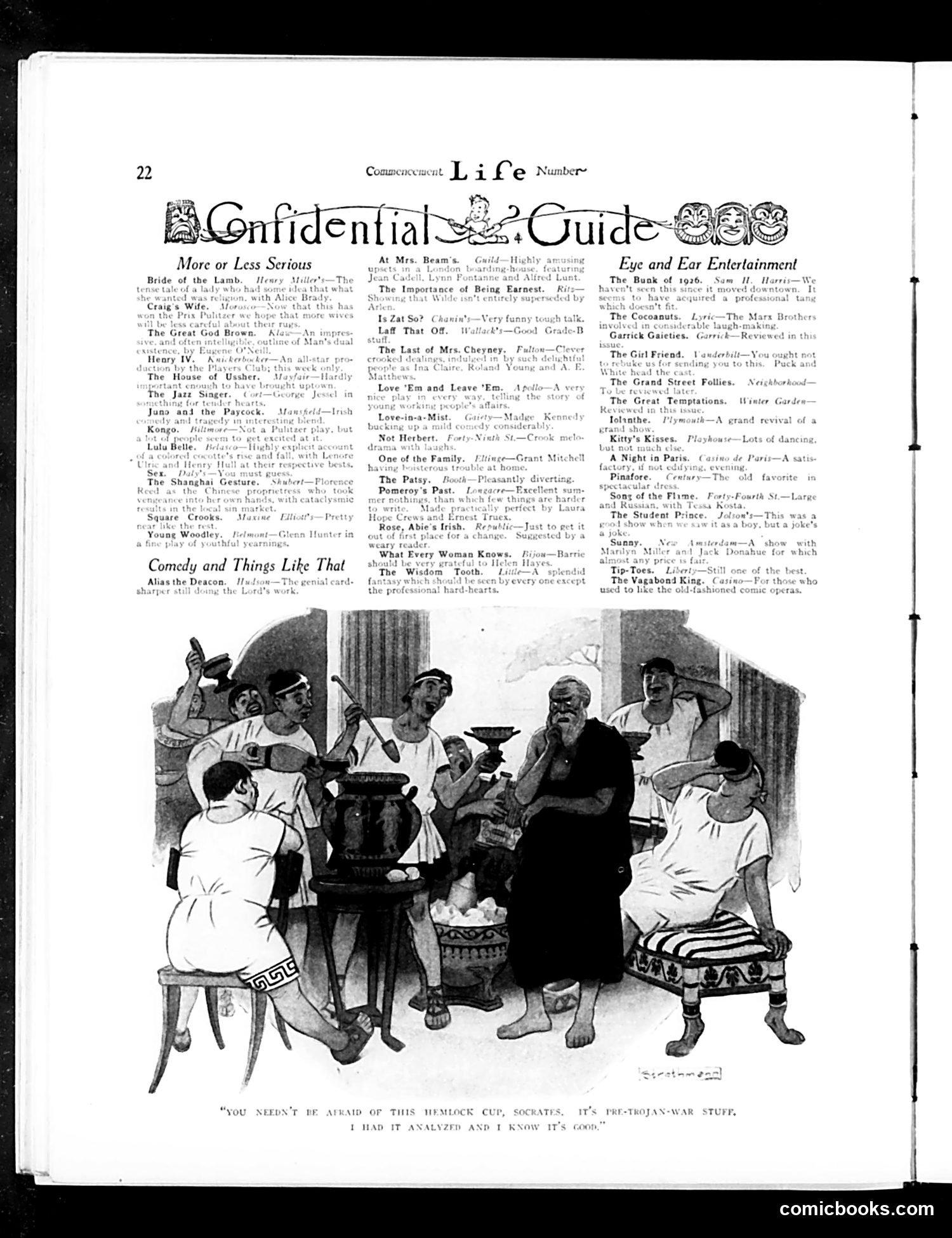
This page showcases the "Confidential Guide"—Life's satirical theater and entertainment reviews from the 1920s. The main cartoon depicts a social scene where an elderly man (likely representing a classical scholar or intellectual, given the "hemlock cup" reference) sits among younger people. The caption reads: "You needn't be afraid of this hemlock cup, Socrates. It's pre-trojan-war stuff. I had it analyzed and I know it's good." The joke references **Socrates' execution by hemlock poison** in ancient Athens, but satirizes modern anxiety about product safety and authenticity. In the Prohibition era (1920s America), the "pre-trojan-war" phrasing humorously suggests the "analysis" proves this poison is *old stock*—implying contemporary concern about adulterated bootleg liquor. The cartoon mocks both classical pretension and Jazz Age anxieties about food and drink safety. The page itself lists current Broadway shows and entertainment reviews, representing Life's role as a cultural arbiter of the period.
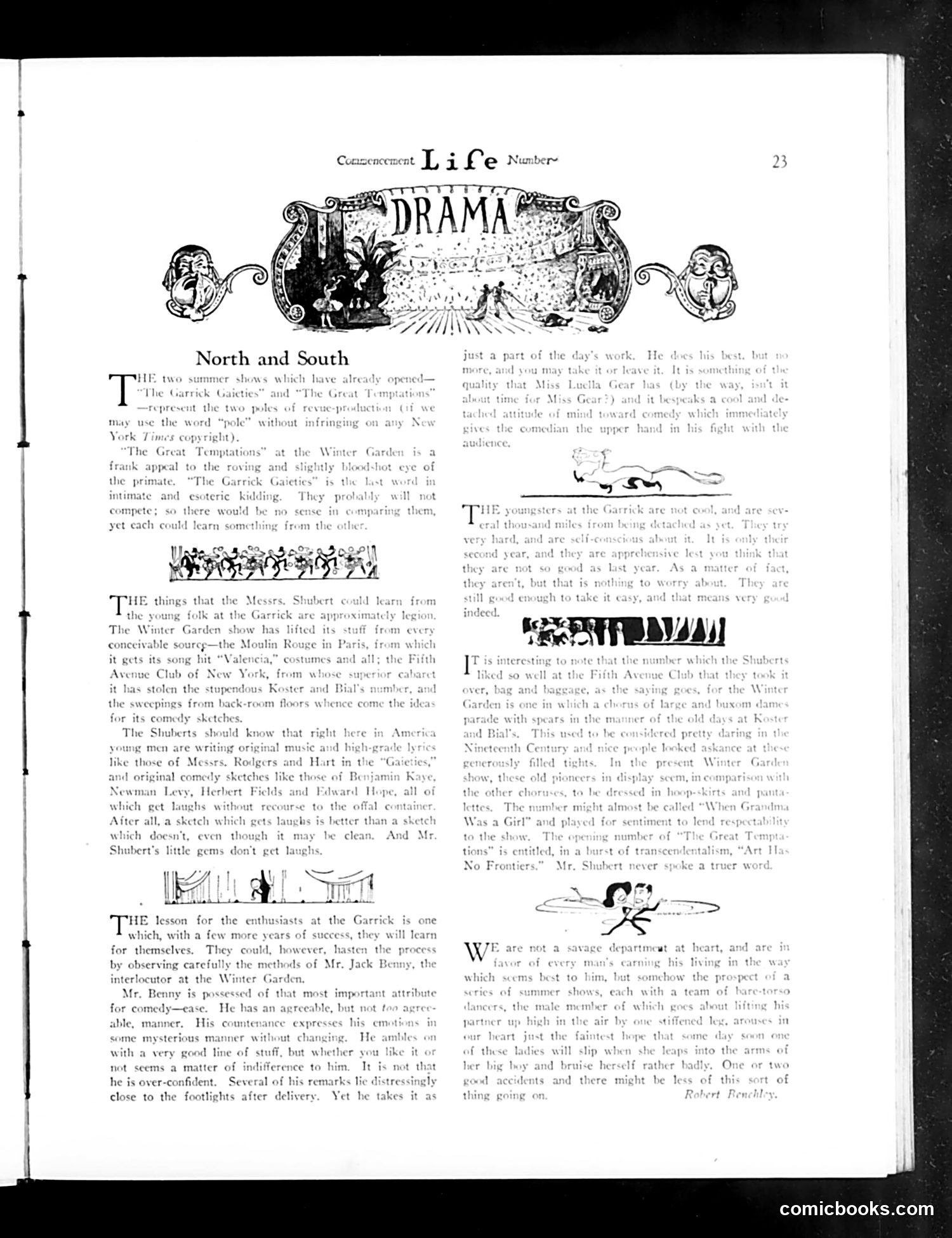
This page discusses theatrical productions at New York venues—"The Garrick Gaieties" and "The Great Temptations" at the Winter Garden. The text compares summer shows, noting the Winter Garden's "blood-shot eye" appeal to audiences seeking entertainment. The article critiques performers' abilities, particularly mentioning the Shubert brothers' theatrical productions. It discusses young performers at the Garrick who work hard but lack refinement compared to established stars. The piece includes commentary on comedic timing and theatrical technique, suggesting that proper execution of comedy requires skill. There are small decorative illustrations throughout, typical of Life magazine's satirical style. Without clear caricatures or political figures visible, this appears to be general theatrical criticism rather than political satire—focusing on 1920s-era Broadway entertainment quality and performer abilities.
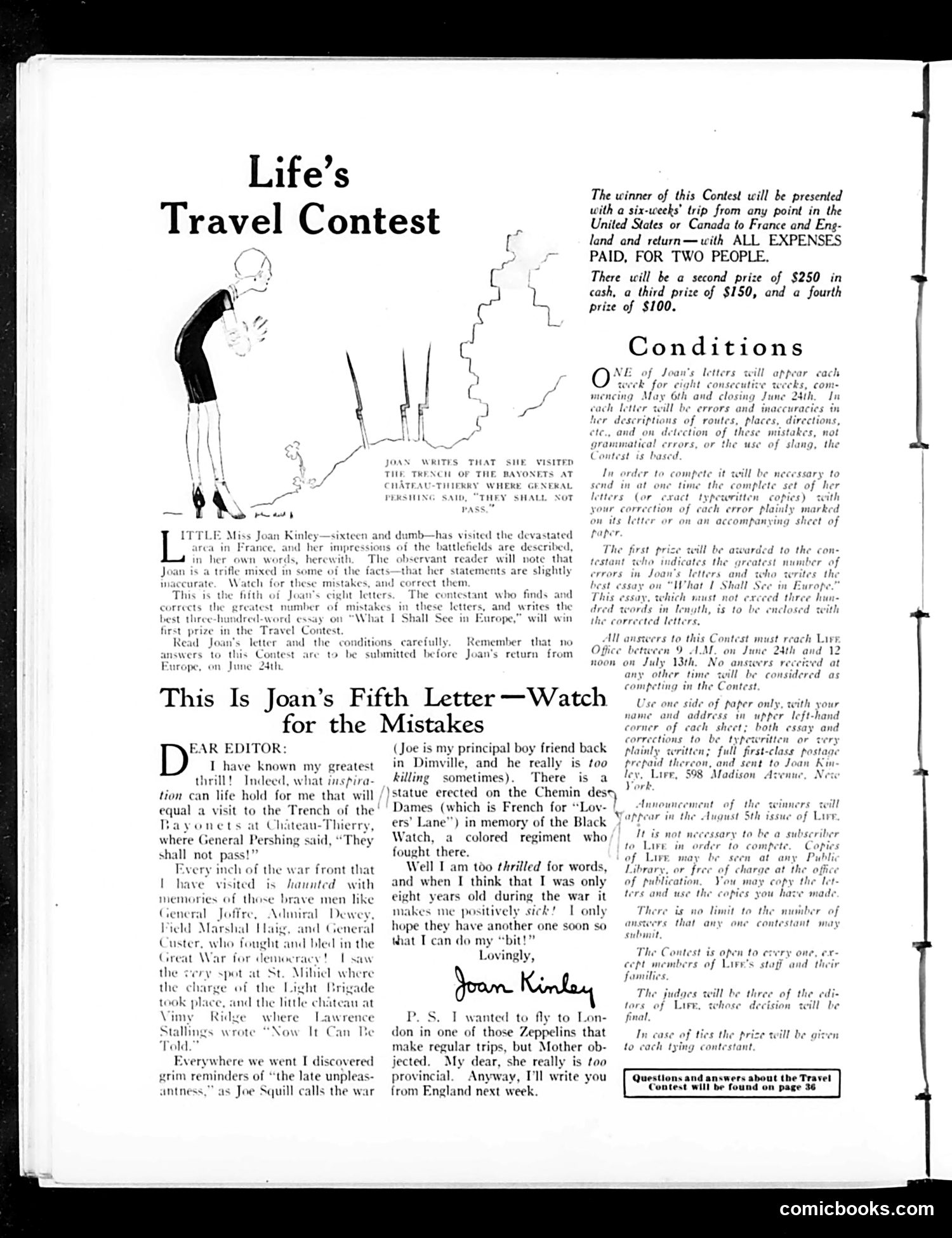
This page presents a **contest where readers must find factual errors in letters** written by "Joan Kinley," a sixteen-year-old who visited European battlefields after World War I. The satire works by having Joan deliberately pack her letters with **historical and geographical mistakes**: - She conflates WWI generals (Pershing, Joffre, Haig) with Civil War figures (Admiral Dewey, General Custer) - She references "the Charge of the Light Brigade" (Crimean War, not WWI) - She confuses battle locations and regiment details - She admits being only eight during the war, yet describes personal observations **The joke**: Life is mocking both historical ignorance and the tendency of Americans (particularly young women of the era) to conflate different wars and get basic facts wrong while discussing patriotic sacrifice. Readers competed to find these errors; the winner would receive a six-week European trip. This reflects Life's satirical approach—using humor to educate readers about actual history while poking fun at casual patriotism divorced from factual knowledge.
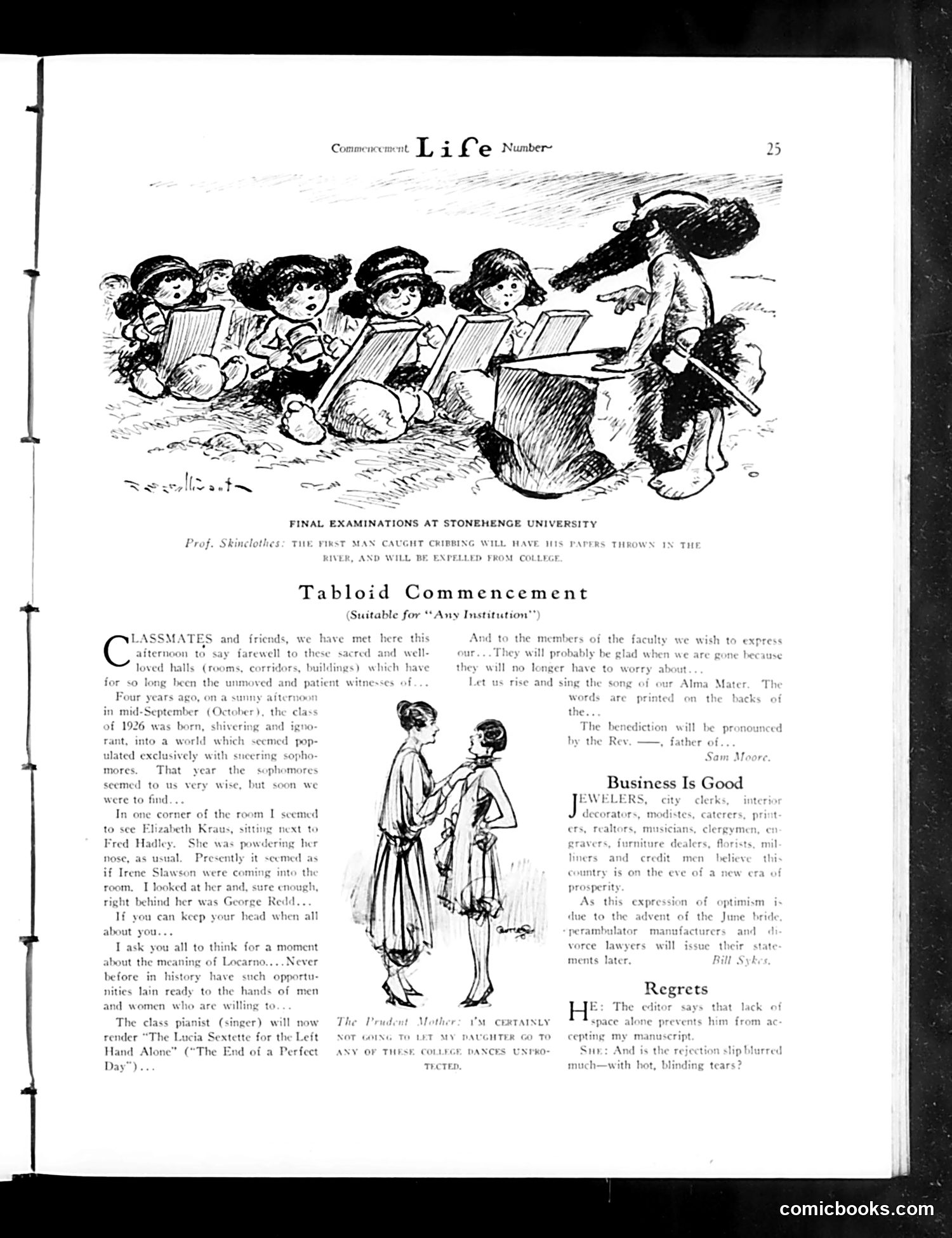
This page from *Life* magazine satirizes college commencement ceremonies through two main pieces: **Top Cartoon**: "Final Examinations at Stonehenge University" mocks academic cheating with dark humor. The caption warns that the first student caught cribbing (cheating) will have papers thrown in the river and face expulsion—an absurdly severe punishment meant as joke. **"Tabloid Commencement"**: A humorous mock program for graduation, written in deliberately sensationalized newspaper style ("tabloid" format). It includes satirical elements like farewell speeches, mentions of specific student dramas, and a section called "Business Is Good" celebrating post-graduation job prospects for various professions. **"Regrets" section**: Features an exchange between an editor and a prudent mother who refuses to let her daughter attend college dances—poking fun at both overly protective parenting and the growing sexual anxieties around collegiate social life in the 1920s. The overall satire targets pretentious commencement traditions while reflecting contemporary concerns about academic integrity, parental control, and college social life.
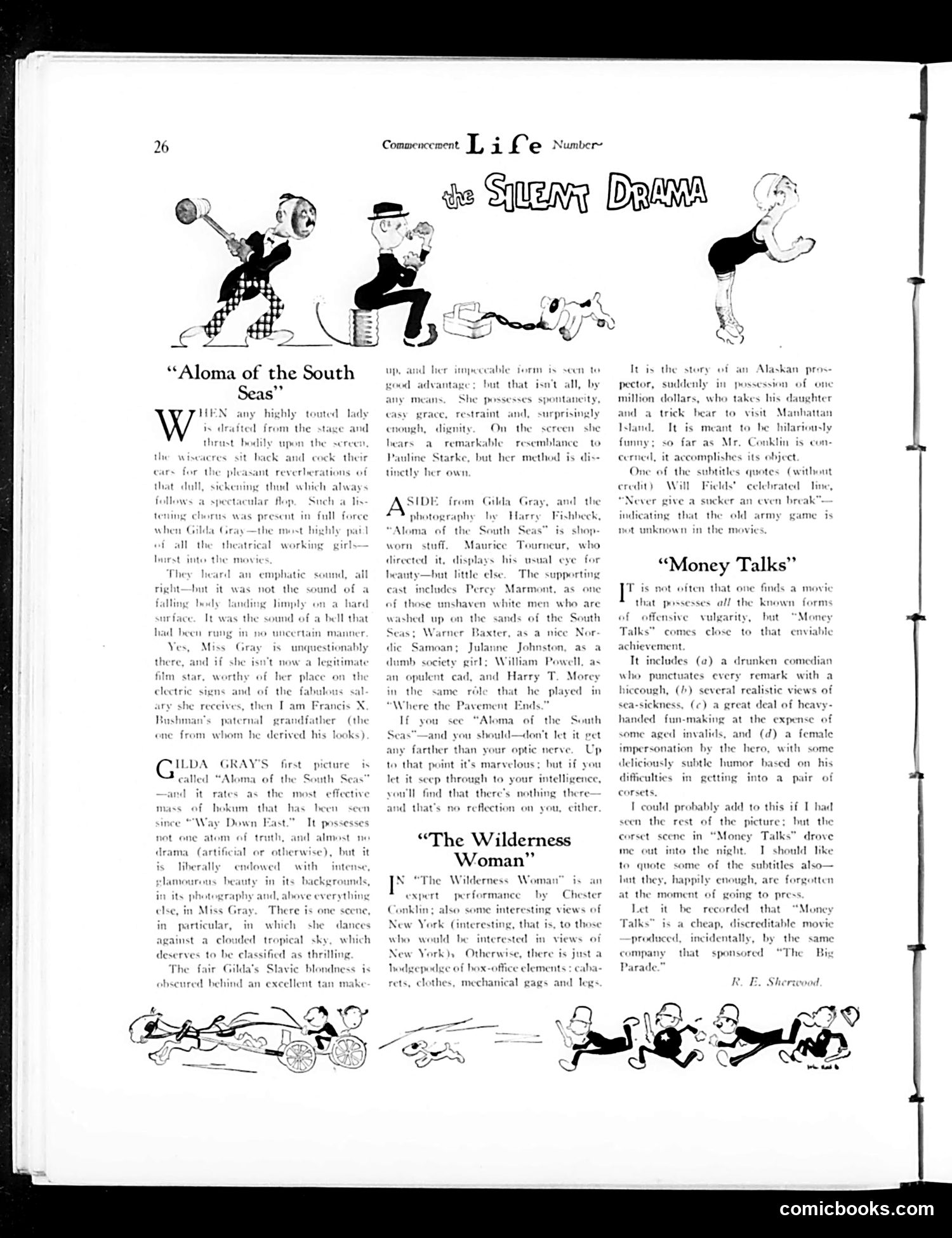
This page reviews three silent films for modern audiences unfamiliar with early cinema: **"Aloma of the South Seas"** stars Gilda Gray in a tropical adventure story. The reviewer critiques the film's visual appeal while warning that the plot lacks substance—advising viewers to enjoy the cinematography without thinking too hard about the narrative. **"The Wilderness Woman"** features comedian Chester Conklin in a story about an Alaskan prospector who strikes it rich. The review notes the film includes a Will Fields quote ("never give a sucker an even break"), marking the film as part of early slapstick comedy tradition. **"Money Talks"** is criticized as relying on crude humor: a drunken comedian, sick people for laughs, and cross-dressing comedy. The reviewer found it offensive enough to leave before the ending. These reviews reflect 1920s film criticism's concern with balancing visual spectacle against substance, and early cinema's heavy reliance on physical comedy and vulgarity.
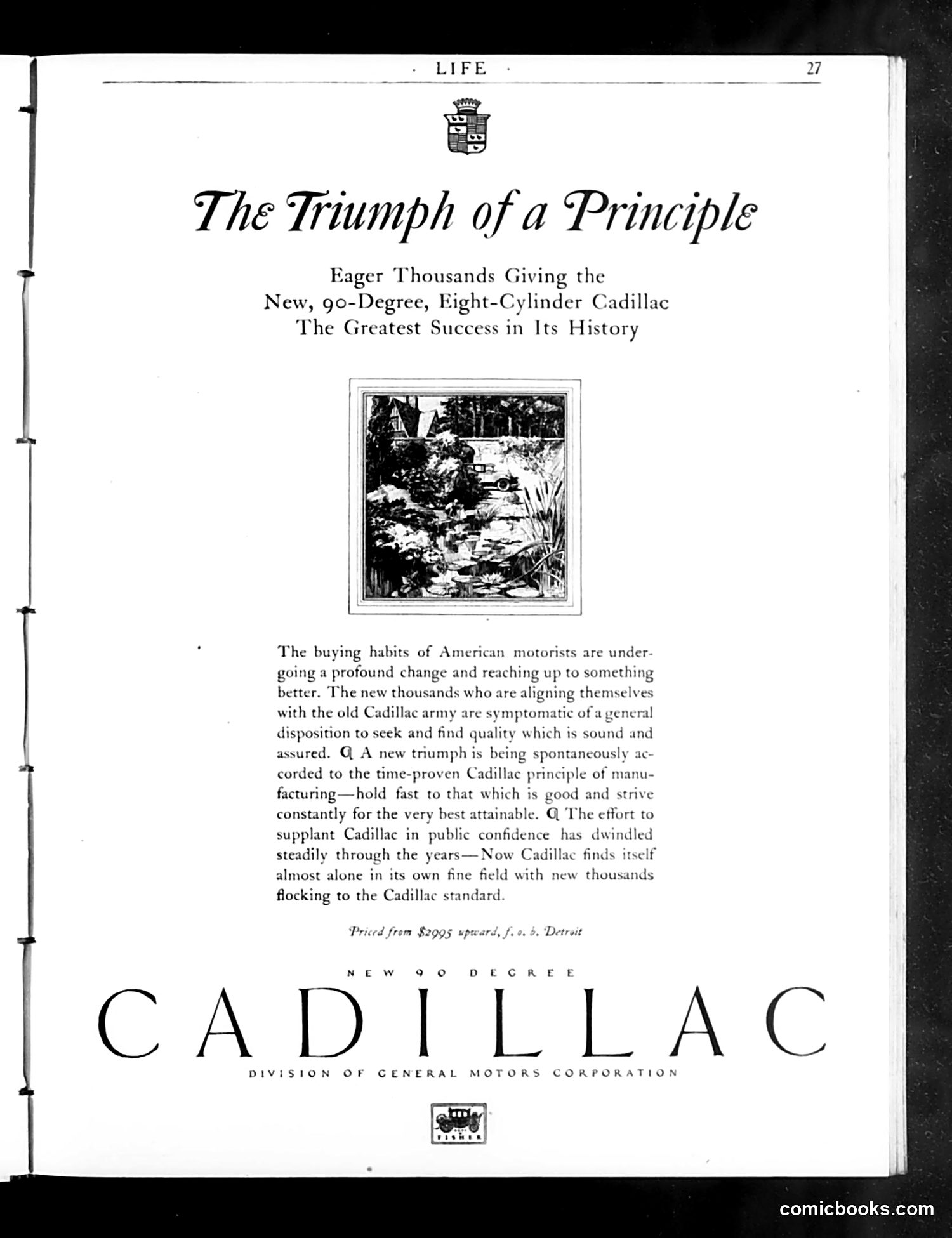
This is primarily a **Cadillac automobile advertisement**, not political satire. The page celebrates Cadillac's market dominance and the introduction of a new "90-degree, eight-cylinder" engine. The text claims that American motorists are shifting toward quality vehicles, with "eager thousands" adopting the Cadillac standard. It boasts that competitors' efforts to challenge Cadillac "have dwindled steadily" and that Cadillac now stands "almost alone in its own fine field." The small illustration shows a pastoral scene, likely meant to evoke leisure and prosperity associated with Cadillac ownership. **For modern readers**: This represents early automotive marketing emphasizing engineering superiority and brand loyalty. The phrase "triumph of a principle" suggests Cadillac's manufacturing philosophy of quality consistency. The $2,995 base price (1920s dollars) positioned it as a luxury vehicle. The advertisement subtly dismisses competitors while celebrating American consumer preference for established prestige brands.
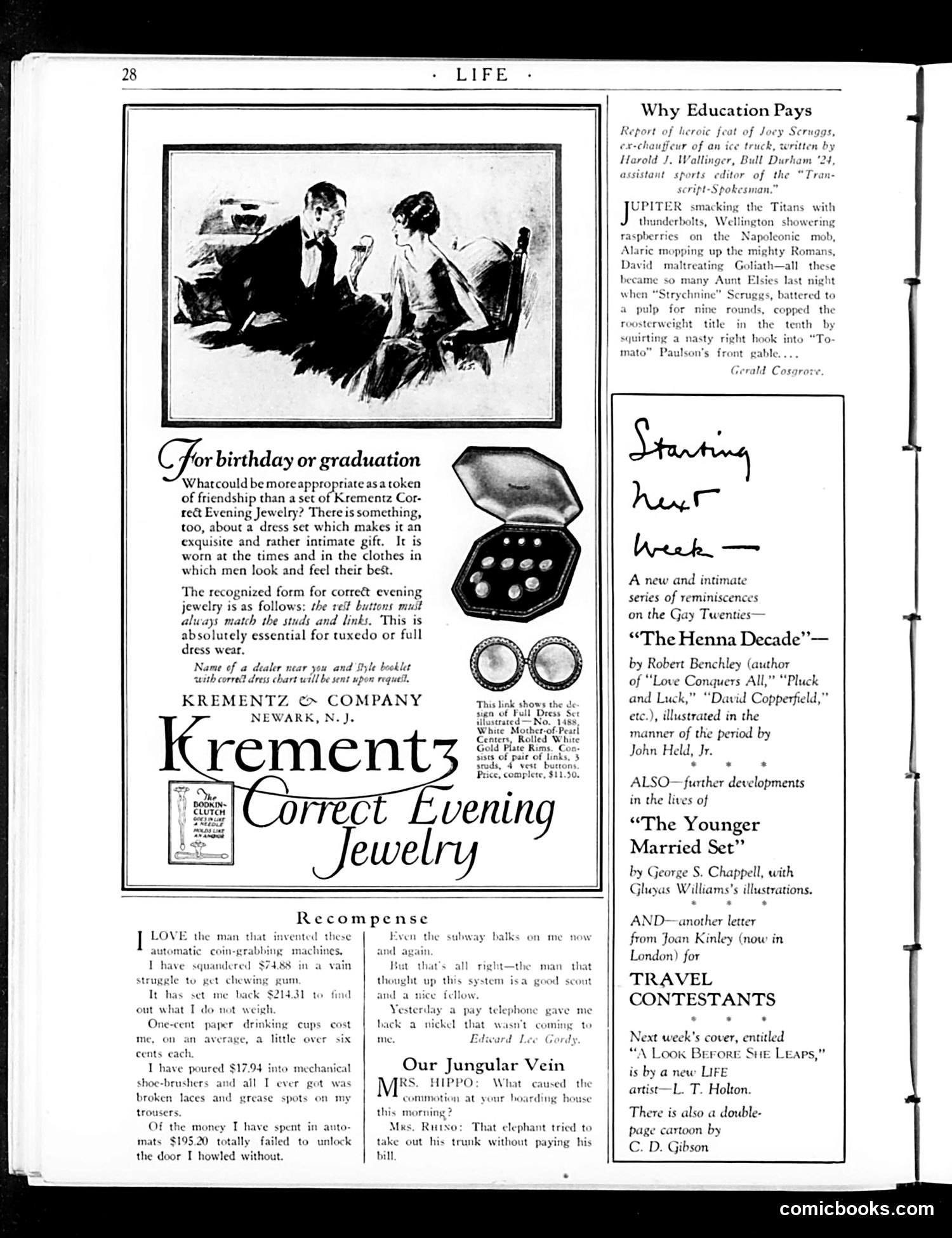
This is primarily a **advertising and content page** from Life magazine, not a political cartoon. The main image shows a domestic scene of a man and woman in conversation—likely illustrating courtship or marriage humor typical of 1920s Life. The page advertises **Krementz jewelry** for formal wear, emphasizing that matching cufflinks, studs, and buttons are essential for correct evening dress. This reflects the era's strict etiquette rules for gentlemen's formal attire. The text sections are mostly **humorous columns and upcoming features**: "Why Education Pays" mocks sports journalism hyperbole; "Recompense" jokes about coin-operated machines eating money; and "Our Jungular Vein" presents brief witty anecdotes. Upcoming features include Robert Benchley's reminiscence series on the 1920s ("The Henna Decade") and other serialized humor. The overall tone is **lighthearted social satire** aimed at middle-class American readers navigating modern conveniences, fashion standards, and relationships.
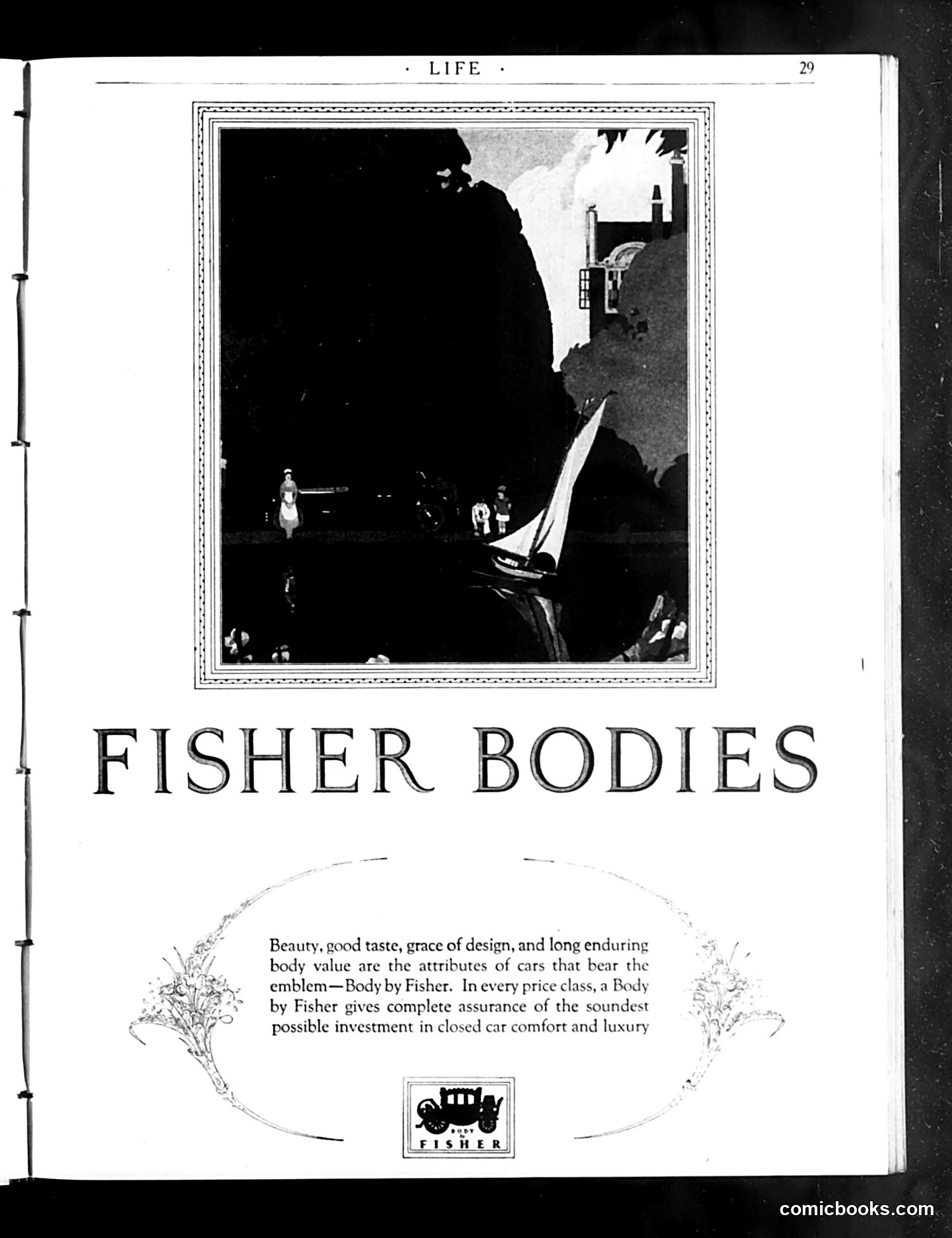
This is a full-page advertisement for Fisher Body, an automobile body manufacturer. The top contains an atmospheric illustration of a seaside or lakeside scene with cliffs, a sailboat, and figures—designed to evoke luxury and leisure. The text emphasizes that Fisher Bodies represent quality, design, and durability across all price points. The company's logo appears at bottom center. This is **not political satire or a cartoon**—it's straightforward product advertising from an era when car body manufacturers were distinct companies that supplied bodies to various automakers. The romantic imagery and emphasis on "luxury" and "investment value" target middle-to-upper-class consumers considering closed cars, which were still relatively new and desirable. Fisher Body later became part of General Motors.
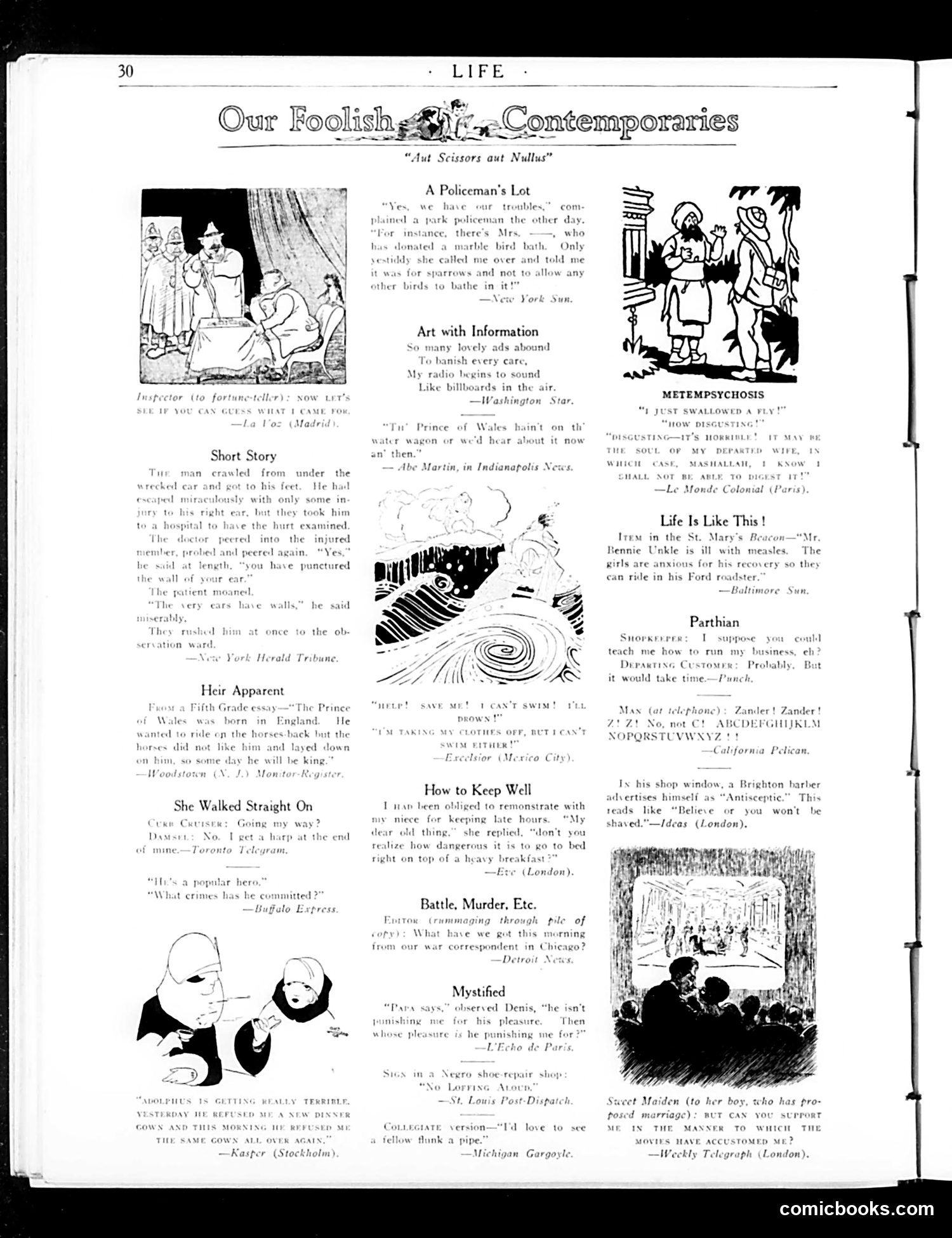
This is a humor section collecting satirical anecdotes and jokes from contemporary newspapers, organized by topic. The page mocks everyday social situations and human foibles rather than political figures. **Key sections:** - **"A Policeman's Lot"**: A woman's complaint about neighbors using her marble bird bath - **"Short Story"**: A doctor's dark joke about a punctured patient's stomach - **"Heir Apparent"**: A child's essay claiming English princes ride horses (satirizing children's naive reasoning) - **"She Walked Straight On"**: A woman ignores a popular hero, questioning his fame - **Various one-liners** on keeping late hours, running businesses, and social pretension The cartoons accompanying these items depict ordinary people in humorous domestic or social situations. The satire targets everyday human vanity, absurdity, and social pretension rather than specific political events or figures. This reflects *Life* magazine's focus on satirizing contemporary American middle-class culture and behavior.
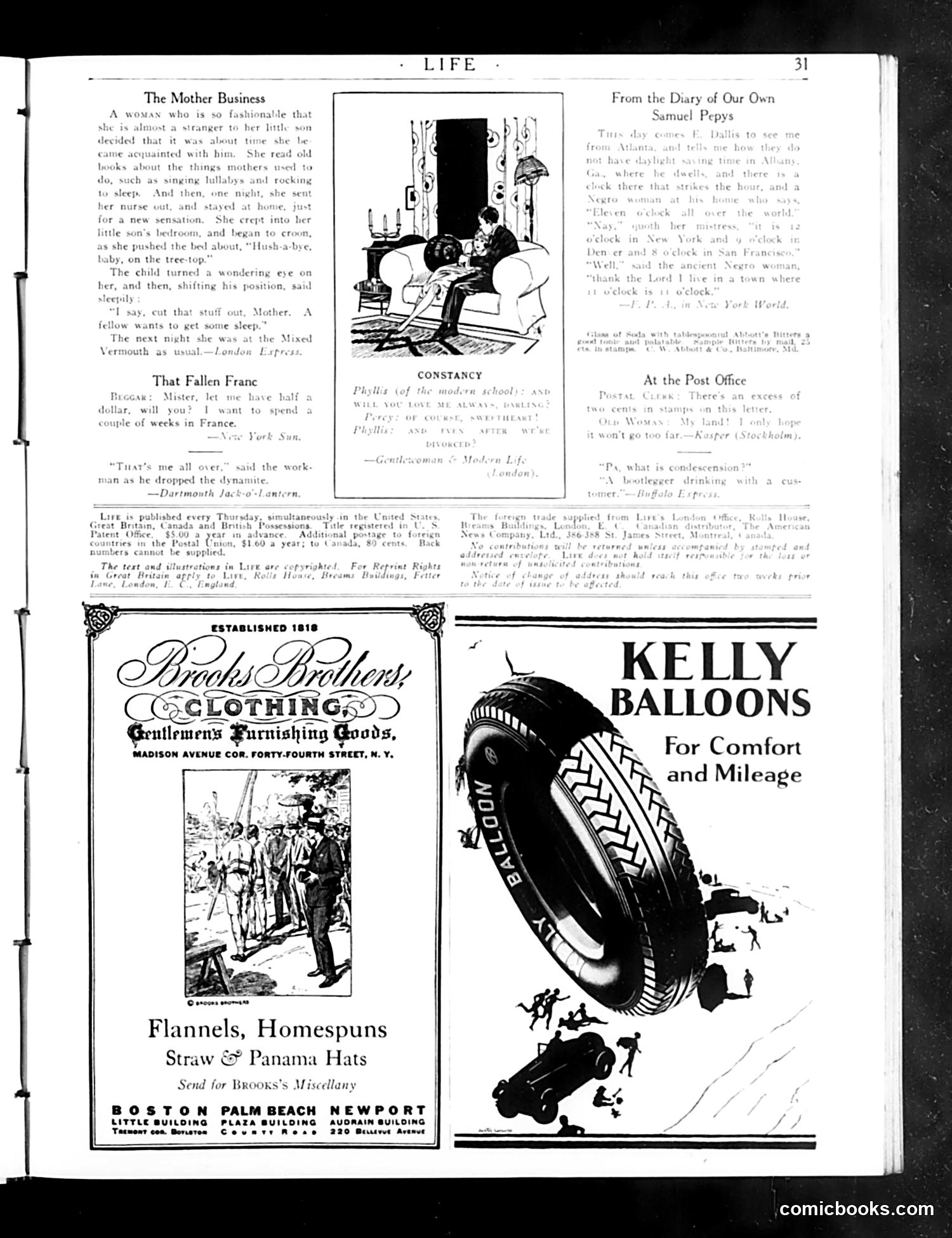
This page is primarily **advertising and filler content** from Life magazine, not political satire. The main elements are: 1. **"The Mother Business"** and **"That Fallen France"** — brief humorous anecdotes about everyday domestic life and a workman's mishap, typical of Life's light satirical humor section. 2. **"Constancy"** — a small cartoon about modern romance/relationships, with accompanying verse about constancy in love. 3. **"At the Post Office"** — another brief anecdote about postal service confusion. 4. **Two full advertisements**: Brooks Brothers (established 1818) advertising clothing and accessories, and Kelly Balloons advertising tires for automobiles. The page contains no identifiable political figures or references. It represents typical early-20th-century magazine content mixing light social commentary with commercial advertising—the business model supporting such publications.
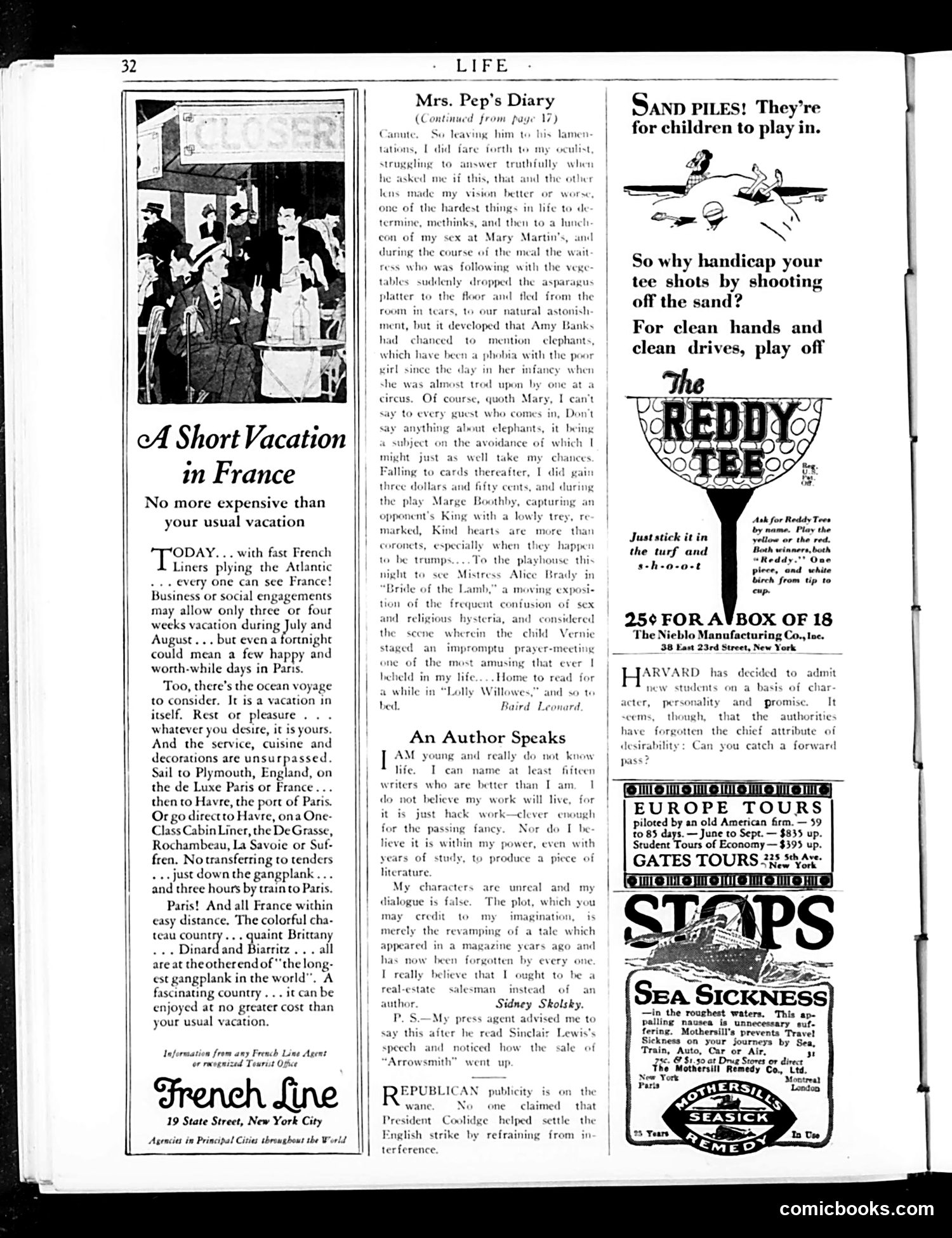
This page is primarily **advertising and miscellaneous content** rather than political satire. The main elements are: 1. **French Line Advertisement**: A travel ad promoting affordable French ocean liner vacations to Paris—positioned as no more expensive than domestic U.S. vacations. 2. **"Mrs. Pep's Diary"**: A gossipy society column continuing from page 17, recounting lunch anecdotes and theater outings among upper-class acquaintances. 3. **"An Author Speaks"**: A brief piece where an unnamed young writer expresses self-doubt about his literary merit, claiming his work is "hack work" and derivative. The reveal is darkly humorous: his agent advised him to make this self-deprecating statement *after* noticing Sinclair Lewis's speech boosted "Arrowsmith" sales—suggesting the confession is calculated publicity rather than genuine. 4. **Republican Publicity quip**: A brief jab at President Coolidge, claiming Republican propaganda credits him with settling the English strike simply by staying uninvolved. The page contains no significant political cartoons—mainly period advertisements (Reddy Tee golf clubs, sea-sickness remedy, European tours).
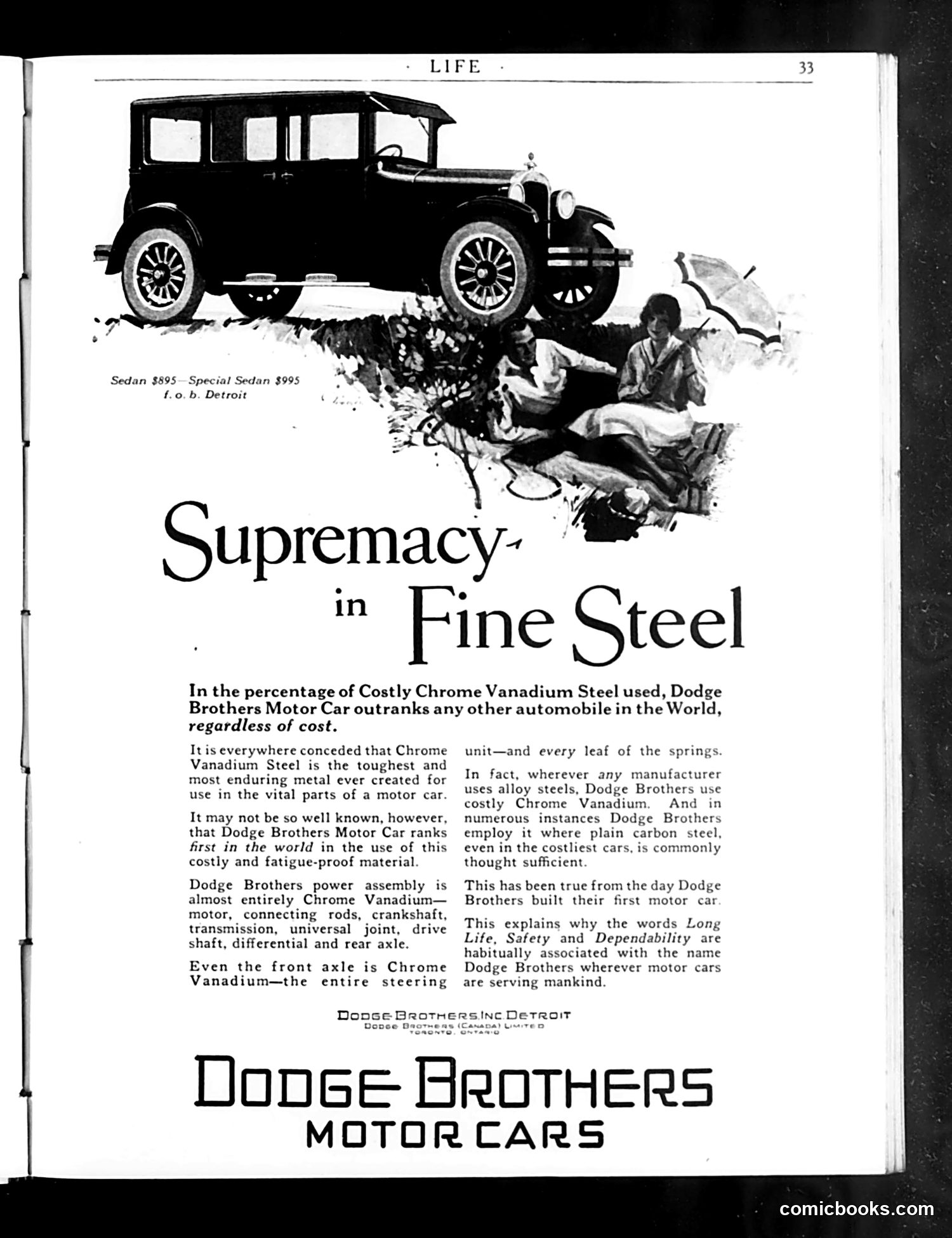
This is primarily **advertising, not satire or political commentary**. It's a straightforward 1920s-era Dodge Brothers motor car advertisement emphasizing superior manufacturing materials. The page shows a sedan automobile with an illustration of a couple on a picnic blanket nearby—a common advertising trope depicting leisure and prosperity. The ad's central claim is that Dodge Brothers uses Chrome Vanadium Steel more extensively than competitors, even expensive ones, making their vehicles superior in durability and safety. The text repeatedly asserts Dodge's "supremacy in fine steel," listing specific components (motor, crankshaft, axles, steering) made from this costly alloy. The ad claims this explains why Dodge is associated with "Long Life, Safety and Dependability." **For modern readers:** This reflects early automotive competition focusing on material quality rather than features, design, or performance—emphasizing engineering credibility during a period when automobile reliability was still a significant consumer concern.
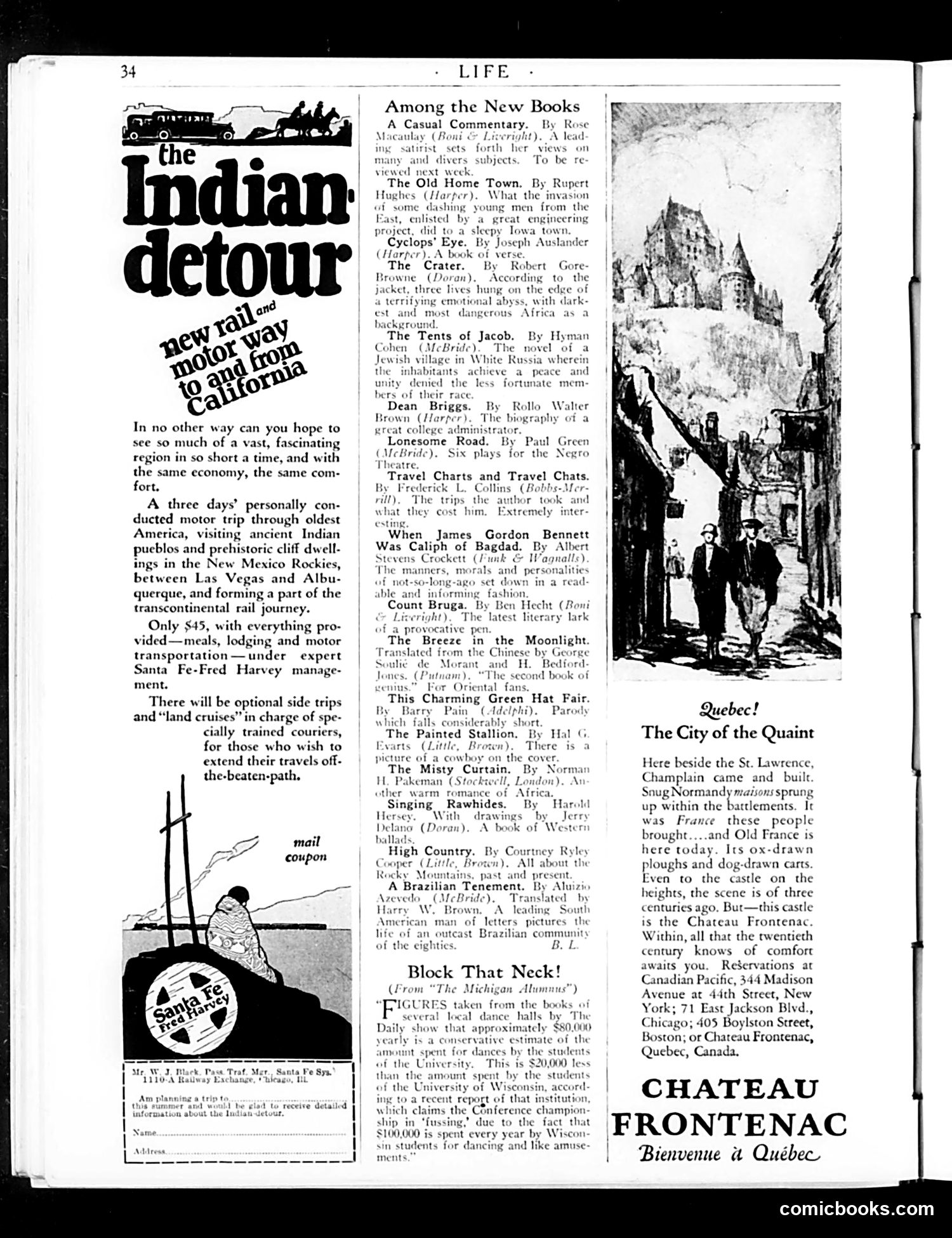
This page combines book reviews with travel advertising. The main satirical content is "Block That Neck!" — a brief joke from *The Michigan Alumnus* contrasting spending priorities at universities. The joke criticizes University of Michigan students for spending approximately $80,000 yearly on dances, while the University of Wisconsin spends $100,000 annually on dancing and amusement. The humor lies in the absurdity: Wisconsin boasts a "Conference championship in 'fussing'" (flirting/romantic activity), attributing this dubious achievement to their lavish entertainment spending. The satire mocks both institutions for prioritizing social activities over academics, and Wisconsin's pride in this frivolous "championship." The page also features travel advertisements for Santa Fe Railway's New Mexico tours and Chateau Frontenac in Quebec — typical period marketing targeting affluent readers. The "book reviews" section is standard literary coverage, mentioning works by established authors like Robert Browne and Ben Hecht.
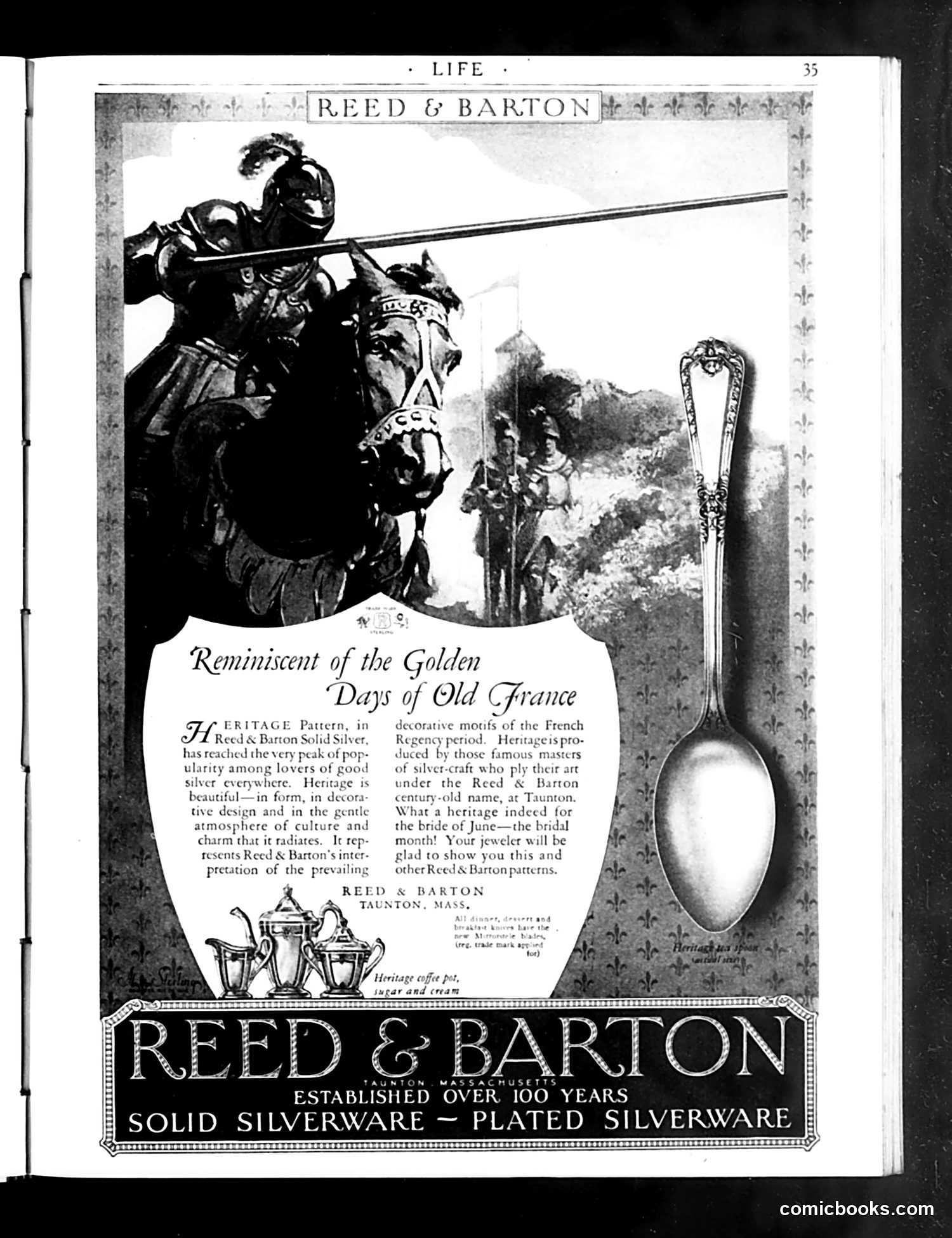
This page is **primarily an advertisement**, not a political cartoon. It's a Reed & Barton silverware ad from *Life* magazine featuring decorative imagery rather than satire. The illustration depicts a **medieval or Renaissance knight on horseback** wielding a lance, with period figures in the background—evoking "Old France" and historical grandeur. This romantic imagery is purely decorative, meant to associate the "Heritage" silverware pattern with French Regency period aesthetics and cultural refinement. The ad's pitch is nostalgic marketing: Reed & Barton positions their silverware as embodying timeless elegance and heritage craftsmanship (established over 100 years). The reference to "the bride of June" targets June weddings, a standard advertising demographic. There is **no political satire** here—it's straightforward luxury goods advertising using historical romance and appeals to taste and tradition.
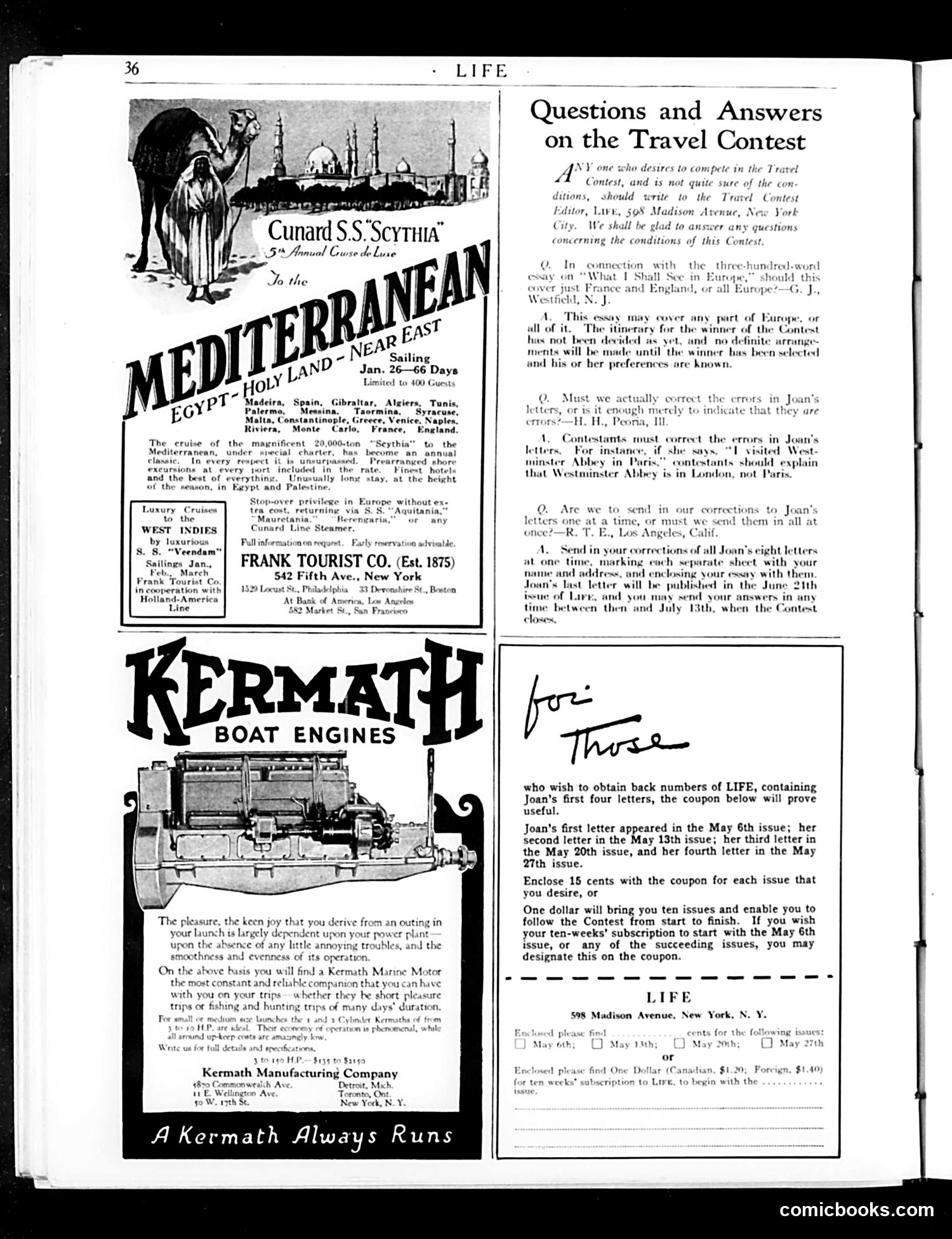
This page is primarily **advertising and contest administration**, not satire or political commentary. It contains: **Main Content:** - A "Travel Contest" Q&A section where Life magazine answers reader questions about a contest involving correcting errors in letters written by someone named "Joan" - Contestants must identify geographical mistakes (example given: Joan claiming Westminster Abbey is in Paris when it's actually in London) - The contest runs through mid-July; winners receive European travel prizes **Advertisements:** - Cunard cruise line promoting Mediterranean voyages - Frank Tourist Co. advertising Caribbean cruises - Kermath boat engines The page reflects early-20th-century consumer culture: travel contests as marketing tools, luxury cruises as aspirational products, and magazines as platforms for both editorial content and commercial promotion. There is no evident political satire or caricature—it's a straightforward mix of contest rules and period advertising.
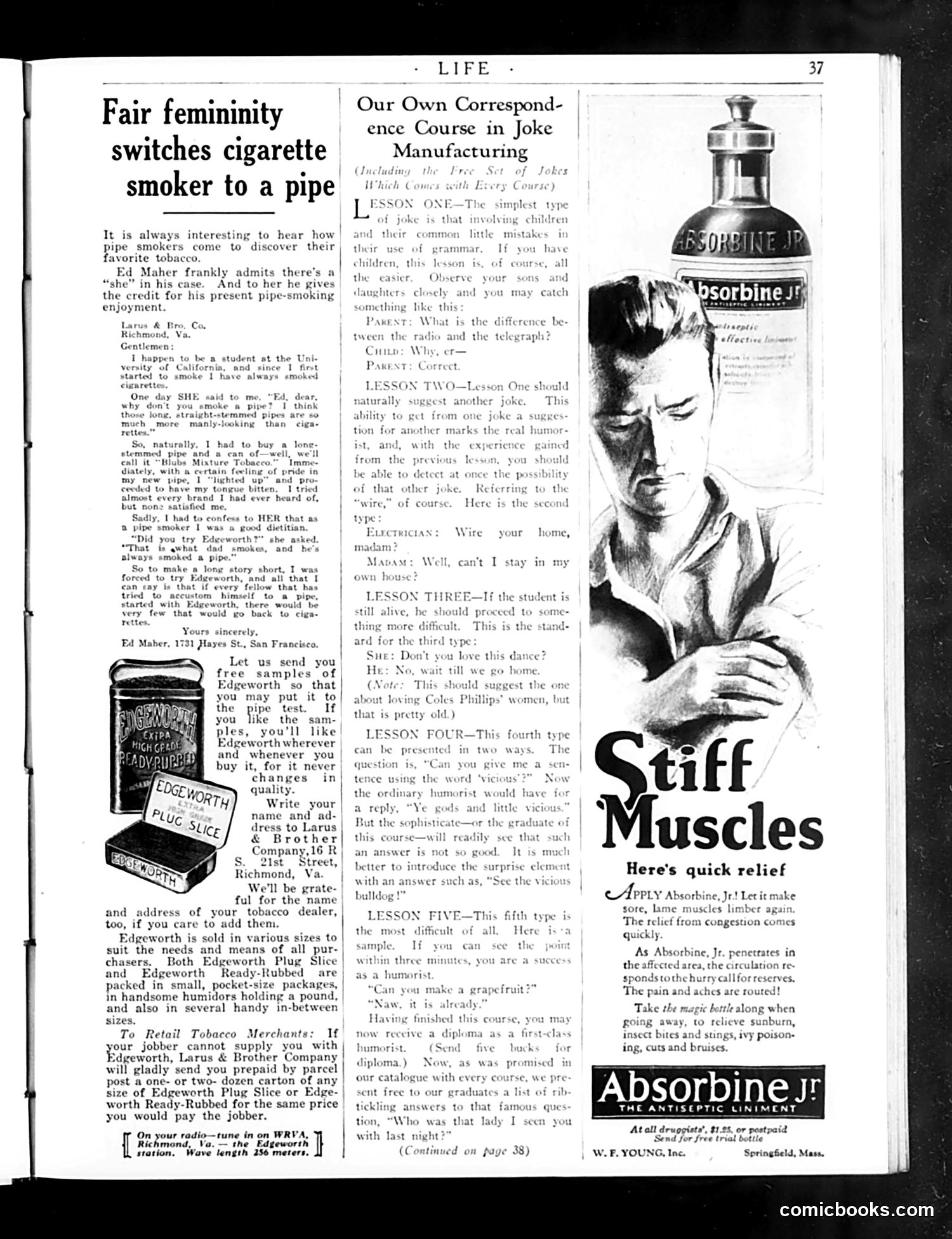
This page contains two distinct elements: **Left side:** A testimonial advertisement for Edgeworth pipe tobacco. A student named Ed Maher writes that his girlfriend convinced him to switch from cigarettes to a pipe, positioning pipe-smoking as more sophisticated and appealing. The satire here targets gender dynamics—a woman's "fair femininity" persuades a man toward what's framed as a more refined habit. It's a tobacco ad exploiting romantic persuasion as a marketing angle. **Center:** "Our Own Correspondence Course in Joke Manufacturing"—a humorous lesson series teaching joke-writing techniques through five progressive difficulty levels, from children's jokes to more sophisticated humor requiring setup and punchlines. **Right side:** An advertisement for Absorbine Jr., a liniment product claiming quick relief for sore muscles, congestion, and minor injuries. The page reflects 1920s advertising culture where gender appeal and pseudo-educational humor were common sales tactics.
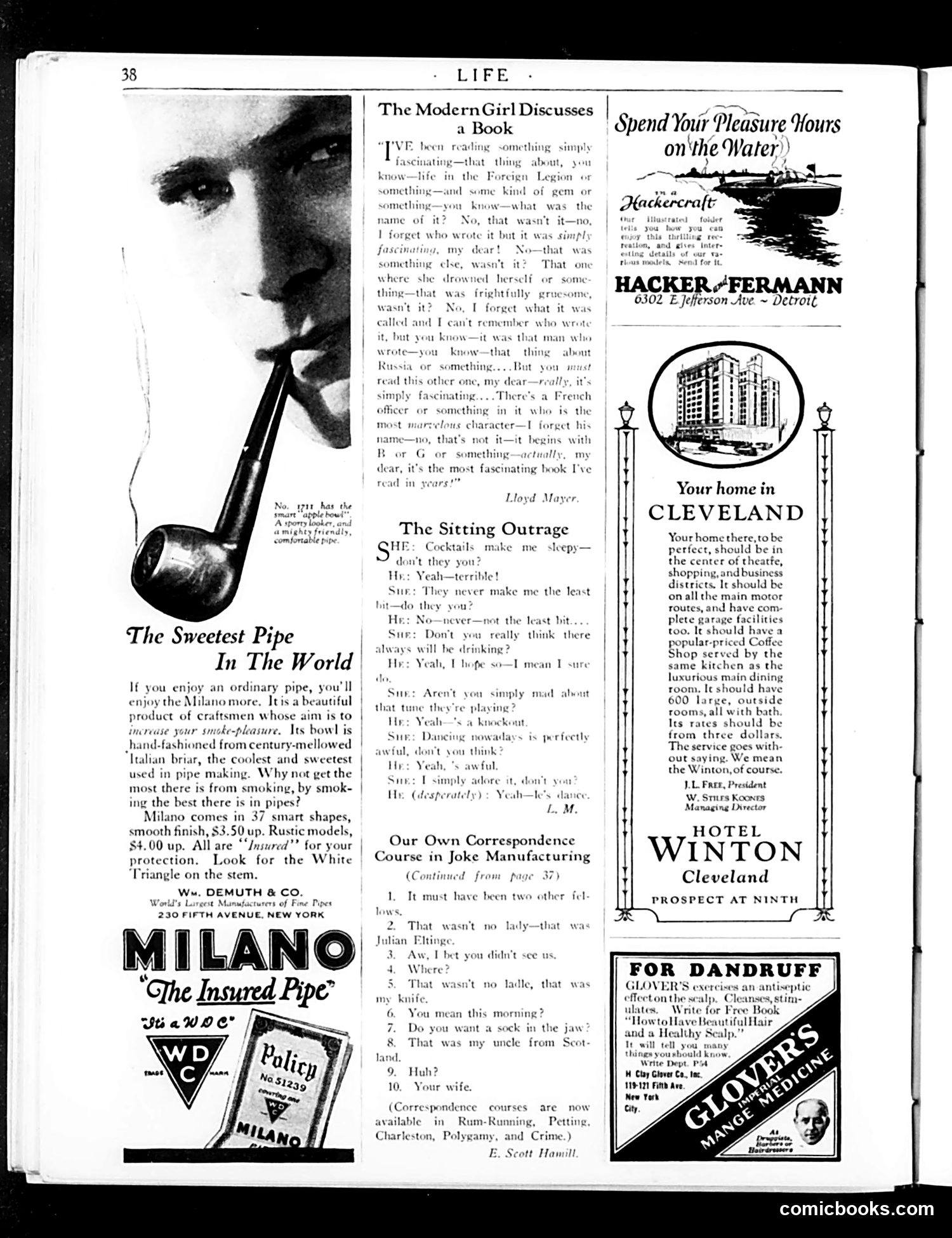
This page is primarily **advertising with satirical content**. The main humor pieces are: **"The Modern Girl Discusses a Book"**: A satire on superficial intellectualism. A young woman rambles about a book she's supposedly read—forgetting the title, author, and plot details—yet insists it's "simply fascinating." She remembers only vague impressions (a French officer, a drowning scene) and admits confusion throughout. The joke targets the pretension of modern women who affect literary sophistication without genuine engagement. **"The Sitting Outrage"**: A dialogue satirizing Prohibition-era hypocrisy. A couple discusses cocktails and drinking with obvious contradiction and evasion ("They never make me sleepy"... "the least bit"). The humor derives from their transparent denial about alcohol consumption during the Prohibition period when drinking was illegal but widespread. Both pieces mock 1920s social conventions and affectations among young, fashionable people. The remainder of the page consists of advertisements for pipes, hotels, and dandruff remedies—typical of Life's era.
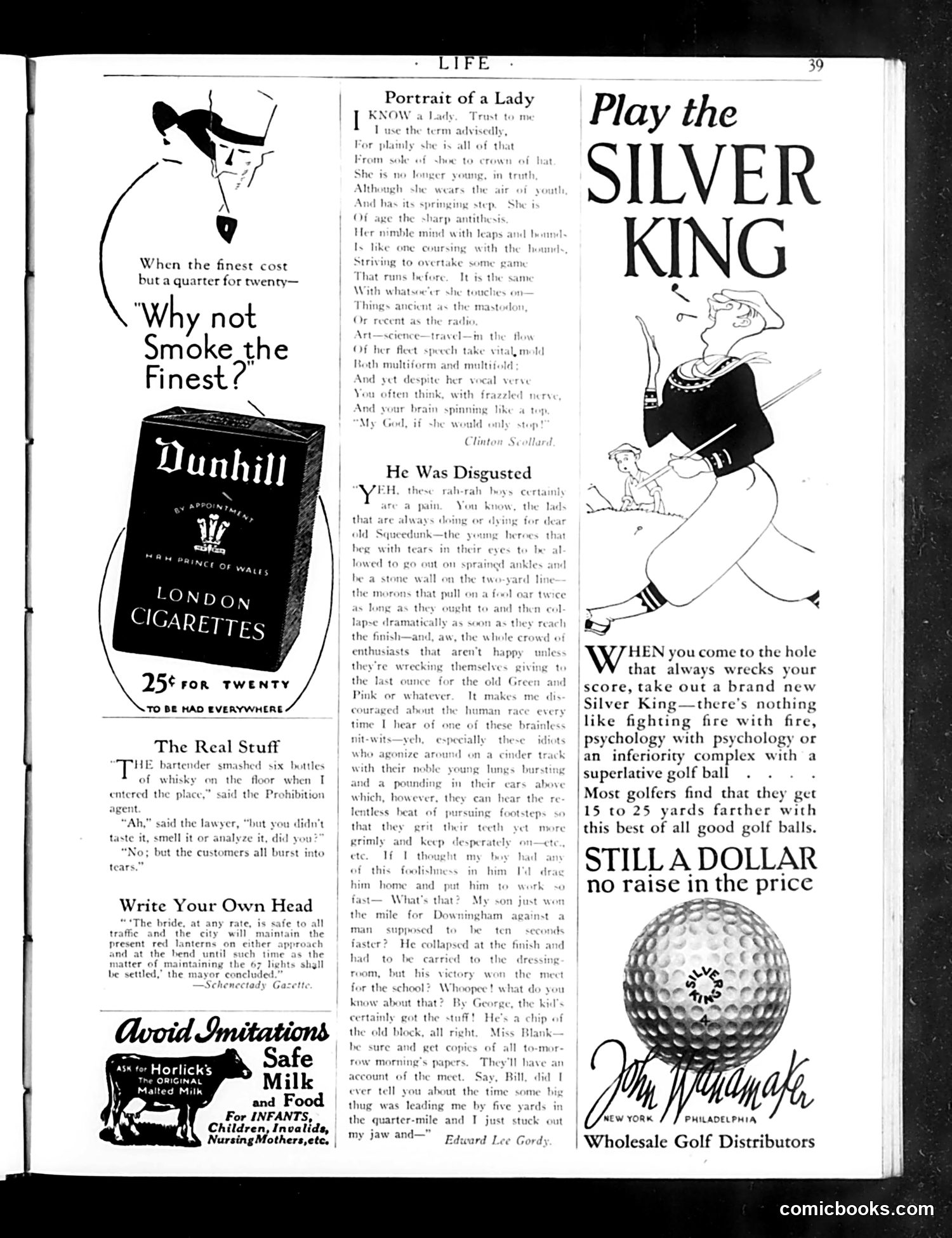
This page from *Life* magazine contains primarily **advertisements and light humor** rather than political satire. **Main Content:** 1. **Dunhill Cigarettes ad** (top left): A straightforward luxury cigarette advertisement playing on affordability ("25¢ for twenty"). 2. **"The Real Stuff"** (center left): A brief humorous anecdote set during **Prohibition**, referencing the illegal alcohol trade. A lawyer questions whether a bartender properly disposed of whisky bottles when caught—the joke being that customers' emotional reaction proved the alcohol was genuine contraband, not fake. 3. **"Portrait of a Lady"** (center): A poem describing a fashionable, modern woman—likely commentary on 1920s social attitudes toward women's independence and behavior. 4. **"Play the Silver King"** (right): A golf ball advertisement using psychology-based marketing language, claiming the product helps overcome mental barriers in golf. 5. **Horlick's Malted Milk ad** (bottom): A medicinal food product advertisement. The page reflects 1920s consumer culture and Prohibition-era references, with minimal actual satire.
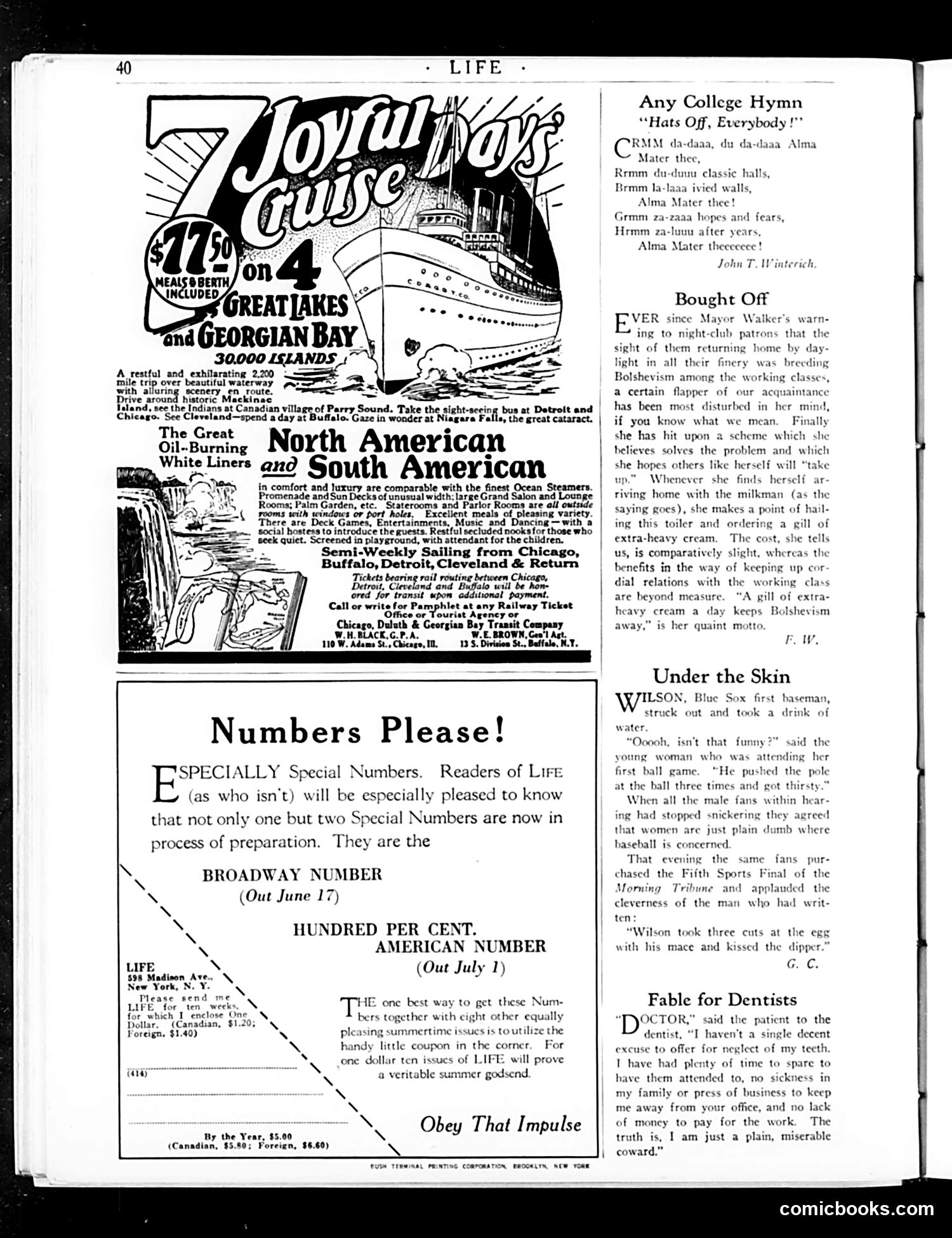
This is primarily a **commercial advertisement page** for a Great Lakes cruise line, with several short humorous columns typical of Life's satirical content. The main cruise ad promotes a 2,200-mile "North American White Liners" voyage departing from Chicago, emphasizing luxury amenities comparable to ocean steamers—a significant selling point for inland travel in this era. The page's humor sections include: **"Bought Off"**: Satirizes a wealthy flapper (young woman) who bribes her milkman with expensive cream when he catches her returning home with a date, fearing her behavior might radicalize working-class resentment. The joke targets both the frivolous wealthy and paranoia about "Bolshevism" (communism) spreading among workers. **"Under the Skin"**: Mocks women's supposed ignorance of baseball, depicting a female spectator not understanding basic rules. **"Fable for Dentists"**: A patient complains about dental costs while admitting he avoids the dentist entirely—a straightforward joke about human contradiction. The page reflects 1920s-era attitudes toward class, gender, and leisure, with advertising integrated among satirical commentary.
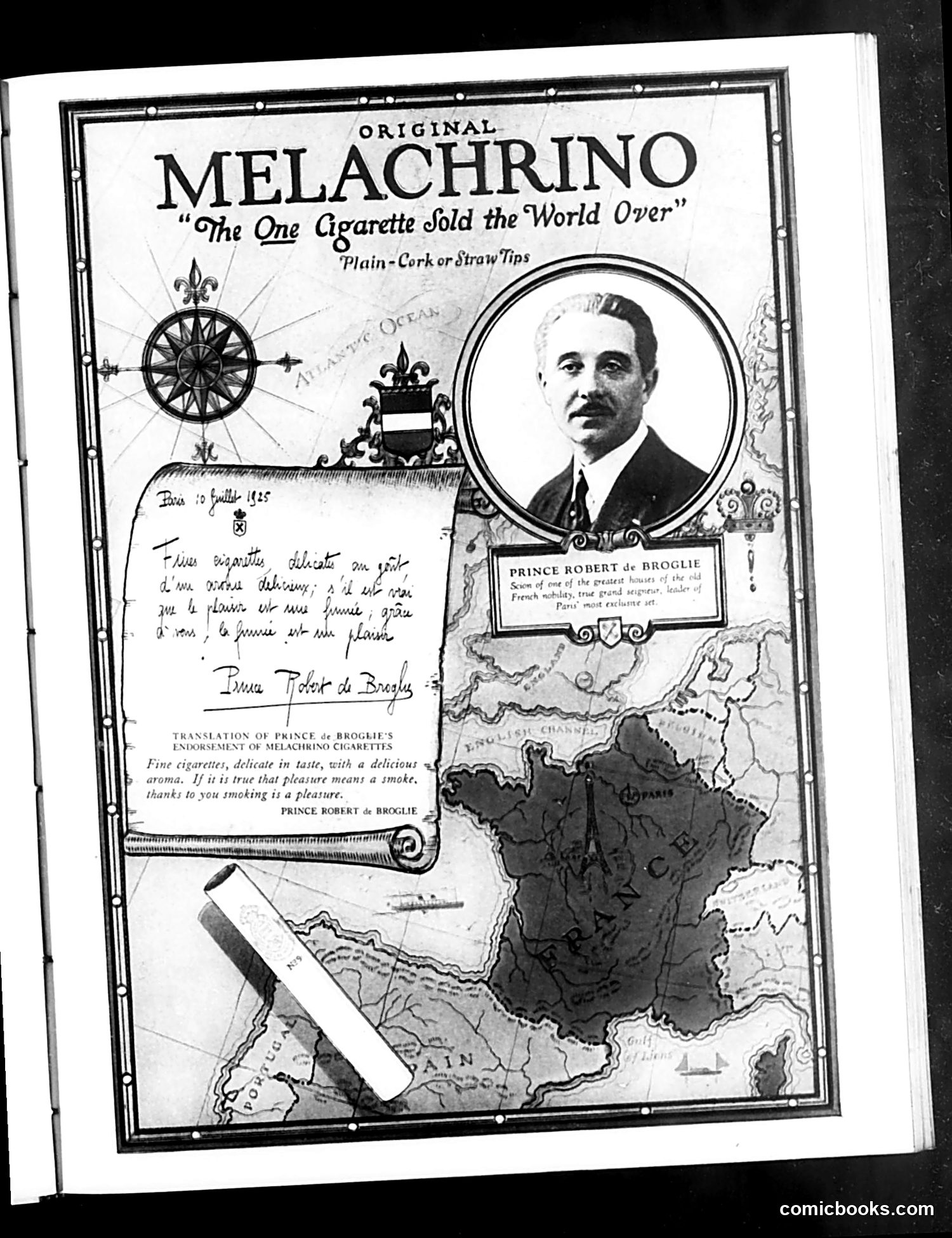
This is a **cigarette advertisement**, not political satire. It promotes Melachrino cigarettes as "The One Cigarette Sold the World Over" by featuring an endorsement from **Prince Robert de Broglie**, a French nobleman identified as "one of the greatest houses of the old French nobility." The advertisement includes: - A portrait of the prince in formal dress - His handwritten endorsement in French - A map of France showing the brand's reach - A compass rose and decorative heraldic elements emphasizing international prestige The satire here is subtle: **Life magazine** (known for mockery) is likely satirizing celebrity endorsement culture and the pretentious use of European aristocratic titles to sell commercial products to American consumers. The elaborate, ornate presentation itself—with its overwrought map and noble imagery—appears designed to amuse readers by exposing the absurdity of marketing tactics.
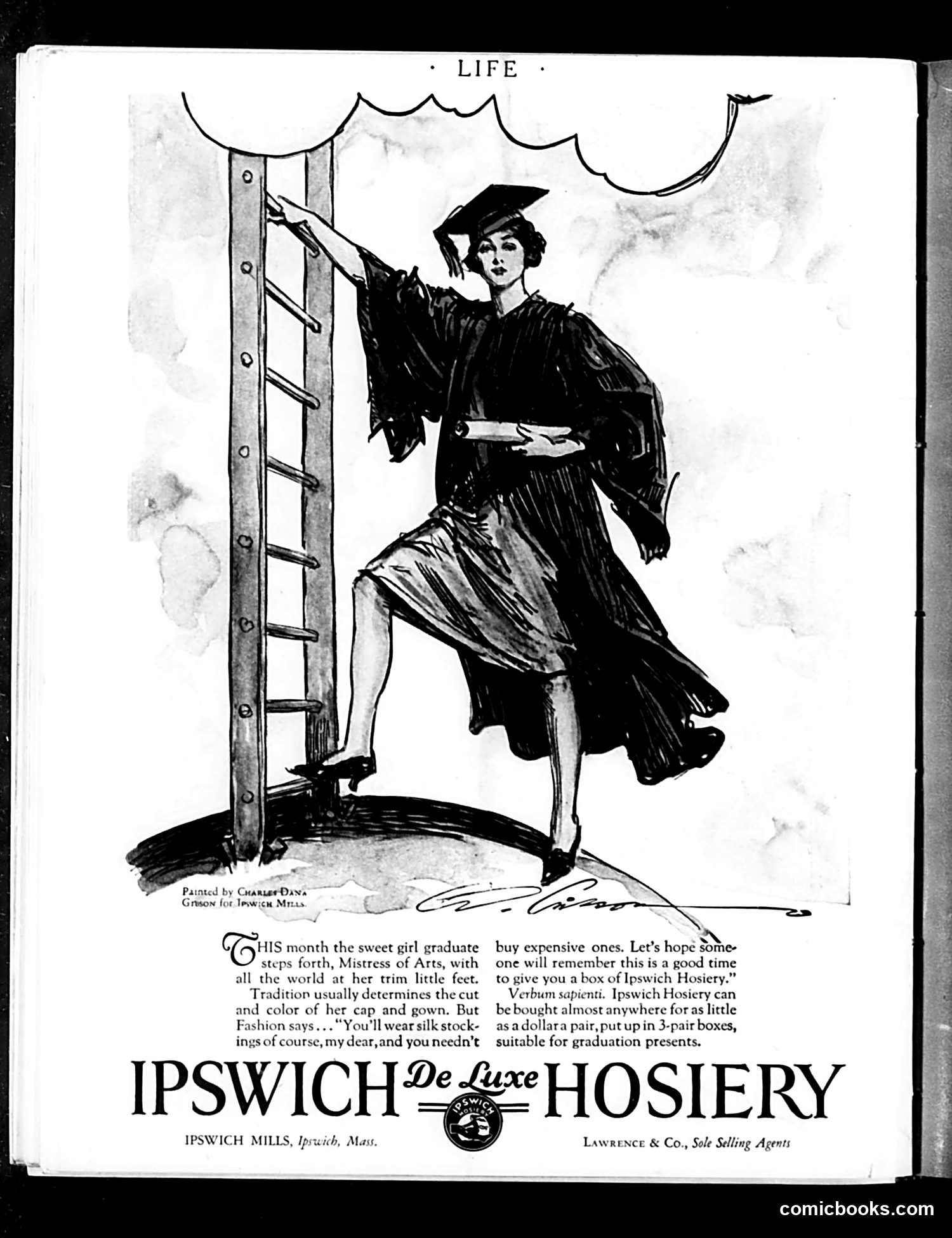
This is primarily an **advertisement**, not political satire. It features an illustration of a female college graduate in academic regalia climbing a ladder toward a flag, symbolizing ambition and achievement. The "joke" is a gentle social commentary on women's aspirations: the text notes that while tradition dictates graduates' academic dress, fashion (and practicality) demands quality silk stockings. The ad plays on the tension between women's educational advancement and persistent attention to appearance and feminine accessories. The phrase "Verbum sapienti" ("a word to the wise") frames hosiery as a thoughtful graduation gift. The illustration's dynamic pose—climbing upward—celebrates the graduate's ambitions while the advertisement anchors messaging to an expected feminine concern: what she'll wear. This reflects early 20th-century attitudes: celebrating women's education while assuming consumer interest in fashion remained paramount.