
A complete issue · 40 pages · 1925
Life — May 21, 1925
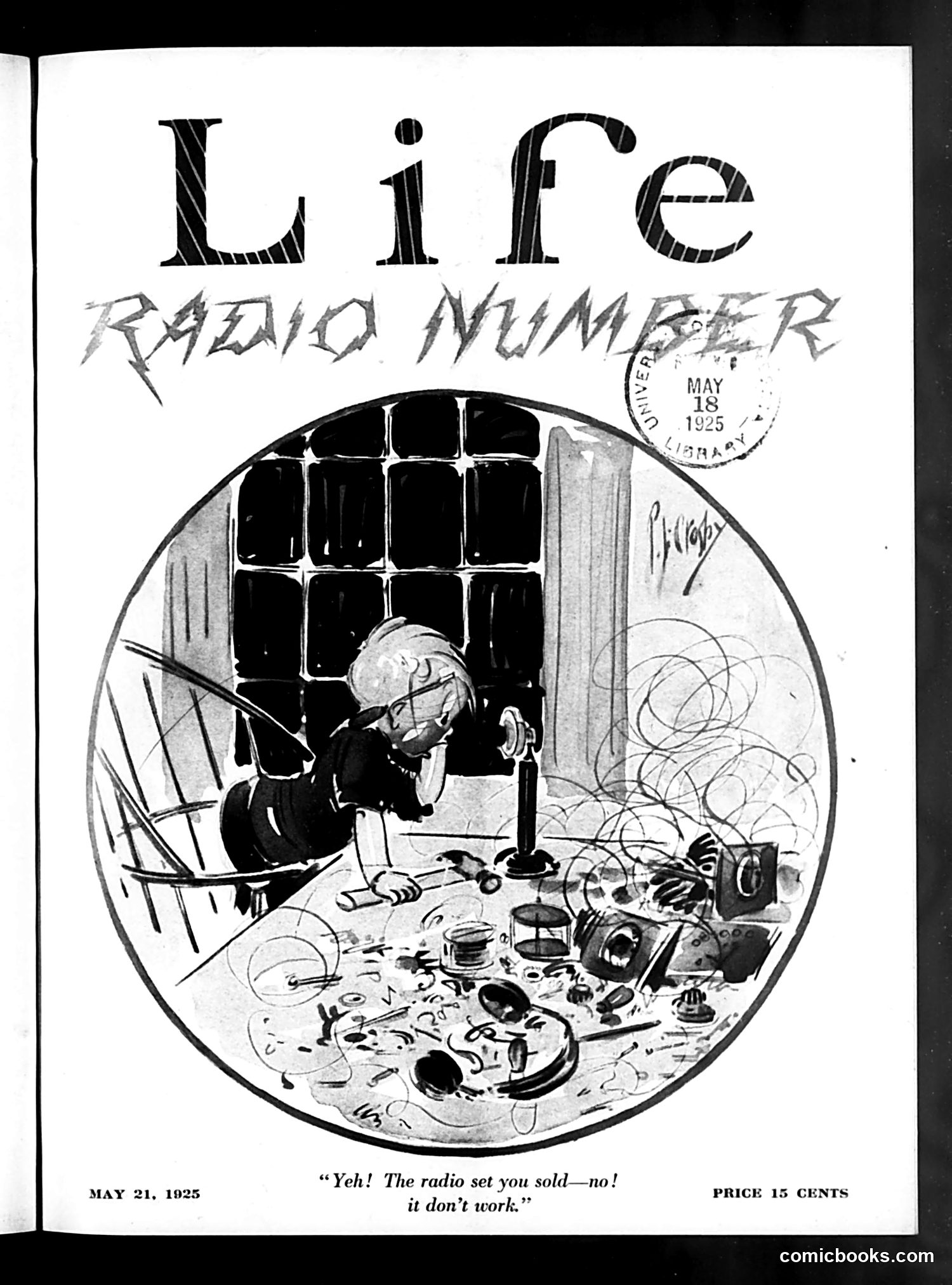
This cover satirizes consumer frustration with early radio technology. The illustration shows a man at a desk surrounded by radio equipment and components, appearing distressed. The caption reads: "Yeh! The radio set you sold—no! it don't work." The satire targets the boom in radio sales during the 1920s, when mass-produced radio sets were often unreliable or defective. The chaotic pile of parts and equipment emphasizes the complexity and poor quality control of early consumer electronics. The buyer's complaint suggests he's been sold a faulty product by an unscrupulous seller. This reflects 1920s consumer culture anxieties about new technology and unregulated sales practices before modern consumer protection standards existed.
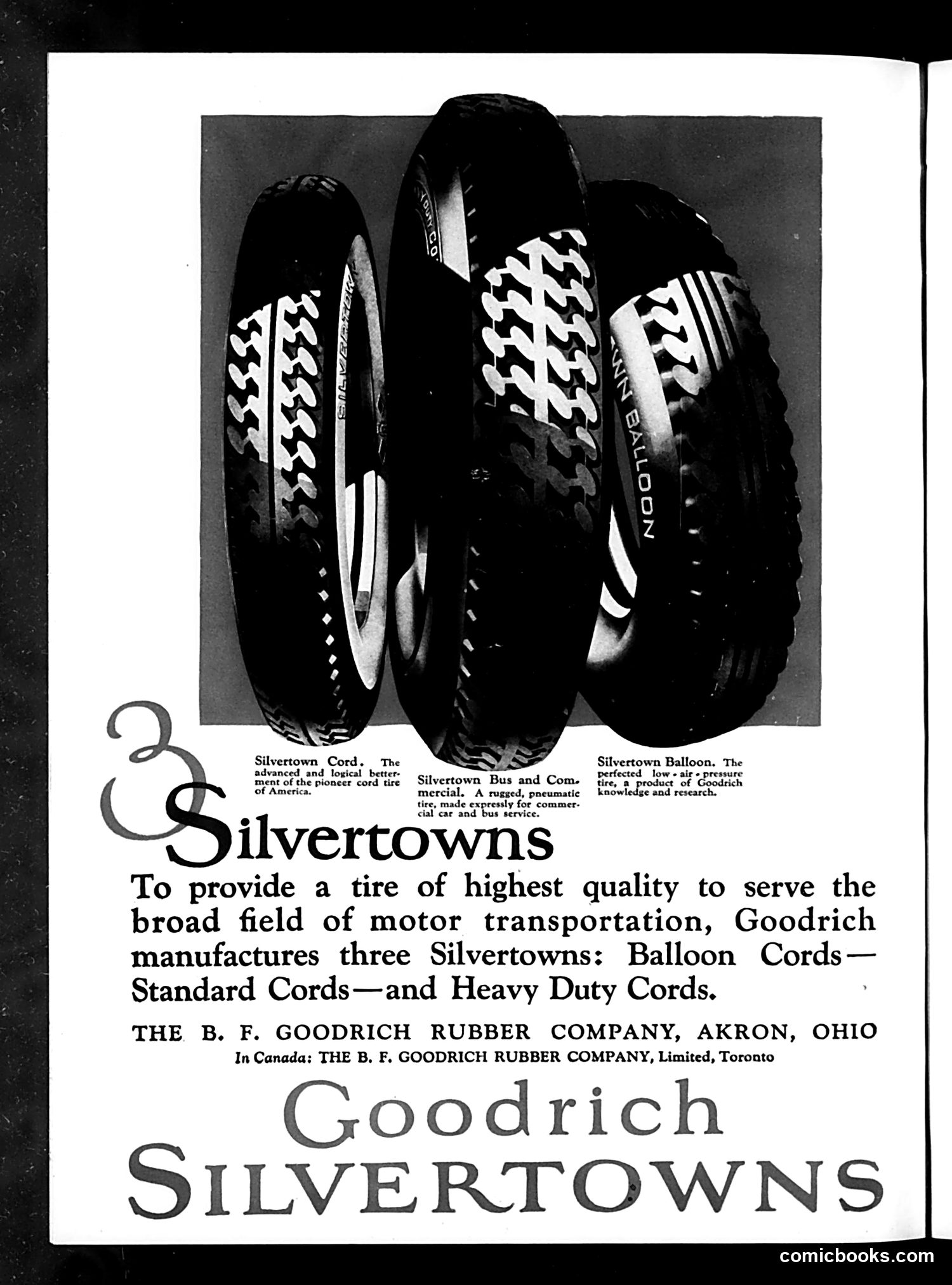
This page is **advertising, not satire or political commentary**. It's a Goodrich Rubber Company advertisement for "Silvertowns" tires, showing three tire models arranged artistically in black and white photography. The ad promotes three tire variants: - **Silvertown Balloon** (low-pressure tire for passenger cars) - **Silvertown Cord** (standard tire for pioneer cord use) - **Silvertown Bus and Commercial** (heavy-duty tire for commercial vehicles) The text emphasizes quality across "broad field of motor transportation." This appears to be from an era when tire technology was actively evolving, with manufacturers competing on different tire designs for different vehicle types. The "Silvertown" branding suggests Goodrich's premium product line.
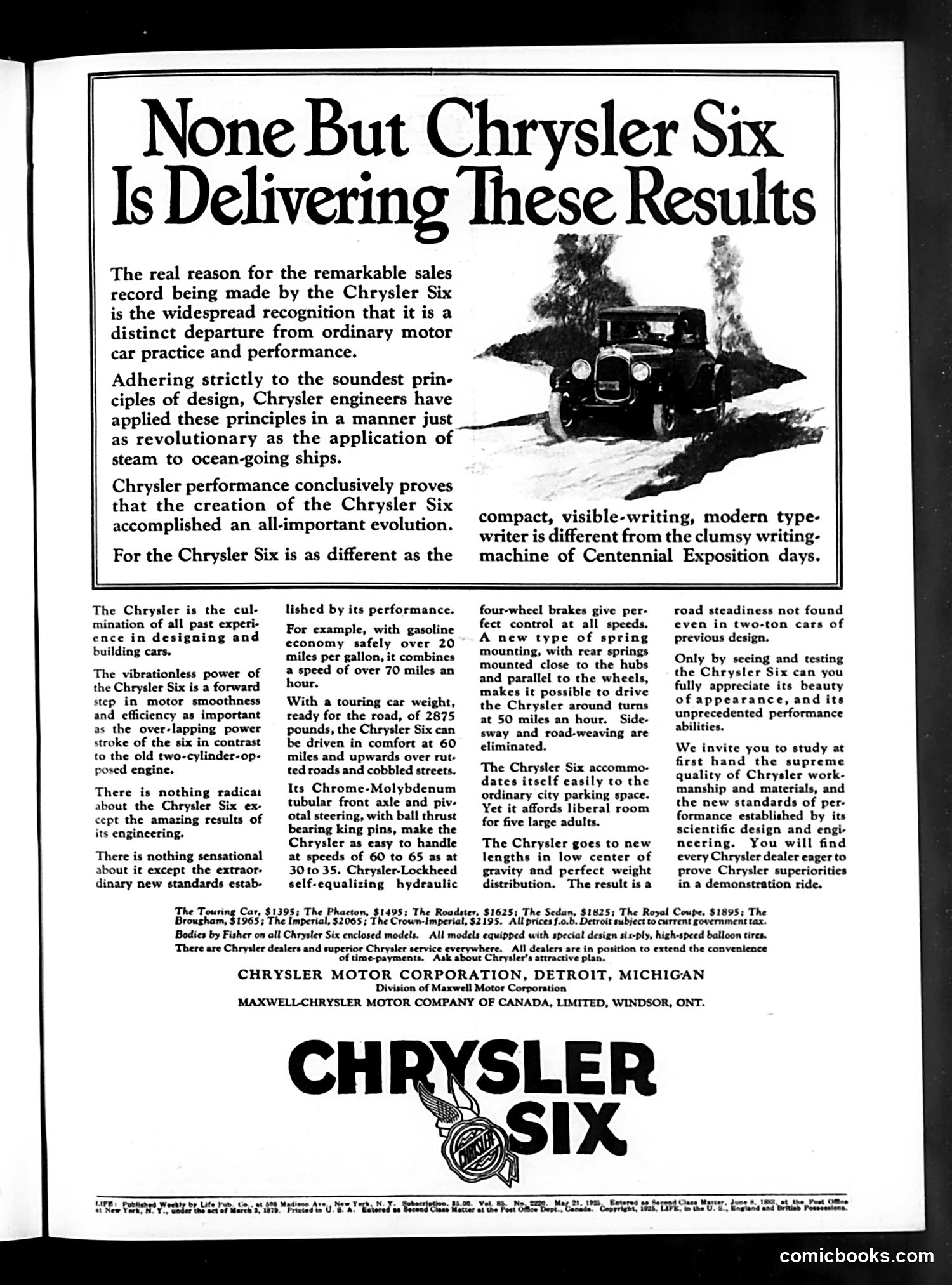
This is **not a cartoon or satirical content**, but rather a **straightforward automobile advertisement** for the Chrysler Six. The page promotes the vehicle's technical innovations and performance capabilities—emphasizing features like its vibrationless engine, four-wheel brakes, and fuel economy (over 20 miles per gallon). The only potentially notable element for a modern reader is the comparison of the Chrysler Six's engineering to "the application of steam to ocean-going ships"—positioning automotive advancement as a significant technological achievement worthy of pride. The small photograph shows the car in a rural setting, and the lower section references prices and dealer locations. This represents typical 1920s American advertising emphasizing mechanical superiority and modern engineering as selling points.
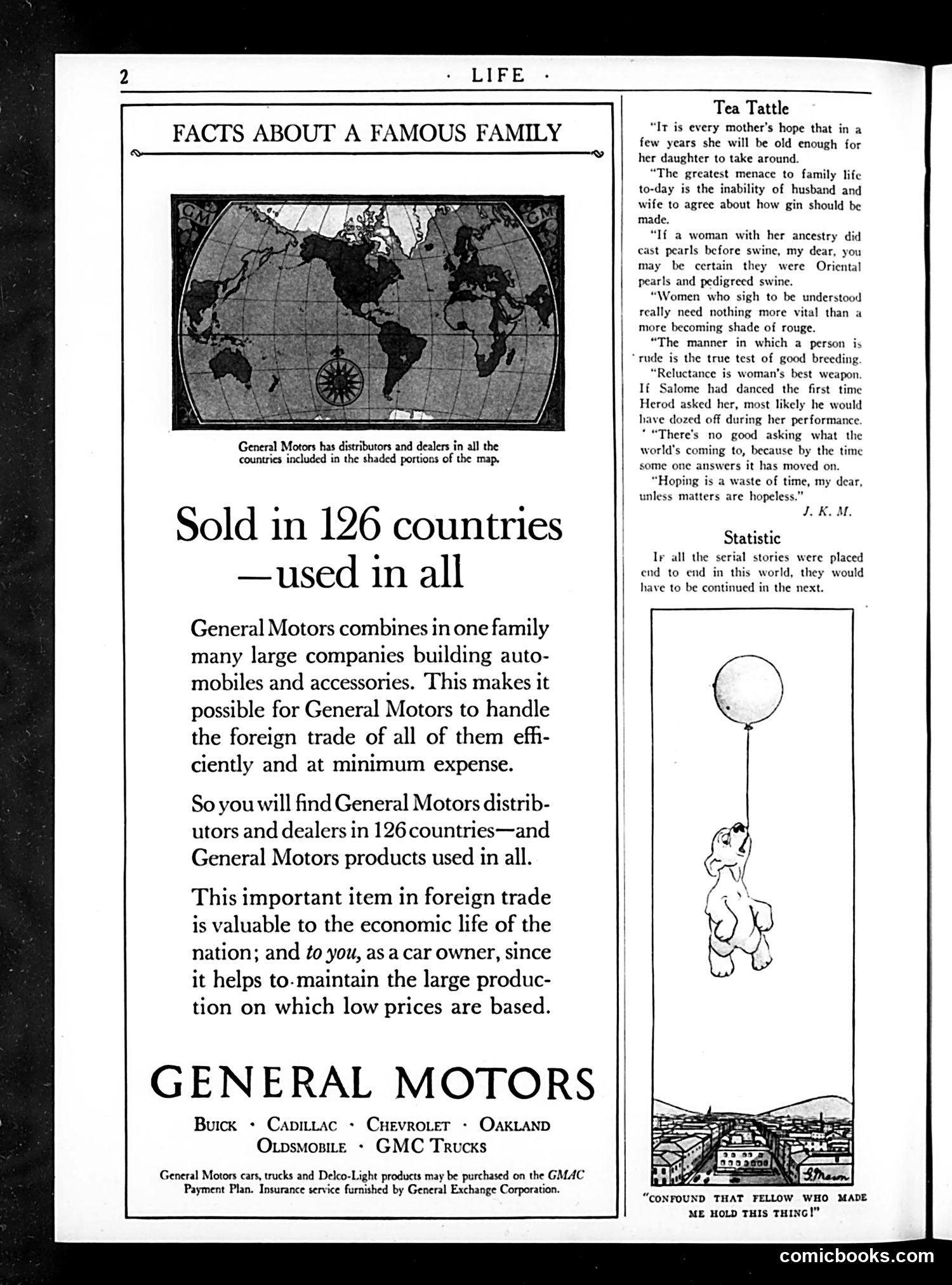
This page is primarily a **General Motors advertisement** rather than political satire. The left side promotes GM's global distribution network across 126 countries, emphasizing economic benefits and affordability. The right side contains unrelated content: a "Tea Tattle" column with cynical observations about women and social behavior (attributed to "J. K. M."), a brief "Statistic" note about serial stories, and a cartoon showing a small child holding a balloon above a cityscape with the caption "Confound that fellow who made me hold this thing!" The child's cartoon appears to be social commentary on childhood frustration or constraint, though its precise meaning is unclear without additional context. The page mixes advertising, humor columns, and light illustration typical of 1920s-era Life magazine content.
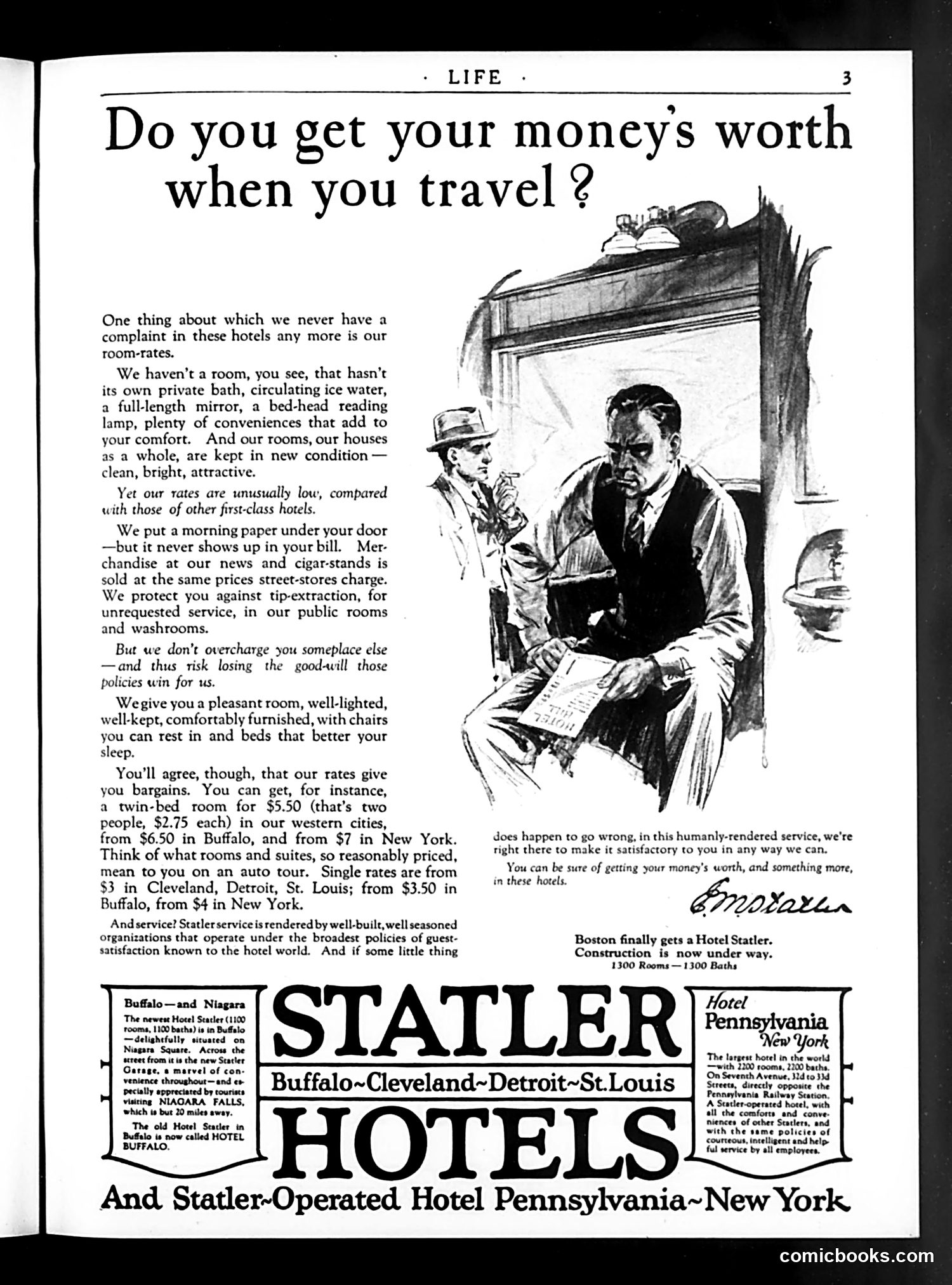
This page is primarily **advertising for Statler Hotels**, not satire or political commentary. The main illustration shows two men in a hotel room—likely a bellhop and guest—examining the room's amenities and service quality. The advertisement's appeal is straightforward: Statler Hotels emphasizes value and comfort for traveling businessmen. It highlights competitive room rates ($5.50 for a twin bed in western cities), quality furnishings, daily newspapers, and reliable service. The copy addresses a real concern for 1920s travelers: getting fair value. The advertisement promises "your money's worth" through standardized, quality accommodations across multiple cities (Buffalo, Cleveland, Detroit, St. Louis, and New York). There is **no political cartoon or satire present**—this is purely commercial messaging targeting the traveling public.
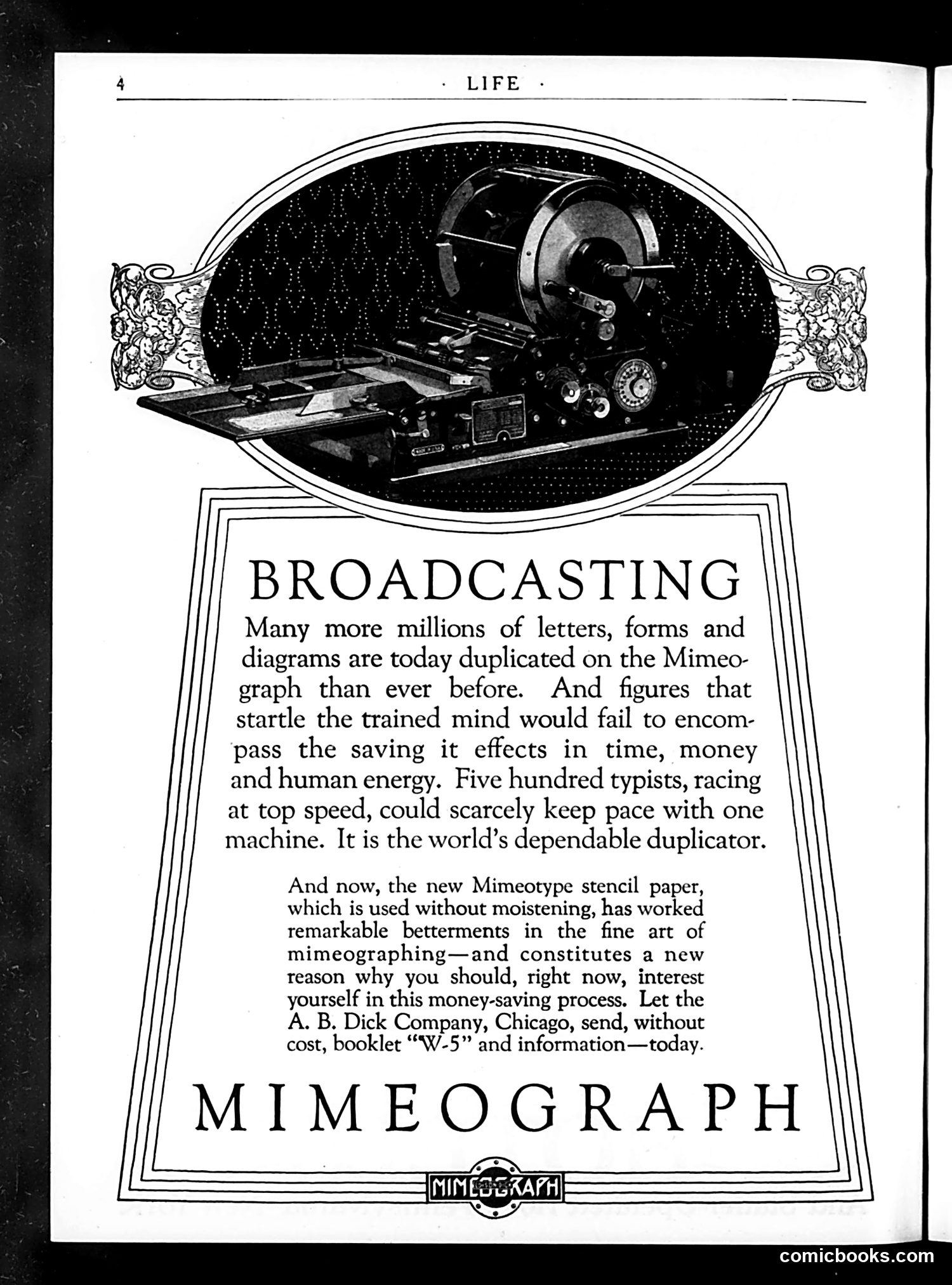
This page is primarily **advertising, not satire or political commentary**. It's a full-page advertisement for the Mimeograph machine, placed in Life magazine. The ad highlights the machine's efficiency for duplicating documents—letters, forms, and diagrams. The copy claims one Mimeograph could outpace 500 typists working at top speed, emphasizing massive time and cost savings for businesses. The oval illustration shows the actual mimeograph device. The ad also promotes new "Mimeotype stencil paper" requiring no moistening, positioning this as an improvement over existing processes. The decorative borders and ornate design are typical of early 20th-century advertising aesthetics. This represents straightforward product marketing aimed at business managers, not editorial content with political meaning.
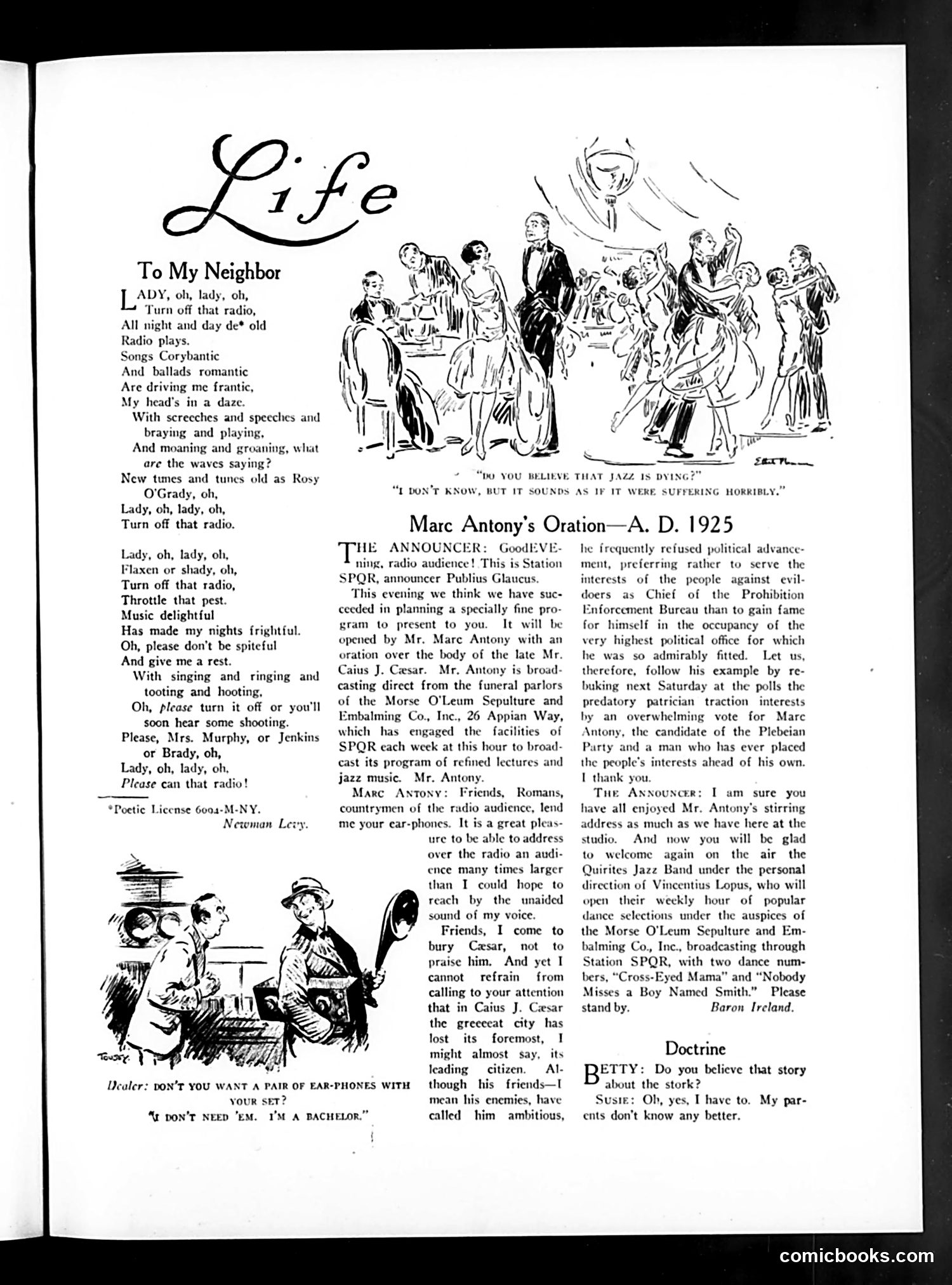
This cartoon satirizes 1920s radio culture and prohibition-era politics. The illustration shows a radio broadcast where Marc Antony (a classical reference) delivers a speech praising the deceased Caius J. Caesar—a fictional funeral oration mimicking Shakespeare's *Julius Caesar*. The satire targets Marc Antony as a Prohibition Enforcement Bureau chief who refuses political advancement to instead fight "evil-doers." The cartoon mocks earnest civic radio programming of the era, where stations broadcast "refined lectures and jazz music" to mass audiences. The accompanying poem "To My Neighbor" ridicules listeners driven to distraction by constant radio broadcasts, particularly romantic songs and news. The humor lies in treating grandiose classical oratory through the mundane lens of 1920s commercial radio.
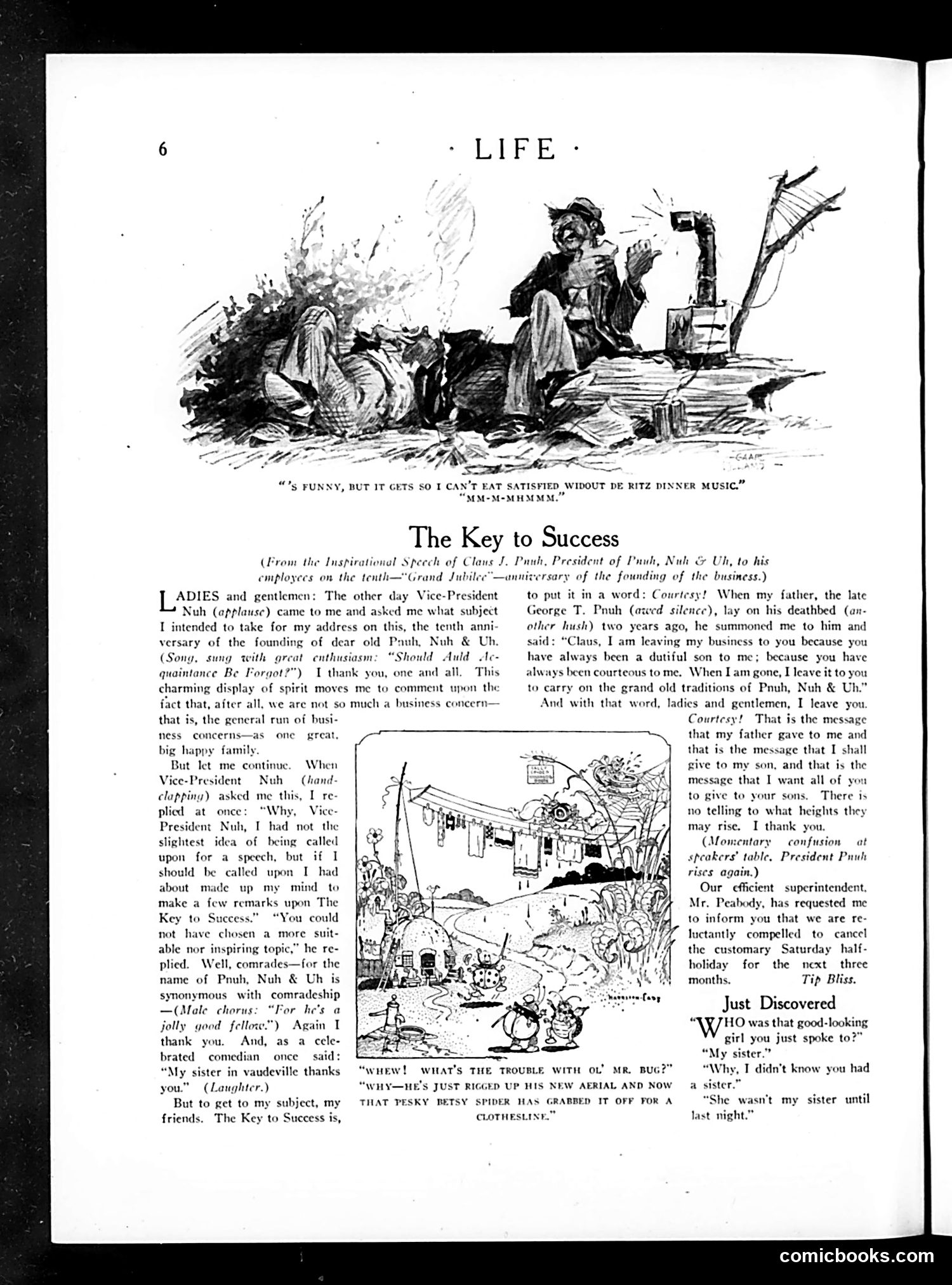
This page features "The Key to Success," a speech by Class J. Pauh, President of Pauh, Nuh & Uh (a business), delivered at the company's tenth anniversary. **The Satire:** The cartoons mock corporate platitudes about success. The top sketch shows vagrants camping in squalor while one claims he can't eat without "Ritz dinner music"—mocking how the wealthy attach pretentious cultural rituals to basic needs. **The Speech's Point:** Pauh emphasizes that true success requires *courtesy*—a quality his late father George T. Pauh valued. The message is earnest rather than ironic, advocating for kindness as the foundation of business ethics. **The Humor:** The contrast between the earnest corporate speech and the absurdist cartoons (including one about a spider stealing laundry) suggests Life's satirical skepticism toward business motivational rhetoric, even when well-intentioned.
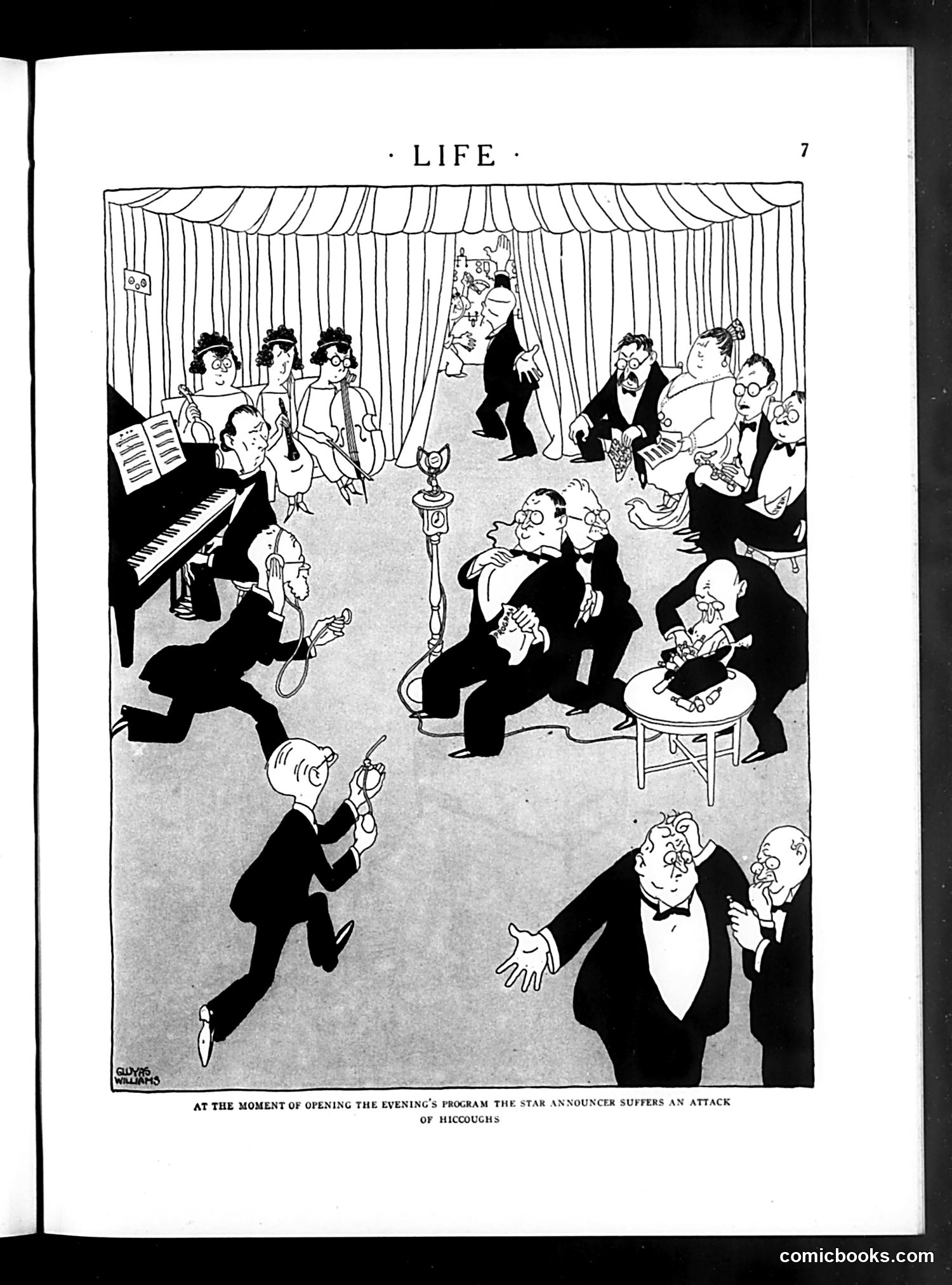
This is a satirical cartoon from *Life* magazine depicting a chaotic scene at what appears to be a formal evening performance or gala. According to the caption, "At the moment of opening the evening's program the star announcer suffers an attack of hiccoughs." The humor centers on the disruption caused by an announcer's hiccoughs during an elegant, formal event. The cartoon shows various orchestra musicians, formally-dressed attendees, and audience members in disarray—some reacting with shock, others gesturing wildly. The formal setting with curtains, piano, and tuxedos contrasts absurdly with the undignified physical interruption. This is straightforward physical comedy satirizing the gap between formal decorum and bodily dysfunction, a timeless source of humor. No specific political or social figures appear to be referenced—it's simply comedic commentary on embarrassment in high-society settings.
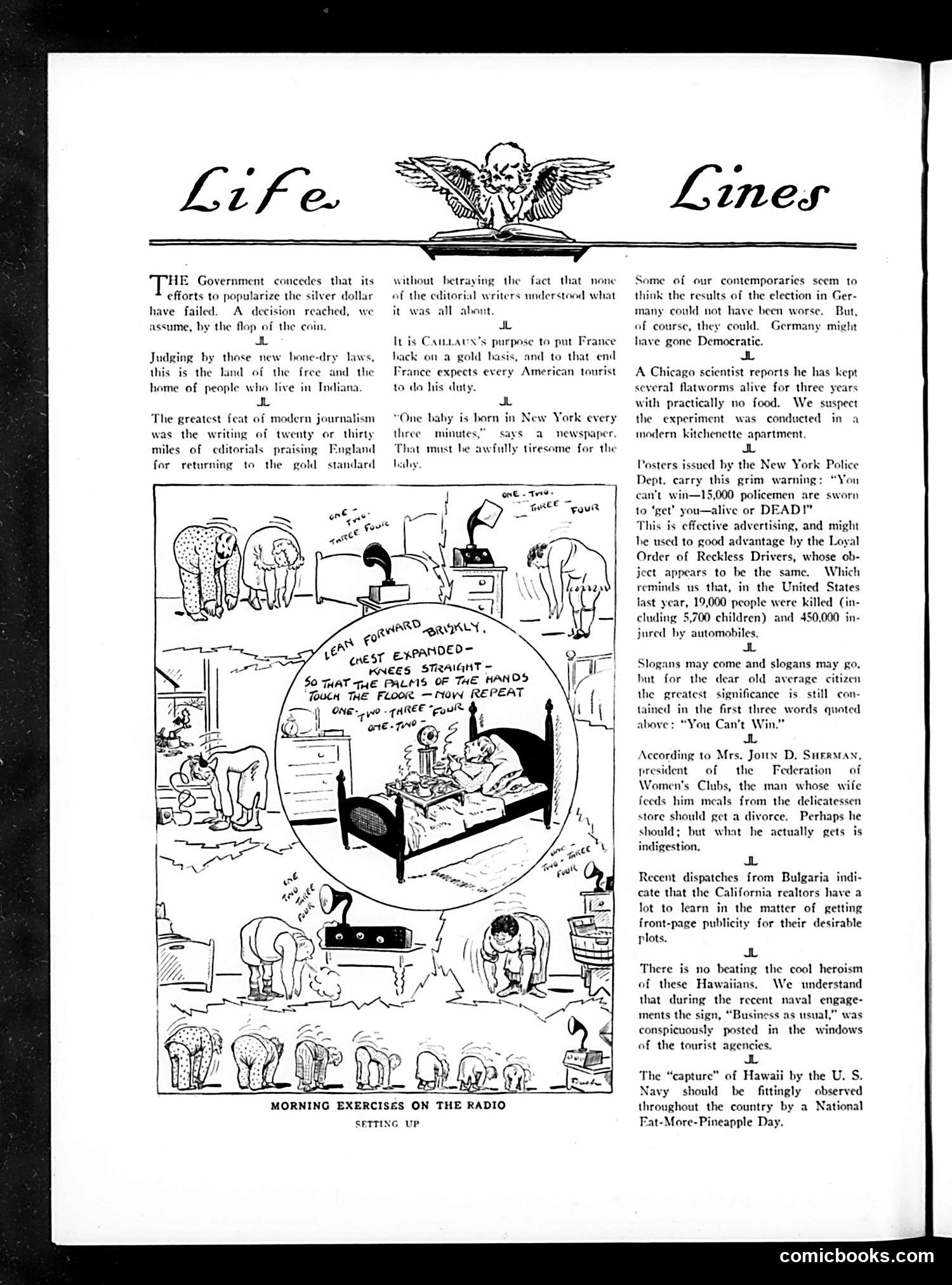
This page satirizes early 1920s domestic life and technology through a central cartoon titled "Morning Exercises on the Radio." The large illustration depicts a family performing calisthenics while listening to radio-broadcast exercise instructions—a new phenomenon at the time. The cartoon mocks this trend by showing people contorted in awkward poses, following disembodied radio commands. The surrounding text snippets are characteristic Life editorial commentary on contemporary absurdities: a scientist starving rats experimentally, Germany potentially becoming democratic, and New York police threatening criminals with execution. The page exemplifies Life's satirical approach: using humor to critique both modern technologies (radio instruction culture) and social/political developments, treating contemporary news with irreverent wit.
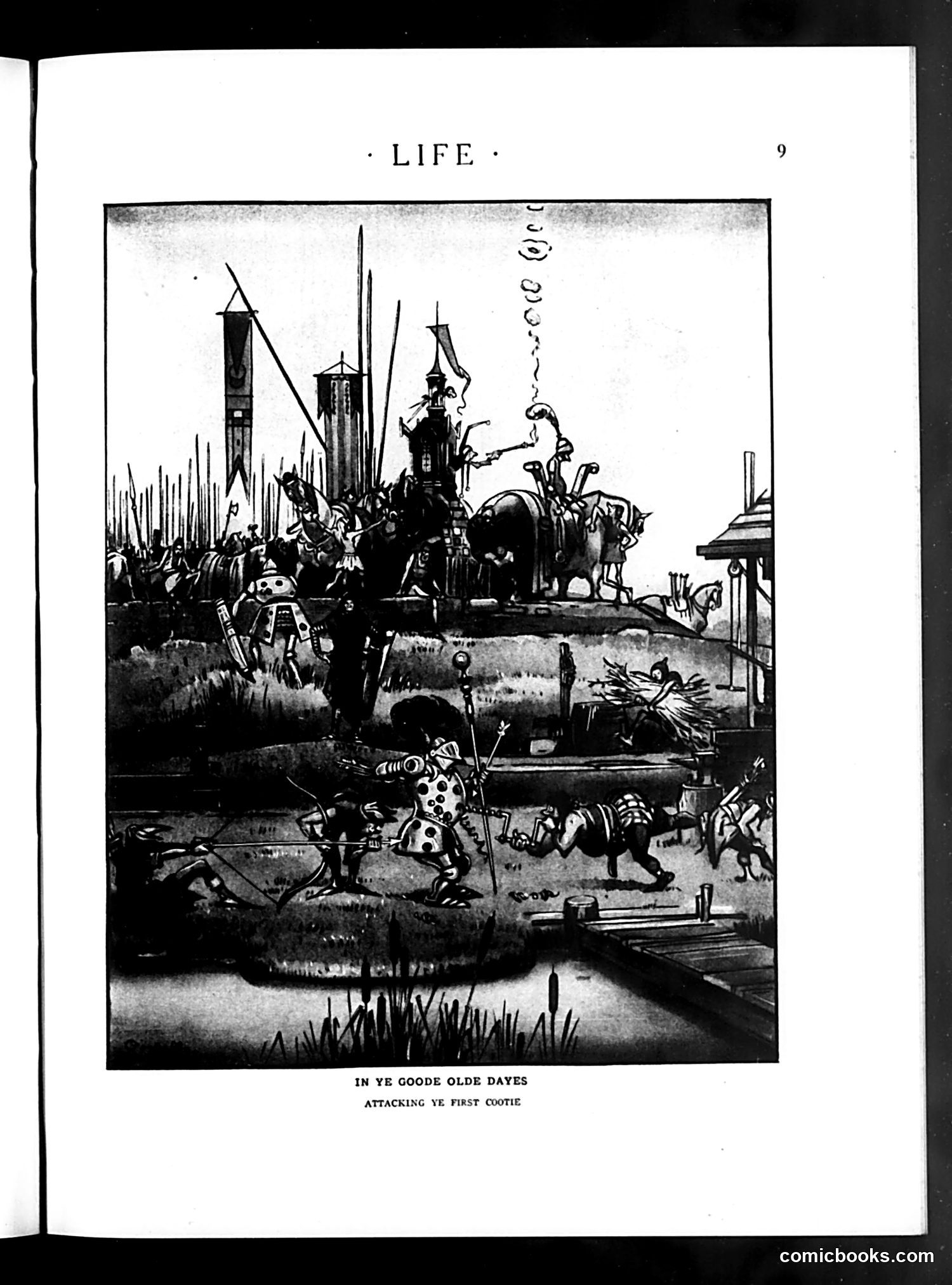
This is a satirical illustration titled "In Ye Goode Olde Dayes / Attacking Ye First Cootie." The cartoon depicts a fantastical medieval or historical scene with elaborate towers and armed figures attacking what appears to be giant insects or "cooties" (lice). "Cootie" was period slang for body lice, a widespread problem among soldiers during World War I. The satire appears to mock both the difficulty of combating this persistent pest and perhaps the military's grandiose but ineffective responses to it. The elaborate medieval warfare setup—with its ornate structures and numerous armed soldiers—humorously contrasts with the trivial nature of fighting microscopic parasites. The "olde dayes" framing suggests nostalgia for supposedly simpler times, while the reality depicted shows chaos and struggle. This likely resonated with readers familiar with soldiers' complaints about lice infestations.
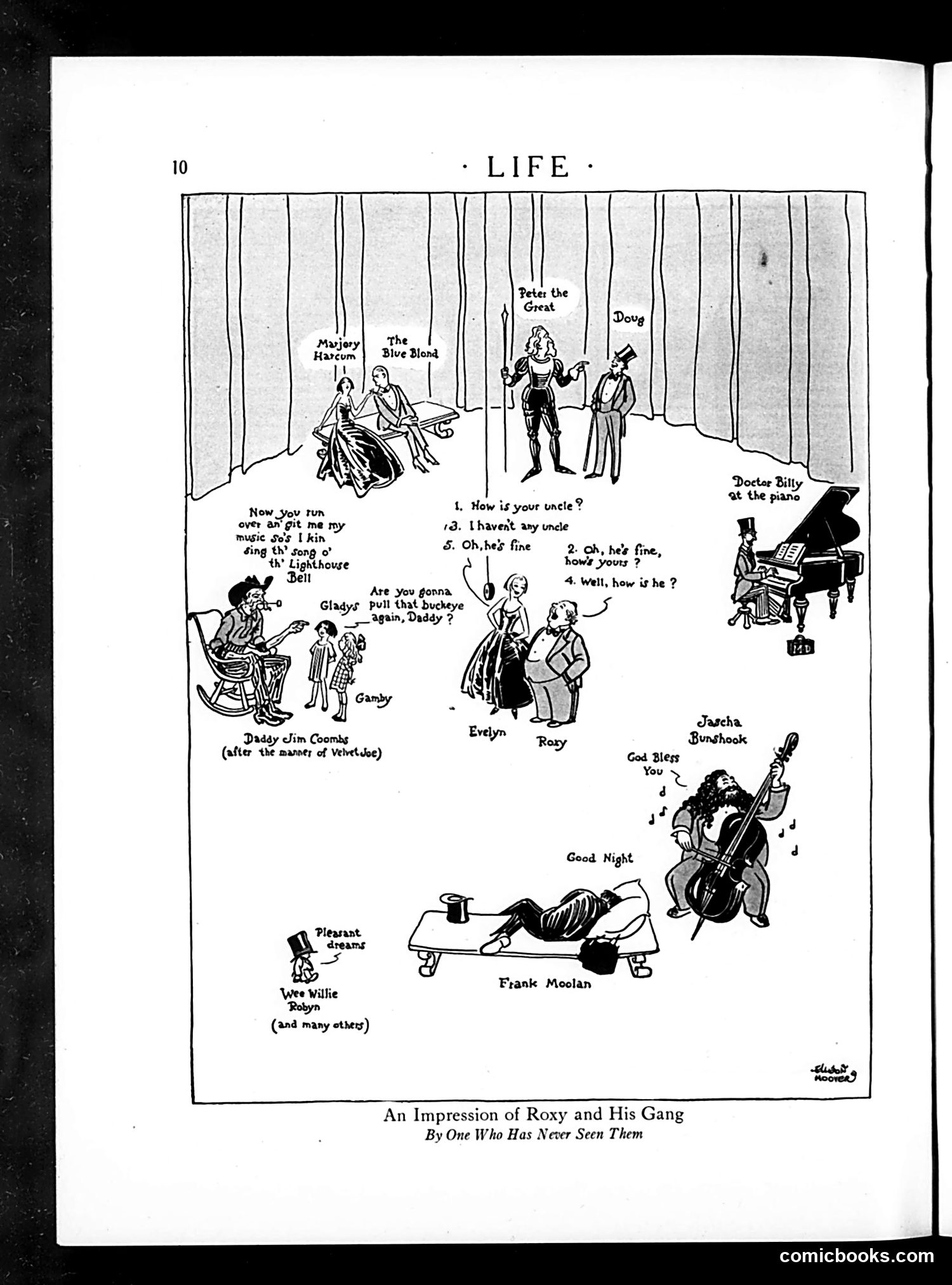
This is a satirical cartoon mocking "Roxy" (likely Samuel Rothafel, a famous theater impresario) and his circle of entertainers and cultural figures. The cartoon depicts various labeled characters in a forest setting, including performers like "Peter the Great," "Doug" (likely Douglas Fairbanks), "Doctor Billy at the piano," and others such as "Daddy Jim Coombs" and "Frank Moolan." The satire appears to target the pretentiousness and star-studded nature of Roxy's entertainment empire—treating these celebrities and their associates as a peculiar "gang" in an absurd woodland scene. The subtitle notes it's "By One Who Has Never Seen Them," suggesting the artist is deliberately creating an imaginative, exaggerated impression rather than accurate representation, poking fun at Roxy's famous productions and their mystique.
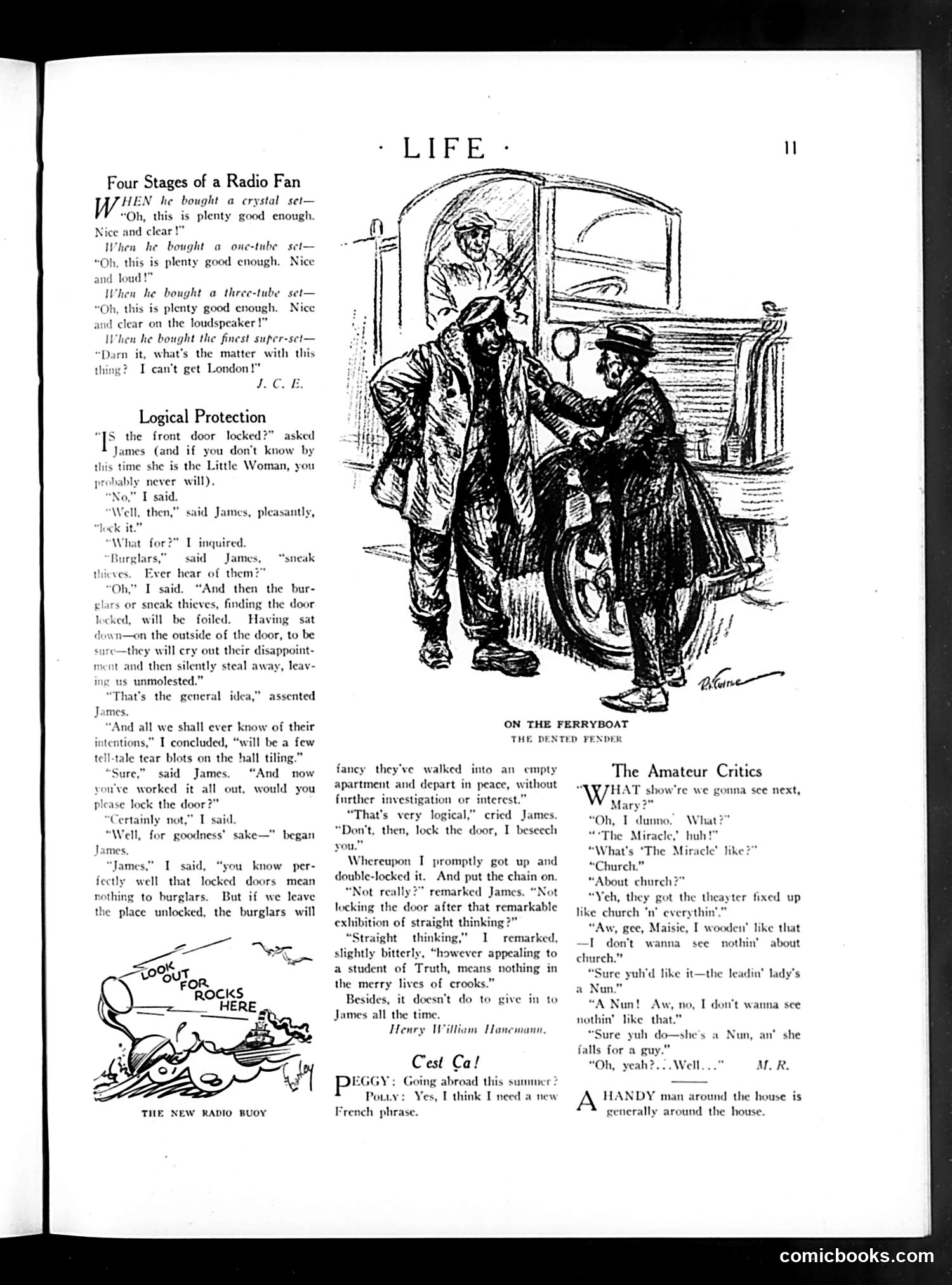
This page from Life magazine contains several satirical pieces about 1920s-1930s consumer culture and social behavior: **"Four Stages of a Radio Fan"** mocks the escalating obsession with radio technology. As a man buys progressively better equipment (crystal set → one-tube → three-tube → finest super-set), his satisfaction paradoxically decreases, culminating in frustration that he "can't get London!" **"Logical Protection"** presents a humorous dialogue where James employs absurdist reasoning to justify leaving his apartment door unlocked—burglars would be foiled by the apparent lack of valuables, so the unlocked door is actually protective logic. **"On the Ferryboat"** (illustration) shows working-class figures in casual interaction. **"The Amateur Critics"** presents snippets of pretentious theatergoers discussing shows with affected sophistication, satirizing amateur cultural commentary. The humor targets consumerism, pseudo-intellectual posturing, and urban social pretension.
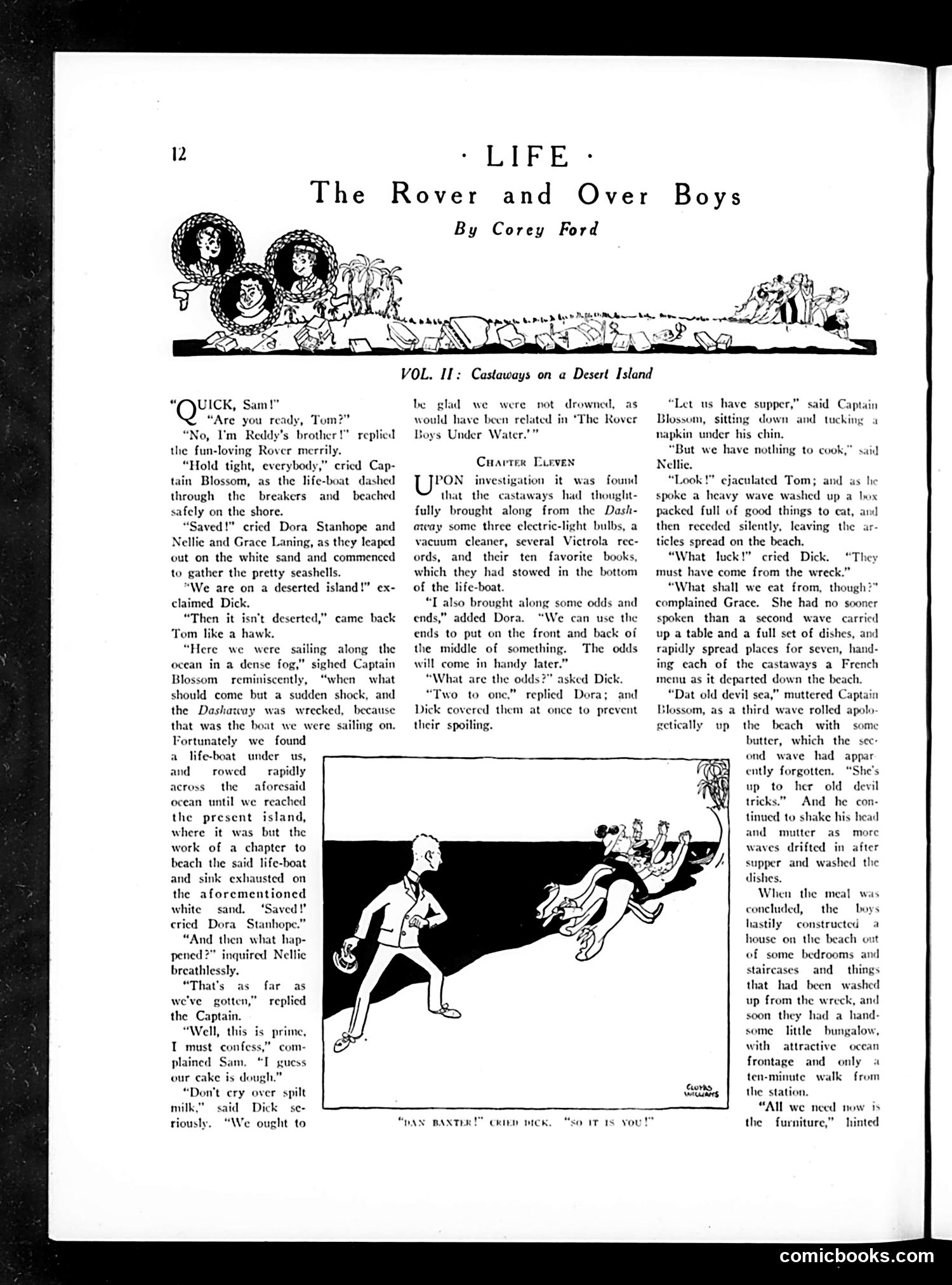
This is a serialized adventure story by Corey Ford titled "Castaways on a Desert Island" (Volume II). The page contains narrative text describing young castaways who've salvaged items from a wrecked ship called the *Dashaway*. The central cartoon illustration shows two boys engaged in what appears to be a physical altercation or "dan battle," with the caption "DAN BATTLE!" CRIED DICK. "SO IT IS YOU!" This is not political satire but rather lighthearted children's adventure fiction typical of Life magazine's content. The story follows established "rover boys" adventure-story conventions popular in early 20th-century American youth literature—resourceful young protagonists surviving on an island through ingenuity and pluck.
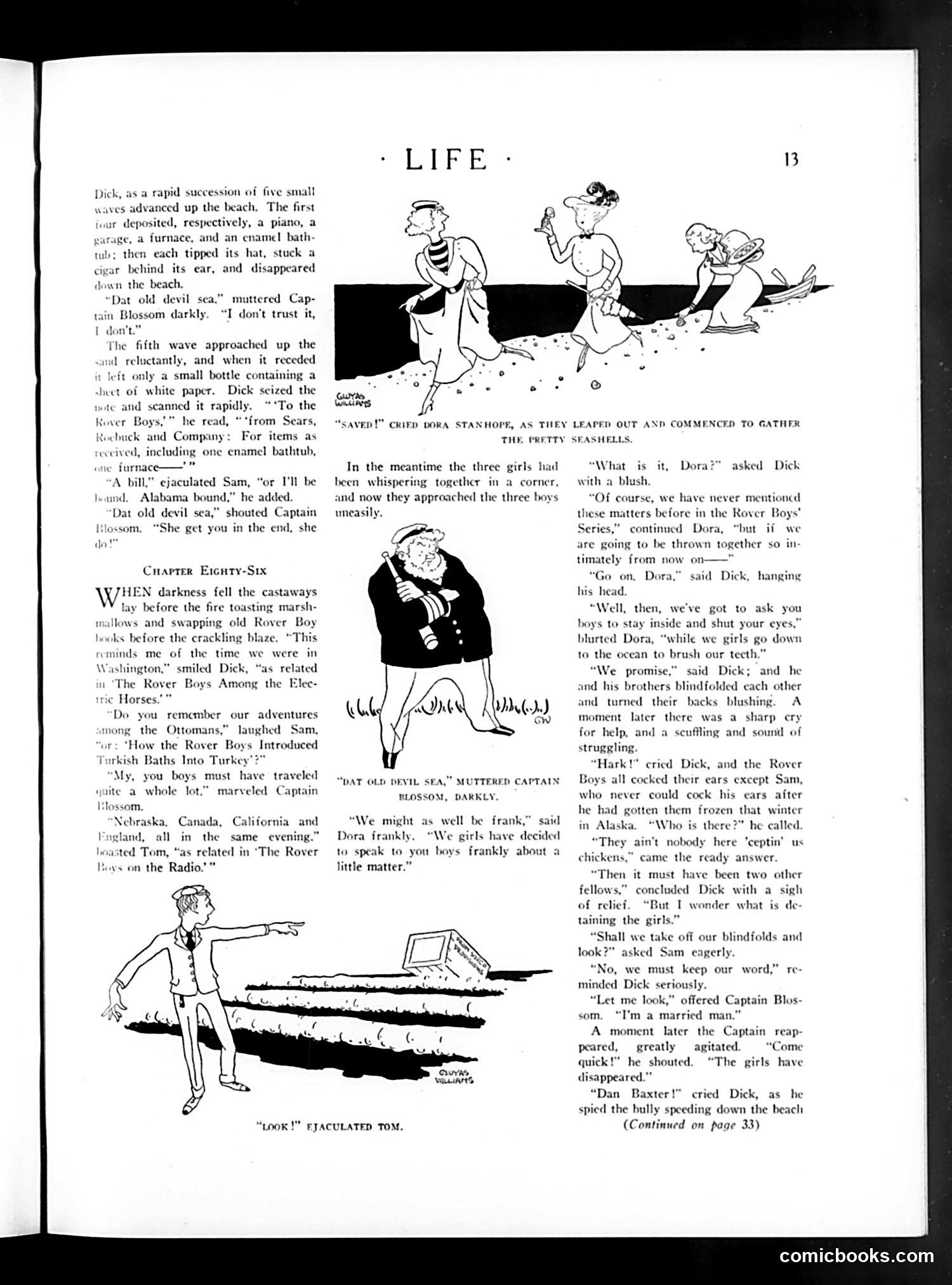
This page contains fiction rather than political satire. It's Chapter Eighty-Six from what appears to be a serialized adventure story involving characters named Dick, Captain Blossom, Sam, and Dora—likely "The Rover Boys" series, referenced explicitly in the dialogue. The illustrated scenes show young people on a beach discovering a bottle containing a message from Sears, Roebuck and Company (a major mail-order retailer), and later, the girls swimming while the boys remain ashore. The humor is domestic/comedic rather than political: the boys arguing about "ceptin' us chickens" and anxiously wondering where the girls have gone. This is serialized juvenile adventure fiction with light humor, not political commentary.
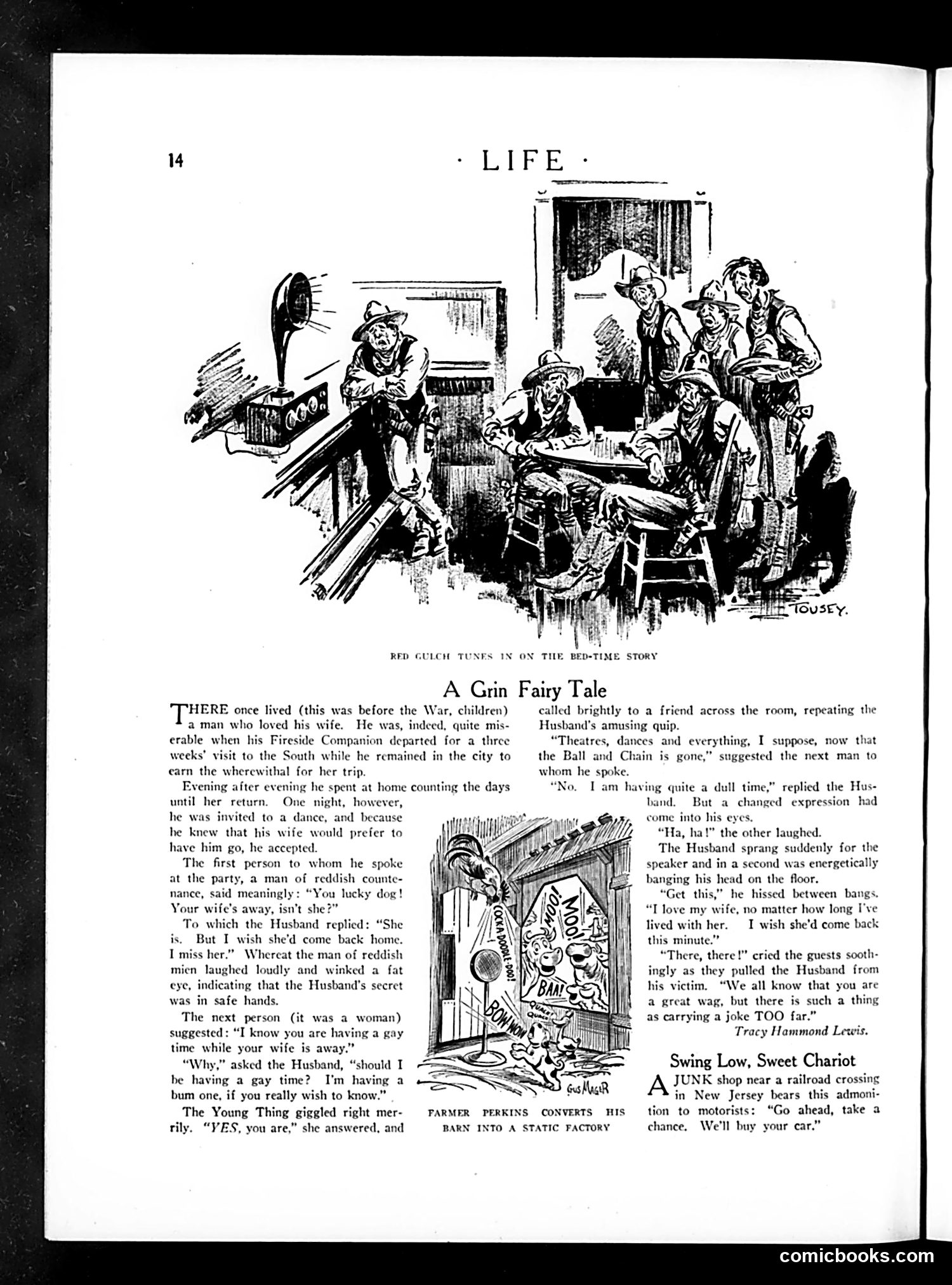
This page contains two humorous short stories with accompanying illustrations, typical of Life magazine's satirical format. **"A Grin Fairy Tale"** depicts a husband at a party, asked about his absent wife. He claims she's visiting relatives, but admits missing her. When a reddish man laughs knowingly, the husband reveals his "secret": he's actually having a gay time without her. The story satirizes marital discord and suggests men preferred their wives absent for social enjoyment—a common domestic humor trope of the era. **"Swing Low, Sweet Chariot"** is a brief joke about a junk shop near a railroad crossing advertising to motorists: "Go ahead, take a chance. We'll buy your car"—dark humor about inevitable accidents. Both pieces reflect early 20th-century social attitudes toward marriage and automotive safety through gentle satire.
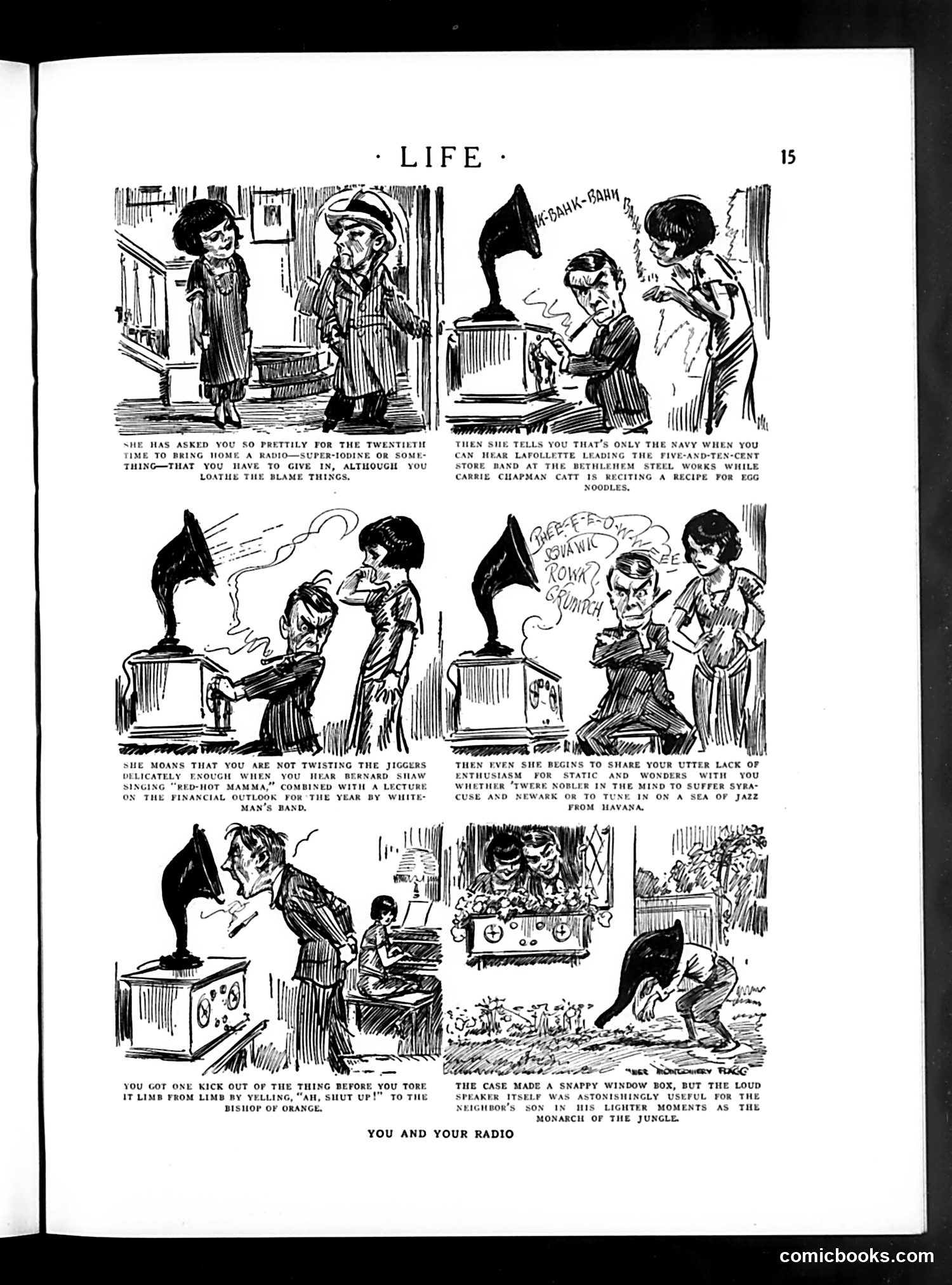
This is a humorous comic strip mocking the early radio craze and its domestic disruptions. The narrative shows a wife repeatedly asking her husband to bring home various radio models and accessories, each more elaborate and expensive than the last. The satire targets: - **Radio obsession**: The husband's escalating enthusiasm for radio technology - **Domestic conflict**: The wife's frustration with his fixation and the noise/clutter radios create - **Consumer excess**: Each panel shows bigger, more elaborate radio installations - **Social disruption**: The final panels show radios interfering with neighbors and children's activities The joke is that this new technology, meant to entertain, instead becomes a source of family tension and neighborhood annoyance—a common 1920s complaint about the radio's sudden ubiquity in American homes.
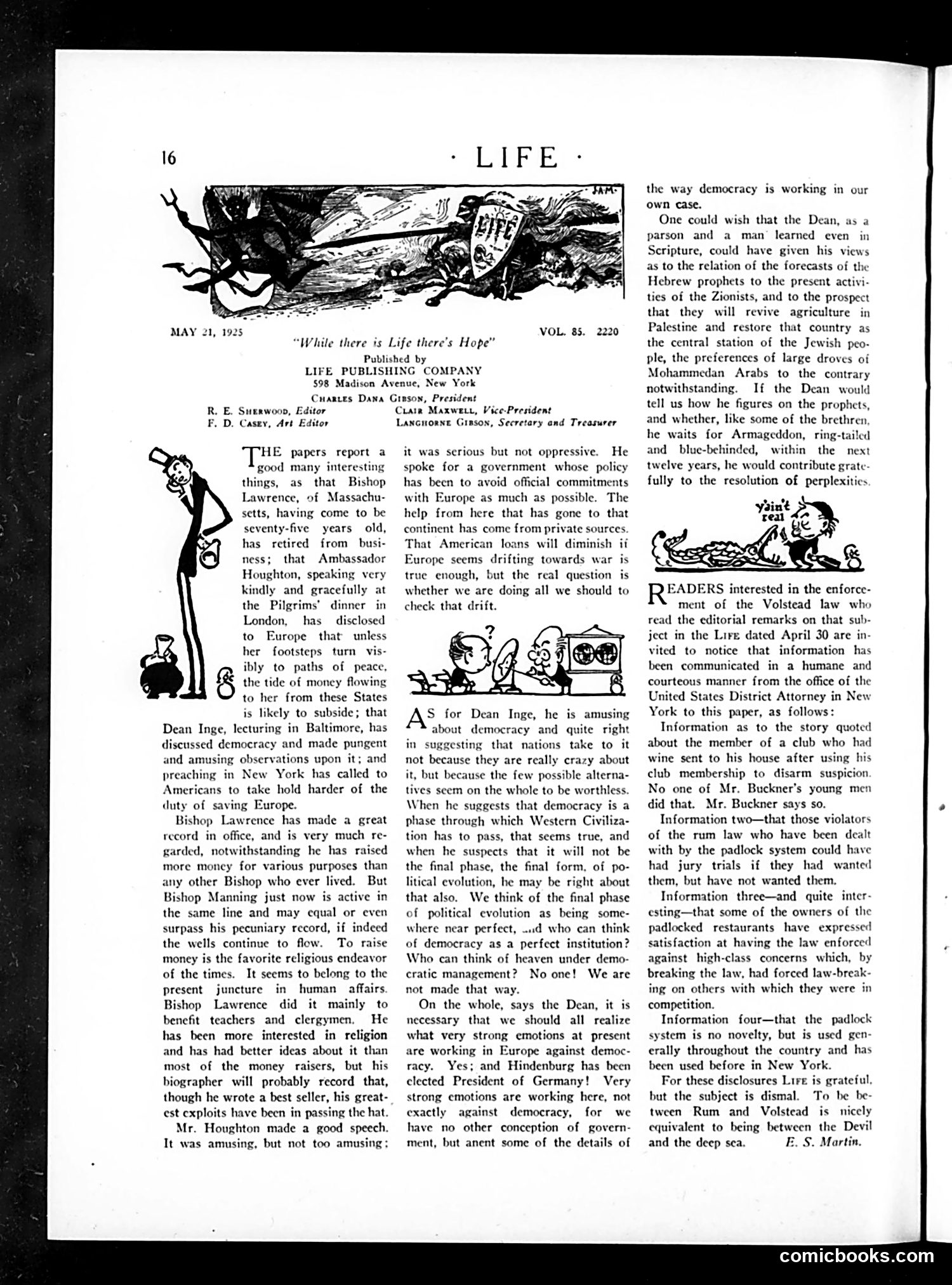
This page contains editorial commentary rather than cartoons. It discusses three prominent American figures making public statements: **Bishop Lawrence** (retired Massachusetts clergyman) and **Bishop Manning** are criticized for their primary accomplishment being fundraising—"passing the hat"—rather than substantive religious leadership. **Ambassador Houghton** delivered a speech warning Europe that American financial aid depends on avoiding war, reflecting U.S. isolationist policy of the 1920s. **Dean Inge** (a British religious figure lecturing in America) discussed democracy as a necessary but imperfect political phase, not humanity's final form of government. The editorial agrees democracy is practical rather than ideal—adopted because alternatives seem worse. The author suggests strong emotions currently drive European politics, implying instability threatens peace and American investment. The page reflects post-WWI American concerns about European stability and America's financial role in rebuilding.
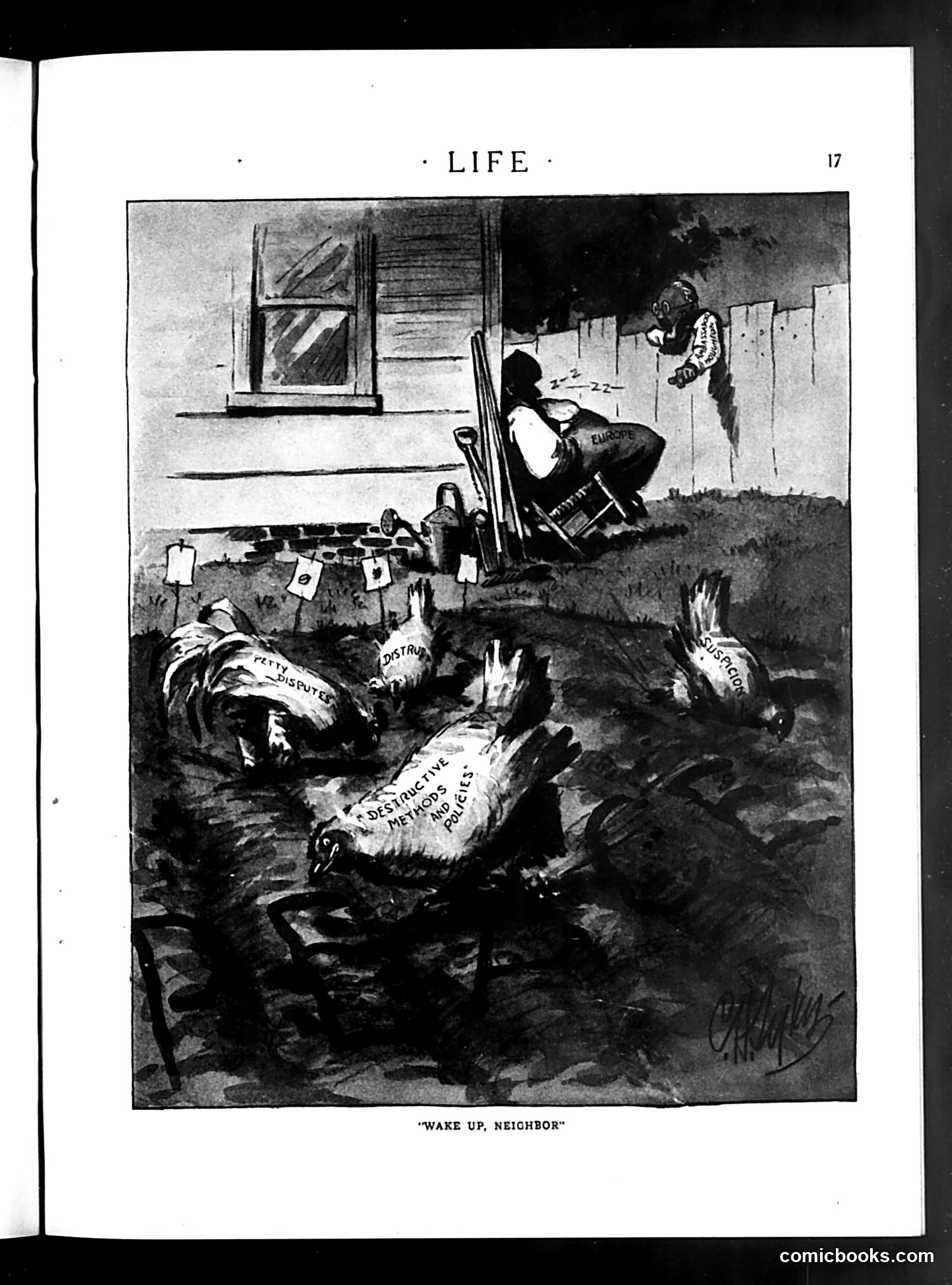
This appears to be a political allegory depicting destructive forces at the viewer's doorstep. Several roosters or birds are labeled with phrases including "DESTRUCTIVE," "DISPUTE," and what appears to be "METHODS" and "POLICIES"—likely representing dangerous ideologies or social conflicts of the era. A man sits casually in a chair near his house, seemingly indifferent to these threats gathering in his yard. Another figure in the background (possibly representing a warning voice) gestures urgently toward the danger. The title "Wake Up, Neighbor" suggests the cartoon is urging American citizens to recognize and respond to emerging threats—possibly labor unrest, economic instability, or radical ideologies—before they escalate. The satire targets public complacency in the face of mounting social problems.
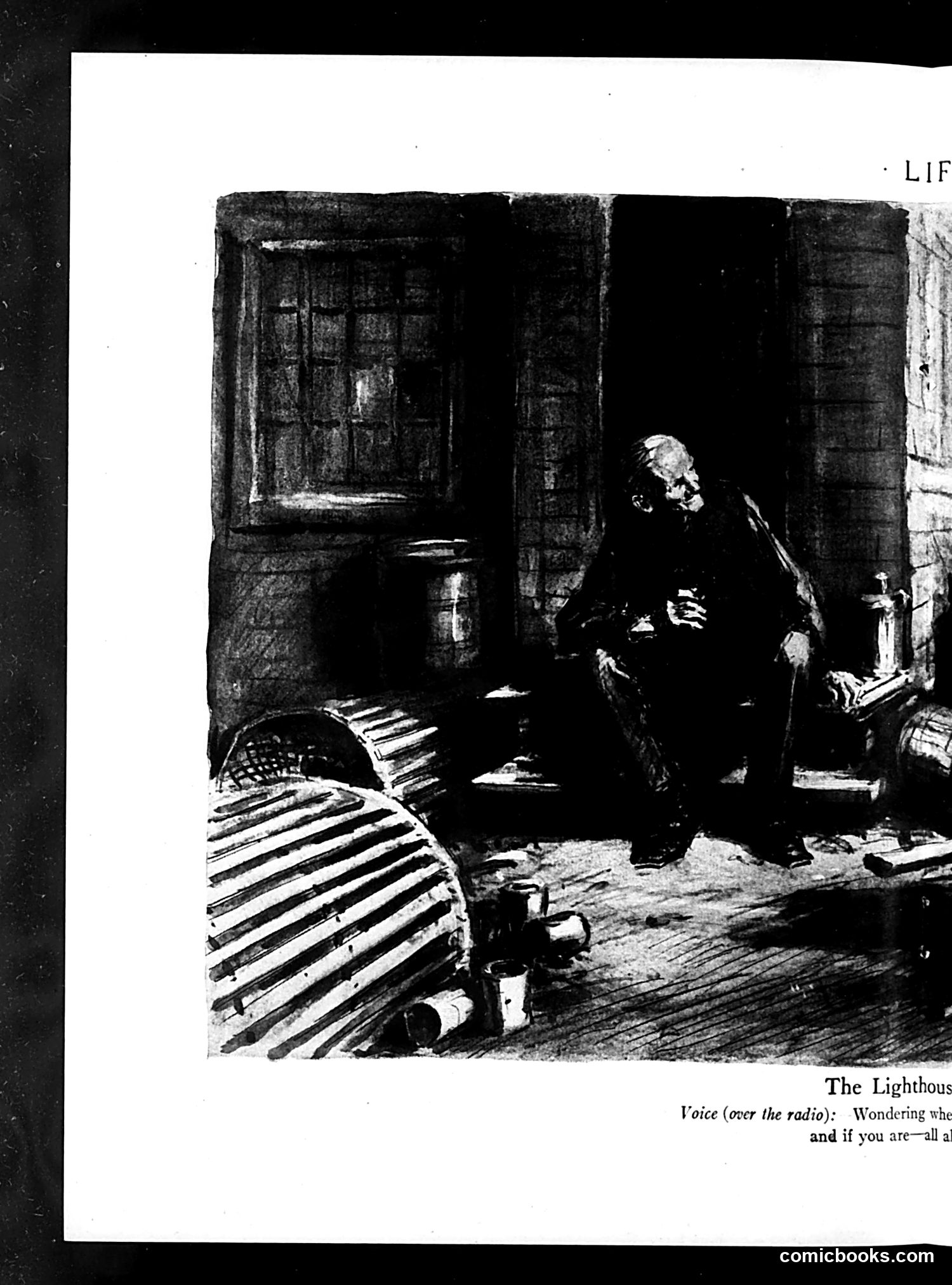
This appears to be a dramatic illustration titled "The Lighthouse," likely depicting a scene from a radio play or serialized story featured in Life magazine. The image shows an elderly man in dark clothing standing in what appears to be a lighthouse interior, with barrels and nautical equipment visible. The OCR'd text references a "Voice (over the radio)," suggesting this accompanies a radio drama adaptation. The incomplete caption ("Wondering wh... and if you are—all a") hints at suspenseful dialogue typical of 1930s-40s radio entertainment. Without complete text or publication date, the specific satirical point remains unclear, but Life frequently satirized popular radio programs and entertainment trends of its era.
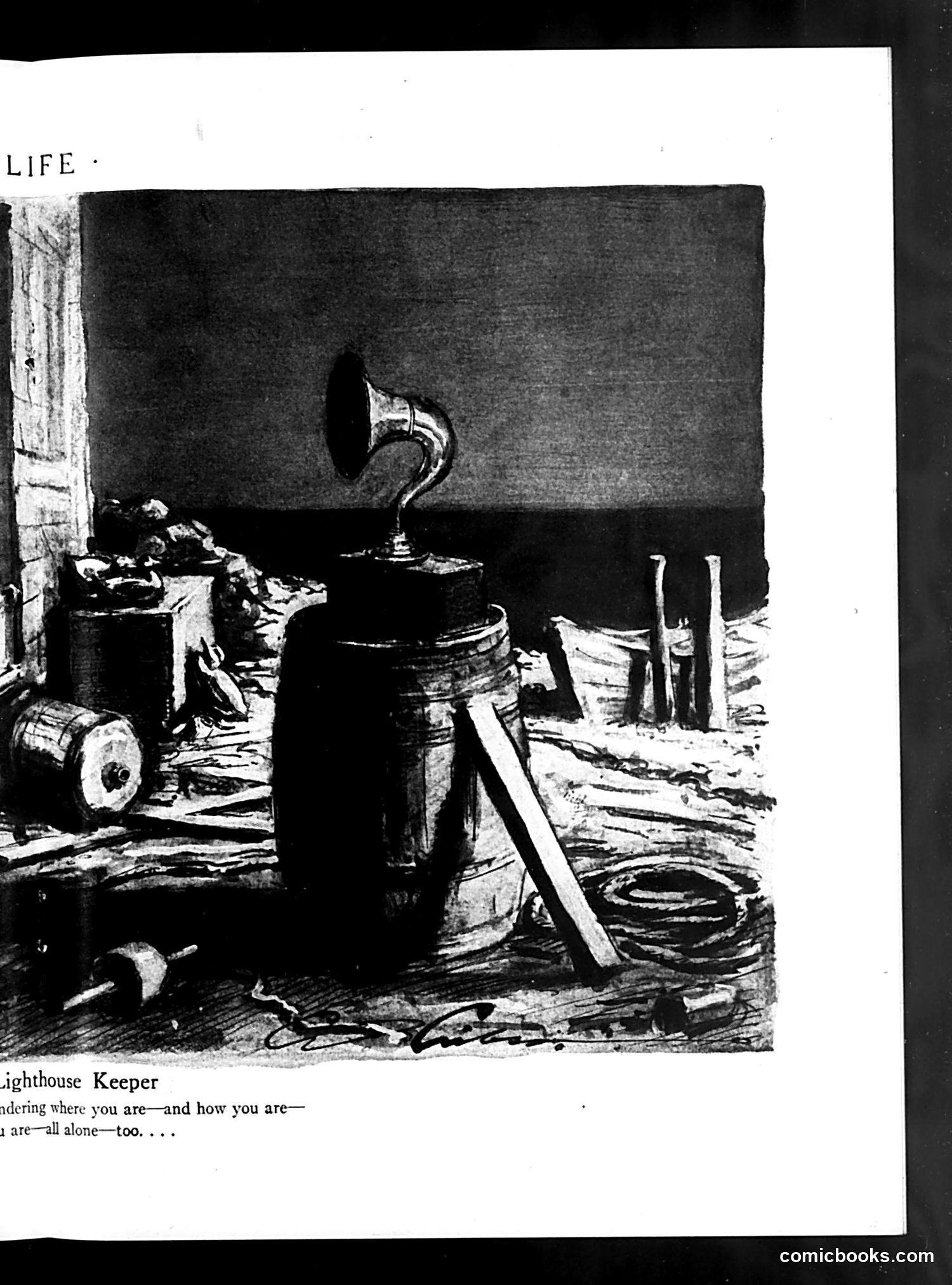
This appears to be a **Life magazine illustration** titled "Lighthouse Keeper," depicting a solitary, cluttered interior space with a gramophone (old phonograph), barrels, rope, and various debris. The visible caption fragment reads: "...ndering where you are—and how you are— n are—all alone—too...." The image seems to illustrate **isolation and loneliness**—a lighthouse keeper's solitary existence far from civilization. The gramophone suggests the keeper's only entertainment or connection to the outside world. The scattered, humble surroundings emphasize the bleakness of the job. Without the complete OCR text, the full satirical point is unclear, but this appears to comment on **occupational solitude** or possibly **wartime separation** (if from a WWI-era Life). The melancholic tone suggests social commentary on isolation rather than humor.
This page reviews Anne Nichols' wildly successful 1920s play "Abie's Irish Rose," written in mock-serious tone as if analyzing a classic for future scholars. The satire targets the play's unprecedented commercial success—it had run 1,292 performances, a record Life sarcastically suggests will be studied in 2125. The plot involves a Jewish boy (Abraham Levy) secretly marrying an Irish Catholic girl (Rosemary Murphy), then deceiving his father by calling her "Rosie Murpheski" to seem Jewish. Complications arise when her Catholic father arrives expecting an Irish wedding. Life's joke: the play was enormously popular despite (or because of) its lightweight treatment of interfaith marriage—a genuinely controversial topic in 1920s America. The satire mocks both the play's sentimental resolution of real social tensions and the public's hunger for it, suggesting even Chief Justice Taft appears satirized within the script.
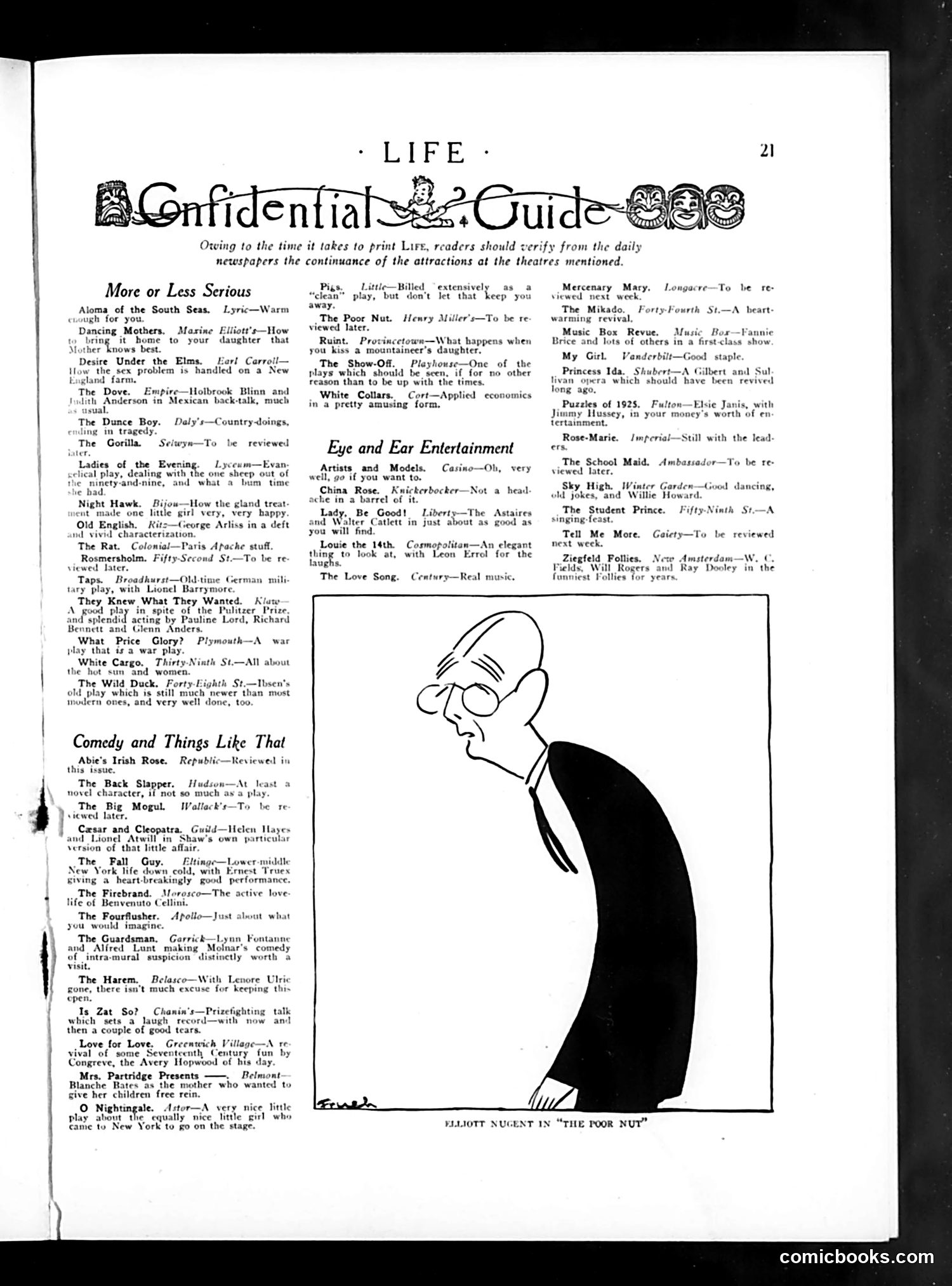
This page is a **theater guide and review section** for Broadway productions, not primarily a political cartoon page. The single illustration shows **Elliott Nugent in "The Poor Nut,"** a character study in profile—a simple theatrical promotional sketch rather than political satire. The text lists dozens of Broadway plays categorized as "More or Less Serious" and "Comedy and Things Like That," with brief, often witty descriptions. Notable entries include "Abie's Irish Rose" (reviewed separately in the issue), the Astaire siblings in "Lady, Be Good!," and Ibsen's "The Wild Duck." The tone is satirical toward the plays themselves—mocking their plots, themes, and sometimes actors' performances—rather than offering political commentary. This reflects Life's role as a cultural critic of 1920s American theater and entertainment.
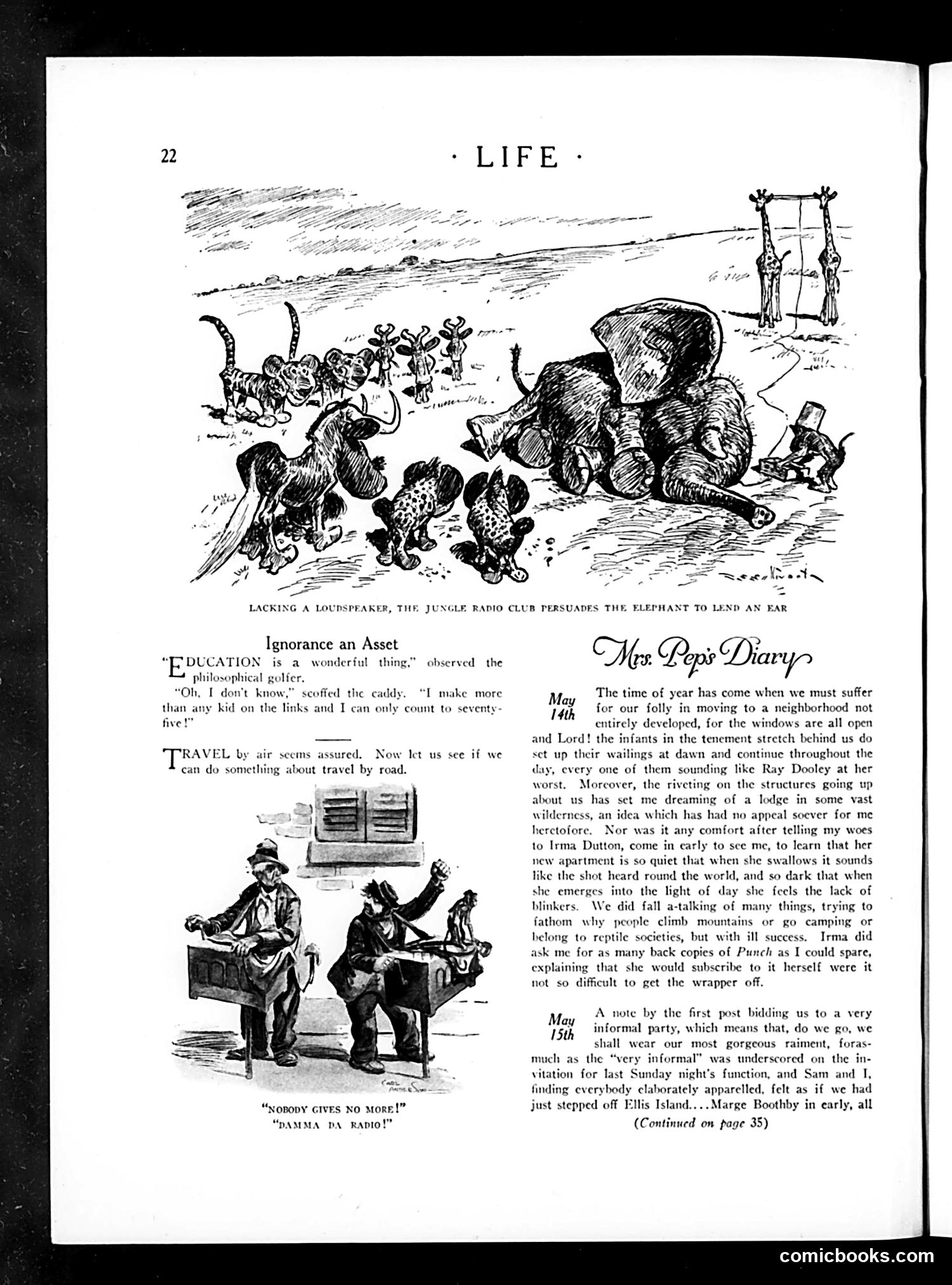
This page contains three separate pieces of satirical content: **"Ignorance an Asset"** presents a golf joke where a caddy claims he earns more than the golfer despite being unable to count beyond seventy—suggesting the caddy's practical street smarts outweigh the educated golfer's book learning. The satire mocks pretentious wealth. **"Travel by Road"** cartoon depicts two men discussing air travel, with the caption "SORROW GIVES NO MORE!" and "DAMMA DA RADIO!"—likely satirizing how radio and modern technology have changed communication and travel discussions, possibly mocking those who complain about progress. **"Mrs. Pep's Diary"** (May 14-15) is a society column humorously chronicling upper-middle-class anxieties: noisy neighbors in a developing neighborhood, conversational mishaps, and the awkwardness of misinterpreting "very informal" dress codes. It satirizes both residential pretension and the social climbing anxieties of the era's leisure class, particularly women navigating social propriety. All three pieces use humor to mock contemporary American social hierarchies and modern inconveniences.
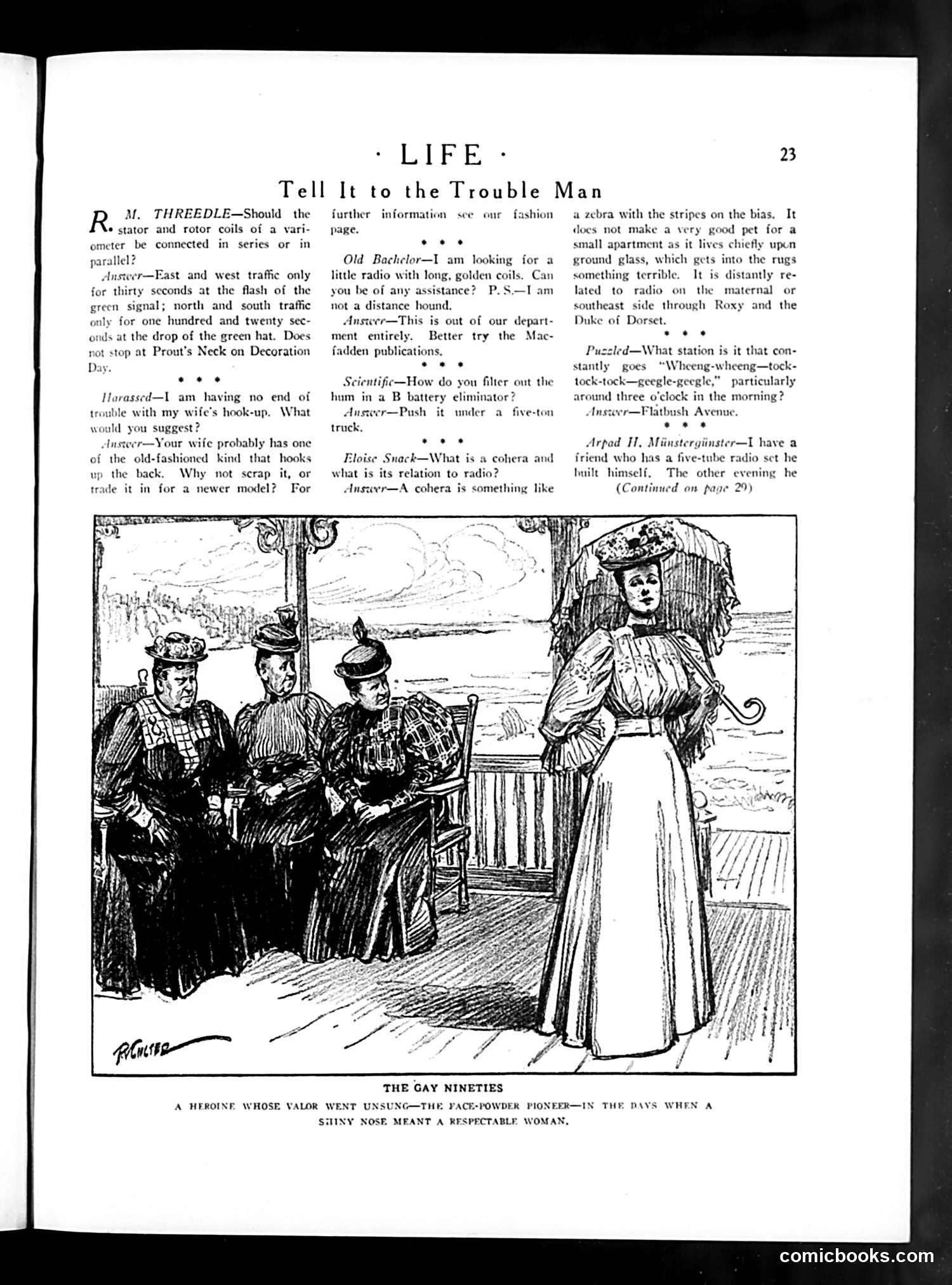
This page contains absurdist humor typical of 1920s Life magazine. The "Trouble Man" section mocks readers' technical questions about emerging radio technology by providing deliberately nonsensical answers. For example, a question about radio coil connections receives traffic signal instructions; a radio inquiry gets redirected to fashion publications; and a question about filtering battery hum suggests crushing the device under a truck. The humor relies on the contradiction between serious technical inquiry and ridiculous, unhelpful responses—satirizing both the newfangled radio craze and perhaps the magazine's own advice columns. The illustration depicts "The Gay Nineties," showing a well-dressed woman with an elaborate hat and parasol addressing three older women. The caption refers to her as a "face-powder pioneer," humorously suggesting that using cosmetics was once scandalously bold behavior—when exposed skin was considered improper for respectable women.
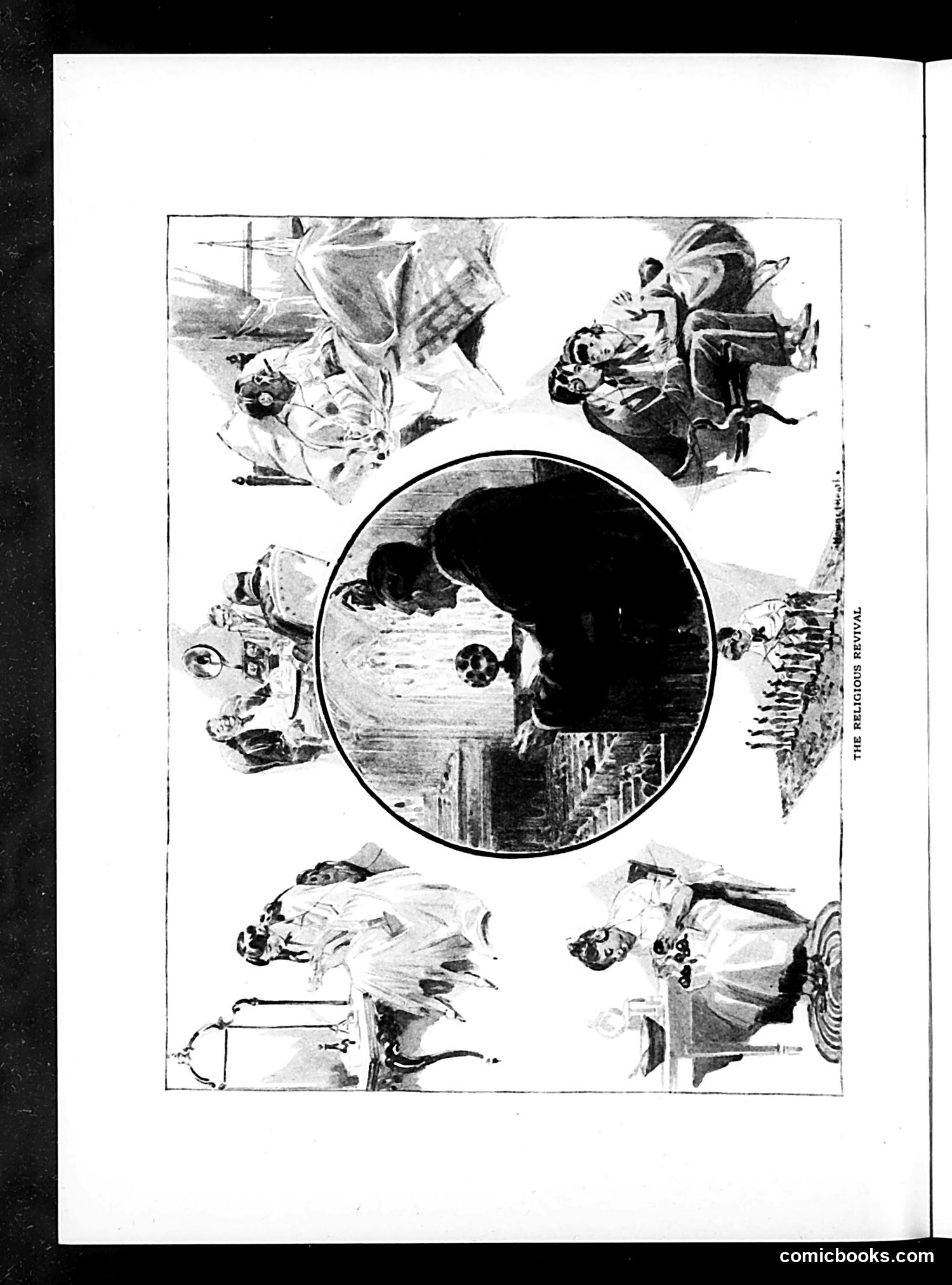
I can see this is a page from Life magazine with a central circular image surrounded by smaller sketches or vignettes arranged around it. However, the OCR text provided is corrupted/reversed and illegible, making it impossible to read any caption or title that would explain the content. The central circular photograph appears to show people in what looks like an interior scene, while the surrounding smaller images seem to depict various figures in different poses or situations. Without legible text identifying the subject, figures, or satirical point, I cannot reliably explain what political or social commentary this page intended to convey. To properly interpret this cartoon/content, a clearer image of any captions or title would be necessary.
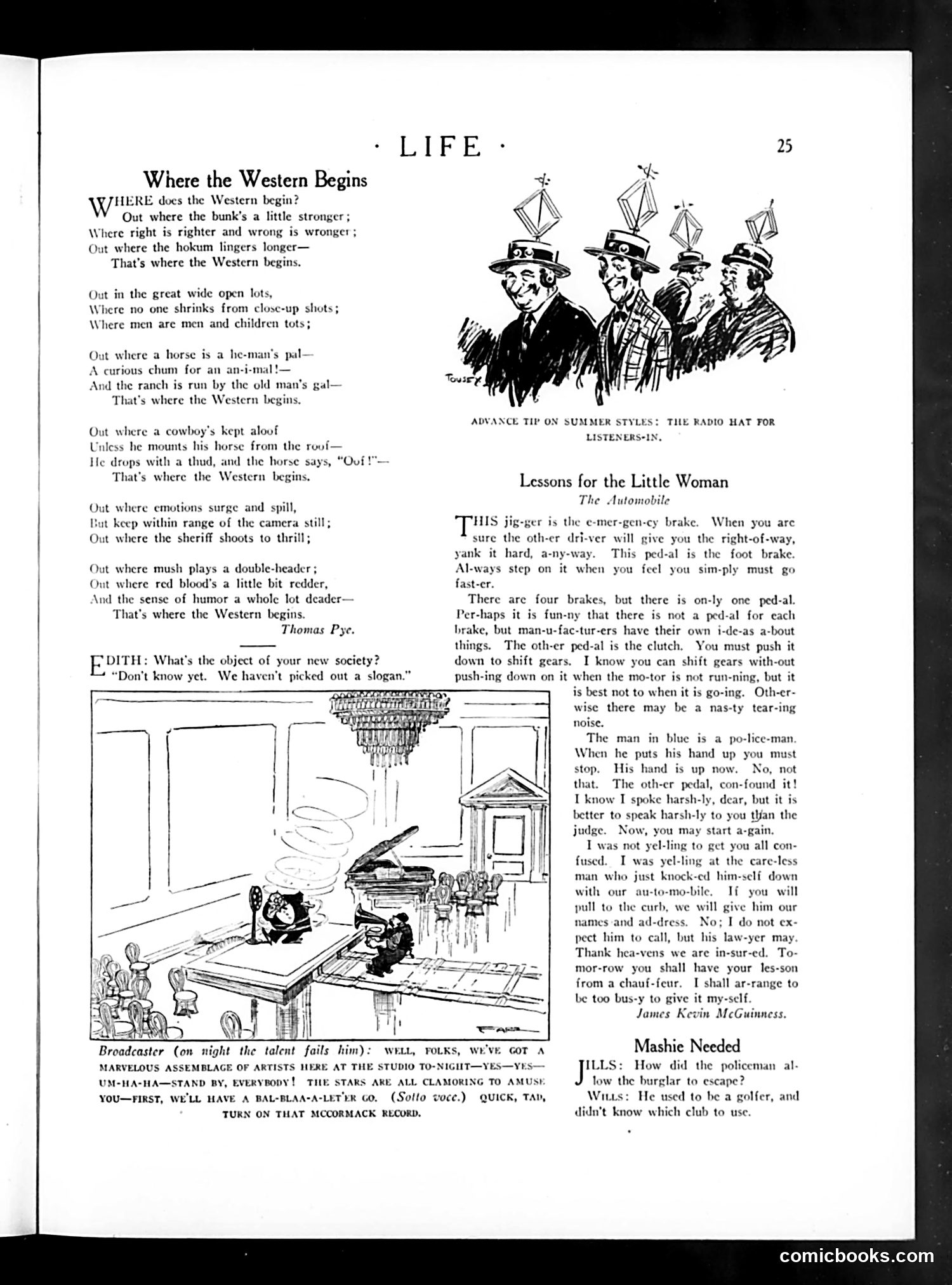
This page contains satirical content mocking early 1900s American culture: **"Where the Western Begins"** (poem by Thomas Pye) satirizes Western films and frontier mythology. It mocks the exaggerated morality ("right is righter and wrong is wronger"), artificial drama ("sheriff shoots to thrill"), and melodrama of Wild West cinema—a booming genre at the time. The humor lies in exposing how filmmakers created heightened, unrealistic versions of frontier life for entertainment. **"Lessons for the Little Woman"** parodies condescending driving instruction for women, presented in patronizing, exaggerated phonetic spelling. It mocks both the automobile industry's dismissive attitude toward female drivers and husbands who treat their wives as incompetent behind the wheel. **Lower sections** include brief joke items: a radio broadcaster spoof and a golfer/burglar punchline. The page overall targets emerging 20th-century anxieties: cinema's influence, automobile adoption, and changing gender roles—presented through satirical humor typical of Life's editorial voice.
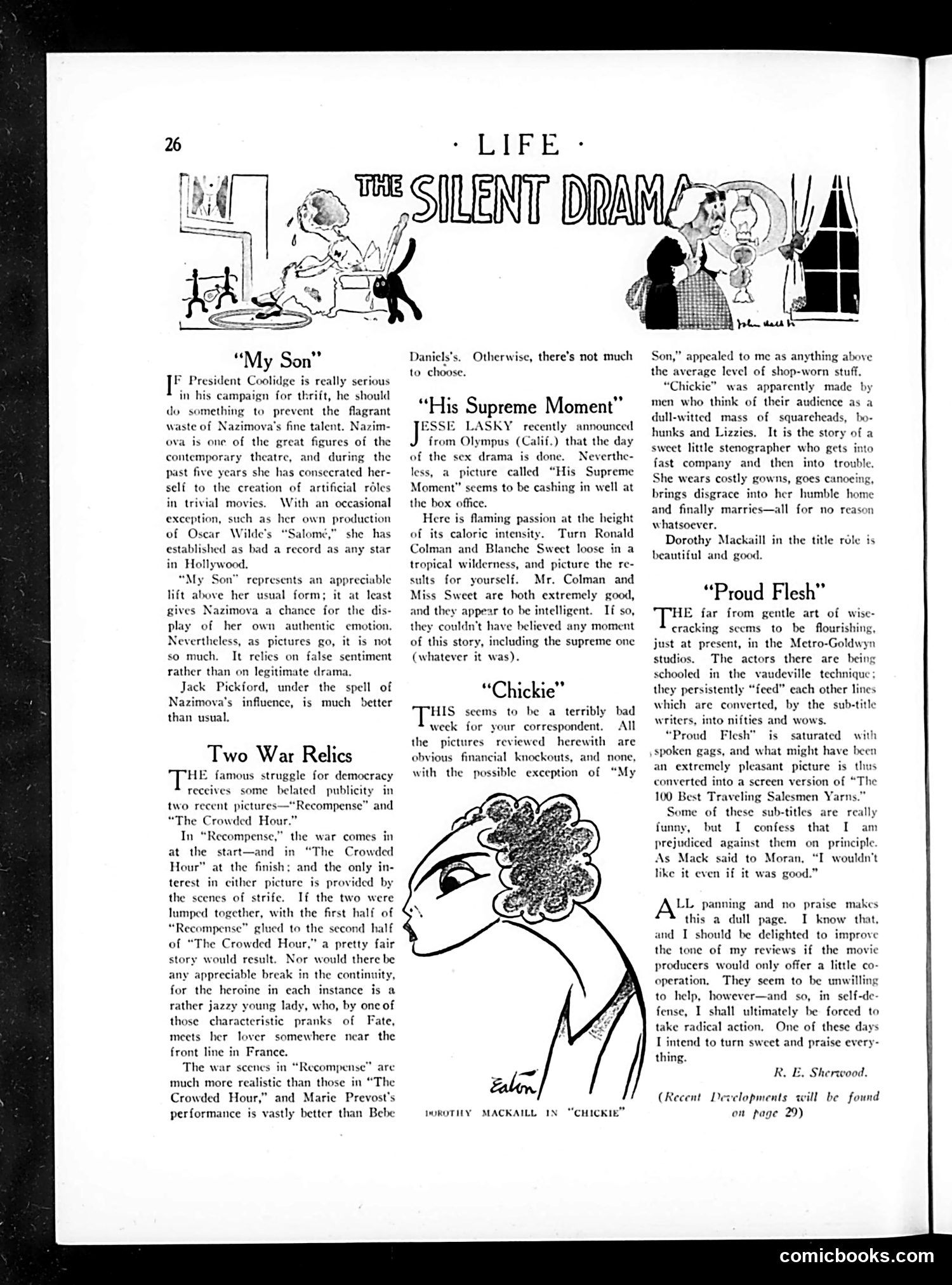
This page contains film criticism reviewing several recent movies. The reviewer dismisses most releases as mediocre or worse, particularly criticizing "Chickie" as pandering to audiences he considers "dull-witted" and "squareheads" (a derogatory term for working-class immigrants). The reviews reveal 1920s cinema conventions: "war relics" (films opportunistically grafting WWI scenes), sex dramas (melodramas centered on passion), and slapstick comedies relying on "wise-cracking" and vaudeville-style humor. Notably, the critic expresses prejudice against low-brow entertainment while grudgingly acknowledging talented performers like Nazimova and Ronald Colman. The tone reflects elitist attitudes common among contemporary critics who lamented Hollywood's appeal to mass audiences rather than sophisticated viewers.
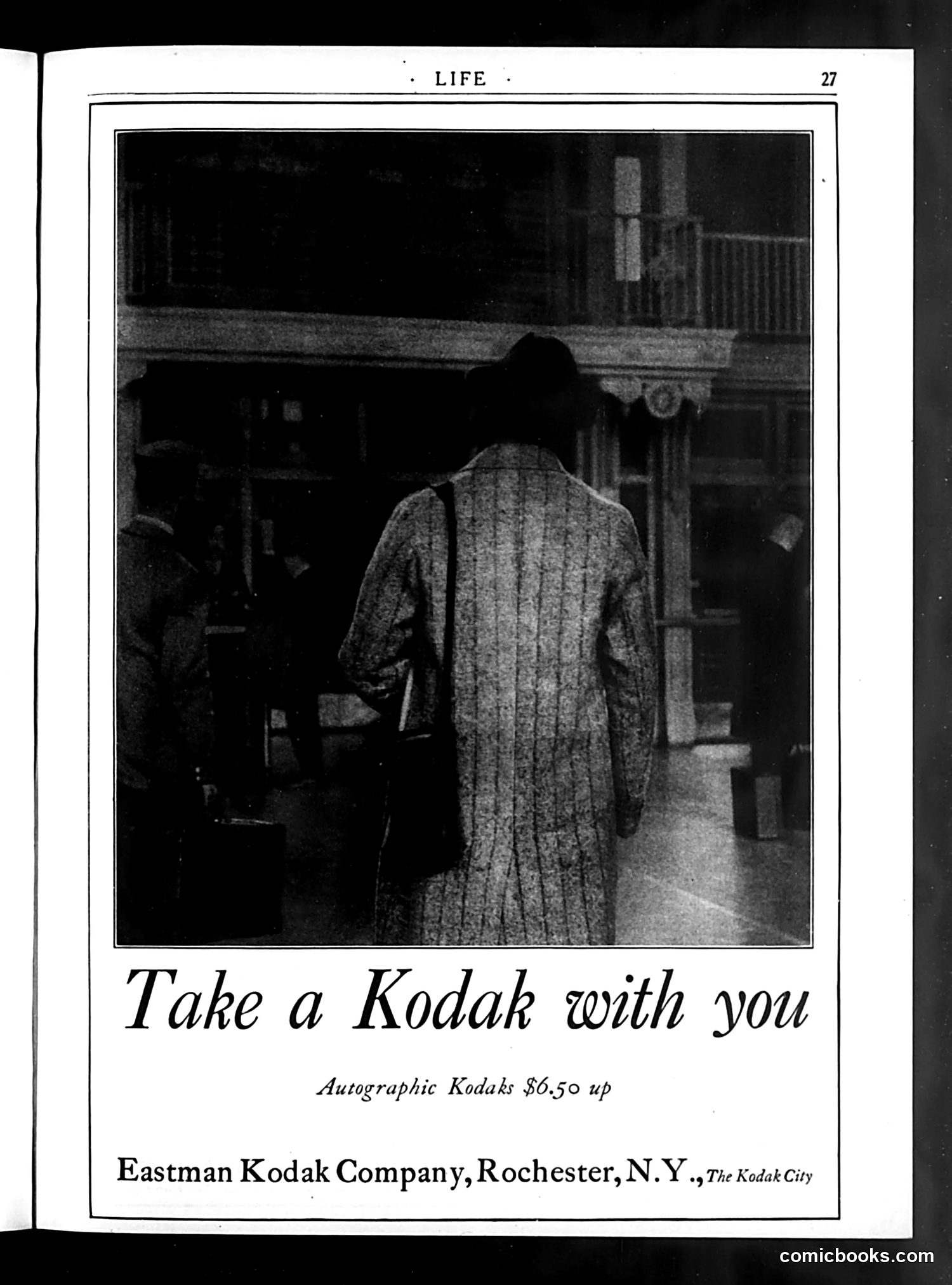
This is a full-page advertisement for Eastman Kodak Company, not a political cartoon or satirical content. The image shows a woman from behind, wearing a robe, standing in what appears to be an interior domestic or hotel setting. The ad's slogan is "Take a Kodak with you," promoting portable cameras priced at $6.50 and up. The tagline identifies Rochester, New York as "The Kodak City," referencing the company's headquarters location. This is a straightforward commercial advertisement encouraging consumers to purchase cameras for personal use and travel documentation—typical of early 20th-century advertising strategy promoting consumer photography as an accessible leisure activity.
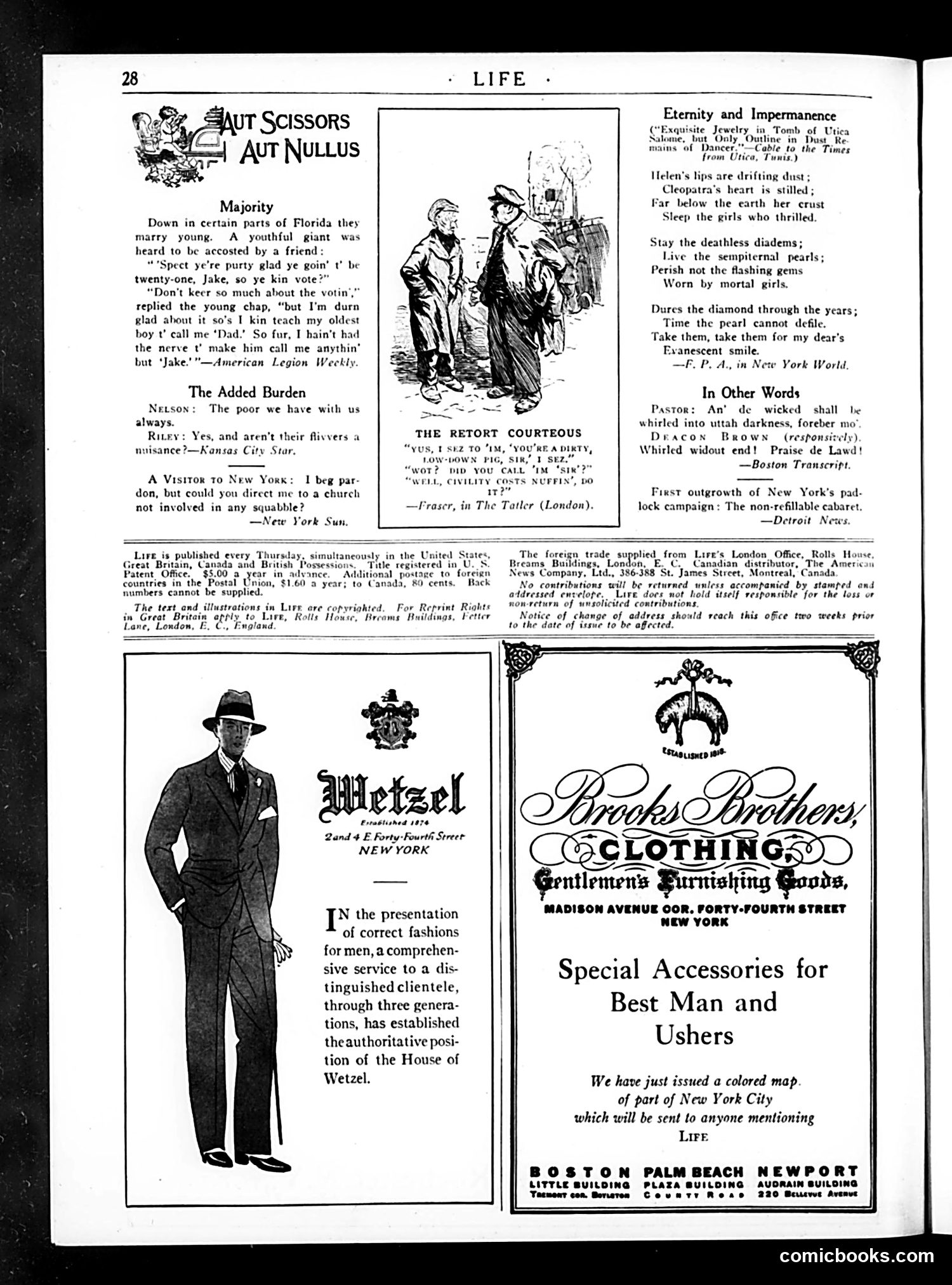
This page combines humor columns with period advertisements. The main content consists of several short jokes: **"Majority"** satirizes early marriage in rural Florida—a young man is more excited about being old enough to be called "Dad" than gaining voting rights, suggesting premature fatherhood in that region. **"The Added Burden"** mocks the irony of poverty: poor people's cheap automobiles ("flivvers") are now *society's* problem, not theirs. **"The Retort Courteous"** depicts a street confrontation where civility persists even during an insult. **"Eternity and Impermanence"** is serious poetry mourning that jewelry outlasts the mortal women who wear it—a meditation on mortality and vanity. **"In Other Words"** is an ethnic dialect joke (featuring "Deacon Brown") where a preacher's hellfire sermon gets affirmed enthusiastically by a congregant. **"First Outgrowth"** references NYC's "padlock campaign"—Prohibition-era raids on speakeasies—joking that bars now serve non-refillable drinks to avoid leaving evidence. The advertisements below (Wetzel, Brooks Brothers) are period fashion marketing.
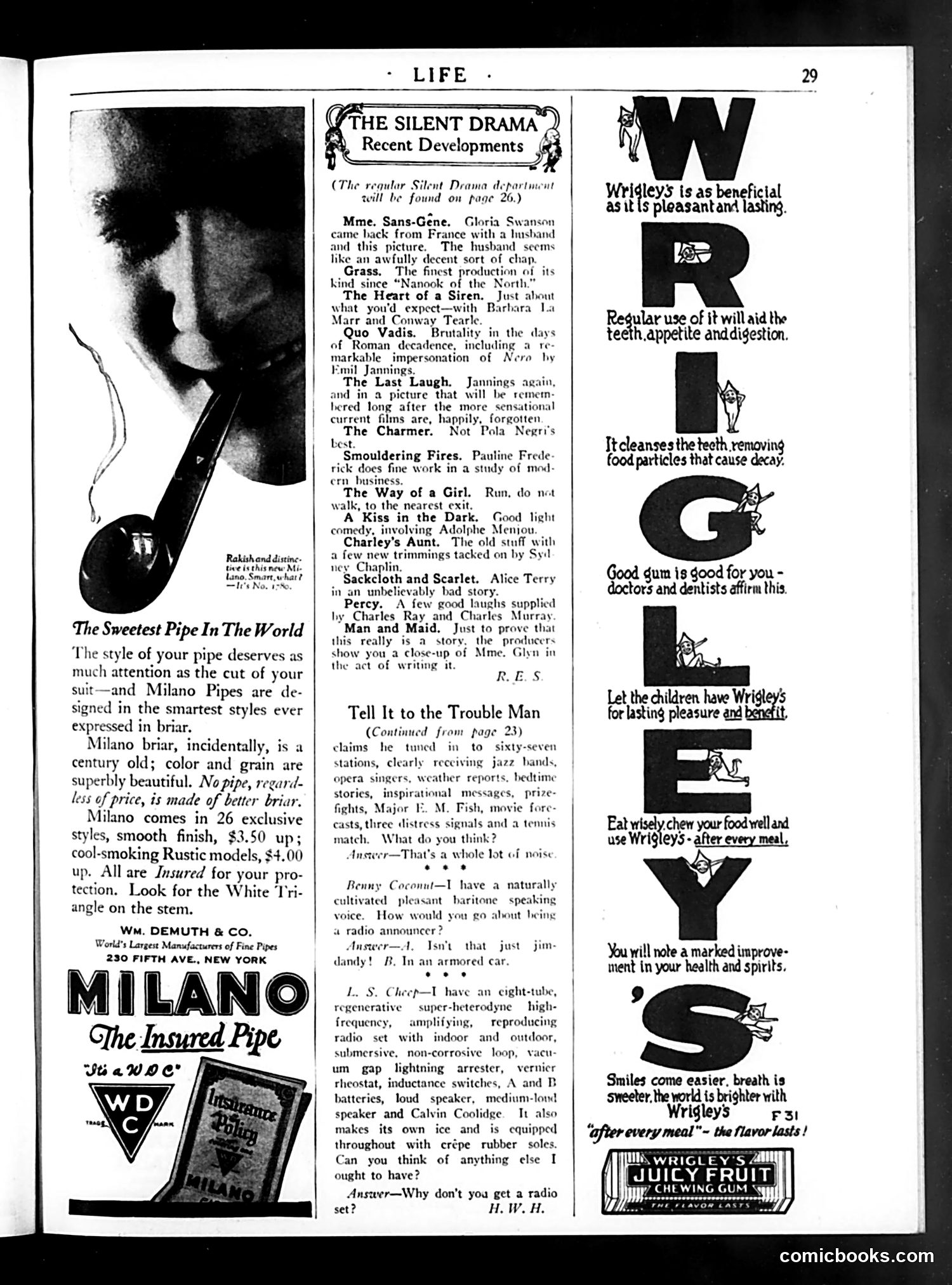
This page combines film reviews, advertising, and humor typical of 1920s Life magazine. **"The Silent Drama" section** reviews contemporary silent films, mentioning stars like Gloria Swanson, Emil Jannings, and Pola Negri—major figures of early cinema. The reviews are brief and casual ("Just about what you'd expect"). **"Tell It to the Trouble Man"** is a humor column answering reader questions about radio technology. The jokes mock the era's fascination with complex radio sets: one reader describes an absurdly over-engineered receiver with every conceivable feature, and the columnist sarcastically suggests he simply "get a radio set"—implying his elaborate contraption isn't actually a functional radio. Another joke about becoming a radio announcer suggests doing so "in an armored car," likely mocking overly confident or loud amateur broadcasters. **The advertisements** promote Milano pipes and Wrigley's gum with health claims typical of the period—gum aids digestion and dental health, pipes deserve as much style consideration as suits. The page reflects 1920s consumer culture, emerging broadcast media, and silent film's golden age.
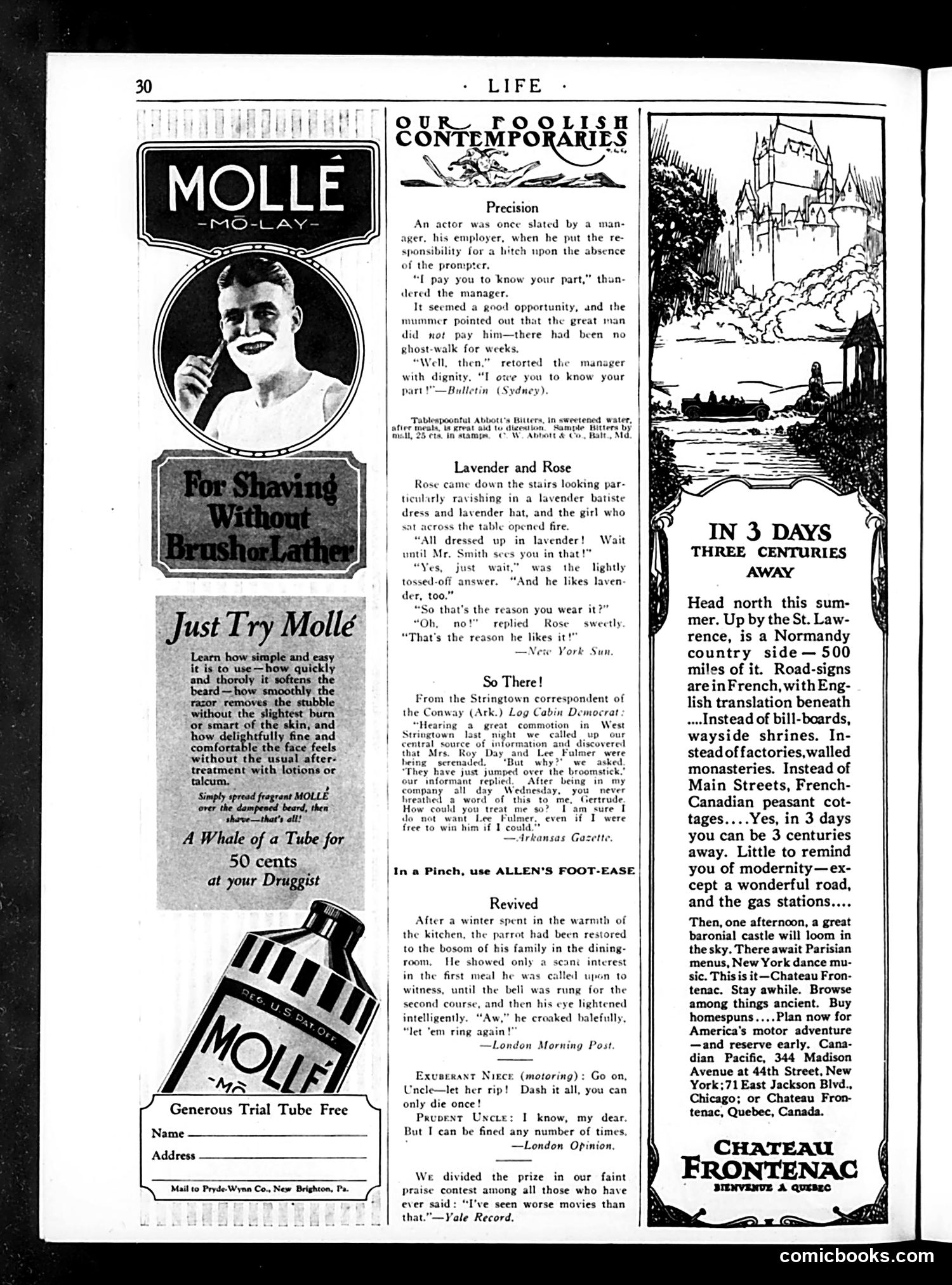
This page is primarily **advertising and humorous anecdotes**, not political satire. The left side features a **Mollé shaving cream advertisement** promoting brushless shaving—a relatively new product innovation at the time. The ad emphasizes convenience and comfort. The center contains brief **humorous stories** (common filler in Life magazine): - "Precision": A joke about an actor blaming a prompter when unpaid - "Lavender and Rose": A domestic wit exchange about a woman's outfit choice - "So There!": A rural gossip anecdote about a couple's elopement - A parrot joke and motoring anecdote The right side advertises **Chateau Frontenac**, a Canadian resort promoting tourism via the new automobile. It romanticizes rural French-Canadian culture as a nostalgic escape from American modernity, emphasizing "3 centuries away" from factories and billboards—ironic given the gas stations mentioned. The page reflects **1920s consumer culture**: new products, automobile tourism, and escapist advertising targeting affluent readers.
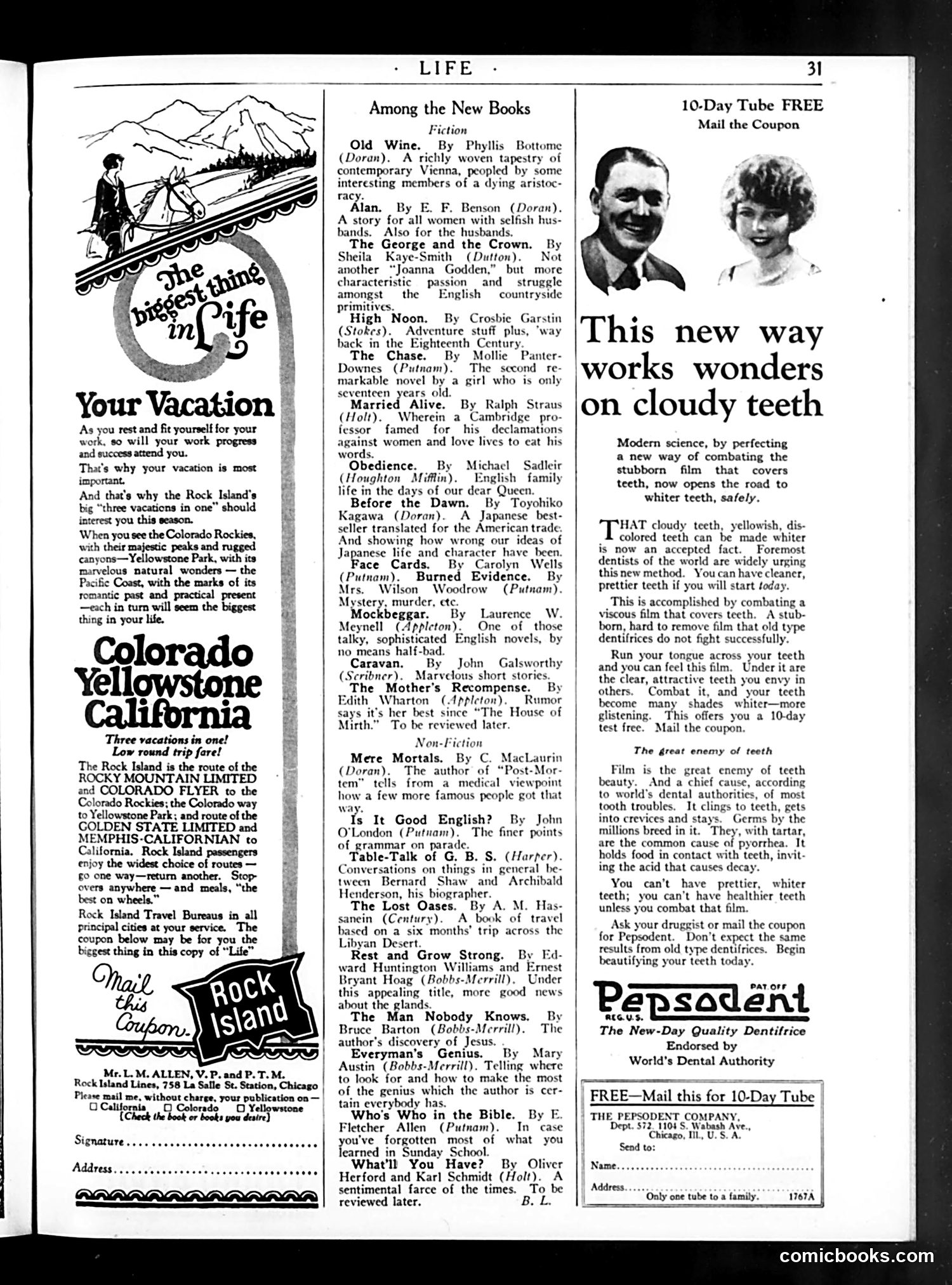
This is primarily a **vacation advertisement** for the Rock Island railroad line, disguised as editorial content in *Life* magazine. The cartoon depicts a romantic scene of train travel through America's natural wonders—the Colorado Rockies, Yellowstone, and California—framing vacation as essential rest for workers seeking success. The ad's pitch: three distinct vacations in one economical trip, with superior dining and flexible routing. This reflects early 20th-century rail travel as a luxury leisure activity for middle/upper-class Americans. The page also includes book reviews typical of *Life*'s literary coverage, plus a **Pepsodent toothpaste advertisement** offering a free 10-day trial tube. Both ads use the magazine's credibility to promote consumer products—a common practice blending advertising with genuine editorial material.
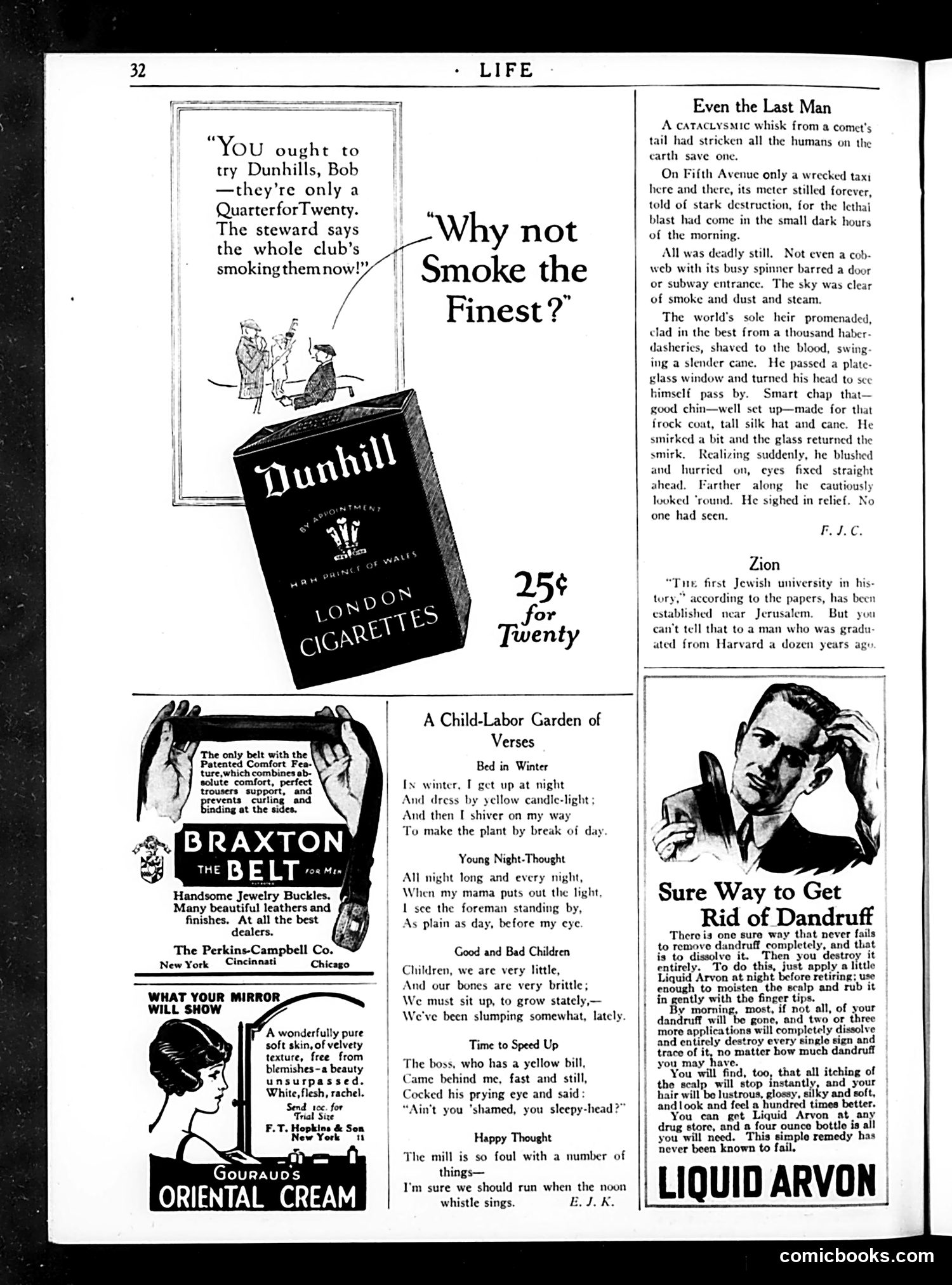
This page blends advertisements with satirical content typical of Life magazine's approach. **Main Advertisement**: A Dunhill cigarettes ad features a dialogue about smoking quality products at clubs—targeting affluent male consumers. **"Child-Labor Garden of Verses"**: This is sharp social satire. The poems, attributed to E.J.K., mock child factory workers through ironic "children's verse." References include: working by candlelight, seeing "the foreman standing by" at night, bones being "brittle" from labor, and running when "the noon whistle sings." The satire exposes the grim reality of child labor by presenting it in the innocent form of nursery rhymes—the contrast between the cheerful genre and the dark subject matter creates the satirical punch. This critiques industrial exploitation of children. **"Even the Last Man"**: A satirical story about humanity's extinction, focusing on the sole survivor's vanity—he admires himself in a window despite apocalypse. The joke: even facing extinction, human narcissism endures. **Remaining ads**: Typical period products (belts, skin cream, dandruff remedy) fill remaining space—standard magazine filler.
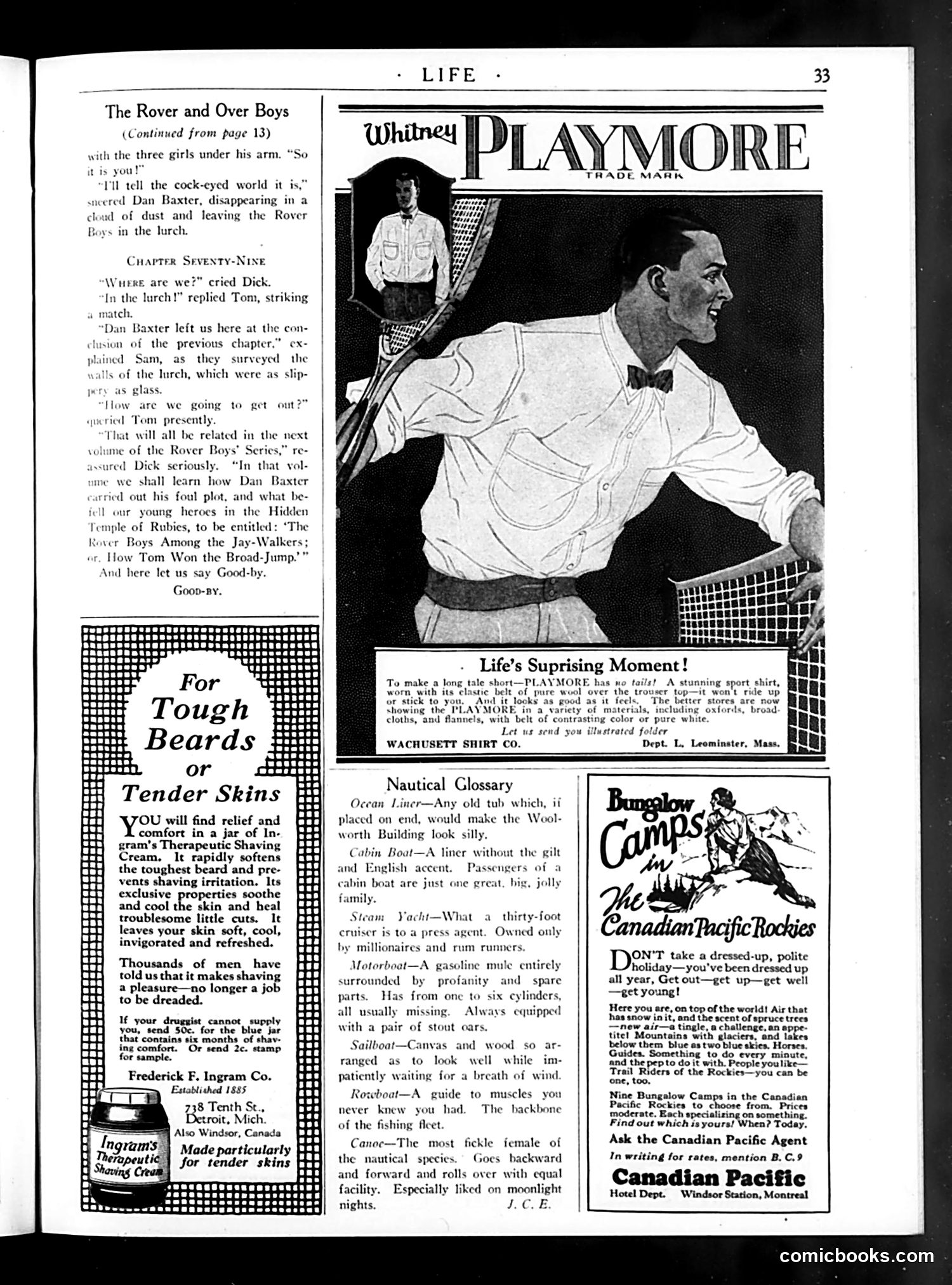
This page contains **serial fiction, advertisements, and humor** typical of early 20th-century Life magazine. The main text ("The Rover and Over Boys") is a **parody of the popular "Rover Boys" adventure series**—a children's serial about daring young heroes. Life satirizes the cliffhanger format by having characters literally stuck "in the lurch" (trapped), then breaking the fourth wall: they announce the resolution will appear "in the next volume," mocking how these serials stretched stories across many installments to maintain readership. The advertisements (Playmore shirts, shaving cream, Canadian Pacific Camps) represent typical early 1900s consumer marketing. The "Nautical Glossary" is **humorous definitions**—e.g., calling an ocean liner "any old tub" that would make the Woolworth Building look silly if stood vertically; defining a motorboat as a "gasoline mule entirely surrounded by profanity." This is lighthearted mockery of nautical pretension and tourist culture. The overall page reflects Life's mix of satirical fiction parodying popular entertainment alongside period advertising.
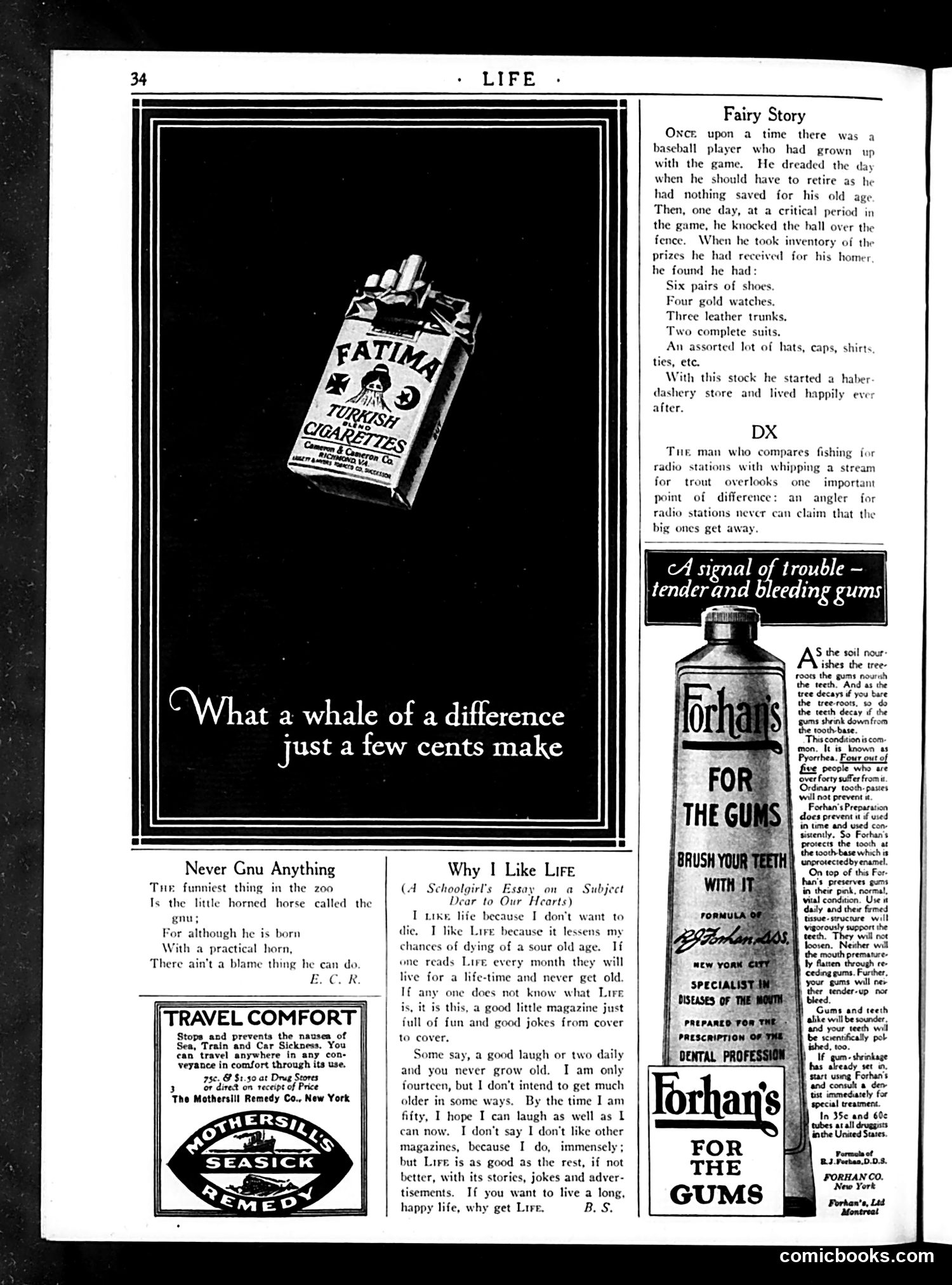
This page is primarily **advertising and light humor content**, typical of Life magazine's format. The main visual advertises **Fatima Turkish Cigarettes** with the tagline "What a whale of a difference just a few cents make"—emphasizing that a small price difference yields superior quality. The text content includes: - **"Never Gnu Anything"**: A pun-based poem mocking the gnu (wildebeest) for being born with a horn but being useless otherwise. - **"Fairy Story"**: A satirical tale of a baseball player who retires with only merchandise prizes (shoes, watches, suits)—implying professional athletes of this era earned minimal salaries and depended on product endorsements rather than wages. - **"DX"**: A brief joke comparing radio tuning to fishing—radio listeners can't claim "the big ones got away." - **"Why I Like Life"**: A schoolgirl's essay praising the magazine itself. The page also contains period advertisements for travel sickness remedies and **Forhan's toothpaste**, promoting gum health—a relatively new marketing concern of the era.
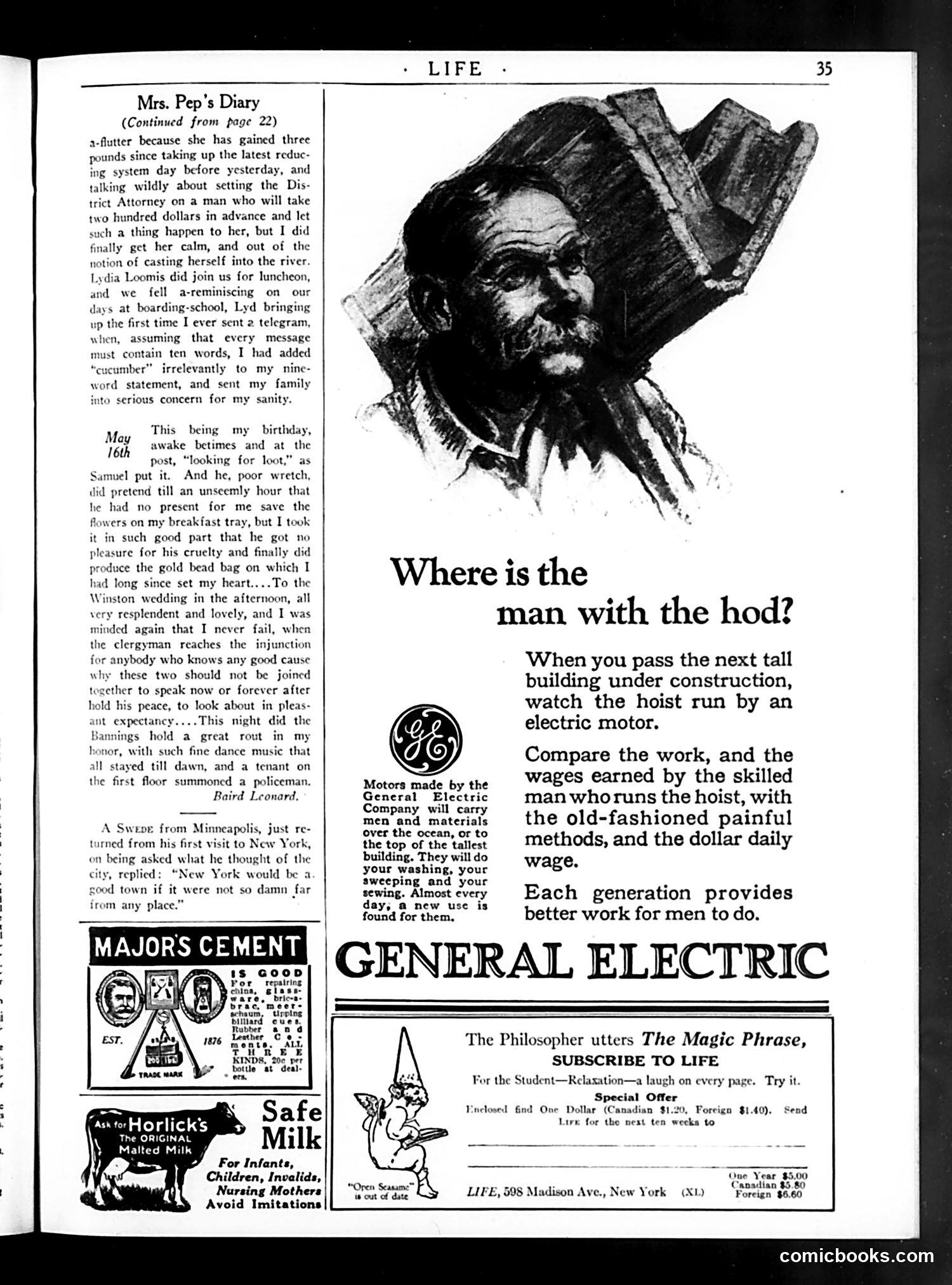
**Main Content:** This page is primarily **advertising** (General Electric, Major's Cement, Horlick's Malted Milk) interspersed with a serialized diary column ("Mrs. Pep's Diary"). **The Diary:** A society woman's gossipy account of social events—a friend's weight-loss panic, a birthday celebration, a wedding, and a dance party. The humor is gentle domestic satire: a husband pretending to forget a gift, a woman's anxiety over gaining three pounds, and an embarrassing telegram gaffe from boarding school days. It satirizes upper-middle-class concerns and female social anxieties. **The GE Advertisement:** Features a sketch of a working man with a hod (a V-shaped carrier for bricks/materials). The ad compares modern electric hoists to manual labor, arguing that mechanization provides "better work for men to do"—a progressive argument justifying technological displacement as creating superior employment rather than eliminating jobs. This reflects early-20th-century optimism about industrial progress. **Anecdote:** A brief quip from a Minneapolis visitor marveling that New York would be perfect "if it were not so damn far from any place"—frontier-era American humor about distance and isolation.
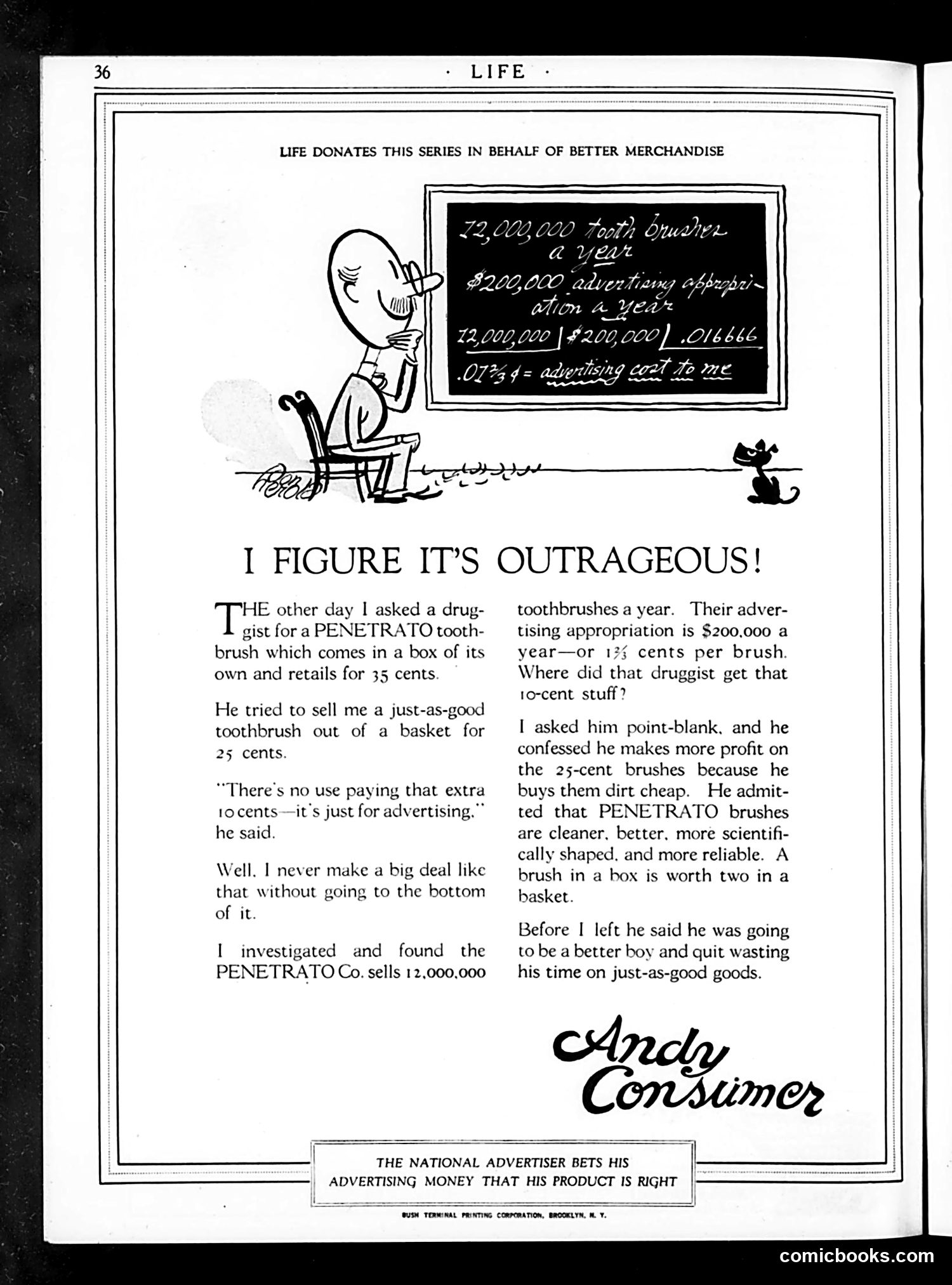
This is a paid advertisement disguised as consumer advocacy journalism. "Andy Consumer" (a fictional character created by Life magazine) confronts a druggist selling cheap toothbrushes while claiming they're equivalent to the advertised PENETRATO brand. The satire targets deceptive retail practices: the druggist admits he profits more from inferior products he buys "dirt cheap" and falsely attributes the price difference to advertising rather than quality. Andy's investigation "proves" PENETRATO's superiority by calculating their advertising spend per brush (1.67 cents) is minimal and justified by genuine product quality. The tagline—"The National Advertiser Bets His Advertising Money That His Product Is Right"—frames advertising itself as evidence of product trustworthiness, essentially arguing that companies wouldn't spend money promoting inferior goods. This represents early 20th-century "consumer education" sponsored by corporations, promoting brand loyalty over generic alternatives while presenting corporate interests as consumer protection.
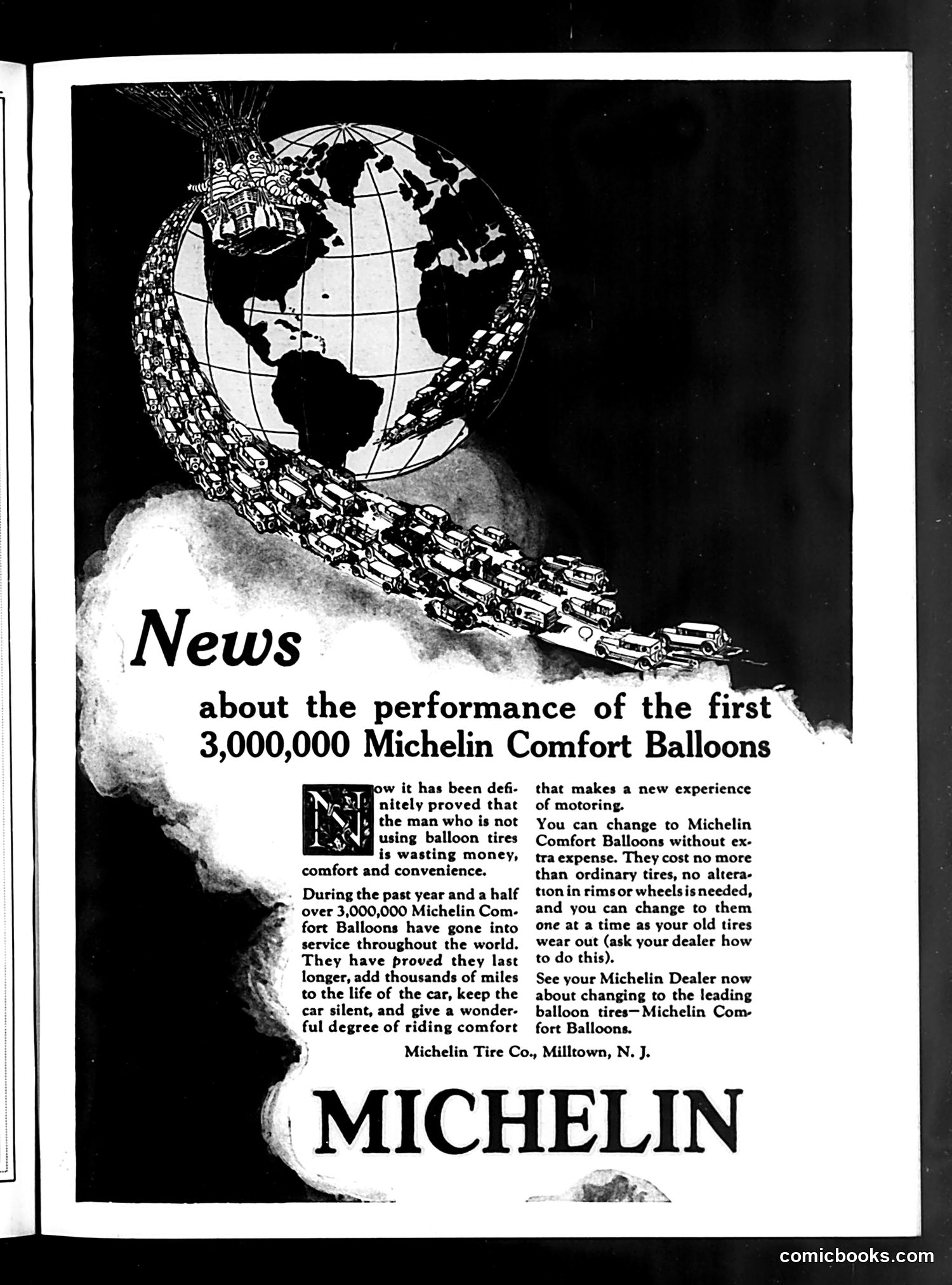
This is a **Michelin tire advertisement**, not political satire or a cartoon. The image shows a globe with a trail of automobiles, designed to convey global reach and widespread adoption. The "news" being advertised is that 3 million Michelin "Comfort Balloons" (balloon tires—a then-modern tire technology with lower pressure, offering smoother rides) have been sold worldwide. The advertisement claims these tires provide comfort, durability, and silence while costing no more than ordinary tires and requiring no wheel modifications. For modern readers: balloon tires were a significant automotive innovation of the 1920s-30s. This ad uses the impressive sales figure and globe imagery to establish credibility and suggest the product's superiority through popularity. The language emphasizes practical benefits—longer tire life, improved comfort, easier adoption—attempting to overcome consumer reluctance to switch brands.
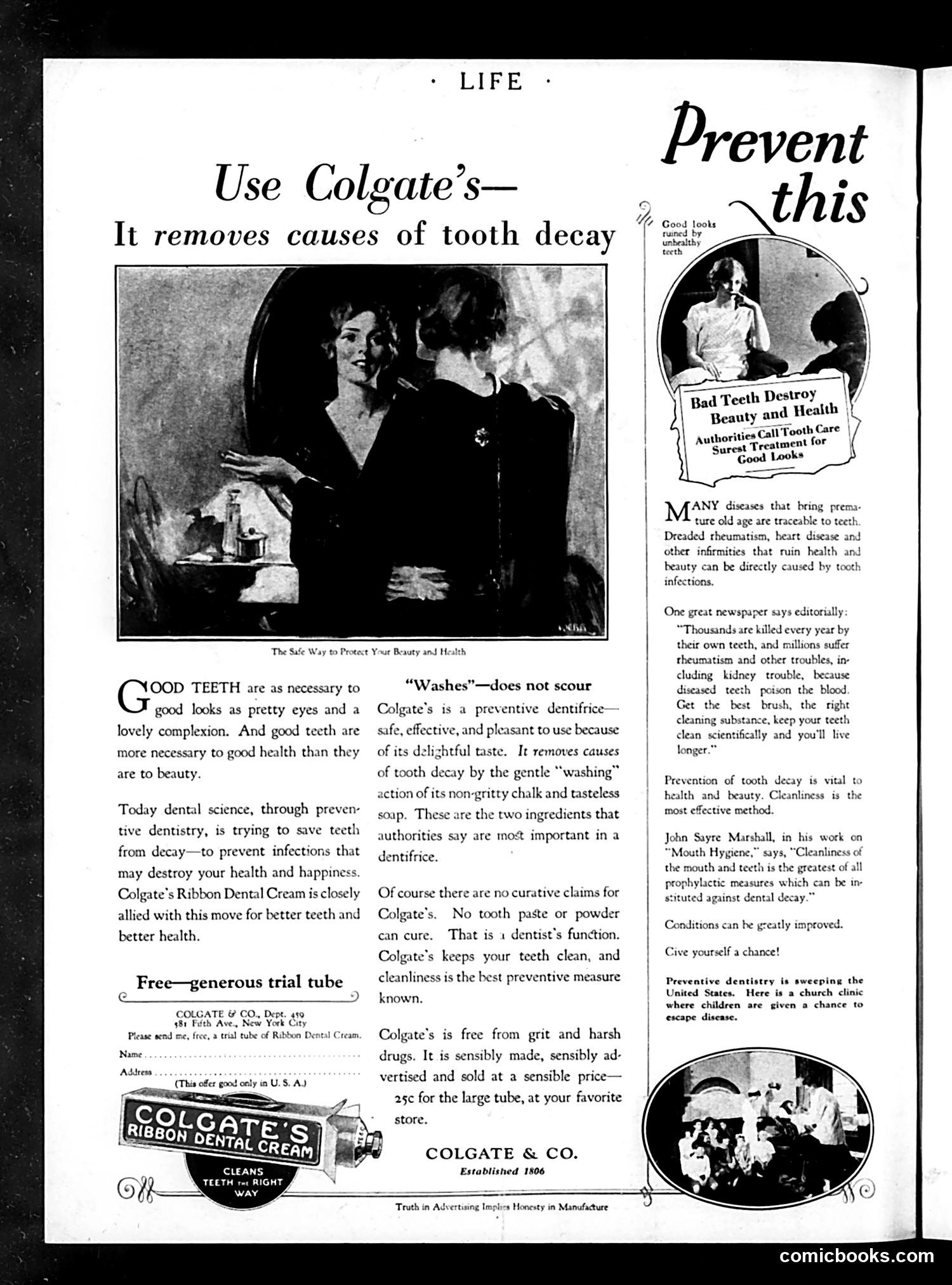
This is primarily a **toothpaste advertisement**, not political satire. The page promotes Colgate's Ribbon Dental Cream by linking dental hygiene to broader health and beauty concerns. The advertisement argues that bad teeth cause serious diseases—rheumatism, heart disease, kidney trouble—by poisoning the blood through tooth infections. This reflects **early 20th-century medical thinking** that poor oral hygiene was responsible for systemic illness. The imagery shows an upper-class woman being advised about dental care, and a church clinic where children receive preventive dental treatment. The satire is mild: the ad gently mocks those who ignore dentistry while positioning Colgate's as the sensible, scientifically-sound solution at an affordable price (25¢). The accompanying editorial text from "a great newspaper" uses dramatic language—"thousands are killed every year by their own teeth"—typical of health-scare advertising of that era, now recognized as exaggerated but reflecting genuine contemporary medical anxieties.