
Life, 1925-05-21 · page 18 of 40
Life — May 21, 1925 — page 18: what you’re looking at
What you’re looking at
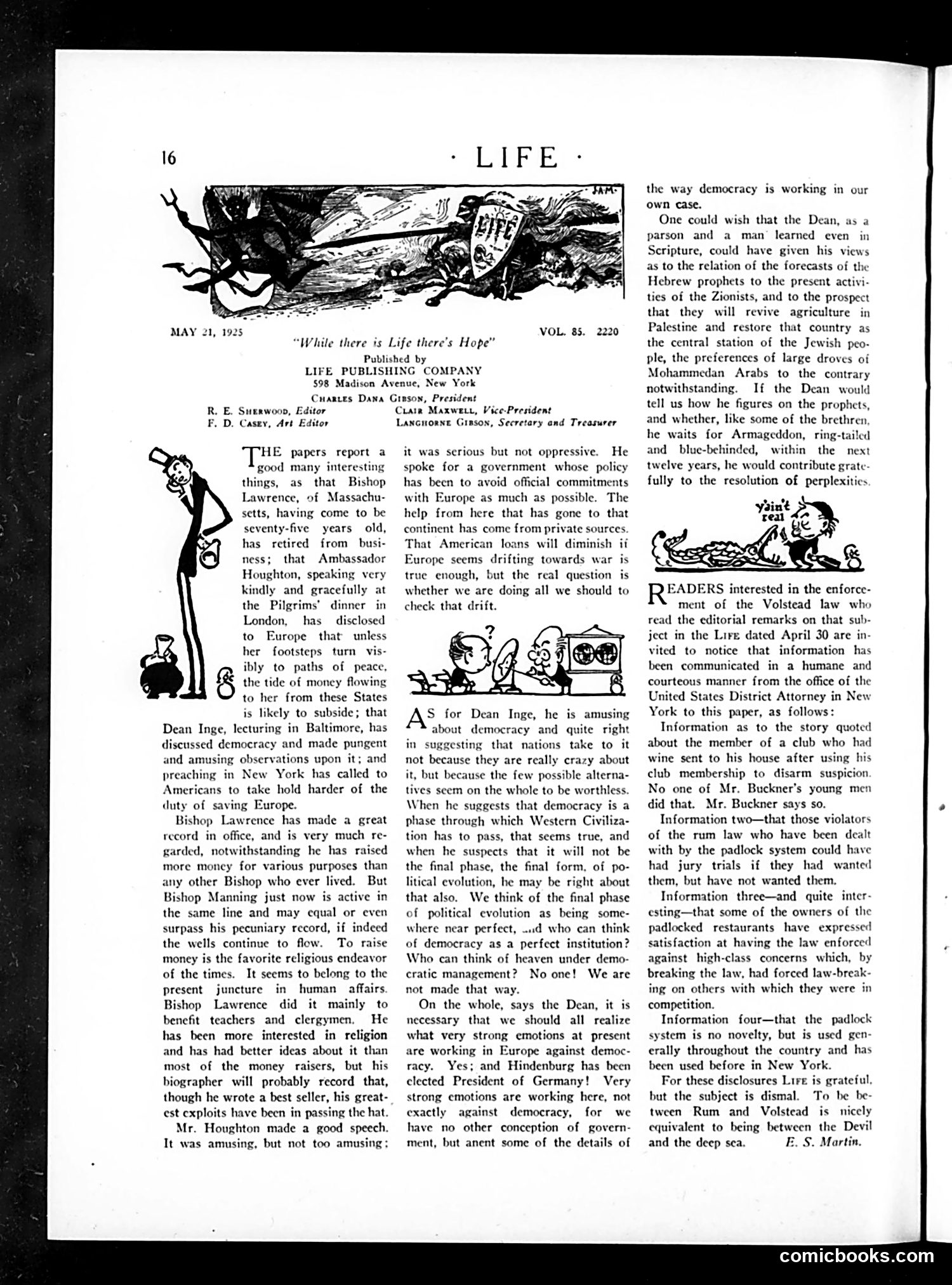
This page contains editorial commentary rather than cartoons. It discusses three prominent American figures making public statements: **Bishop Lawrence** (retired Massachusetts clergyman) and **Bishop Manning** are criticized for their primary accomplishment being fundraising—"passing the hat"—rather than substantive religious leadership. **Ambassador Houghton** delivered a speech warning Europe that American financial aid depends on avoiding war, reflecting U.S. isolationist policy of the 1920s. **Dean Inge** (a British religious figure lecturing in America) discussed democracy as a necessary but imperfect political phase, not humanity's final form of government. The editorial agrees democracy is practical rather than ideal—adopted because alternatives seem worse. The author suggests strong emotions currently drive European politics, implying instability threatens peace and American investment. The page reflects post-WWI American concerns about European stability and America's financial role in rebuilding.
📄 Transcribed text from this page (OCR, searchable)
Machine-transcribed from the original scan — historical spelling and the odd misread are preserved.
the way democracy is working in our own case. One could wish that the Dean, as a parson and a man learned even in Scripture, could have given his views as to the relation of the forecasts of the Hebrew prophets to the present activi- ties of the Zionists, and to the prospect that they will revive agriculture in Palestine and restore that country as the central station of the Jewish peo- ple, the preferences of large droves of Mohammedan Arabs to the contrary notwithstanding. If the Dean would tell us how he figures on the prophets, and whether, like some of the brethren, . . , VOL. 85. 2220 “While there is Life there's Hope” Published by LIFE PUBLISHING COMPANY $98 Madison Avenue, New York Cuaaues Dawa Ginson, President Care Maxwett, Vice-President Lancnorne Ginsox, Secretary and Treasurer R. EL RWOOD, F. D. Casey, Art HE papers report a good many interesting things, as that Bishop Lawrence, of Massachu- setts, having come to be seventy-five years old, has retired from busi- ness; that Ambassador Houghton, speaking very kindly and gracefully at the Pilgrims’ dinner in London, has disclosed to Europe that unless her footsteps turn vis- R ibly to paths of peace, the tide of money flowing to her from these States is likely to subside; that Dean Inge, lecturing in Baltimore, has discussed democracy and made pungent and amusing observations upon it; and preaching in New York has called to Americans to take hold harder of the duty of saving Europe. Bishop Lawrence has made a great record in office, and is very much re- garded, notwithstanding he has raised more money for various purposes than any other Bishop who ever lived. But Bishop Manning just now is active in the same line and may equal or even surpass his pecuniary record, if indeed the wells continue to flow. To raise money is the favorite religious endeavor of the times. It seems to belong to the Present juncture in human affairs Bishop Lawrence did it mainly to benefit teachers and clergymen, He has been more interested in religion and has had better ideas about it than most of the money raisers, but his biographer will probably record that, though he wrote a best seller, his great- est exploits have been in passing the hat. Mr. Houghton made a good speech. It was amusing, but not too amusing; it was serious but not oppressive. He spoke for a government whose policy has been to avoid official commitments with Europe as much as possible. The help from here that has gone to that continent has come from private sources. That American loans will diminish if Europe seems drifting towards war is true enough, but the real question is whether we are doing all we should check that drift. AS for Dean Inge, he is amusing about democracy and quite right in suggesting that nations take to it not because they are really crazy about it, but because the few possible alterna- tives seem on the whole to be worthless. When he suggests that democracy is a phase through which Western Civiliza- tion has to pass, that seems true, and when he suspects that it will not be the final phase, the final form, of po- litical evolution, he may be right about that also. We think of the final phase of political evolution as being some- where near perfect, .ud who can think of democracy as a perfect institution? Who can think of heaven under demo- cratic management? No one! We are not made that way. On the whole, says the Dean, it is necessary that we should all realize what very strong emotions at present are working in Europe against democ- racy. Yes; and Hindenburg has been clected President of Germany! Very strong emotions are working here, not exactly against democracy, for we have no other conception of govern- ment, but anent some of the details of he waits for Armageddon, ring-tailed and blue-behinded, within the next twelve years, he would contribute grate- fully to the resolution of perplexities READERS interested in the enforce- ment of the Volstead law who read the editorial remarks on that sub- ject in the Lire dated April 30 are in- vited to notice that information has been communicated in a humane and courteous manner from the office of the United States District Attorney in New York to this paper, as follows: Information as to the story quoted about the member of a club who had wine sent to his house after using his club membership to disarm suspicion No one of Mr. Buckner’s young men did that. Mr. Buckner says so. Information two—that those violators of the rum law who have been dealt with by the padlock system could have had jury trials if they had wanted them, but have not wanted them, Information three—and quite inter- esting—that some of the owners of the padlocked restaurants have expressed satisfaction at having the law enforced against high-class concerns which, by breaking the law, had forced law-break- ing on others with which they were in competition. Information four—that the padlock system is no novelty, but is used gen- erally throughout the country and has been used before in New York. For these disclosures Lire is grateful, but the subject is dismal. To be be- tween Rum and Volstead is nicely equivalent to being between the Devil and the deep sea. E. S. Martin. comicbooks.com