
Life, 1925-05-21 · page 22 of 40
Life — May 21, 1925 — page 22: what you’re looking at
What you’re looking at
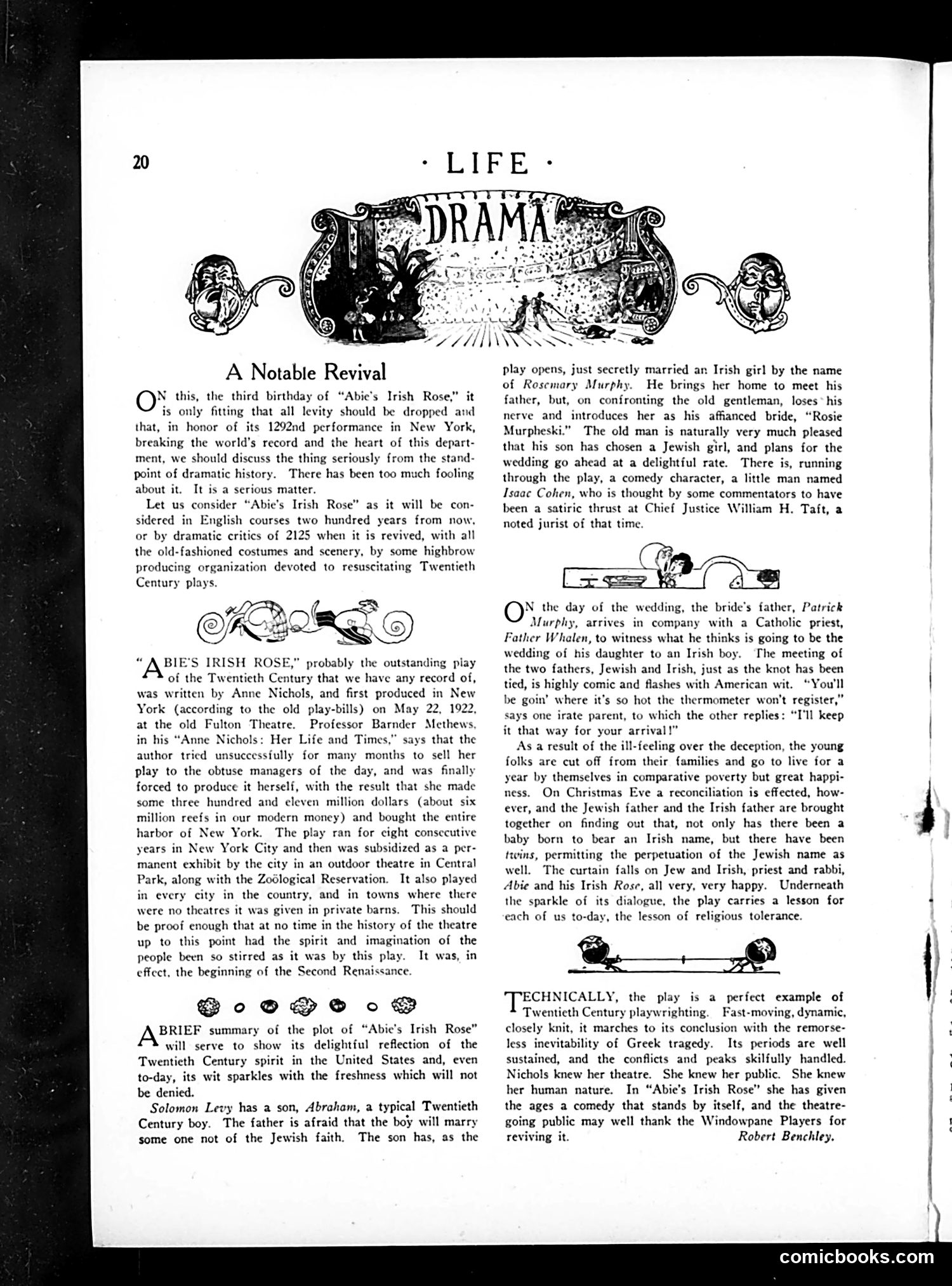
This page reviews Anne Nichols' wildly successful 1920s play "Abie's Irish Rose," written in mock-serious tone as if analyzing a classic for future scholars. The satire targets the play's unprecedented commercial success—it had run 1,292 performances, a record Life sarcastically suggests will be studied in 2125. The plot involves a Jewish boy (Abraham Levy) secretly marrying an Irish Catholic girl (Rosemary Murphy), then deceiving his father by calling her "Rosie Murpheski" to seem Jewish. Complications arise when her Catholic father arrives expecting an Irish wedding. Life's joke: the play was enormously popular despite (or because of) its lightweight treatment of interfaith marriage—a genuinely controversial topic in 1920s America. The satire mocks both the play's sentimental resolution of real social tensions and the public's hunger for it, suggesting even Chief Justice Taft appears satirized within the script.
📄 Transcribed text from this page (OCR, searchable)
Machine-transcribed from the original scan — historical spelling and the odd misread are preserved.
A Notable Revival O \ this, the third birthday of “Abic’s Irish Rose,” it is only fitting that all levity should be dropped and that, in honor of its 1292nd performance in New York, breaking the world’s record and the heart of this depart- ment, we should discuss the thing seriously from the stand- point of dramatic history. There has been too much fooling about it. It is a serious matter. Let us consider “Abie’s Irish Rose” as it will be con- sidered in English courses two hundred years from now, or by dramatic critics of 2125 when it is revived, with all the old-fashioned costumes and scenery, by some highbrow producing organization devoted to resuscitating Twentieth Century plays. ( SS IRISH RO probably the outstanding play of the Twentieth Century that we have any record of, was written by Anne Nichols, and first produced in New York (according to the old play-bills) on May 22, 1922, at the old Fulton Theatre. Professor Barnder Methews, in his “Anne Nichols: Her Life and Times,” says that the author tried unsuccessfully for many months to sell her play to the obtuse managers of the day, and was finally forced to produce it herself, with the result that she made some three hundred and eleven million dollars (about six million reefs in our modern money) and bought the entire harbor of New York. The play ran for cight consecutive years in New York City and then was subsidized as a per- manent exhibit by the city in an outdoor theatre in Central Park, along with the Zodlogical Reservation. It also played in every city in the country, and in towns where there were no theatres it was given in private barns. This should be proof enough that at no time in the history of the theatre up to this point had the spirit and imagination of the people been so stirred as it was by this play. It was, in effect, the beginning of the Second Renaissance. BSor®oMme o GB BRIEF summary of the plot of “Abie’s Irish Rose” will serve to show its delightful reflection of the Twentieth Century spirit in the United States and, even to-day, its wit sparkles with the freshness which will not be denied. Solomon Levy has a son, Abraham, a typical Twentieth Century boy. The father is afraid that the boy will marry some one not of the Jewish faith, The son has, as the “A CCI\\\WN\N *s Se play opens, just secretly married an Irish girl by the name of Rosemary Murphy. He brings her home to meet his father, but, on confronting the old gentleman, loses* his nerve and introduces her as his affianced bride, “Rosie Murpheski.” The old man is naturally very much pleased that his son has chosen a Jewish girl, and plans for the wedding go ahead at a delightful rate. There is, running through the play, a comedy character, a little man named Isaac Cohen, who is thought by some commentators to have been a satiric thrust at Chief Justice William H. Taft, a noted jurist of that time. eek 7 N the day of the wedding, the bride’s father, Patrick Murphy, arrives in company with a Catholic priest, Father Whalen, to witness what he thinks is going to be the wedding of his daughter to an Irish boy. The meeting of the two fathers, Jewish and Irish, just as the knot has been tied, is highly comic and flashes with American wit. “You'll be goin’ where it’s so hot the thermometer won't register,” says one irate parent, to which the other replies: “I'll keep it that way for your arrival!” As a result of the ill-feeling over the deception, the young folks are cut off from their families and go to live for a year by themselves in comparative poverty but great happi- ness. On Christmas Eve a reconciliation is effected, how- ever, and the Jewish father and the Irish father are brought together on finding out that, not only has there been a baby born to bear an Irish name, but there have been twins, permitting the perpetuation of the Jewish name as well. The curtain falls on Jew and Irish, priest and rabbi, Abie and his Irish Rose, all very, very happy. Underneath the sparkle of its dialogue, the play carries a lesson for each of us to-day, the lesson of religious tolerance. = ECHNICALLY, the play is a perfect example of Twentieth Century playwrighting. Fast-moving, dynamic, closely knit, it marches to its conclusion with the remorse- less inevitability of Greek tragedy. Its periods are well sustained, and the conflicts and peaks skilfully handled. Nichols knew her theatre. She knew her public. She knew her human nature. In “Abie’s Irish Rose” she has given the ages a comedy that stands by itself, and the theatre- going public may well thank the Windowpane Players for reviving it. Robert Benchley. comicbooks.com