
A complete issue · 36 pages · 1924
Life — January 24, 1924
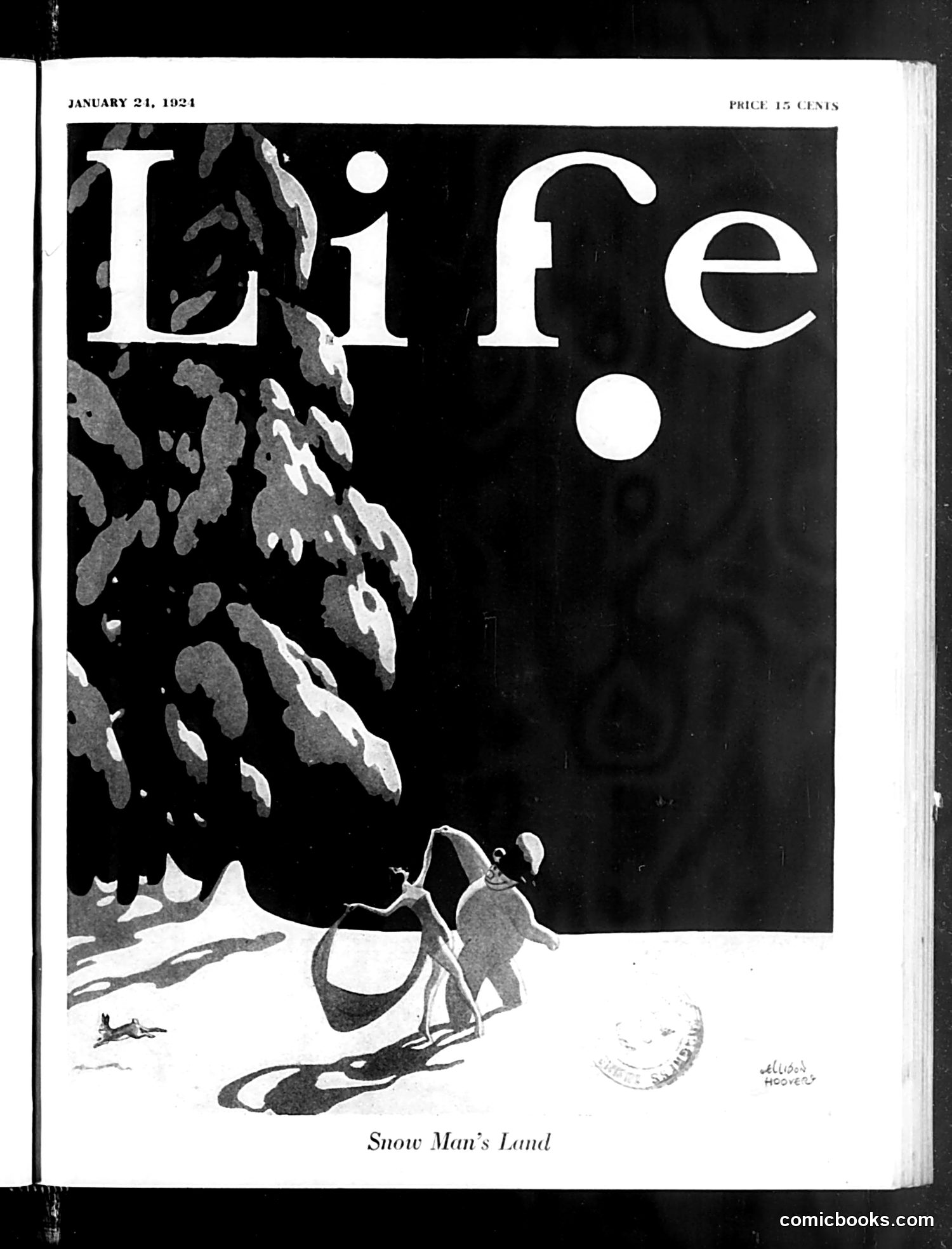
This is the cover of *Life* magazine from January 1924, priced at 15 cents. The illustration titled "Snow Man's Land" depicts a figure in winter clothing pulling a large sack or bundle through snow beneath hanging icicles and evergreen branches, under moonlight. The satire likely references post-World War I conditions—"Snow Man's Land" appears to be a pun on "No Man's Land," the devastated territory between opposing trenches. The figure struggling through harsh winter conditions may symbolize European recovery or hardship following WWI's conclusion in 1918. The imagery suggests hardship and struggle rather than comfort, typical of *Life*'s satirical social commentary during this period of post-war adjustment.
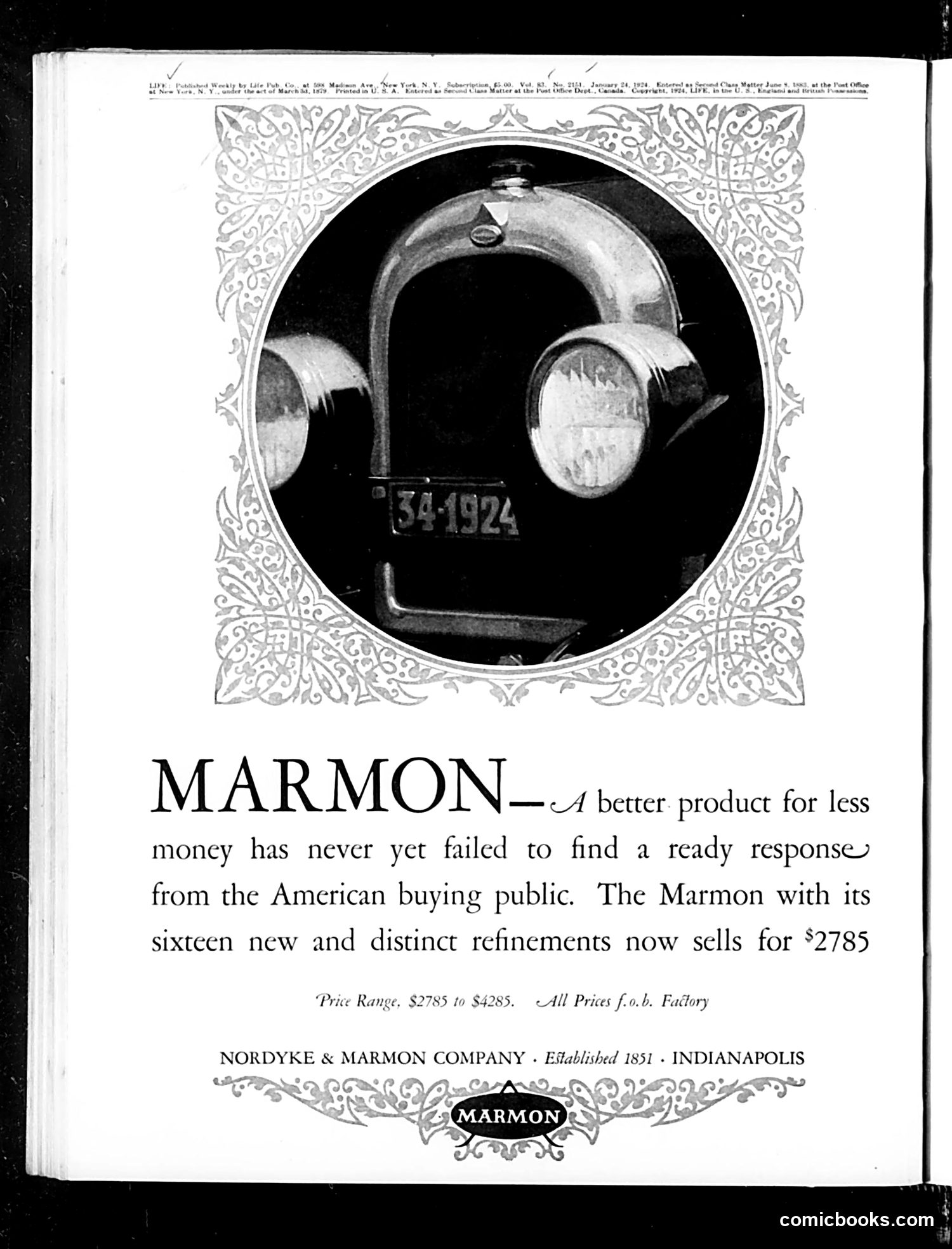
This page is **primarily an advertisement**, not satirical content. It's a 1924 Marmon automobile ad from the Nordyke & Marmon Company of Indianapolis. The ad promotes the Marmon car as offering superior value—"a better product for less money." The vehicle pictured, numbered 34-1924, displays the car's front end with distinctive dual headlights. The ornate decorative border frames the image in the style typical of 1920s magazine advertising. The text emphasizes "sixteen new and distinct refinements" available at $2,785, positioning the Marmon as an affordable luxury option within a price range of $2,785 to $4,285. This reflects the early automotive market when cars were still relatively expensive consumer goods for middle and upper-class buyers.
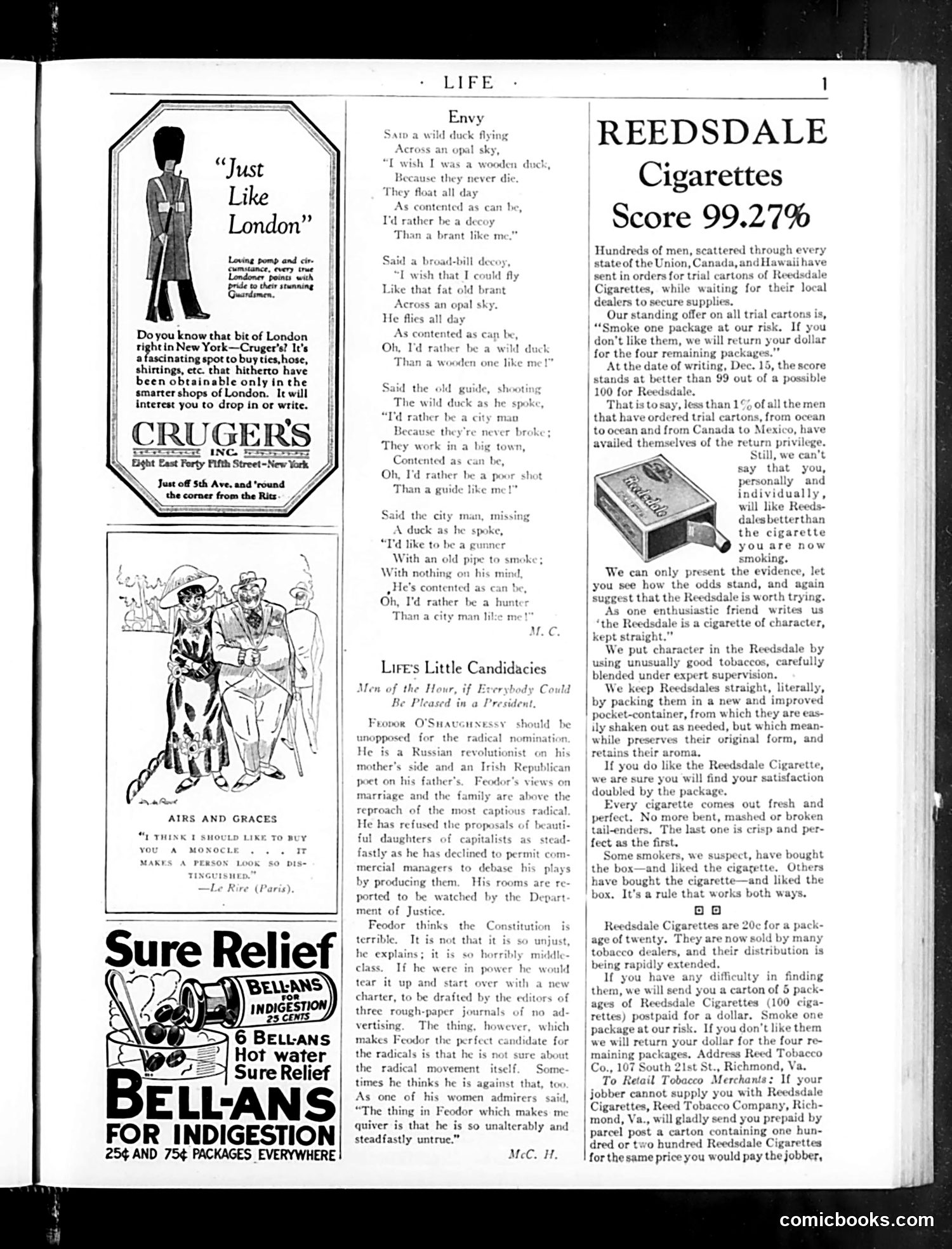
This page is primarily **advertising** rather than editorial content. The dominant features are: 1. **Cruger's Advertisement** (top left): A fashion ad for London-style clothing, using the slogan "Just Like London" to market men's shirts and haberdashery. The illustration shows a fashionably dressed man, appealing to American consumers' desire for British style. 2. **Bellans Advertisement** (bottom left): A patent medicine ad for indigestion relief, featuring a cartoon figure in distress. These dubious health products were common in early 20th-century magazines. 3. **Reedsdale Cigarettes** (right): An extended advertisement claiming high quality and offering a satisfaction guarantee with money-back promise. The page reflects the era's heavy reliance on advertising revenue rather than satirical editorial content.
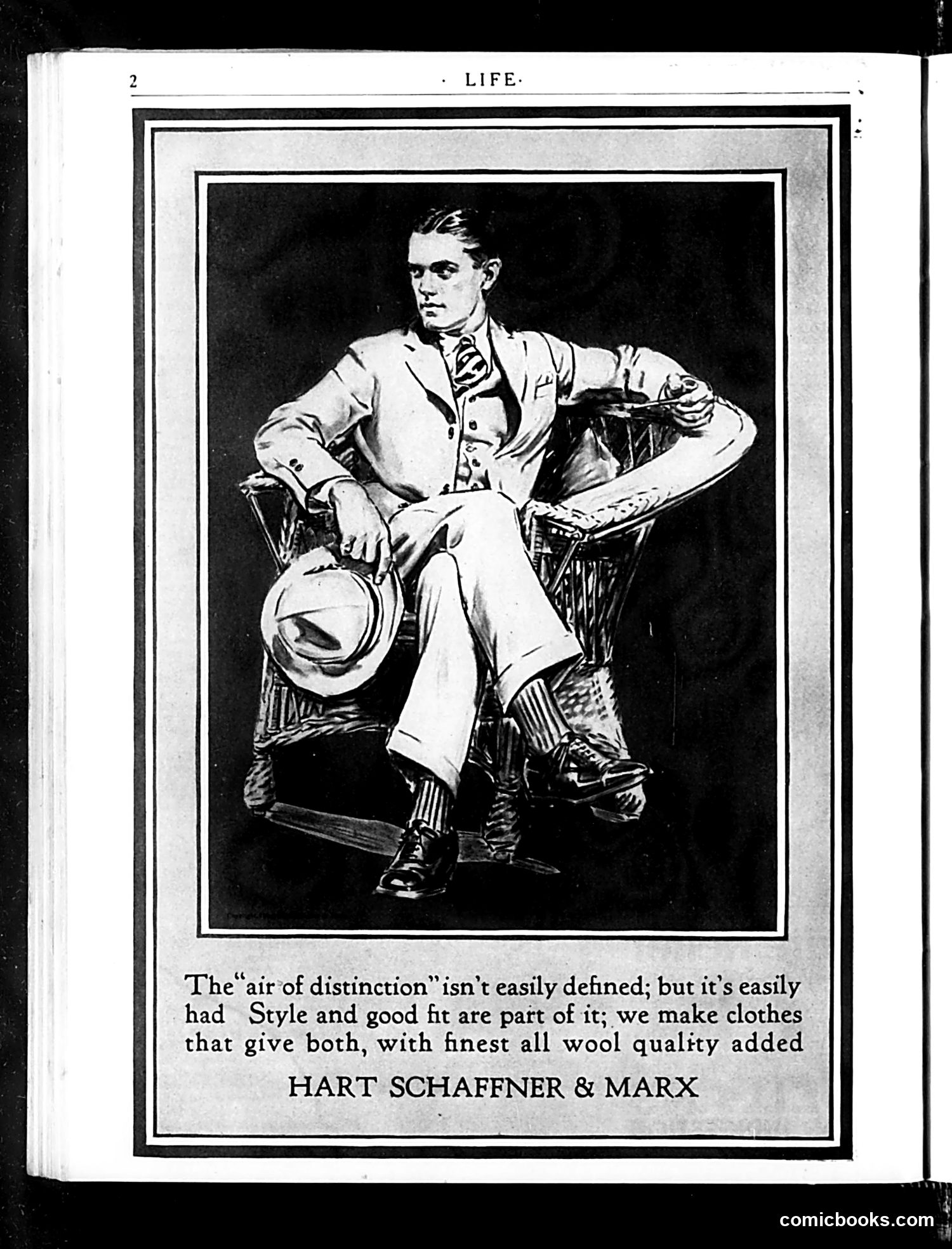
This is an **advertisement**, not a political cartoon. Hart Schaffner & Marx, a menswear company, uses a portrait of a well-dressed man in a light suit seated casually with a hat in hand to sell their clothing. The ad's text claims that "air of distinction" comes from style and fit, achieved through their "finest all wool quality" garments. The posed subject embodies the aspirational ideal the brand marketed: refined, confident masculinity conveyed through proper tailoring and material quality. This represents early 20th-century advertising strategy—using lifestyle imagery and implicit social status to appeal to middle and upper-class male consumers concerned with appearance and respectability.
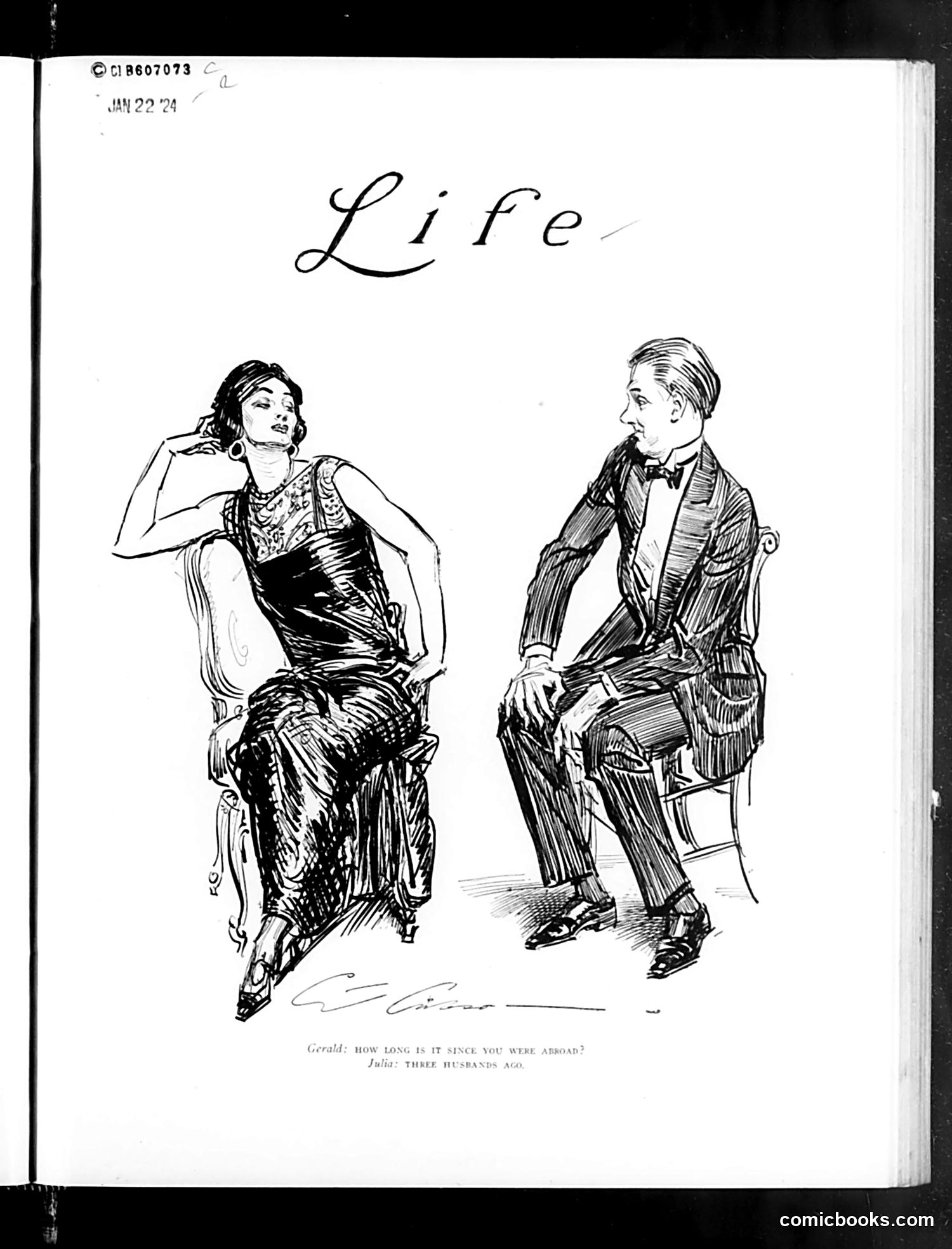
This page presents a domestic comedy sketch titled "Life," featuring two figures in conversation. Based on the caption dialogue—"Gerald: how long is it since you were abroad? / Julia: three husbands ago"—the humor relies on a woman casually referencing her multiple marriages as a time measurement. The sketch satirizes upper-class social conventions and marital instability among wealthy circles, where divorce and remarriage were apparently common enough to serve as humorous reference points. The woman's blasé attitude toward her matrimonial history—treating husbands as disposable markers of time—mocks both female independence and the shallow materialism of high society. The elegant pen-and-ink drawing style is typical of early 20th-century Life magazine illustration.
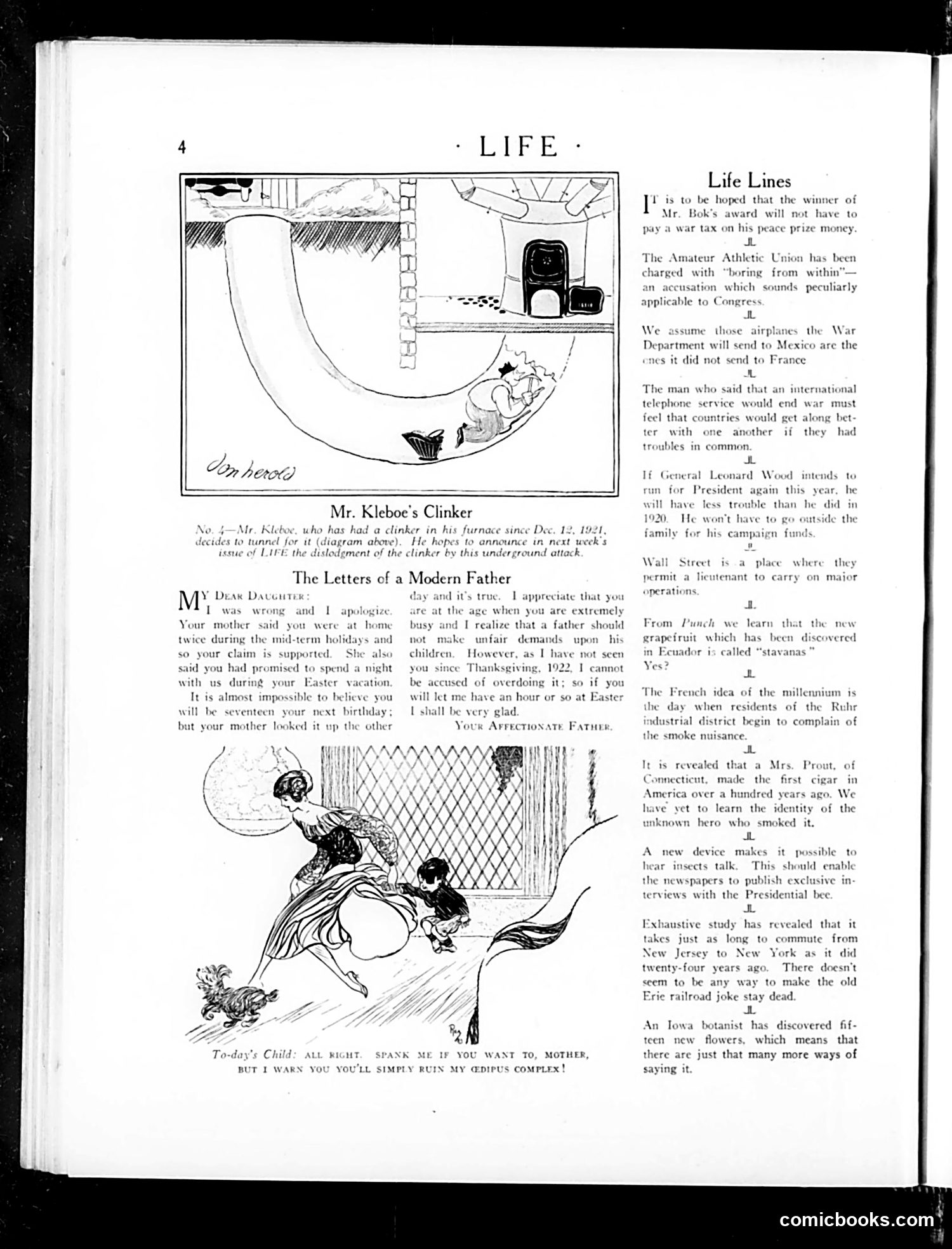
**Mr. Kleboe's Clinker** (top cartoon): A humorous diagram showing a man's elaborate scheme to hide from his wife's complaints—apparently involving architectural features and a chair. The joke targets domestic marital dynamics. **"The Letters of a Modern Father"** (center): A father apologizes to his daughter for being absent during holidays, admitting he prioritized business over family time. This satirizes the disconnect between wealthy fathers' ambitions and family obligations—a common Jazz Age social critique. **Bottom illustration**: A woman spanking a child while another child watches, captioned about warning the child against wanting her spankings—dark humor about parenting and corporal punishment norms of that era. The page collectively mocks early 20th-century American family relationships and masculine priorities.
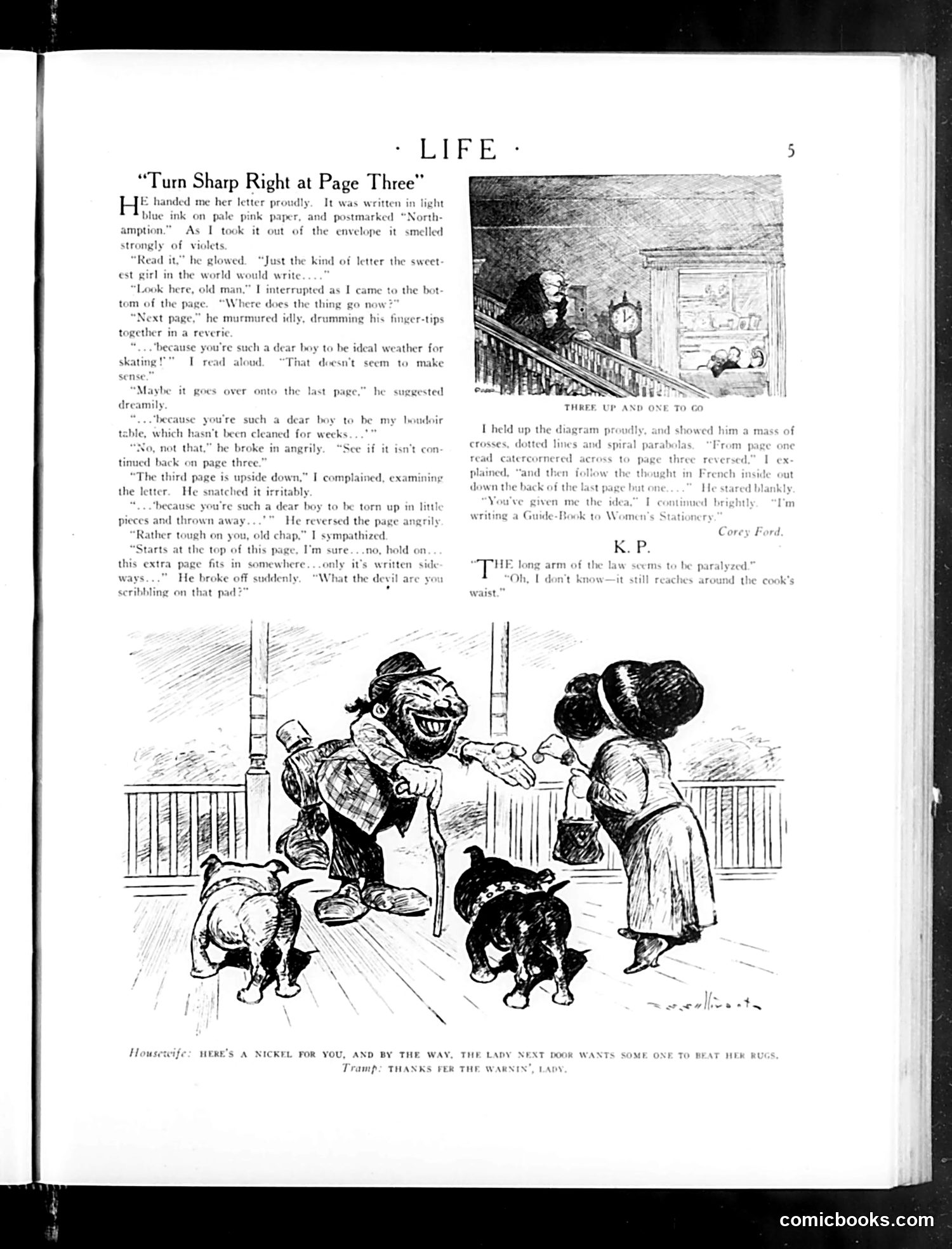
This page from *Life* magazine contains two distinct pieces: **Upper section:** A narrative story titled "Turn Sharp Right at Page Three" about someone reading a letter written in light blue ink on pale pink paper, postmarked "Northampton." The dialogue humorously depicts a young man receiving romantic correspondence and his older male companion teasing him about the letter's romantic nature and suggesting it contains instructions about page navigation. **Lower cartoon:** Depicts a tramp or vagrant character handing money to a housewife while two small dogs interact nearby. The caption reads: "Here's a nickel for you, and by the way, the lady next door wants some one to beat her rugs. Thanks fer the warnin', lady." The humor appears to center on the tramp's clever entrepreneurial opportunism—converting a small charitable donation into potential paid work by passing along neighborhood information.
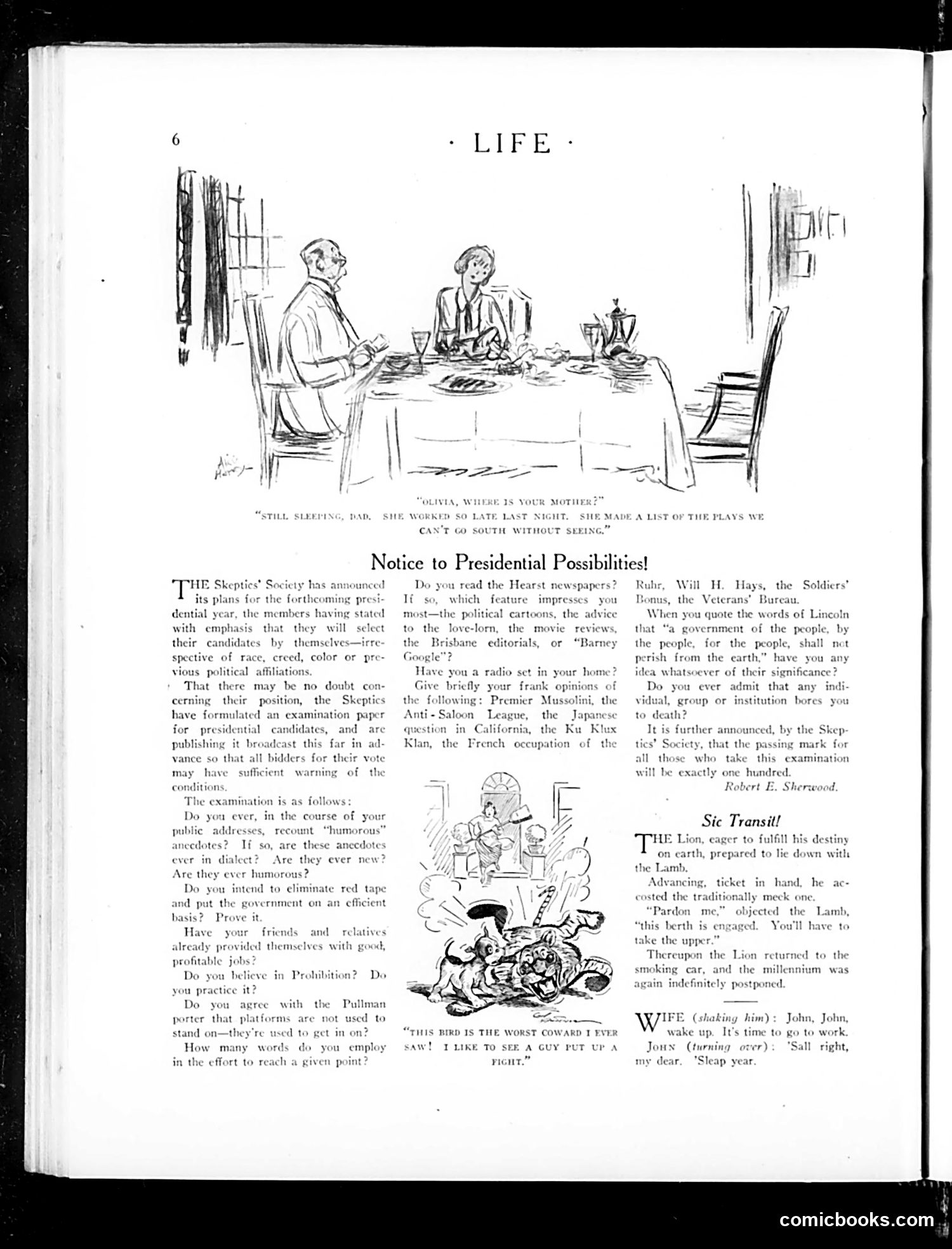
**Top Cartoon:** Two men dine while discussing a woman's late-night theater work. The caption notes she "worked so late last night, she made a list of the plays we can't go south without seeing"—satirizing wives who compulsively attend Broadway shows. **"Notice to Presidential Possibilities!"** This section mocks candidates for the upcoming presidential election by proposing an examination testing their knowledge of political cartoons, editorials, and popular opinions. The Skeptics' Society (likely a real organization) seeks to ensure candidates can articulate coherent positions on current issues—satirizing politicians' vagueness and evasiveness. **Bottom Cartoons:** Two brief humorous strips: one about a lion's postponed encounter with a lamb; another depicting domestic marital friction over a husband's work schedule. The page exemplifies Life's satirical approach to politics and domestic life.
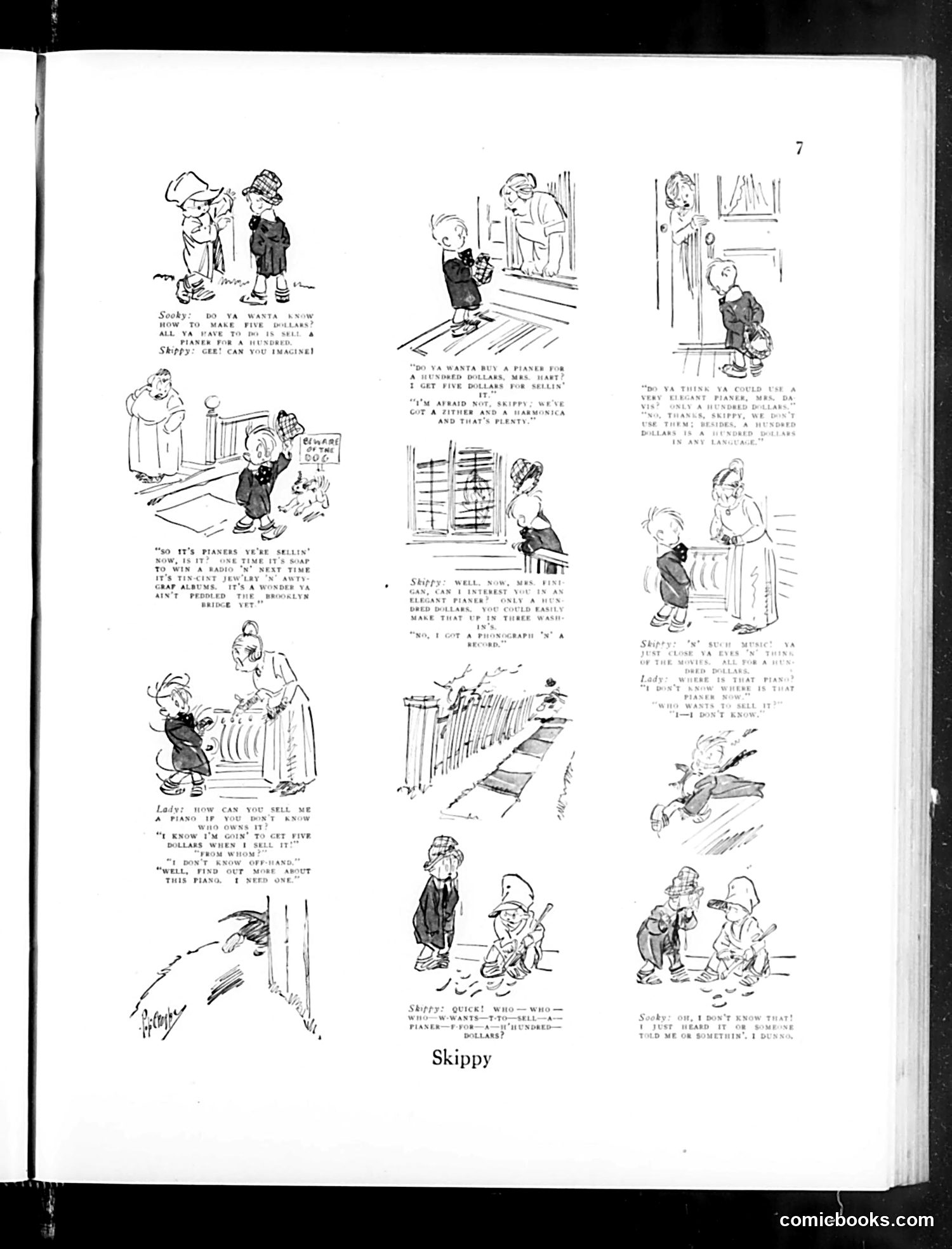
This is a humorous comic strip featuring a young boy named Skippy and adults around him, centered on a running gag about piano sales. The joke involves Skippy persistently asking adults about buying a piano, claiming he can sell it for a hundred dollars. Each adult dismisses him—one mentions pianos cost far more, another suggests he find out about the instrument first. The satire appears to mock: - **Children's naive business schemes** and lack of economic understanding - **Adults' condescending responses** to children's questions - Possibly **inflated post-WWI prices** or economic confusion of the era The recurring setup—Skippy asking each new character about selling a piano for impossibly low money—relies on absurdist humor typical of 1920s comics. The strip's humor derives from Skippy's persistence despite consistently receiving the same discouraging response.
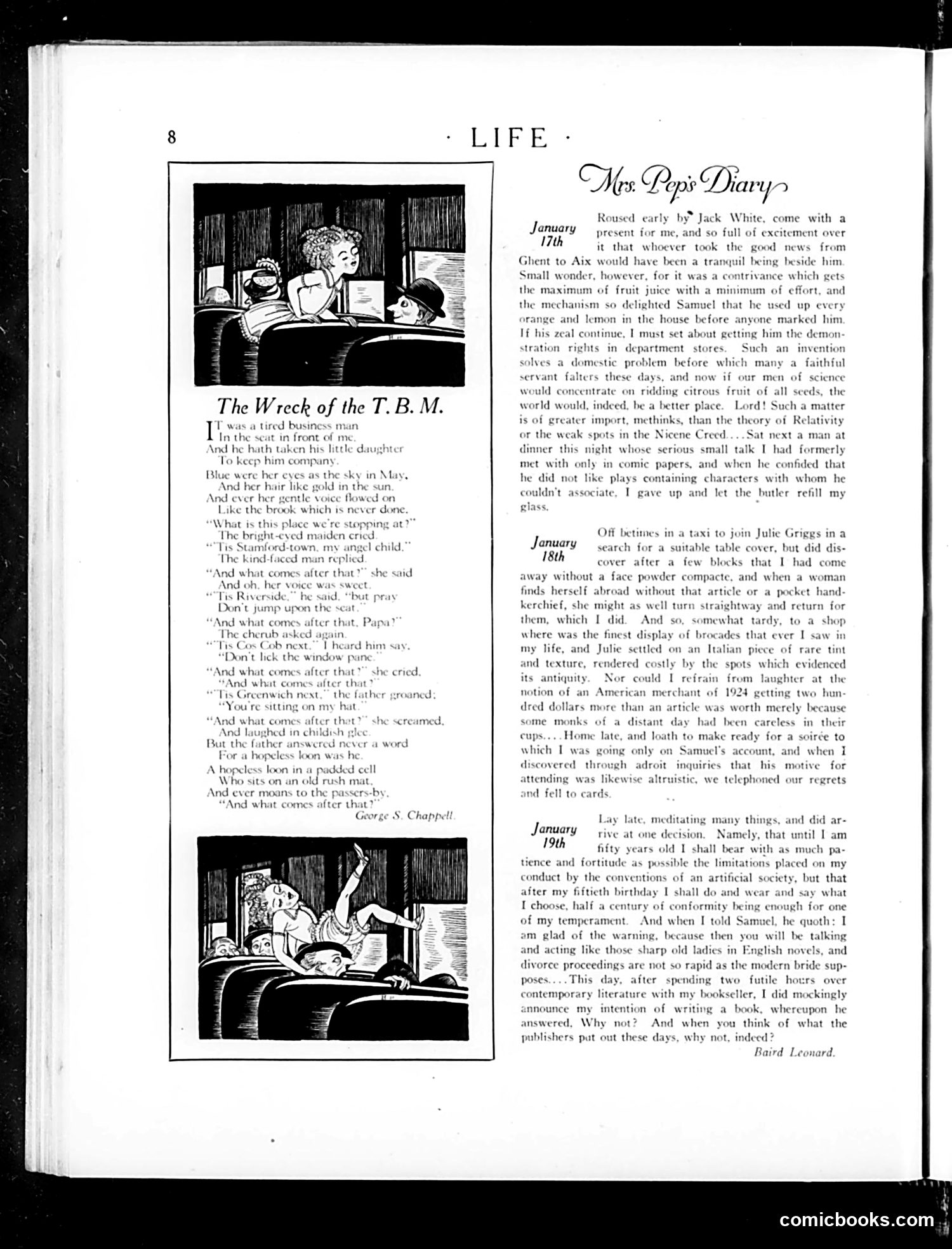
This page presents diary entries by "Baird Leonard" (pseudonym or author) featuring two woodcut illustrations satirizing domestic life and social pretension. **"The Wreck of the T.B.M."** (top cartoon) depicts a tired businessman arriving home to find his daughter has taken over—she's reading to him while he's exhausted. The verse mocks how he sacrificed everything ("kept him company") yet receives no gratitude, only demands. The satire targets both the ungrateful younger generation and the worn-out patriarch. The diary entries (January 10th, 18th, 19th) humorously chronicle mundane urban life: taxi searches, face powder compacts, shopping trivialities, and birthday reflections. The humor derives from the gap between trivial domestic concerns and the writer's pretentious self-awareness about aging and society's artificial conventions.
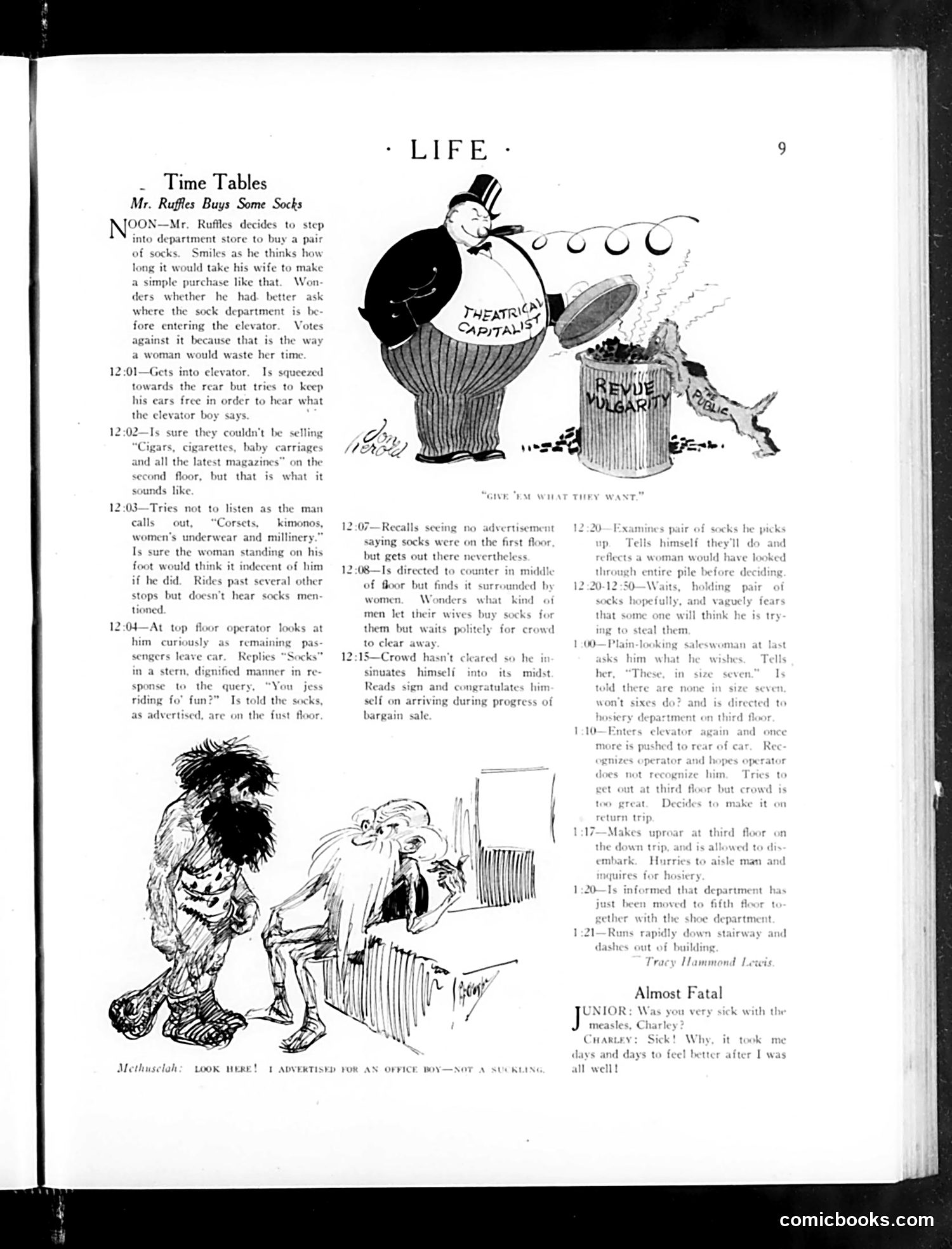
This page contains two satirical pieces: **"Time Tables: Mr. Ruffles Buys Some Socks"** is a humorous narrative following a man's tedious shopping expedition at a department store. The joke satirizes retail inefficiency—the customer navigates multiple floors, confusing elevator operators, and sales staff while attempting a simple sock purchase. The accompanying cartoon depicts an overstuffed "Theatrical Capitalist" being squeezed into a can labeled "Bulgaria," captioned "GIVE 'EM WHAT THEY WANT." This likely references post-WWI Balkan politics and capitalist exploitation. The lower cartoon shows a disheveled character labeled "Methuselah" advertising an office boy position—the humor derives from hiring someone impossibly ancient for a junior role. **"Almost Fatal"** is a brief dialogue joke about recovering from measles, with no deeper satirical intent. The page primarily uses domestic humor and political allegory typical of Life's satirical approach.
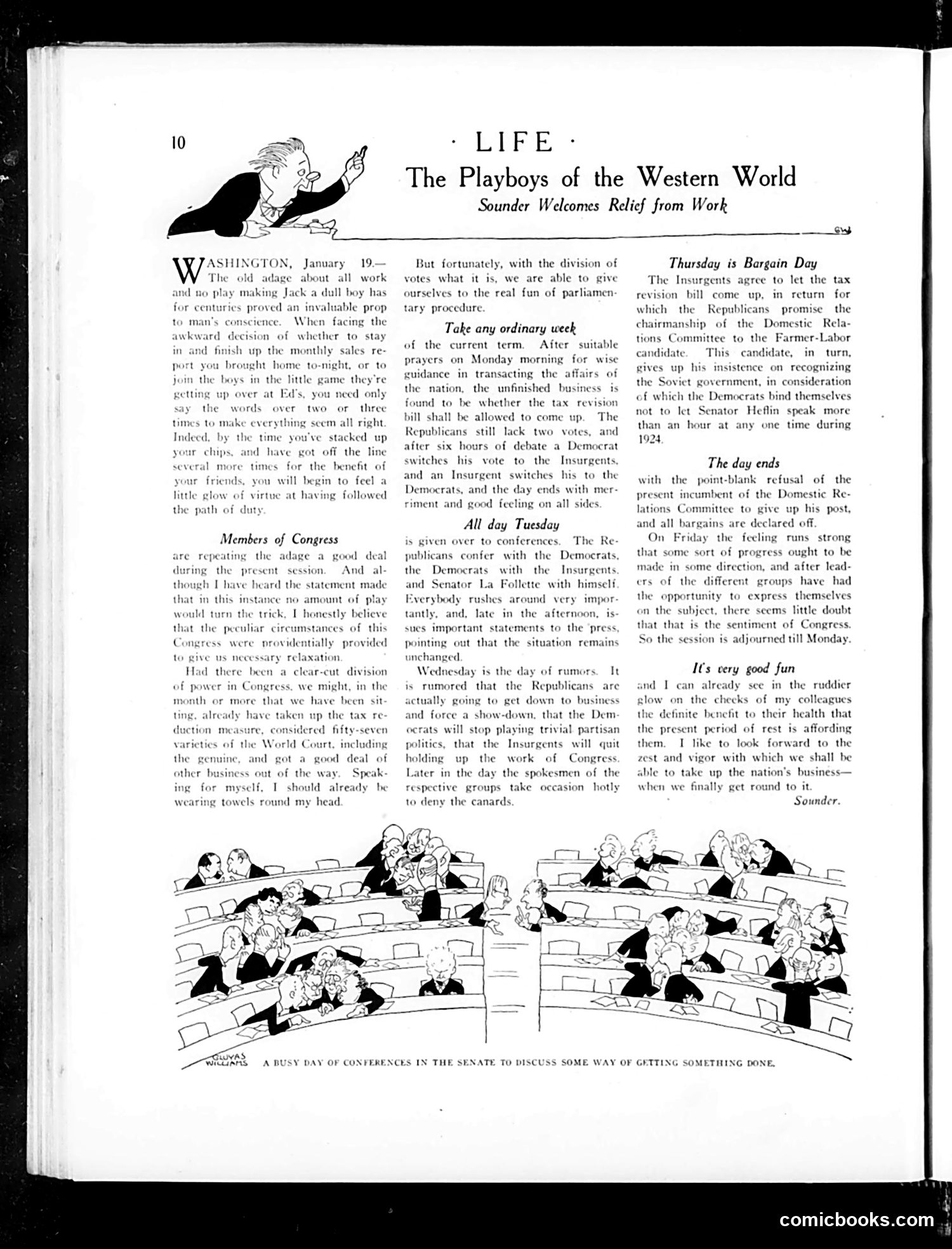
This satirical piece mocks Congress during the January 1924 session. The main cartoon depicts senators in a chaotic chamber, supposedly conferring on legislative business but appearing mostly idle and disorganized. The accompanying text criticizes Congress members for treating serious work—particularly tax revision and agricultural policy—as secondary to partisan political maneuvering. The author sarcastically notes that despite contentious debate between Republicans, Democrats, and Insurgents, little productive work occurs. The satire's target is Congressional inefficiency and the prioritization of party politics over governance. The subtitle "Sounder Welcomes Relief from Work" (referring to someone named Sounder) suggests even leadership figures are exhausted by the dysfunction and welcome breaks from actual legislative duties.
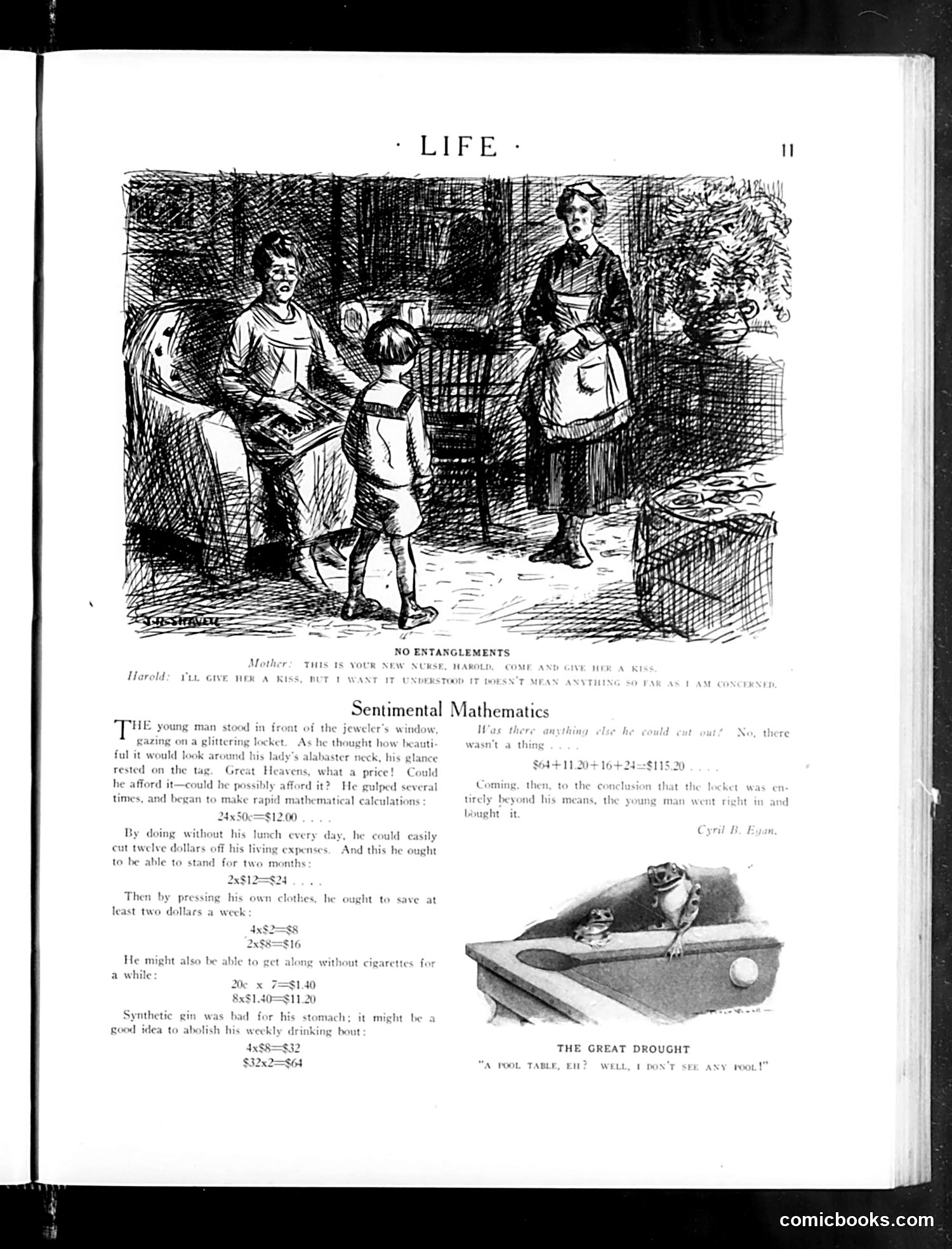
This page from *Life* magazine contains two distinct satirical pieces: **"No Entanglements"** (top cartoon): A domestic scene depicting a mother introducing a new nurse to her son Harold. Harold's dialogue expresses reluctance about kissing the nurse, claiming he doesn't want "entanglements." The satire mocks young men's anxiety about romantic commitment, using the word "entanglement" (often used in diplomatic contexts) humorously to describe avoiding a simple social gesture. **"Sentimental Mathematics"** (middle section): A humorous piece about a young man attempting financial calculations to afford a jeweler's locket for a woman he's interested in. The satire ridicules how romantic aspirations lead men to perform increasingly absurd mathematical gymnastics—cutting expenses, eliminating cigarettes and alcohol—to save money for romantic gestures, ultimately proving the purchase impossible. **"The Great Drought"** (bottom): A brief cartoon about a fool and a table, likely commenting on scarcity or deprivation, though context is limited.
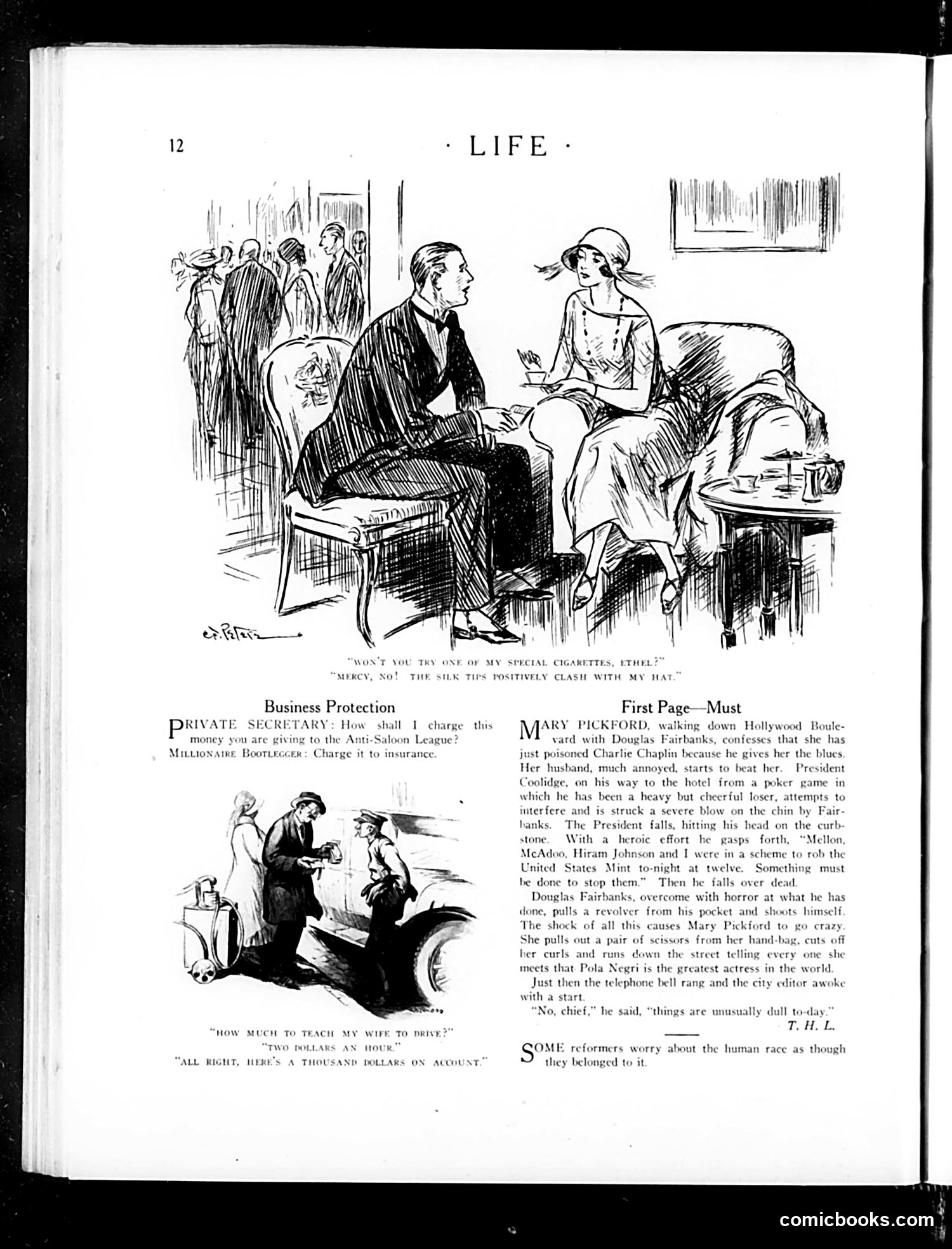
This page contains two satirical cartoons about early 20th-century social issues. **Top cartoon:** A man offers a woman cigarettes; she declines, citing that "silk tips positively clash with my hat." The joke satirizes trivial female vanity—women rejecting something on aesthetic grounds rather than health or practical concerns. **Bottom cartoon & "Business Protection" section:** A conversation about teaching someone to drive costs "two dollars an hour," with payment promised "on August." The satire mocks financial irresponsibility and broken promises among the wealthy. **"First Page—Must":** A narrative about Mary Pickford (silent film star) and Douglas Fairbanks involves plot elements with Charlie Chaplin, suggesting contemporary Hollywood gossip or scandal, though specific context is unclear without additional historical information. The page reflects early 1900s attitudes toward gender, wealth, and celebrity culture.
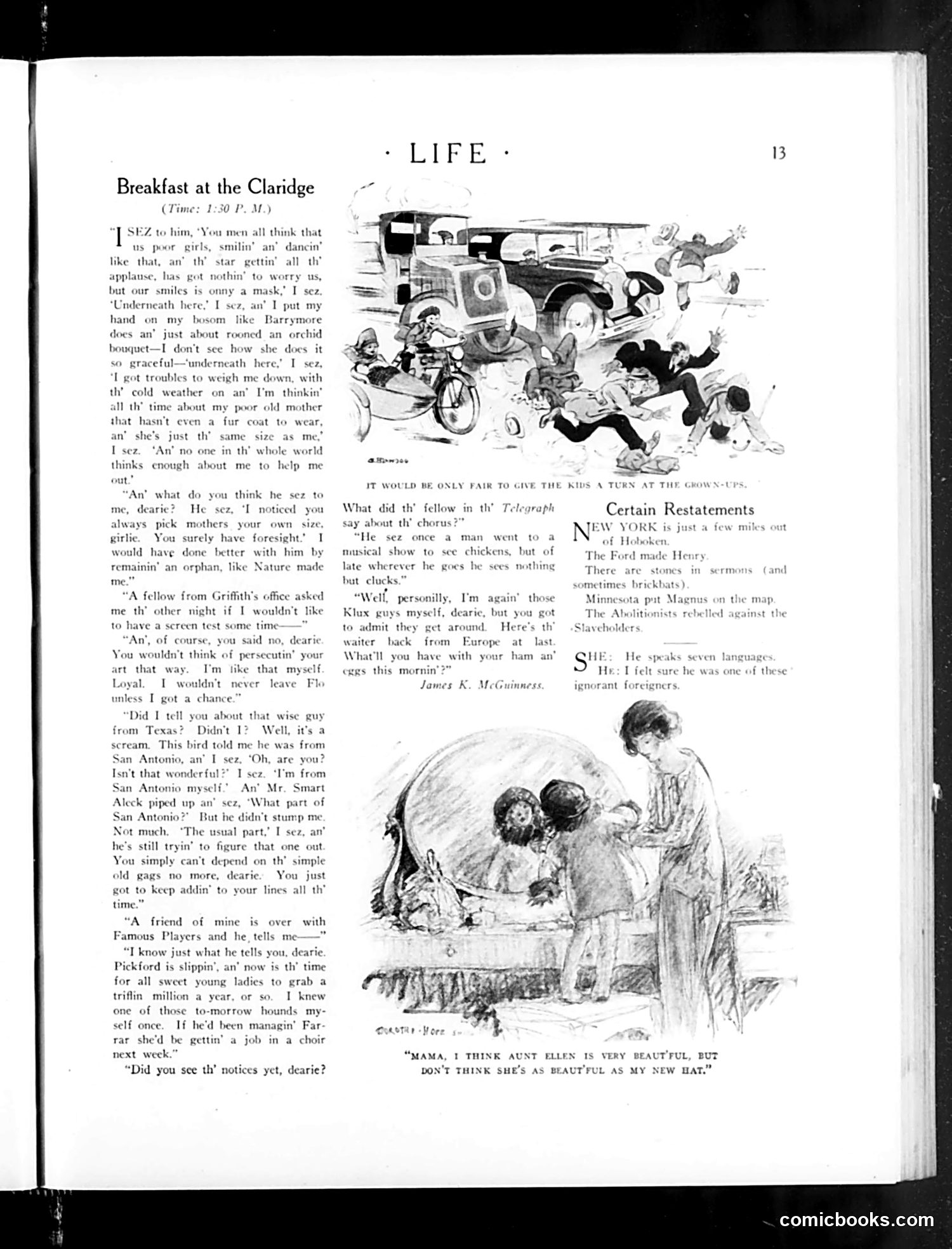
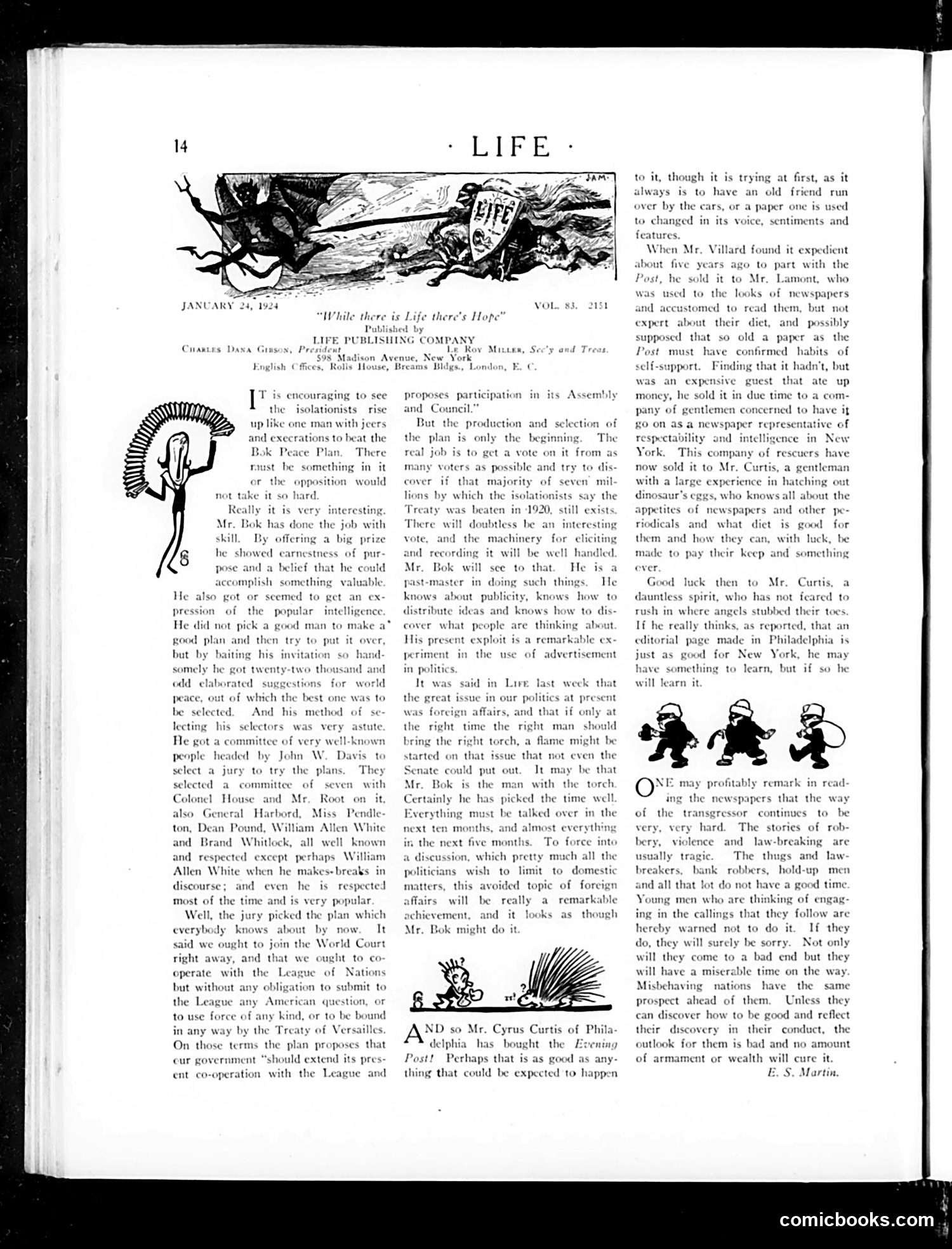
The main cartoon titled "While there is Life there's Hope" depicts a skeletal figure (Death or Despair) alongside the Life magazine mascot, satirizing post-WWI anxieties about global peace. The accompanying article discusses a proposal for U.S. participation in the League of Nations Assembly and Council—a contentious political issue in 1924. The text references Senator William Allen White and others debating American isolationism versus international cooperation. A secondary cartoon shows figures appearing to break barriers, likely illustrating the article's discussion of crime and lawlessness ("transgressor continues to be very, very hard"). The satire critiques both American political hesitation about international engagement and domestic social disorder in the post-war period.
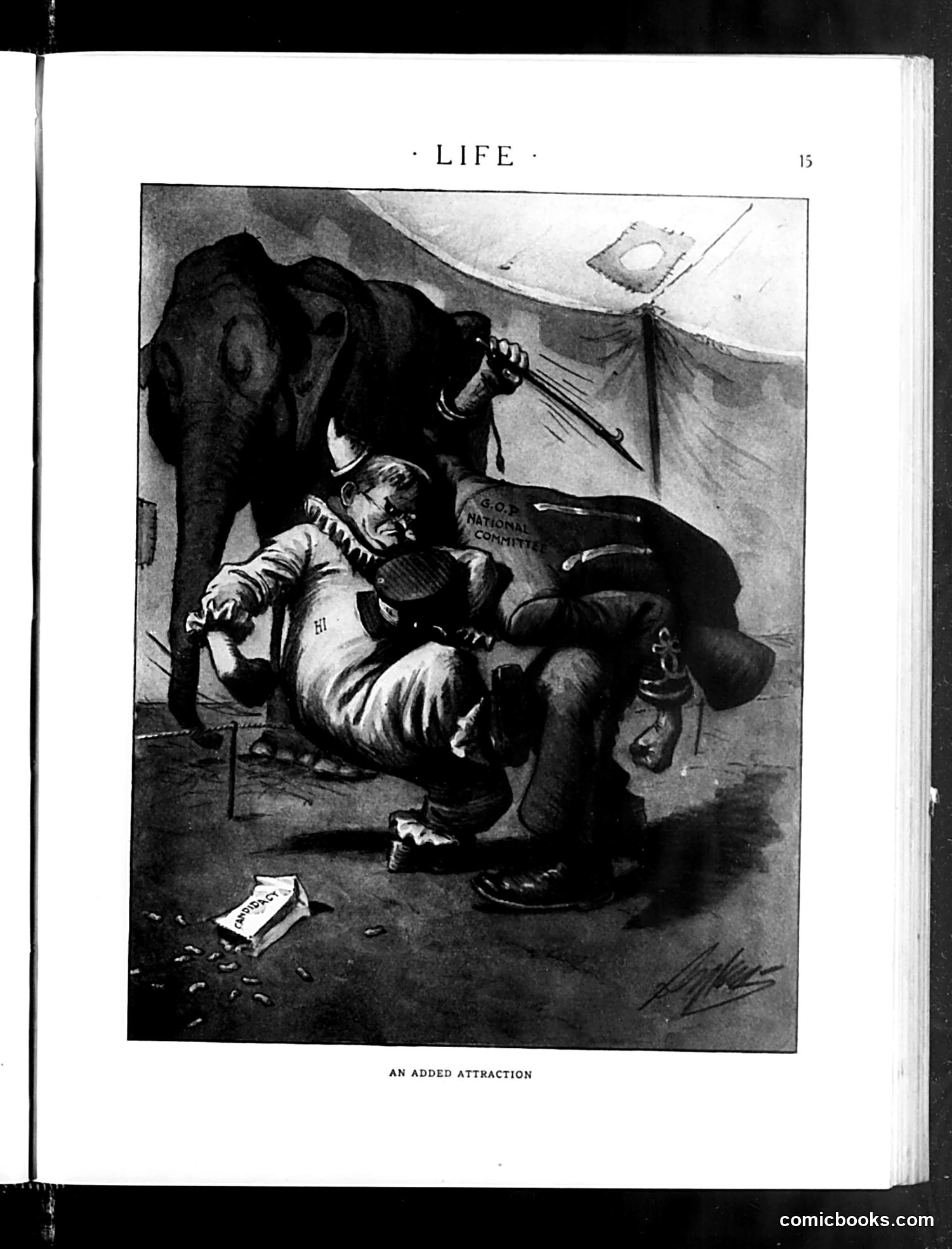
This satirical cartoon depicts a military officer being kicked by an elephant inside a circus tent. The officer wears a uniform marked "National Committee" and appears to be a caricatured political or military figure. The title "An Added Attraction" suggests this is treating some political misfortune as entertainment—like a circus act. The specific identities remain unclear without additional context, but the cartoon likely satirizes a contemporary political or military figure experiencing public humiliation or defeat. The circus setting emphasizes the absurdity or spectacle of the situation. The elephant, a common symbol of the Republican Party, may indicate partisan political commentary, though the precise event referenced is uncertain without knowing the publication date.
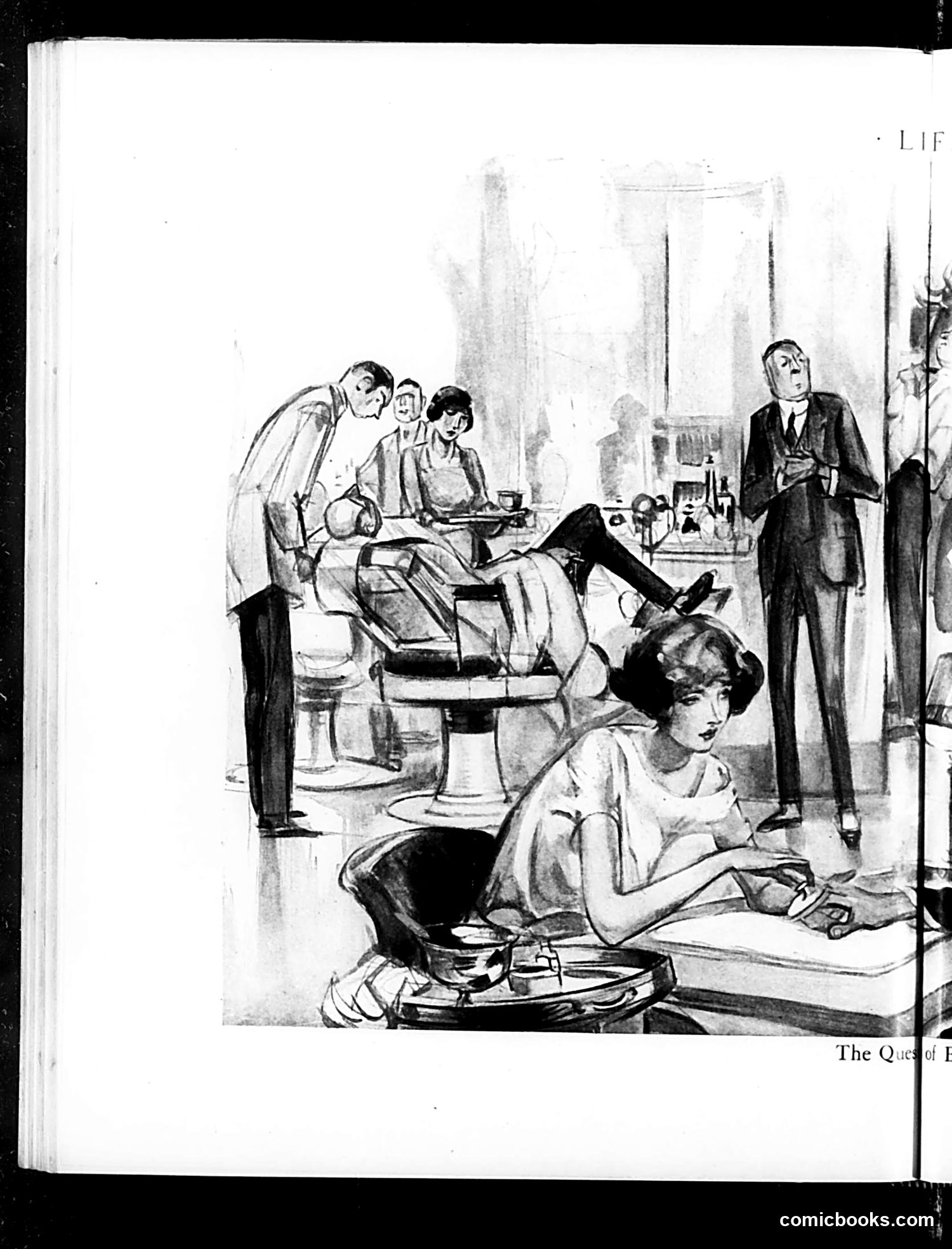
This appears to be a satirical illustration from *Life* magazine depicting a beauty salon or spa setting. The scene shows multiple figures in formal attire observing a woman seated in what looks like a beauty chair or treatment station. The caption begins "The Que..." (likely "The Quest of..." based on the partial text), though the complete title is cut off. The satire likely mocks either the vanity of beauty culture, the elaborate procedures women underwent for appearance, or possibly critiques observers (possibly wealthy patrons or professionals) watching these treatments. Without the full caption or date visible, the specific target—whether it's salon culture, women's beauty standards, or class dynamics—cannot be definitively determined, though the formal dress of observers suggests social commentary on wealthy clientele or elite society engagement with beauty practices.
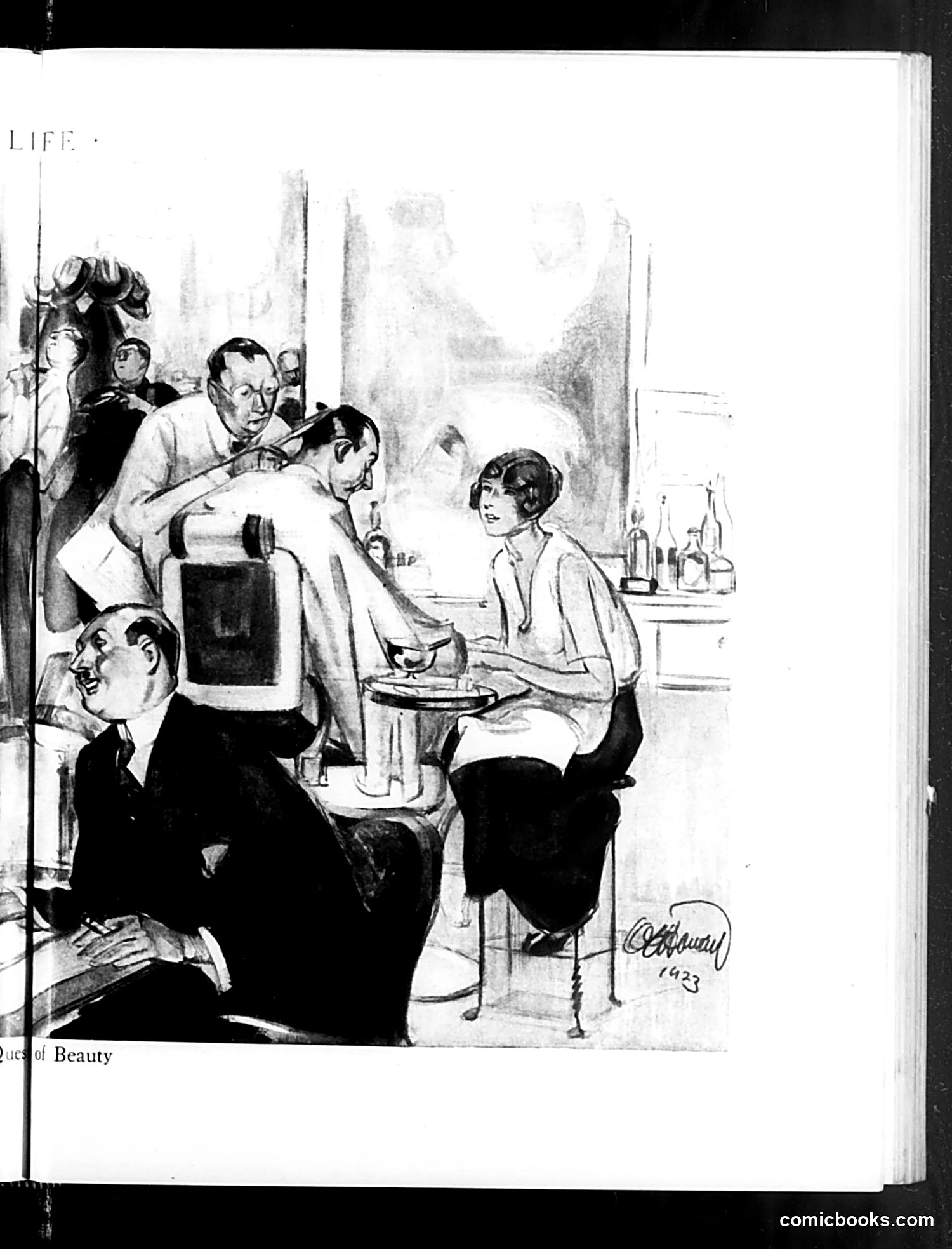
This appears to be a satirical illustration from *Life* magazine titled "Ques of Beauty" (possibly "Quest of Beauty"). The sketch depicts what seems to be a beauty salon or cosmetics counter scene. A woman sits at right, apparently receiving beauty treatments or consultations, while several men in the background observe or work on her appearance. The satire likely mocks either: - The vanity of beauty culture and cosmetics industry - Male involvement or exploitation in women's beauty practices - The absurdity of modern beauty standards and treatments The composition suggests commentary on how beauty is constructed or commercialized, with the woman as the subject of scrutiny and intervention by multiple male figures. Without clearer context or dates visible, the specific target remains somewhat unclear, though the overall tone is clearly critical of beauty industry practices.
This page reviews experimental theater productions. The main critique concerns **Strindberg's "The Spook Sonata,"** performed by the Provincetown Playhouse with Eugene O'Neill and Kenneth MacGowan as producers. The reviewer praises the atmospheric staging by designer Robert Edmond Jones but warns that certain mundane words ("soup," "soap," "milk-wagon") undercut the play's eerie mood—like a drum major slipping on ice during a serious moment. The reviewer humorously interprets the play's symbolism as representing **Belgium and Industrial Division of Labor**—a tongue-in-cheek admission they're uncertain of its actual meaning. The page also reviews Shaw's **"Saint Joan"** (with Winifred Lenihan) and a production of **"Roseanne,"** praising particularly a church spirituals scene featuring Black performers. The tone is sophisticated yet playful—characteristic of Life's cultural criticism during this era of American theatrical experimentation.
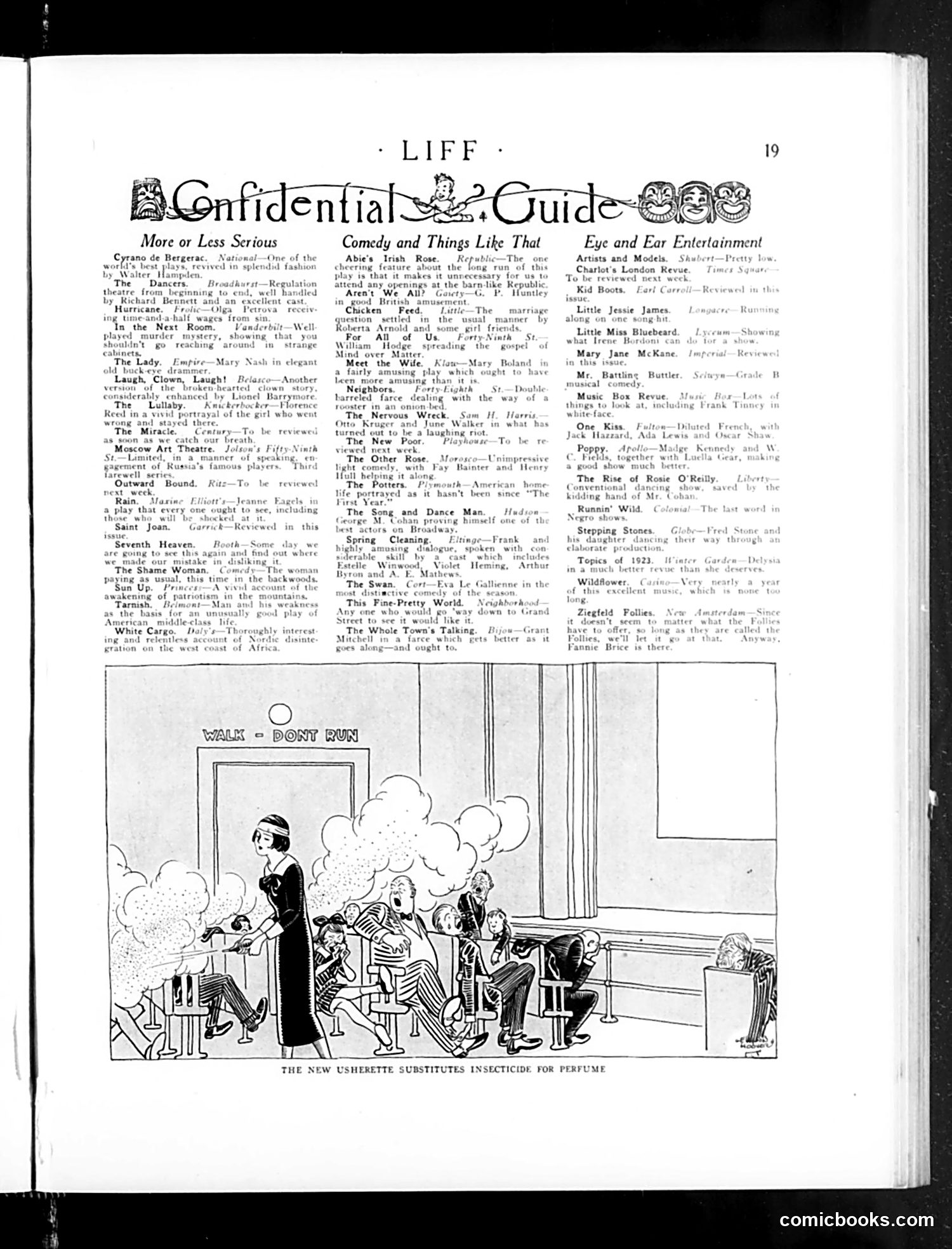
This cartoon satirizes post-World War I social changes, specifically the modernization of theater ushering practices. The joke targets the "new woman" of the 1920s—the usherette who sprays insecticide instead of perfume on theater patrons. The humor operates on multiple levels: it mocks the shift from genteel, perfume-wearing attendants to utilitarian pest control (reflecting practicality over elegance); it suggests theaters had genuine insect problems; and it lampoons the era's enthusiasm for modern efficiency and chemical solutions to everyday problems. The exaggerated reactions of patrons—choking and distressed—underscore the absurdity. This reflects 1920s anxieties about modernization's unintended consequences and the loss of refined service standards, while also poking fun at the decade's faith in technological "progress" as a solution to everything.
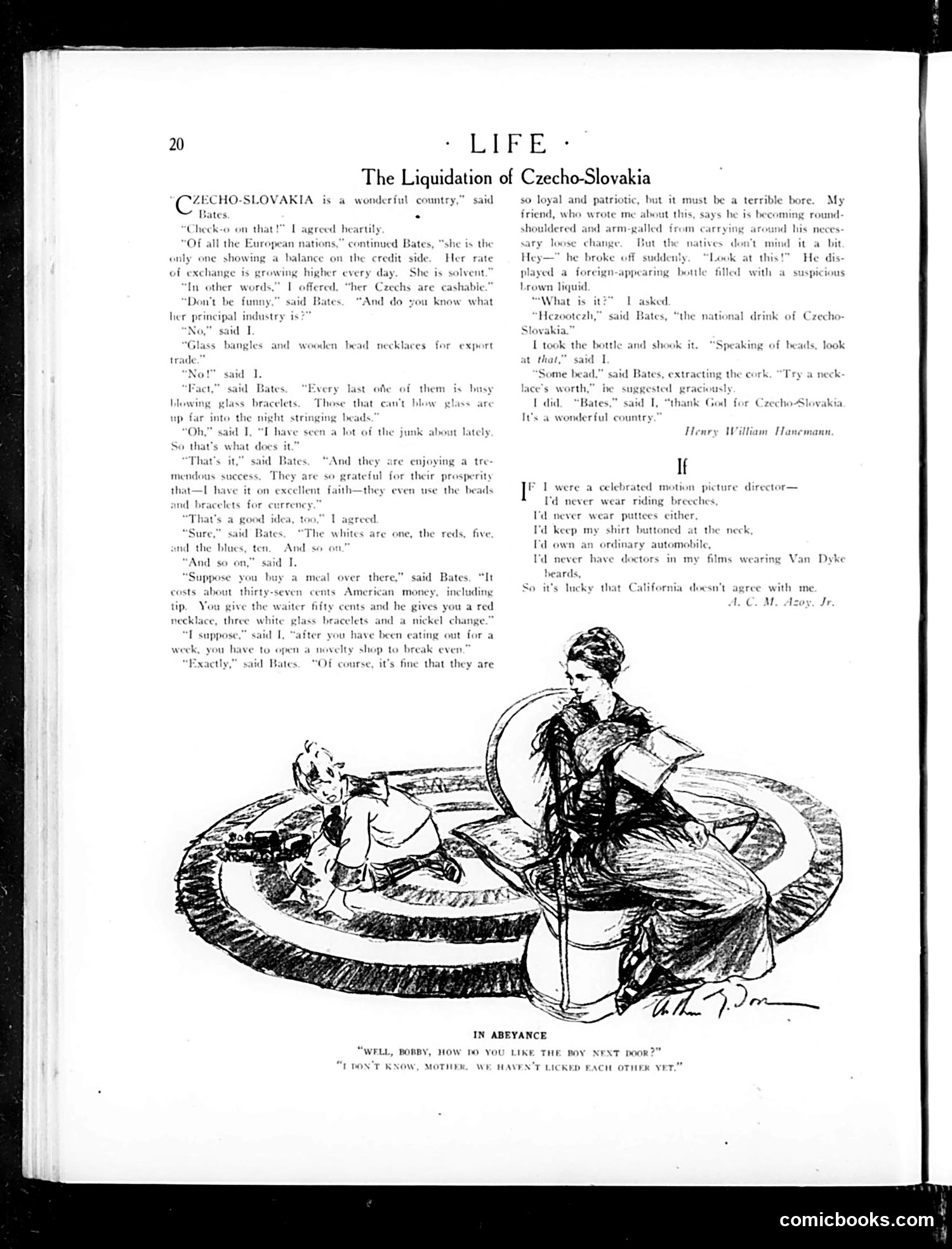
This page satirizes the dissolution of Czechoslovakia in 1939, when Nazi Germany dismantled the country. The main article, "The Liquidation of Czecho-Slovakia," presents a conversation between the author and someone named Bates discussing the nation's economic collapse through dark humor. The satire centers on economic desperation: Bates describes how Czechoslovak industries (glass bangles, wooden beads) have become worthless as export trade collapses, and suggests the currency itself is so devalued that beads serve as actual currency. The "national drink" (likely Becherovka) represents what little value remains. The cartoon at bottom—captioned "In Abeyance"—shows a mother and child discussing a neighbor boy, concluding "we haven't licked each other yet." This appears to satirize international relations, suggesting nations have temporarily suspended conflict but haven't yet resolved tensions. The overall tone mocks both Czechoslovakia's economic crisis and the international community's passive response to the country's fate.
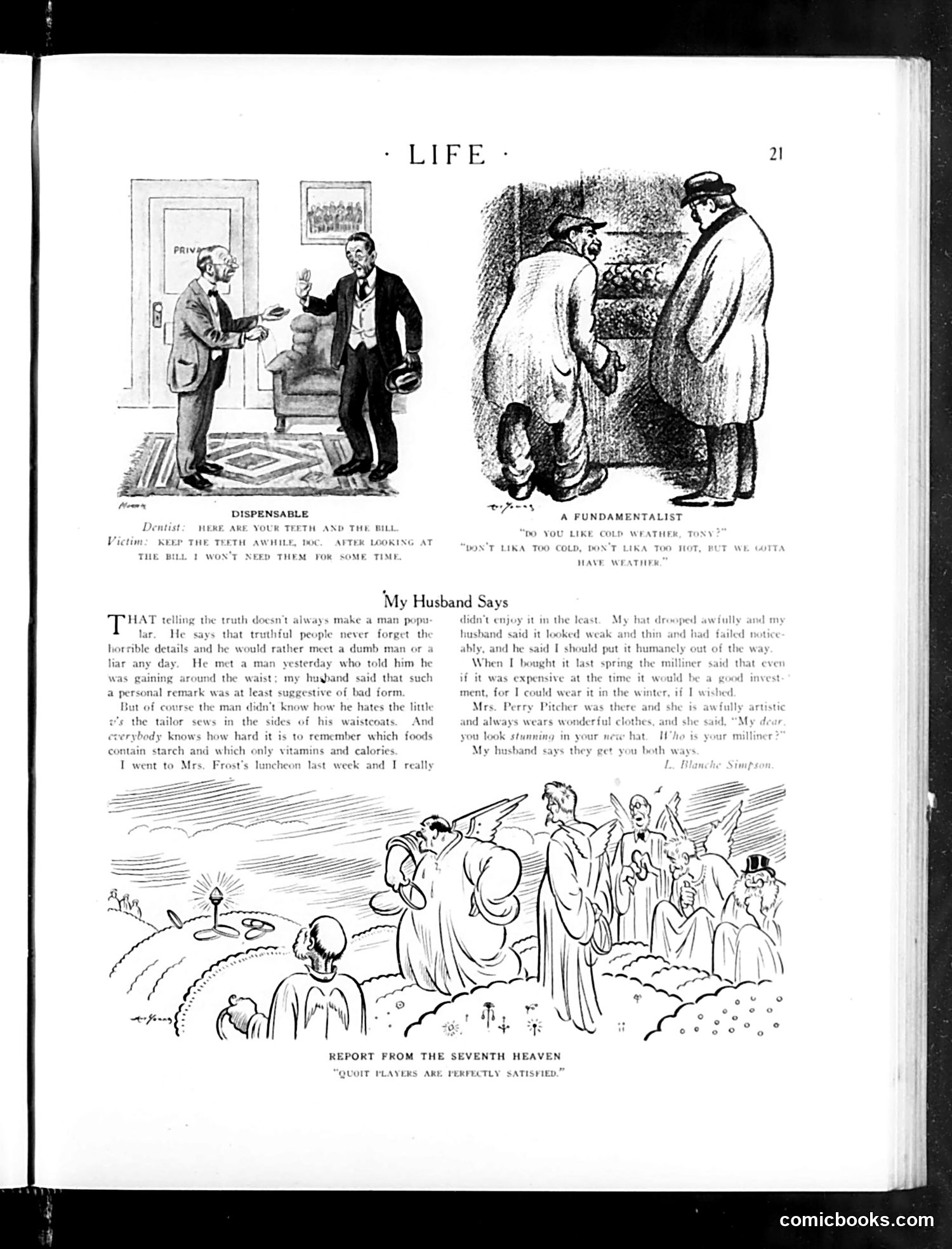
This page contains three separate satirical pieces: 1. **"Dispensable"** (top left): A dentist extracts teeth while presenting a bill, joking that the patient won't need teeth for some time anyway—satirizing unnecessary medical procedures and their costs. 2. **"A Fundamentalist"** (top right): Two men discuss cold weather, with one declaring he doesn't like it cold and prefers hot weather instead. The satire targets religious fundamentalists' perceived rigidity and illogical thinking—the absurdity of stating obvious preferences as if they're profound positions. 3. **"My Husband Says"** (middle): A column about marital observations, discussing husbands' preferences regarding teeth, tailors, and millinery—gentle domestic satire about male pickiness and wives' practical concerns. 4. **"Report from the Seventh Heaven"** (bottom): A heavenly scene where quoit players (a ring-toss game) are "perfectly satisfied"—likely satirizing either sports enthusiasm or perhaps religious concepts of paradise as simple contentment.
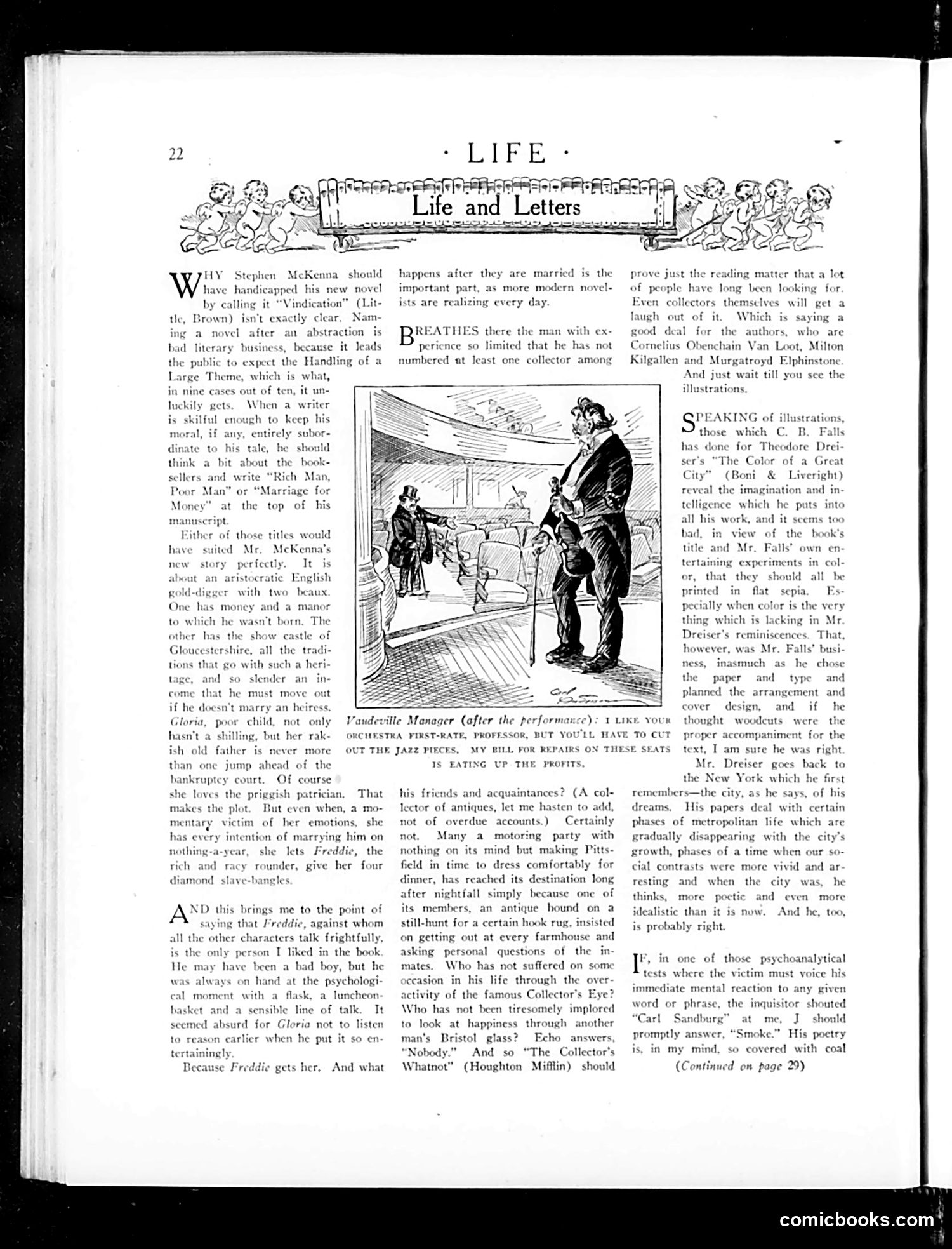
This page from Life magazine contains a book review section titled "Life and Letters." The main cartoon depicts a **theater manager confronting a conductor** about an orchestra's cost-cutting measures. The manager complains that the conductor's "first-rate orchestra" requires him to cut jazz pieces from the bill because repair costs on damaged theater seats are consuming profits—implying the lively jazz music causes audience members to jump around so enthusiastically they damage the seating. The satire mocks both the expense of maintaining theaters and, more broadly, the cultural tension between "serious" classical music and the increasingly popular jazz genre of the 1920s. It's a gentle jab at how jazz's energetic appeal threatened traditional entertainment venues' budgets and sensibilities during the Jazz Age. The surrounding text reviews novels by Stephen McKenna and Theodore Dreiser, discussing literary themes and illustration quality—typical highbrow magazine content of the period.
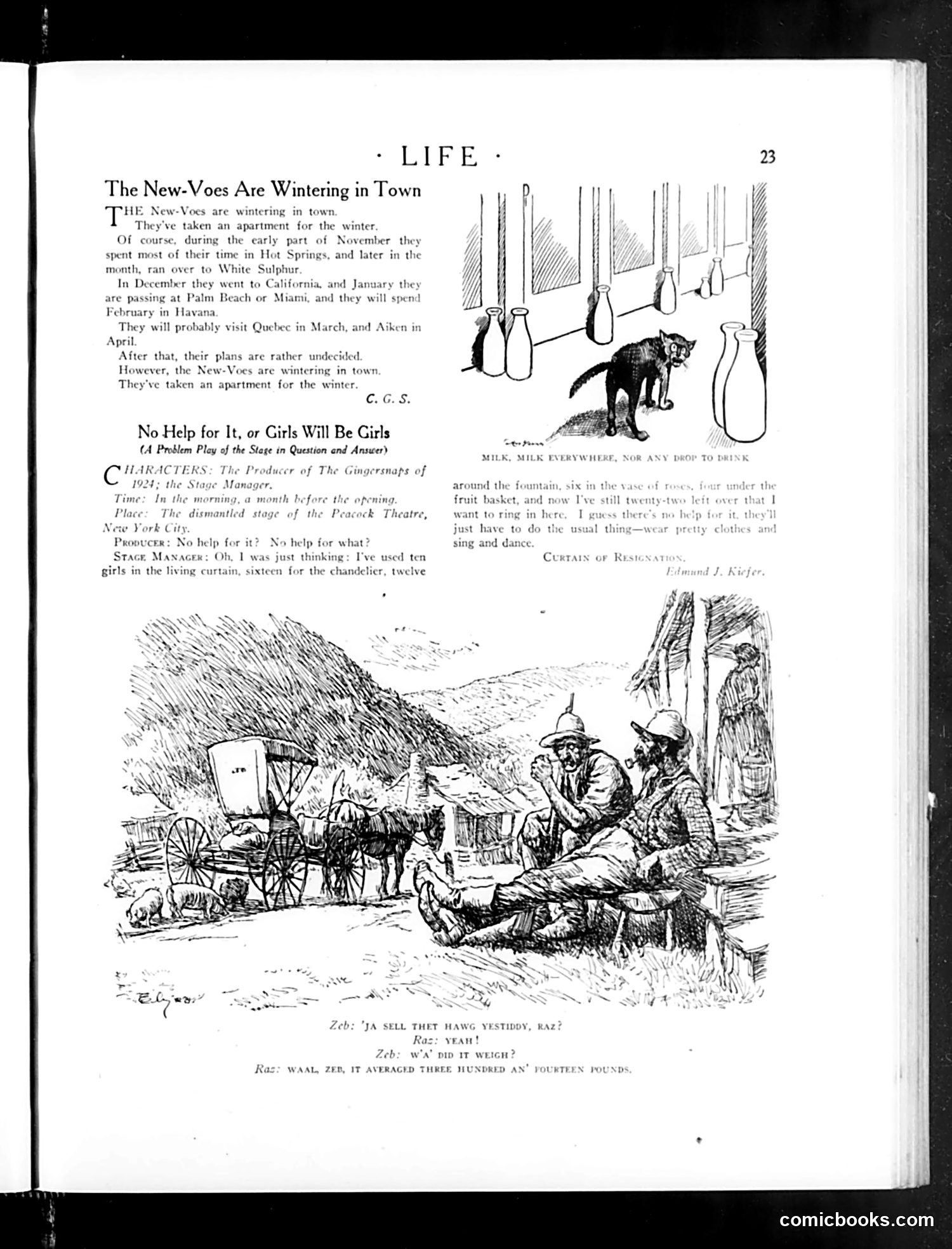
This page contains two satirical pieces: **"The New-Voes Are Wintering in Town"** mocks wealthy Americans' seasonal migration patterns. The "New-Voes" (nouveau riche—newly rich) follow a predictable winter circuit: Hot Springs, White Sulphur Springs, California, Palm Beach/Miami, Havana, Quebec, and Aiken. The satire targets their ostentatious leisure lifestyle and herd-like behavior, suggesting their travels are performative rather than purposeful. The byline "C.G.S." likely credits the writer. **"No Help for It, or Girls Will Be Girls"** is a stage comedy sketch mocking theatrical excess. A Stage Manager laments needing numerous chorus girls (ten for a curtain, sixteen for a chandelier), implying producers use them decoratively rather than functionally. The girls' response—to sing and dance regardless—satirizes their disposability and the entertainment industry's superficiality. The rural illustration below depicts rustic characters discussing livestock prices, providing tonal contrast to the urban satire above.
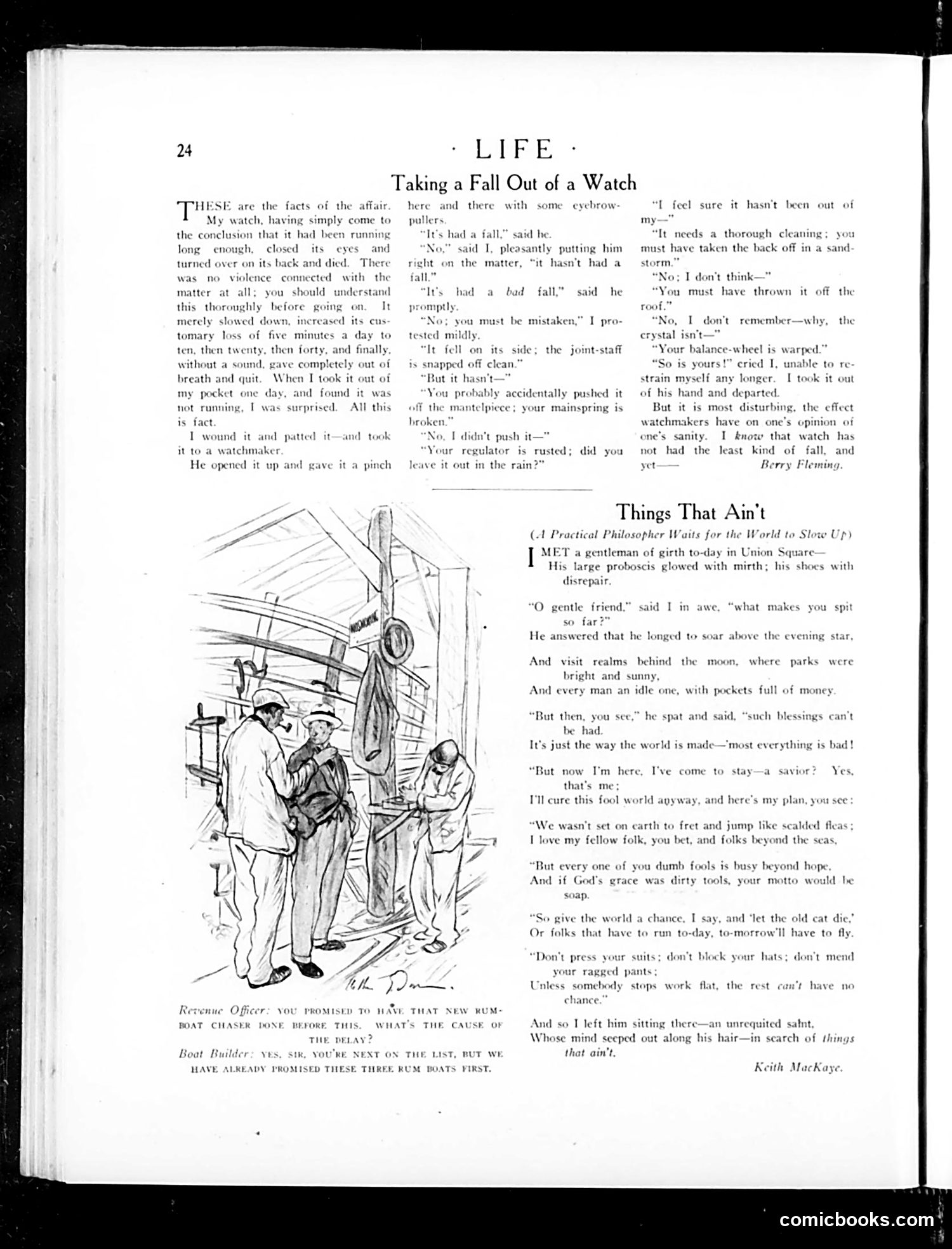
This page contains two unrelated pieces of satirical humor typical of early 20th-century Life magazine. **"Taking a Fall Out of a Watch"** is a comedic dialogue between a watch owner and a watchmaker. The narrator's broken watch has stopped working; the watchmaker diagnoses various problems (bent balance-wheel, rusted regulator, broken mainspring). The humor lies in the owner's escalating frustration as he realizes the watch likely suffered from minor damage he himself caused—possibly dropping it—which he initially denied. The cartoonist's illustration shows them examining the watch together. The satire targets both the narrator's self-deception and watchmakers' patronizing explanations of mechanical failure. **"Things That Ain't"** is a poem by Keith MacKaye about meeting an optimistic vagabond in Union Square. The man dreams of escaping to paradise but acknowledges the world is flawed. He offers himself as a "savior" to fix society through work ethic and moral reform, though he appears homeless ("shoes with disrepair"). The satire mocks utopian reformers and their naive faith that common sense and hard work can cure society's systemic problems. Both pieces share skepticism toward false solutions.
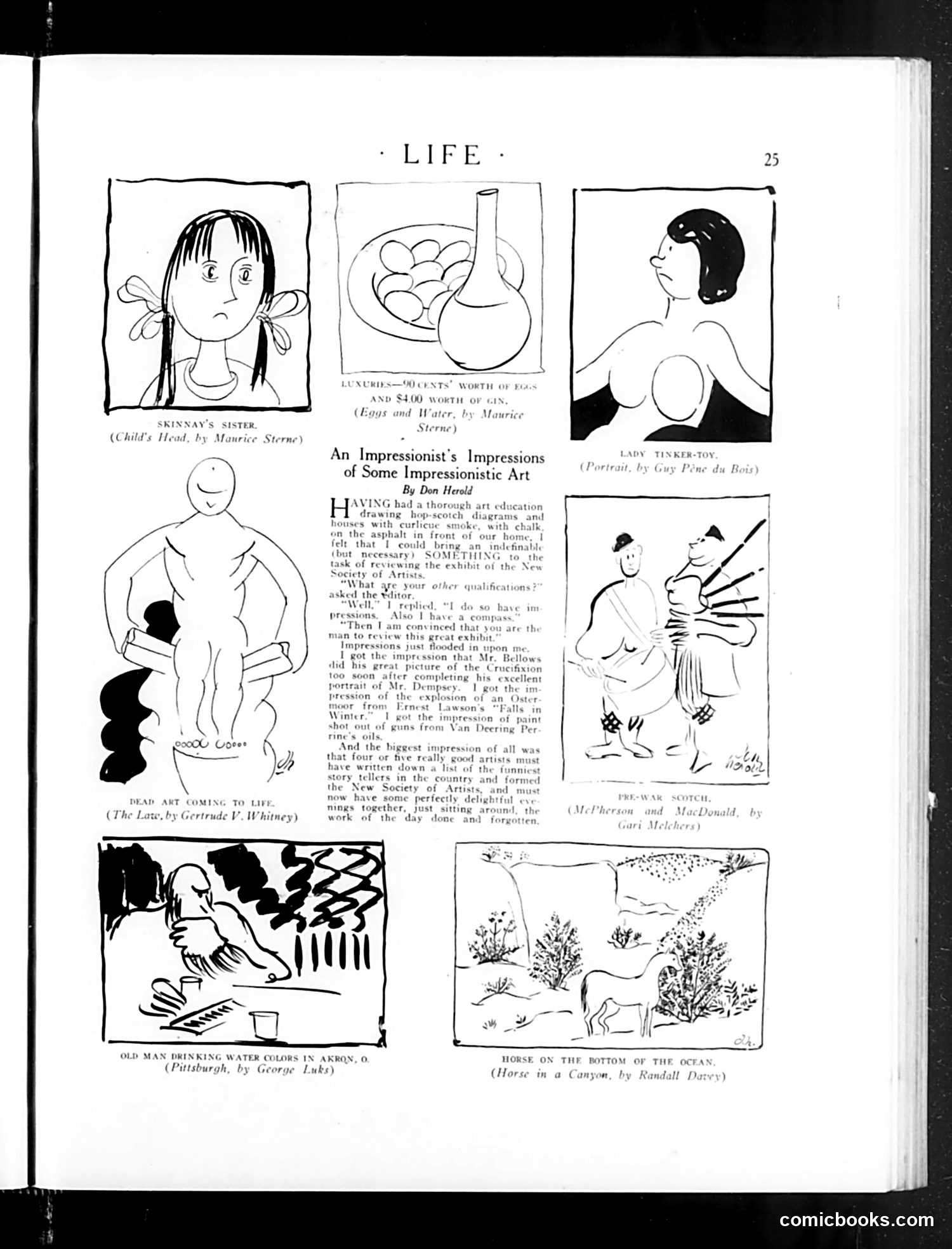
This page features art criticism disguised as humor. Don Herold's "An Impressionist's Impressions of Some Impressionistic Art" satirizes the New Society of Artists exhibition by mocking both modernist artwork and pretentious art commentary. The cartoons shown—including "Skinny's Sister," "Dead Art Coming to Life," and "Pre-War Scotch"—are deliberately crude or absurd sketches meant to parody impressionist and modernist art styles that seemed incomprehensible to mainstream audiences. The accompanying text reveals Herold was asked to review this "great exhibition" but admits the avant-garde works baffled him, producing only vague impressions rather than genuine understanding. The satire targets two audiences: the artists creating experimental work and the critics praising it uncritically. The point is that modernist art was alienating and that enthusiastic critical endorsement sometimes masked confusion rather than genuine appreciation.
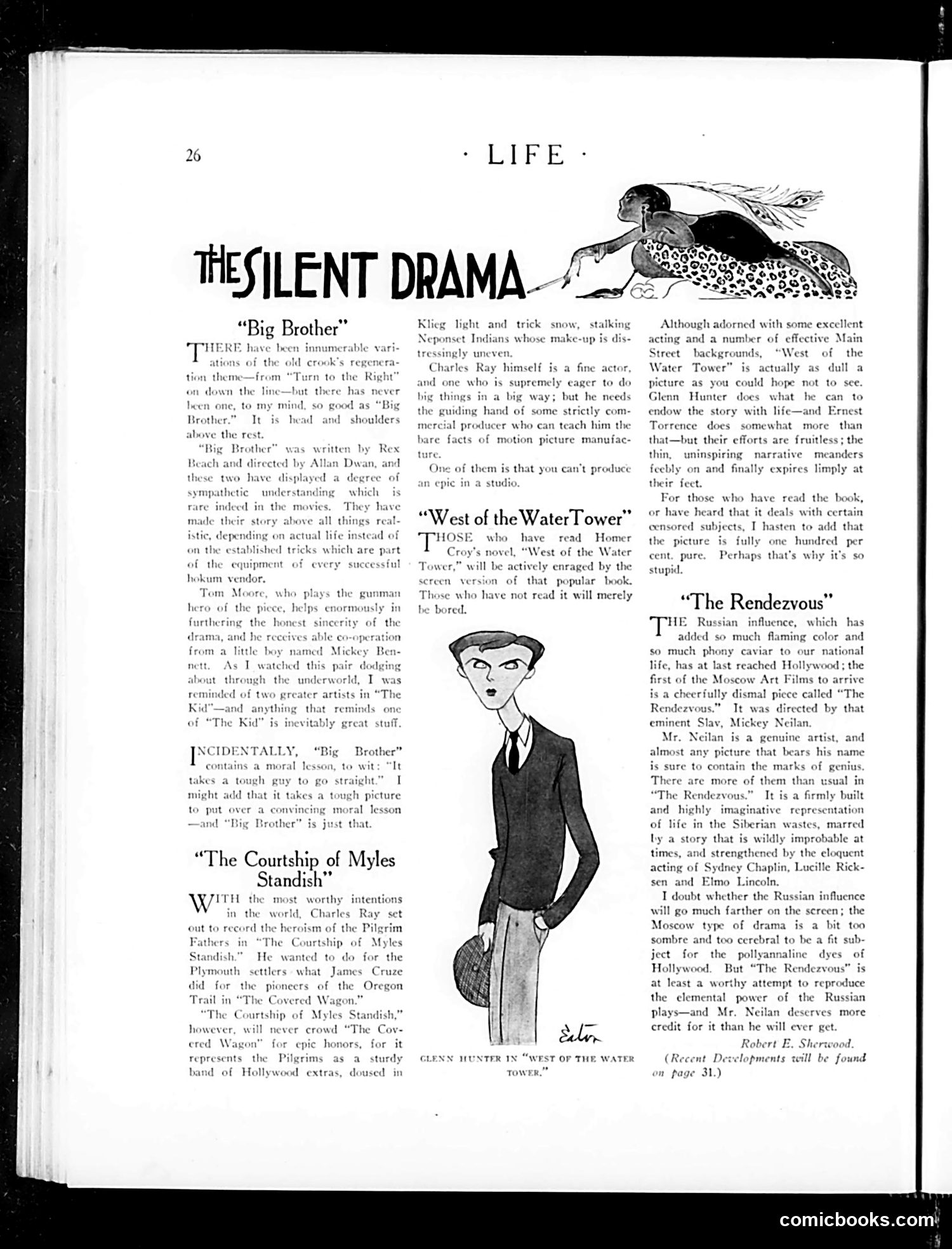
This page contains reviews of four silent films, written in Life's characteristic sardonic style. The critic dismisses most efforts: **"Big Brother"** and **"The Courtship of Myles Standish"** receive brief mentions—the latter critiqued for attempting epic subject matter (the Pilgrims) without sufficient commercial discipline. **"West of the Water Tower"** is harshly mocked as "dull," despite Glenn Hunter's acting. The reviewer suggests the film, based on Homer Croy's novel about small-town life, is tediously boring—hence calling it "stupid." **"The Rendezvous,"** a Russian-influenced Moscow Art Film directed by Mickey Neilan, fares better. The critic acknowledges its imaginative ambition and the talented acting (Sydney Chaplin, Lucille Ricksen, Elmo Lincoln), though it's "wildly improbable." Still, the reviewer respects it as a genuine artistic attempt, even if Russian cinema's introspective style doesn't suit American audiences' preferences for lighter entertainment ("pollyannaline dyes"). The page reflects 1920s Hollywood's dismissal of artistic pretension in favor of commercial appeal.
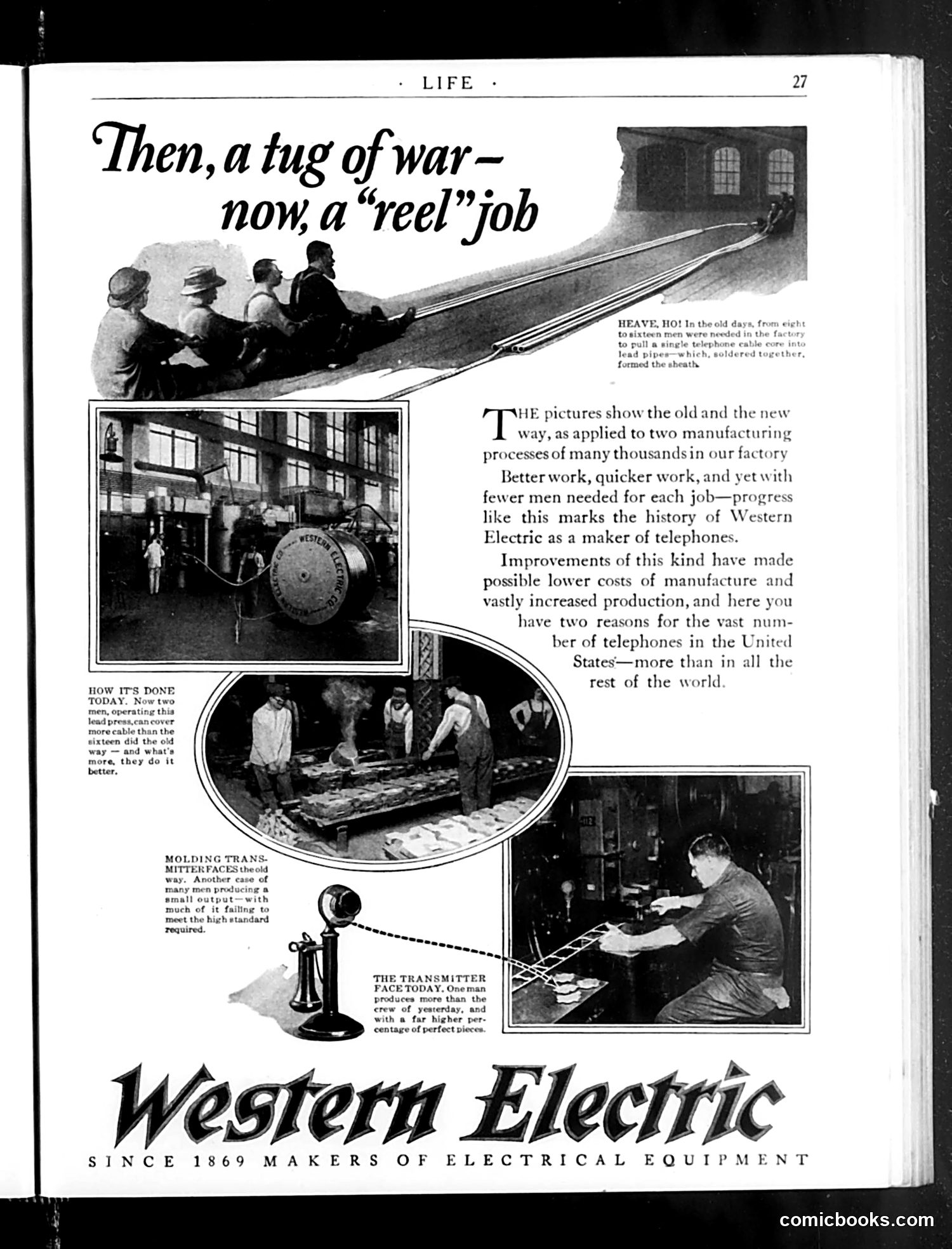
This is a **Western Electric advertisement**, not satire—it's corporate propaganda celebrating industrial "progress." The page contrasts old and new manufacturing methods for telephone components. The "tug of war" headline metaphorically presents factory work as a struggle, but the advertisement frames mechanization as victory: fewer workers producing better results faster. Photos show workers operating machinery and performing precision assembly tasks. The implicit message targets a **post-WWI American audience** concerned about job displacement from automation. Rather than acknowledge this threat, Western Electric frames efficiency gains as national progress—more telephones means American superiority globally. The rhetoric ("better work, quicker work, fewer men needed") normalizes workforce reduction while crediting improved living standards to corporate innovation. This reveals early-20th-century attitudes: technological unemployment was repackaged as patriotic advancement, and corporate interests were presented as serving the public good.
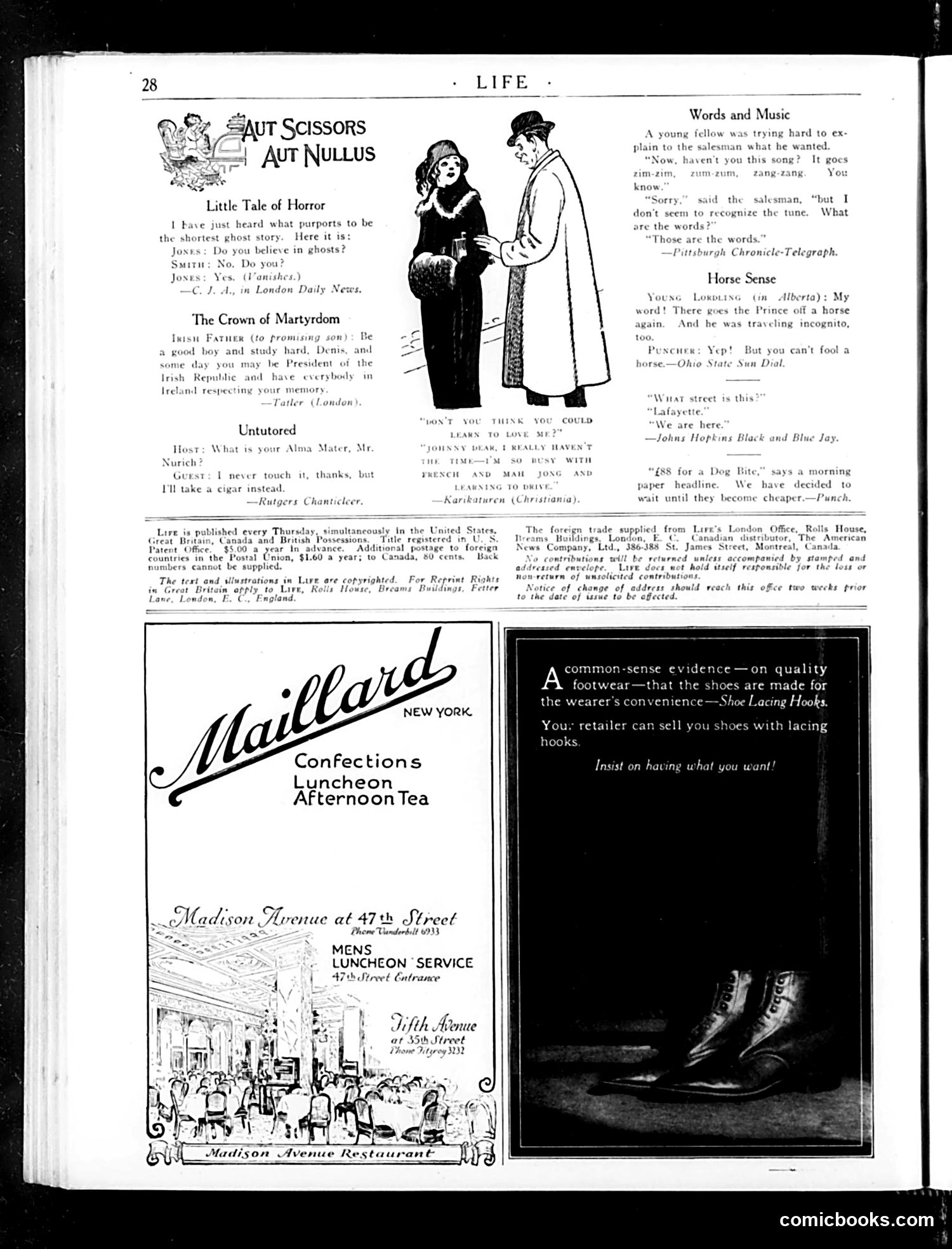
This page from Life magazine contains several brief humorous items typical of the publication's satirical format: **"Little Tale of Horror"** and **"The Crown of Martyrdom"** are short joke pieces playing on contemporary themes—one a meta-joke about ghost stories, the other addressing Irish independence and filial duty (relevant to early-20th-century Irish political discourse). **"Words and Music"** depicts a salesman unable to identify a song the customer describes only by humming ("zim-zim, zang-zang"), with the punchline that the humming *is* the actual lyrics—poking fun at either the customer's poor musical communication or low-quality popular songs. **"Horse Sense"** jokes about a Prince repeatedly falling from horses while traveling incognito, mocking aristocratic incompetence or the absurdity of royalty attempting disguise. The page is otherwise dominated by **advertisements** (Maillard confections, shoe-lacing hooks, restaurants) typical of Life's revenue model. The cartoons are light social humor rather than political satire.
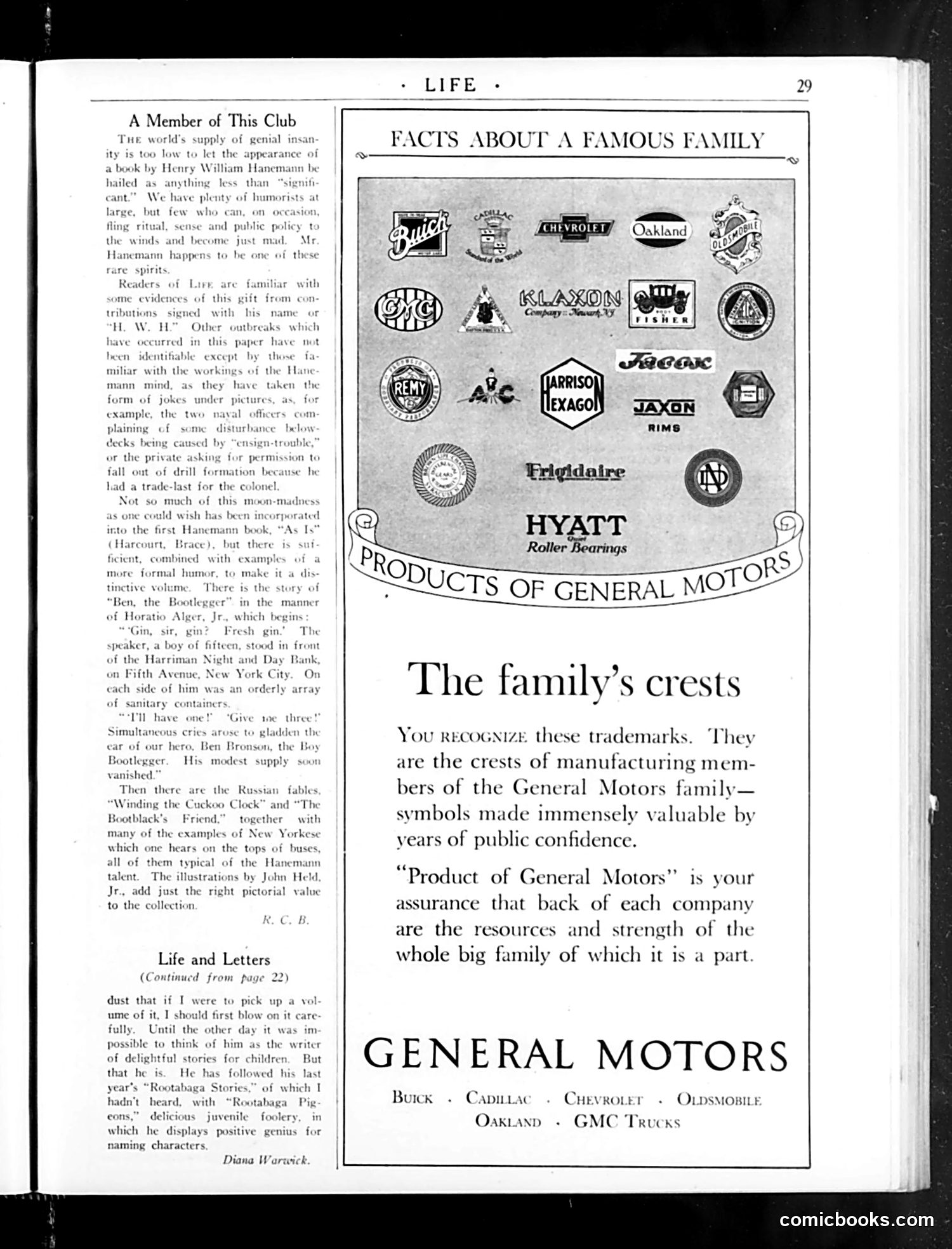
This page is primarily a **General Motors corporate advertisement**, not political satire. The upper section displays logos of GM's manufacturing divisions (Buick, Cadillac, Chevrolet, Oldsmobile, Oakland, GMC Trucks, plus associated brands like Hyatt Roller Bearings and Frigidaire). The text beneath, titled "The family's crests," explains these trademarks as symbols of the GM corporate family's "public confidence" and combined resources. The left column contains unrelated editorial content about humorist Henry William Hanemann and literary discussion (including references to Carl Sandburg's *Rootabaga Stories*), labeled "Life and Letters." The advertisement's message is straightforward corporate branding: buying any GM product means accessing the entire corporation's strength and reputation. This appears to be from the 1920s-1930s era of American industrial expansion, when such unified corporate family marketing was novel and persuasive to consumers.
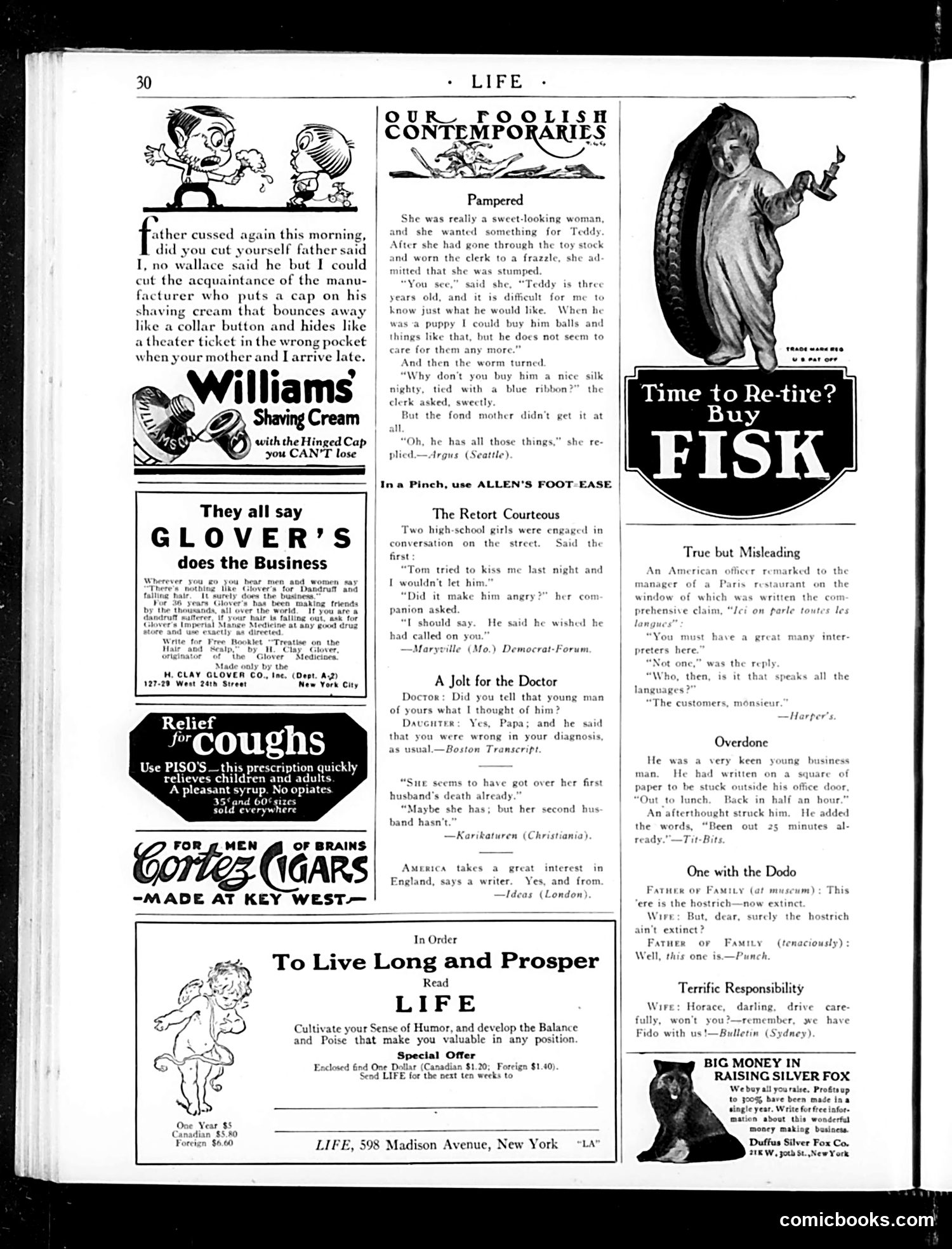
This page is primarily **advertising with interspersed humor shorts**—typical of Life's satirical format. **Key Content:** The advertisements dominate: Williams Shaving Cream, Glover's (hair product), Piso's cough syrup, Cortés cigars, and Fisk tires feature illustrated ads with humorous copy. The **humor shorts** are brief anecdotes mocking everyday social situations: - A woman shopping for toys for a difficult child, receiving a cheeky silk "nighty" suggestion - High school flirtation humor ("retort courteous") - A doctor questioned about his diagnosis accuracy - Office workers and domestic comedy **The satire targets:** Upper-middle-class consumer anxieties, courtship conventions, professional incompetence, and marital dynamics—all presented as relatable vignettes. The **"Fisk Tires" illustration** shows a tired man considering retirement, a common advertising trope of the era. Overall, this reflects early 20th-century magazine culture: advertisements subsidized humor content, and jokes assumed readers familiar with shopping frustrations, dating rituals, and workplace mishaps.
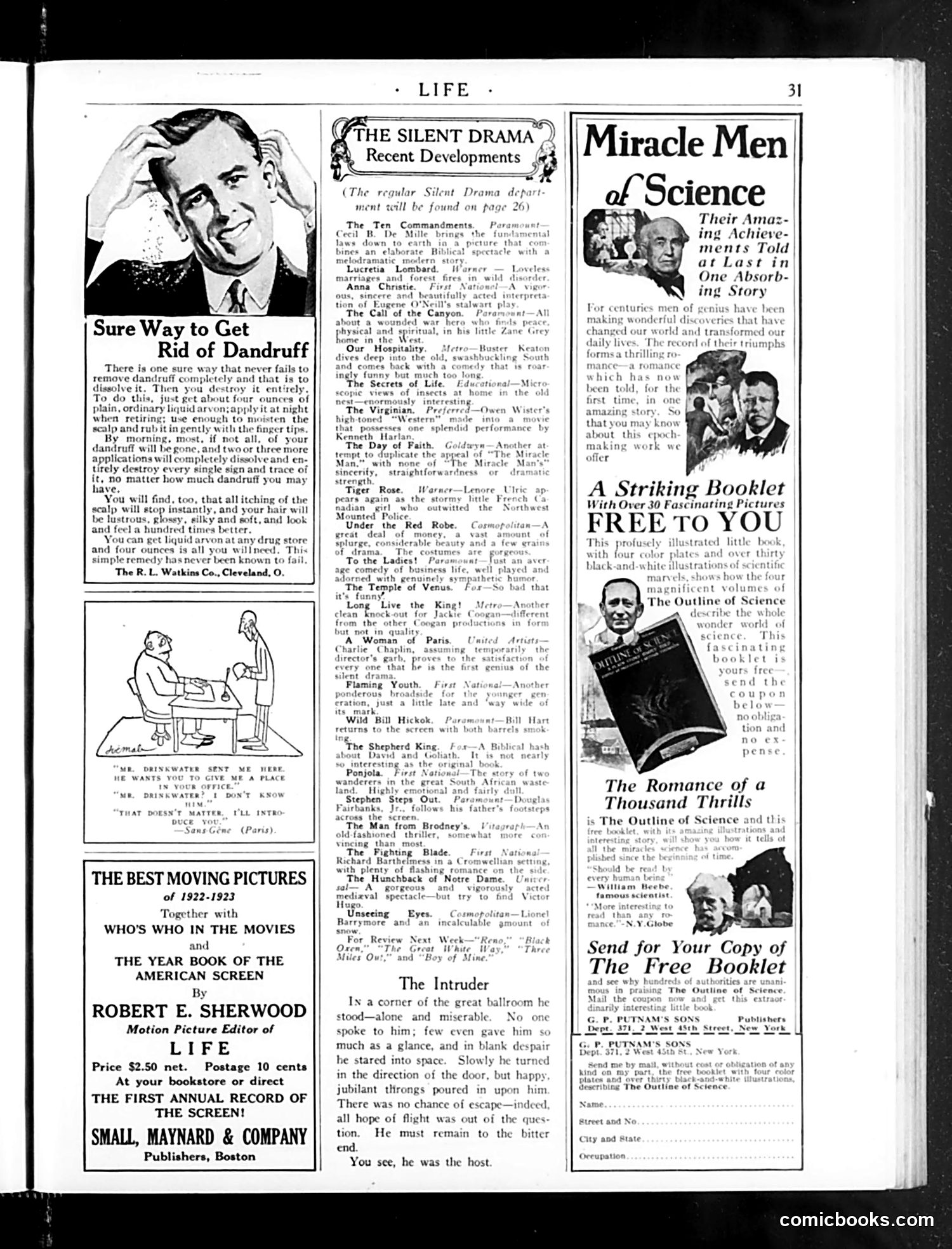
This page mixes advertising with entertainment content typical of early 1920s Life magazine. **The Main Cartoon** (top left) shows a job-seeker approaching a desk, introducing himself with a reference from "Mr. Drinkwater." The employer responds dismissively: "I don't know Mr. Drinkwater" and "That doesn't matter." The joke satirizes the uselessness of personal recommendations—even when the employer doesn't know the person vouching for you, they still won't hire based on that weak endorsement. It's about the gap between networking expectations and hiring realities. **The Advertising Content** dominates: dandruff remedy ads, a Robert Sherwood film yearbook promotion, and multiple advertisements for "Miracle Men of Science" and "The Outline of Science" booklets. These represent the magazine's revenue model. **"The Intruder" Story** (bottom right) describes a lonely figure at a ballroom—the "host" trapped by social obligation, unable to escape his own party. It's a humorous commentary on social anxiety and the burden of hospitality.
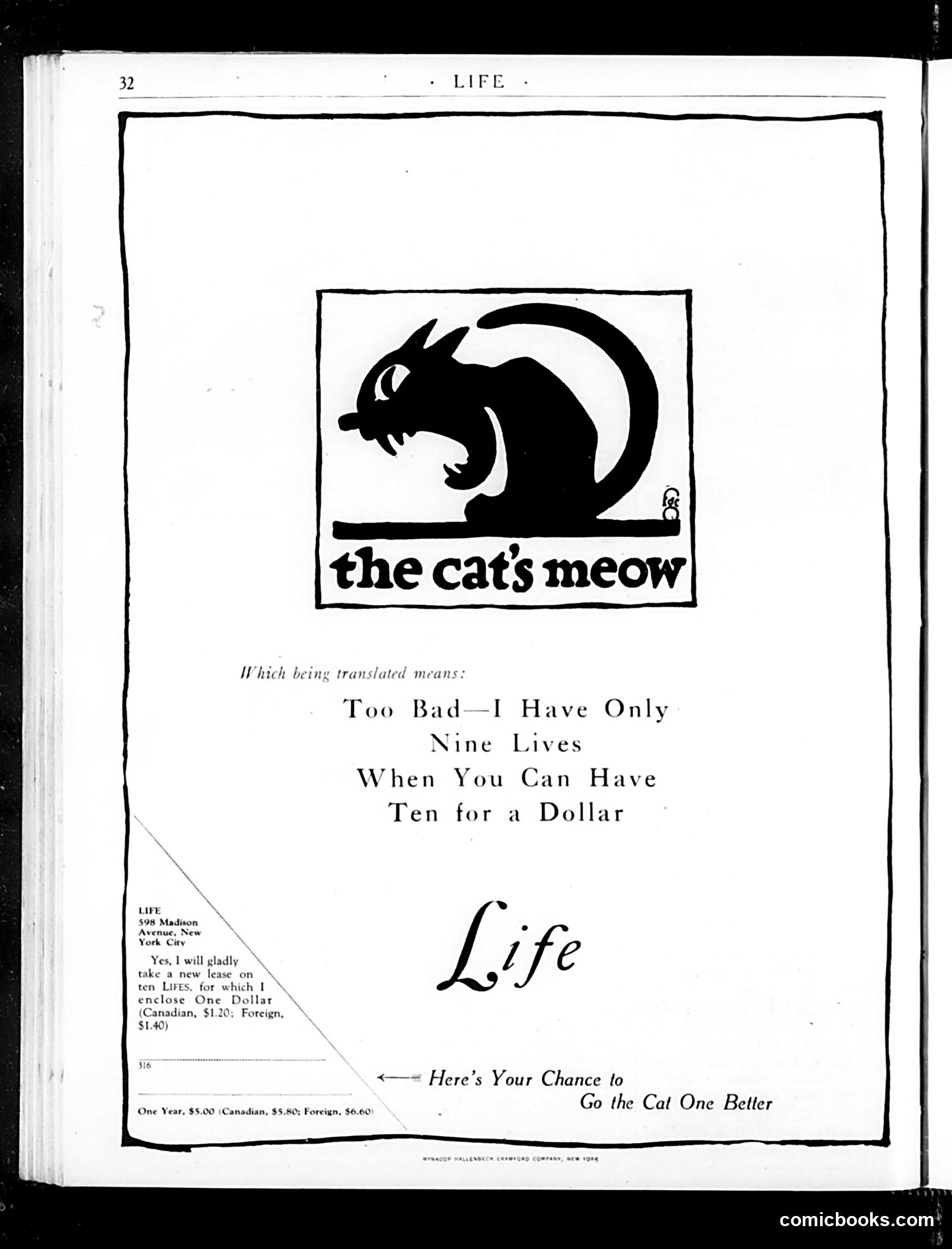
This is primarily a **subscription advertisement** for *Life* magazine, not a political cartoon. The humor plays on the magazine's title: it presents "the cat's meow" (1920s slang for "the best thing") as a feline complaint about having only nine lives when humans can get ten *Life* magazine subscriptions for a dollar. The joke invites readers to "go the cat one better" by subscribing. The silhouetted black cat is stylized in the art deco manner popular in that era. This is clever wordplay advertising rather than social satire—it exploits the double meaning of "Life" (existence/the magazine) to create an absurdist pitch. The pricing suggests this dates from the early 1920s, when *Life* was a humor and general-interest publication competing aggressively for readers.
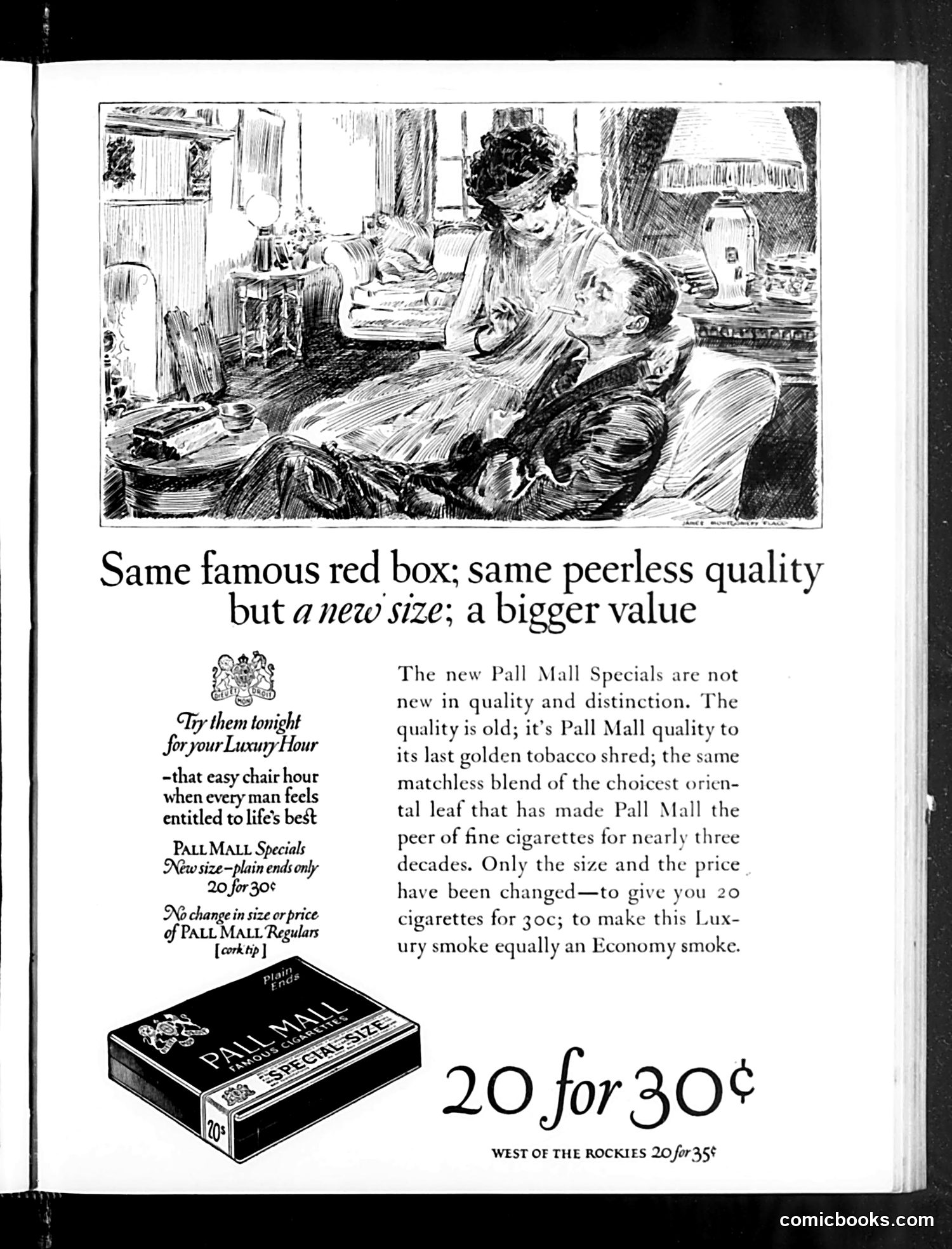
This is a **cigarette advertisement**, not satire or political content. It promotes Pall Mall's new "Specials" product line during what appears to be the Depression era (pricing suggests 1930s). The sketch shows a domestic leisure scene: a woman attending to a man relaxing in an easy chair—the "Luxury Hour" when he feels "entitled to life's best." This reflects period advertising conventions romanticizing masculine comfort and leisure. The ad's pitch emphasizes value: same premium quality tobacco in a smaller package at lower cost (20 cigarettes for 30¢ versus regulars). The marketing frames this as making luxury "equally an Economy smoke"—appealing to consumers during economic hardship who still wanted quality goods at affordable prices. The "famous red box" references Pall Mall's recognizable packaging and established brand reputation.
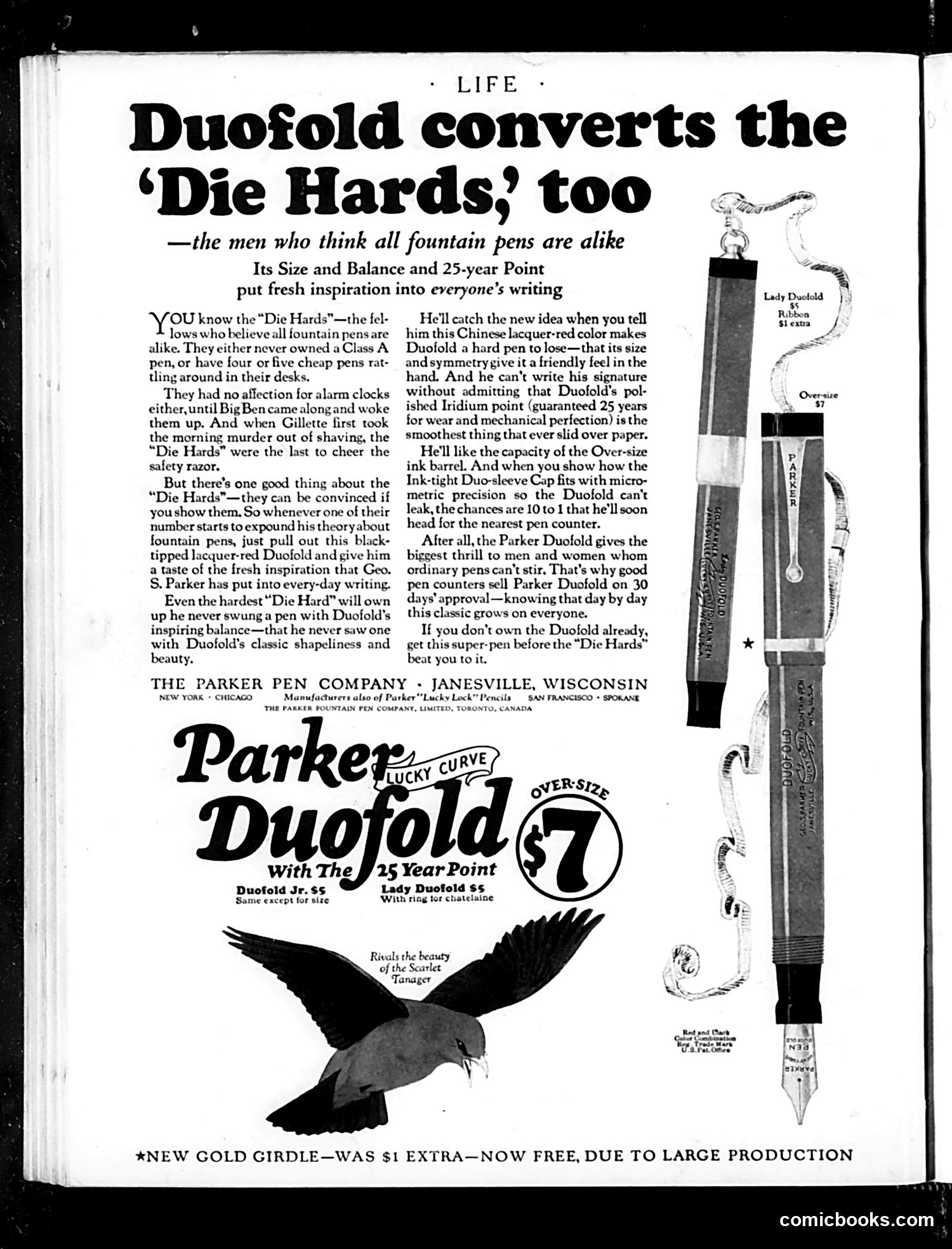
This is primarily a **product advertisement**, not a political cartoon. It uses satirical humor to market fountain pens by targeting "Die Hards"—skeptics who believe all pens are identical and resist new products (the text compares them to men who resisted alarm clocks and safety razors). The ad's joke: stubborn men who dismiss quality distinctions can be "converted" by experiencing the Parker Duofold's superior features—its balance, lacquer-red color, 25-year iridium point, and leak-proof cap. The "Die Hard" figure represents a common early 20th-century consumer type: the resistor to innovation. By framing product adoption as conquering this resistance, the ad appeals to readers' desire to appear modern and discerning about quality. The illustrated pen and variants (Lady Duofold, Over-size) emphasize the product's prestige and range. Pricing ($7 Over-size) and the note about free gold girdles highlight value propositions.