
Life, 1924-01-24 · page 20 of 36
Life — January 24, 1924 — page 20: what you’re looking at
What you’re looking at
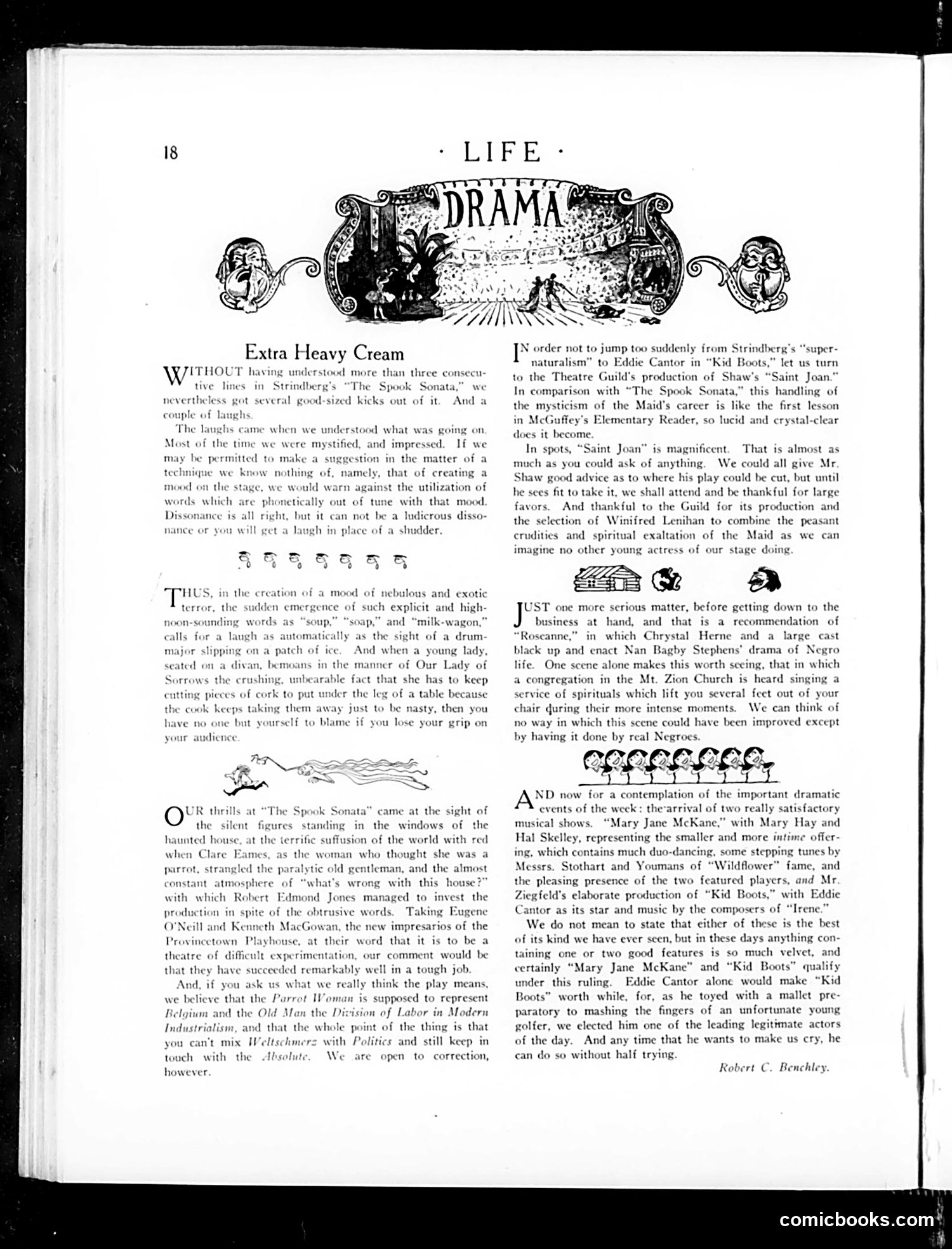
This page reviews experimental theater productions. The main critique concerns **Strindberg's "The Spook Sonata,"** performed by the Provincetown Playhouse with Eugene O'Neill and Kenneth MacGowan as producers. The reviewer praises the atmospheric staging by designer Robert Edmond Jones but warns that certain mundane words ("soup," "soap," "milk-wagon") undercut the play's eerie mood—like a drum major slipping on ice during a serious moment. The reviewer humorously interprets the play's symbolism as representing **Belgium and Industrial Division of Labor**—a tongue-in-cheek admission they're uncertain of its actual meaning. The page also reviews Shaw's **"Saint Joan"** (with Winifred Lenihan) and a production of **"Roseanne,"** praising particularly a church spirituals scene featuring Black performers. The tone is sophisticated yet playful—characteristic of Life's cultural criticism during this era of American theatrical experimentation.
📄 Transcribed text from this page (OCR, searchable)
Machine-transcribed from the original scan — historical spelling and the odd misread are preserved.
Extra Heavy Cream WITHOUT having understood more than thee consecu- tive lines in Strindberg’s “The Spook Sonata,” we nevertheless got several good-sized kicks out of it. And a couple of laughs The laughs came when we understood what was going on Most of the time we were mystified, and impressed. If we may be permitted to make a suggestion in the matter of a technique we noth . namely, that of creating a 1 the stage, we would warn against the utilization of words which are phonetically out of tune with that mood Dissonance is all right, but it can not be a ludicrous disso- nance or you will get a laugh in place of a shudder. Baa 5 the creation of a mood of nebulous and exc the sudden emergence of such explicit and high: noon-sounding words as “soup,” “soap,” and “milk-wagon,” calls for a laug 4s automatically as the sight of a drum major slipp na patch of ice. And when a young lady, seated on a divan, bemoans in the manner of Our Lady of Sorrows the crushing, unbearable fact that she has to keep cutting pieces of cork to put under the leg of a table because the cook keeps taking them away just to be nasty, then you have no one but yourself to blame if you lose your grip on your audience UR thrills at “The Spook Sonata” came at the sight of the silent figures standing in the windows of the haunted house, at the terrific suffusion of the world with red when Clare Eames, as the woman who thought she was a parrot, strangled the paralytic old gentleman, and the almost constant atmosphere of “what's wrong with this house?” with which Robert Edmond Jones managed to invest the production in spite of the obtrusive words. Taking Eugene O'Neill and Kenneth MacGowan, the new impresarios of the Provincetown Playhouse, at their word that it is to be a theatre of difficult experimentation, our comment would be that they have succeeded remarkably well in a tough job. And, if you ask us what we really think the play means, we believe that the Parrot Woman is supposed to represent Belgium and the Old Man the Division of Labor in Modern Industrialism, and that the whole point of the thing is that you can't mix Weltschmers with Politics and still keep in if We are open to correction, however. [8 order not to jump too suddenly from Strindberg’s “super- naturalism” to Eddie Cantor in “Kid Boots,” let us turn to the Theatre Guild's production of Shaw's “Saint Joan.” In comparison with “The Spook Sonata,” this handling of the mysticism of the Maid’s career is like the first lesson in McGuffey’s Elementary Reader, so lucid and crystal-clear does it become. In spots, “Saint Joan” is magnificent. That is almost as much as you could ask of anything. We could all give Mr Shaw good advice as to where his play could be cut, but until he sees fit to take it, we shall attend and be thankful for large favors. And thankful to the Guild for its production and the selection of Winifred Lenihan to combine the peasant crudities and spiritual exaltation of the Maid as we can imagine no other young actress of our stage doing aa oO UST one more serious matter, before getting down to the J business at hand, and that is a recommendation of “Roseanne,” in which Chrystal Herne and a large cast black up and enact Nan Bagby Stephens’ drama of Negro life. One scene alone makes this worth seeing, that in which a congregation in the Mt. Zion Church is heard singing a service of spirituals which lift you several feet out of your chair quring their more intense moments. We can think of no way in which this scene could have been improved except having it done by real Negroes. ND now for a contemplation of the important dramatic events of the week: thearrival of two really satisfactory musical shows. “Mary Jane McKane,” with Mary Hay and Hal Skelley, representing the smaller and more intime offer- ing, which contains much duo-dancing, some stepping tunes by Messrs. Stothart and Youmans ¢ Vildflow fame, and the pleasing presence of the two featured players, and Mr Ziegfeld’s elaborate production of “Kid Boots,” with Eddie Cantor as its star and music by the composers of “Irene.” We do not mean to state that either of these is the best of its kind we have ever seen, but in these days anything con- taining one or two good features is so much velvet, and certainly “Mary Jane McKane” and “Kid Boots” qualify under this ruling. Eddie Cantor alonc would make “Kid Boots” worth while, for, as he toyed with a mallet pre- paratory to mashing the fingers of an unfortunate young golfer, we elected him one of the leading legittmate actors of the day. And any time that he wants to make us cry, he can do so without half trying Robert C. Benchley comicbooks.com*