
A complete issue · 36 pages · 1924
Life — January 3, 1924
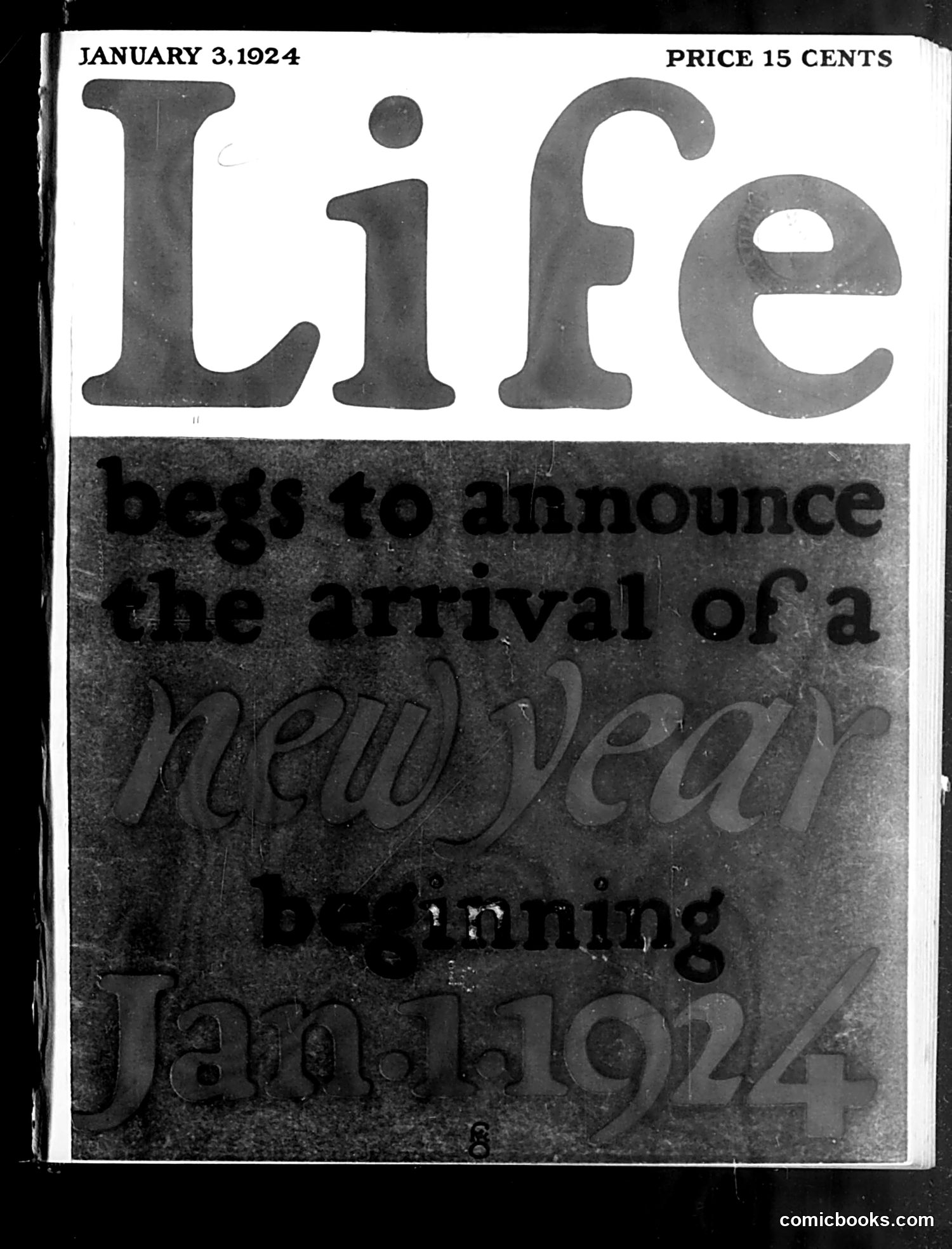
This is a *Life* magazine cover announcing "the arrival of a new year beginning January 1924." The large letters spelling "LIFE" dominate the upper portion in bold typography. The cover is primarily a **New Year's announcement** rather than political satire. The celebratory tone and emphasis on the calendar date (January 1924) suggest this is a standard holiday issue marking the transition into a new year. Without additional interior content visible, the specific satirical commentary or jokes cannot be determined. The cover functions as a straightforward seasonal greeting and mastheading for the magazine's New Year edition, priced at 15 cents.
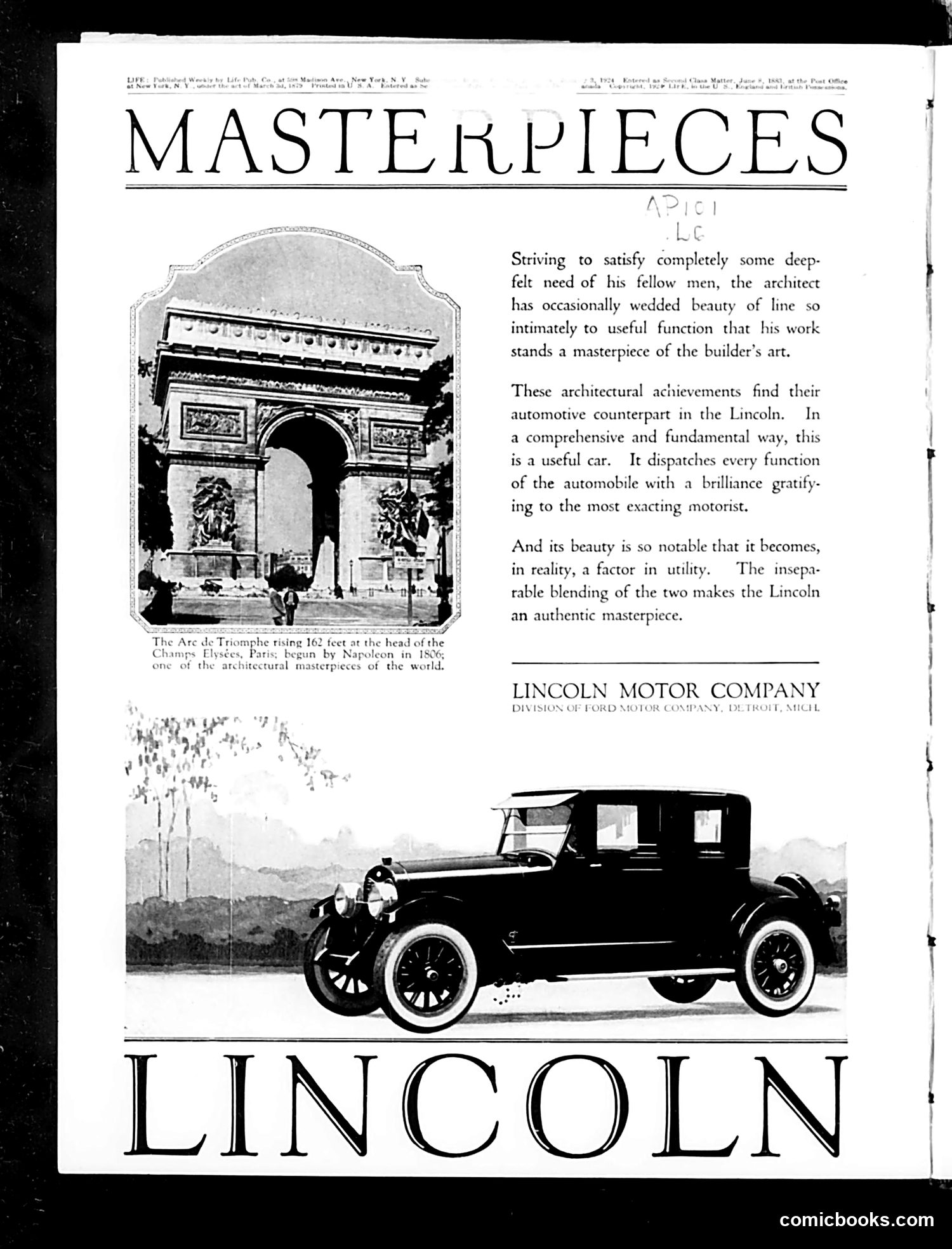
This is primarily a **Lincoln automobile advertisement**, not a political cartoon. The page uses an architectural comparison as its marketing strategy rather than satire. The ad compares the Lincoln car to the **Arc de Triomphe in Paris**—an iconic architectural masterpiece begun by Napoleon in 1806. The text argues that just as architects blend beauty with function in great buildings, Lincoln automobiles blend aesthetic design with practical automotive utility. There is **no political satire or caricature** present. The "Masterpieces" heading and architectural imagery serve as an extended metaphor to position the Lincoln as a luxury product combining engineering excellence with artistic design—a common advertising approach in early automotive marketing during the 1920s.
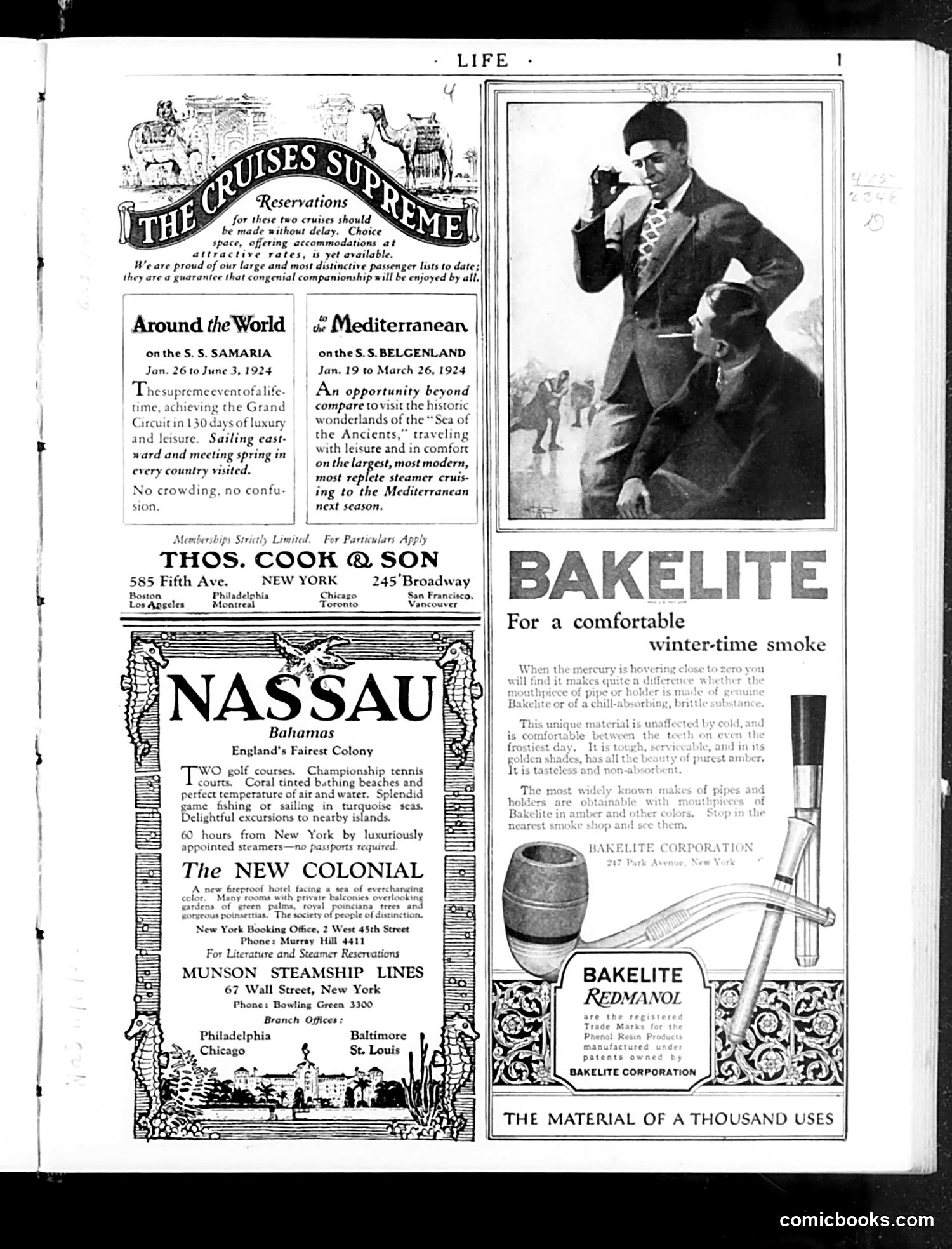
This page is primarily **advertising**, not political satire. The dominant content includes: - **The Cruises Supreme** (top left): cruise line advertisements for luxury ocean voyages on ships like the S.S. Samaria and S.S. Belgeland, marketed to wealthy travelers in 1924. - **Nassau, Bahamas** (center left): resort advertisement for "The New Colonial" hotel, promoting golf, tennis, and tropical leisure. - **Bakelite** (right side): advertisement for Bakelite pipe stems and smoking accessories, marketed as superior comfort for winter smoking. The photograph showing two men appears to be a lifestyle image supporting the luxury travel/leisure theme rather than political commentary. This represents Life magazine's mixed advertising and editorial content model from the 1920s, targeting affluent readers.
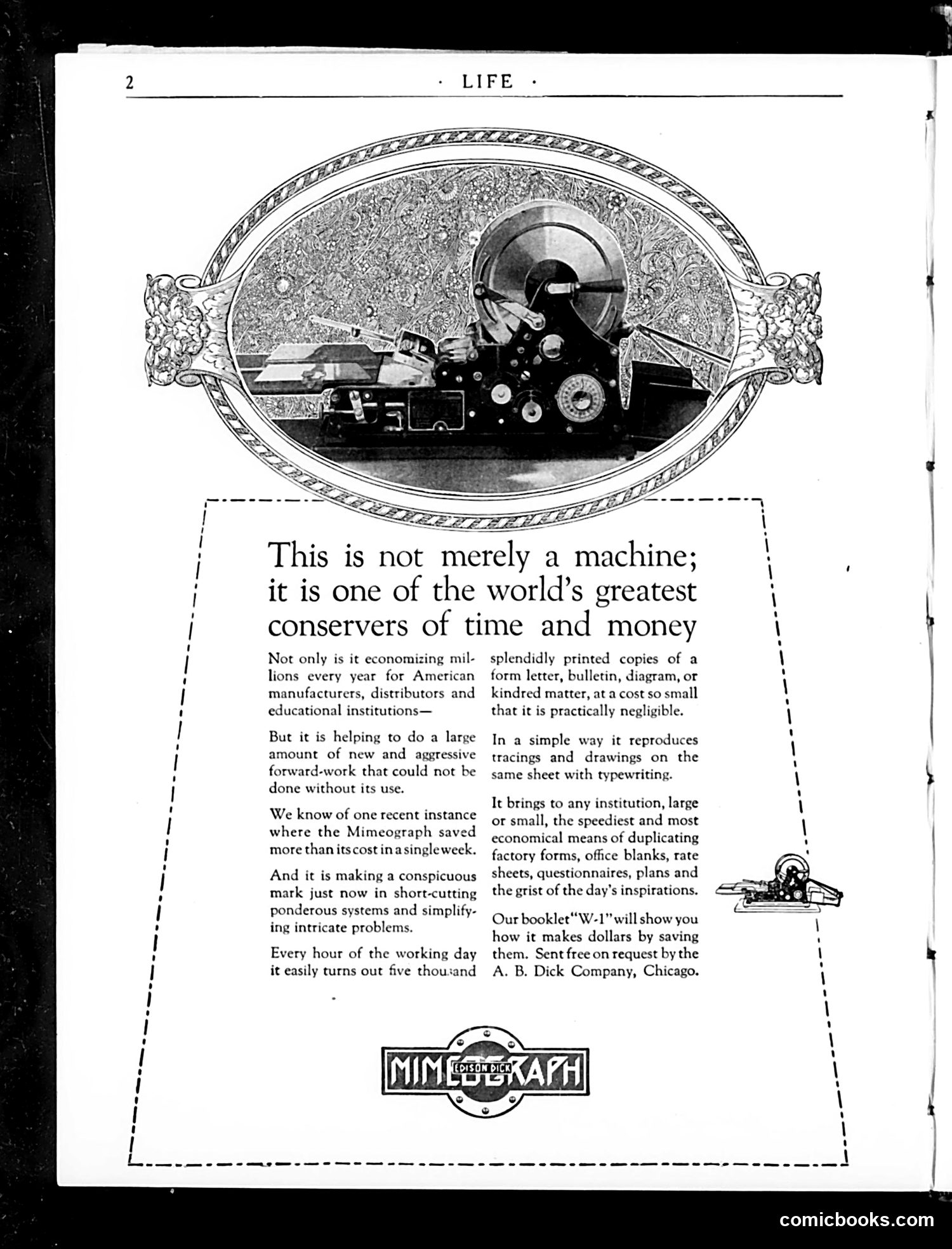
This page is primarily **advertising, not satire or editorial content**. It's a full-page advertisement for the Mimeograph machine by A.B. Dick Company of Chicago. The ad's headline claims the mimeograph is "one of the world's greatest conservers of time and money," emphasizing its practical business value. The image shows the machine's internal mechanisms. The text highlights specific benefits: economizing for manufacturers and schools, enabling document duplication at negligible cost, and saving companies money—one instance allegedly saved more than its cost in a single week. This represents early 20th-century office technology marketing, presenting the mimeograph as essential modern business equipment. The ornamental oval frame and formal layout reflect the era's advertising design conventions.
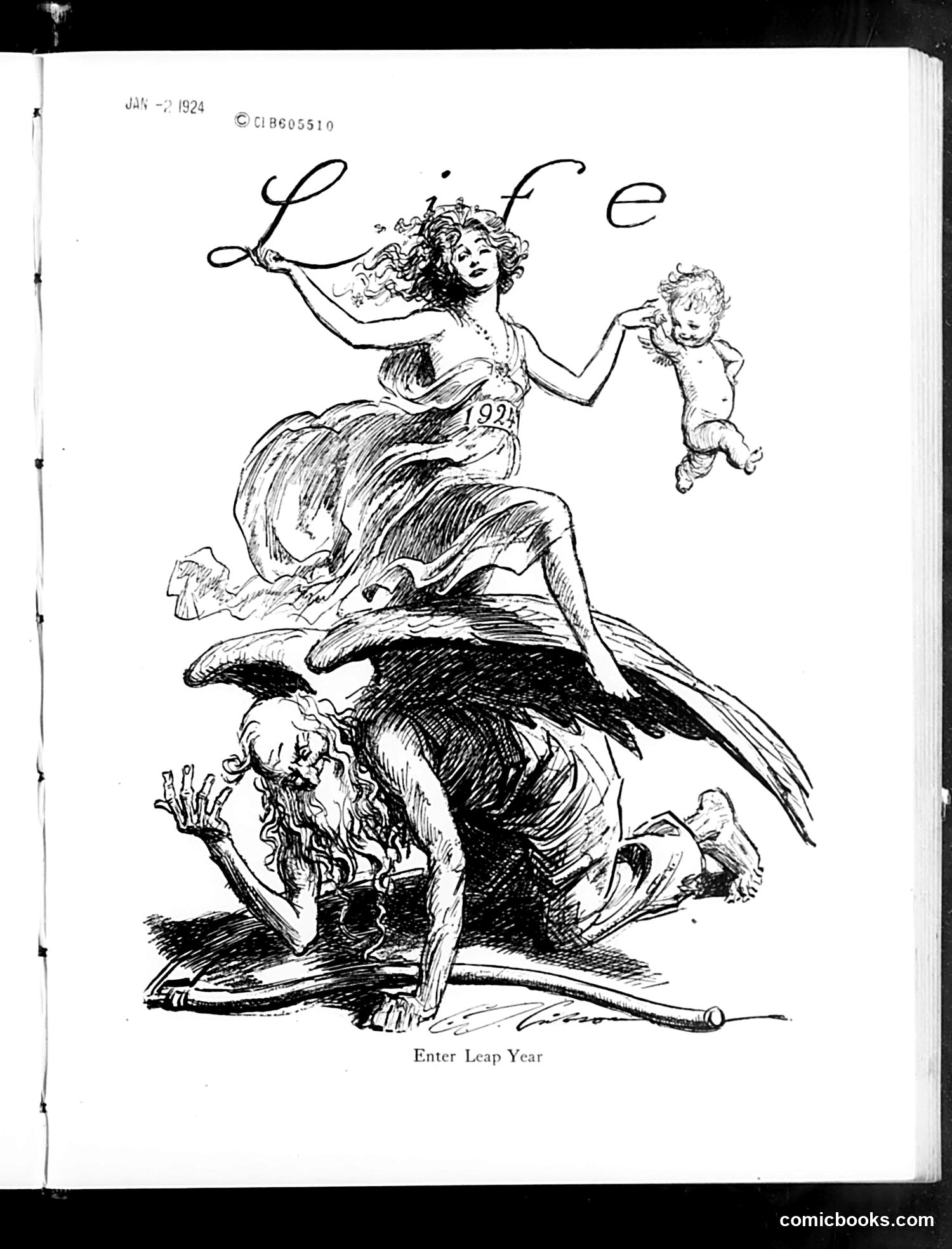
This satirical illustration celebrates 1924 as a leap year—traditionally a year when women could propose to men, inverting normal courtship conventions. The central female figure, labeled with "1924," actively pursues romantic conquest, wielding what appears to be a net or lasso while holding a cherub (Cupid). Below her, a male figure (likely representing "Old Man 1923" or general manhood) tumbles backward in defeat, overwhelmed by this reversal of gender roles in courtship. The satire reflects early 20th-century anxieties about women's increasing social independence and changing gender dynamics following women's suffrage (1920). The "leap year license" for female courtship aggression was a recurring cultural trope used to humorously explore discomfort with shifting power dynamics between men and women.
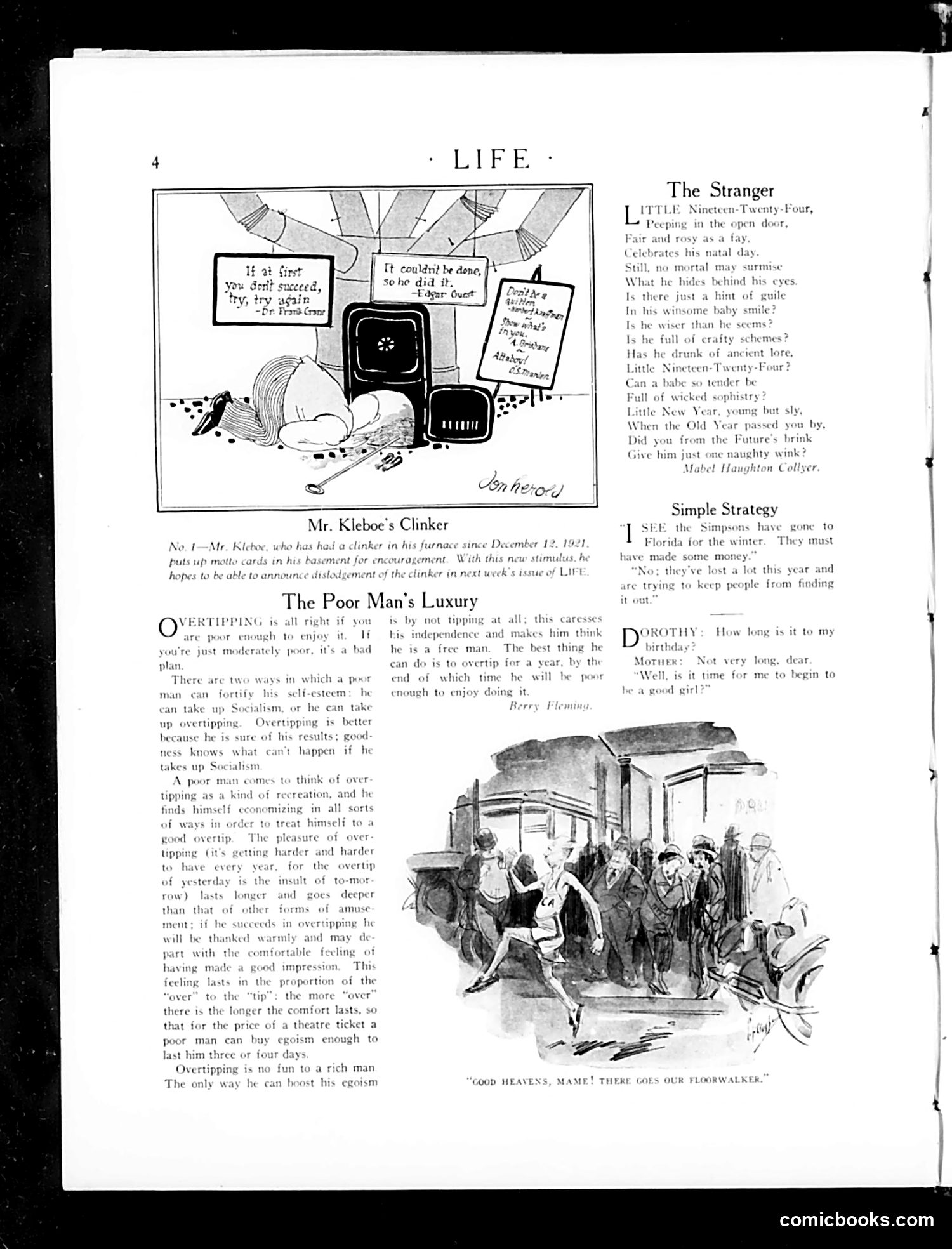
**"Mr. Klebow's Clinker"** (top cartoon): This depicts a man surrounded by failed New Year's resolutions and encouragement cards. The joke satirizes the common experience of making ambitious New Year's promises—Mr. Klebow has apparently resolved to announce his clinker (failure) weekly to Life magazine. It mocks how people struggle to keep resolutions despite good intentions and public encouragement. **"The Poor Man's Luxury"** (essay): This piece argues that tipping—specifically overtipping—offers working-class men an affordable form of ego-boosting. It frames tipping as psychological self-esteem maintenance, suggesting poor men can feel momentarily superior through generous tipping, unlike wealthier men who need other status markers. The content reflects 1920s class anxieties and consumer psychology.
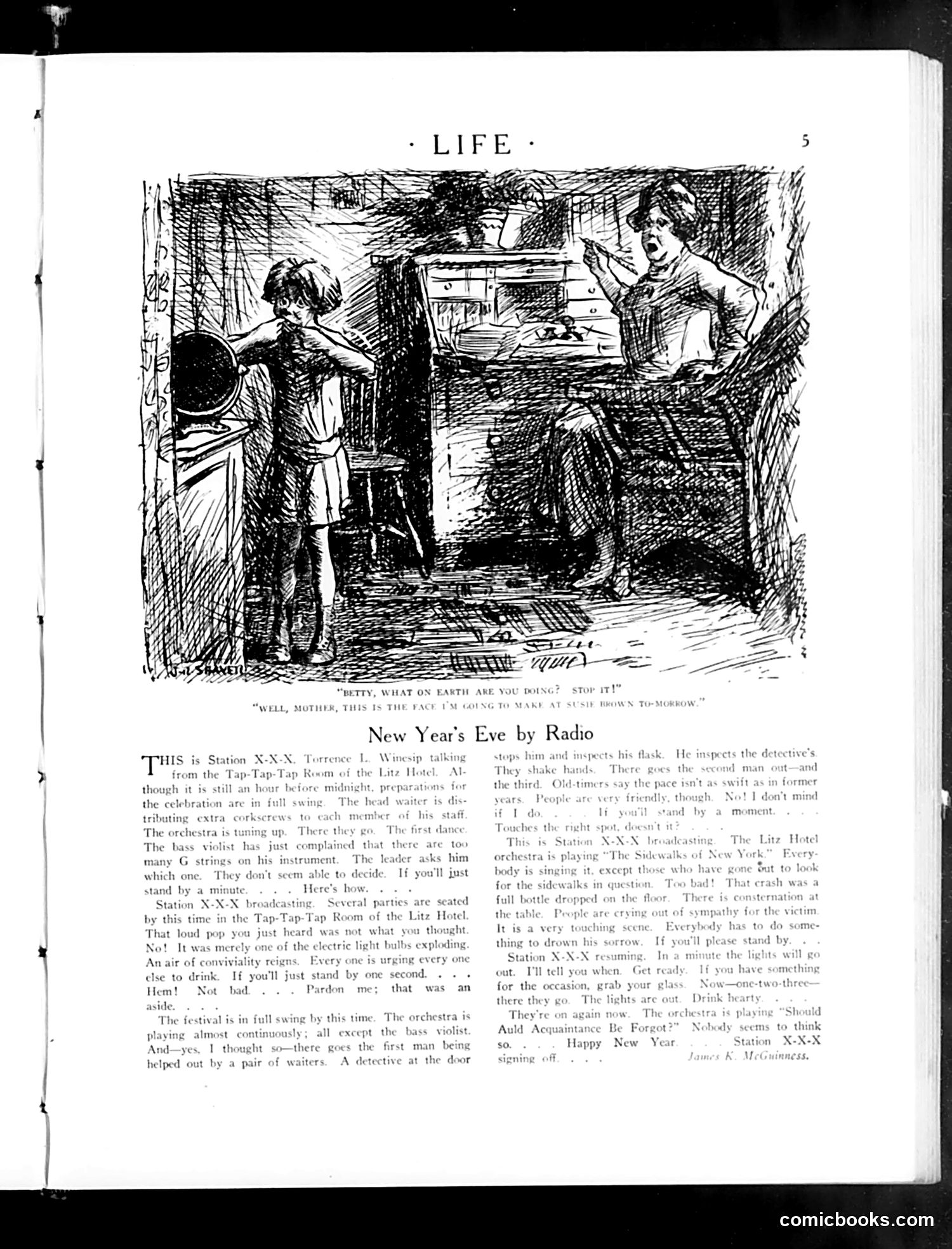
This satirical piece depicts a domestic scene where a mother is scolding her daughter Betty during a New Year's Eve radio broadcast from Station X-X-X at the Litz Hotel. The humor centers on the contrast between the *broadcast* festivities—an orchestra playing dance music, celebrations, and cheerful announcements—and the *domestic reality* unfolding simultaneously: Betty has apparently broken something (possibly a bottle), prompting her mother's exasperated reprimand. The satire mocks how radio creates an illusion of glamorous, carefree celebration while ordinary people at home face mundane domestic chaos. The gap between broadcast fantasy and actual life is the joke. The piece gently ridicules both the manufactured sophistication of radio entertainment and the inescapable realities of family life.
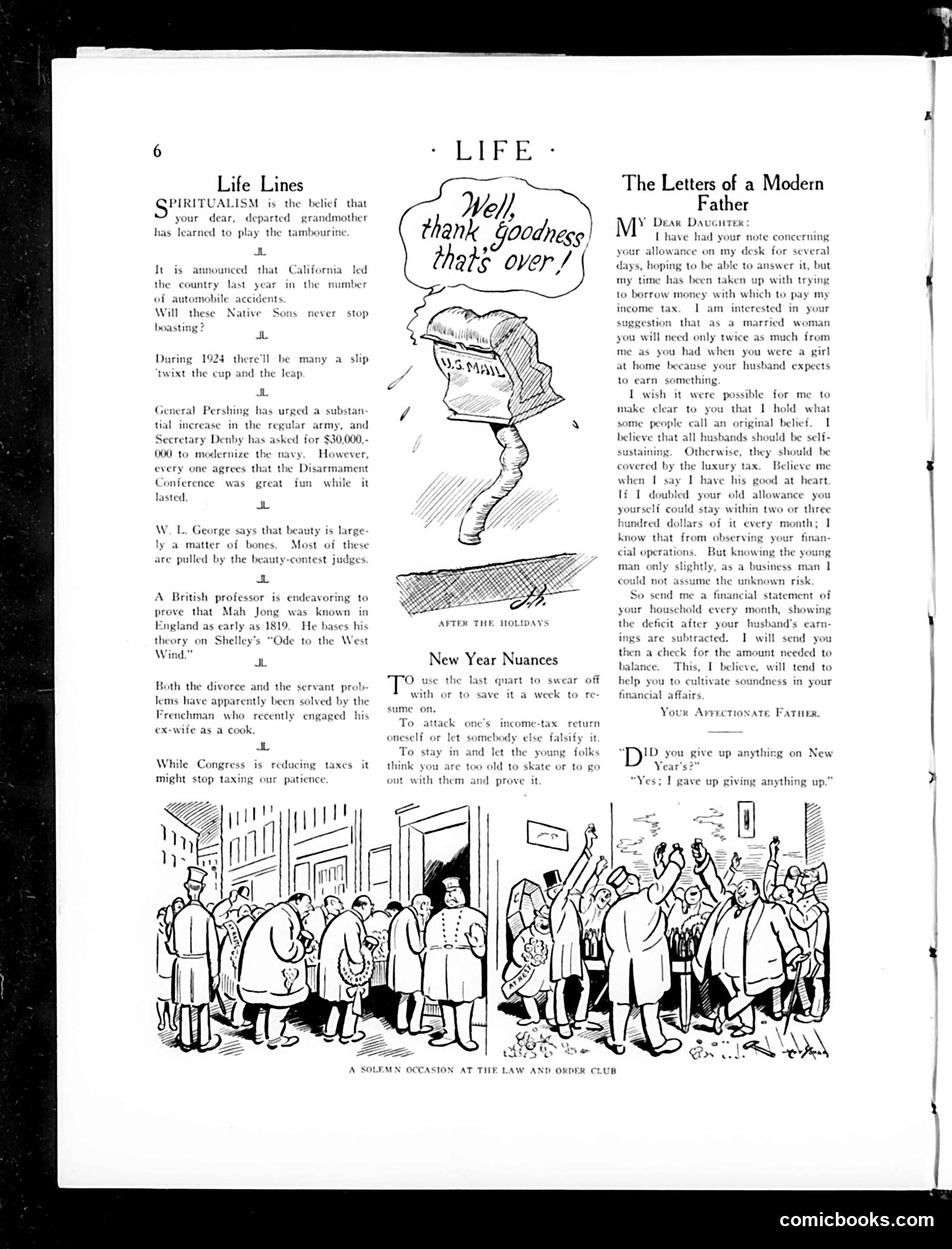
This page contains several satirical commentary pieces and illustrations typical of 1920s Life magazine. **"Life Lines"** offers brief social observations, including spiritualism's popularity and commentary on Native American automobile accidents and military spending. **"After the Holidays"** cartoon shows a mailman struggling under the weight of correspondence—satirizing the burden of post-holiday thank-you notes and correspondence. **"New Year Nuances"** humorously lists ways people rationalize New Year's resolutions, such as falsifying income-tax returns or convincing oneself one is too old for physical activity. **"The Letters of a Modern Father"** is an advice column addressing a daughter's financial allowance, discussing married women's income taxation and household financial management—reflecting 1920s tax policy debates and gender expectations regarding women's economic roles. The bottom cartoon depicts a crowded "solemn occasion at the Law and Order Club," likely satirizing Prohibition-era enforcement efforts.
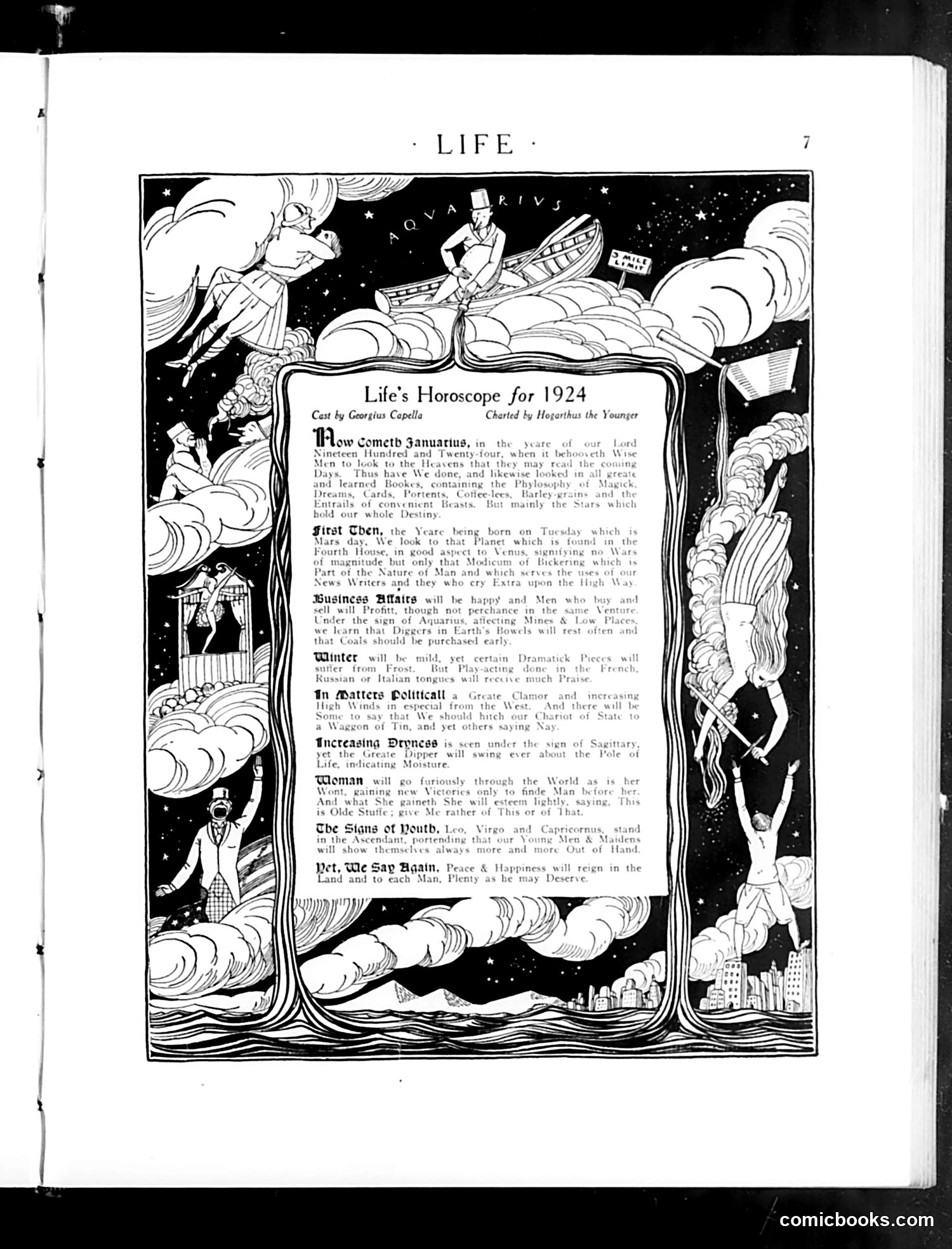
This page presents a satirical "horoscope" for the year 1924, cast by "Georgius Capella" and charted by "Hepasthas the Younger." Rather than genuine astrology, it's a humorous social and political commentary using zodiac signs as framework. The predictions mock contemporary concerns: business affairs will see profit but instability; winter will bring dramatic theatrical pieces; political matters show increasing discord; women's advancement ("Increasing Dryness") suggests irony about women's rights; and the final prediction promises peace and happiness will reign universally. The ornate art deco border with figures sailing clouds and celestial imagery creates whimsical tone, while the detailed predictions satirize 1920s anxieties about economics, international relations, and social change through the pretense of astrological authority.
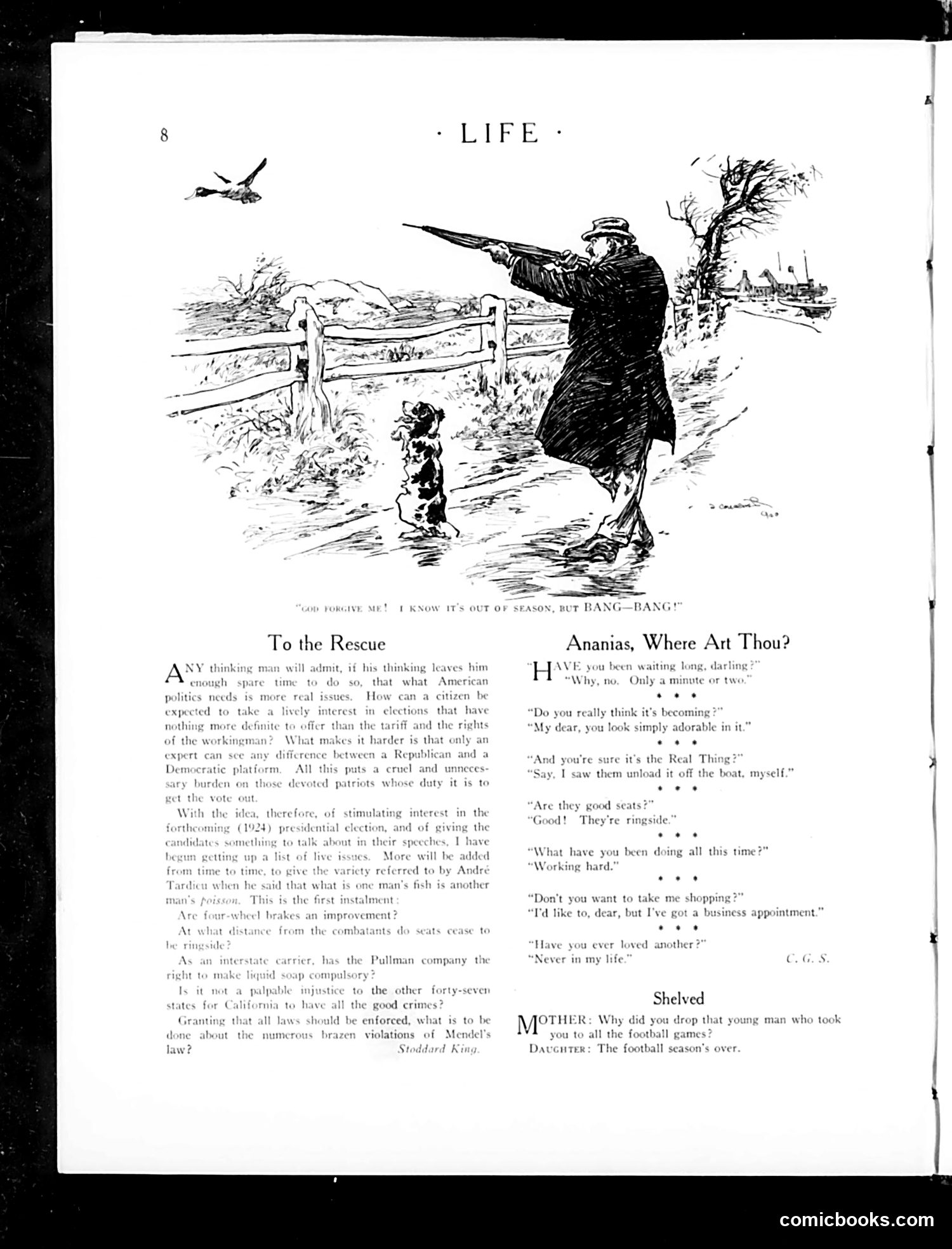
The top illustration depicts a man in a coat and hat firing a gun at a duck while a hunting dog watches. The caption reads: "GOD FORGIVE ME! I KNOW IT'S OUT OF SEASON, BUT BANG—BANG!" This is a visual joke about breaking hunting laws—specifically shooting game outside the legal season. The humor relies on the hunter's mock contrition: he acknowledges the illegality ("out of season") but shoots anyway. The dog's presence emphasizes the absurdity of flouting established rules. The accompanying article "To the Rescue" discusses the 1924 presidential election and political disengagement. The subsequent short pieces are humorous domestic dialogues. Below appears another comic titled "Shelved," a brief husband-wife exchange about ending a romantic relationship when "the football season's over."
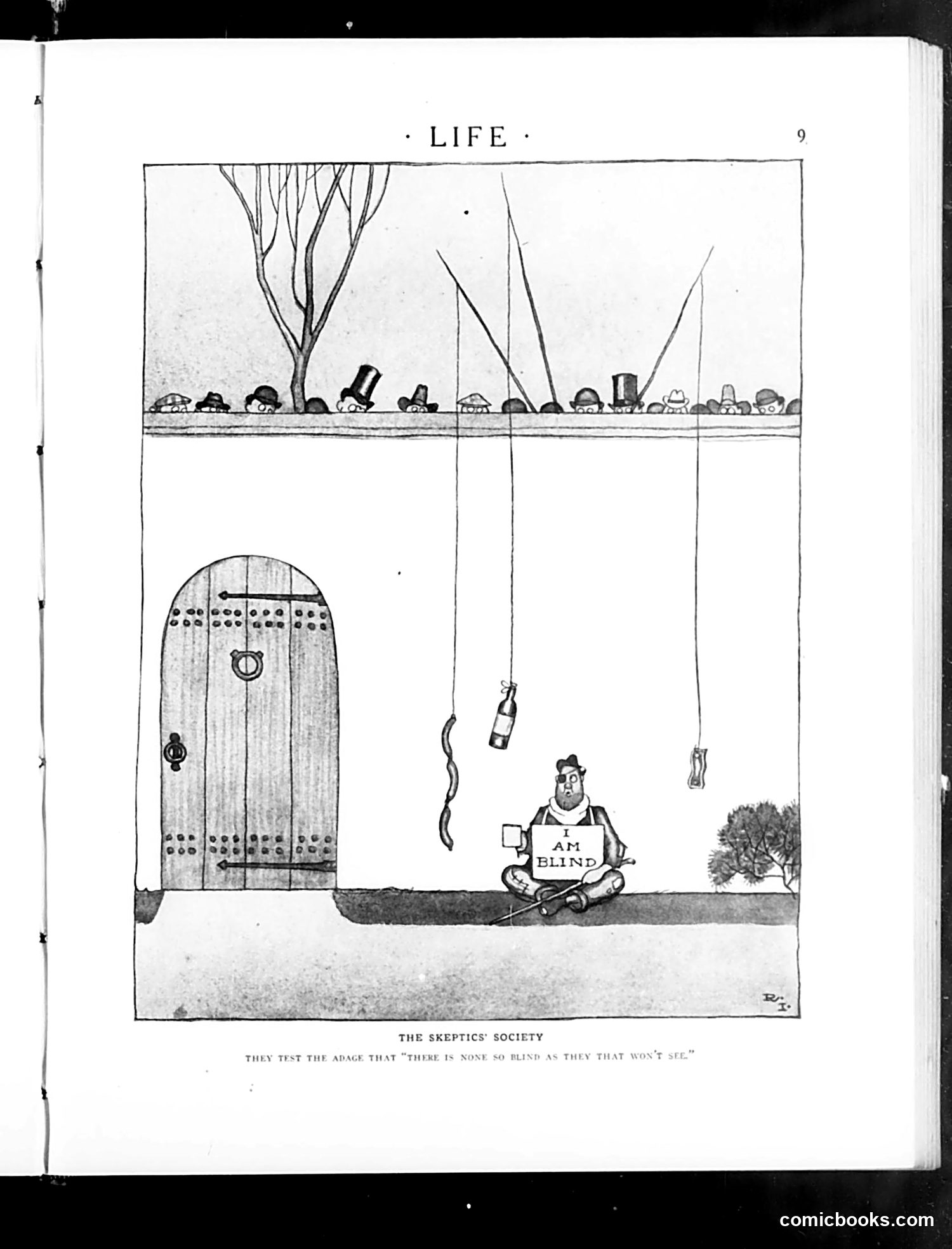
This cartoon satirizes philosophical skepticism through a darkly ironic image. A blindfolded man labeled "I AM BLIND" sits underground in a coffin-like chamber, surrounded by various objects suspended above him—a bottle, curved object, and other items—that he cannot see. Above ground, wealthy figures in top hats and formal dress observe from the surface. The caption reads: "THEY TEST THE ADAGE THAT 'THERE IS NONE SO BLIND AS THEY THAT WON'T SEE.'" The joke targets willful ignorance among the privileged classes. The cartoon suggests that skeptics who refuse to acknowledge obvious social realities—likely poverty, inequality, or other contemporary issues—are as limited as someone literally buried and blind. Their skepticism isn't intellectual honesty but deliberate refusal to confront uncomfortable truths.
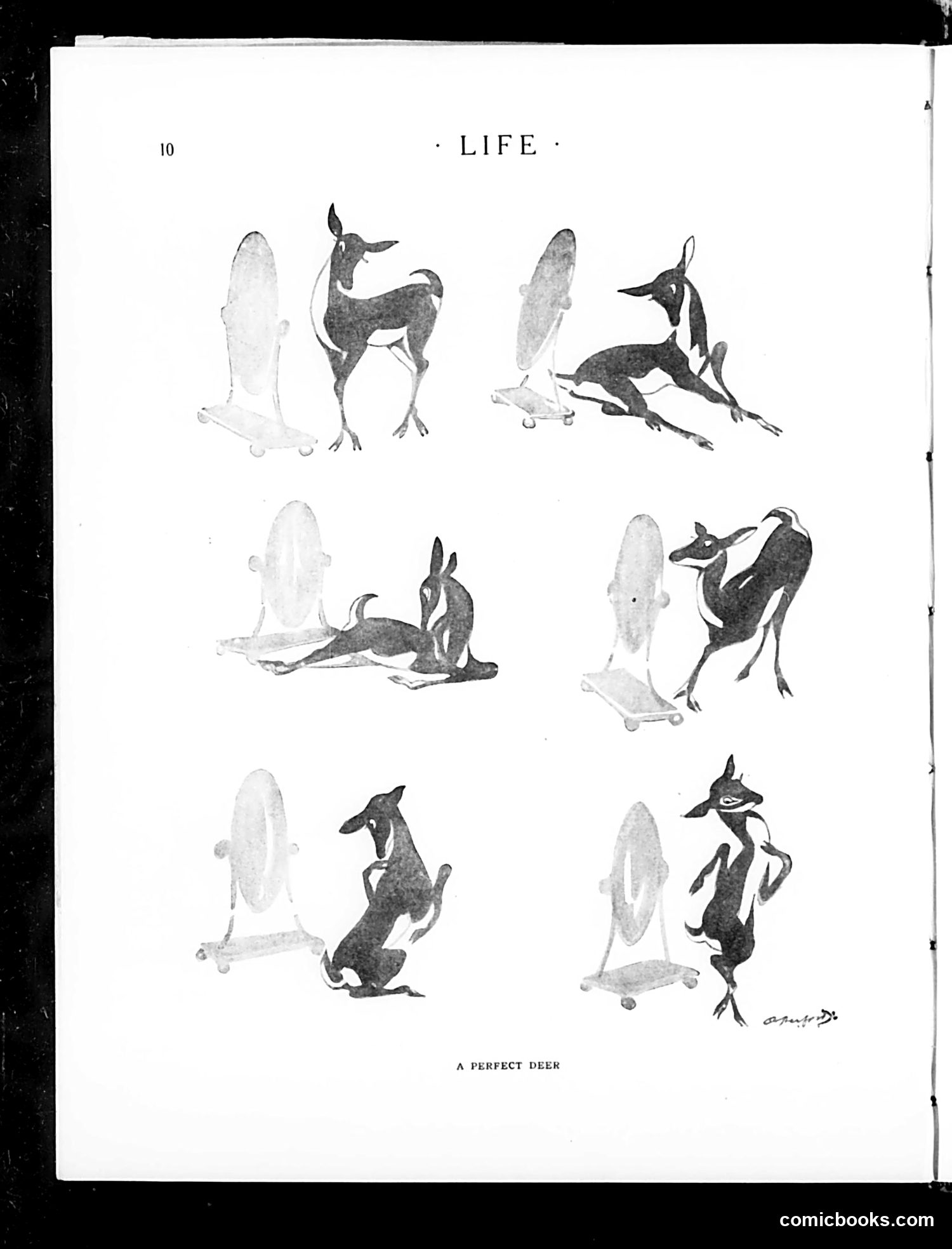
This page presents a humorous visual sequence titled "A Perfect Deer," showing a small deer interacting with a mirror across multiple panels. The satirical point appears to be a commentary on vanity and self-admiration—the deer repeatedly gazes at or poses before the mirror in various attitudes, seemingly entranced by its own reflection. The joke likely works as social satire, using the deer as a stand-in for vain humans who are excessively concerned with their appearance. The repetition of mirror-gazing poses emphasizes the absurdity of such vanity. The title "A Perfect Deer" may be ironic, suggesting that the deer's preoccupation with self-image defines what makes it "perfect" in societal terms—a critique of superficial values.
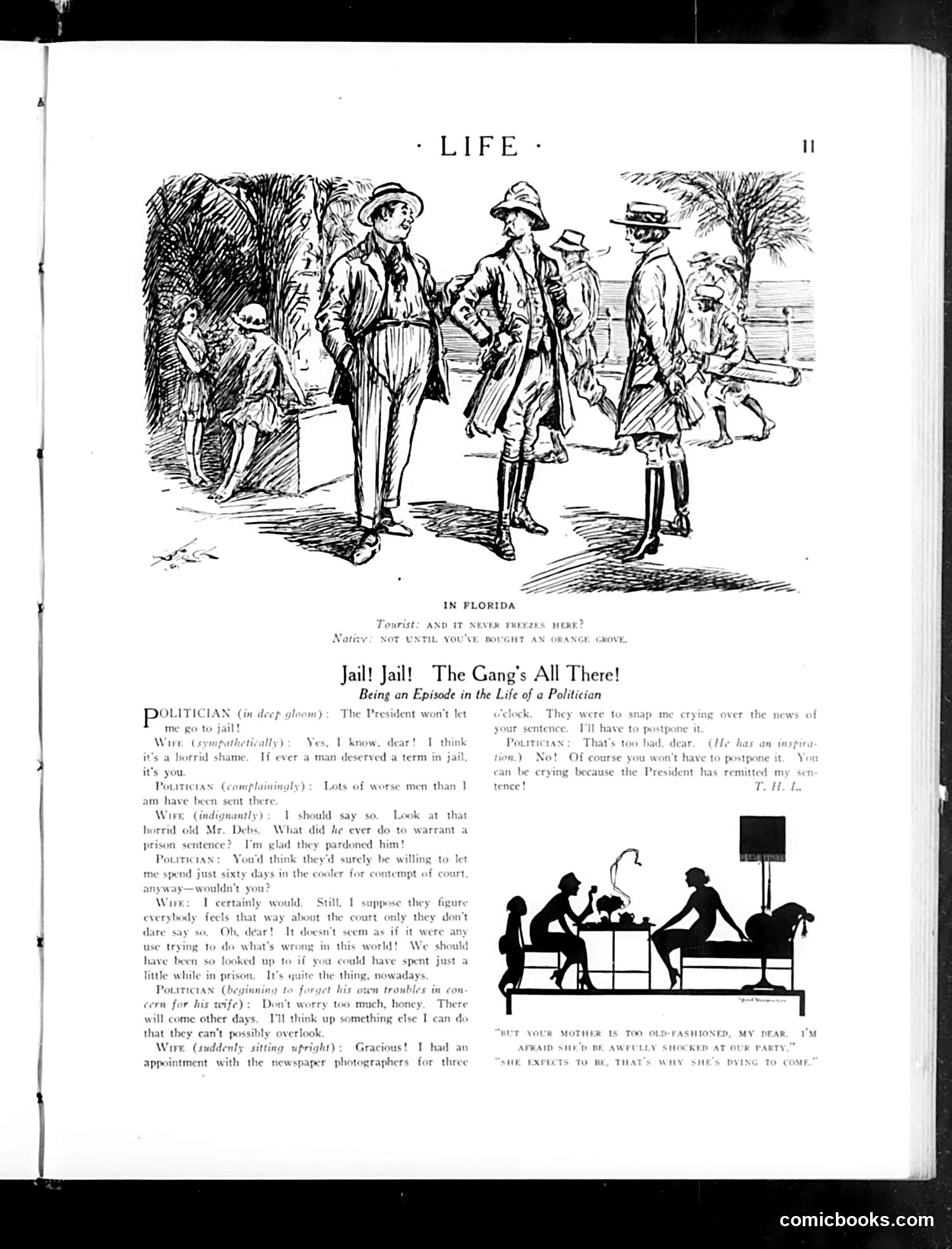
This page contains two satirical pieces about politicians and social behavior. **Top illustration:** A scene "In Florida" depicting tourists and what appears to be a native guide, with the caption joking that things never freeze there—referencing Florida's warm climate as an attraction. **Main article:** "Jail! Jail! The Gang's All There!" satirizes a politician facing jail time for contempt of court. The dialogue shows his wife unsympathetically noting that worse men have served time, while the politician complains about the severity of his sentence and suggests the President might help. The satire mocks both his self-pity and the implied corruption of political favoritism. **Bottom illustration:** A domestic scene where a woman reassures her husband about inviting his elderly mother, fearing she'll be "shocked" by the party—satirizing concerns about propriety and generational attitudes toward entertainment.
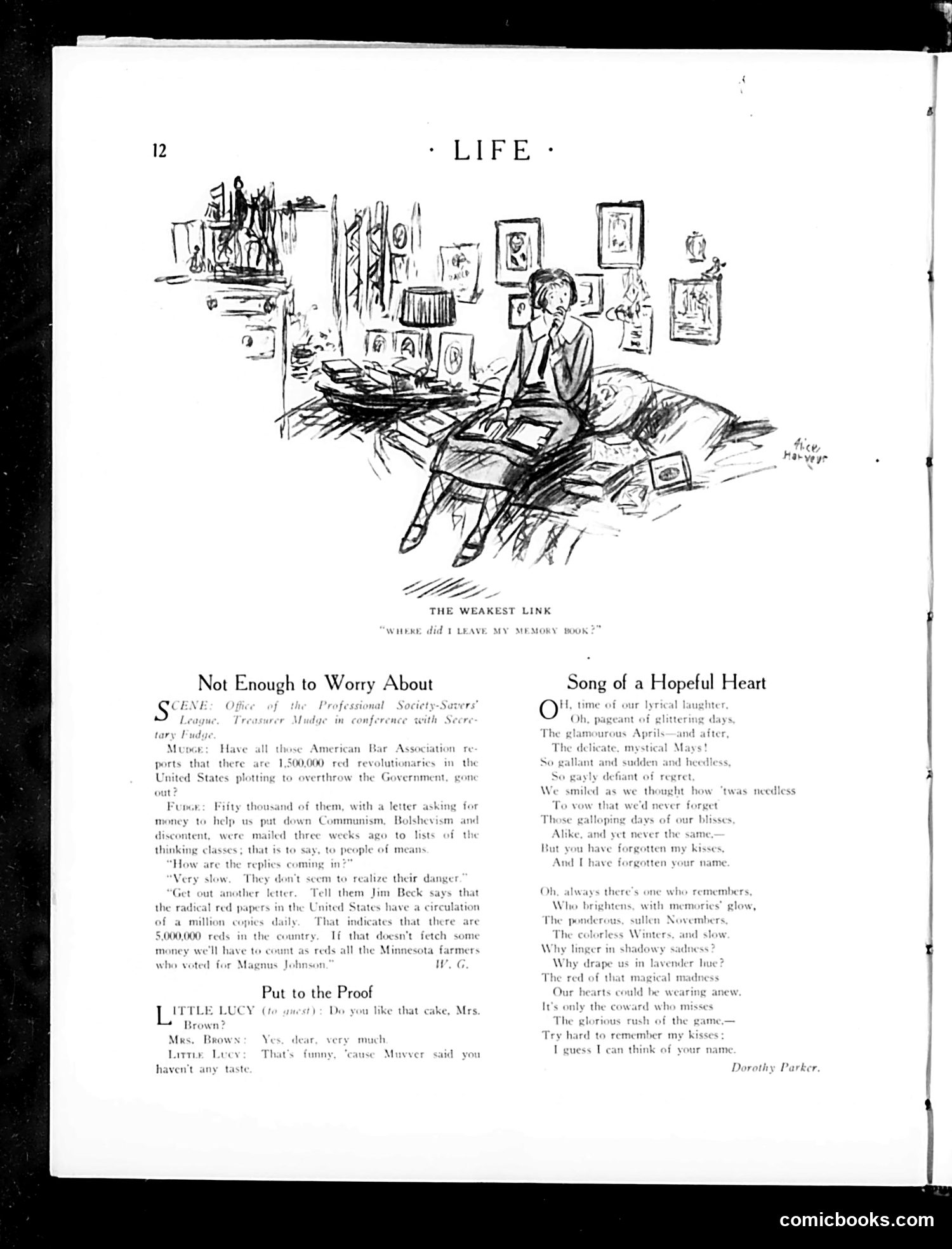
The sketch depicts a woman sitting amid scattered photographs and memory books, with the caption "WHERE DID I LEAVE MY MEMORY BOOK?" This is a gentle satirical jab at the domestic sphere—suggesting that women are so scattered by household duties and social obligations that they literally cannot keep track of their own possessions and memories. The numerous framed pictures and papers surrounding her emphasize the irony: she's surrounded by memory aids yet cannot locate the one thing meant to organize them. The accompanying text discusses Bolshevism and radical newspapers, appearing unrelated to the cartoon. The page also contains dialogue and poetry about love and forgetting, creating an odd juxtaposition between political commentary and sentimental content typical of Life magazine's mixed editorial approach.
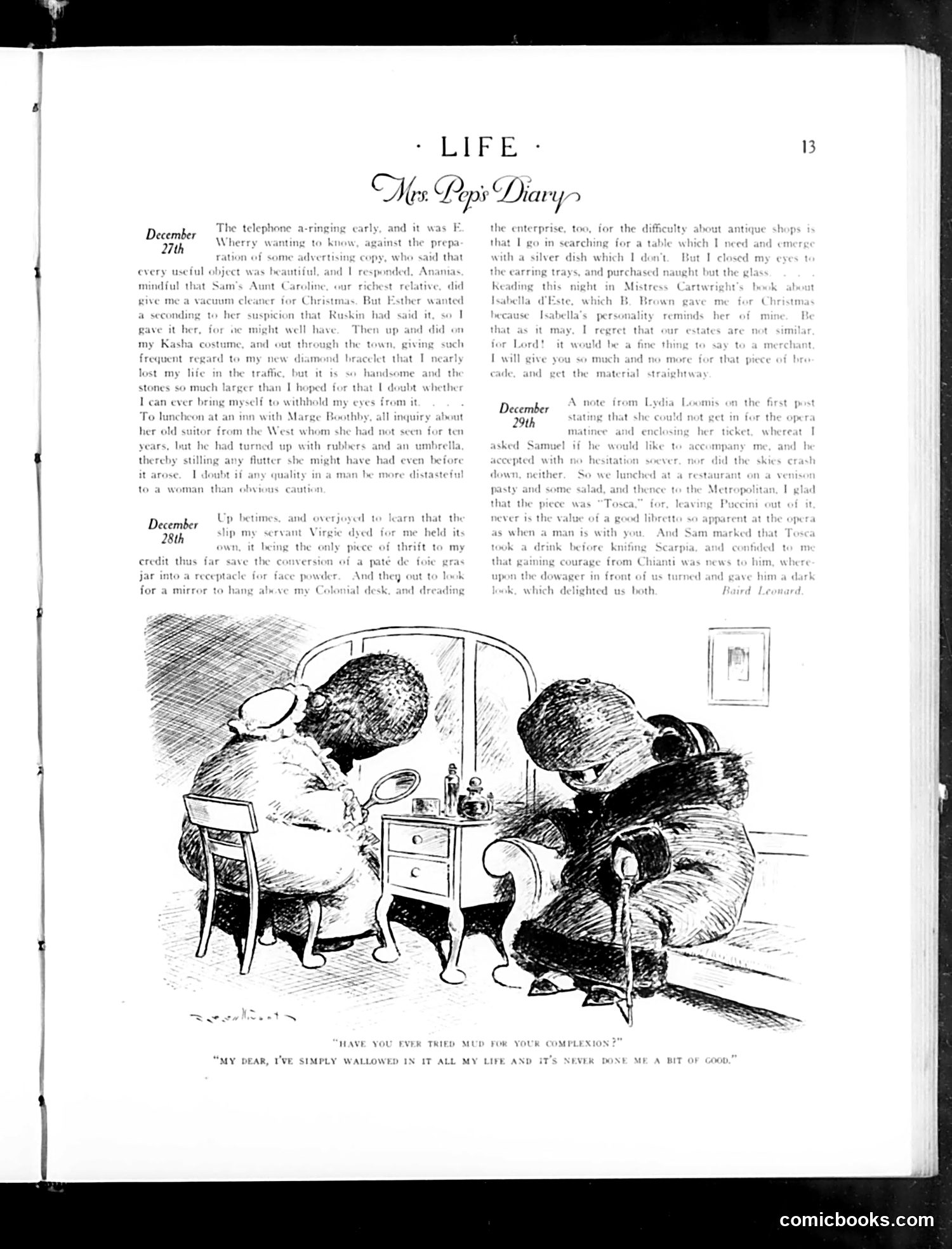
This page presents a satirical diary entry column titled "Mrs. Peps Diary," a recurring feature in Life magazine. The cartoon illustrates a humorous domestic scene showing two women at a vanity mirror, with exaggerated facial features suggesting caricature. The caption reads: "Have you ever tried mud for your complexion?" with the response: "My dear, I've simply wallowed in it all my life and it's never done me a bit of good." The joke mocks beauty treatments and cosmetic vanity—specifically mud facials that were fashionable beauty remedies of the era. The satirist suggests that despite trying such treatments religiously ("wallowed in it"), they produce no visible improvement. This reflects period humor about women's obsession with beauty routines and the ineffectiveness of popular cosmetic fads.
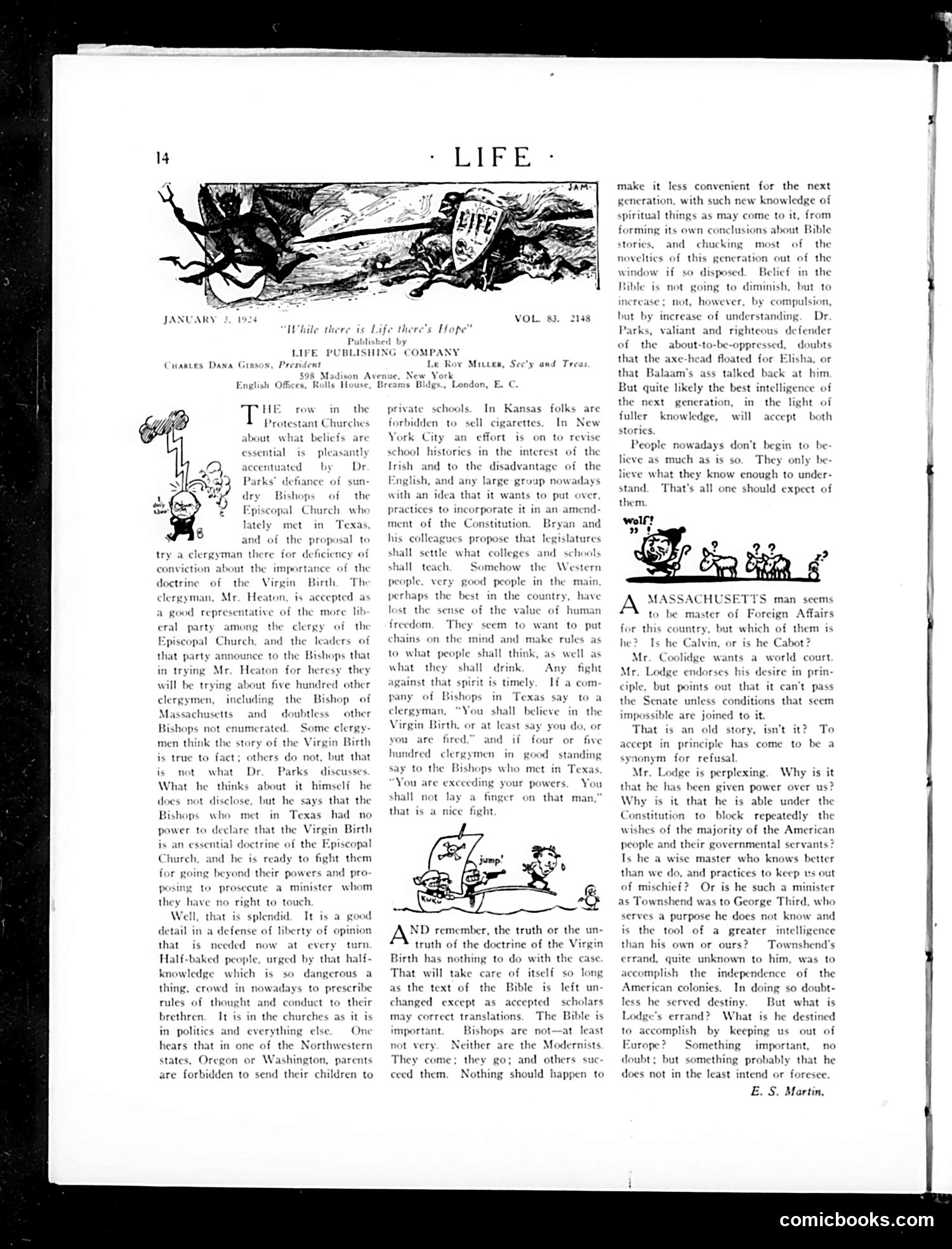
This page satirizes religious and educational controversies of the 1920s. The text discusses debates over teaching evolution and Bible interpretation in schools, particularly attacks on Dr. Harry Emerson Fosdick and other modernist clergy by conservative Episcopalians. The cartoons (though small and somewhat unclear) appear to mock authority figures—possibly bishops or clergymen—and their attempts to control what schools teach. The piece criticizes efforts to ban cigarettes, revise school curricula, and suppress free thought, presenting these as hypocritical overreach by religious institutions. The final section, signed "E.S. Martin," questions whether concentrating power in fewer hands (referencing Lodge and Townsend) serves the public interest—a critique of political centralization during this period.
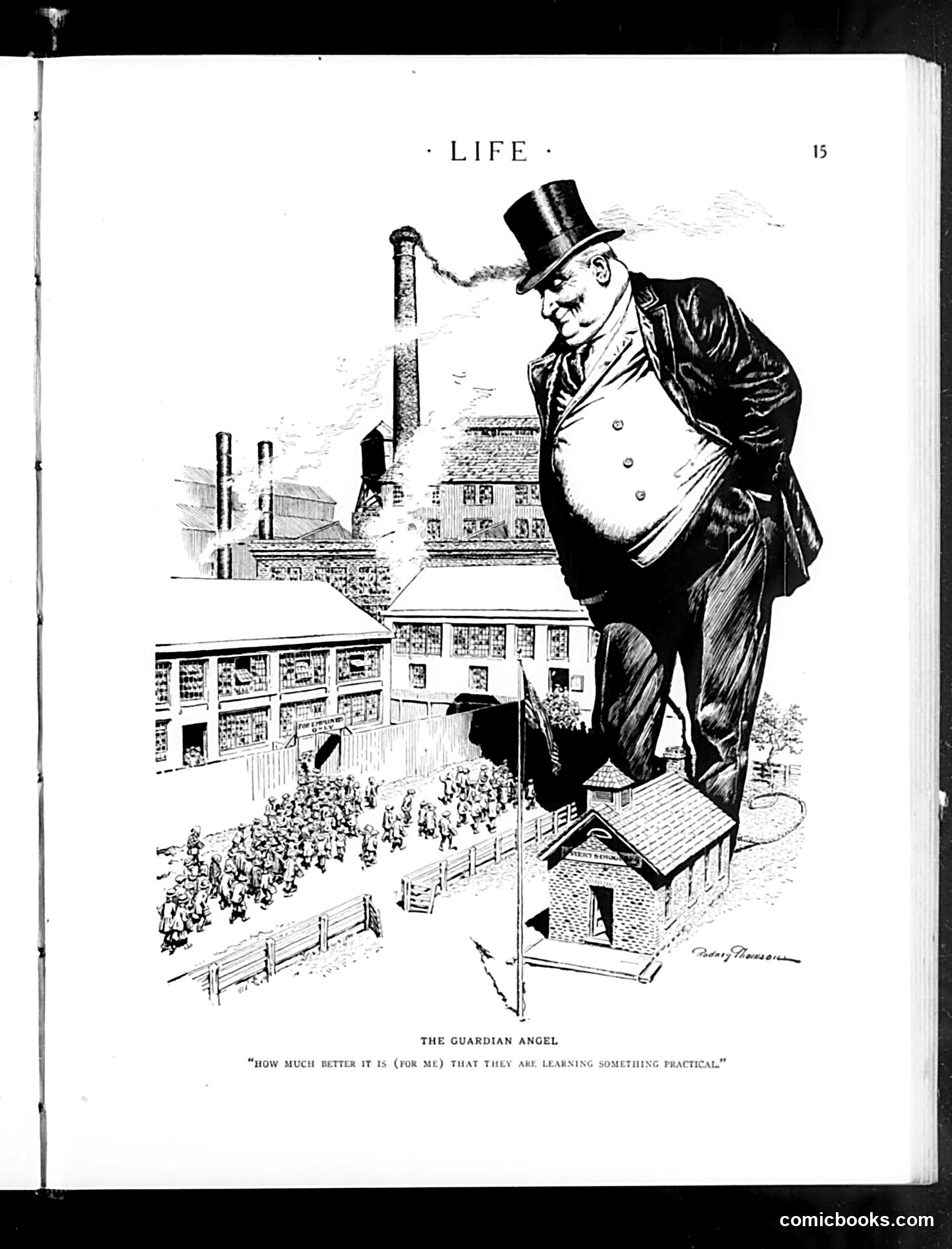
This satirical cartoon depicts a wealthy, corpulent industrialist in top hat and formal dress looming over a factory complex and schoolhouse. The caption reads: "How much better it is (for me) that they are learning something practical." The satire targets **industrial capitalists** who supported vocational/practical education for working-class children rather than academic education. The "guardian angel" framing is deeply ironic—the fat plutocrat is no benevolent protector but a self-interested overseer ensuring the labor force remains trained for factory work rather than gaining education that might enable social mobility or class advancement. The cartoon critiques how industrial elites shaped educational policy to serve their workforce needs rather than workers' genuine interests. The tiny schoolhouse contrasts starkly with the massive factories behind it, emphasizing whose interests truly mattered.
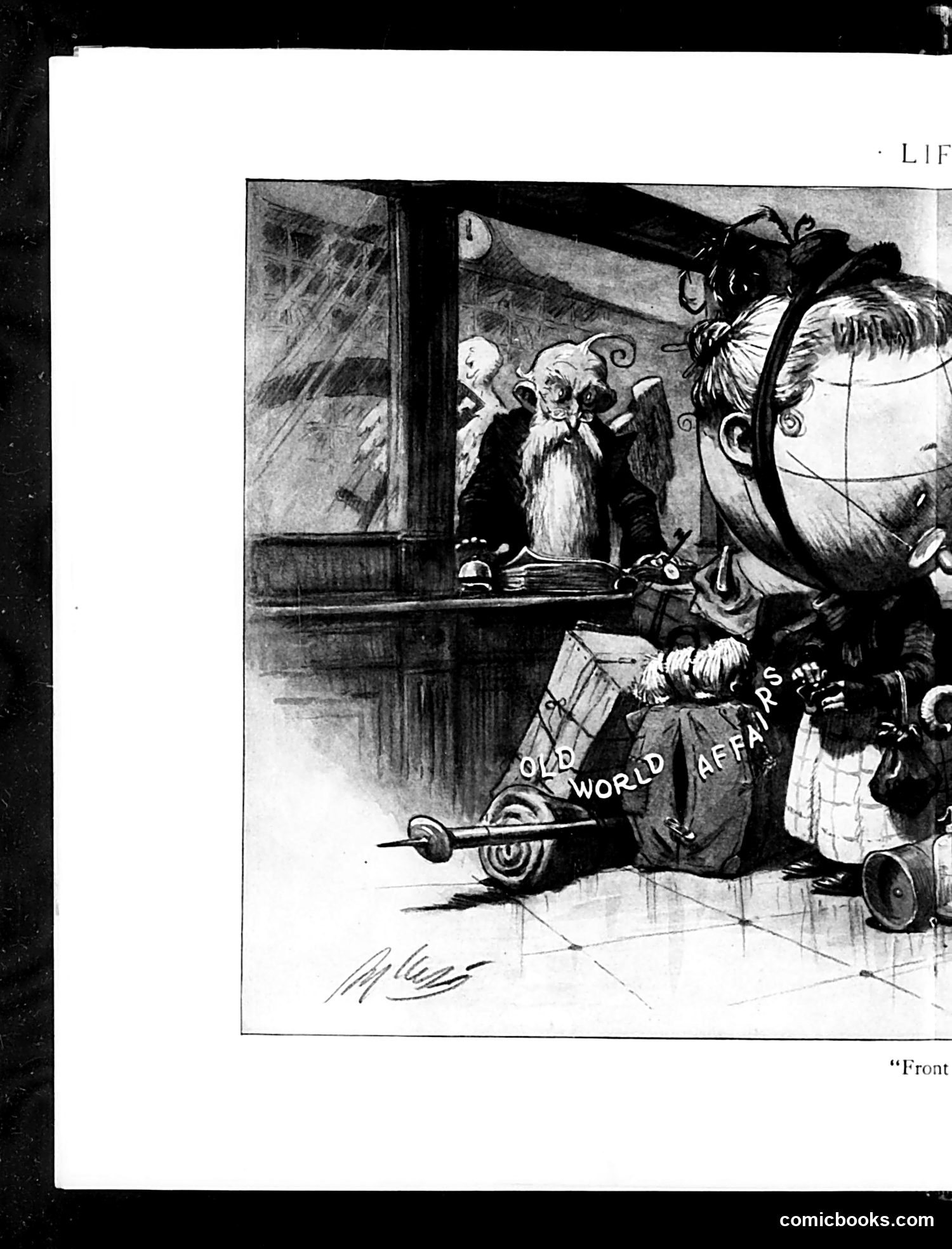
This appears to be a satirical cartoon from *Life* magazine depicting a figure with an enormous head labeled "OLD WORLD AFFAIRS" arriving at a doorway where two men (appearing to be politicians or diplomats) look out nervously. The grotesquely oversized head suggests that international complications are literally overwhelming—dominating discourse and attention. The cartoon likely satirizes American political preoccupation with foreign affairs during a period when isolationist versus interventionist debates were contentious (likely early-to-mid 20th century). The exaggerated proportions mock how "world affairs" have become disproportionately large concerns compared to domestic issues, suggesting the weight of international entanglements threatens to overtake national priorities. The specific political figures remain unclear from the image alone.
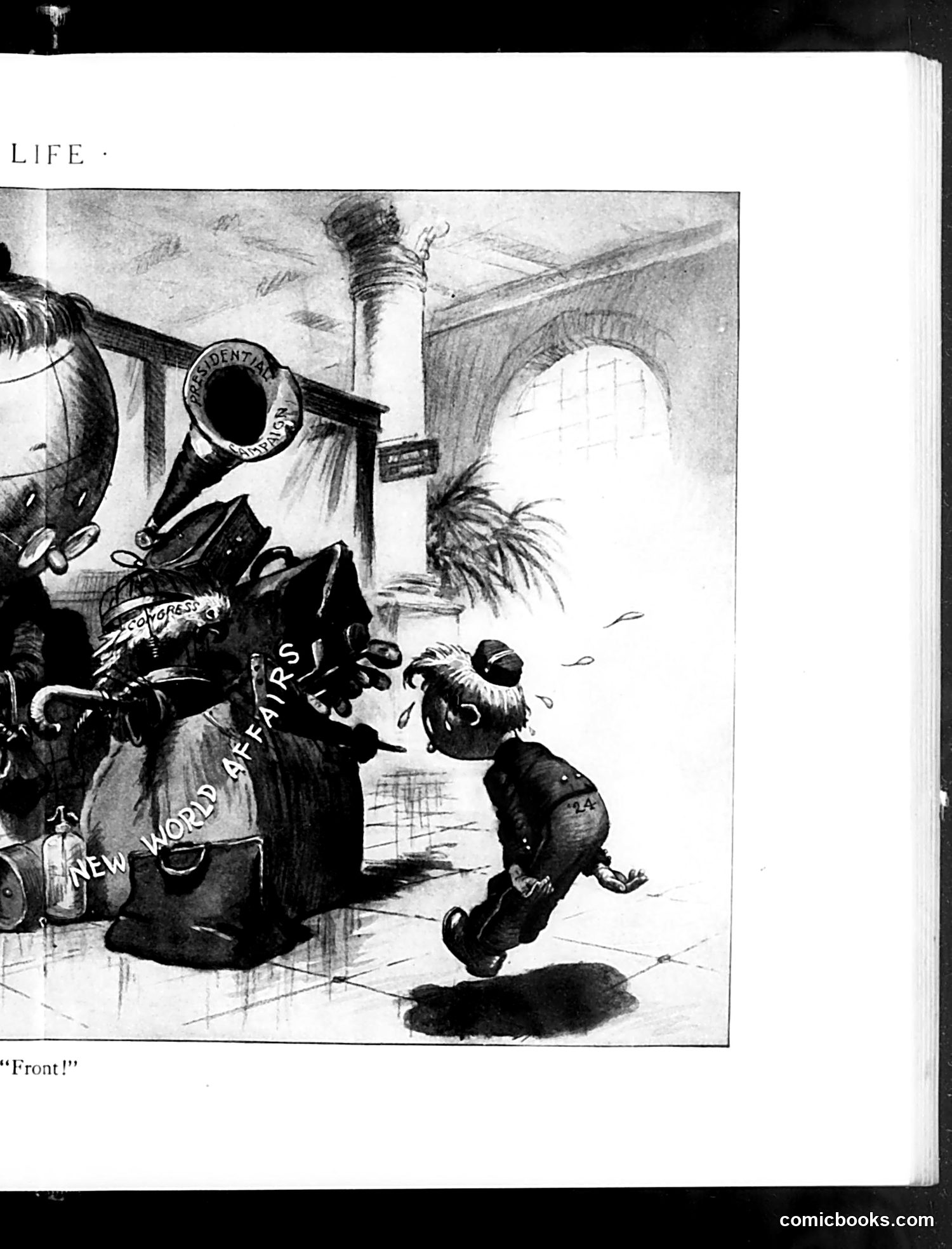
This is a political cartoon from *Life* magazine titled "Front!" The image depicts a large figure labeled "NEW WORLD" (visible on clothing) operating what appears to be a mechanical device or megaphone labeled "PRESIDENTIAL." A smaller figure, styled as a caricatured person in formal dress, is being blown backward by the force of this mechanism. The satire appears to criticize how presidential campaigns or political machinery manipulate public discourse—the "New World" (likely America or American politics) uses the presidency as a tool to project amplified messages. The small figure's shock and backward motion suggest the overwhelming, distorting power of this political apparatus. Without visible dates or names, the exact target remains unclear, but the cartoon satirizes how political institutions overwhelm individual voices or truth.
This page discusses the Hippodrome theater's reopening after a closing announcement, contrasting the old and new productions. The cartoon header shows theatrical masks and dramatic scenes, setting the "Drama" section context. **Key points:** The writer humorously describes their earlier farewell article about the Hippodrome closing—only to have it reopen that fall. They note the new show features the "Sixteen Mineral Lava Beauties" and Breitbart the Strong Man, a real strongman performer known for feats like lying on nails while horses gallop over him. The joke is that parents must tell children "Sh-h-h!" to prevent uncomfortable questions about impossible physics. The column defends foreign theater productions (like the Chauve-Souris and Moscow Art players) against critics, arguing good acting transcends language barriers. A good actor offers voice quality, facial expression, and visual beauty beyond mere dialogue. The underlying satire critiques American provincialism about non-English theater while celebrating physical spectacle over narrative.
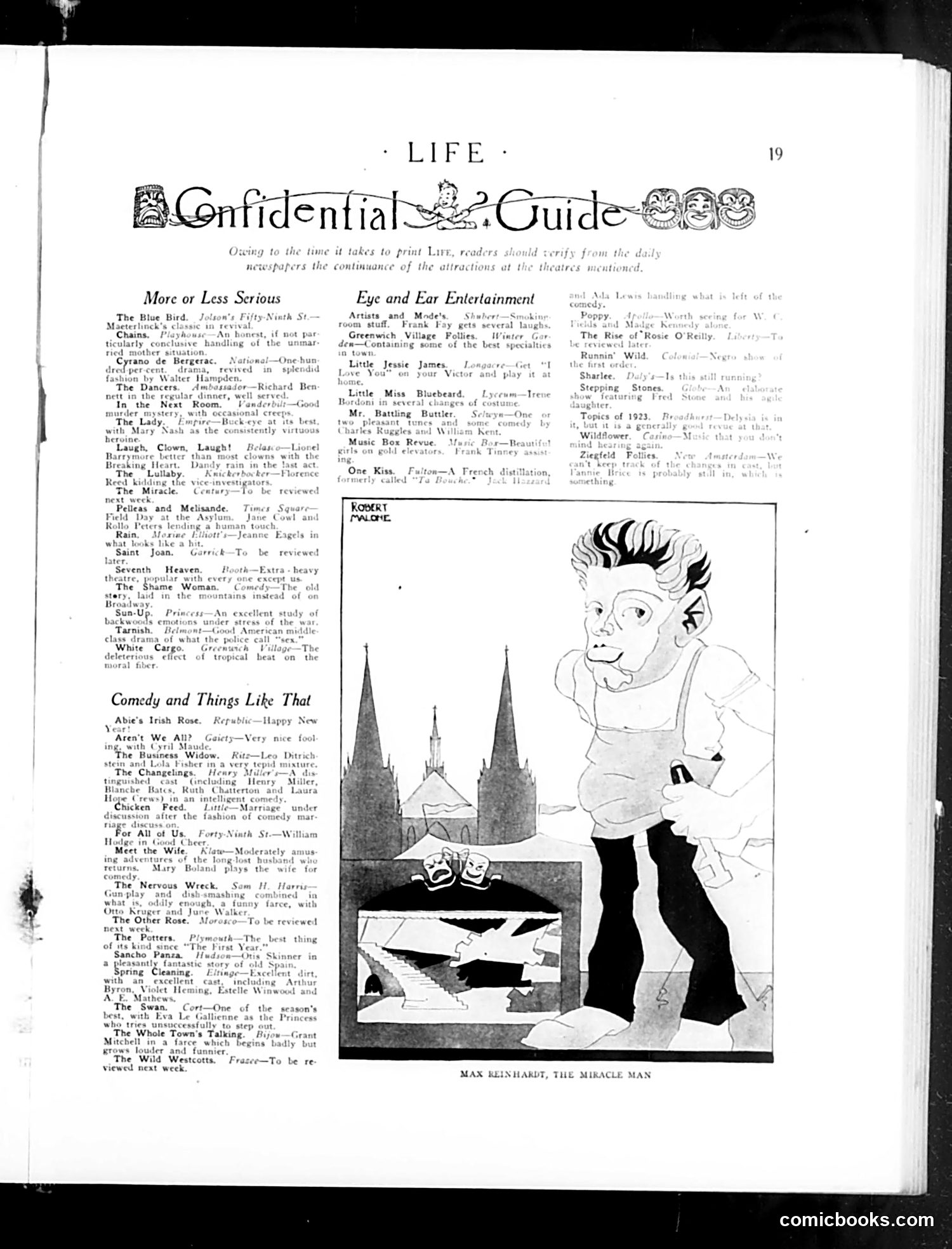
This page from *Life* magazine is a theater guide listing Broadway productions and entertainment options. The illustration labeled "Max Reinhardt, The Miracle Man" shows a caricatured figure (likely Max Reinhardt, the famous Austrian theater director) gesturing dramatically above a cathedral scene. The joke appears to reference Reinhardt's 1924 production of "The Miracle," a spectacular theatrical adaptation featuring elaborate staging and religious imagery. The exaggerated caricature mocks Reinhardt's grandiose directorial style—the wild hair and theatrical gesture suggest he's presenting himself as almost miraculous in his ability to transform a stage production. The cathedral backdrop reinforces the biblical/religious spectacle he was known for creating. The surrounding theater listings show this was a robust Broadway season with serious plays (*Saint Joan*, *Cyrano de Bergerac*) alongside comedies and lighter fare, offering readers a comprehensive guide to current entertainment options.
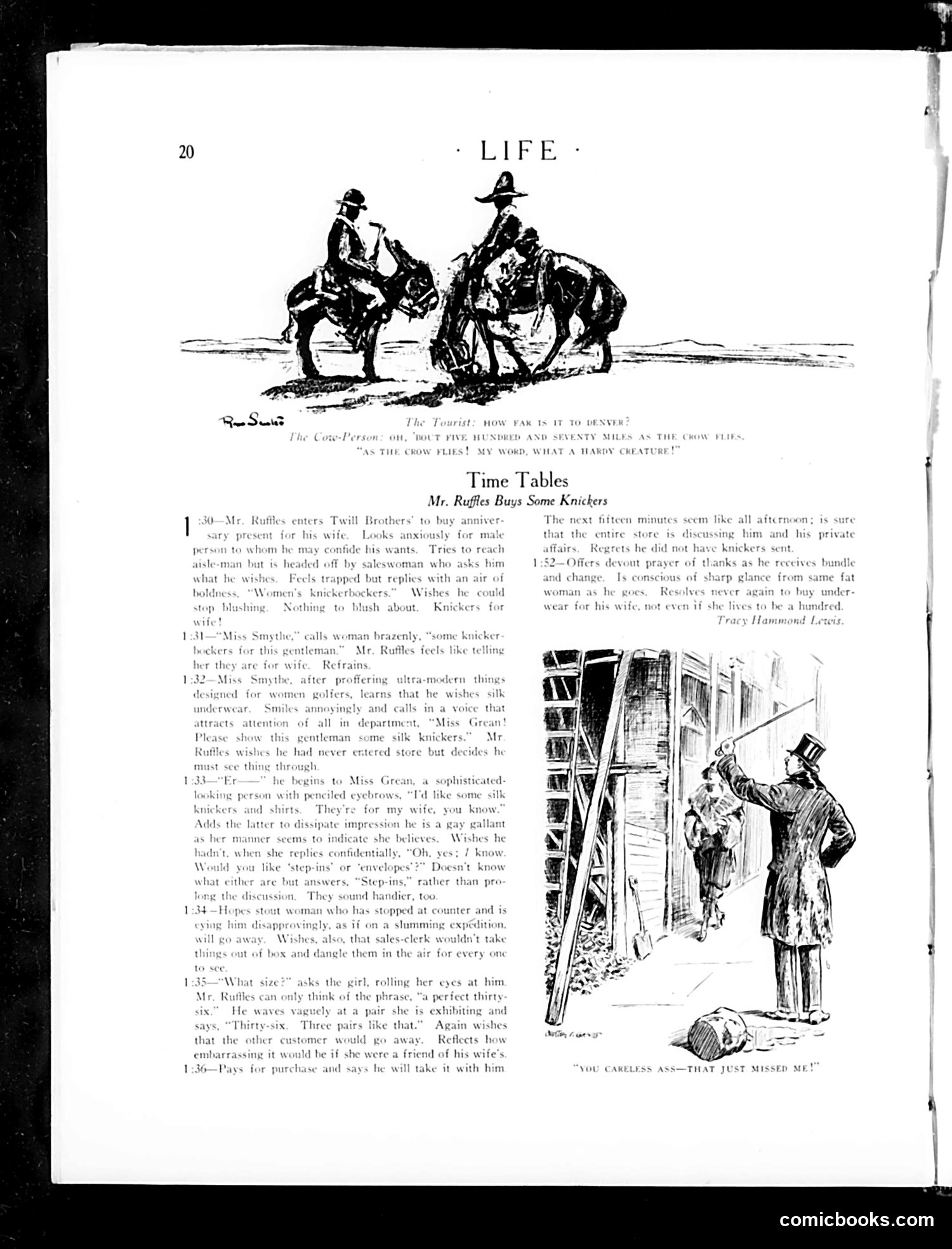
This page contains two separate pieces of humor: **Top cartoon:** A Western scene showing two cowboys on horseback. The caption indicates one is asking the other about distance to Denver—a straightforward travel joke playing on the vast distances of the frontier West. **"Time Tables: Mr. Ruffles Buys Some Knickers":** This is a satirical narrative about a man shopping for women's undergarments (knickers). The humor centers on his embarrassment and the social awkwardness of the era regarding such intimate purchases. Each time entry (1:30, 1:41, etc.) marks moments in his increasingly uncomfortable shopping experience—he's self-conscious, the saleswoman is dismissive, and he regrets the whole endeavor. The satire mocks both Victorian-era prudishness about discussing women's clothing and the gap between men's awkwardness in such situations versus women's practical matter-of-factness. The accompanying illustration shows him leaving the store in apparent defeat.
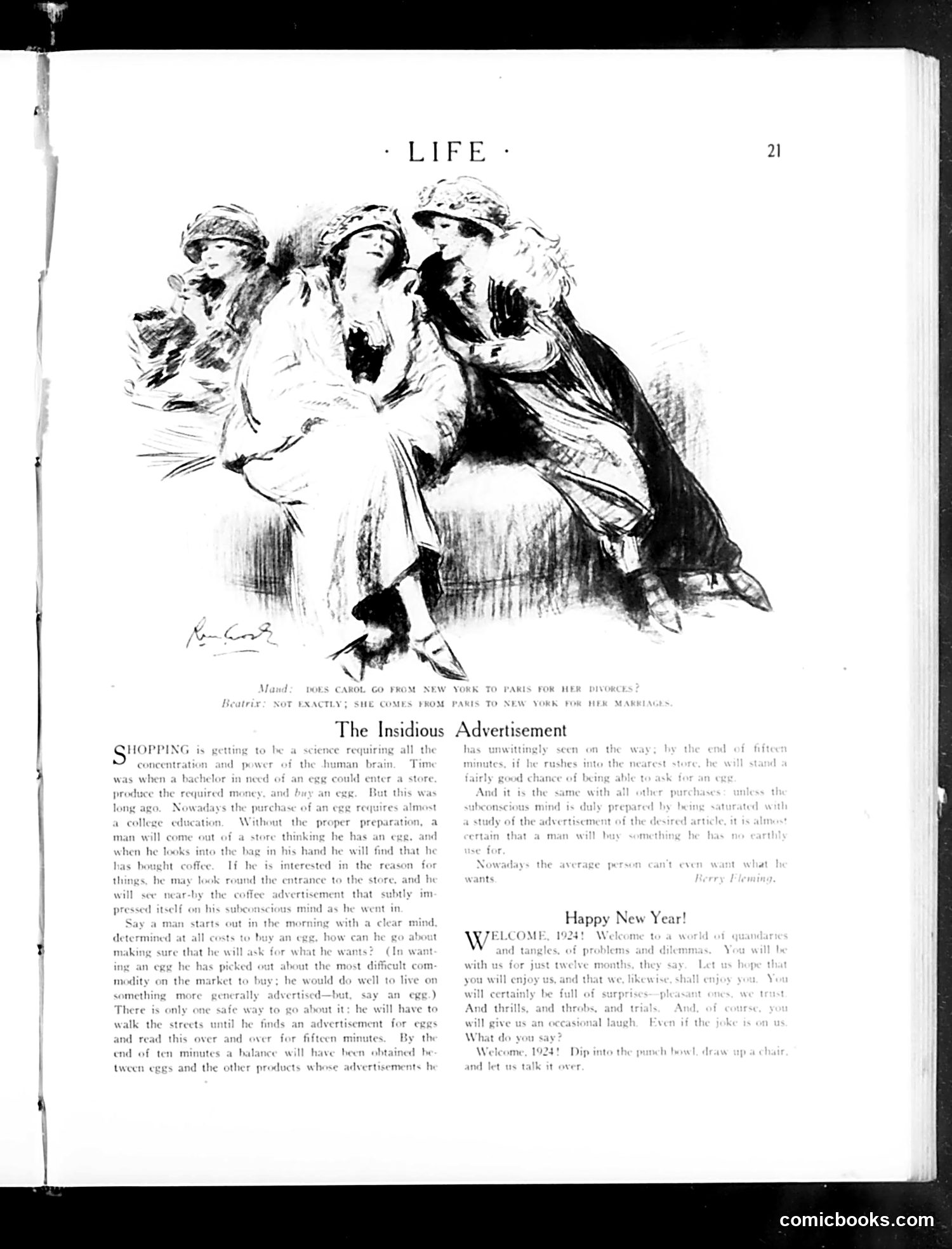
This is page 21 from *Life* magazine featuring a satirical illustration and two articles. The **cartoon** depicts three fashionable women in 1920s attire and cloche hats, with dialogue about travel between New York and Paris for divorces versus marriages—likely mocking the ease of transatlantic divorce among the wealthy during an era when divorce was socially scandalous and legally restrictive. **"The Insidious Advertisement"** satirizes consumer manipulation: it argues that modern shopping requires constant mental discipline because advertisements are deliberately designed to make people buy things they don't need. The author warns that without careful attention, shoppers will unknowingly purchase whatever products surround them. **"Happy New Year!"** is a brief welcoming piece for 1924, encouraging readers to embrace the year's opportunities and challenges ahead. The overall page reflects 1920s concerns: changing gender roles, divorce stigma, consumerism, and advertising's growing cultural influence.
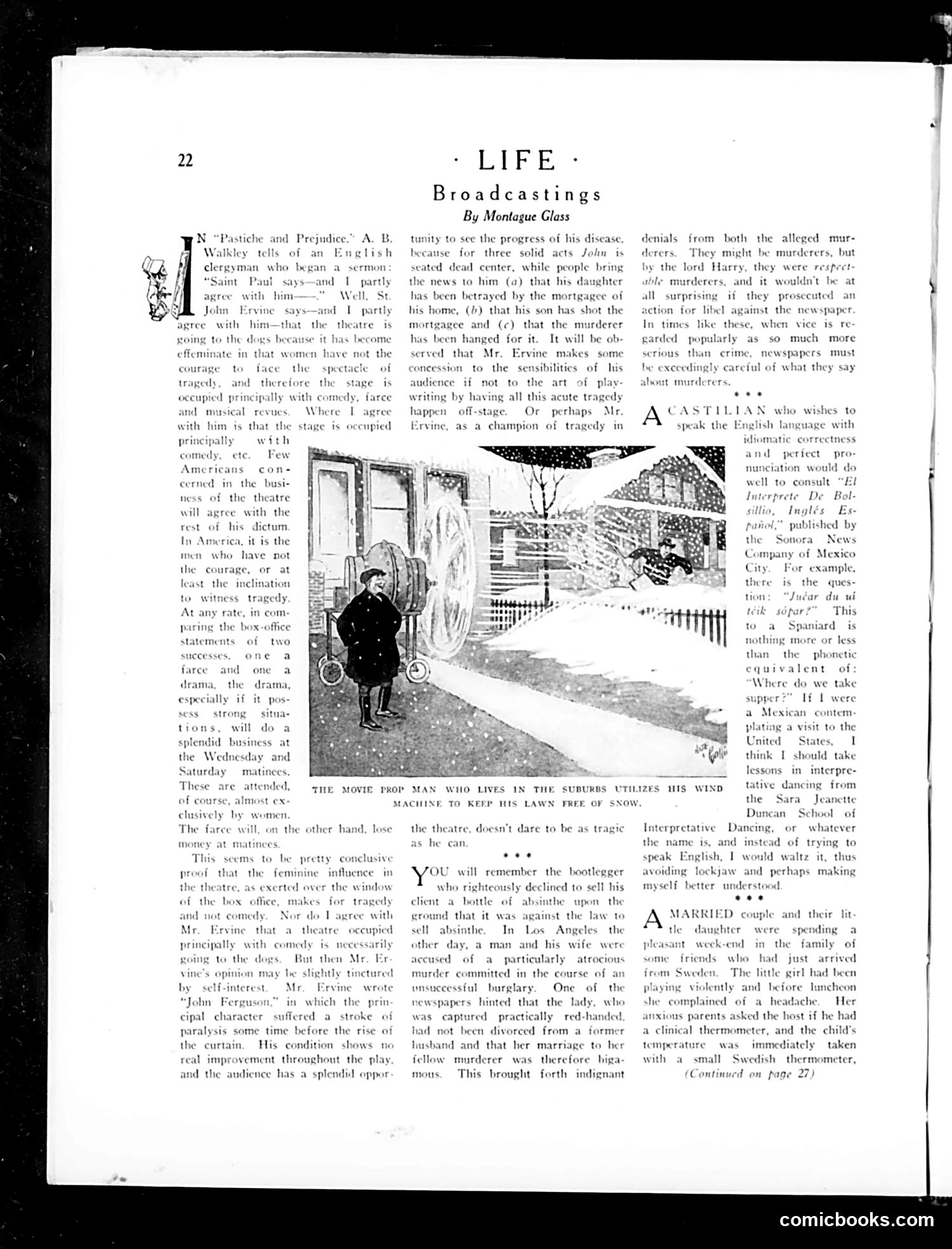
This page contains theater criticism by Montague Glass discussing John Ervine's plays and dramatic principles. The single cartoon depicts a suburban property owner using a wind machine (likely a movie prop) to keep snow off his lawn—a humorous commentary on the absurdity of over-mechanization in everyday domestic life. The main text critiques Ervine's approach to tragedy, arguing that while American theater audiences attend matinee performances (attended "almost exclusively by women"), they lack the courage to witness genuine tragedy. Glass notes Ervine champions off-stage tragedy rather than direct spectacle. The column also includes brief anecdotes: one about a bootlegger prosecuted for selling absinthe, another about a suspicious murder case in Los Angeles where a woman was accused of killing her former husband. The overall tone satirizes both theatrical conventions and sensationalist newspaper coverage of crime, suggesting editors are overly cautious about what they report regarding murderers.
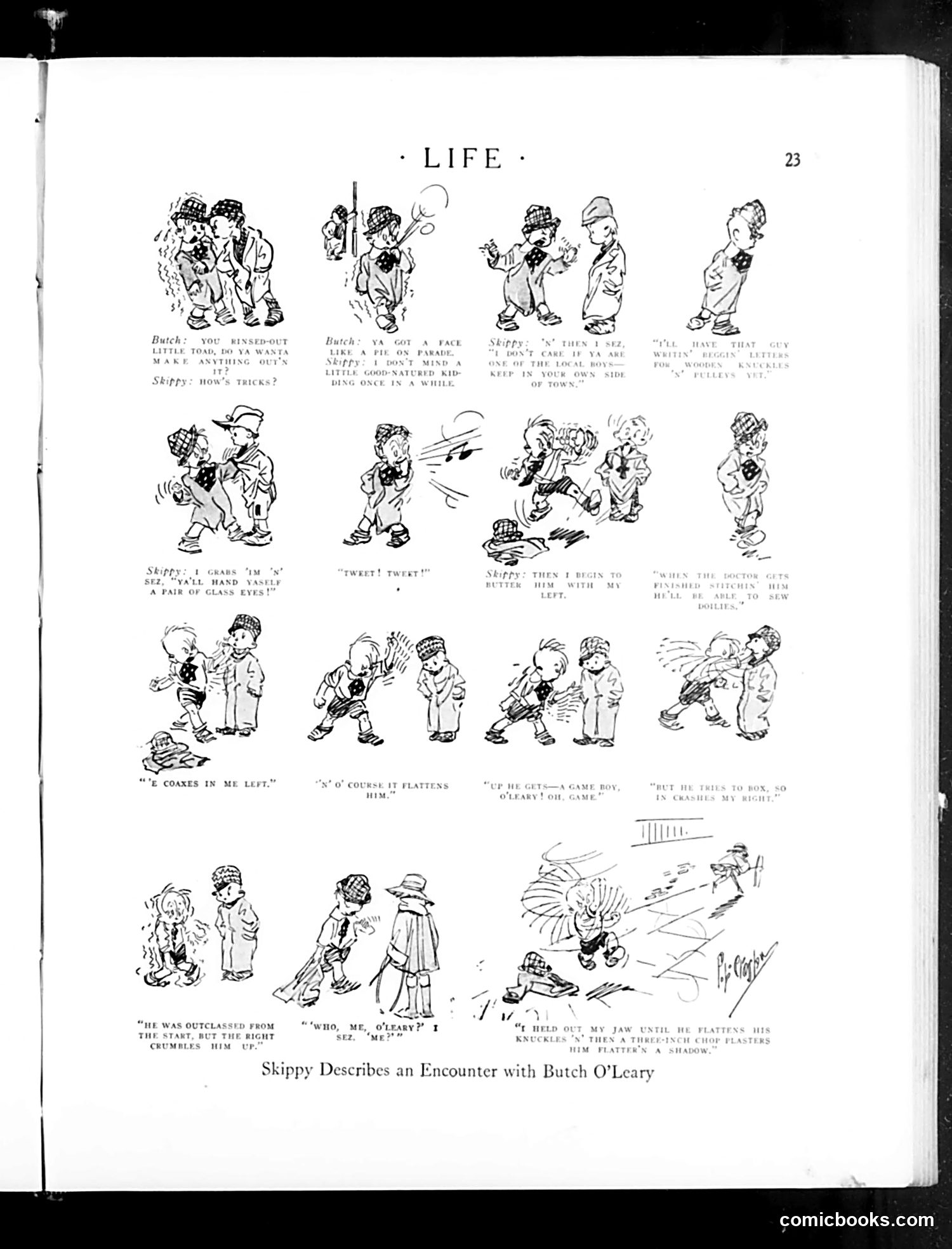
This is a humorous comic strip titled "Skippy Describes an Encounter with Butch O'Leary." The page shows a sequence of panels depicting a young boy (Skippy) recounting a fight with another boy (Butch O'Leary) to what appears to be an adult authority figure, likely a parent or teacher. The humor derives from the classic childhood scenario: Skippy provides an exaggerated, self-aggrandizing account of the confrontation, claiming victory despite obvious evidence to the contrary. The visual gags show him getting thoroughly beaten—knocked down, bloodied, and battered—while his dialogue suggests he dominated the fight ("I held out my jaw until he flattened his knuckles 'n' then a three-inch chop plastered him flatter'n a shadow"). The satire mocks how children embellish stories and misrepresent outcomes to save face before adults, a timeless comedic theme.
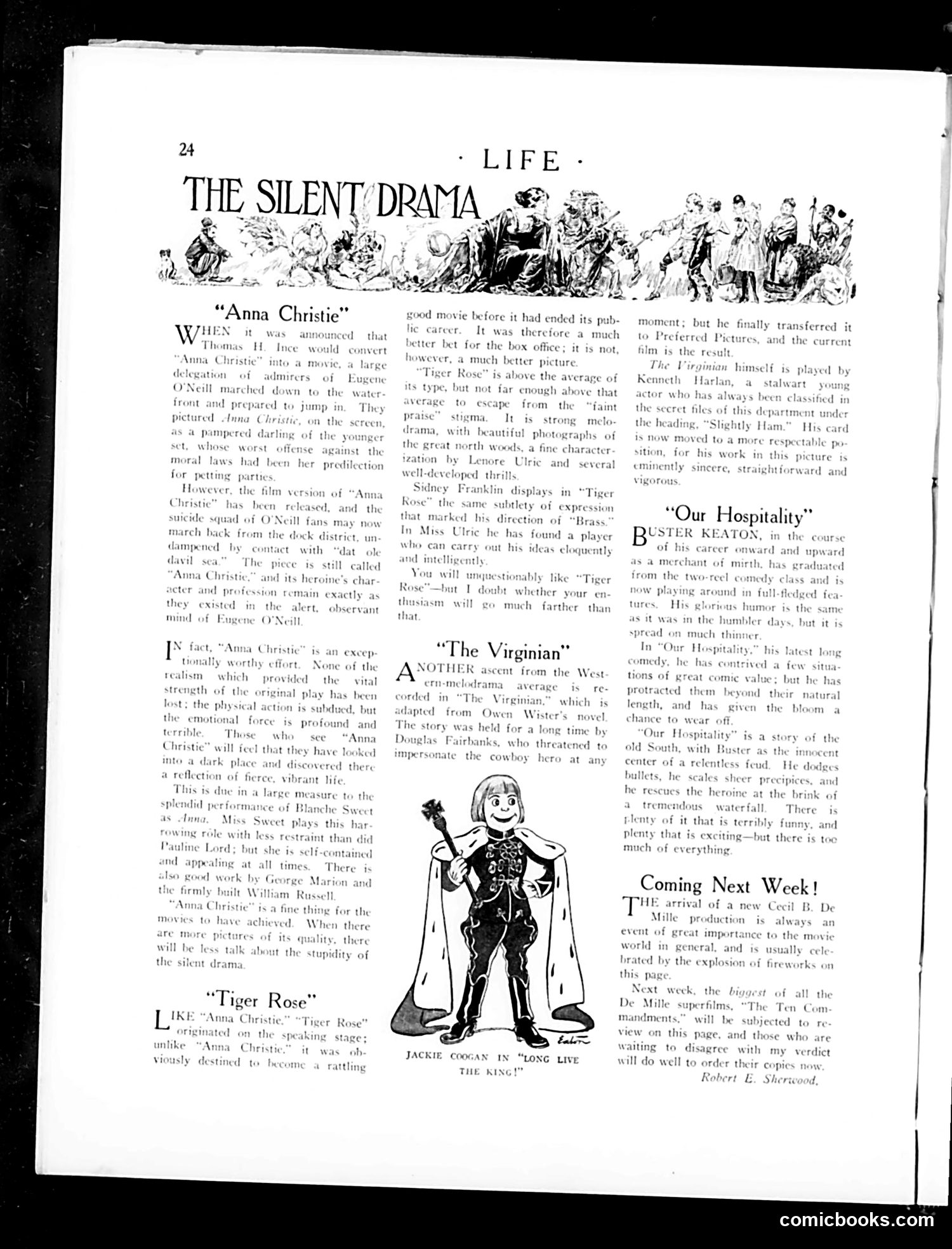
This page contains film criticism rather than political cartoons. It reviews three silent films: **"Anna Christie"** — A stage-to-screen adaptation praised for its realism and emotional depth, though the critic notes the film version loses some of the original play's power. **"Tiger Rose"** — Criticized as derivative of "Anna Christie," yet praised for Sidney Franklin's direction and a capable lead performance. **"The Virginian"** — A Western adapted from Owen Wister's novel, featuring Douglas Fairbanks in the iconic cowboy role. **"Our Hospitality"** — A Buster Keaton comedy praised for combining humor with genuine suspense and physical comedy. The only illustration is a cartoon of **Jackie Coogan** in "Long Live the King!"—likely a child actor vehicle popular in the 1920s. The page concludes by teasing Cecil B. DeMille's upcoming "Ten Commandments," described as the "biggest" De Mille production yet. This reflects the silent era's emphasis on spectacle and star power.
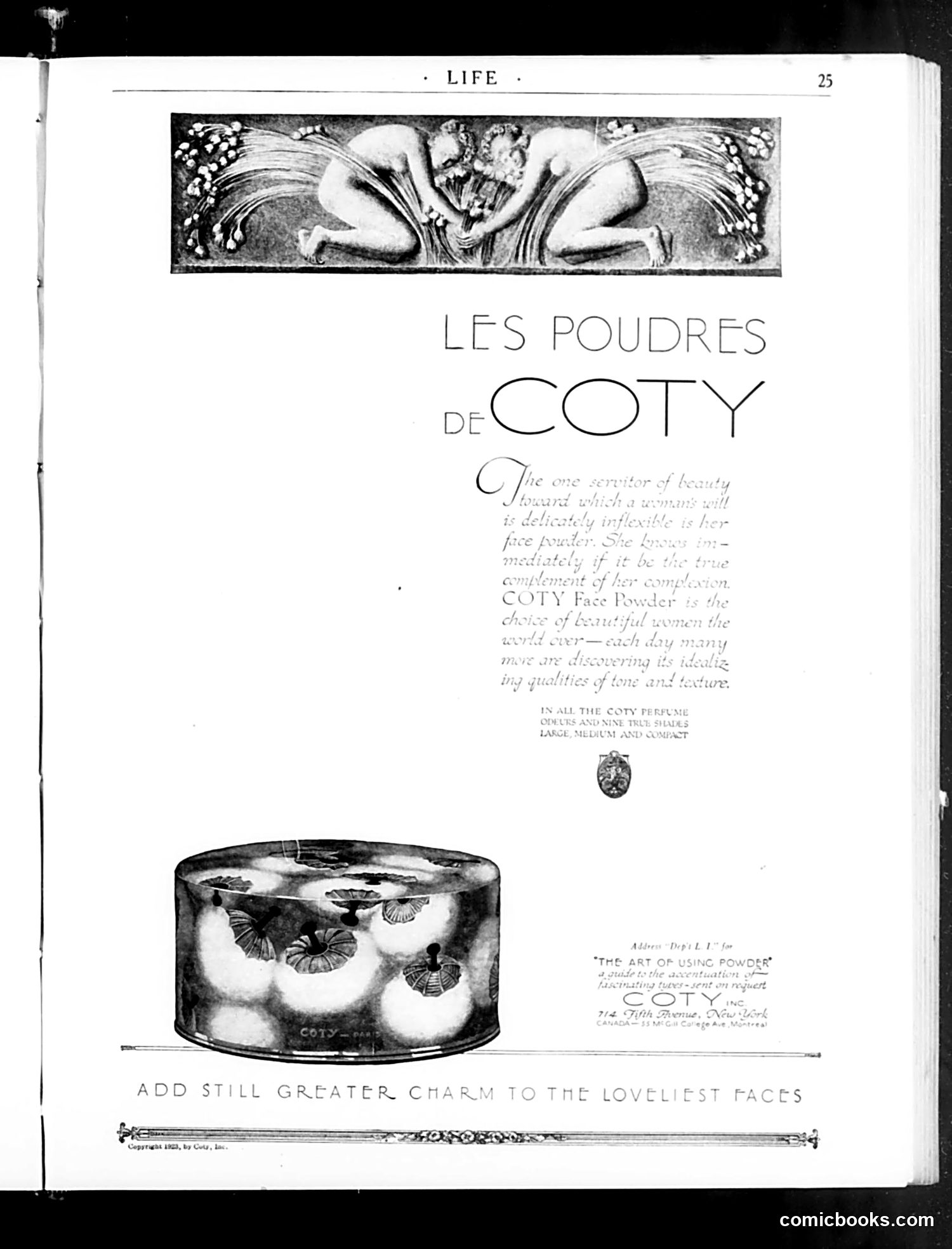
This page is primarily **advertising**, not satire or political commentary. It promotes Coty face powder, a genuine beauty product from the era. The decorative header features classical art depicting cherubs or putti (common in cosmetics advertising of this period). The main image shows an ornate powder box with floral designs. The ad copy appeals to wealthy women, describing face powder as essential to beauty and claiming Coty is "the choice of beautiful women the world over." It emphasizes the powder's quality across multiple sizes and claims it "adds still greater charm to the loveliest faces." There is no cartoon, satire, or political reference here—this is straightforward vintage beauty product marketing using period aesthetic conventions and aspirational messaging aimed at affluent female consumers.
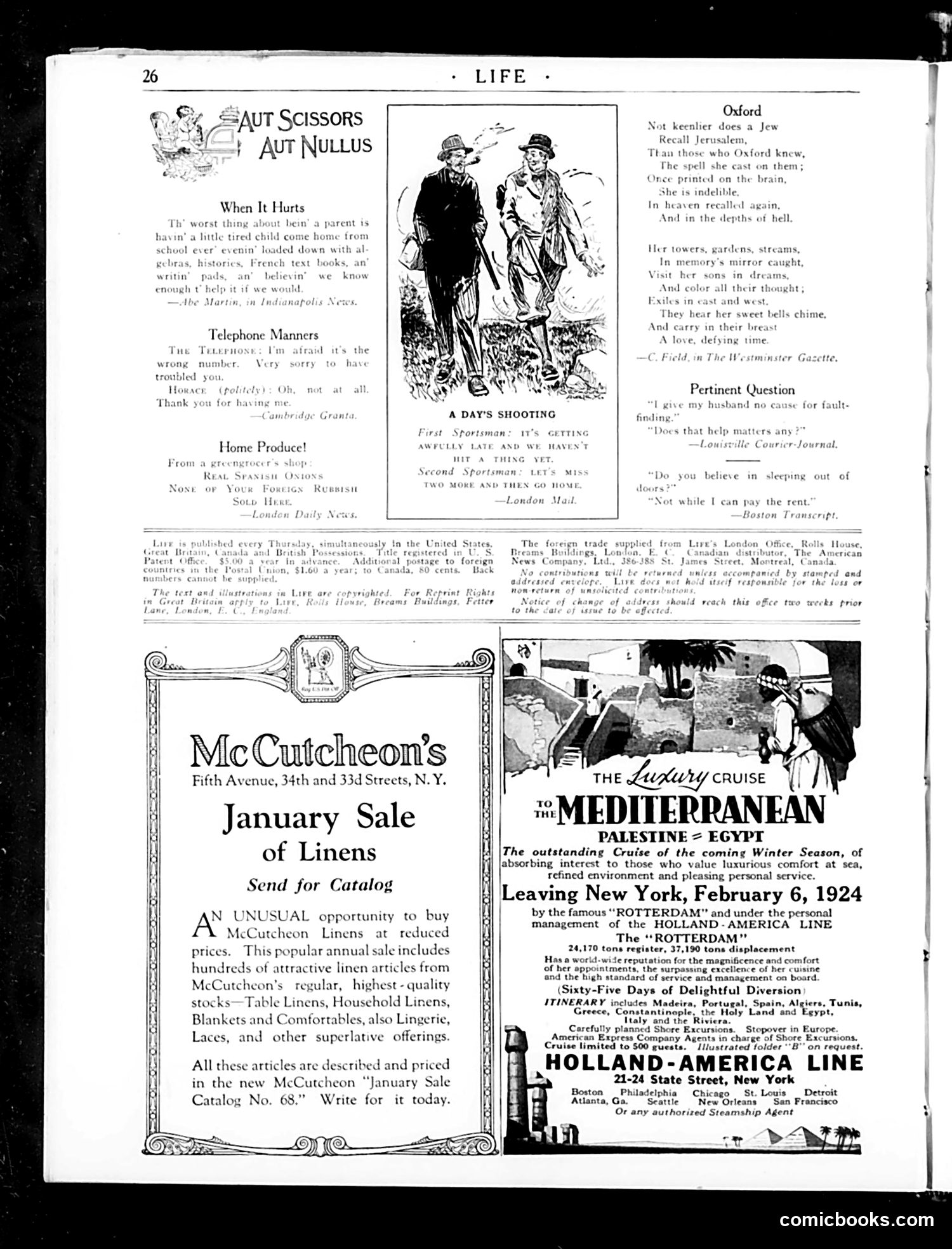
This page from *Life* magazine combines humor with advertising. The main cartoon, "A Day's Shooting," depicts two hunters discussing their outing. The first sportsman complains they arrived late and "haven't hit a thing yet"; the second responds they've missed two more shots and should go home. The joke satirizes incompetent hunters—their day of shooting has been entirely fruitless, yet they persist in staying out. The page also features lighter humor pieces on telephone etiquette and home cooking, typical of *Life's* satirical coverage of contemporary social behavior. The bulk of the page comprises period advertisements: McCutcheon's January linen sale and a Holland-America Line cruise to the Mediterranean. These ads reflect 1920s luxury consumer culture—high-end linens and expensive leisure travel aimed at affluent readers. The Oxford poem appears sentimental rather than satirical, celebrating the university nostalgically.
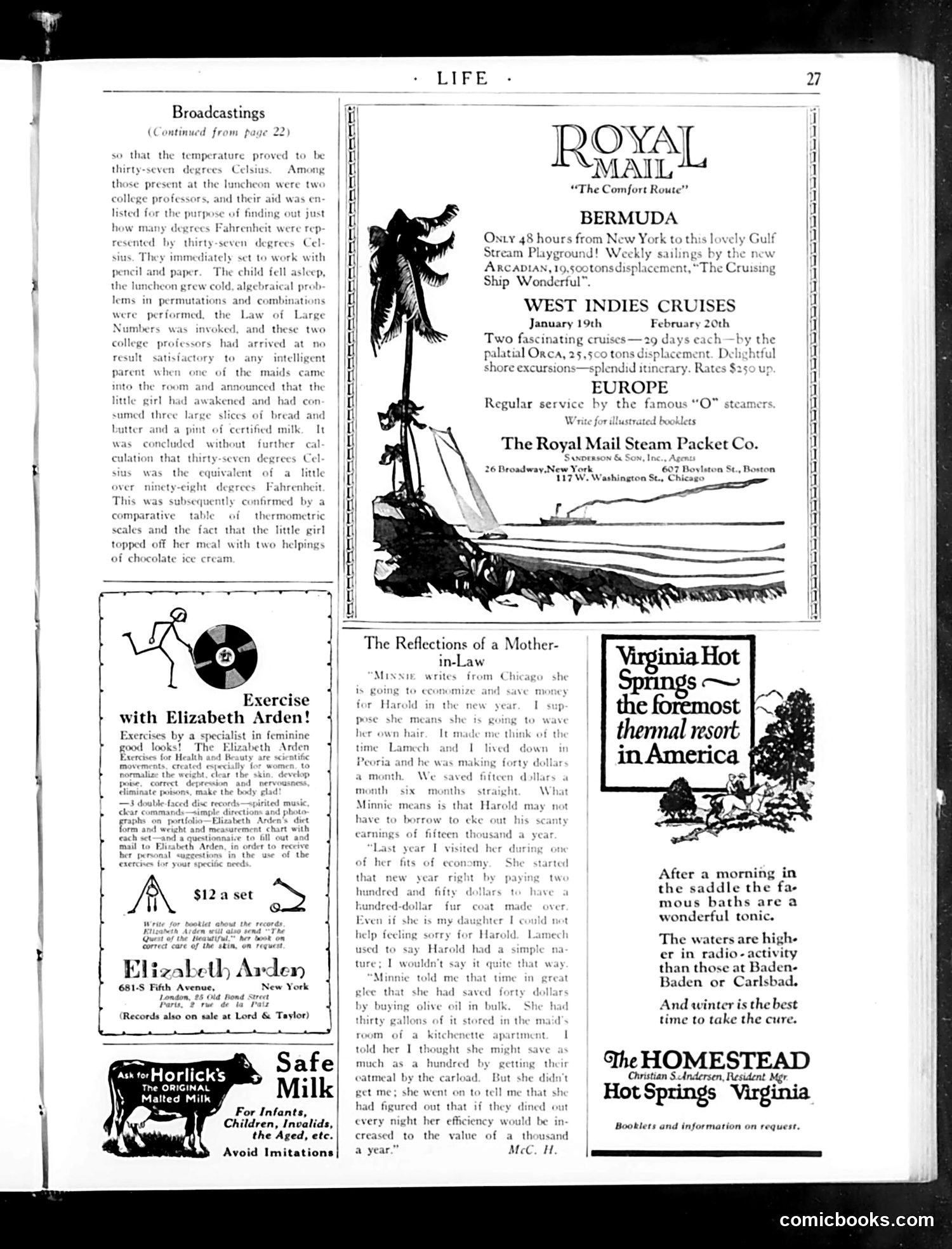
This page is primarily **advertisements and travel promotion**, not political satire. The main content includes: **Advertisements:** - Elizabeth Arden exercise program ($12 a set) targeting women's fitness - Horlick's and Safe Milk products for health - Royal Mail cruise lines advertising Caribbean and European voyages **Editorial Content:** "The Reflections of a Mother-in-Law" (signed McC.H.) is a domestic humor column about a Chicago woman named Minnie describing her daughter-in-law's money-saving strategies—economizing on haircare, buying bulk olive oil, and calculating household efficiency. The joke is gentle domestic comedy about thrift during what appears to be the economic concerns of the 1920s-30s era. **Sidebar ads** promote Virginia Hot Springs resorts, emphasizing their therapeutic waters and winter appeal. The page reflects **early 20th-century consumer culture** targeting affluent readers interested in travel, health products, and modern domestic management—not political commentary or caricature satire.
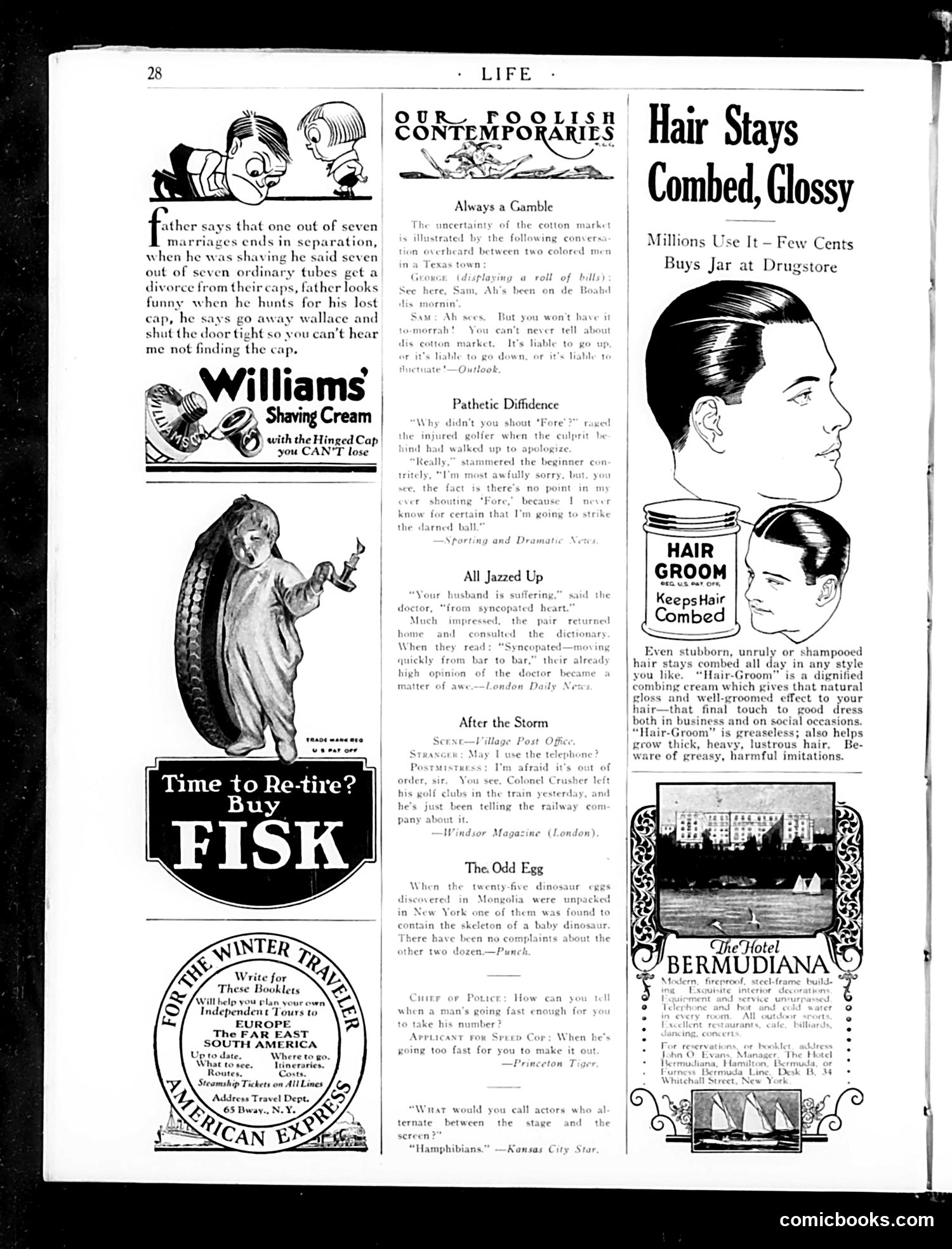
This page is primarily **advertising** with some brief humorous anecdotes ("Our Foolish Contemporaries" section). The main cartoon/advertisement features **Williams Shaving Cream**, showing a frustrated man unable to locate a lost cap—a relatable domestic joke about the era's tube closures popping off. **Hair-Groom** dominates the right side, advertising a pomade/combing cream. The product pitch emphasizes that it keeps hair "combed, glossy" all day and works on "even stubborn, unruly or shampooed hair"—appealing to men wanting a polished appearance for "business and on social occasions." The warning against "greasy, harmful imitations" suggests competing products existed. The anecdotes mock everyday situations: cotton market uncertainty, a golfer's embarrassment, and marital discord. These brief humor pieces were typical of Life's satirical style. **Fisk Tires** and **American Express** travel advertisements fill remaining space, targeting affluent readers with leisure travel and automotive interests typical of 1920s Life readership. The page reflects early 20th-century male grooming standards and consumer culture.
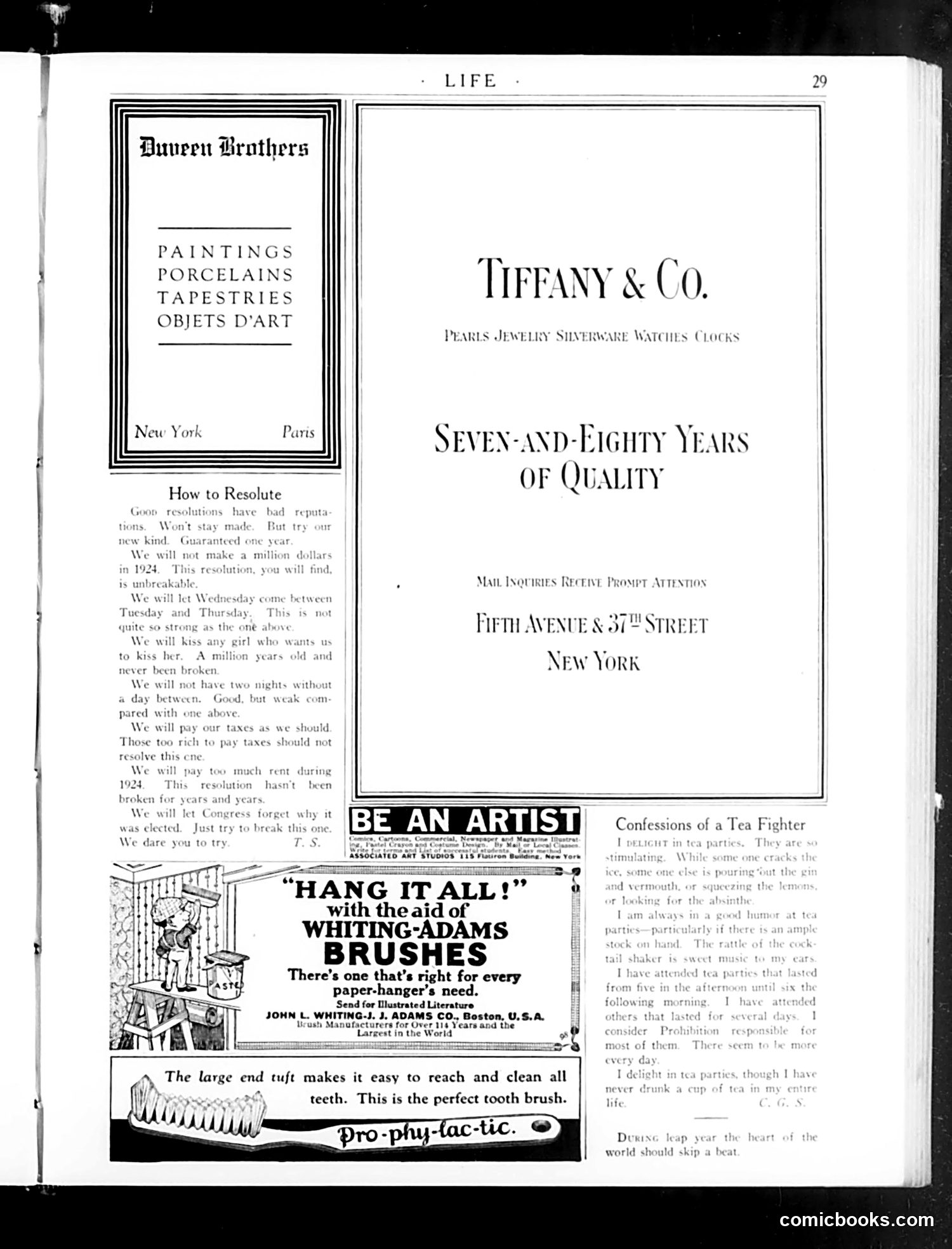
This page is primarily **advertisements and luxury brand promotions** rather than satirical content. The main ads feature: - **Duveeen Brothers** (art dealers) and **Tiffany & Co.** (jewelry/luxury goods) — high-end retailers targeting wealthy readers - **Whiting-Adams Brushes** — a practical hardware advertisement with cartoon imagery of a paperhanger - **Pro-phy-lac-tic** toothbrushes — claiming superior dental design The only editorial content is "Confessions of a Tea Fighter," a brief humorous piece about attending tea parties, which appears unrelated to the advertisements. The **"How to Resolute" section** contains New Year's resolutions written tongue-in-cheek, poking fun at common pledges people make and break annually. **Context for modern readers:** This reflects 1920s Life magazine's business model — luxury advertising alongside satire — and shows the era's social divisions between affluent consumers and working-class readers.
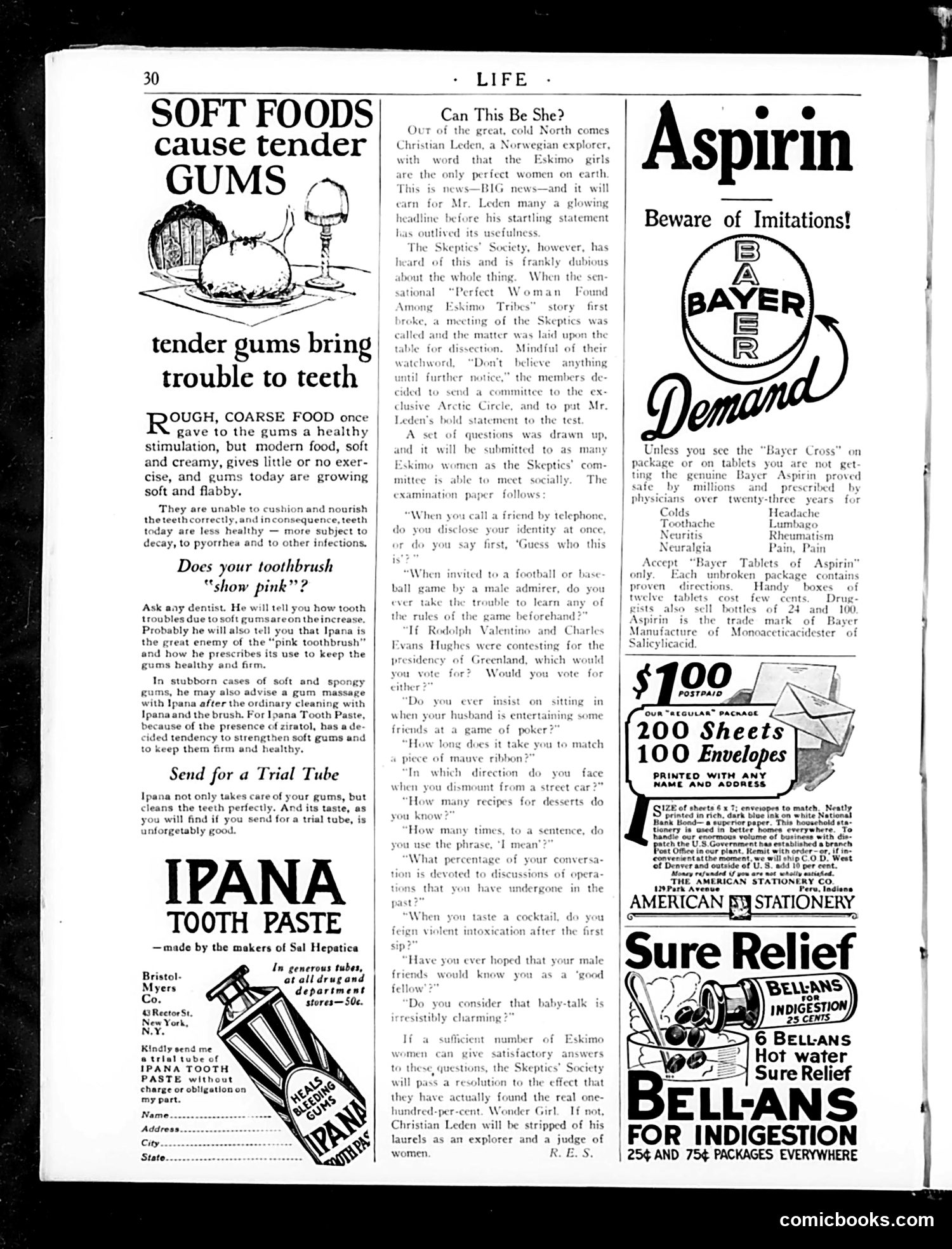
This page combines satirical editorial content with period advertisements. The main article, "Can This Be She?," mocks the "Skeptics' Society," which claims to have discovered "perfect women" among Eskimo tribes based on explorer Christian Leden's claims. The satire presents absurd questions the Society will pose to test these women—queries about telephone etiquette, poker games, ribbon colors, and cocktail tolerance—revealing the ridiculous assumptions underlying such pseudo-scientific racial theories. The joke targets both Leden's credulity and the Society's pseudo-intellectual pretense. By subjecting "perfection" to trivial social conventions, the piece lampoons early 20th-century racial pseudoscience and the notion that any group could be objectively "perfect." The surrounding advertisements (Ipana toothpaste, Aspirin, Bellans indigestion remedy) are typical period marketing, emphasizing modern health anxieties about soft food causing weak gums and digestive troubles.
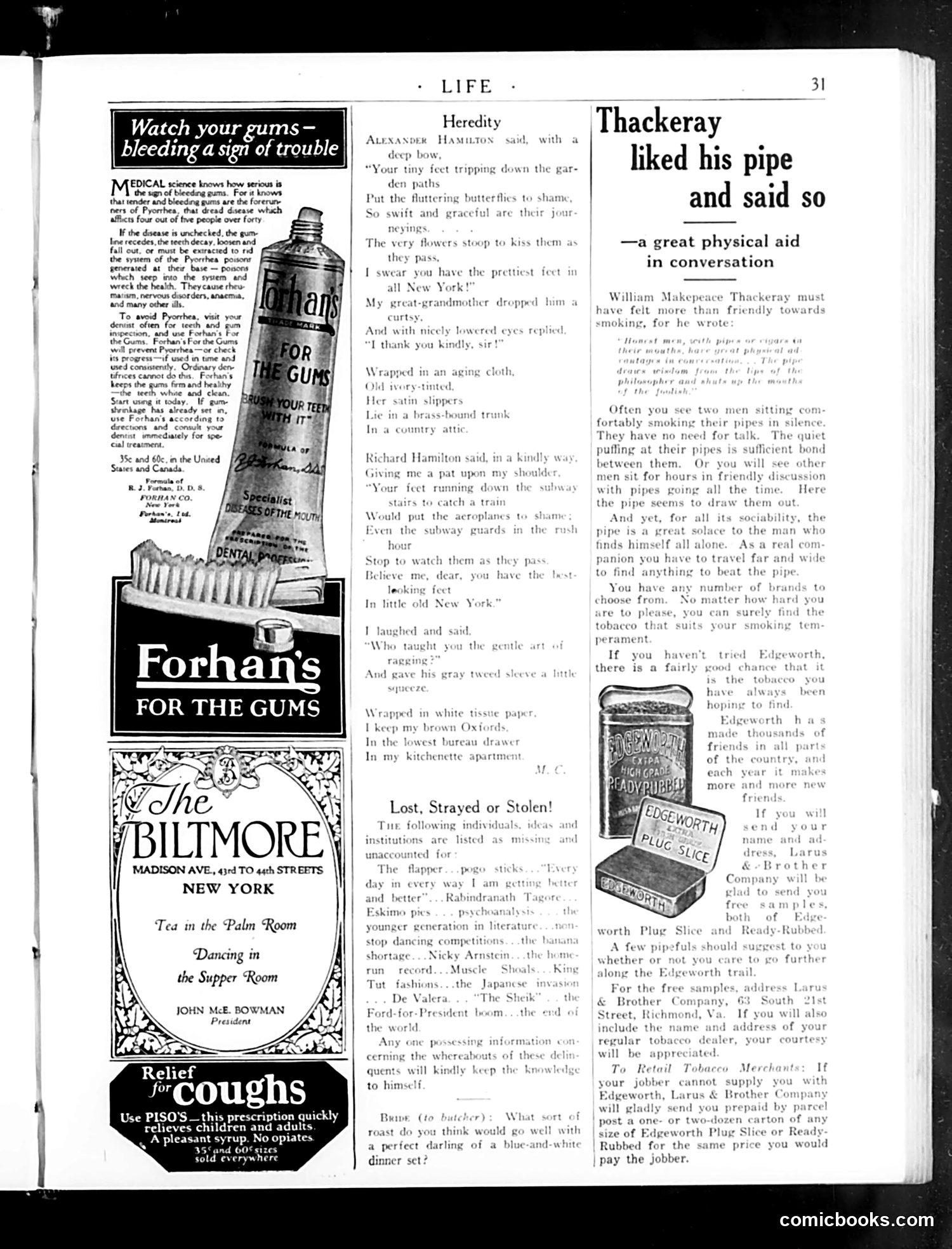
This page is primarily **advertising and light social commentary** rather than political satire. The main content includes: **Advertisements:** - Forhan's toothpaste (warning about pyorrhea/gum disease affecting "four out of five people over forty") - The Biltmore hotel in New York - Piso's cough syrup - Edgeworth pipe tobacco **Editorial Content:** A short piece titled "Thackeray liked his pipe and said so" references 19th-century author William Makepeace Thackeray, arguing that pipe-smoking facilitates conversation and companionship. It includes a Thackeray quote praising pipes as "a great physical aid in conversation." The poem "Heredity" describes a woman's refined manners, attributed to Alexander Hamilton. **Context for modern readers:** This reflects early 20th-century attitudes normalizing smoking and dental disease as inevitable. The ads present serious health conditions casually while promoting consumer products as solutions—typical of pre-regulation advertising practices.
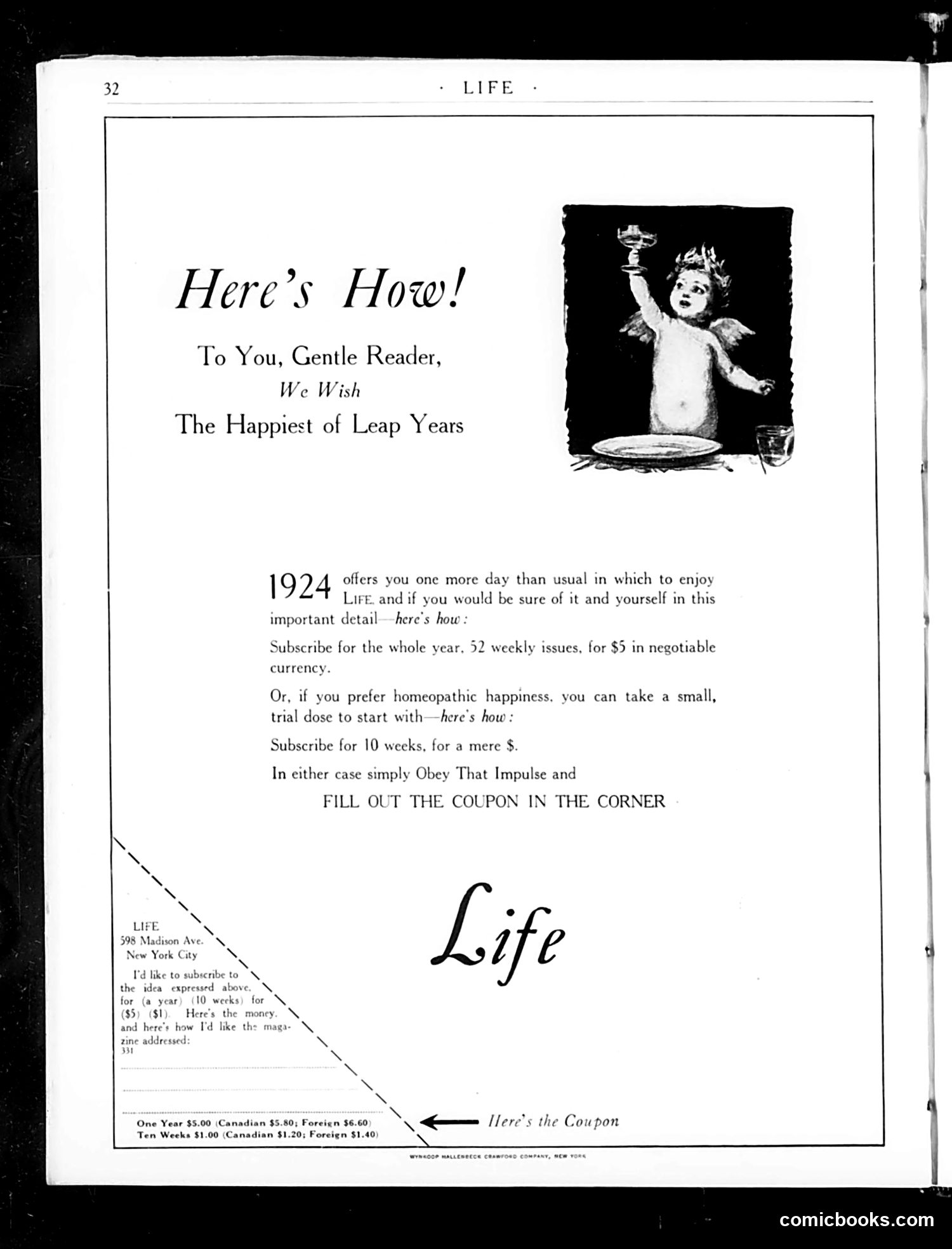
This is primarily a **subscription advertisement**, not a political cartoon. The page celebrates 1924 as a leap year—offering "one more day than usual"—and uses this to humorously pitch subscriptions to *Life* magazine. The illustration shows a **cherub or cupid figure** holding a lamp, a classical symbol of enlightenment or guidance, reinforcing the magazine's appeal to readers seeking knowledge and entertainment. The satire is subtle: the ad suggests that subscribing to *Life* is the proper way to "enjoy" that extra February 29th. It offers two subscription options—$5 for a full year (52 weekly issues) or $1 for a 10-week "trial dose"—using medicinal language ("homeopathic happiness") to joke about taking the magazine like medicine. The "Obey That Impulse" call-to-action reflects 1920s consumer culture humor, gently mocking readers' susceptibility to advertising while selling the magazine itself.
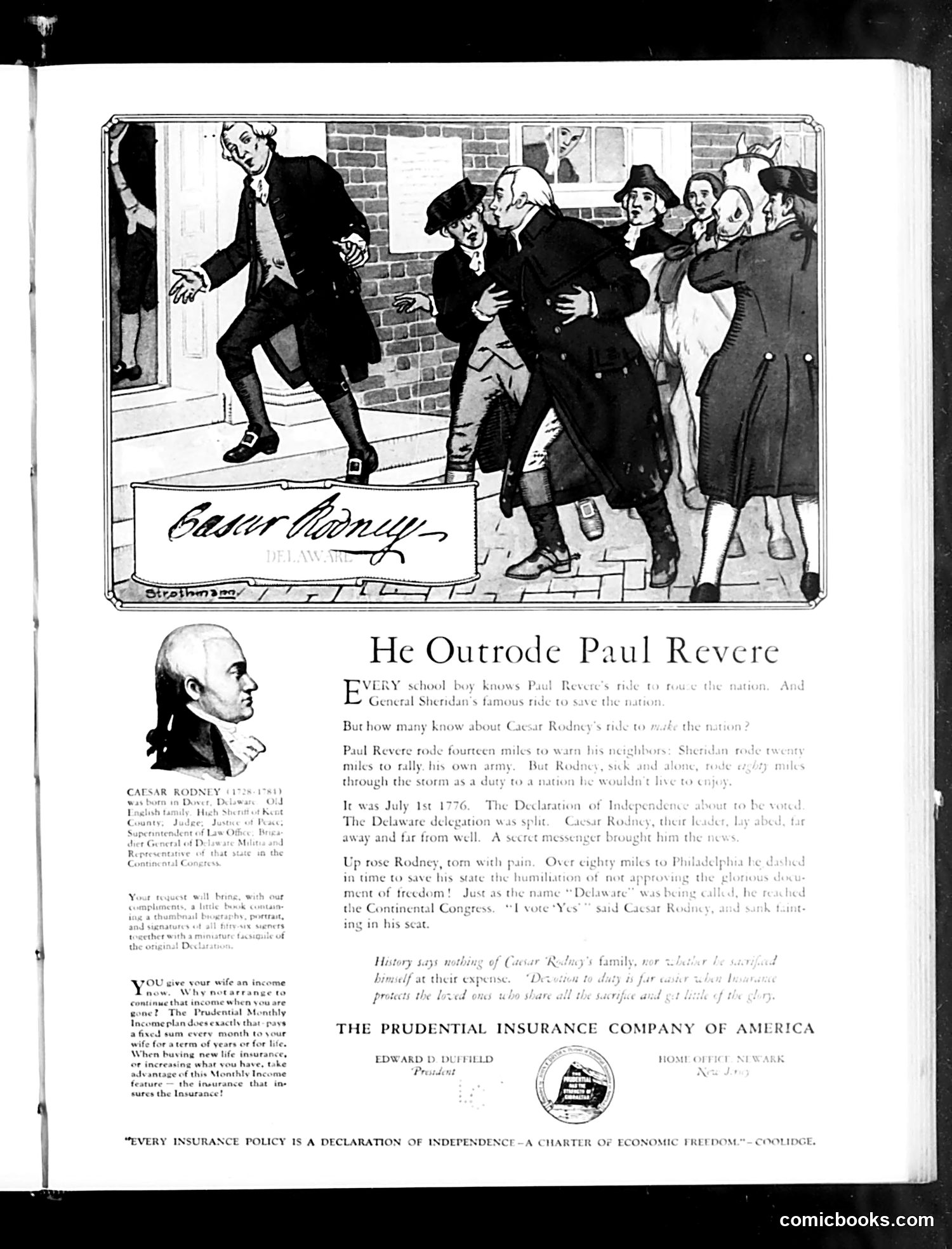
This page celebrates Caesar Rodney (1728-1784), a Delaware signer of the Declaration of Independence, via a Prudential Insurance advertisement. The cartoon depicts Rodney arriving at the Continental Congress on July 1st, 1776. The text claims he rode 80+ miles through a storm to cast Delaware's deciding vote for independence—a dramatic counter to Paul Revere's famous midnight ride. Rodney was reportedly ill but rode anyway to prevent Delaware's delegation from blocking the Declaration. The satire contrasts Rodney's unknown sacrifice against Revere's celebrated status ("Every school boy knows Paul Revere's ride"). The advertisement equates insurance with "economic freedom," paralleling political independence—suggesting financial security enables personal liberty. The historical accuracy of Rodney's dramatic ride is debated by modern historians, but the advertisement uses it to promote insurance as patriotic economic protection.
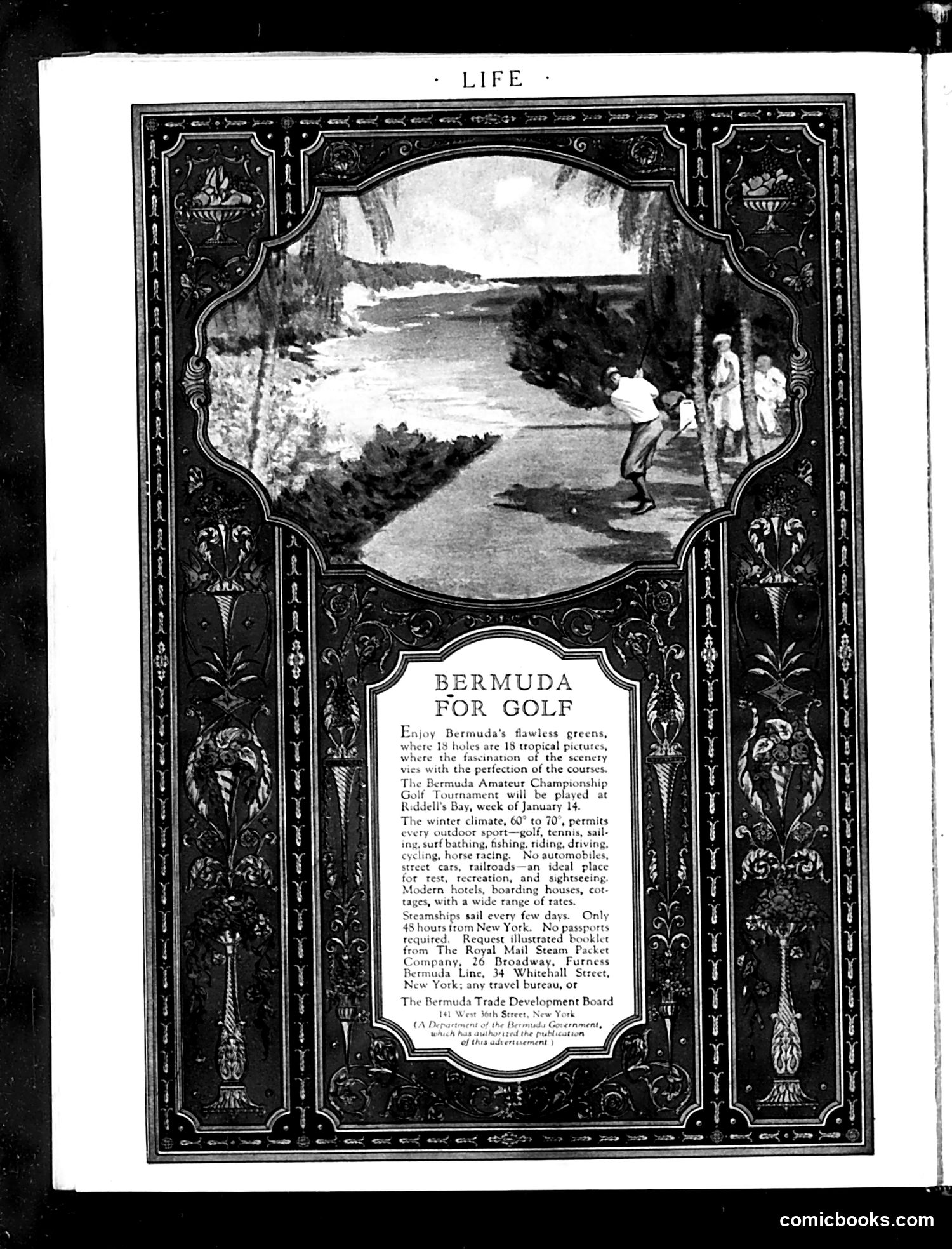
This is a **travel advertisement**, not a political cartoon. The page promotes Bermuda as a golf destination, featuring a scenic photograph of a coastal landscape with golfers visible on the right side. The text emphasizes Bermuda's attractions for winter tourism: "flawless greens," scenic beauty, and favorable climate (60-70°F). It highlights the upcoming Amateur Championship at Riddell's Bay (January 14) and lists practical travel information—48-hour steamship journey from New York, no passport required, and contact details for booking. The ornate Art Deco border and formal "LIFE" masthead indicate this is an early 20th-century magazine advertisement positioned as editorial content, typical of how travel promotions appeared in luxury publications. The message targets affluent winter travelers seeking outdoor recreation.