
A complete issue · 36 pages · 1909
Life — October 14, 1909
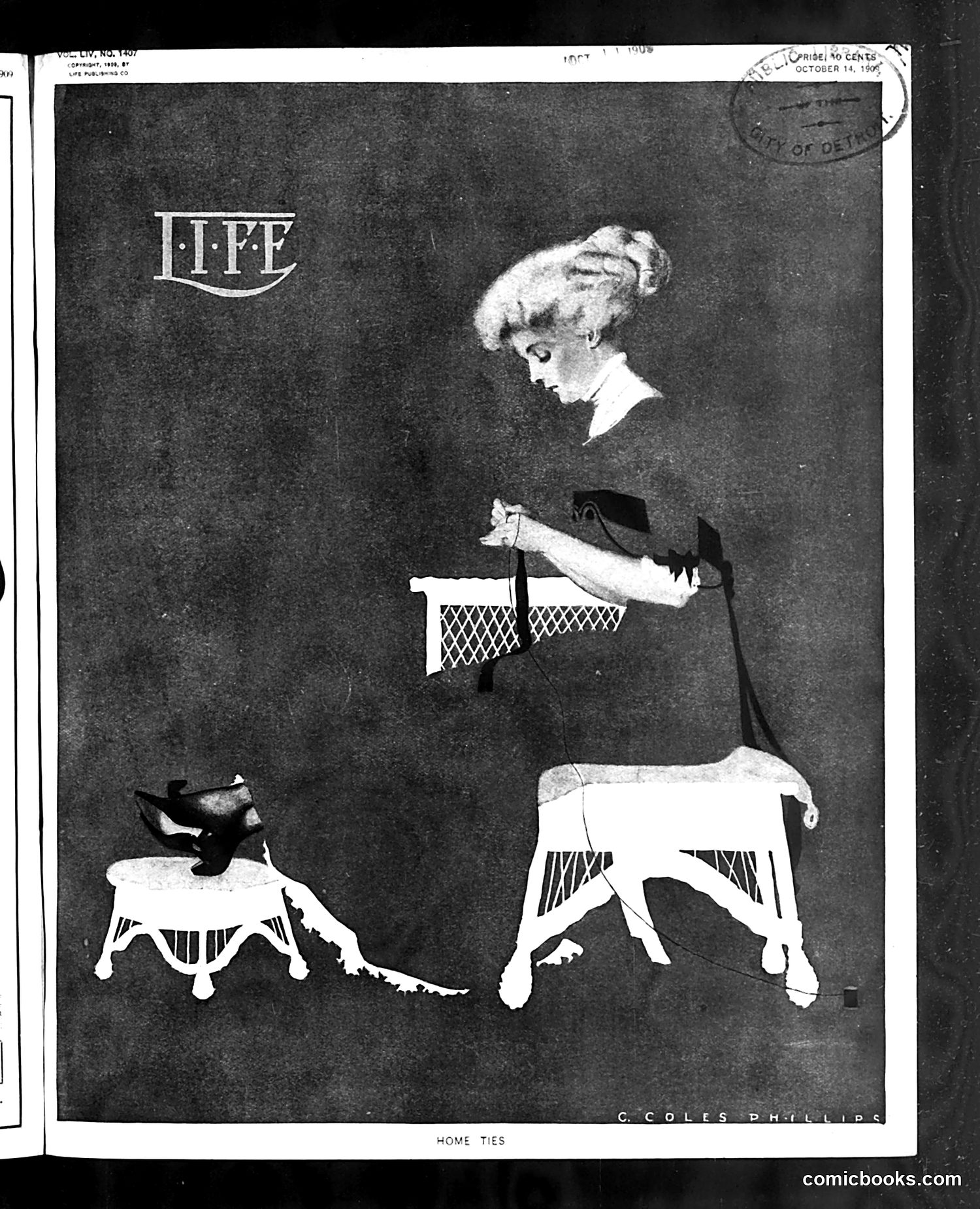
This Life magazine advertisement for Cole's Phillips showcases decorative home furnishings, likely circa 1920s based on the styling and publication. The illustration depicts a fashionably dressed woman with period-appropriate bobbed hair and upswept styling, arranging what appears to be decorative table covers or linens on small tables. The "home ties" reference suggests these are furnishings that bind people to domestic comfort. The satire is subtle: the elegant woman is performing domestic labor—arranging household goods—yet her fashionable appearance and the stylized presentation suggest aspirational leisure. This likely comments on the emerging consumer culture where domestic duties were being glamorized through modern design and mass-marketed home goods, allowing women to feel fashionable while managing household responsibilities. The Cole's Phillips signature indicates this is professional advertising art, not political commentary.
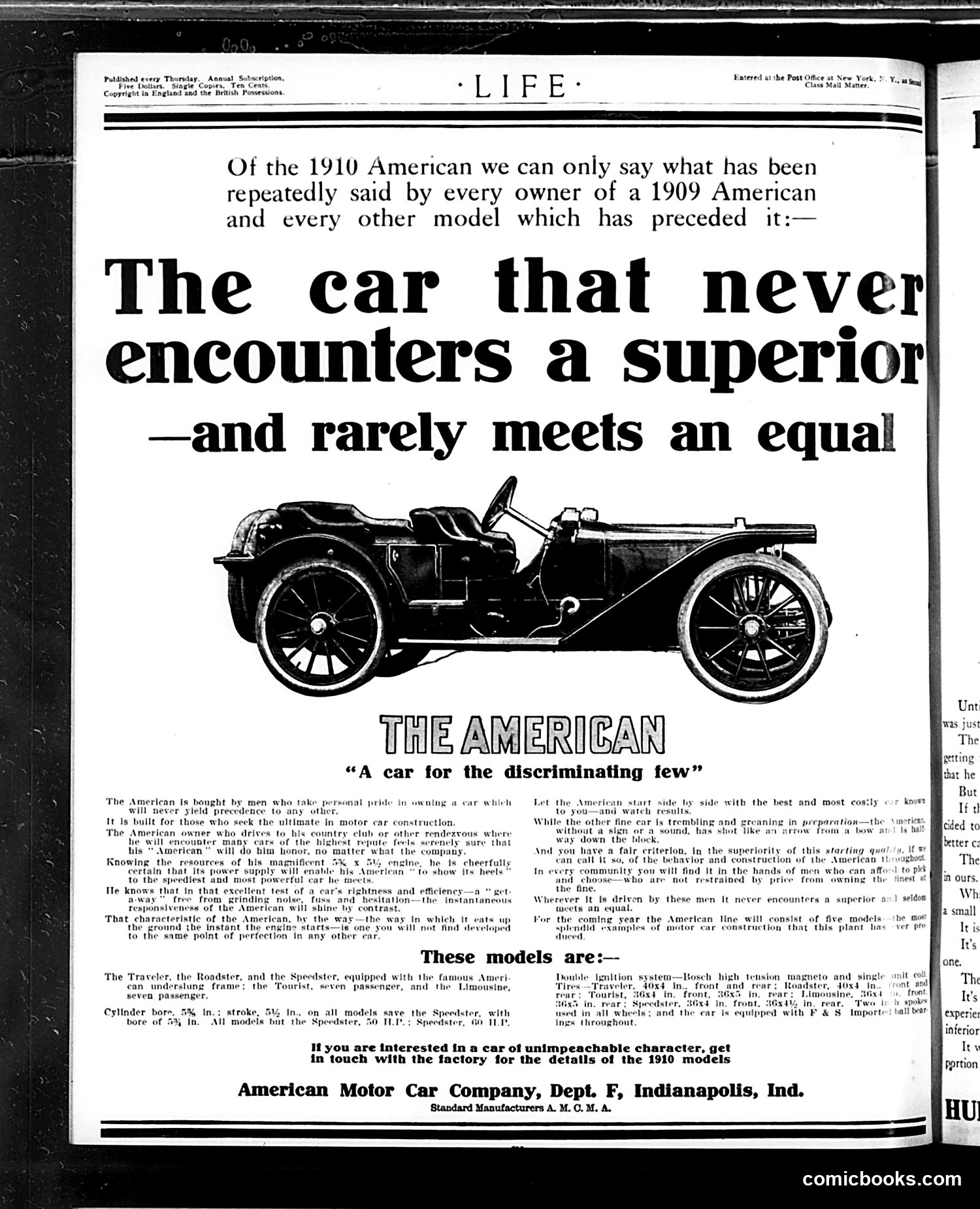
This is primarily **advertising content**, not satire or editorial material. The American Motor Car Company placed a full-page advertisement in *Life* magazine promoting their 1910 automobile models. The ad's headline claims the American car "never encounters a superior—and rarely meets an equal," positioning it as the finest vehicle available. The illustration shows a side-view technical drawing of an open-air motorcar typical of the era. Rather than satire, the ad uses *Life*'s reputation for wit to craft aspirational messaging: the car appeals to men of "personal pride" seeking "the ultimate in motor car construction." It emphasizes quality, craftsmanship, and prestige—standard luxury-car marketing even by 1910 standards. The page demonstrates how premium brands leveraged satirical magazines' educated readership for upscale product placement.
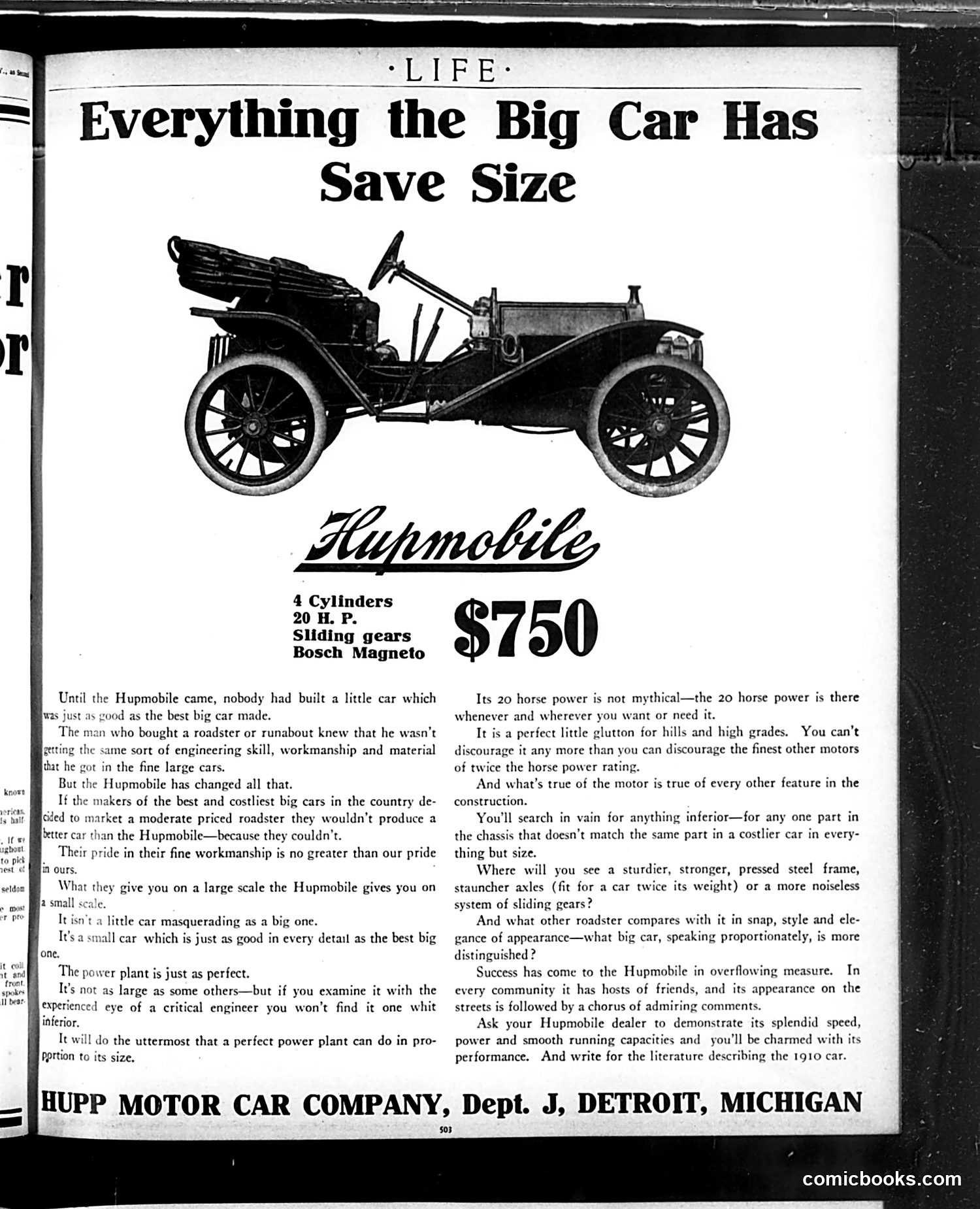
This is **not a cartoon or satire** — it's a straightforward product advertisement for the Hupmobile automobile, published in *Life* magazine. The ad promotes the Hupmobile as an affordable "little car" alternative to larger vehicles, priced at $750. The copy emphasizes that despite its smaller size, the car features quality engineering comparable to costlier models: 4 cylinders, 20 horsepower, sliding gears, and Bosch magneto ignition. The headline's wit ("Everything the Big Car Has Save Size") is marketing copy rather than social commentary. The ad targets budget-conscious buyers seeking reliable transportation without premium pricing — reflecting early automotive market competition in what appears to be the 1910s era.
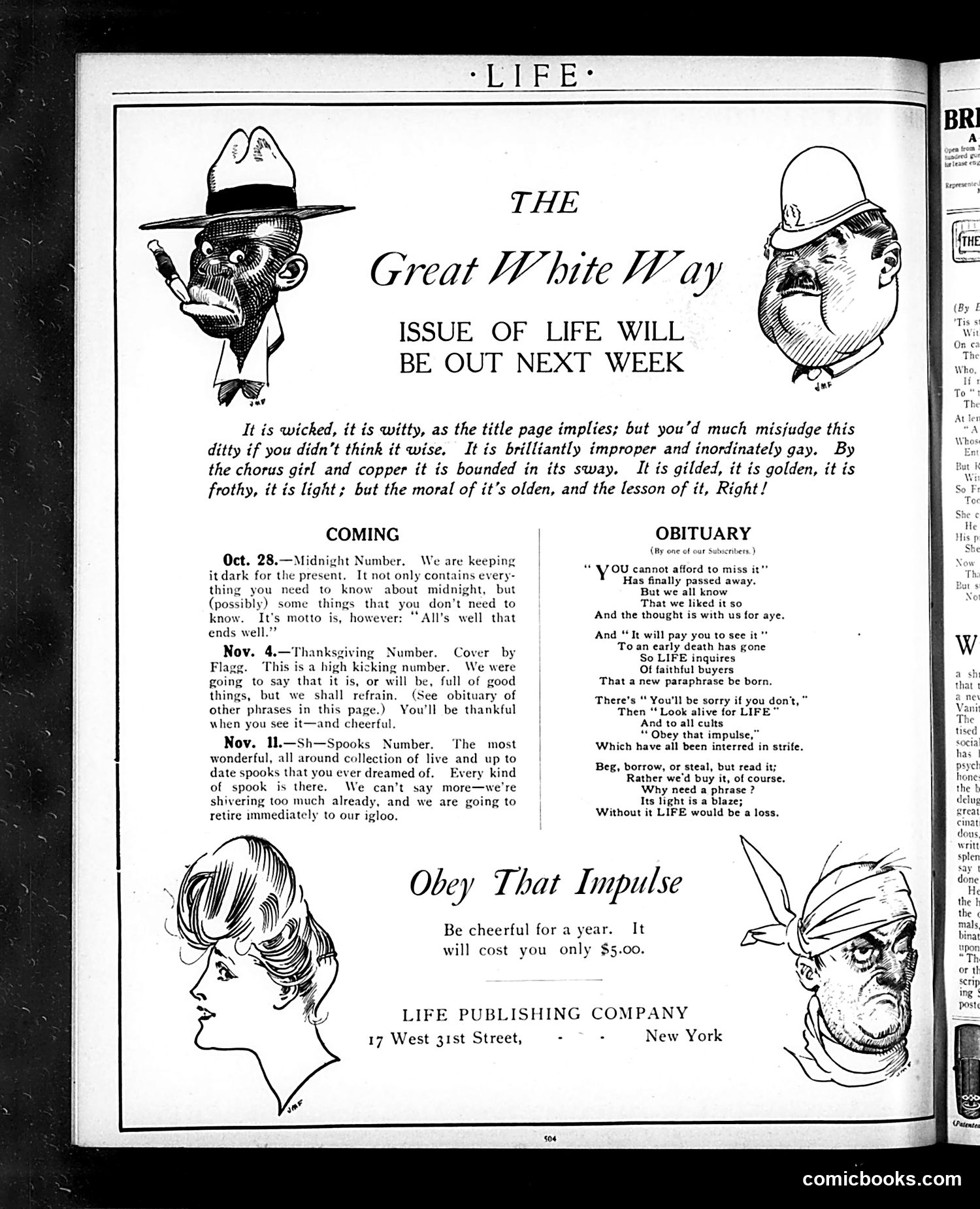
This is primarily a **subscription advertisement** for Life magazine, not political satire. The page announces upcoming issues: a Midnight Number (Oct. 28), Thanksgiving Number (Nov. 4), and Spooks Number (Nov. 11). The title "The Great White Way" refers to Broadway's theater district, known for its bright lights. The four caricatured faces flanking the text appear to be **illustrative character types** rather than specific political figures—they're stylized heads of different ethnicities and types typical of early 20th-century magazine art. The main content is the subscription pitch: "Be cheerful for a year. It will cost you only $5.00," encouraging readers to subscribe to Life Publishing Company at their New York address.
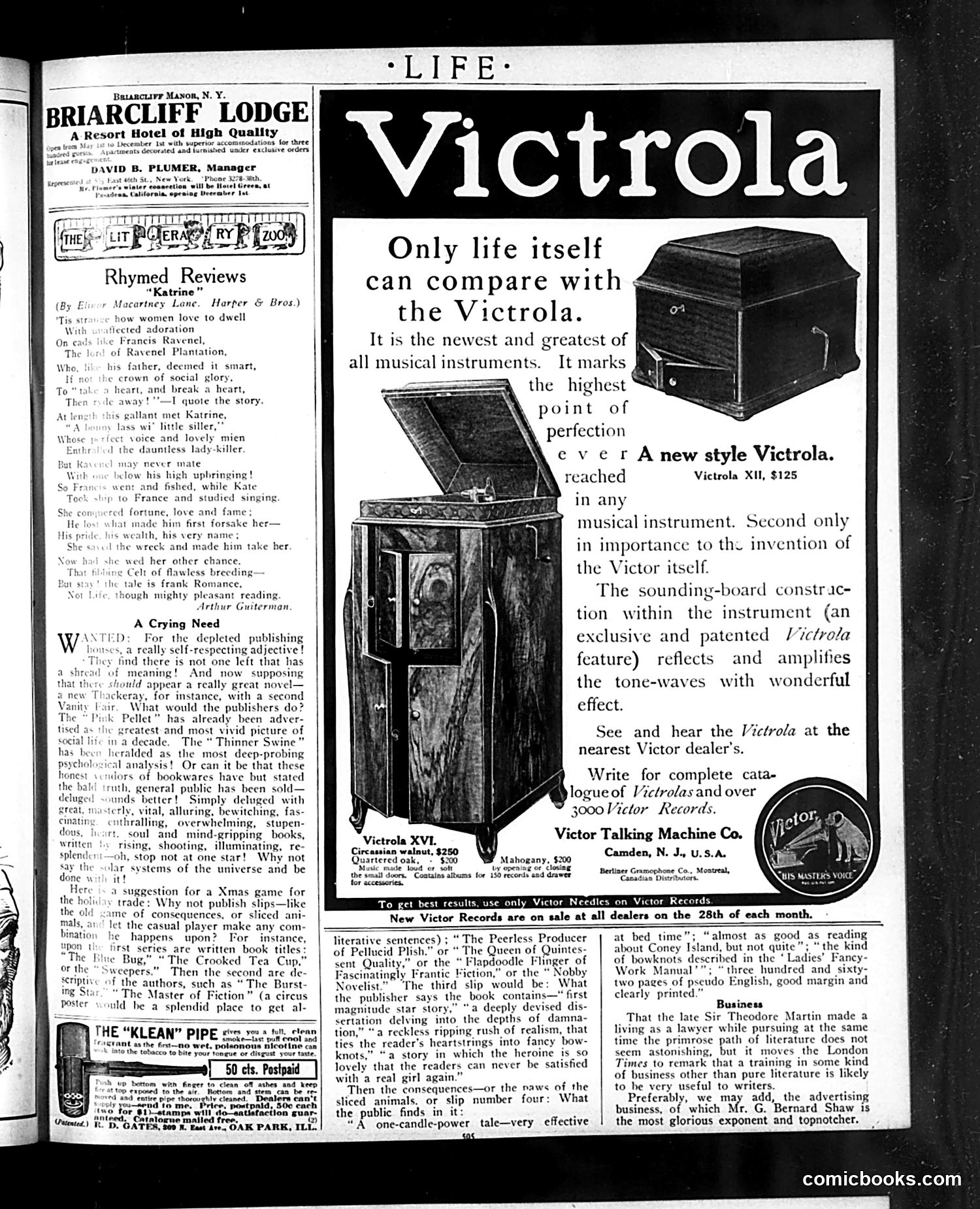
This page is primarily **advertising rather than satire**. The dominant content is a Victrola phonograph advertisement (right side), promoting the "newest and greatest of all musical instruments" with models priced at $125 and $150. The ad emphasizes the machine's superior sound quality and encourages readers to visit dealers or request catalogues. The left side contains literary content: "Rhymed Reviews" (poetry critiques of books), and "A Crying Need" (editorial commentary on publishing). There's also a small advertisement for Briarcliff Lodge at the top. No political cartoons or caricatures appear on this page. It represents typical Life magazine content from the early 20th century, mixing light literary commentary with commercial advertisements.
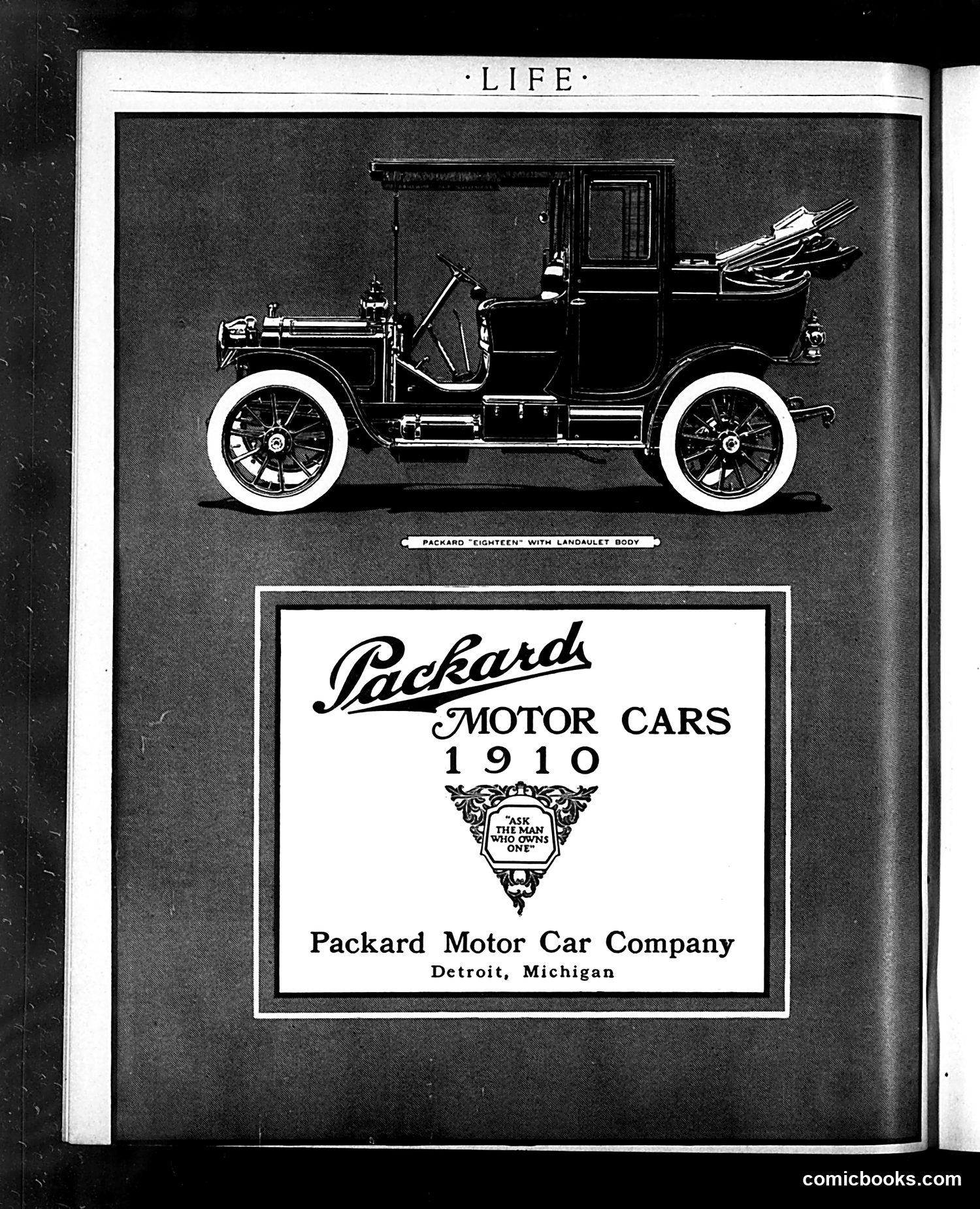
This page is **not a cartoon or satirical content** — it is a **automobile advertisement** from Life magazine's 1910 issue. The image shows a Packard "Eighteen" motorcar with a Landaulet body style, depicted in detailed technical side-view illustration typical of early automotive advertising. The vehicle features the distinctive design elements of 1910s luxury cars: white-wall tires, an open cabin design, and elegant proportions. The advertisement is placed by the Packard Motor Car Company of Detroit, Michigan, with their corporate tagline "Ask the Man Who Owns One" — a famous marketing slogan emphasizing customer satisfaction and word-of-mouth endorsement. This is straightforward commercial content advertising a premium automobile to Life's affluent readership, not satirical commentary.
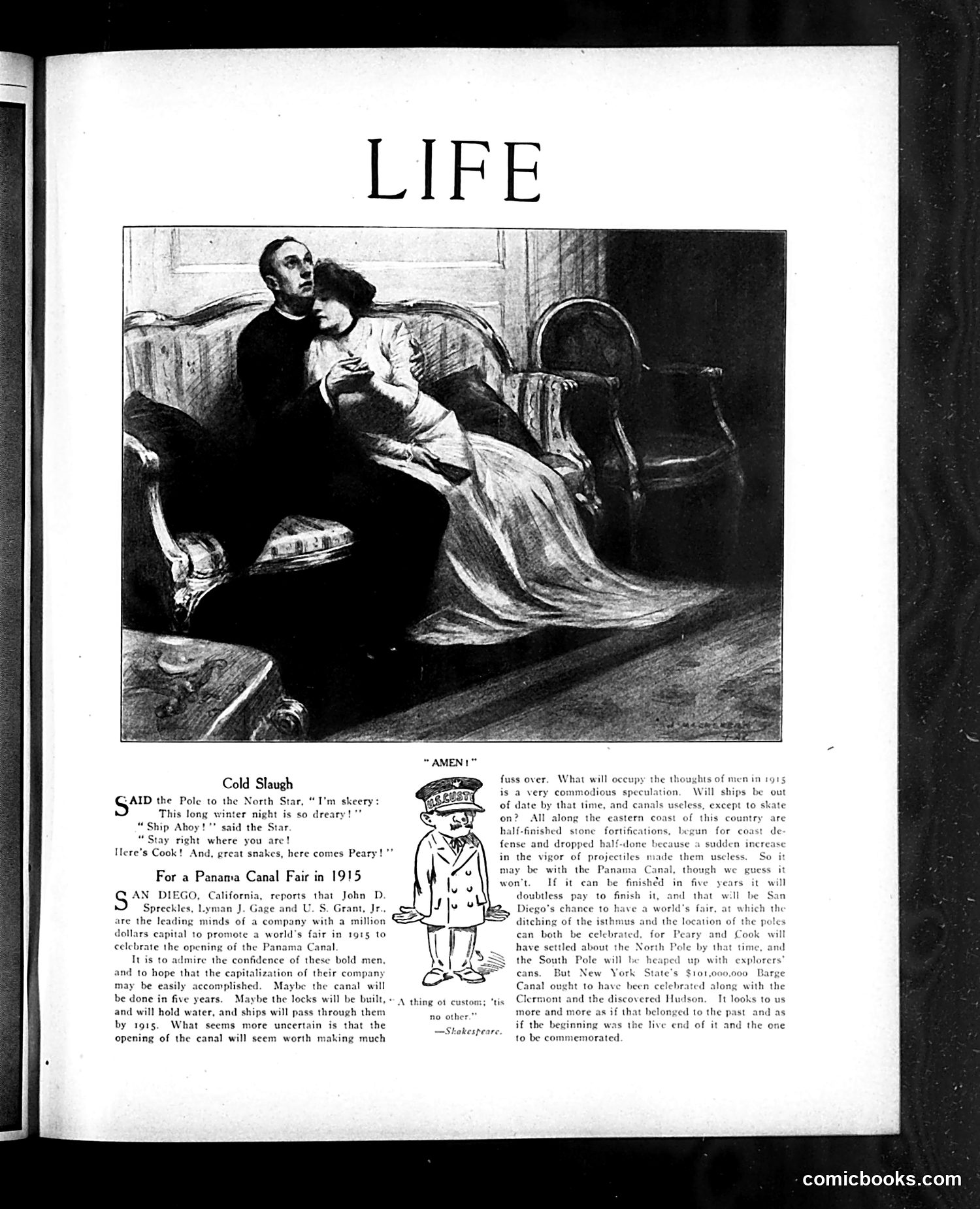
This page contains two separate items: **"Cold Slaugh" (top illustration):** A romantic scene depicting a couple on a sofa, illustrating period poetry about winter and courtship. The dialogue references traditional romantic verses about staying warm together. **"For a Panama Canal Fair in 1915" (bottom):** A satirical piece mocking an ambitious proposal by San Diego businessman John D. Spreckels to promote a world's fair celebrating the Panama Canal's opening by 1915. The text skeptically questions whether such an ambitious construction timeline is realistic, noting uncertainties about canal completion, lock construction, and water management. The small cartoon figure appears to represent Spreckels or his optimistic ambitions. The satire centers on the audacity of planning a fair around infrastructure that may not actually be finished on schedule.
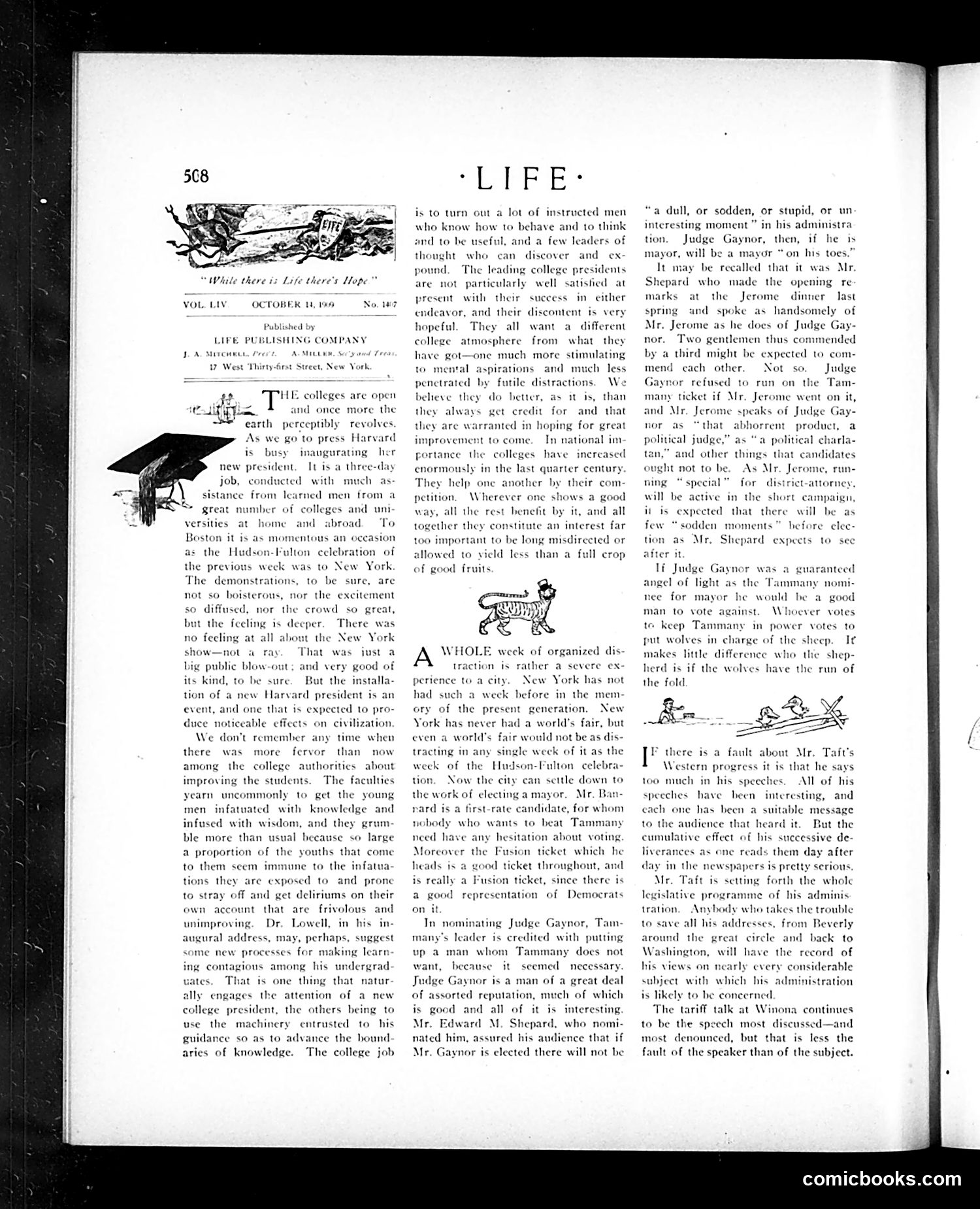
This page contains editorial commentary about college leadership and an upcoming New York mayoral election. The text discusses dissatisfaction with college presidents and mentions Judge Gaynor as a mayoral candidate, crediting Edward M. Shepard with nominating him. The small decorative cartoons appear to be generic illustrations (a figure with "While there is Life there's Hope" and what appears to be a tiger or cat illustration) rather than political caricatures. The substantive satire targets college administrators as ineffective and discusses the mayoral race—specifically the Fusion ticket's strategy. The passage critiques both educational leadership and urban politics, suggesting Tammany Hall's dominance in New York governance as problematic, though specific figures aren't caricatured on this page.
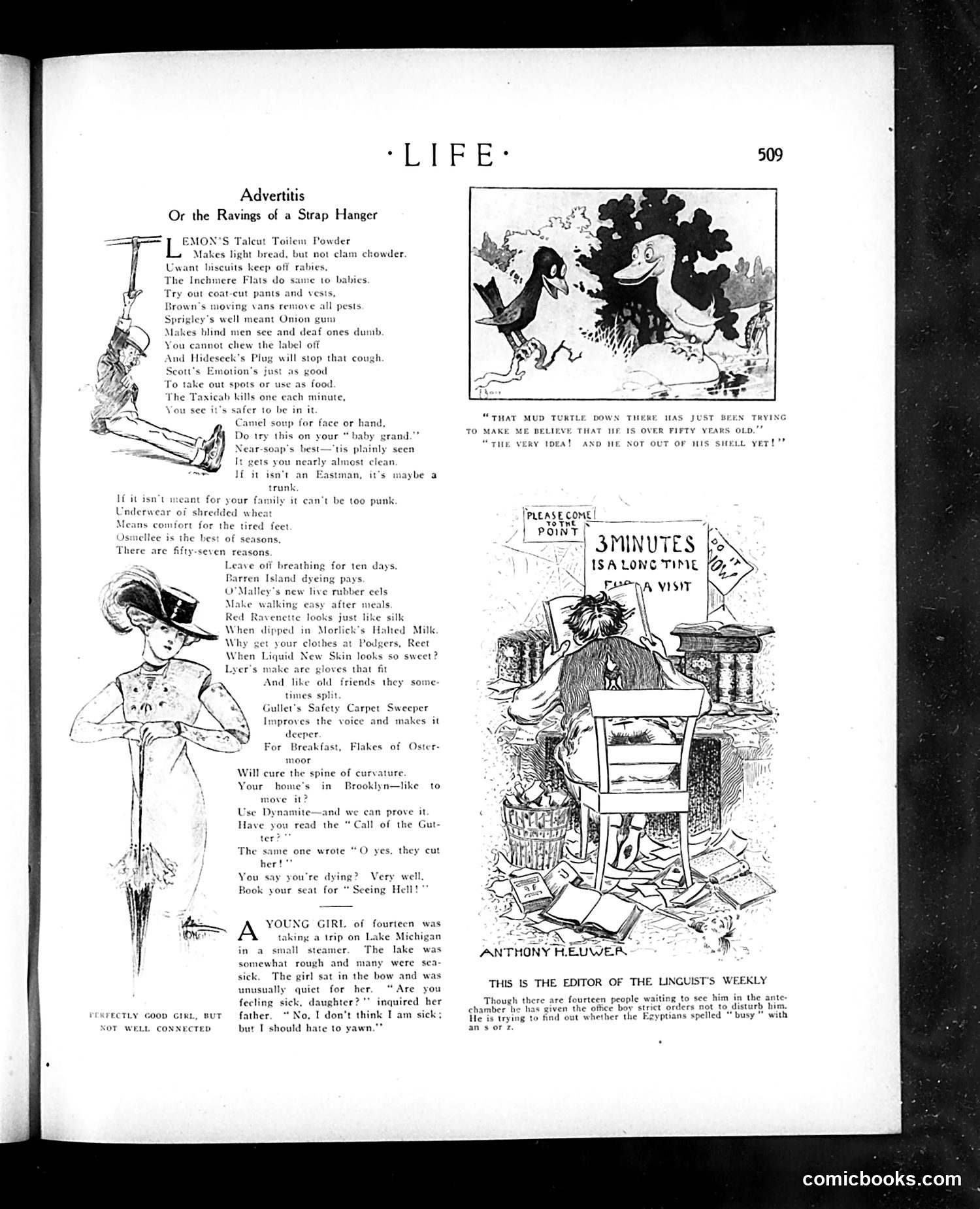
This page contains satirical advertisements and humorous commentary typical of Life's early 20th-century style. The "Advertisitis" section mockingly presents fake product endorsements, with absurd claims about items like "Lemon's Talent Tonic Powder" and various dubious remedies—satirizing contemporary advertising's deceptive marketing practices. The cartoon by Anthony H. Euwer depicts an editor overwhelmed with office visitors, with a sign reading "3 MINUTES IS A LONG TIME / A VISIT." The joke critiques how people waste editors' valuable time with lengthy office visits. The top cartoon shows a turtle claiming to be over fifty years old, likely a humorous visual gag about longevity or appearance. Overall, this page exemplifies Life's focus on lampooning consumer culture, advertising excess, and workplace social dynamics of the era.
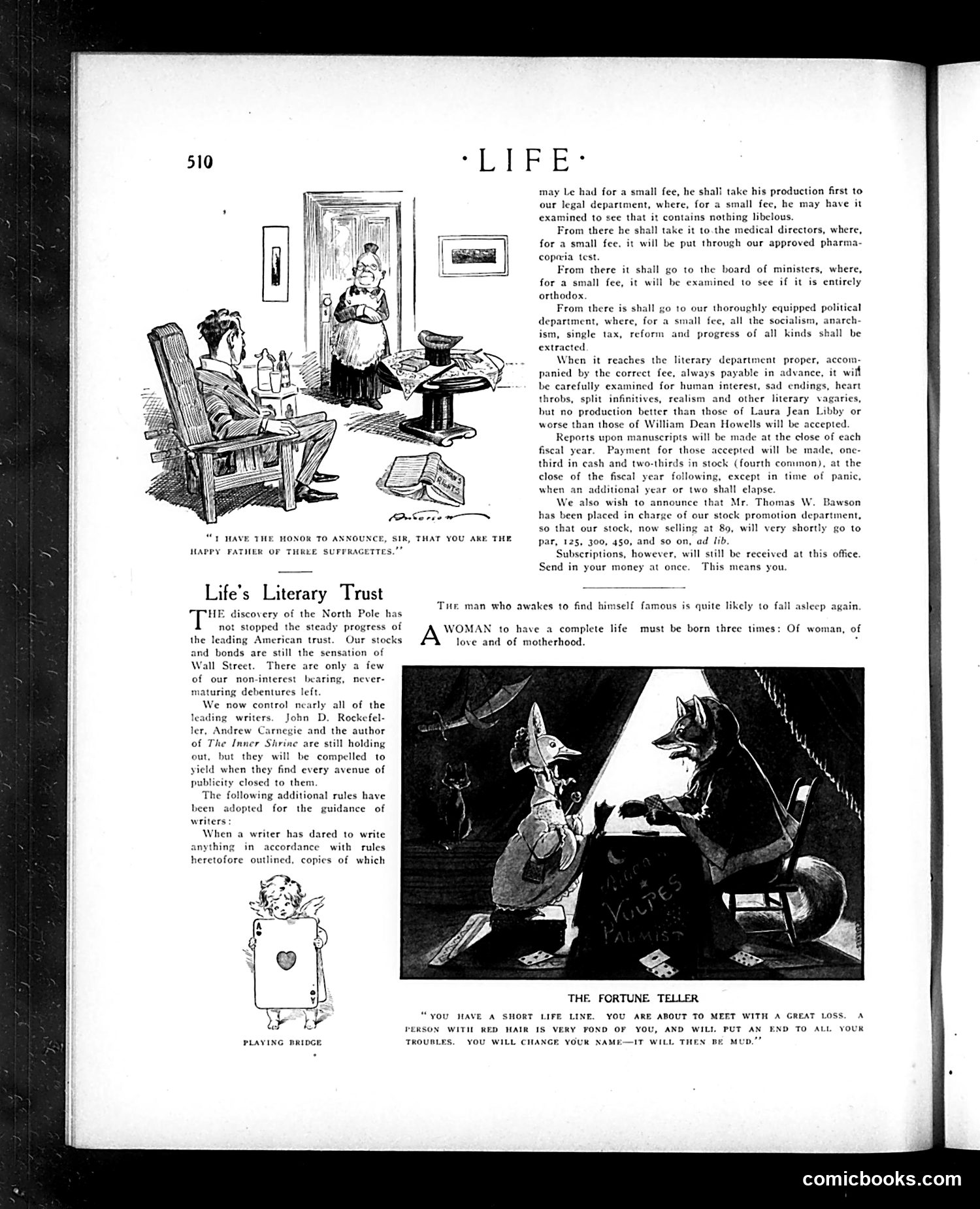
This page satirizes the publishing industry's control over writers. The main article, "Life's Literary Trust," argues that major publishers (mentioning John D. Rockefeller and Andrew Carnegie) now control "nearly all the leading writers" and impose restrictive rules on authors. The top cartoon shows a woman (likely representing a publisher or gatekeeper) examining a manuscript, surrounded by rejection materials—satirizing the gatekeeping process writers faced. "The Fortune Teller" cartoon below uses a fortune teller's grim predictions to mock writers' prospects: "short life line," meeting "great loss," a person with red hair causing trouble, and ultimately changing one's name—suggesting commercial failure forces writers into obscurity or pseudonyms. The satire targets how concentrated publishing power constrains artistic freedom.
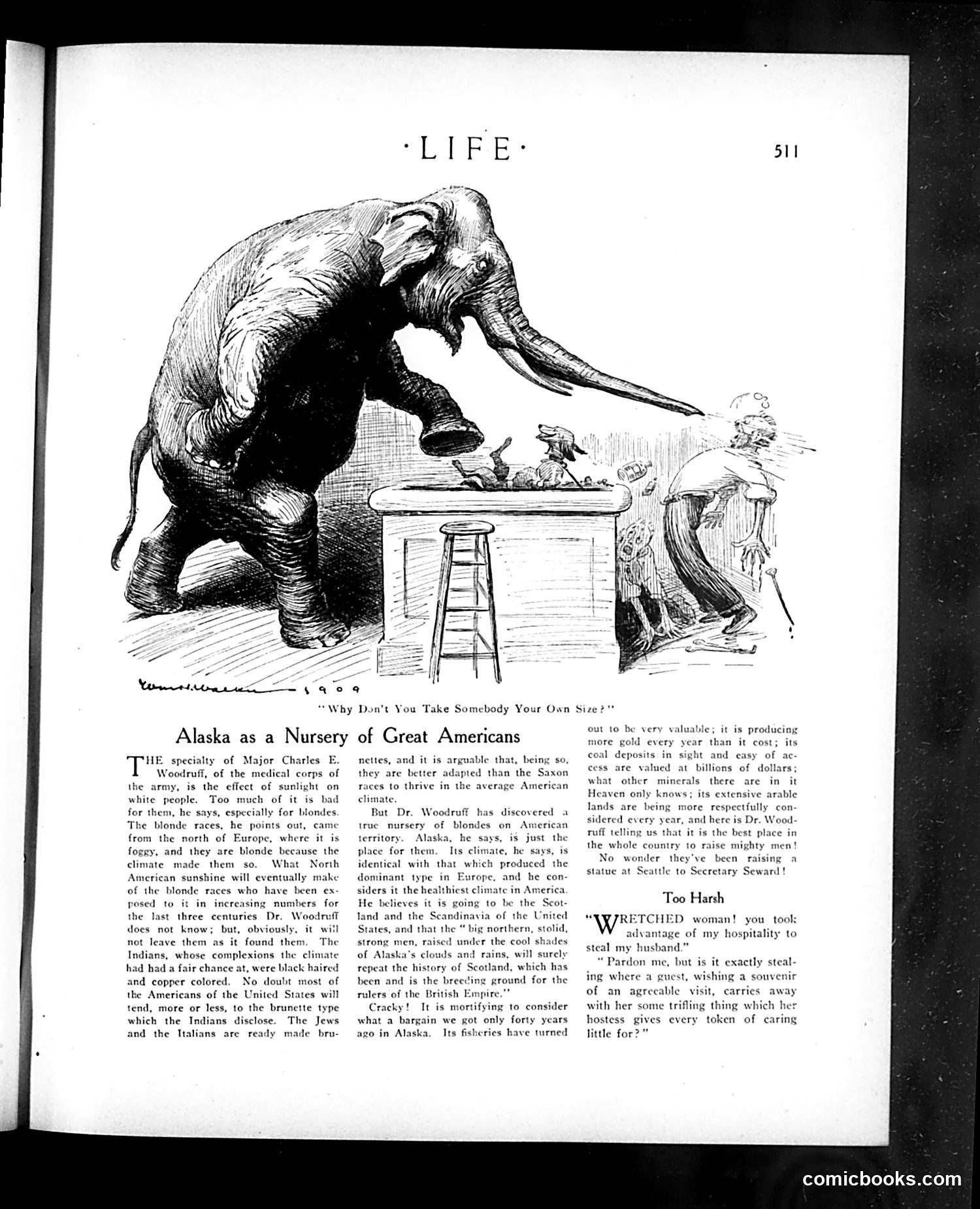
This Life magazine page features a satirical cartoon titled "Why Don't You Take Somebody Your Own Size?" The image depicts a large elephant confronting a tiny human figure at what appears to be a workbench or table, while onlookers observe. The accompanying article discusses Alaska as a potential source of "great Americans," referencing Major Charles E. Woodruff's theories about climate's effects on human development. The cartoon appears to critique this notion through absurdist humor—the massive elephant represents Alaska's scale or resources, while the diminutive human suggests the impracticality of Woodruff's breeding/development theories. The "own size" reference likely mocks the mismatch between ambitious Alaskan ambitions and realistic human capabilities or resources required.
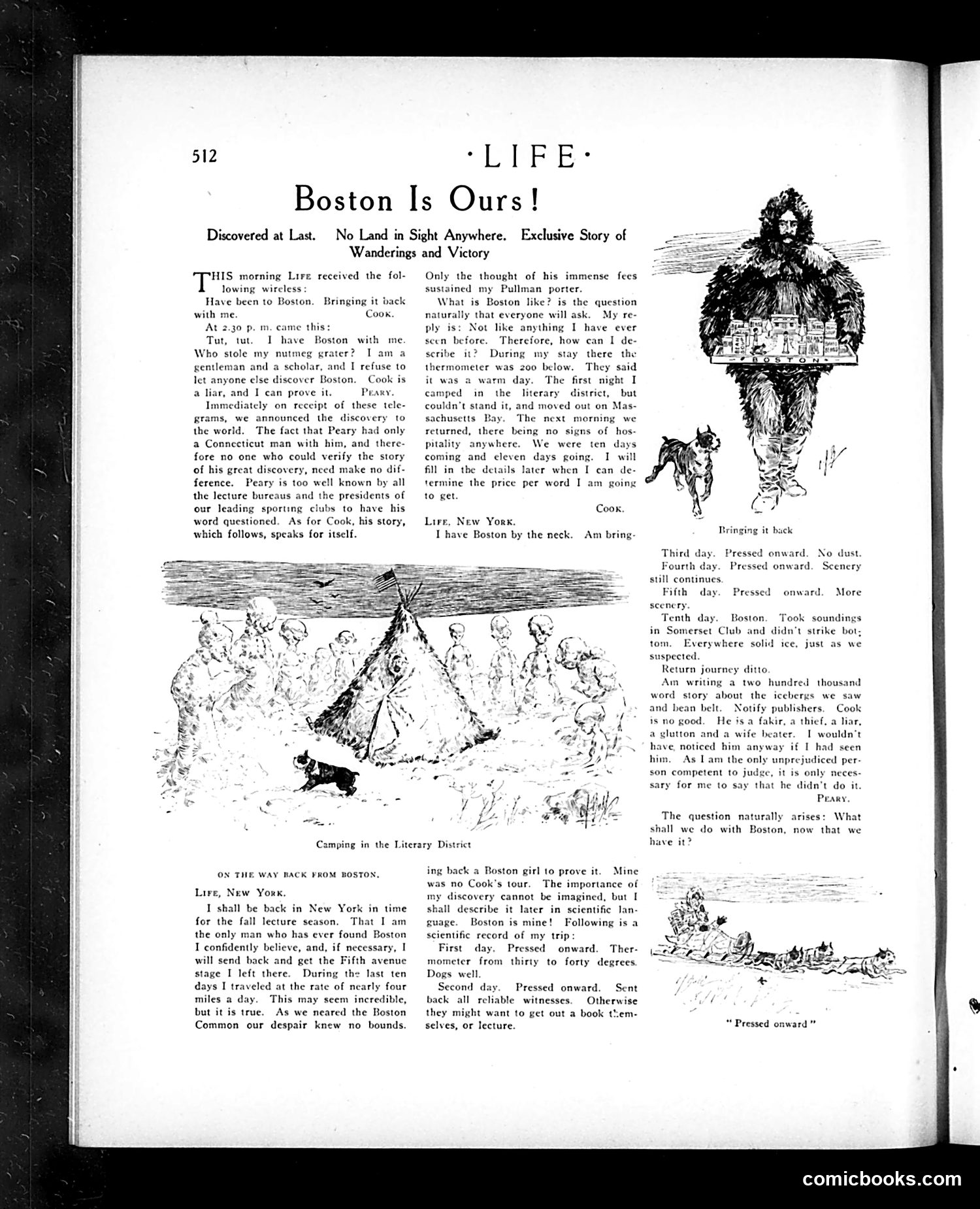
This page satirizes a traveler's exaggerated claim to have "discovered" Boston. The article mimics exploration narratives, with a character named Cook claiming exclusive knowledge of the city—"No Land in Sight Anywhere. Exclusive Story of Wanderings and Victory." The humor lies in the absurdity: Boston, a major American city, is presented as an uncharted discovery requiring heroic documentation. Cook's self-aggrandizing account (200,000-word story about "icebergs" and "bean belt") parodies both explorers' tall tales and the pretentious lecture-circuit culture of the era. The illustrations show camping and wilderness imagery, treating an established urban center as undiscovered territory—mocking both travelers' exaggerations and Boston's cultural significance being treated as shocking revelation.
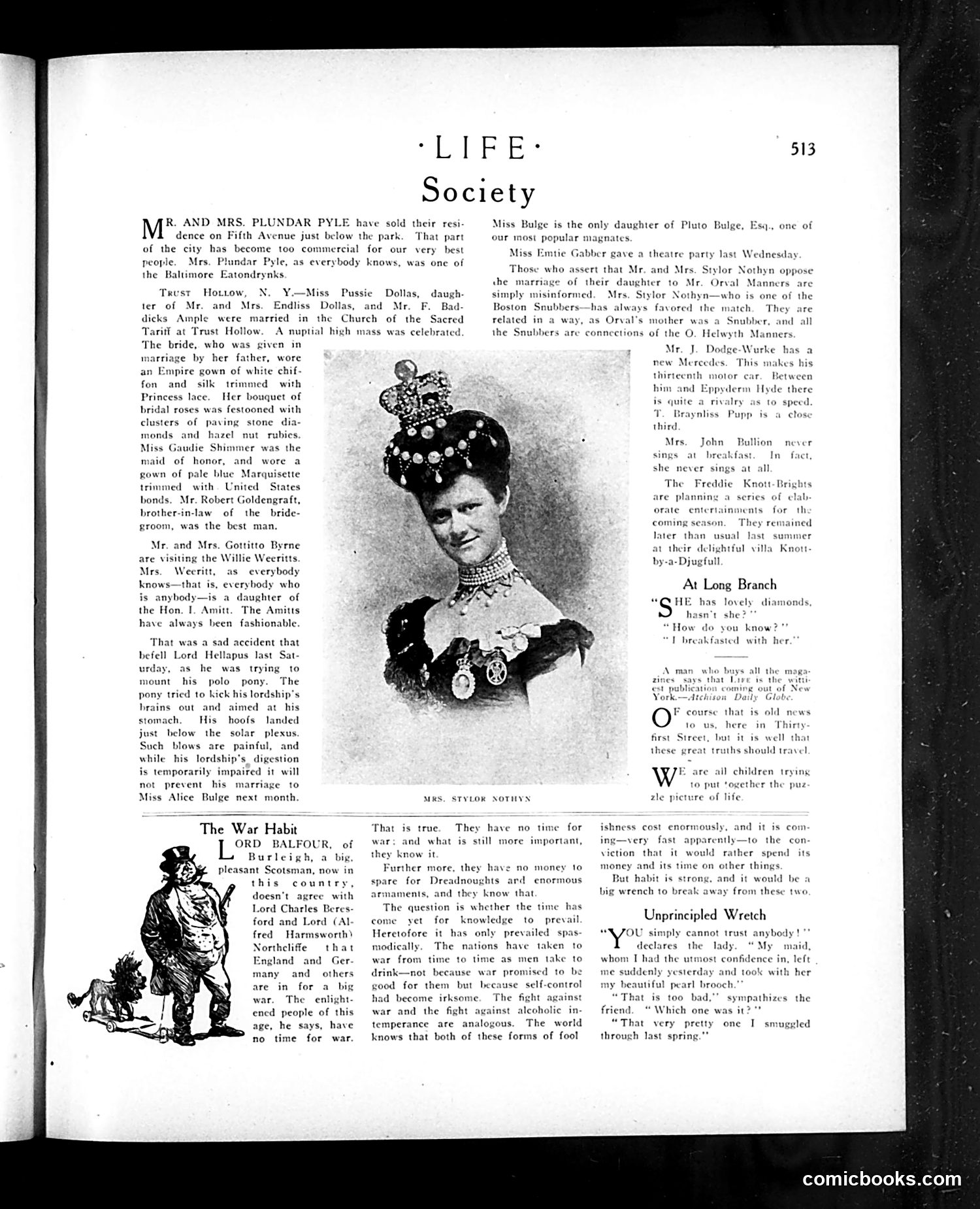
This political cartoon depicts **Lord Balfour**, identified in the text as "a pleasant sportsman" who disagrees with peace efforts. The illustration shows an aristocratic figure in hunting attire with a rifle. The accompanying text satirizes Balfour's apparent belief that nations require periodic warfare, comparing war to an addictive habit. The satirist argues that Balfour and similar leaders claim "no time for war" due to current obligations, yet fundamentally believe warfare is necessary and beneficial—suggesting they suffer from a psychological compulsion toward conflict. The cartoon critiques militaristic attitudes among British leadership, portraying them as habitually dependent on warfare rather than genuinely committed to peace.
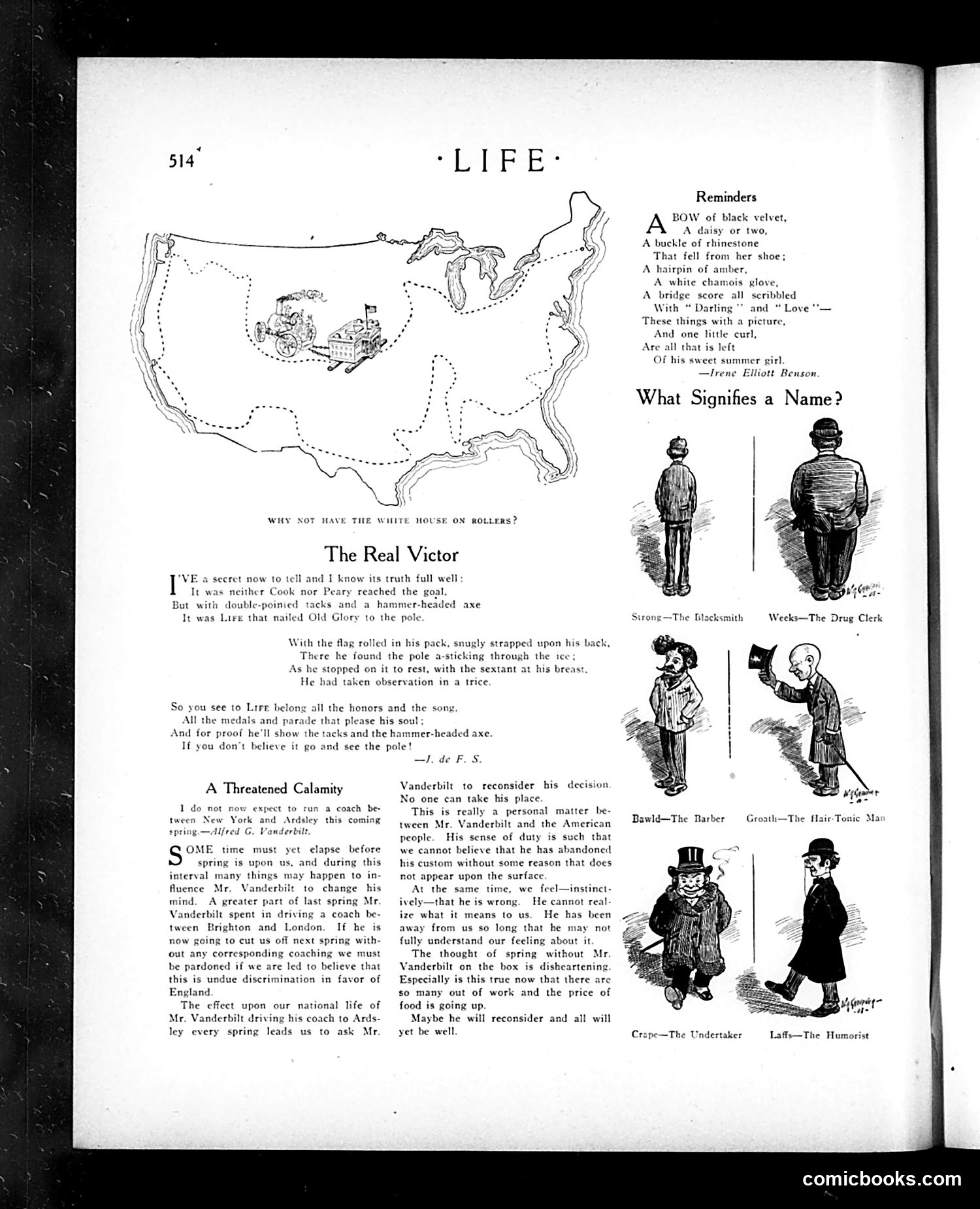
This page contains two separate satirical pieces: **"The Real Victor"** mocks the polar exploration rivalries of the early 1900s (likely referencing Peary and Cook's competing North Pole claims). The joke credits "Lure" with the actual achievement, using a pun—suggesting that persistence ("lure" as bait/temptation) rather than the famous explorers deserves credit. **"What Signifies a Name?"** presents character types identified by their occupations rather than names: "Strong—The Blacksmith," "Weeks—The Drug Clerk," etc. This appears to satirize how society defines people solely by their jobs—reducing human identity to economic function. **"A Threatened Calamity"** expresses mock-horror that millionaire Vanderbilt may discontinue his annual spring coaching ritual between Brighton and London. The satire critiques wealthy indulgence during economic hardship: the wealthy leisuring while ordinary people face unemployment and food inflation. All pieces use gentle, ironic humor typical of *Life* magazine's satirical approach to social commentary.
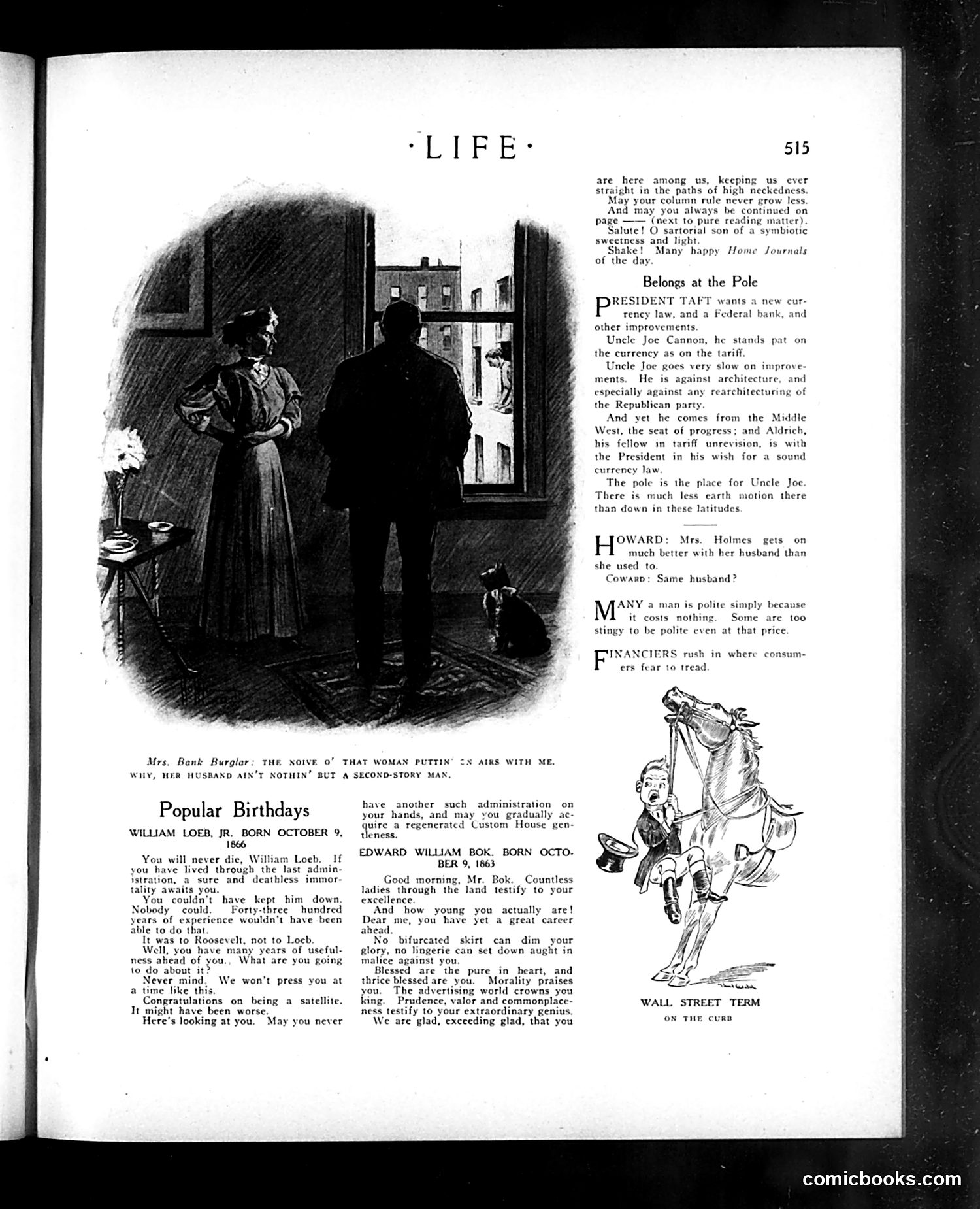
**Main Cartoon (top left):** Titled "Mrs. Bank Burglar," this depicts two working-class women. One boasts about her husband being a "second-story man" (a burglar who enters through upper floors). The joke mocks pretension: she's putting on airs despite her husband being a common criminal. The satire targets social climbing and false respectability among the poor. **"Popular Birthdays" Section:** Birthday greetings to William Loeb Jr. (likely a Roosevelt administration official) and Edward William Bok (magazine editor). The Loeb entry is heavily sarcastic, congratulating him for surviving "the last administration" with "immortality"—suggesting he endured a chaotic or unpopular presidency. Bok's entry praises his moral influence on fashion (attacking "bifurcated skirts"—bloomers/women's trousers), sarcastically celebrating his conservative influence on women's dress. **"Belongs at the Pole":** Political commentary on President Taft, Uncle Joe Cannon (House Speaker), and Senator Aldrich regarding currency and tariff reform. The satire suggests Uncle Joe should go to the North Pole—implying he's outdated and obstructive to progress. **Bottom section:** Generic witticisms about politeness and finance.
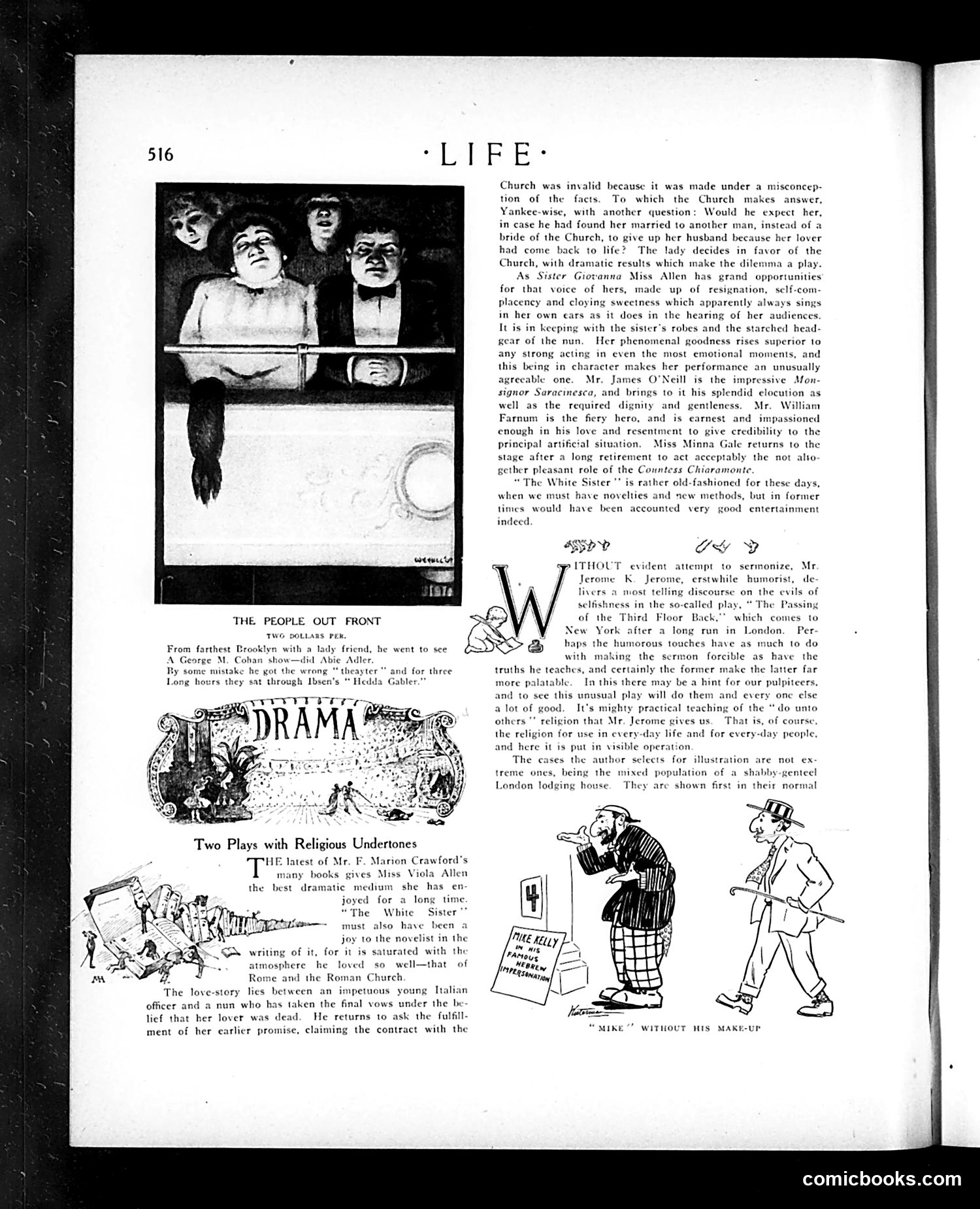
This page reviews two plays with religious themes. "The White Sister," adapted from F. Marion Crawford's novel, stars Viola Allen as a nun who discovers her presumed-dead lover is alive, creating a moral dilemma between her vows and earlier promises. The review praises Allen's performance and James O'Neill's dignified portrayal of a monsignor. The second play, "The Passing of the Third Floor Back" by Jerome K. Jerome, is a morality play about selfishness set in a shabby London boarding house. The reviewer notes Jerome—"erstwhile humorist"—delivers his ethical message effectively through humor rather than preaching, making the lesson more palatable to audiences. The cartoon "Mike Without His Make-Up" (bottom right) appears to illustrate an actor's transformation, likely commenting on theatrical artifice versus reality.
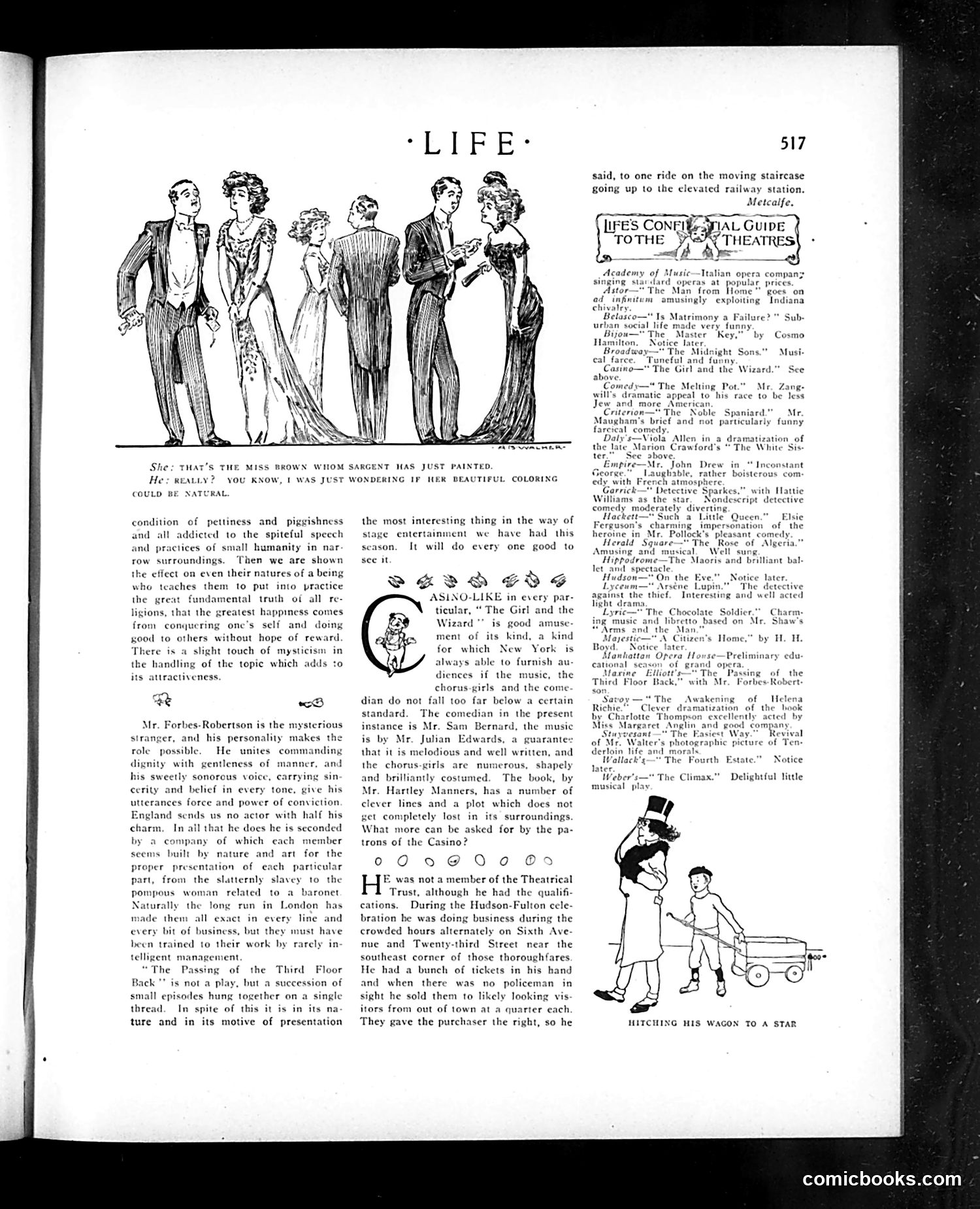
This page combines theater criticism with two distinct comedic pieces: **The Main Cartoon** (top): A society joke about a woman named Miss Brown recently painted by the famous portrait artist John Singer Sargent. The humor lies in whether her beautiful appearance in the portrait is "natural" coloring or artistic enhancement—a jab at both high society vanity and artistic license. **The Text Section** reviews theatrical productions, praising actor Forbes-Robertson's performance in "The Passing of the Third Floor Back" as morally uplifting entertainment. **The Bottom Anecdote** (captioned "Hitching His Wagon to a Star"): Satirizes a ticket scalper operating near the elevated railway during the Hudson-Fulton celebration. He fraudulently sells tickets to naive out-of-town visitors, claiming they grant elevator rides—a con exploiting both gullibility and the era's new mechanical wonders. The page epitomizes Life's satirical approach: mocking pretension among the wealthy while exposing street-level deception in Gilded Age New York.
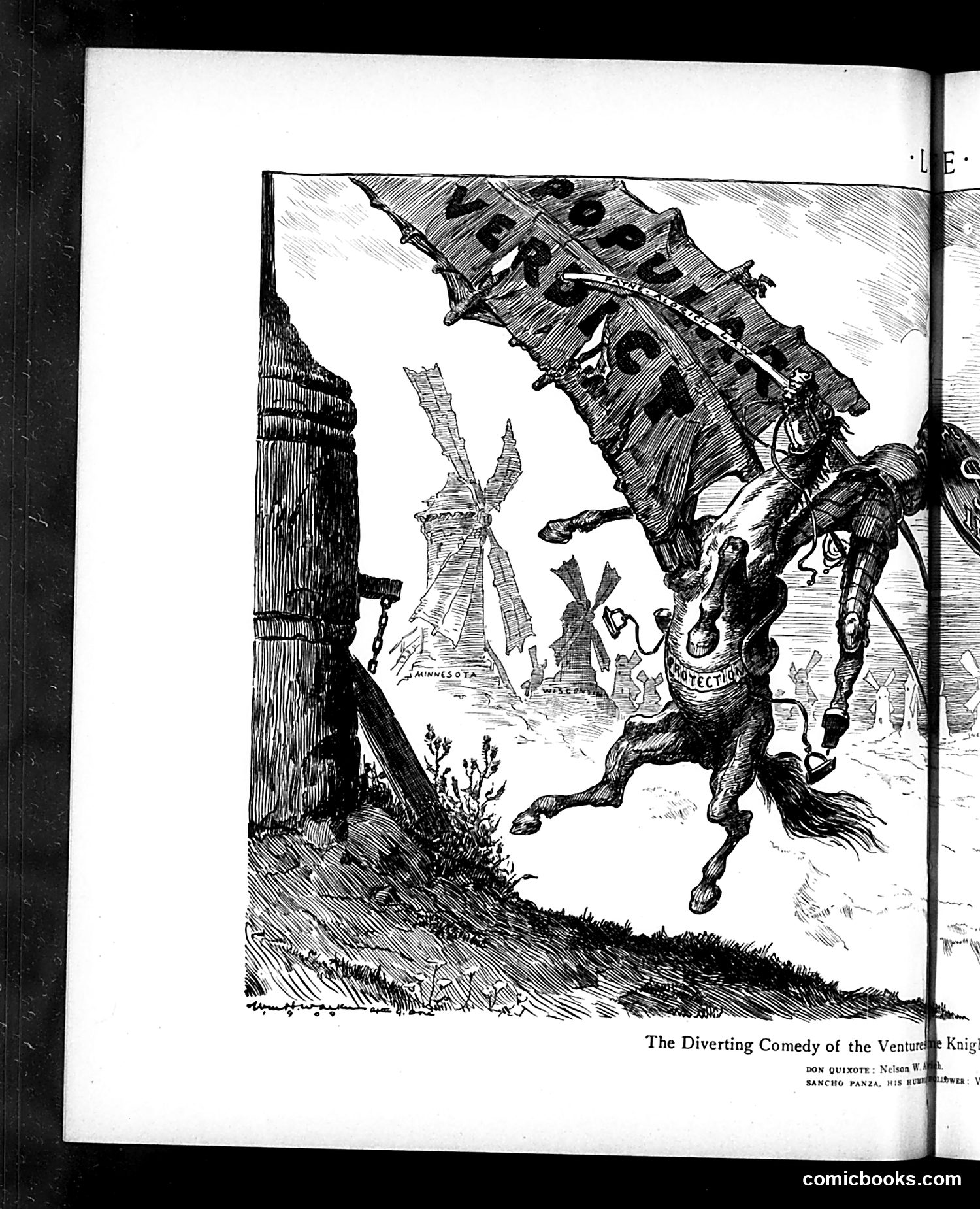
This is a satirical illustration referencing *Don Quixote*, the classic novel about a delusional knight tilting at windmills. The cartoon depicts a donkey-headed figure (labeled "Sancho Panza, his Humble") rearing up before a tilting building—likely representing a Midwestern venture or company (possibly "Minnesota" is visible in the background). The satire appears to mock a foolish business venture or political scheme by comparing its promoters to Cervantes' famous fool. The donkey imagery and chaotic composition suggest the endeavor is absurd and destined to fail. The reference to Don Quixote was a common way early-20th-century *Life* magazine criticized impractical or delusional public figures and their schemes.
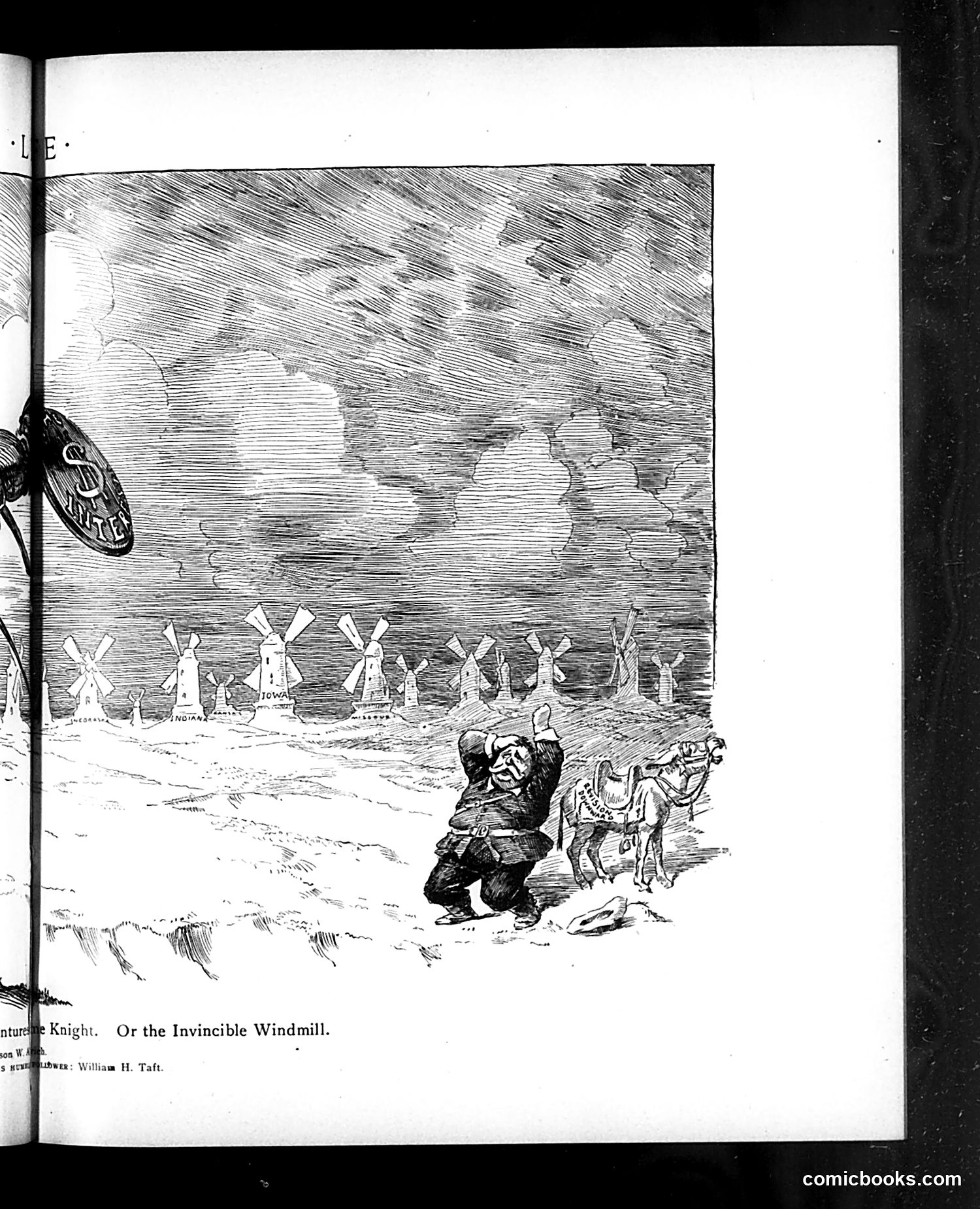
This is a satirical illustration referencing Cervantes' *Don Quixote*, the classic tale of a delusional knight tilting at windmills. The cartoon depicts a figure in armor attacking windmills across a landscape, with a donkey beside him. The title credits William H. Taft as the "publisher," suggesting this is political satire about Taft's presidency (1909-1913). The "invincible windmill" metaphor likely criticizes Taft as foolishly tilting at unbeatable opponents or chasing futile political battles—portraying his administration's efforts as quixotic or doomed ventures. The Don Quixote parallel implies Taft is delusional about his political power or effectiveness, perhaps referencing his conflicts with Theodore Roosevelt or unsuccessful reform efforts.
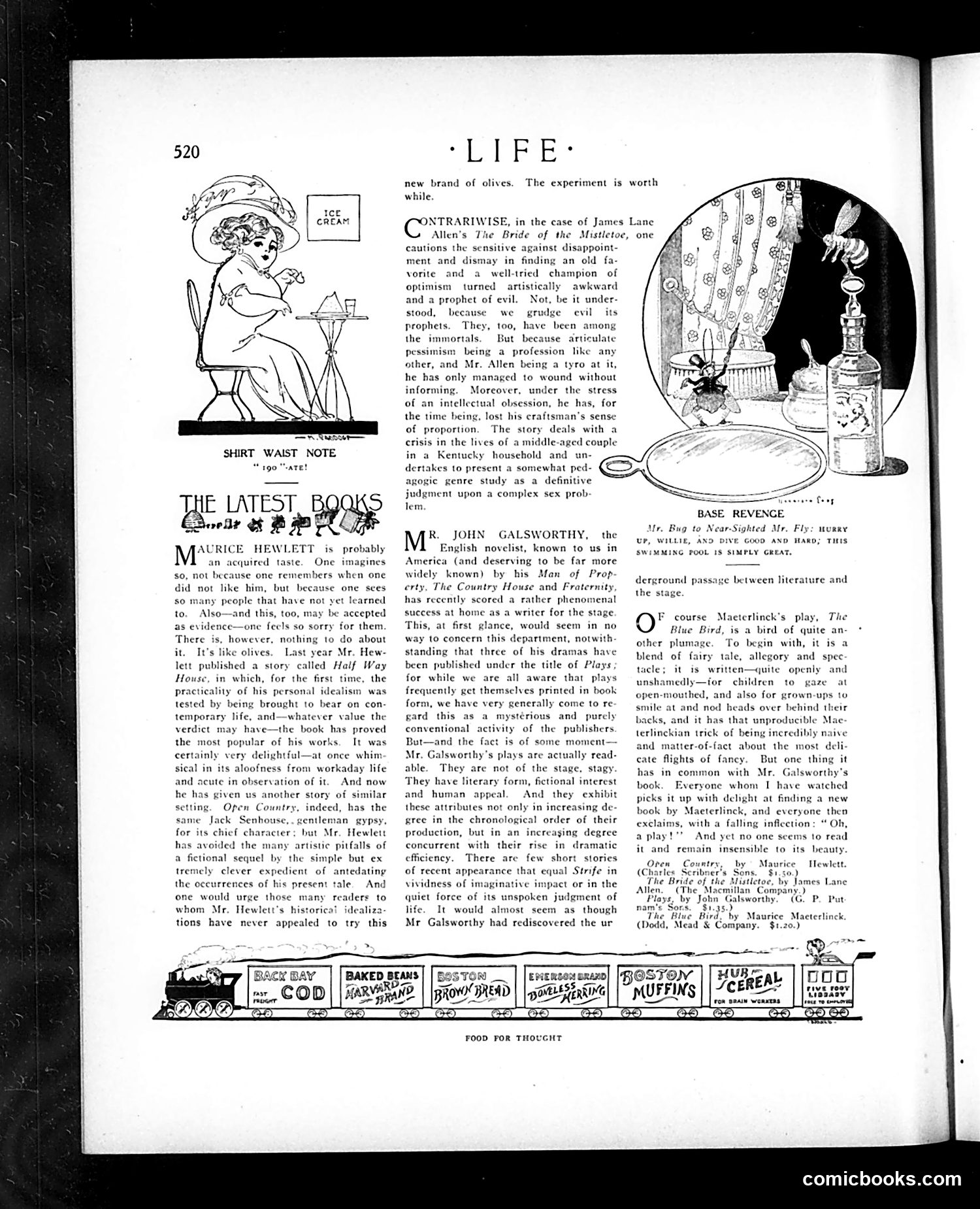
This page contains book reviews and literary commentary, not political cartoons. The main content discusses: **"Shirt Waist Note"** (left): A brief, somewhat sarcastic review of Maurice Hewlett's novel *Open Country*, suggesting Hewlett is "an acquired taste" and praising his latest work's craftsmanship. **Book Reviews**: The page reviews three authors: - James Lane Allen's *The Bride of the Mistletoe*—criticized for turning from optimism to pessimism without artistic skill - John Galsworthy's plays—praised for successfully bridging literature and drama with works like *Strife* - Maeterlinck's *The Blue Bird*—mentioned favorably as an allegorical play **"Base Revenge"** (right): A small cartoon showing a mosquito advising a fly to dive-bomb a bather, mocking the swimmer's overconfidence. The page is primarily a literary review section typical of *Life* magazine's satirical commentary on contemporary books and authors, with minimal visual satire beyond the mosquito cartoon.
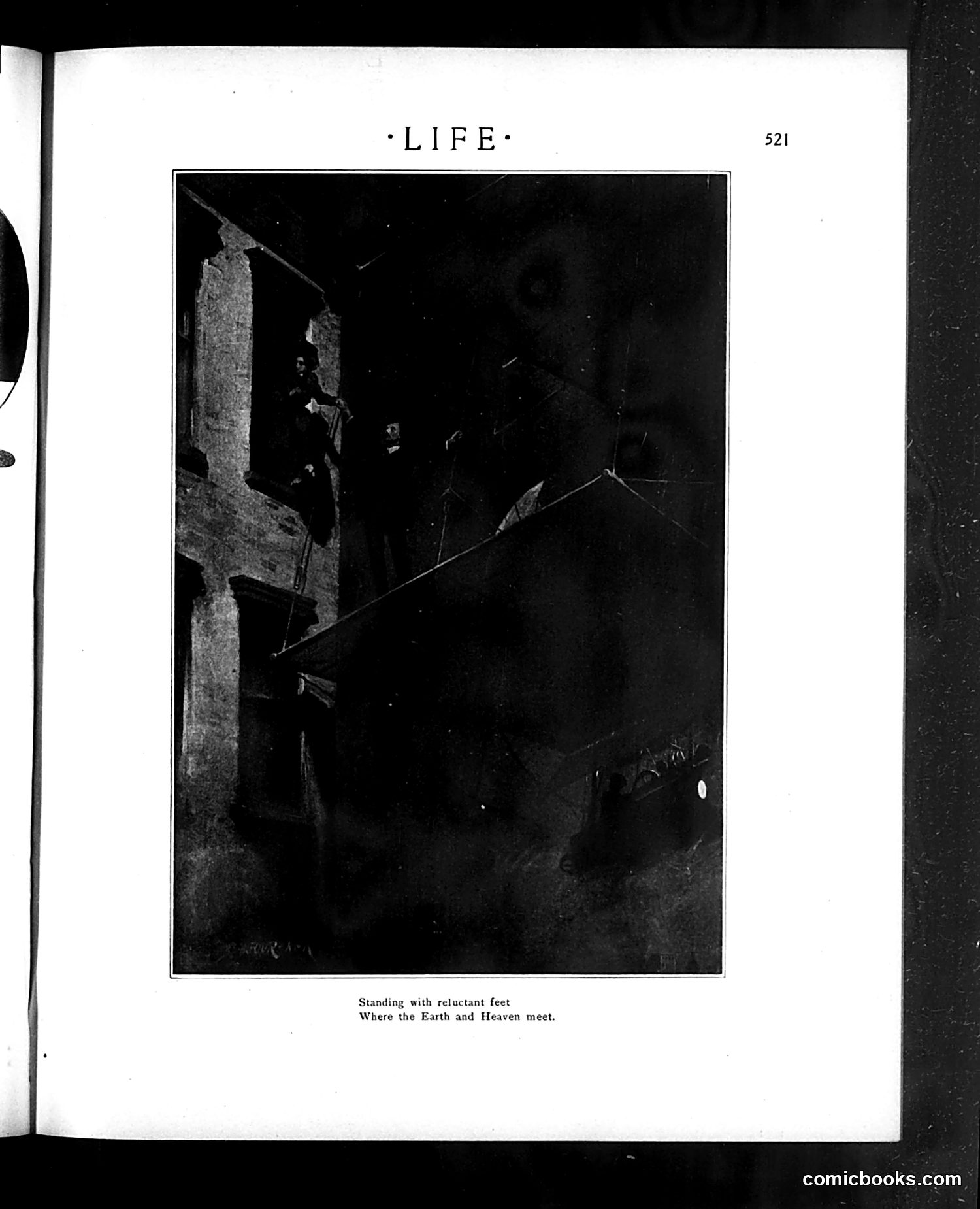
This appears to be a dramatic illustration from *Life* magazine (page 521) titled "Standing with reluctant feet / Where the Earth and Heaven meet." The image shows a figure standing on what appears to be a high, precarious location—possibly a cliff, tower, or elevated structure—silhouetted against a dark sky. The composition suggests hesitation or reluctance, with the figure's posture implying uncertainty or dread. The poetic caption references a liminal space between earthly and heavenly realms, suggesting themes of moral choice, spiritual crisis, or existential doubt. Without additional context about the publication date or surrounding content, the specific satirical target remains unclear, though the imagery implies commentary on contemporary social or political anxiety—possibly regarding duty, sacrifice, or a difficult moral decision confronting the nation or individual.
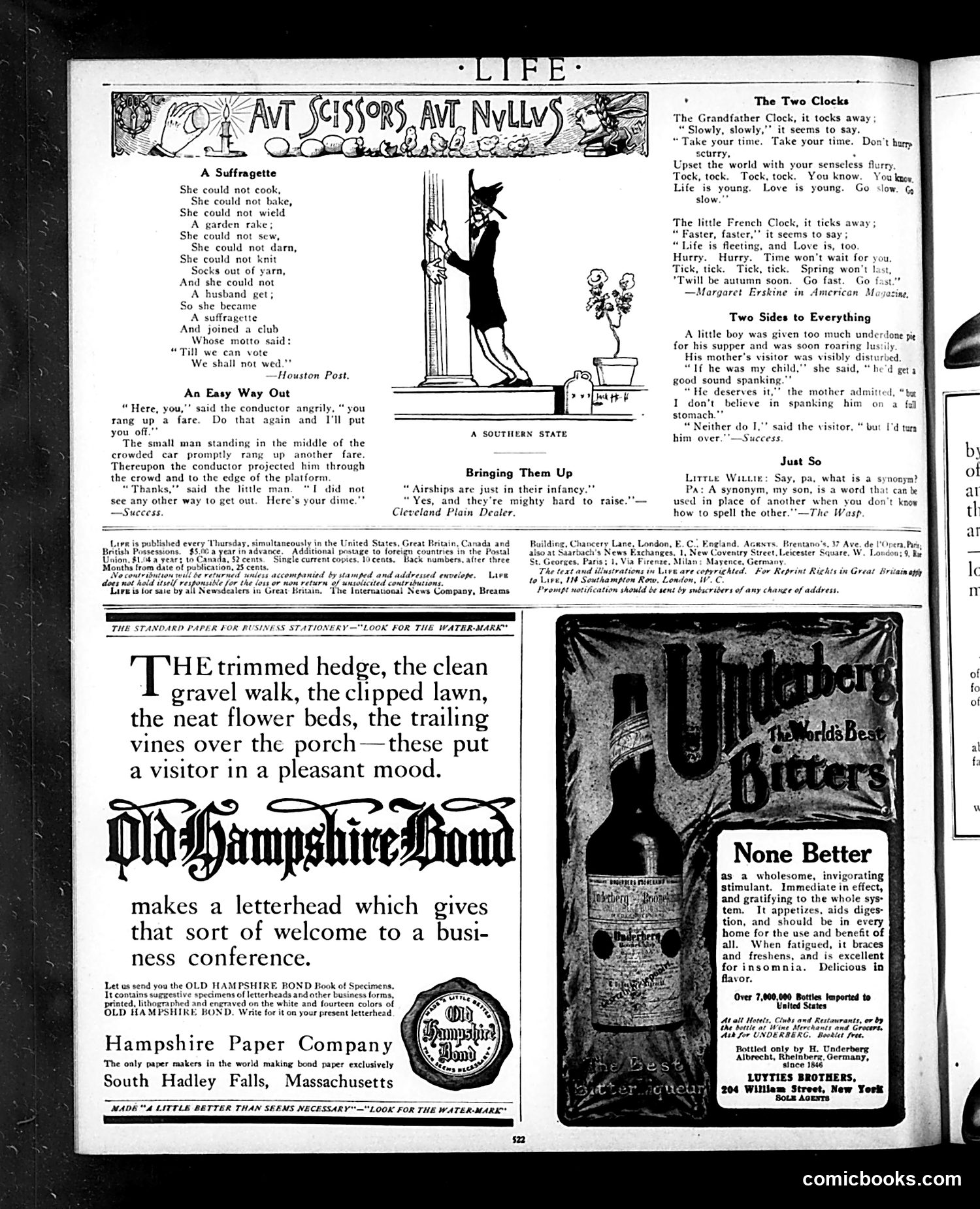
This page contains several satirical pieces reflecting early 20th-century social concerns: **"A Suffragette"** mocks women's suffrage advocates through a poem listing domestic tasks the suffragette "could not" perform—implying women seeking voting rights were incompetent homemakers. The joke presents suffragism as unattractive rebellion rather than legitimate political activism. **"The Two Clocks"** contrasts a slow grandfather clock (urging caution and tradition) with a fast French clock (representing modern haste). This appears to satirize anxieties about changing social pace and values, with the French clock seemingly associated with frivolous modernity. **"An Easy Way Out"** and other brief jokes depict working-class men outwitting authority figures—reflecting tension between laborers and conductors/bosses. **"Two Sides to Everything"** presents domestic discipline debates, while "Just So" jokes with children address child-rearing philosophies. The page is primarily satirical commentary on gender roles, modernization, class dynamics, and social propriety—dominant concerns of early-1900s American culture.
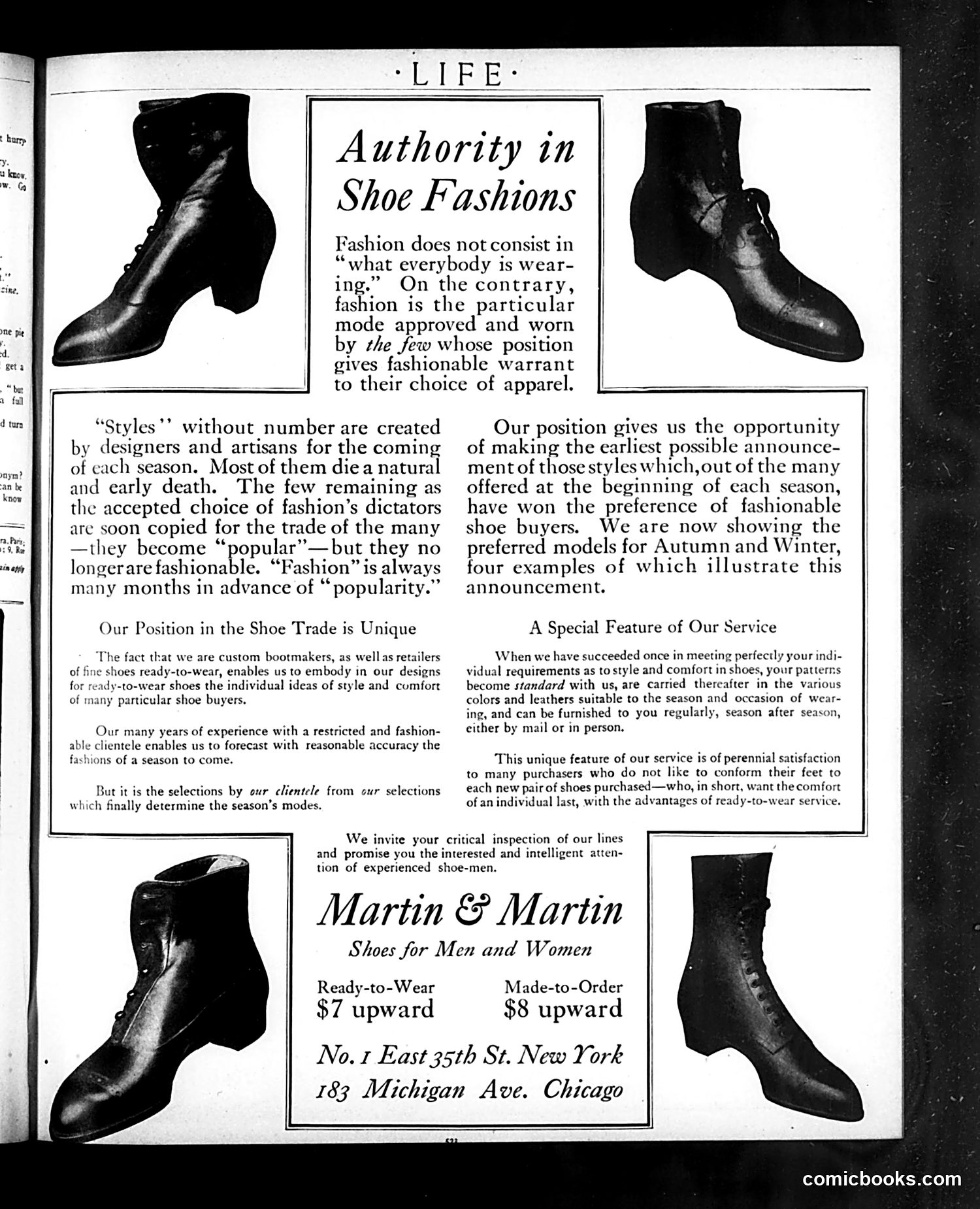
This is **not a cartoon or satire**—it's a straightforward advertisement for Martin & Martin shoes, a retailer with locations in New York and Chicago. The page presents a fashion industry argument: true "fashion" belongs to the wealthy elite whose choices set trends; the masses then copy these choices and make them "popular." Martin & Martin positions itself as an authority by claiming insider access to what fashionable people are actually wearing before it becomes mainstream. The four shoe photographs illustrate their "preferred models for Autumn and Winter"—boots that supposedly reflect elite taste-makers' current selections. The advertisement emphasizes two services: ready-to-wear shoes ($7+) for immediate purchase, and made-to-order custom boots ($8+) where they maintain customers' individual patterns for repeat orders across seasons. The social messaging reflects early 20th-century class consciousness: fashion legitimacy derives from the wealthy few, not mass consumption. The ad reassures customers that buying from Martin & Martin connects them to that exclusive authority.
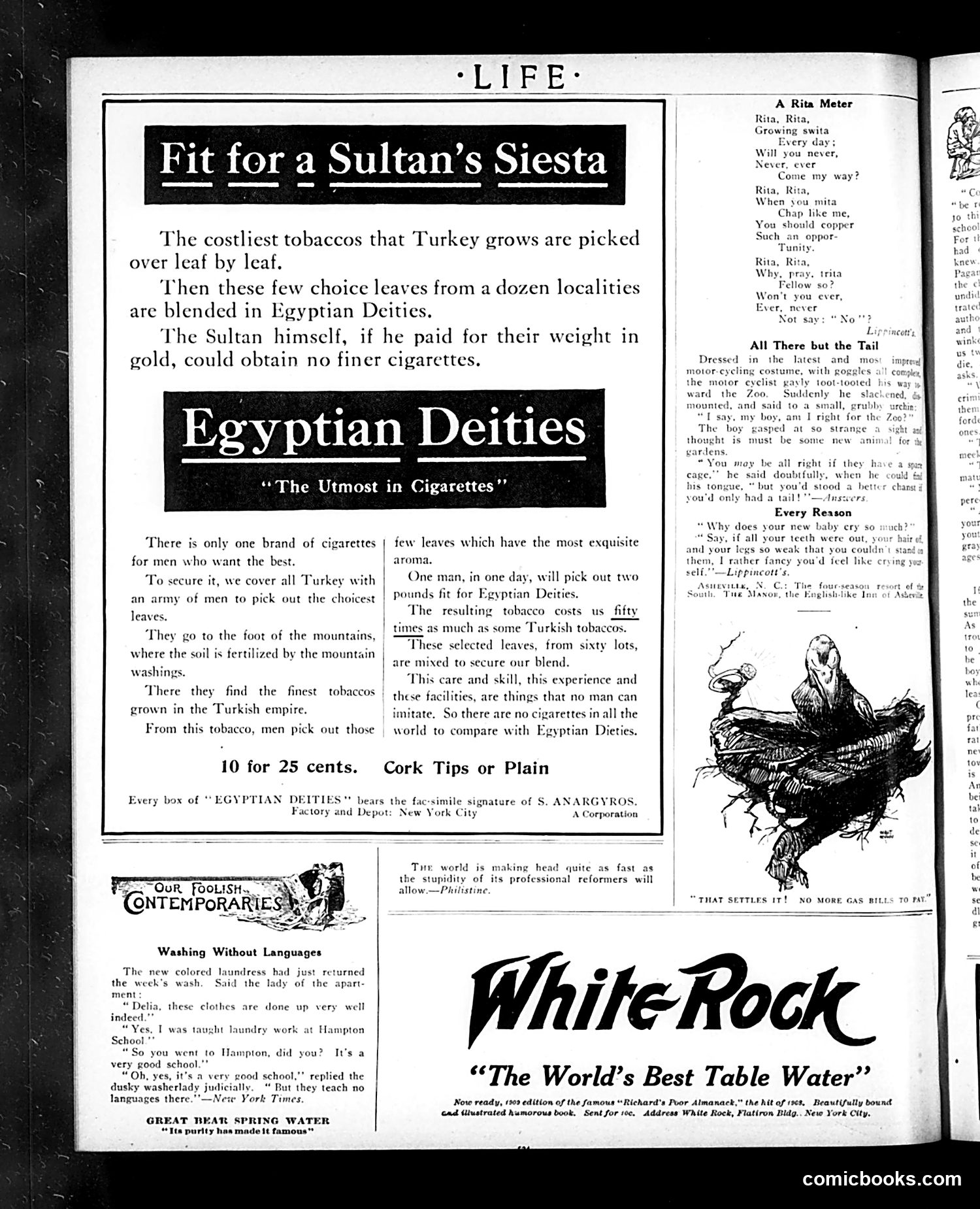
This page is primarily **advertising** for luxury cigarettes and other consumer products, interspersed with brief humor pieces. The main advertisement for "Egyptian Deities" cigarettes employs orientalist marketing: it claims Turkish tobacco is hand-selected by armies of workers in mountain regions, then expertly blended in Egypt—suggesting exotic luxury and meticulous craftsmanship justifying premium pricing (10 for 25 cents). The copy emphasizes exclusivity: even a Sultan couldn't obtain finer cigarettes. The humor section "Our Foolish Contemporaries" satirizes racial attitudes: a story about a Black laundress trained at Hampton Institute (a historically Black school) includes the punchline that "they teach no languages there"—mocking both the school and suggesting the worker's limited education despite formal training. Other advertisements promote White Rock table water and Richard's Poor Almanack. The page reflects early 20th-century marketing strategies combining exotic appeal with implicit class distinctions, alongside period-typical racial stereotyping presented as humor.
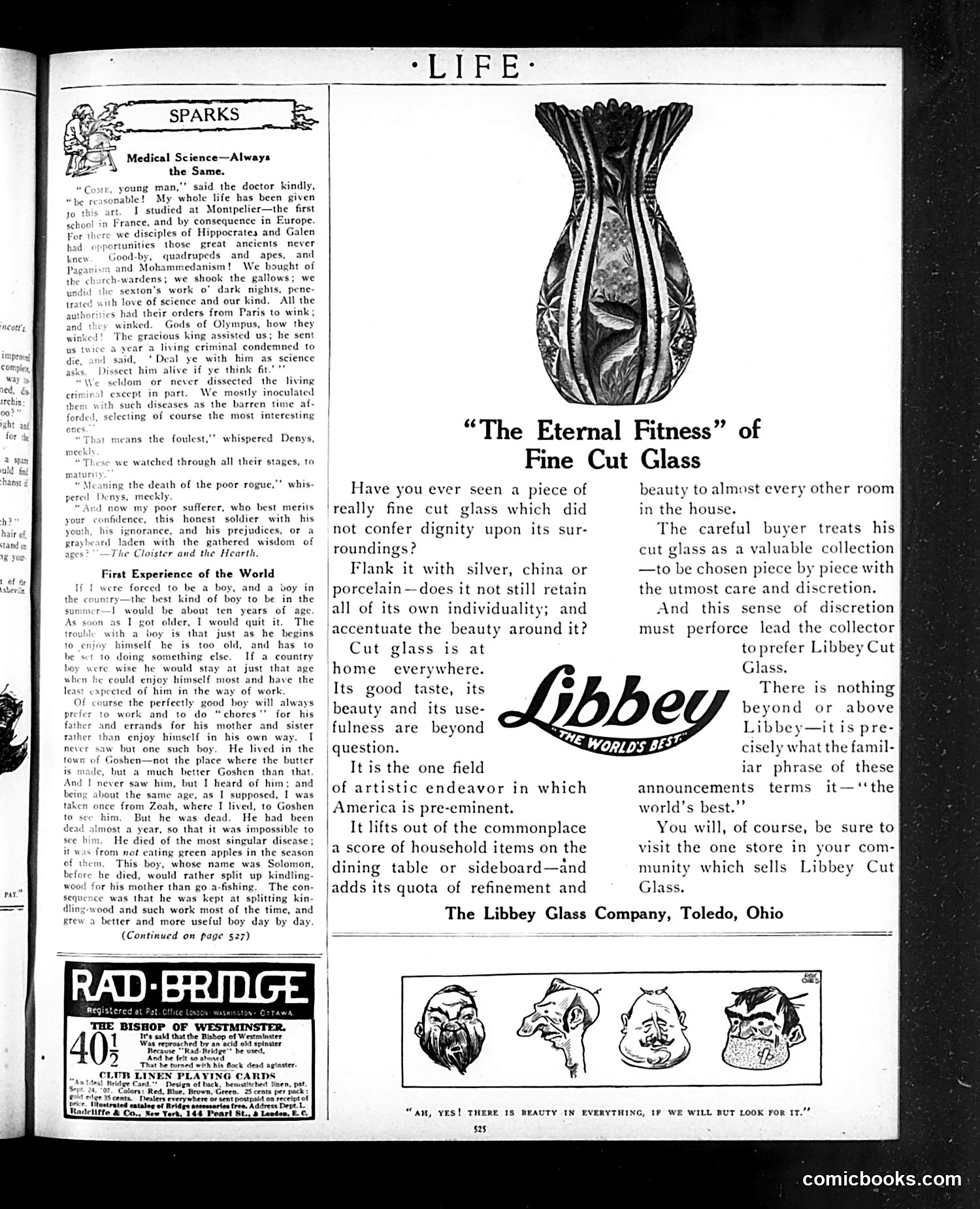
This page contains two distinct sections: a fictional dialogue about medical history and a product advertisement. **The "Sparks" column** presents a doctor recounting the history of medicine, boasting about 18th-century French medical advancement—dissecting cadavers and conducting experiments on executed criminals. The satirical point attacks the doctor's pompous self-satisfaction despite medicine's brutal past. The dialogue suggests that progress required questionable ethics, and the doctor's pride in these "achievements" is darkly ironic. **The Libbey Glass advertisement** dominates the page, promoting cut glass as an American luxury product. It argues that fine cut glass deserves the same status as silver and china, claiming America leads in this artistic field. The ad targets affluent households, encouraging collectors to treat cut glass purchases with serious discretion. The page juxtaposes medical history's moral compromises against consumerist appeals to refinement—typical of *Life* magazine's satirical approach to American society and values.
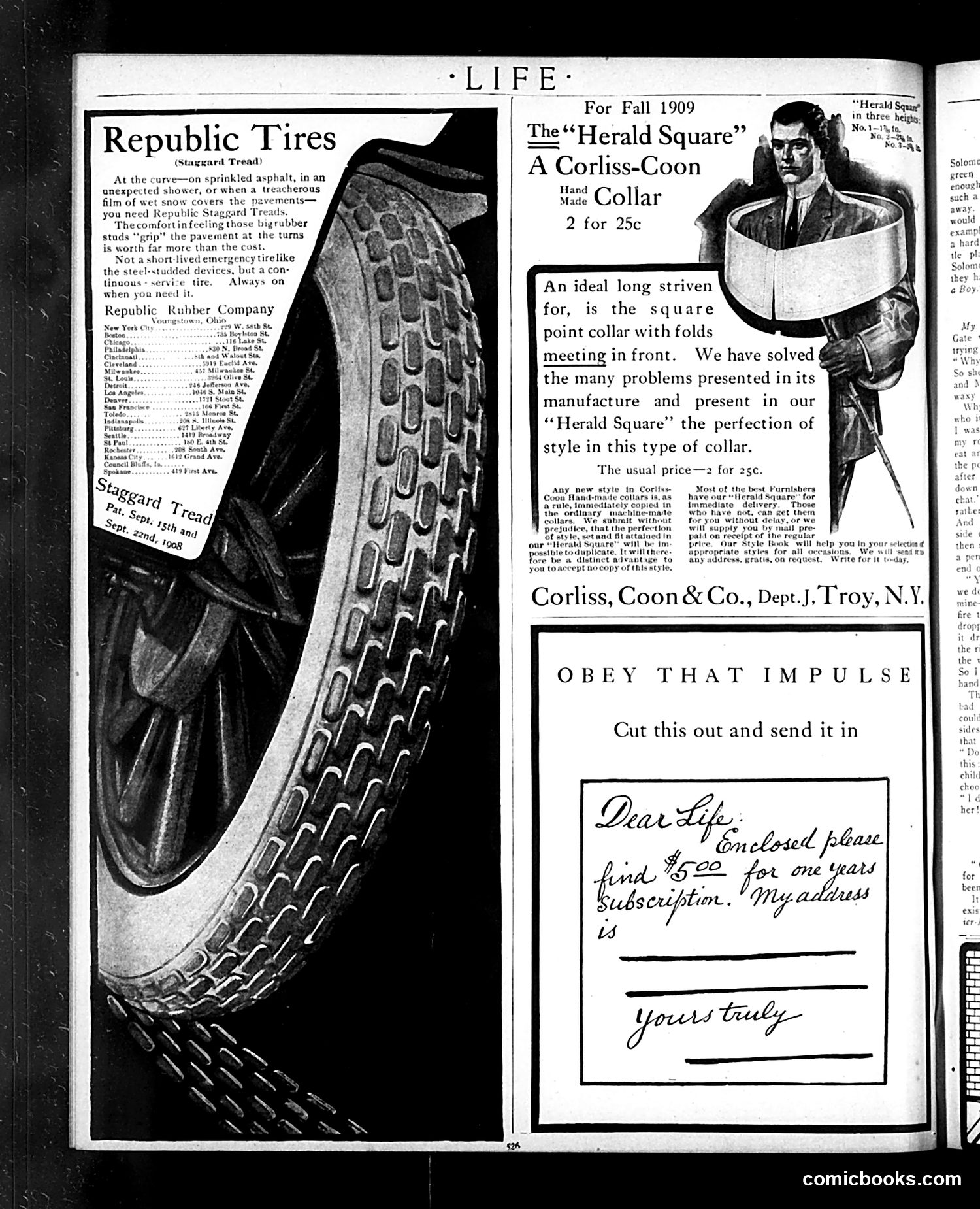
This page contains two separate advertisements with no political cartoon. **Left side:** Republic Tires promotes "Staggard Tread" tires, emphasizing reliability and continuous service in difficult conditions (wet snow, sprinkled asphalt). The large tire photograph showcases the tread pattern. This is straightforward product advertising for automotive safety. **Right side:** Corliss, Coon & Co. advertises the "Herald Square" detachable collar—a practical men's fashion item priced at 2 for 25 cents. The illustration shows a man wearing the square-point collar design. The text emphasizes the collar's innovative design solving manufacturing problems. Below is a subscription card readers could cut out and mail with payment ($5.00 for one year). Both ads reflect early 1900s concerns: automobile reliability (emerging technology) and men's fashion accessories (detachable collars were common before attached collars became standard). There is no satire or political content on this page.
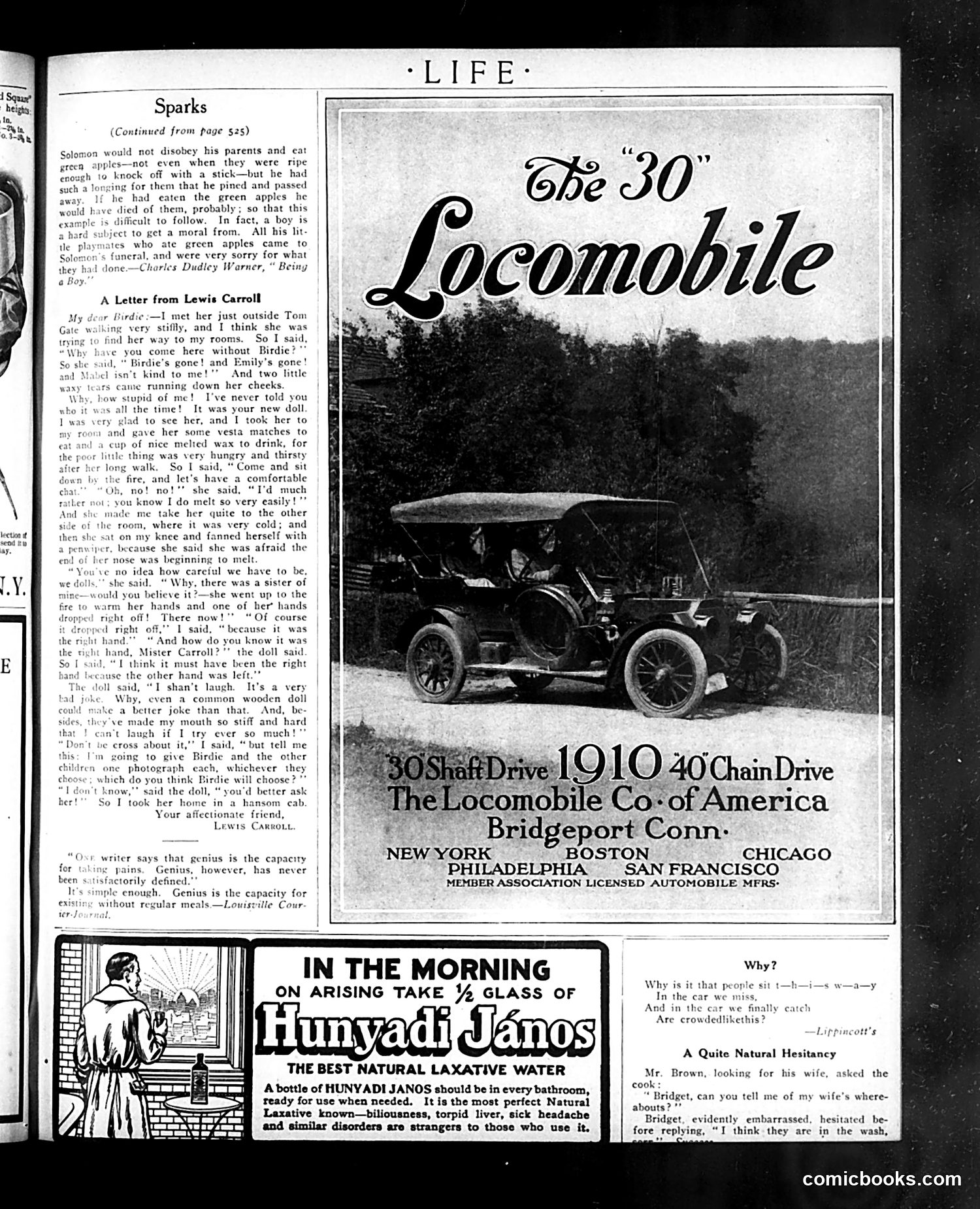
This page from *Life* magazine mixes literary content with advertising. The main text includes a letter purportedly from Lewis Carroll describing an absurdist conversation with a wooden doll—a gentle satire of Carroll's own whimsical writing style, playing with illogical children's-story humor (the doll melting by the fire, the confusion about which hand was cut off). The advertisements are period-specific: a 1910 Locomobile automobile advertisement emphasizes the vehicle's prestige through multiple locations, and a Hunyadi János laxative water ad uses conventional digestive-health messaging typical of early 20th-century patent medicine marketing. The "Why?" cartoon joke at bottom right plays on social awkwardness: a husband cannot find his wife; the cook reveals her undergarments are in the wash—implying the wife cannot leave the house, a domestic humor common to the era that assumes women's social immobility during laundry day. These items reflect *Life*'s mix of literary parody, consumer culture, and genteel domestic comedy typical of 1910s American magazine humor.
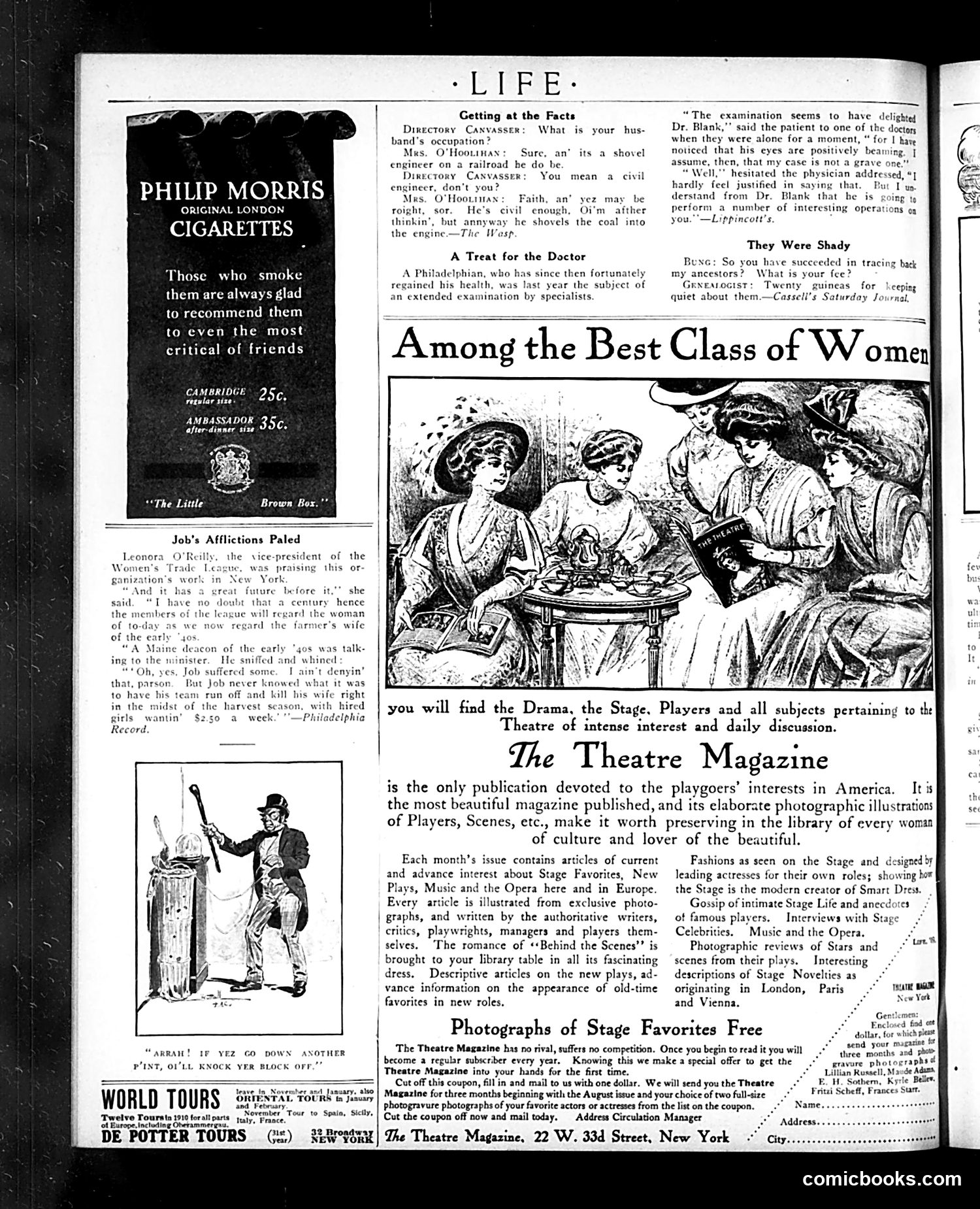
This page contains mostly **advertisements and filler content** rather than political satire. The notable elements are three brief humorous sketches: 1. **"Job's Afflictions Paled"**: A joke about a woman comparing her husband's hardships to Job's biblical suffering. The satire targets the exaggeration of marital complaints. 2. **"Getting at the Facts"**: A census-taker dialogue mocking Irish immigrants' speech patterns and occupational confusion—the humor relies on ethnic stereotyping common to the era. A "civil engineer" who actually shovels coal represents working-class misrepresentation. 3. **"They Were Shady"**: A genealogist charges a client to keep quiet about unflattering ancestry—satirizing both social climbing and the commercialization of genealogy research. The page is dominated by period advertisements (Philip Morris cigarettes, world tours, The Theatre Magazine). These sketches use gentle humor about immigration, class, and social pretension typical of *Life* magazine's early 20th-century satire.
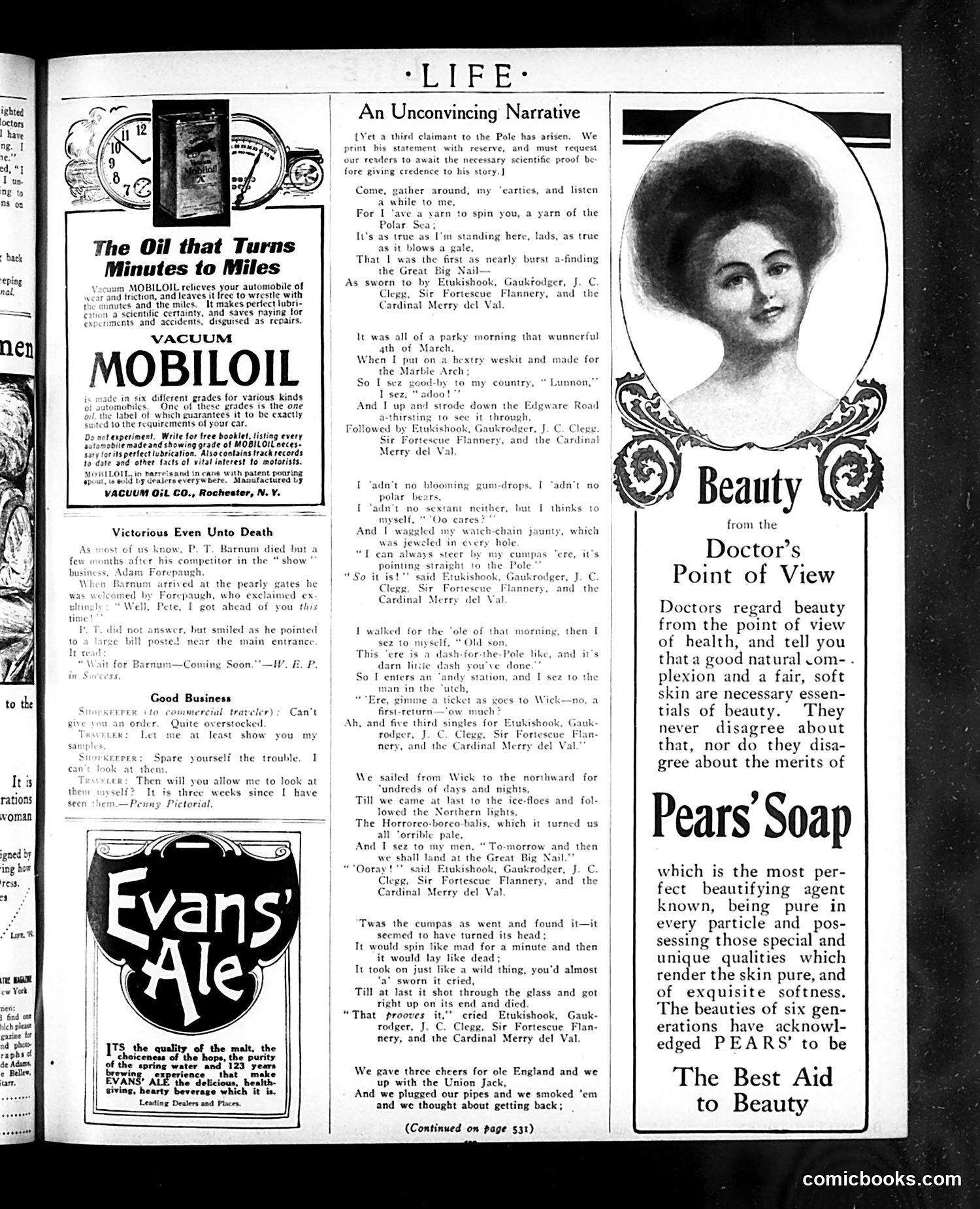
This page primarily contains **advertisements and satirical narrative content** rather than political cartoons. The main feature is "An Unconvincing Narrative"—a mock-heroic poem in Cockney dialect claiming yet another explorer has reached the North Pole. The satire mocks the early 20th-century "Pole race" craze, where multiple explorers claimed discovery. The narrator's absurd account (compass spinning wildly, casual attitude, companions named "Etukishook" and "Gaukrodger") ridicules both the proliferation of dubious polar claims and sensationalist explorer narratives. The poem's working-class voice and exaggerated dialect humorously deflate the glamorous explorer mythology. The advertisements—Mobiloil, Evans' Ale, and Pears' Soap—are straightforward commercial pitches typical of the era, with Pears' Soap notably marketing beauty as medical science ("Doctor's Point of View").
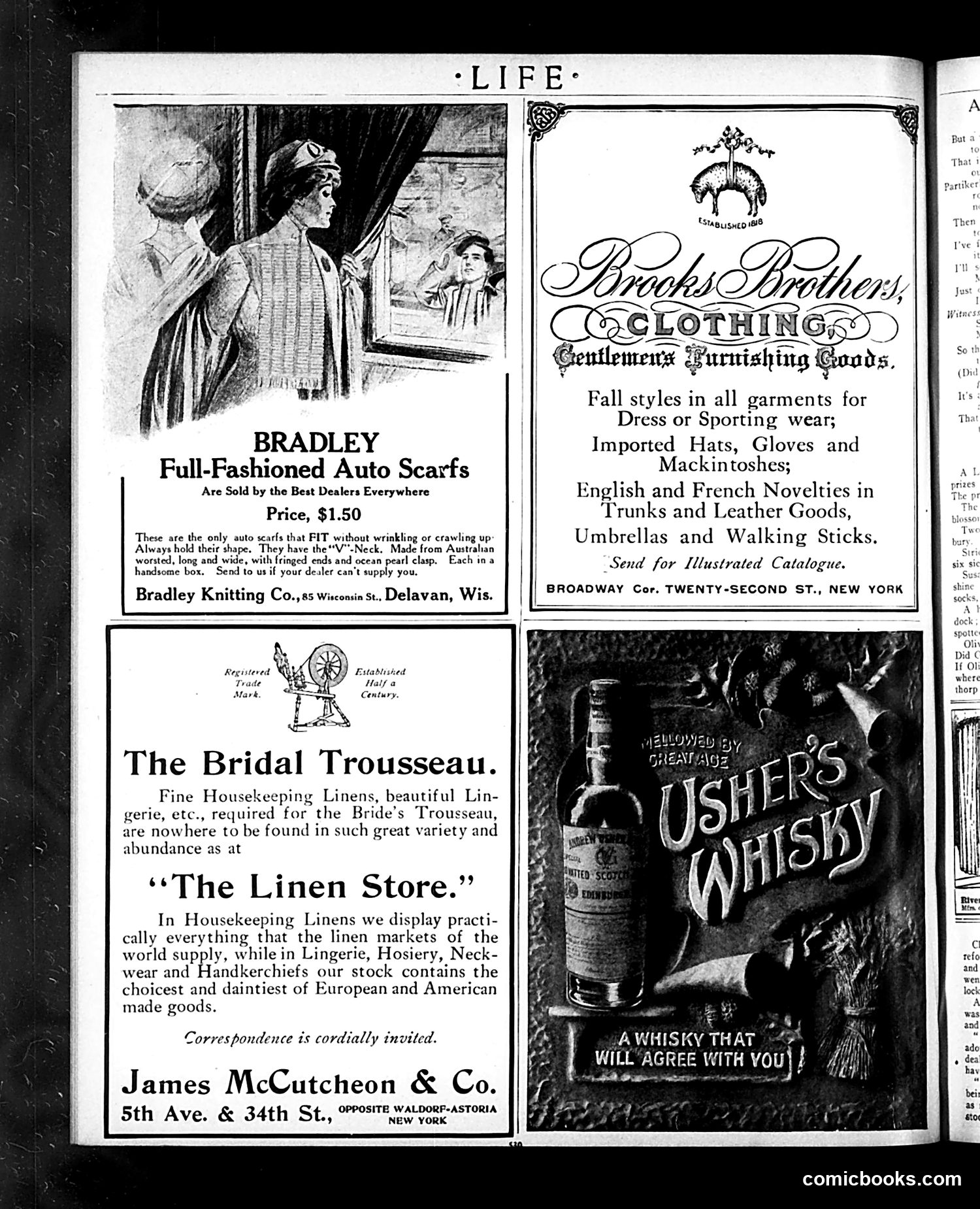
This is primarily an **advertising page**, not a satirical cartoon. It contains four commercial advertisements typical of early 20th-century American magazines: 1. **Bradley Auto Scarfs** — marketed as fashionable neckwear for automobile drivers, priced at $1.50 2. **Brooks Brothers Clothing** — advertising fall fashions, imported accessories, and leather goods from their Broadway location 3. **The Linen Store / James McCutcheon & Co.** — promoting bridal trousseau linens and European housekeeping goods 4. **Usher's Whisky** — a Scottish whisky advertisement with the tagline "A whisky that will agree with you" The only visual element approaching cartoon style is the illustration accompanying the Bradley scarf ad, showing a woman in period dress. The Usher's Whisky ad uses dramatic imagery but is straightforward product promotion. **No political satire is present** — this is a straightforward commercial page reflecting consumer goods and fashion marketed to affluent readers of the era.
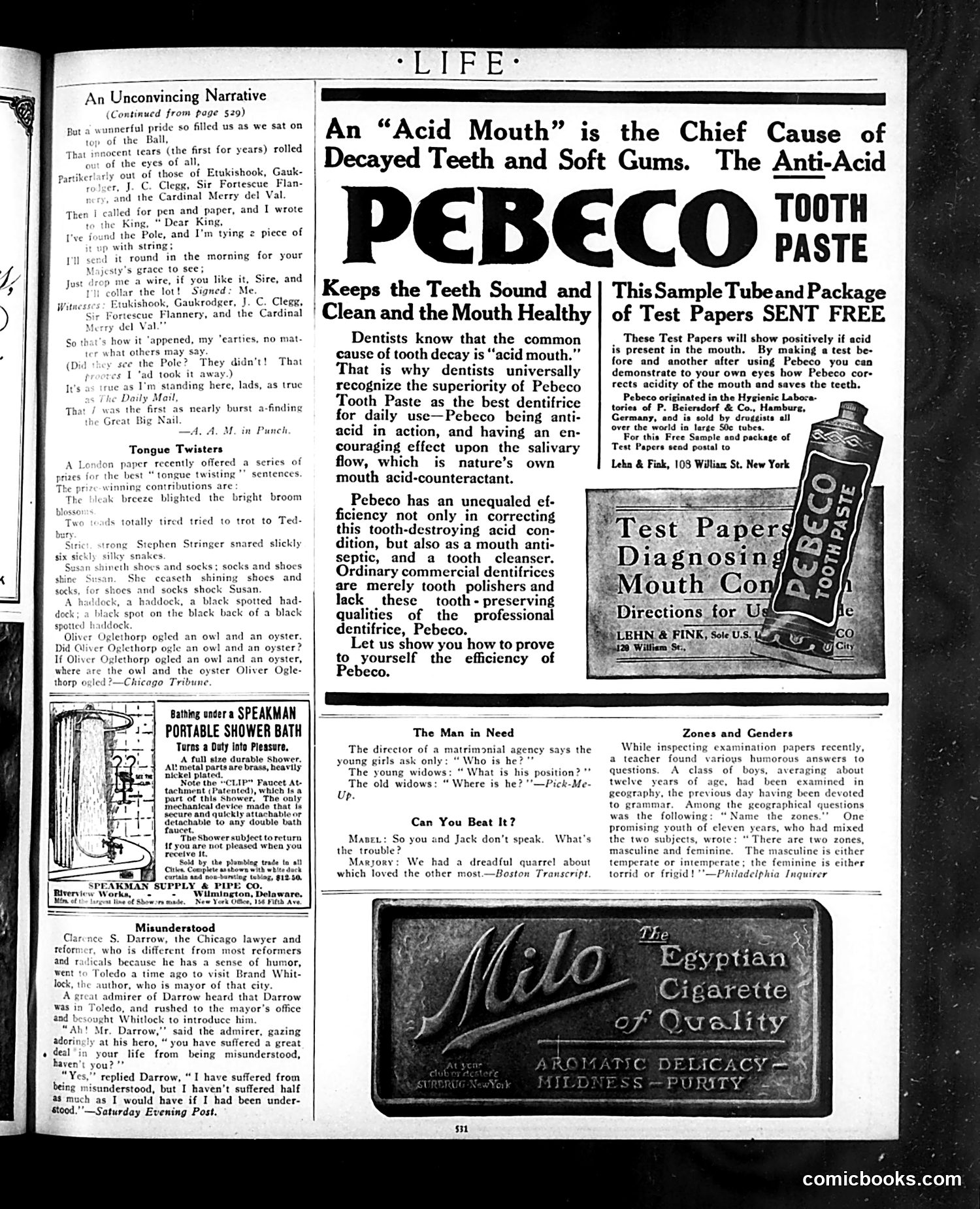
This page is primarily **advertising**, not political satire. The dominant content is a full-page advertisement for **Pebeco Tooth Paste**, which claims to be an "anti-acid" dentifrice that prevents tooth decay by counteracting "acid mouth." The page includes several smaller satirical pieces typical of Life magazine's humor section: - **"An Unconvincing Narrative"**: A humorous tall tale (continued from previous page) written in dialect, appearing to mock exaggerated storytelling - **"Tongue Twisters"**: A collection of alliterative word-play exercises reprinted from various publications - **"Misunderstood"**: A brief anecdote about Chicago lawyer Clarence Darrow, humorously depicting a fan's misinterpretation of Darrow's comment about being "misunderstood" - **"The Man in Need"** and **"Can You Beat It?"**: Short joke pieces with minimal text visible The Pebeco advertisement dominates through bold typography and includes a sample tube offer, typical of early 20th-century direct-response marketing integrated into magazine editorial content.
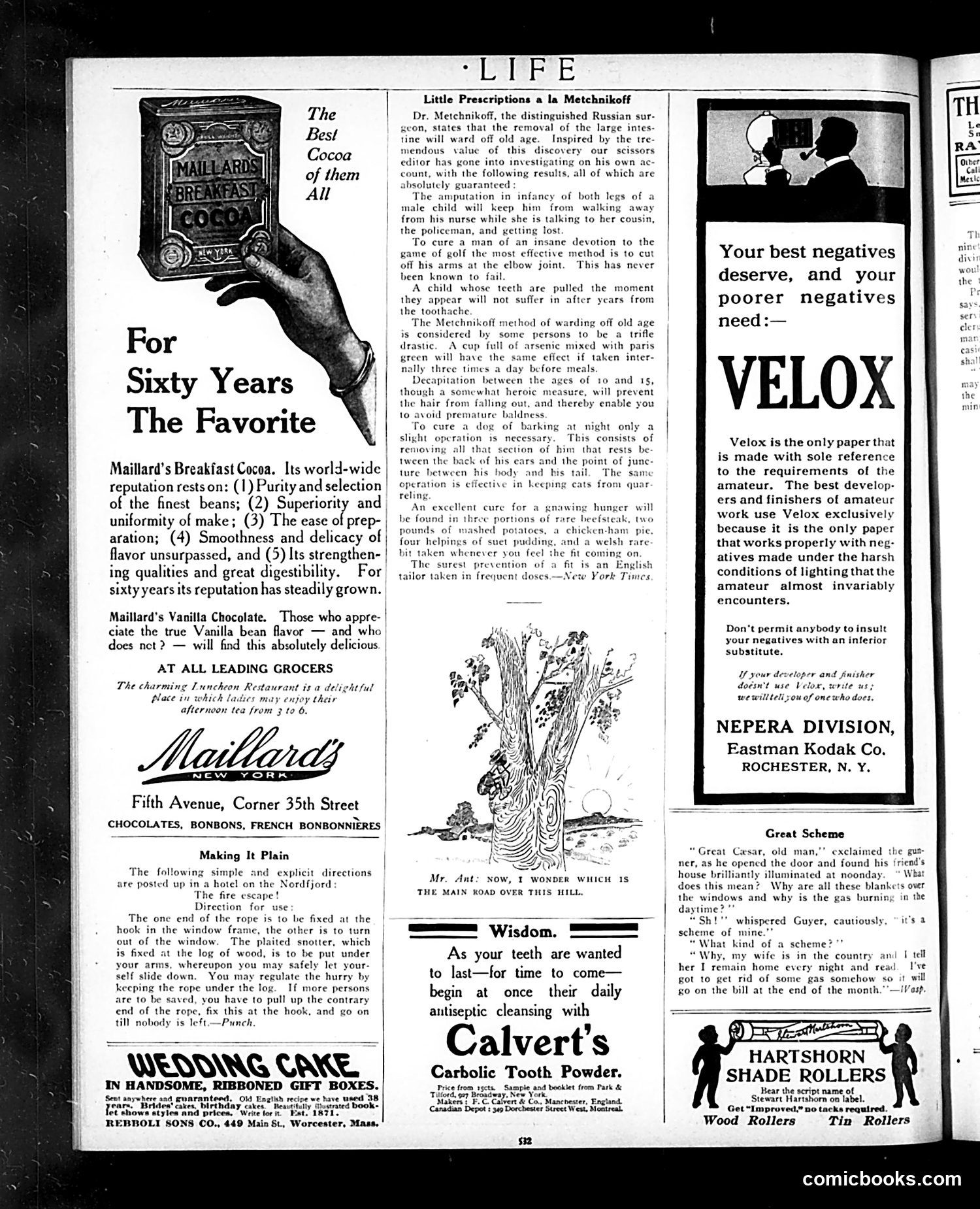
This page is primarily **advertisements and humorous filler content** rather than political cartoons. The main satirical piece is "Little Prescriptions à la Metchnikoff," mocking the Russian surgeon Ilya Metchnikoff's theories about aging. Metchnikoff proposed removing the large intestine to extend life; this section parodies his pseudoscientific claims with absurd "prescriptions"—amputating limbs to prevent golf obsession, extracting teeth to prevent toothaches, decapitation to prevent baldness. The humor relies on exaggerating medical pseudoscience into obvious ridicule. The remainder consists of period advertisements: Maillard's cocoa and chocolate, Calvert's tooth powder, Hartshorn shade rollers, and wedding cake boxes. A brief item titled "Making It Plain" humorously republishes poorly-written Norwegian fire-escape instructions from *Punch* magazine. No identifiable political figures or current events are referenced. The satire targets only general medical quackery.
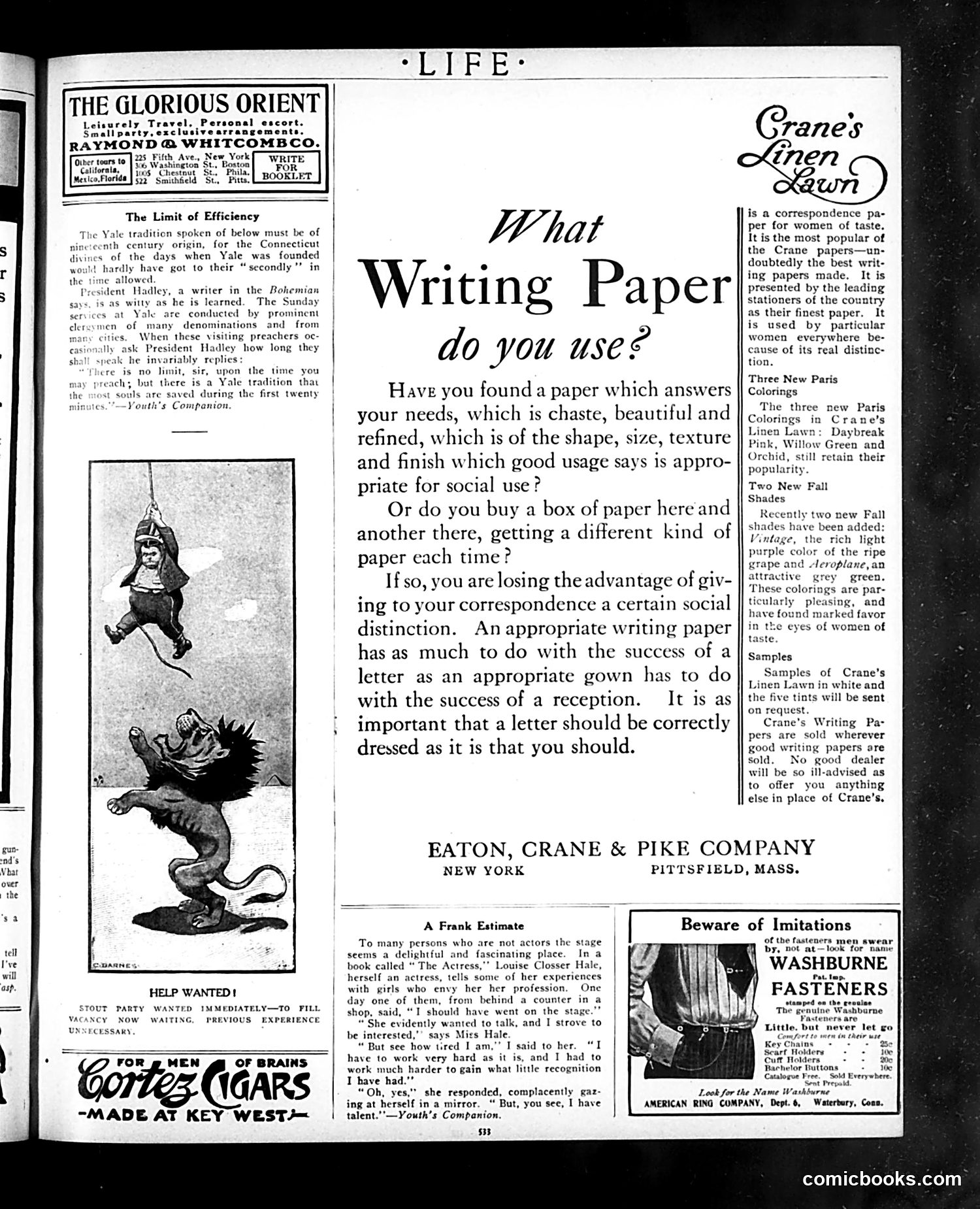
This page mixes advertisements with light social humor typical of early 20th-century Life magazine. The main cartoon (upper left) depicts a dragon-like creature, likely referencing "The Glorious Orient" travel advertisement above it—a humorous visual pun associating exotic Eastern travel with fantastical monsters. The central content is an advertisement for Crane's writing paper, framed as advice: appropriate stationery reflects social status and refinement, just as a proper gown matters for a reception. This speaks to rigid early-1900s social etiquette where paper quality signaled respectability. The "Frank Estimate" piece at bottom satirizes stage aspirations. A shop girl envies an actress's profession, but when the actress describes exhaustion and hard work, the girl gazes at herself in a mirror, declaring "I have talent"—missing the point entirely. The humor mocks naive confidence and the gap between theatrical glamour and actual labor. Other ads include cigars, employment, and fasteners—typical period advertising filling space around editorial content.
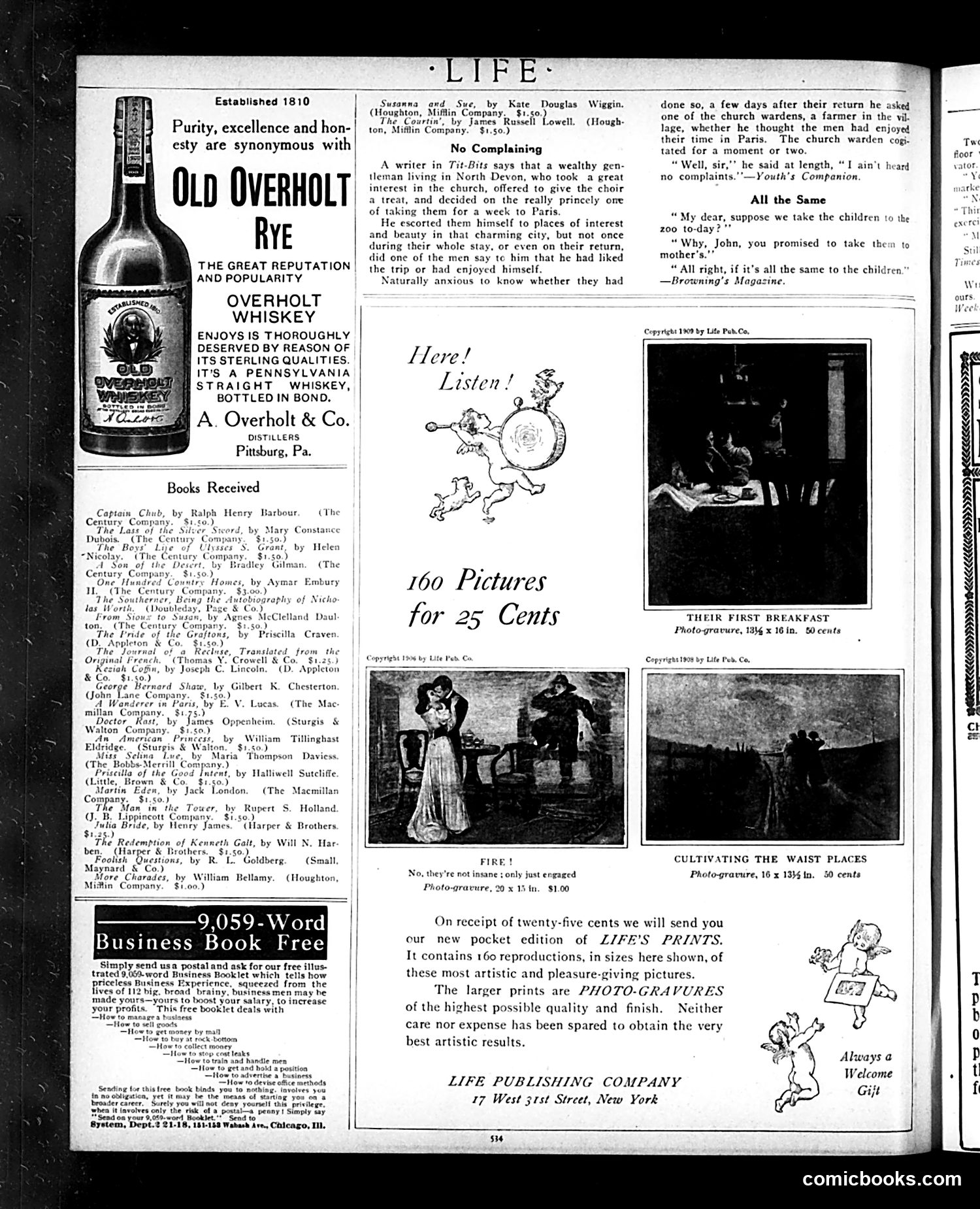
This page is primarily **advertising and announcements**, not political satire. The main content includes: **Old Overholt Rye whiskey advertisement** (left side): A straightforward pitch emphasizing the product's Pennsylvania origin and quality—typical early 1900s liquor marketing. **"Books Received" section**: A standard literary listing common in magazines of the era. **Small humorous anecdotes** (center): Brief comic stories—one about a wealthy man's Paris trip to which churchgoers offer "no complaints" (satirizing English reserve), another about parents debating where to take children (mild domestic humor). **Photo-gravure advertisements** (right): The Life Publishing Company promoting pocket-sized picture collections at 25 cents, featuring photographs titled "Their First Breakfast," "Fire!" (apparently about an engaged couple), and "Cultivating the Waist Places." The page reflects *Life's* mixed content model: high-brow literary mentions alongside light humor and commercial ventures. The satire is gentle and apolitical—focused on social manners rather than politics.
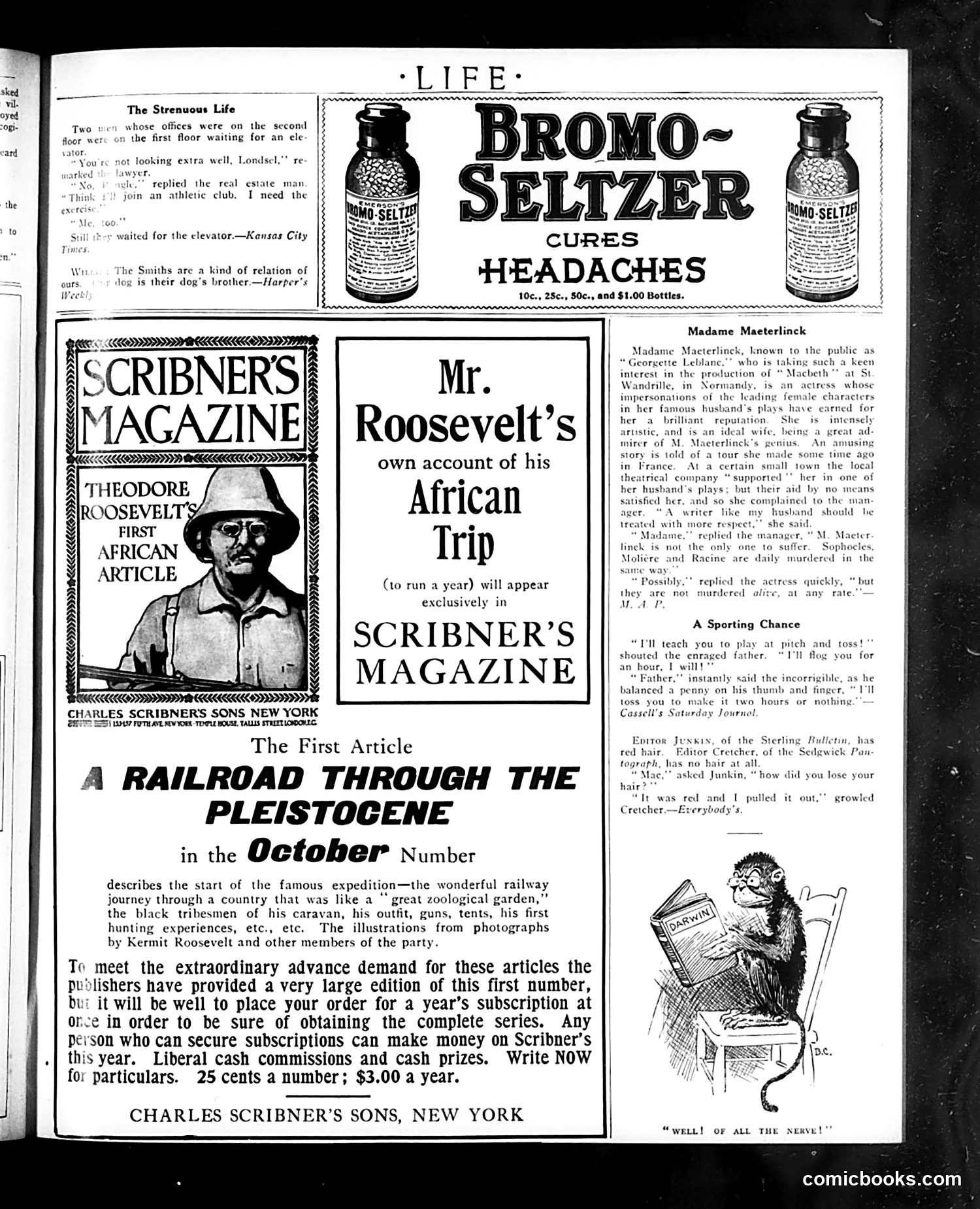
This page is primarily **advertising and promotional content** rather than political satire. The main items are: 1. **Bromo-Seltzer advertisement** — a patent medicine claiming to cure headaches, typical of early 1900s advertising. 2. **Scribner's Magazine promotion** — advertising Theodore Roosevelt's upcoming serialized article about his African hunting expedition, with illustrations by his son Kermit. This references Roosevelt's famous 1909-1910 African safari. 3. **Several brief humorous anecdotes** in "The Strenuous Life" section, including a joke about needing an athletic club and a pun about the Smiths and their dog. 4. **A small cartoon** showing a monkey reading Darwin — likely commenting on evolution, a topical debate of the era. 5. **Biographical sketch of Madame Maeterlinck**, a Belgian playwright's wife. The page reflects early 1900s Life magazine: a mix of advertisements, celebrity gossip, and mild social humor, with Roosevelt's African adventure being the major news peg driving subscriptions.
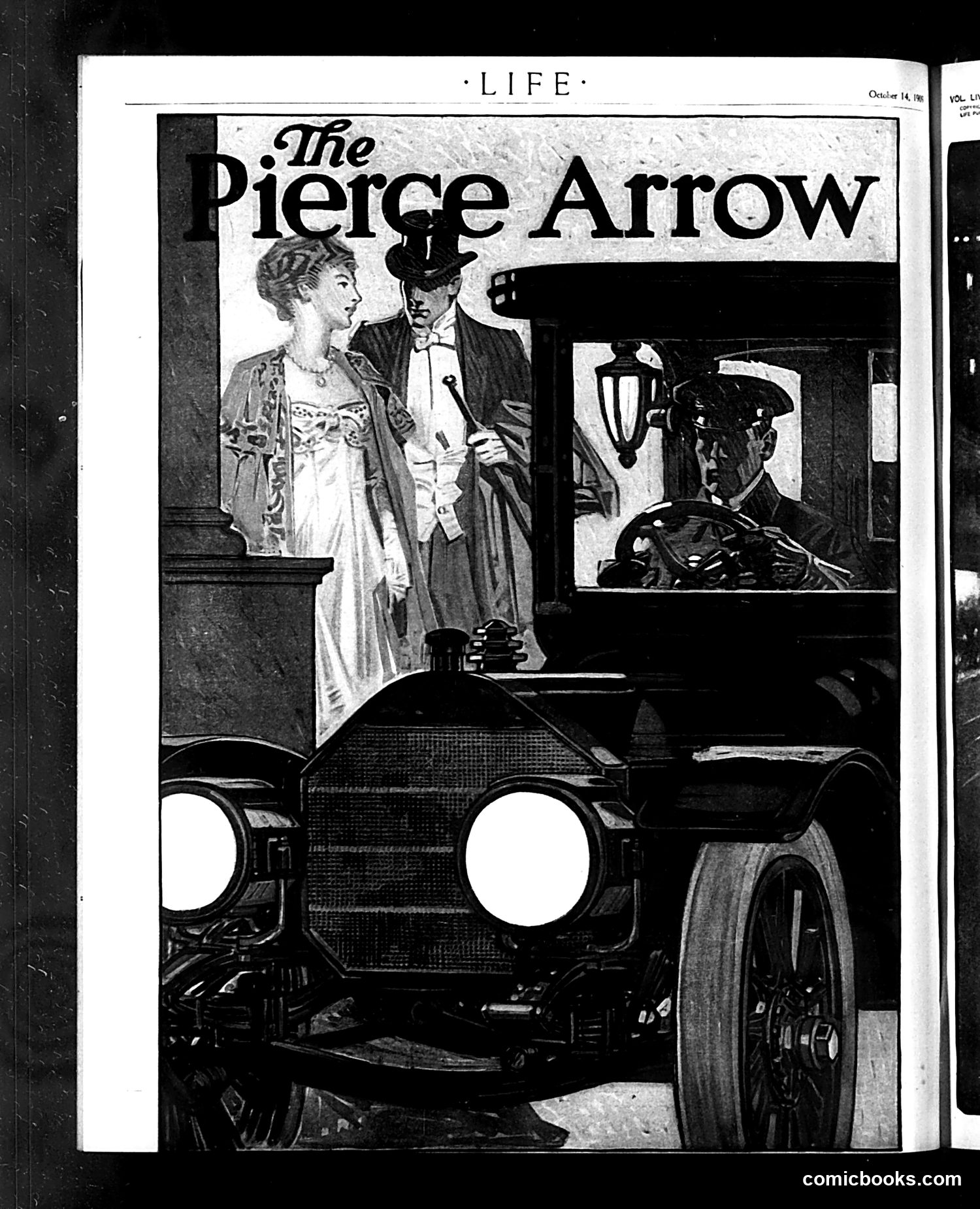
This page advertises the Pierce-Arrow automobile, a luxury car brand popular in the early 20th century. The illustration depicts an elegant social scene: a well-dressed couple in evening wear stands outside what appears to be a formal venue, while a chauffeur waits in their Pierce-Arrow automobile below. The satire likely comments on the car as a status symbol of wealth and sophistication. The formal attire, the attending servants, and the prominent display of the expensive vehicle suggest the Pierce-Arrow represented luxury and social prestige. For modern readers, this reflects how automobiles functioned as markers of class distinction during the automobile's early adoption among the wealthy—before cars became mass-market commodities.