
Life, 1909-10-14 · page 20 of 36
Life — October 14, 1909 — page 20: what you’re looking at
What you’re looking at
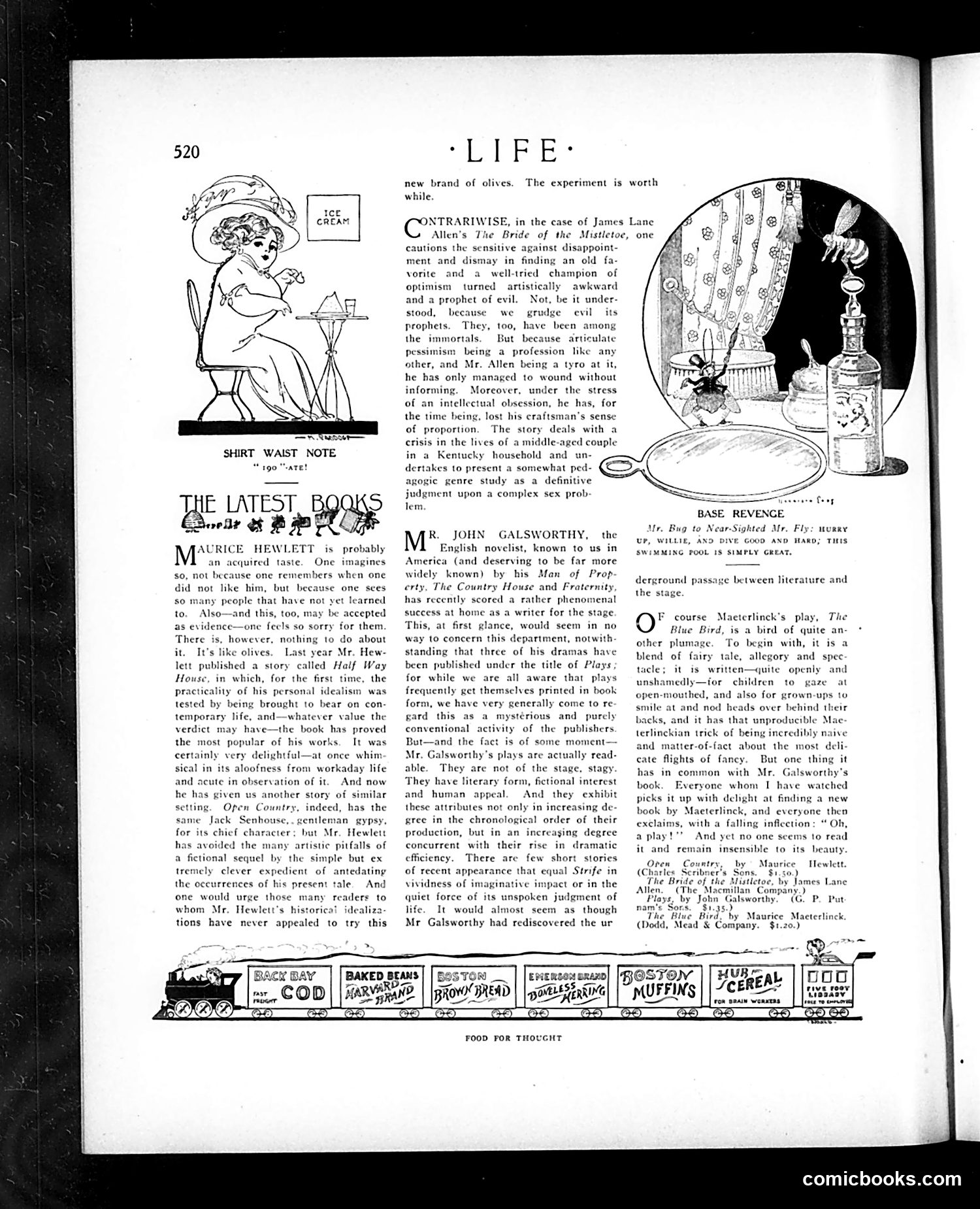
This page contains book reviews and literary commentary, not political cartoons. The main content discusses: **"Shirt Waist Note"** (left): A brief, somewhat sarcastic review of Maurice Hewlett's novel *Open Country*, suggesting Hewlett is "an acquired taste" and praising his latest work's craftsmanship. **Book Reviews**: The page reviews three authors: - James Lane Allen's *The Bride of the Mistletoe*—criticized for turning from optimism to pessimism without artistic skill - John Galsworthy's plays—praised for successfully bridging literature and drama with works like *Strife* - Maeterlinck's *The Blue Bird*—mentioned favorably as an allegorical play **"Base Revenge"** (right): A small cartoon showing a mosquito advising a fly to dive-bomb a bather, mocking the swimmer's overconfidence. The page is primarily a literary review section typical of *Life* magazine's satirical commentary on contemporary books and authors, with minimal visual satire beyond the mosquito cartoon.
📄 Transcribed text from this page (OCR, searchable)
Machine-transcribed from the original scan — historical spelling and the odd misread are preserved.
NR SHIRT WAIST NOTE “190 "are! AURICE HEWLETT is probably an acquired taste. One imagines so, not because one remembers when one did not like him, but because one sees so many people that have not yet learned to. Also—and this, too, may be accepted as evidence—one fecls so sorry for them however, nothing to do about Last year Mr. Hew- lett published a story called Half Way House, in which, for the first time, the practicality of his personal idealism was tested by being brought to bear on con- temporary life, and—whatever value the verdict may have—the book has proved the most popular of his works certainly very delightful—at once whim It was sical in its aloofness from workaday life And now en us another story of similar Open Country, indeed, has the same Jack Senhouse,. gentleman gypsy, for its chief character; but Mr. Hewlett has avoided the many artistic pitfalls of a fictional sequel by the simple but ex and acute in observation of it he h setting tremely clever expedient of antedating is present tale. And one would urge those many readers to whom Mr. Hewlett’s hist ideali tions have never appealed to try this the occurrences of ricat LE - new brand of olives. while. NTRARIWISE, Allen’s The Bride of the Mi cautions the sensitive against disappoint- and dismay in finding an old fa- vorite well-tried champion of optimism turned artistically awkward and a prophet of evil. Not, be it under- stood, grads prophets. They, too, have been among the immortals, But because articulate men and a because we evil its pessimism being a profession like any other, and Mr. Allen being a tyro at it, he has only managed to wound without informing. Moreover, under the stress of an intellectual obsession, he has, for the time being, lost his craftsman’s sense The crisis in the lives of a middle-aged couple in a Kentucky household and un- dertakes to present a somewhat ped- of proportion story deals with a ic genre study as a definitive judgment upon a complex sex prob lem M®* Americ: JOHN GALSWORTHY, the nglish novelist, known to us in (and deserving to be far more widely known) by his Man of Prop erty, The Country House and Fraternity has recently scored a rather phenomenal success at h sa writer for the stage. This, at first glance, would seem in no way to concern this department, notwith standing that three of his dramas have been published under the title of Plays ; for while we are all aware that plays frequently get themselves printed in book form, we have very generally come to re gard this as a mystérious and purely conventional activity of the publishers But—and the fact is of some moment— read- stagy They have literary form, fictional interes and human appeal. And they exhibit these attributes not only in increasing de- gree in the chronological order of their production, but in an increasing degree concurrent with their rise in dramatic efficiency. There are few short stories of recent appearance that equal Strife in vividness of imaginative impact or in the quiet force of its unspoken judgment of life. It would almost seem as though Mr Galsworthy had rediscovered the ur BeSTON __ ERE MSO BRAMD] The experiment is worth in the case of James Lane letoe, one Serene BASE REVENCE Mr. Bug to Near-Sighted Mr. Fly UP, WILLIE, AND DIVE GOOD AND HARD; nurey THs SWIMMING FOOL 18 SIMPLY GREAT. derground passage between literature and the stage. O F course Maeterlinck’s play, The Blue Bird, is a bird of quite an- To begin with, it tale, allegory A—quite other plumage blend of tacle; it is) wri is a airy and. spec openly and unshamedly—for children to gaze at open-mouthed, and also for grown-ups to smile at and nod beads over behind their backs, and it has that unproducible Mae: terlinckian trick of being incredil and matter-of-fact about the cate flights of fancy has in common with Mr. Galsworthy’s book. Everyone whom I picks it up with delight 3 book by Maeterlin and everyone then exclaims, with a falling inficction: “Oh, naive most deli- But one thing it have watched finding a new a play!’? And yet no one seems to read it and remain insensible to its beauty Oven Country, by Maurice Hewlett. (Charles Scribner's Sons. $1.50.) The Bride of the Mistletoe, by James Lane Allen. (The Macmillan Company.) Plays, by John Galsworthy. (G. P. Pat nam's Sors. $1.35.) The Blue Bird, by Maurice Maeterlinck. (Dodd, Mead & Company. $1.20.) FOOD POR THOUGHT comicbooks.com