
A complete issue · 20 pages · 1908
Life — July 30, 1908
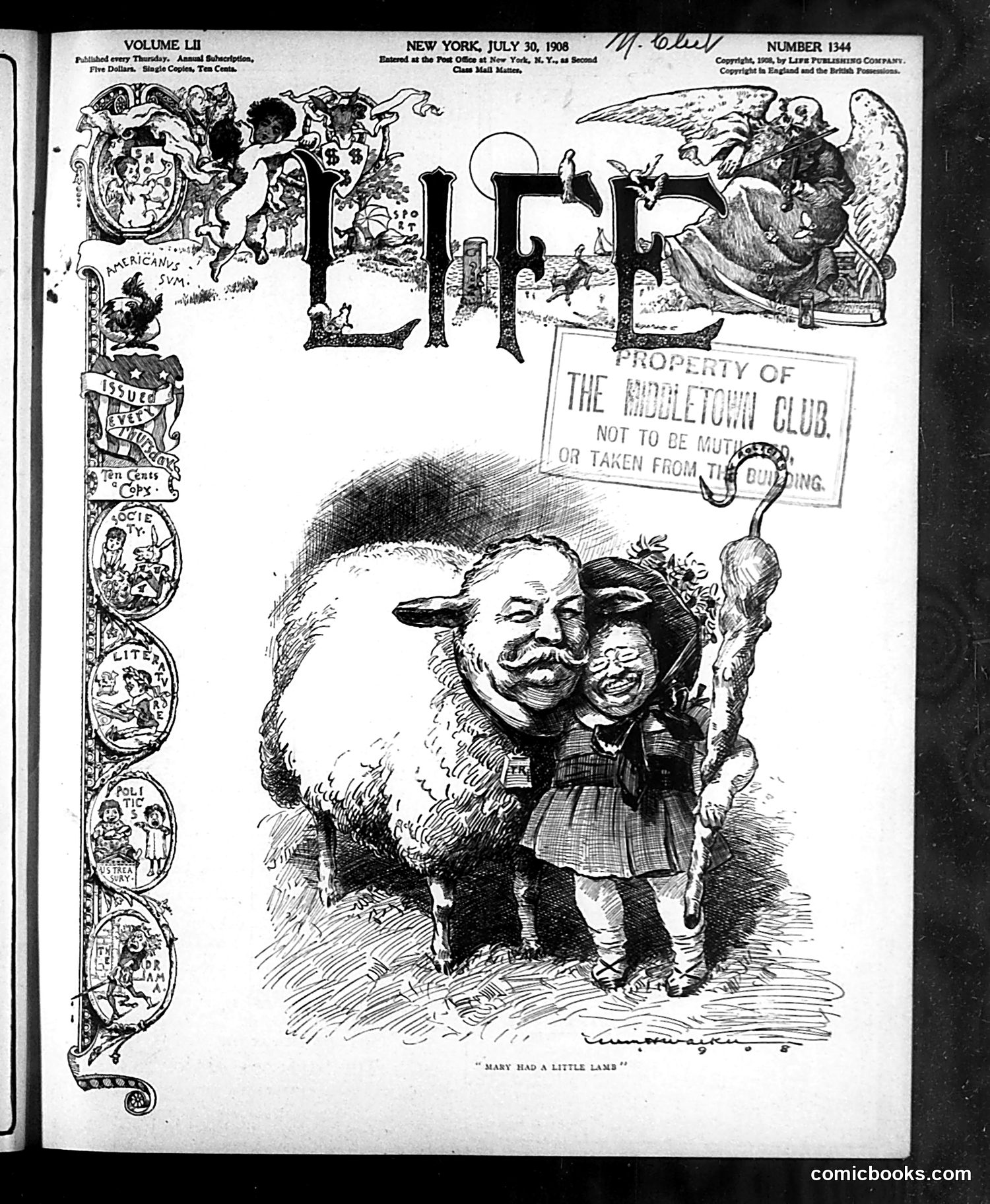
This page features a satirical illustration titled "Mary Had a Little Lamb." The cartoon depicts two exaggerated caricatured figures—appearing to be political or public figures of 1908—alongside a large sheep. The style suggests mockery of contemporary political personalities through the nursery rhyme reference. The left border contains decorative vignettes showing various scenes, typical of Life magazine's design aesthetic. Without clearer identification markers or accompanying article text visible, the specific political figures and the precise satirical point remain unclear. The sheep imagery likely carries symbolic meaning related to 1908 politics—possibly referencing naiveté, blind followers, or similar metaphorical commentary—but the exact reference requires additional historical context about that election year's events and personalities.
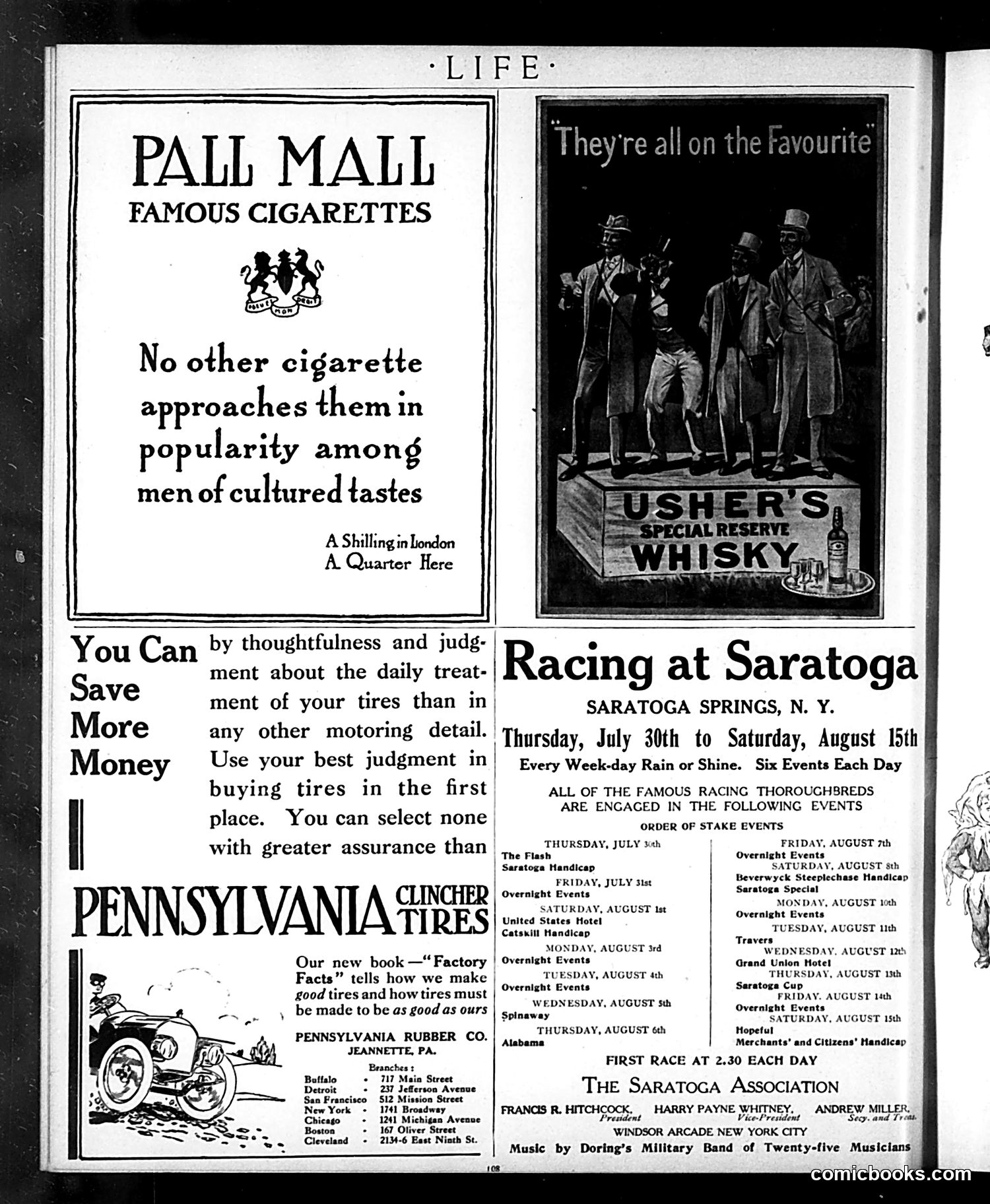
This page contains **advertisements, not political satire**. The left side advertises Pall Mall cigarettes ("Famous Cigarettes") and Pennsylvania Tires, emphasizing quality and value. The right side promotes two leisure activities: Usher's Special Reserve Whisky (featuring men in formal attire) and horse racing at Saratoga Springs, New York, running July 30th to August 15th, listing various stakes races and events. The content reflects early 20th-century American consumer culture and leisure pursuits for affluent men—tobacco, alcohol, and thoroughbred racing. There is no political cartoon or satire present on this page. The Usher's ad's tagline "They're all on the Favourite" is a playful reference to betting on the favorite horse, not political commentary.
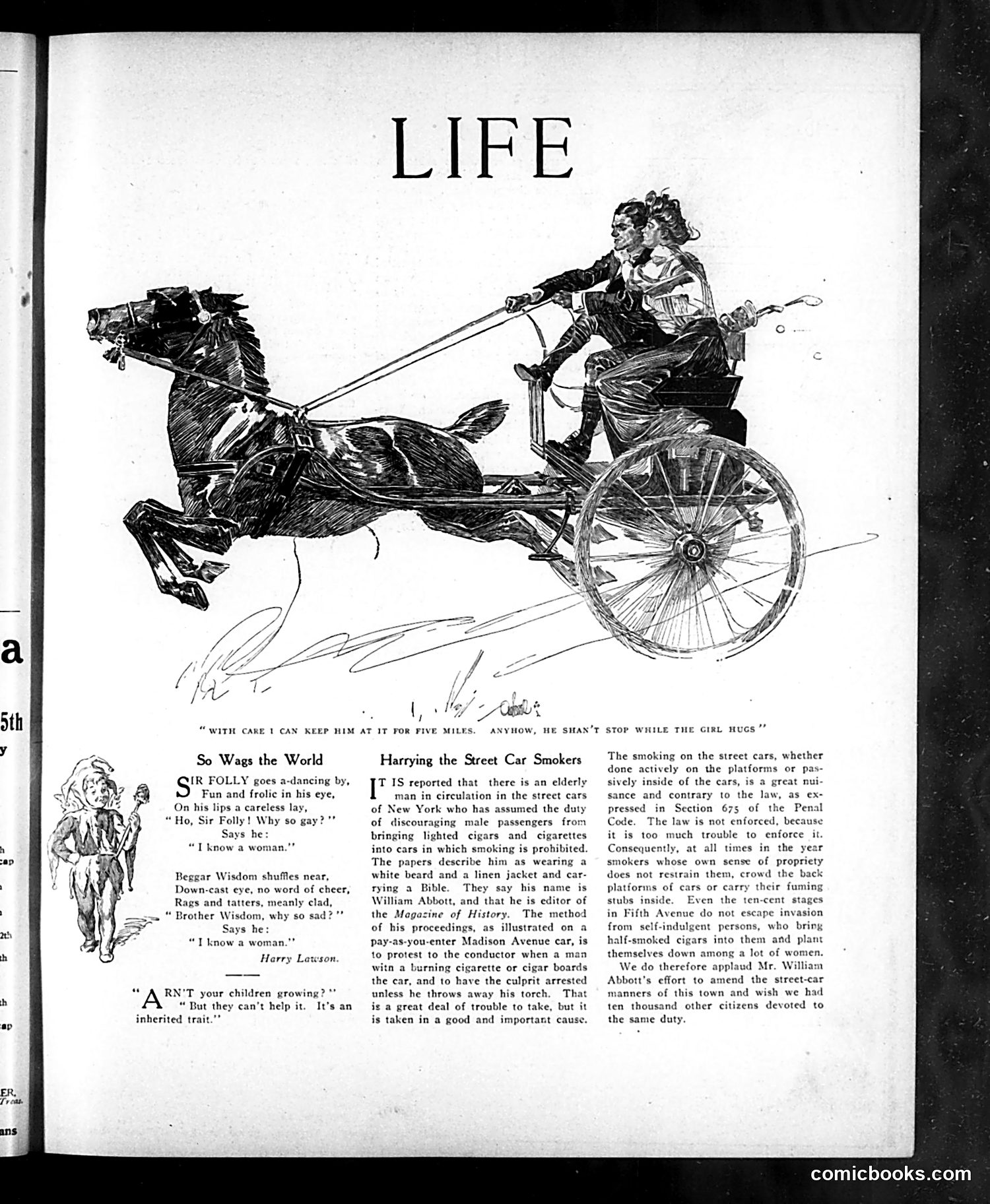
The main illustration depicts a woman driving a horse-drawn cart with the caption "WITH CARE I CAN KEEP HIM AT IT FOR FIVE MILES. ANYHOW, HE SHAN'T STOP WHILE THE GIRL HUGS." The accompanying articles discuss two social issues: 1. **"So Wags the World"** - A humorous piece about men's excuses and women's wisdom, featuring quotes skeptical of male reasoning. 2. **"Harrying the Street Car Smokers"** - Addresses the problem of men smoking on public streetcars despite regulations. The text praises William Abbott's effort to enforce no-smoking rules, noting that enforcement efforts have been crowded with supporters. The cartoons satirize gender relations and public behavior norms of the era, with the horse-cart illustration suggesting women's control over men, while the street car smoking article highlights early public health activism and gender conflict over public space conduct.
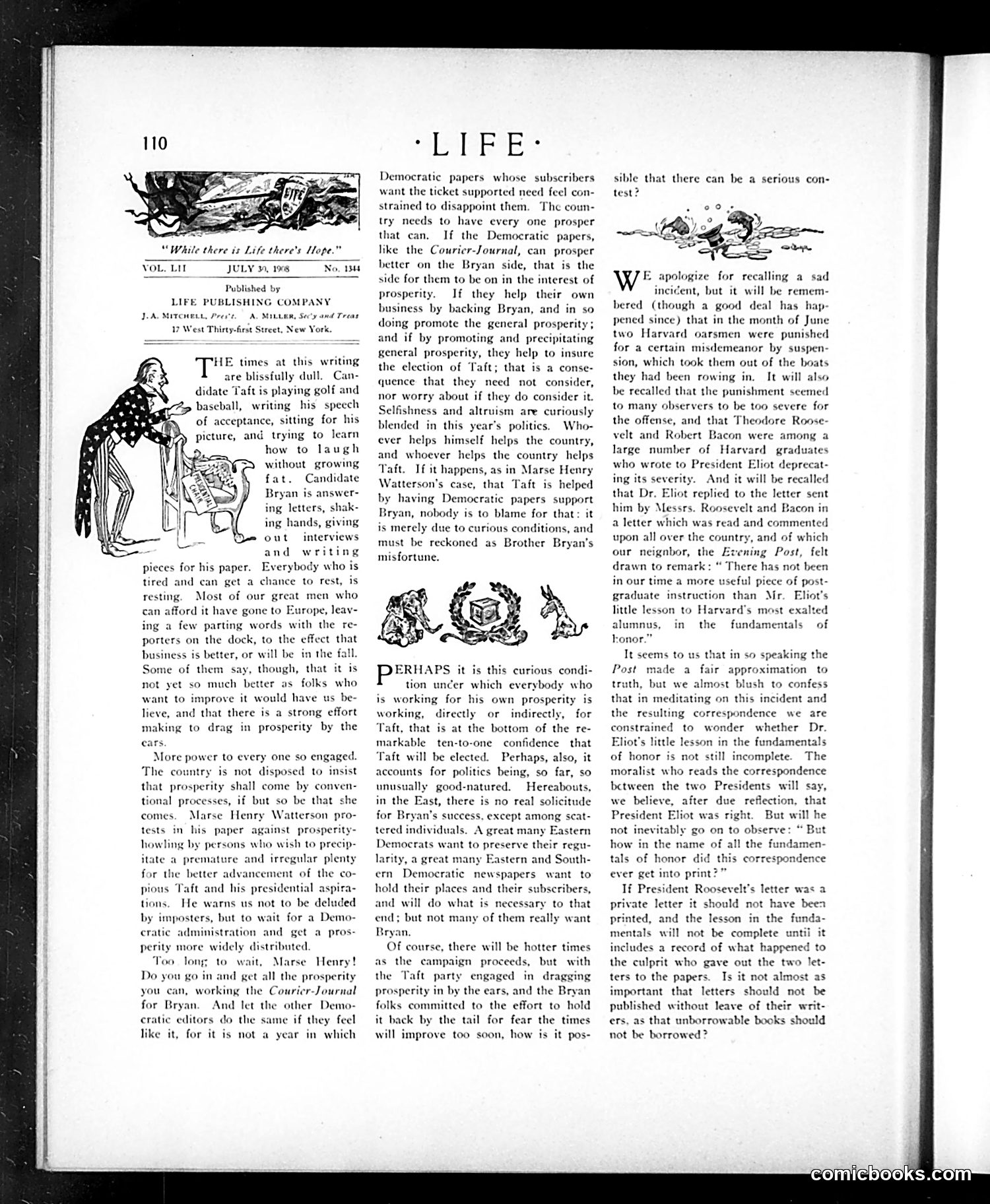
This page from Life magazine (July 1912) discusses the presidential campaign featuring William Howard Taft and William Jennings Bryan. The editorial addresses Democratic newspapers' support for Bryan despite backing Taft, criticizing this as hypocritical—helping one's own business while claiming to support the country's prosperity. The cartoon at top-left (captioned "While there is Life there's Hope") depicts a figure in distress, likely representing the Democratic Party's divided loyalties or internal conflict over the election. The piece references Theodore Roosevelt's Harvard letter criticizing an incident involving two Harvard men punished for "suppression," which the author uses to illustrate questions about honor and presidential character—suggesting Roosevelt's judgment on such matters was relevant to voters considering which candidate deserved their support.
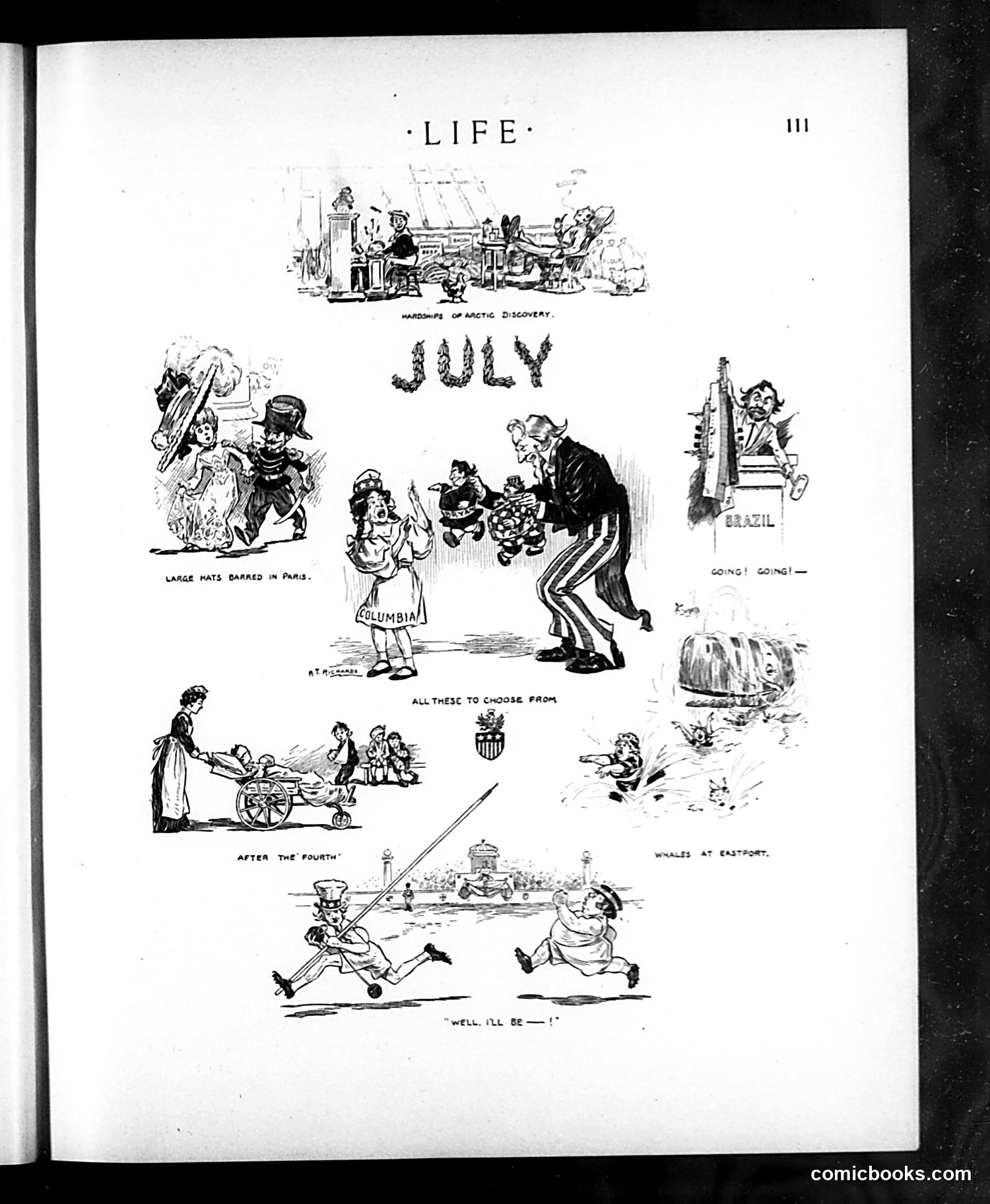
This satirical page from Life magazine presents July-themed political and social commentary through several vignettes: **"Hardships of Arctic Discovery"** (top) likely references contemporary polar exploration expeditions, a popular topic of the era. **"Large Hats Barred in Paris"** mocks a fashion regulation, suggesting Parisian authorities restricted hat sizes—a humorous jab at European fashion governance. **"Columbia"** (center) personifies America as a woman choosing between options, a common allegorical device in American political cartoons. **"Brazil"** and **"Going! Going!"** appear to reference international affairs or trade. **"After the Fourth"** depicts post-Independence Day activities, while **"Whales at Eastport"** and **"Well, I'll Be!"** seem to reference local news items or natural phenomena worthy of July satire. The overall tone is light summer humor mixed with topical commentary.
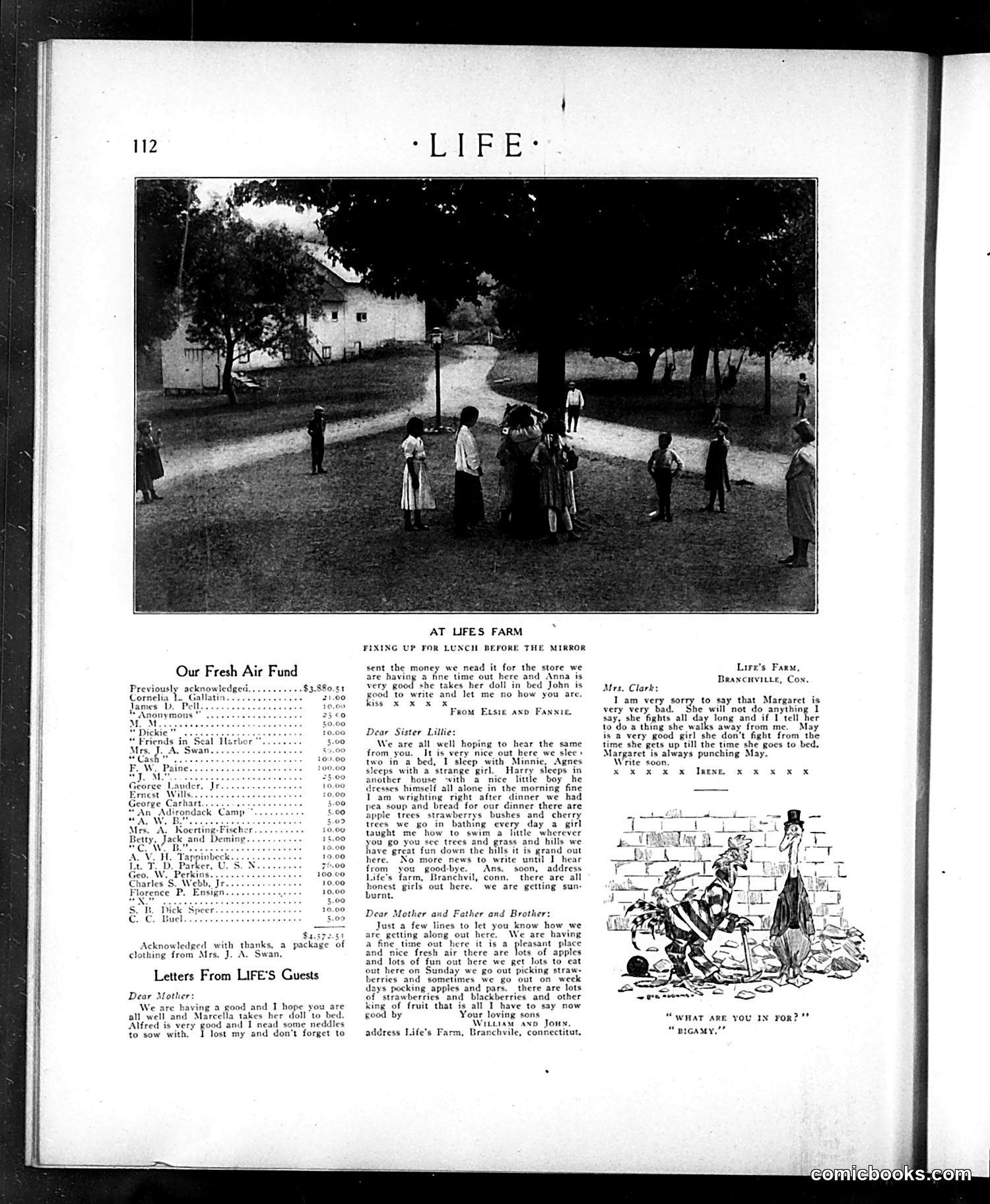
This page from *Life* magazine is primarily **not political satire or cartooning**—it's a lifestyle/human interest feature. The main content shows "Life's Farm" in Branchville, Connecticut, featuring a photograph of children and adults at a rural property. The accompanying letters describe wholesome summer activities: children playing, swimming, picking fruit, and enjoying outdoor recreation. The small cartoon at bottom right depicts a child asking "What are you in for?" to another at what appears to be a fence or enclosure—a gentle joke about children being confined or "punished" during a particular activity, likely meant humorously rather than satirically. This reflects early 20th-century *Life* magazine's focus on genteel humor and middle-class American life rather than hard-hitting political commentary.
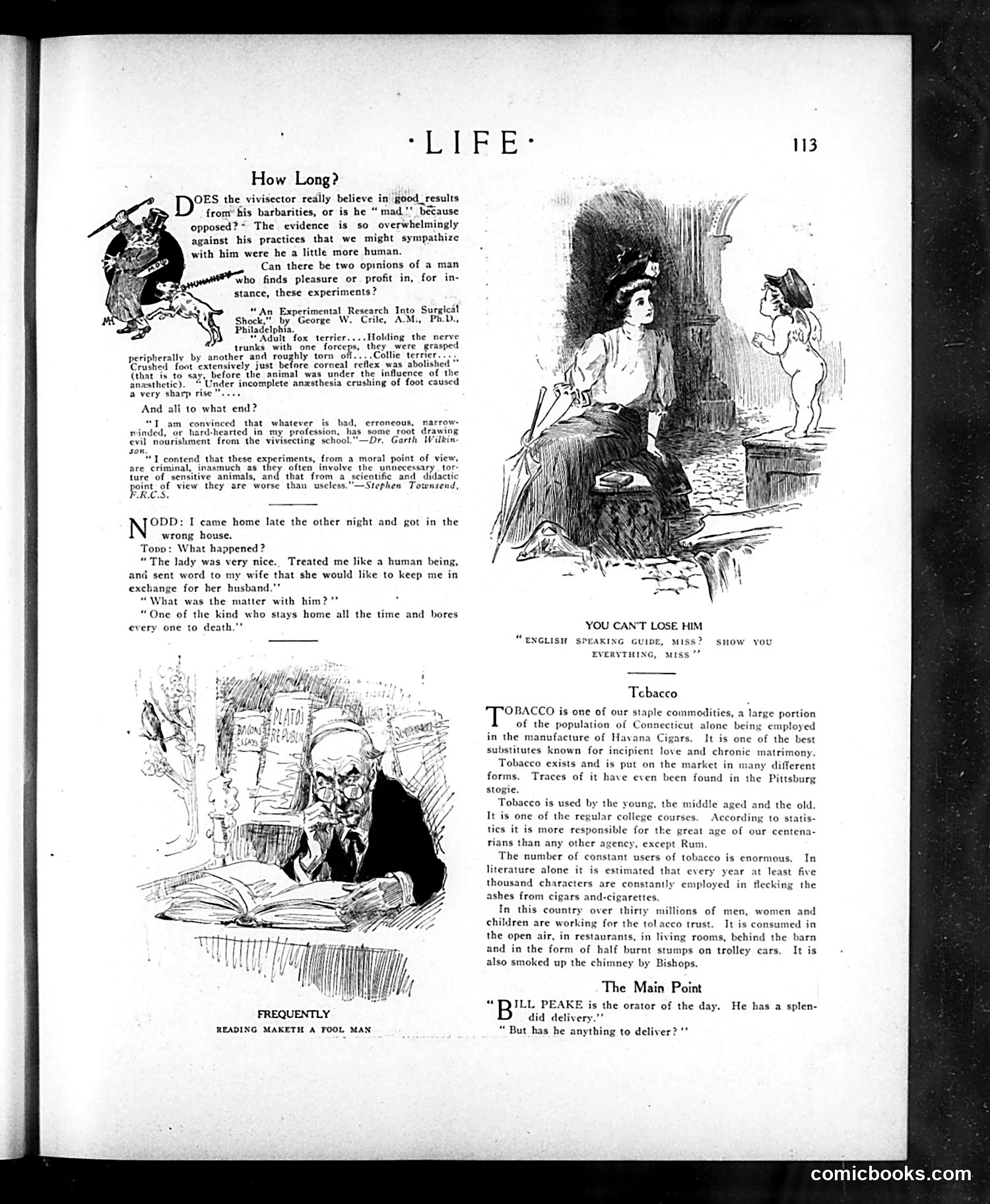
This page contains humorous anecdotes and social commentary typical of Life's satirical format. The top cartoon depicts a vivisectionist (animal researcher) conducting experiments, with the accompanying text questioning whether he genuinely believes in results or is "mad" because opponents challenge his methods. The satire criticizes both animal experimentation and those who defend it. Below, a separate anecdote titled "Nodd" mocks a man who enters the wrong house and is treated courteously by the lady there—she even offers to keep him in "exchange for her husband." The joke plays on the absurdity of casual infidelity. A section on Tobacco follows, providing factual information rather than satire, discussing tobacco's prevalence in society and its widespread consumption across demographics.
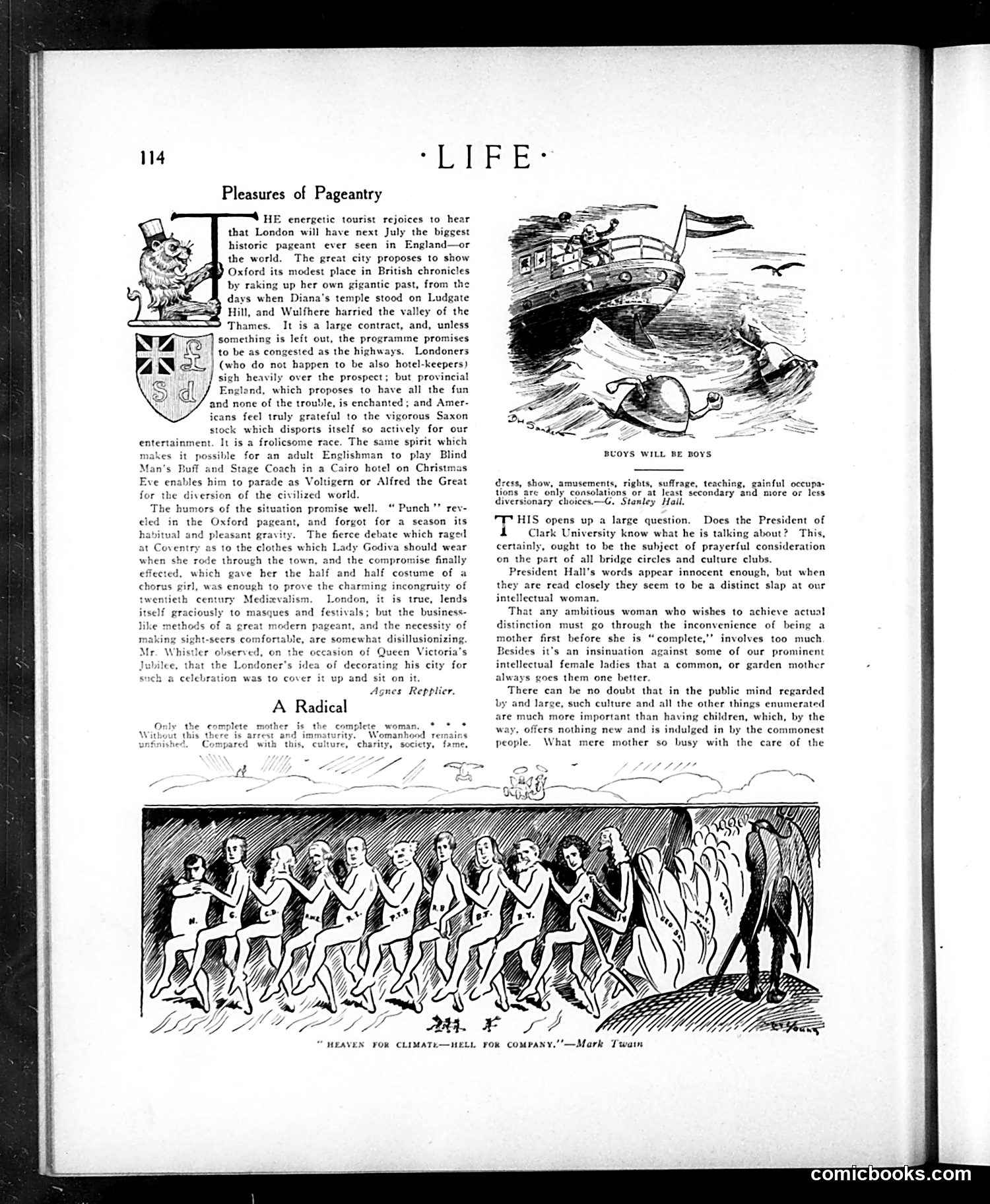
This page contains three satirical sections: **"Pleasures of Pageantry"** mocks London's plan for a massive historical pageant celebrating British history. The text critiques how this nostalgic spectacle obscures present problems, comparing it to distraction tactics. The heraldic coat of arms and ship illustration support the historical theme. **"Buoys Will Be Boys"** appears to be a brief humorous item (text unclear from OCR). **"A Radical"** section discusses women's education and ambition, questioning whether female intellectual achievement matters compared to motherhood—a contemporary debate about women's roles. The bottom cartoon, captioned "Heaven for climate; Hell for company" (attributed to Mark Twain), depicts a procession of nude figures, satirizing human nature and social conformity through absurdist imagery.
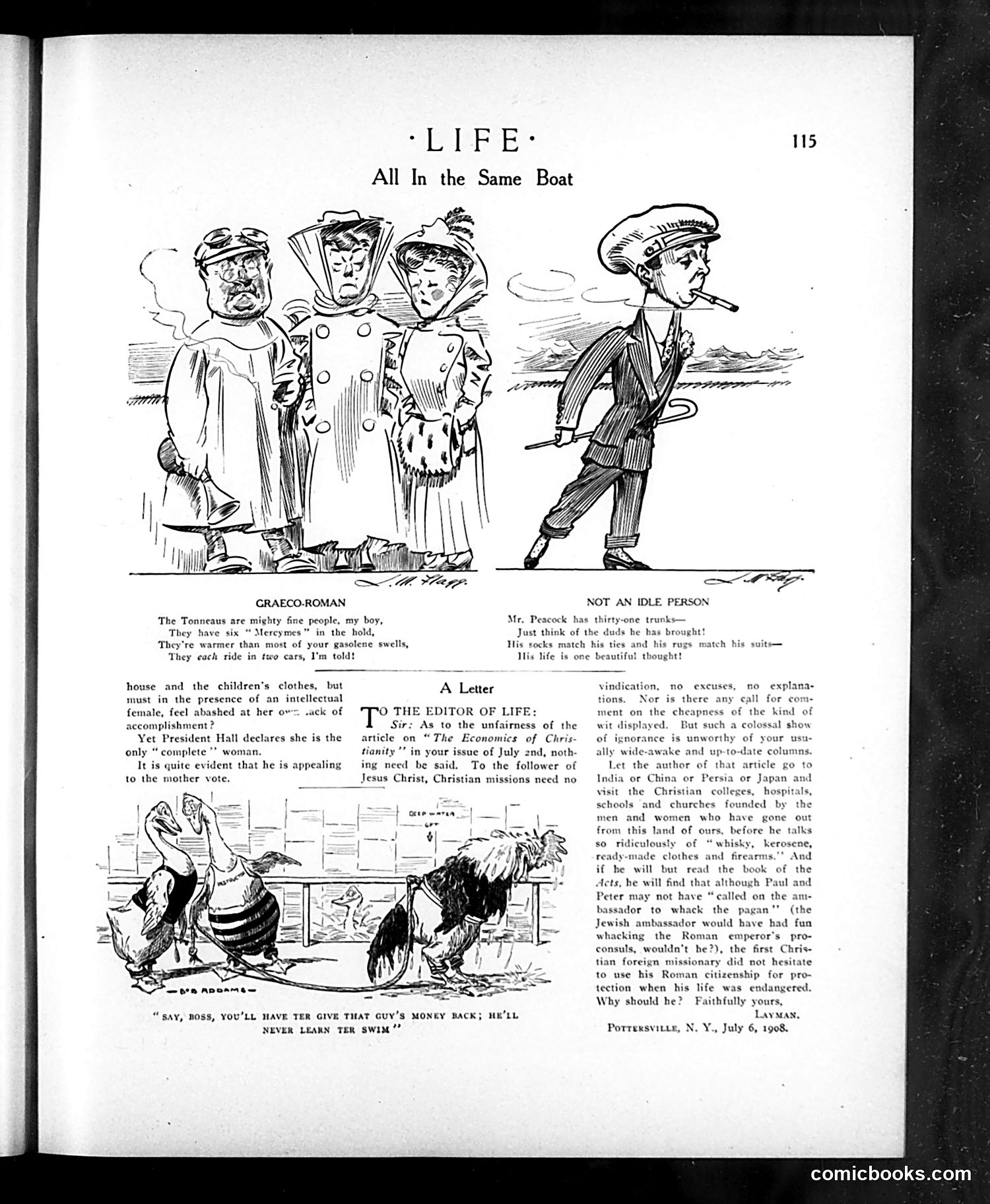
This page contains two satirical cartoons and a letter to the editor. **Top cartoons:** "Graeco-Roman" depicts three caricatured figures (appearing to represent different nationalities or social groups) crowded together, with text suggesting they share common traits despite differences. "Not an Idle Person" shows a man in business attire rushing forward, mocking Mr. Peacock's claim to productivity—his numerous "trucks" and possessions supposedly prove his worth, though the satire suggests hollow materialism. **Bottom cartoon:** A figure on horseback attempts to teach another person to swim, with the caption joking darkly that the student will never learn because they must first recover money lost to the instructor. **Letter:** A reader criticizes an article on Christian economics, arguing missionaries should accept local customs rather than imposing Western standards like "whiskey" and modern dress.
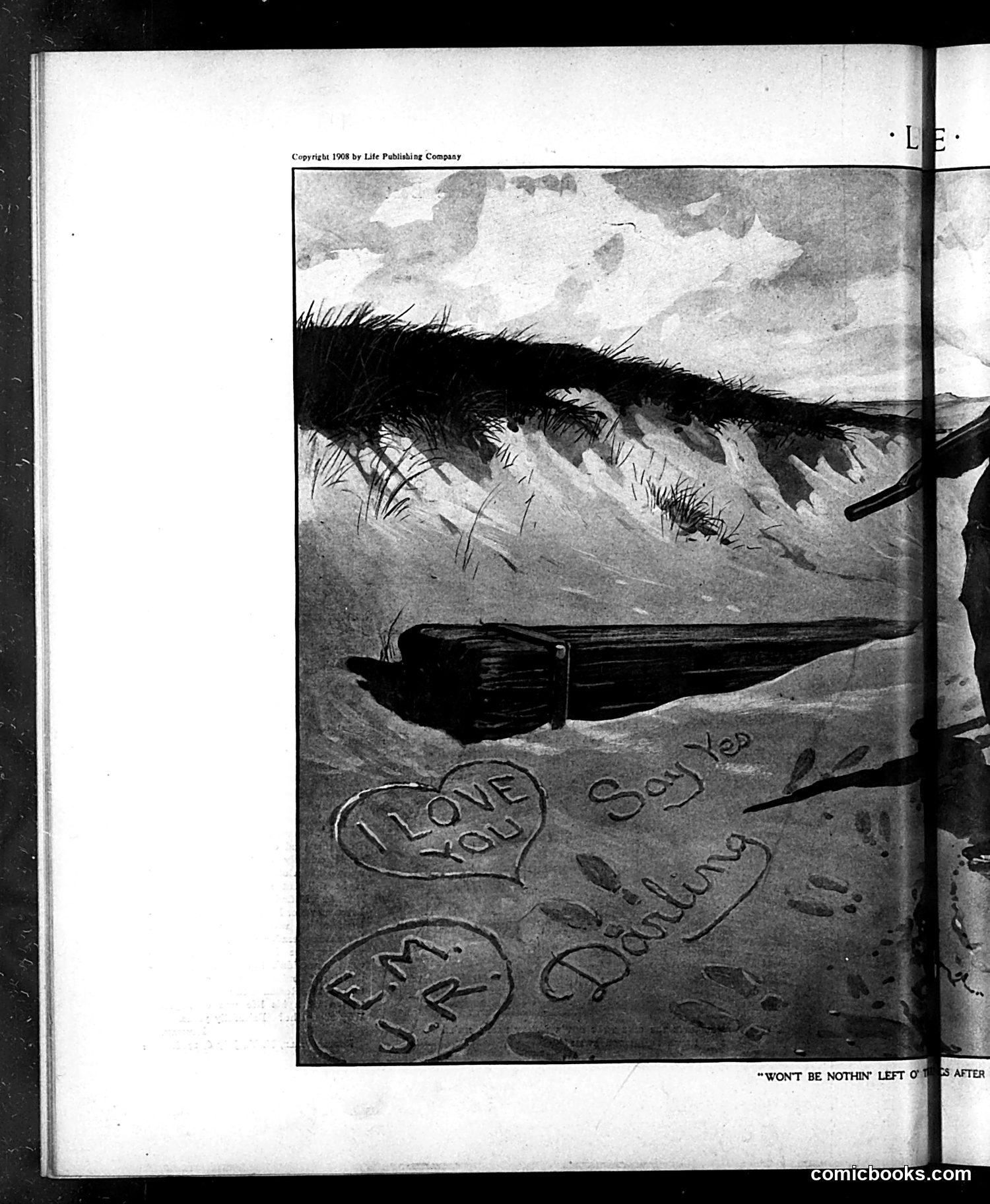
This appears to be a satirical cartoon from Life magazine (copyright 1908) depicting a fish with distinctive features drawn in the sand or beach. The speech bubbles show text that's partially legible: "I LOVE YOU SO," "DARLING," and what appears to be "WON'T BE NOTHIN' LEFT O'" at the bottom. The cartoon likely satirizes romantic or courtship behavior of the era through animal personification—a common satirical device. The fish's exaggerated features and the written declarations suggest commentary on sentimental or perhaps excessive romantic expression. However, without clearer text legibility and additional context about contemporary events or figures from 1908, the specific satirical target remains unclear. The style is typical of early 20th-century magazine humor.
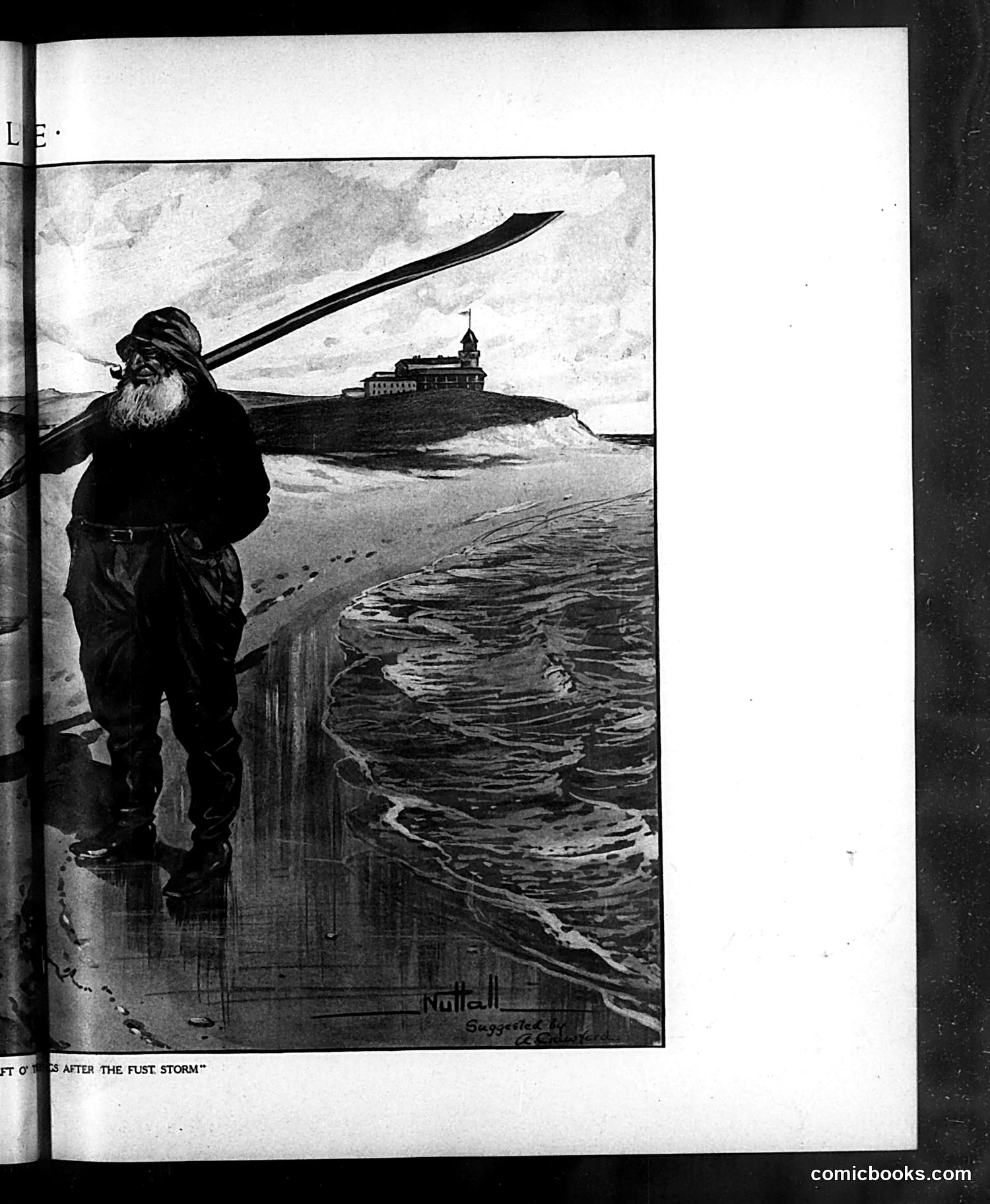
This illustration depicts an elderly man with a long beard standing on what appears to be a wooden pier or dock, gazing toward a building on a distant shore. The title "After the Fust Storm" (likely "First Storm") suggests a scene of aftermath or reflection. The figure's weathered appearance and contemplative pose suggest he may represent a historical or allegorical character—possibly a fisherman, sailor, or personification of an older generation surveying changed circumstances. The stormy seascape and isolated building in the background reinforce themes of solitude, endurance, or loss. Without additional context about Life magazine's publication date or contemporary events, the specific satirical or political meaning remains unclear, though the mood evokes melancholy reflection rather than humor.
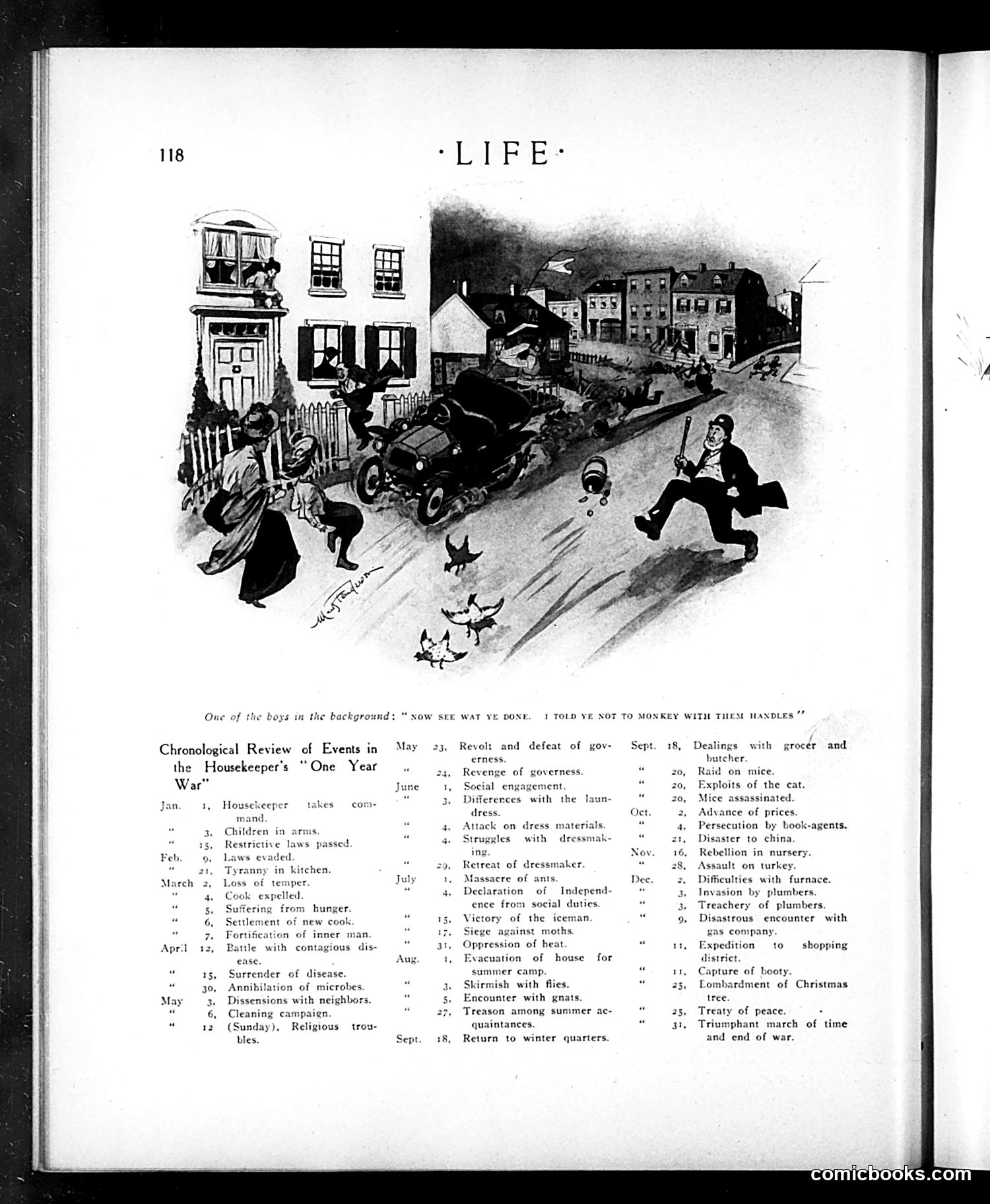
This page from *Life* magazine presents a satirical cartoon titled "One of the boys in the background: 'Now see way ye done. I told ye not to monksy with them handles.'" The cartoon depicts a chaotic street scene with a car accident or collision. A well-dressed man on the right appears to have been struck or knocked over, while other figures react in alarm. The humor seems to target reckless driving or automobile safety—a contemporary concern as motor vehicles became common. Below the cartoon is a "Chronological Review of Events in the Housekeeper's 'One Year War'"—a satirical list documenting domestic conflicts, from kitchen tyranny to negotiations with tradesmen. This mocks the perceived "battles" housekeepers faced managing households during wartime rationing and labor shortages, treating domestic management as literal warfare through humorous exaggeration.
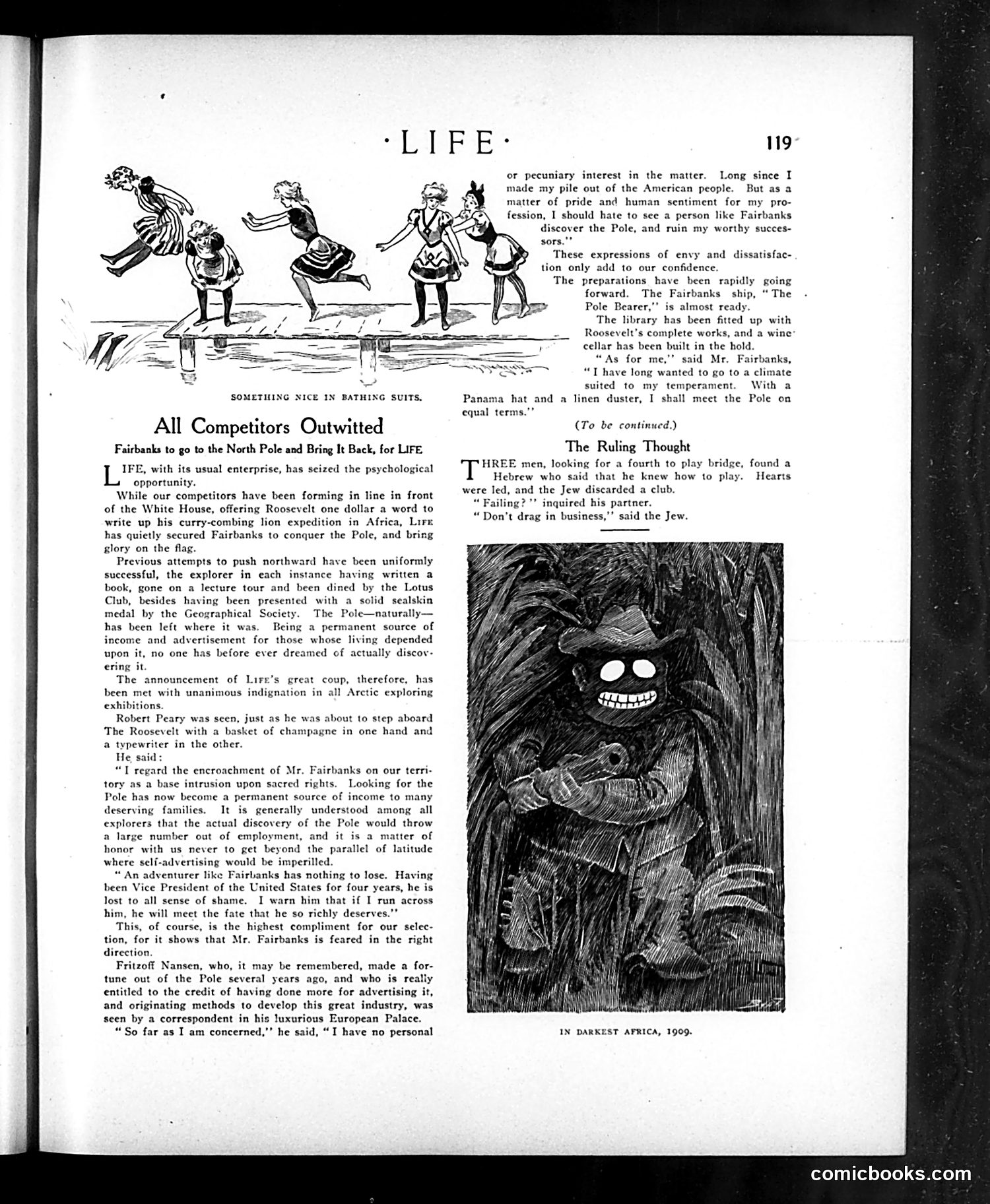
This page satirizes **Richard E. Byrd's (or similar explorer's) North Pole expedition**. The headline "All Competitors Outwitted" mocks how Fairbanks has "quietly secured Fairbanks to conquer the Pole" while other explorers competed publicly. The top cartoon shows people in bathing suits on a platform labeled "SOMETHING NICE IN BATHING SUITS"—likely mocking how expeditions became commercial spectacles and advertising vehicles. **"The Ruling Thought"** section's cartoon depicts a demonic creature with glowing eyes. The accompanying anecdote about three men, a bridge, and a Hebrew/Jewish figure appears to be a joke with antisemitic undertones, common in early 20th-century satire. The overall thrust: Arctic exploration had become commercialized entertainment rather than serious scientific endeavor, with wealthy industrialists and celebrities competing for glory and profit.
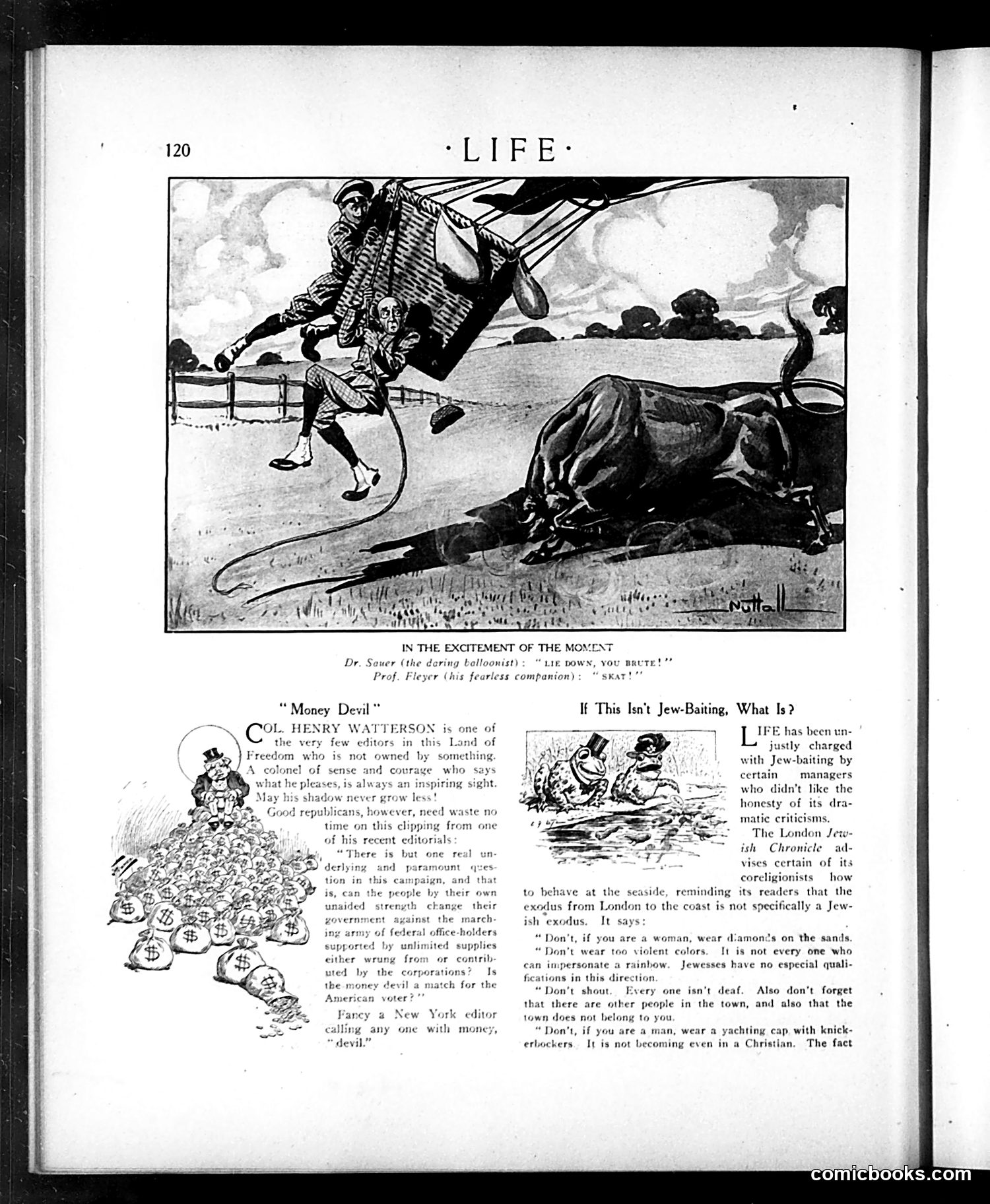
**The Top Cartoon:** A slapstick scene shows a hot air balloon accident where two men fall toward a cow. One shouts "Lie down, you brute!" to the animal below—a visual pun on the command to take cover during the mishap. **The "Money Devil" Section:** Defends Col. Henry Watterson, a newspaper editor, against accusations of antisemitism. The text argues his criticism was honest journalism, not prejudice. **"If This Isn't Jew-Baiting, What Is?":** The author sarcastically quotes the *Jewish Chronicle's* etiquette advice for Jewish visitors to seaside resorts—don't wear diamonds, loud colors, or yachting caps with knickers; don't shout. The satire's point: such prescriptive rules implicitly reinforce harmful stereotypes about Jewish behavior and conspicuousness, effectively policing Jewish visibility in public spaces while claiming to help the community "fit in." The page critiques both explicit and subtle forms of discrimination through contrasting perspectives on what constitutes antisemitism.
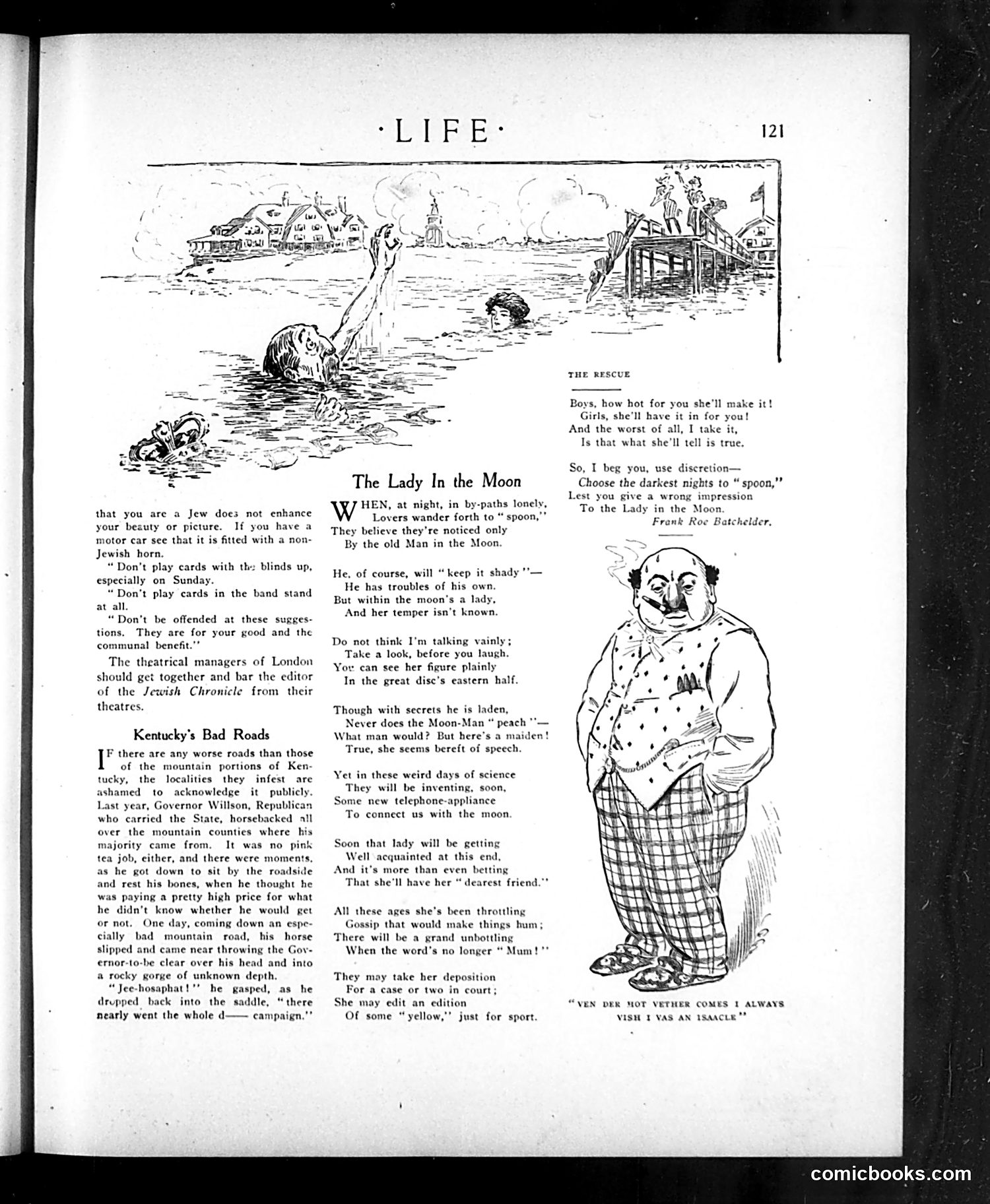
This page contains two distinct pieces of satire: **"The Lady in the Moon"** is a humorous poem playing on the man-in-the-moon concept. The satire suggests that if a "lady" exists within the moon and could somehow communicate (via future "telephone-appliance"), she would expose all the secrets and gossip she's witnessed from lovers "spooning" below. The joke warns young couples that their private moments might not be as private as they think—a playful commentary on surveillance and loss of privacy in the modern age. **"Kentucky's Bad Roads"** mocks the terrible condition of mountain roads in Kentucky. It recounts Governor Willson's horseback campaign tour where rough terrain nearly threw him into a gorge, prompting his desperate exclamation. The satire ridicules both the negligent state infrastructure and the governor's willingness to endure dangerous conditions for political gain, suggesting his concern for votes outweighed voter welfare. The antisemitic "Don't" section is included in the text but appears to be material *being criticized* rather than endorsed by Life's editors.
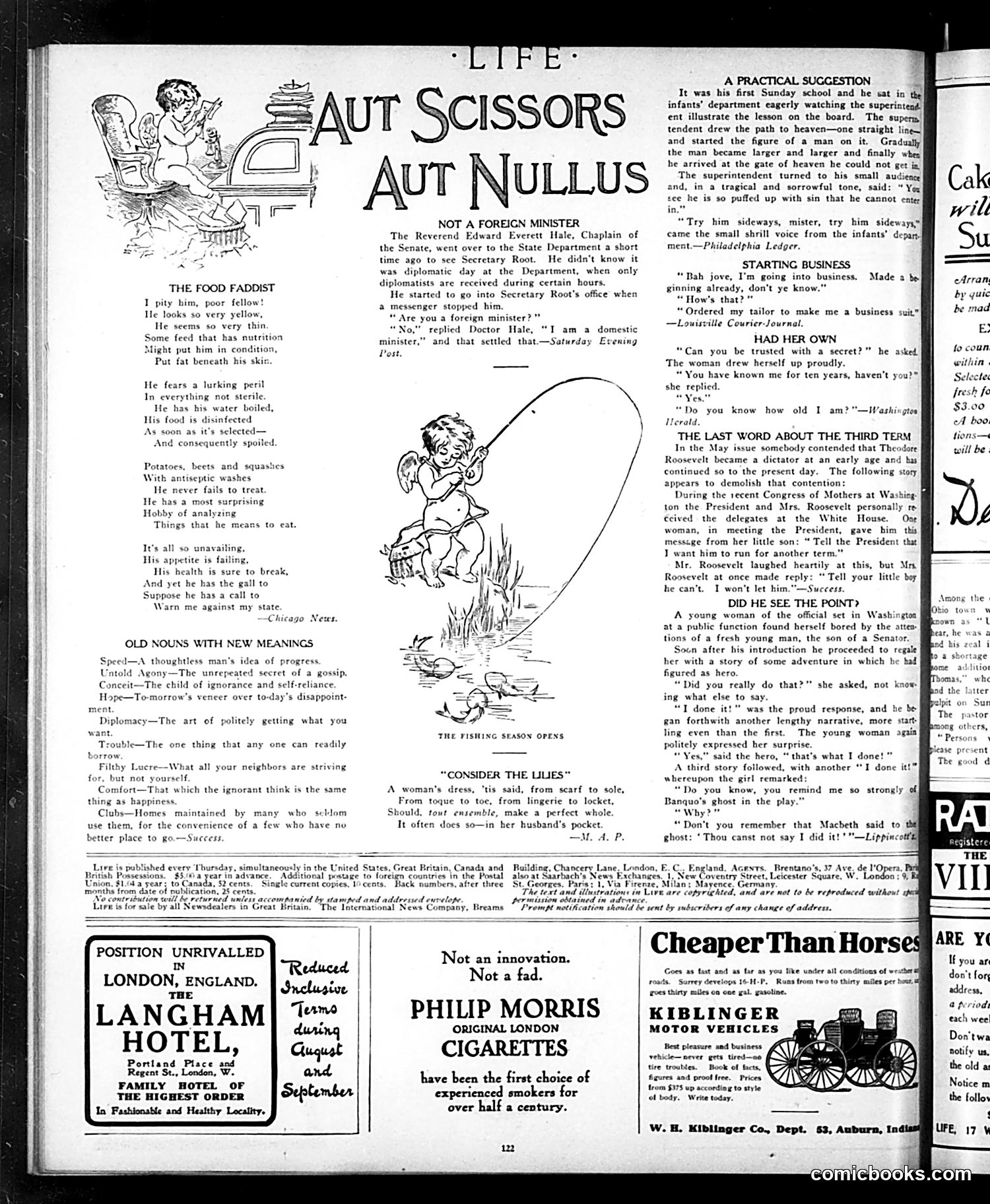
This page contains several satirical pieces targeting 1910s American social pretensions: **"The Food Faddist"** mocks health-obsessed individuals who obsessively sanitize and analyze their food, becoming malnourished and yellow-skinned through neurotic avoidance. The satire ridicules how such people then presume to lecture others about health habits. **"Not a Foreign Minister"** humorously recounts Rev. Edward Everett Hale (Senate Chaplain) being mistaken for a diplomat when visiting Secretary Root—a gentle jab at bureaucratic protocol distinguishing "foreign" from "domestic" ministers. **Other pieces** satirize everyday hypocrisy: the "Old Nouns with New Meanings" section redefines common words cynically (Comfort, Filthy Lucre, Diplomacy), while "Consider the Lilies" jokes that a woman's perfectly coordinated outfit exists only in her husband's wallet. The cartoons throughout use visual humor—a fishing-themed illustration, figures in exaggerated poses—typical of Life's satirical style mocking middle-class social anxieties and pretensions.
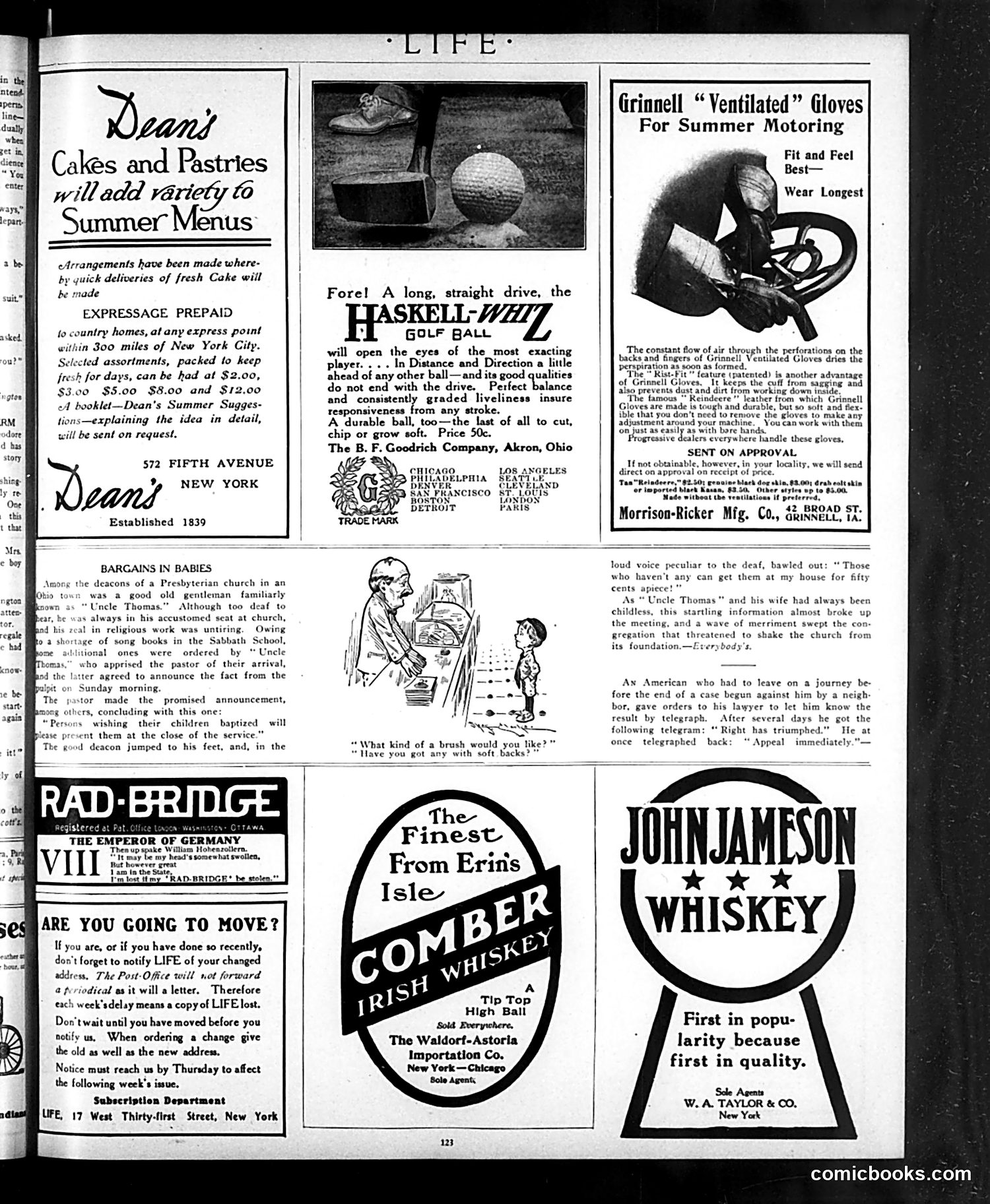
This page is primarily **advertising and administrative notices** rather than political satire. The main content includes: **"Bargains in Babies"** — A humorous anecdote about a deaf Presbyterian deacon who mishears an announcement about child baptisms as an advertisement for children to purchase. The joke relies on wordplay and the deacon's misunderstanding, published for entertainment. **Advertisements** dominate the page: Dean's bakery, Haskell golf balls, Grinnell driving gloves, Comber Irish whiskey, and John Jameson whiskey. These reflect 1920s consumer goods and summer leisure activities (motoring, golf). **Administrative notices** address subscription management and address changes for readers. There is **no clear political cartoon or satire** on this page. The RAD-BRIDGE film advertisement appears unrelated to the main content. The page primarily serves as a vehicle for advertising products to Life's affluent readership while including light, non-political humor.
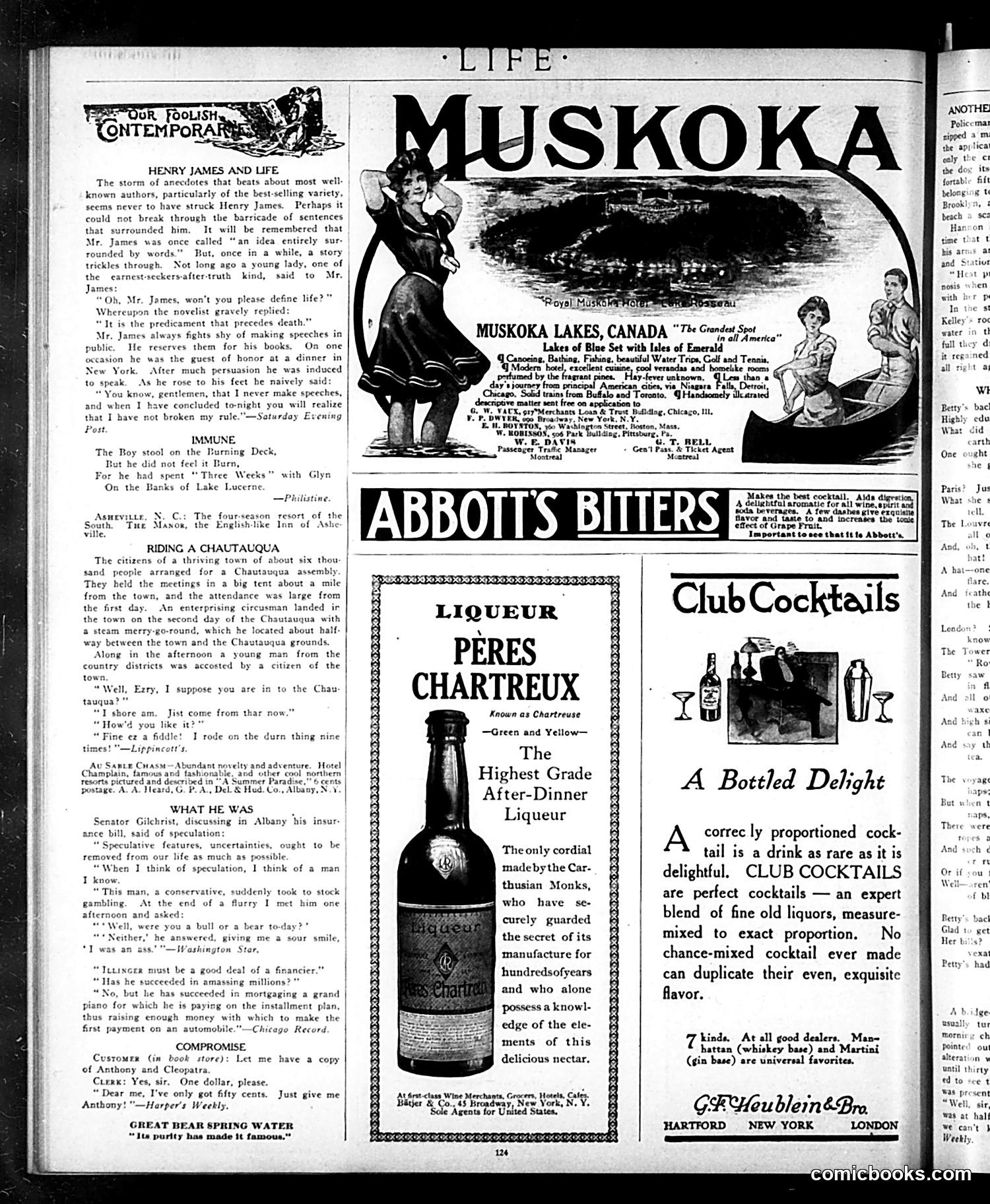
This page is primarily **advertising**, with brief satirical anecdotes interspersed. The main content includes: **"Henry James and Life"**: A humorous anecdote about the famously verbose novelist Henry James, presenting him as so surrounded by elaborate prose that anecdotes can't penetrate it. The joke plays on James's reputation for complex writing—when asked to define life, he replies with a characteristically philosophical abstraction: "It is the predicament that precedes death." **"Riding a Chautauqua"**: A rural comedy sketch where a country boy attends a Chautauqua (educational lecture series) but gets distracted by a merry-go-round positioned midway between town and the event, suggesting simple entertainment trumps intellectual improvement. **Advertisements**: The bulk of the page promotes liqueurs (Peres Chartreux, Abbott's Bitters), Club Cocktails, and Muskoka Lakes resort in Canada—typical early 20th-century magazine advertising. The page reflects contemporary American attitudes toward literary pretension, rural simplicity, and leisure tourism circa 1910s.
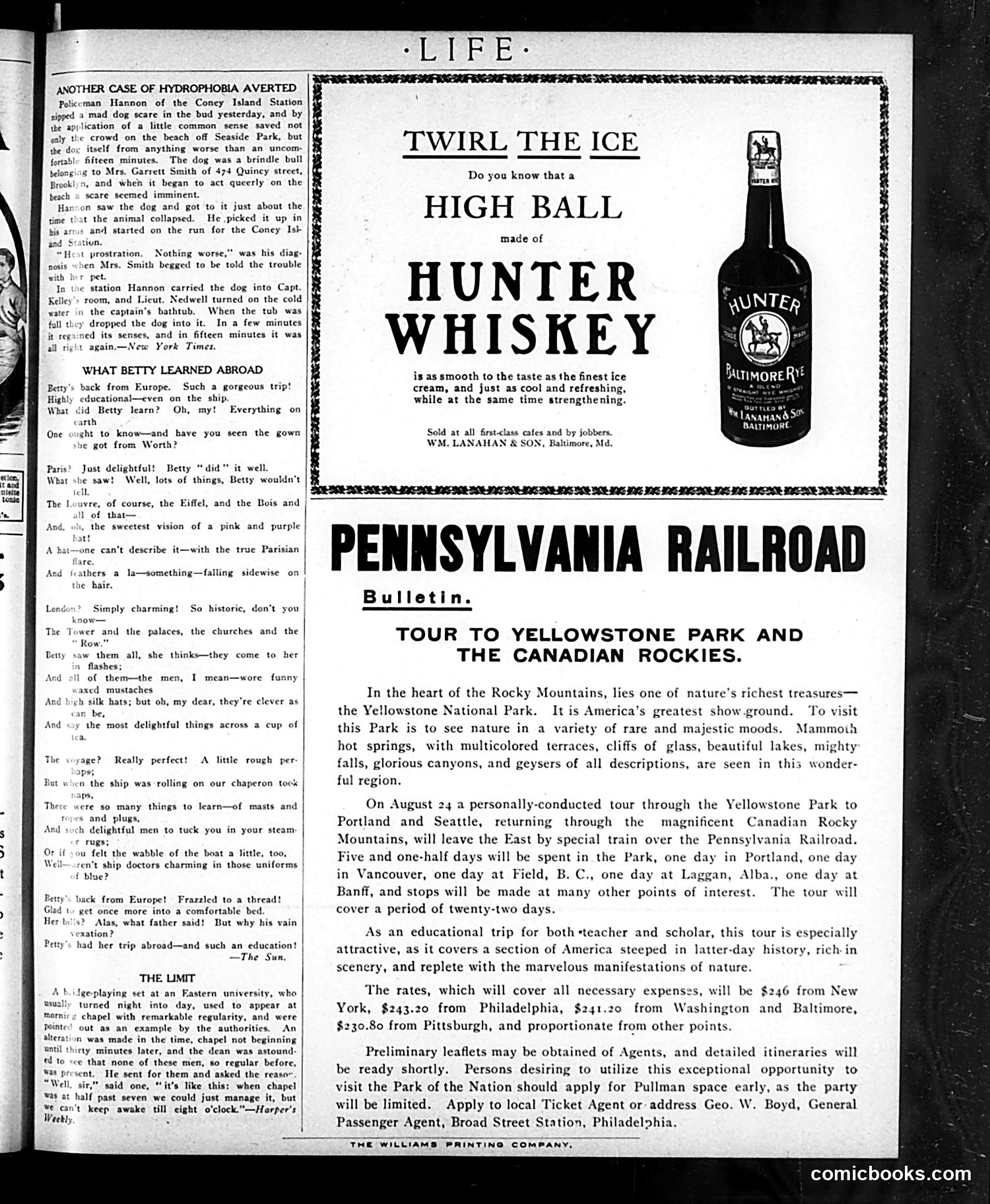
This is primarily an **advertising and miscellaneous content page** from Life magazine, not a political cartoon page. The main content includes: **News Anecdotes**: Brief humorous stories—a policeman saving a dog from apparent heatstroke at Coney Island, and a society girl's return from a European tour focused on fashion and flirtation rather than culture. **Advertisements**: A liquor ad for Hunter Whiskey promoting "high balls" (whiskey cocktails) as refreshing, and a Pennsylvania Railroad bulletin advertising a 20-day luxury tour to Yellowstone Park and the Canadian Rockies. **Social Satire**: The "Betty" story gently mocks wealthy American tourists abroad—the implication being that young women traveling to Europe were more interested in romance, fashion, and male attention than genuine cultural education, despite claims otherwise. The overall tone reflects early 20th-century upper-class American life: travel, alcohol consumption, and gentle mockery of social pretension.
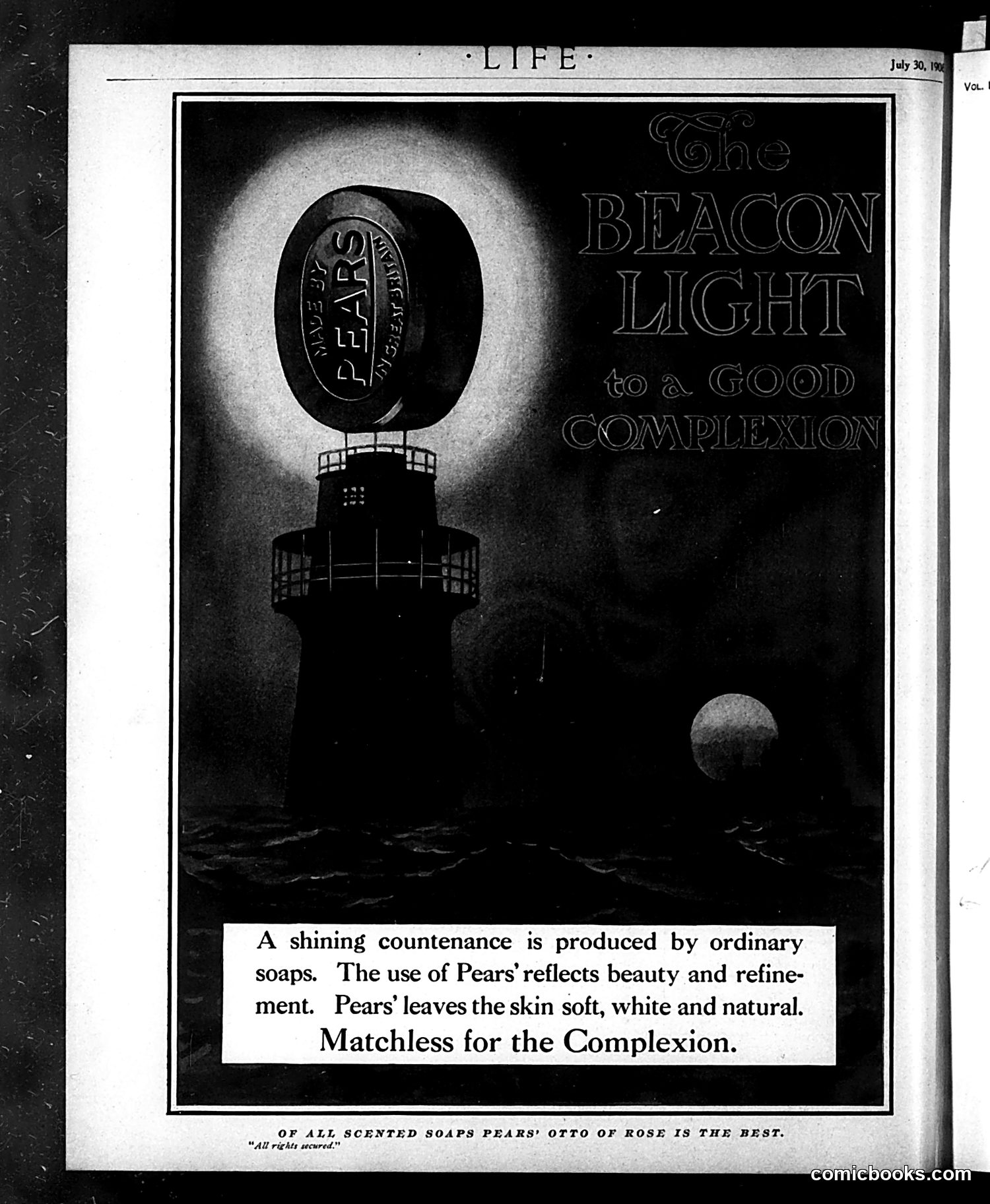
This is a **full-page advertisement**, not a political cartoon. It promotes Pears' soap, a real Victorian-era brand. The image shows a lighthouse with a glowing beacon at its top (featuring the Pears' soap logo). The tagline reads "The Beacon Light to a Good Complexion." **The advertising concept:** The lighthouse beacon serves as a metaphor—just as a lighthouse guides ships safely, Pears' soap guides users to an attractive complexion. The visual metaphor emphasizes the product's role as a guiding light toward beauty and refinement. **Historical context:** Victorian advertisements frequently emphasized "whiteness" and "natural" skin as beauty ideals. The copy claims Pears' produces superior results compared to "ordinary soaps," positioning it as a premium product that "reflects beauty and refinement." This is straightforward commercial advertising, not satire or political commentary.