
Life, 1908-07-30 · page 4 of 20
Life — July 30, 1908 — page 4: what you’re looking at
What you’re looking at
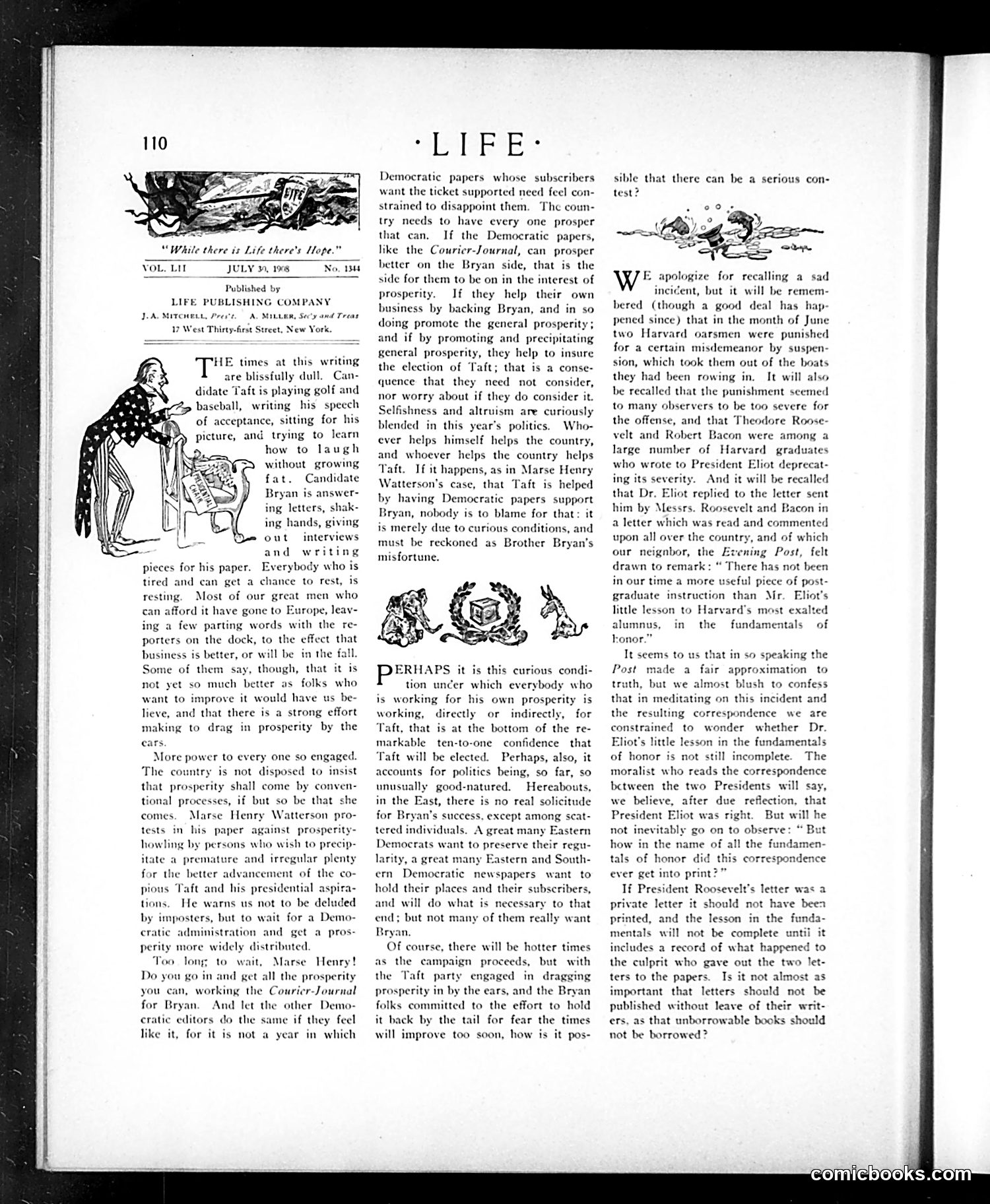
This page from Life magazine (July 1912) discusses the presidential campaign featuring William Howard Taft and William Jennings Bryan. The editorial addresses Democratic newspapers' support for Bryan despite backing Taft, criticizing this as hypocritical—helping one's own business while claiming to support the country's prosperity. The cartoon at top-left (captioned "While there is Life there's Hope") depicts a figure in distress, likely representing the Democratic Party's divided loyalties or internal conflict over the election. The piece references Theodore Roosevelt's Harvard letter criticizing an incident involving two Harvard men punished for "suppression," which the author uses to illustrate questions about honor and presidential character—suggesting Roosevelt's judgment on such matters was relevant to voters considering which candidate deserved their support.
📄 Transcribed text from this page (OCR, searchable)
Machine-transcribed from the original scan — historical spelling and the odd misread are preserved.
JULY 39, 1968 No, 14 Published by LIFE PUBLISHING COMPANY A, MILLER, Sec'y aed Treas LA MiTonent, Prete 17 West Thirty-first Street, New York. HE. times at this writing are blissfully dull. Can- didate Taft is playing golf and baseball, writing his speech of acceptance, sitting for his picture, and trying to learn how to laugh without growing fat. Candidate Bryan is answer- ing letters, shak- ing hands, giving out interviews and writing pieces for his paper. Everybody who is tired and can get a chance to rest, is resting. Most of our great men who can afford it have gone to Europe, leav- ing a few parting words with the re- porters on the dock, to the effe business is better, or will be in the fall. Some of them say, though, that it is not yet so much better as folks who want to improve it would have us be- lieve, and that there is a strong effort making to drag in prosperity by the cars. More power to every one so engaged. The country is not disposed to insist prosperity shall come by conven- tional processes, if but so be that she comes. Marse Henry Watterson pro- tests in his paper against prosperity- howling by persons who wish to precip- premature and irregular plenty nent of the co- itate a for the better advance Taft and his presidential aspira- He warns us not to be deluded pious bons. by imposters, but to wait for a Demo- cratic administration and get a_pros- perity more widely distributed long to wait, Marse Henry! Do you go in and get all the prosperity n, working the Courier-Journal And let the other Demo- cratic editors do the same if they feel like it, for it is not a year in which AL aEeES Democratic papers whose subscribers want the ticket supported need feel con- strained to disappoint them. The coun- try needs to have every one prosper that can. If the Democratic papers, like the Courier-Journal, can prosper better on the Bryan side, that is the side for them to be on in the interest of prosperity. If they help their own business by backing Bryan, and in so doing promote the general prosperity ; and if by promoting and precipitating general prosperity, they help to insure the election of Taft; that is a conse- quence that they need not consider, nor worry about if they do consider it. Selfishness and altruism are curiously blended in this rs politics. Who- ever helps himself helps the country, and whoever helps the country helps Taft. If it happens, as in Marse Henry Watterson’s case, that Taft is helped by having Democratic papers support n, nobody is to blame for that: it is merely due to curious conditions, and must be reckoned as Brother Bryan's misfortune. ERHAPS it is this curious condi- tion uncer which everybody who is working for his own prosperity is working, directly or indirectly, for Taft, that is at the bottom of the re- markable ten-to-one confidence that Taft will be elected. Perhaps, also, it accounts for politics being, so far, so unusually good-natured. Hereabouts, in the East, there is no real solicitude for Bryan’s success, except among scat- tered individuals. A great many Eastern Democrats want to preserve their regu- larity, a great many Eastern and South- ern Democratic newspapers want to hold their places and their subscribers, and will do what is necessary to that end; but not many of them really want Bryan. Of course, there will be hotter times as the campaign proceeds, but with the Taft party engaged in dragging prosperity in by the ears, and the Bryan folks committed to the effort to hold it back by the tail for fear the times will improve too soon, how is it pos- sible that there can be a serious con- W apologize for recalling a sad incident, but it will be remem- bered (though a good deal has hap- pened since) that in the month of June two Harvard oarsmen were punished for a certain misdemeanor by suspen- sion, which took them out of the boats they had been rowing in. It will also be recalled that the punishment seemed to many observers to be too severe for the offense, and that Theodore Roose- velt and Robert Bacon were among a large number of Harvard graduates who wrote to President Eliot deprecat- ing its severity. And it will be recalled that Dr. Eliot replied to the letter sent him by Messrs. Roosevelt and Bacon in a letter which was read and commented upon all over the country, and of which our neignbor, the Evening Post, felt drawn to remark: “ There has not been in our time a more useful piece of post- graduate instruction than Mr. Eliot's little lesson to Harvard's most exalted alumnus, in the fundamentals of lonor.” It seems to us that in so speaking the Post made a fair approximation to truth, but we almost blush to confess that in meditating on this incident and the resulting correspondence we are constrained to wonder whether Dr. Eliot's little lesson in the fundamentals of honor is not still incomplete. The moralist who reads the correspondence between the two Presidents will say, we believe, after due reflection, that President Eliot was right. But will he not inevitably go on to observe: “ But how in the name of all the fundamen- tals of honor did this correspondence ever get into print? If President Roosevelt's letter was a private letter it should not have been printed, and the lesson in the funda- mentals will not be complete until it includes a record of what happened to the culprit who gave out the two let- ters to the papers. Is it not almost as important that letters should not be published without leave of their writ- ers, as that unborrowable books should not be borrowed?