
A complete issue · 24 pages · 1906
Life — August 16, 1906
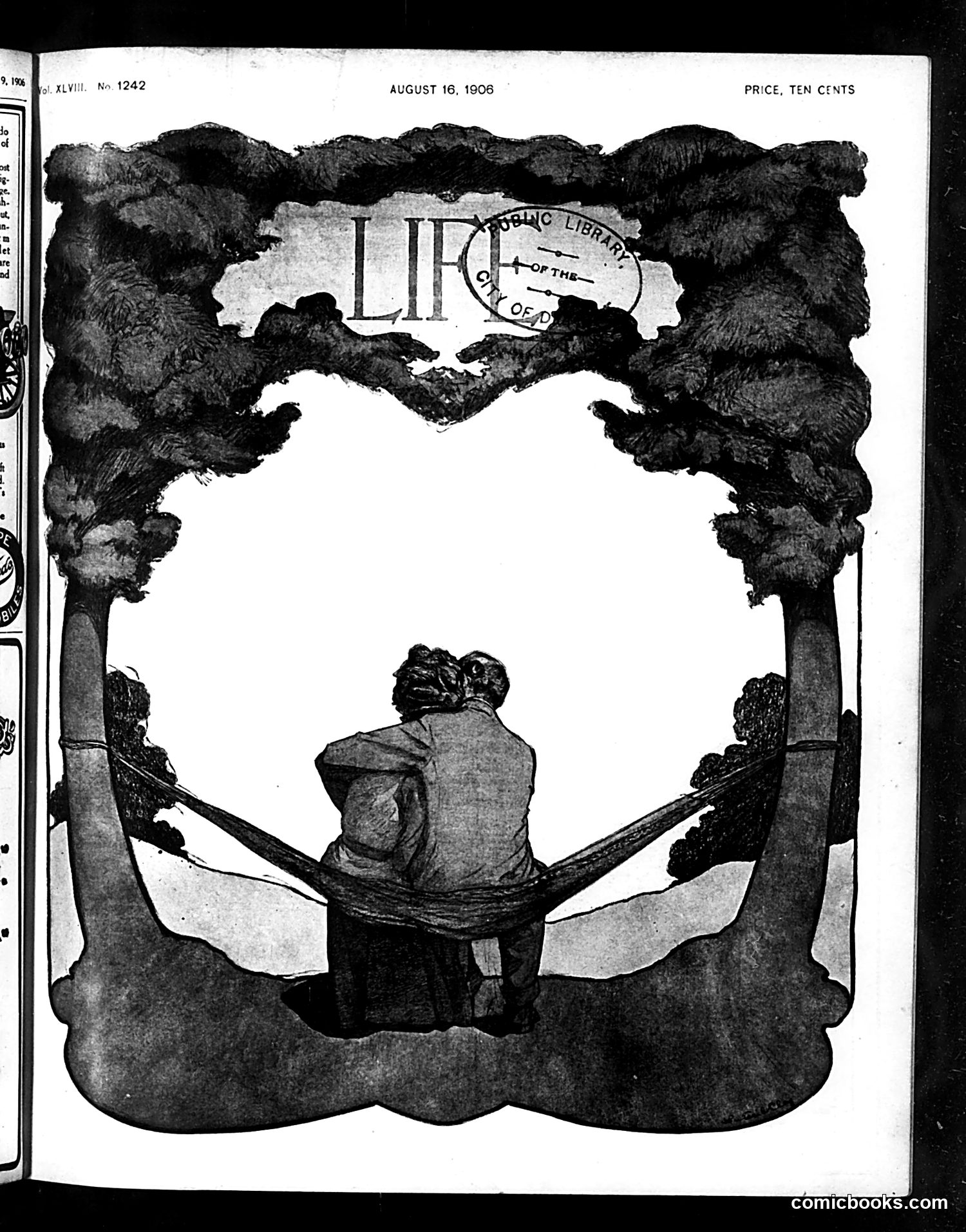
This appears to be a **Life magazine cover** featuring an Art Nouveau-style decorative frame with two large bear heads forming the border. A couple sits in a hammock suspended between the bears' jaws. The bears likely represent **Russia and another major power** (possibly Germany or another European nation), given the 1906 date during the Russian-Japanese War aftermath and heightened European tensions. The intimate couple in the hammock suggests **romantic or diplomatic relations** being precariously balanced between these powerful "bear" nations—a commentary on how smaller nations or couples existed vulnerably amid great power rivalries. The satirical point: international security and personal happiness alike were precarious when powerful nations were in opposition.
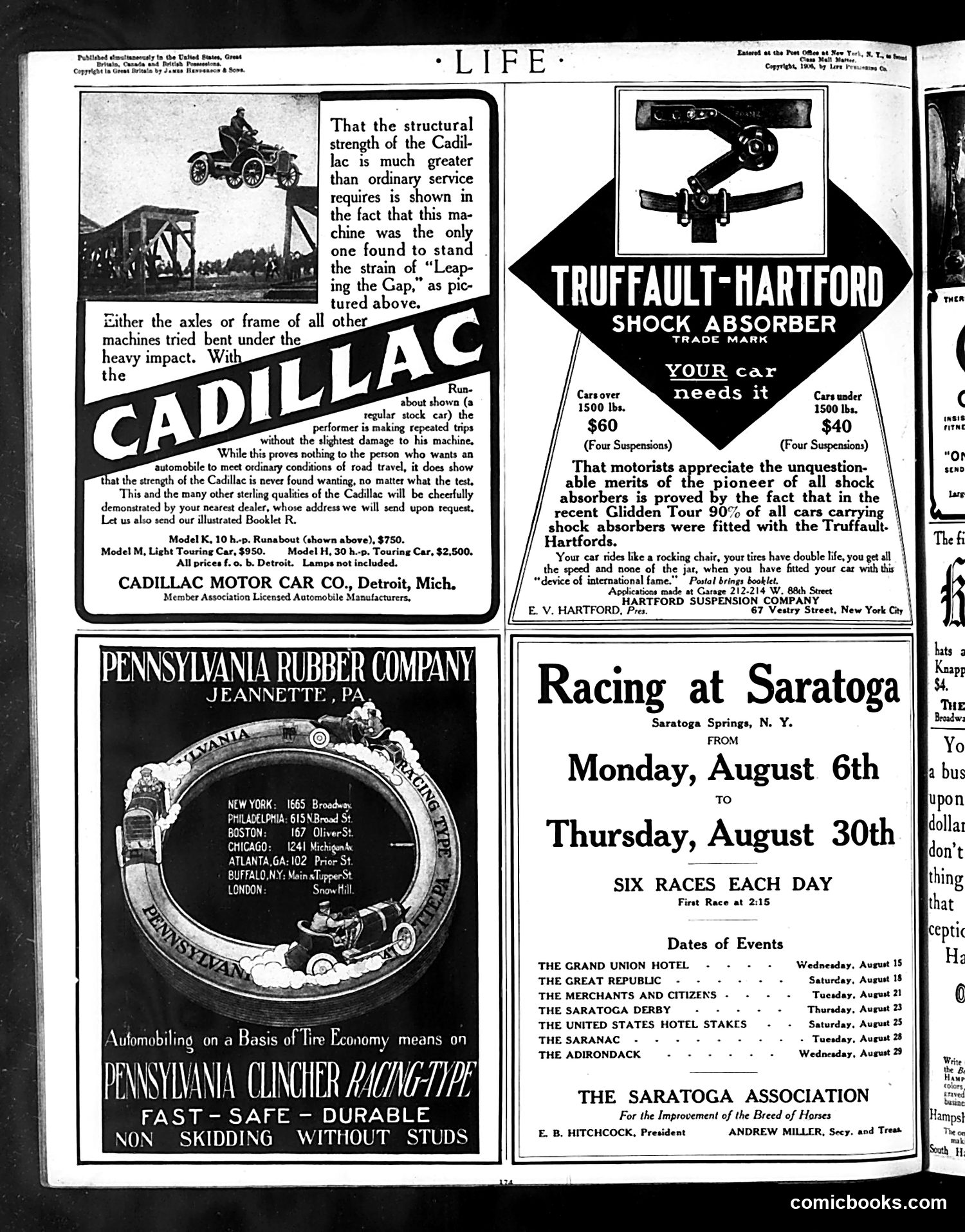
This page is **primarily advertising**, not satire or editorial content. It contains three automobile-related ads: 1. **Cadillac** (top left): Claims their cars' structural strength is proven by surviving a jump over a gap—the only vehicle tested that didn't fail. This is a boast about durability. 2. **Truffault-Hartford Shock Absorber** (top right): A product advertisement claiming superiority based on adoption in a recent "Glidden Tour." 3. **Pennsylvania Rubber Company** (bottom left): Promotes "Clincher Racing-Tyre" tires, emphasizing safety and speed without skidding. 4. **Saratoga Racing** (bottom right): Event announcement for horse racing, August 6-30. The page reflects early automotive advertising emphasizing durability and performance—typical of 1910s-era marketing before modern safety standards.
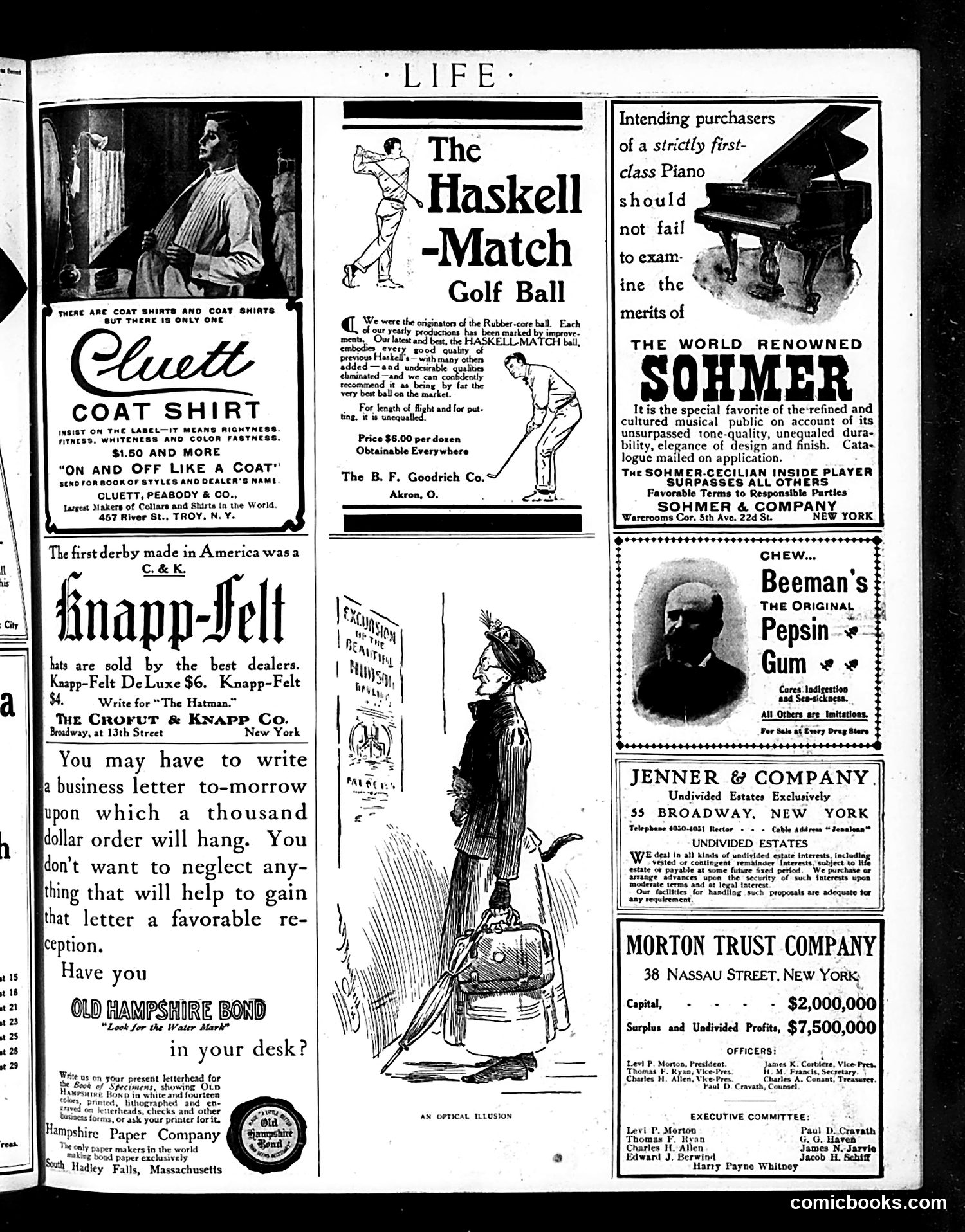
This page is **primarily advertisements** for consumer products (pianos, golf balls, shirts, felt hats, gum, financial services) typical of early 20th-century magazines. The one cartoon present, labeled "AN OPTICAL ILLUSION," depicts a fashionably dressed woman in profile carrying luggage. The caption suggests this is a visual trick—likely playing on period fashion silhouettes or the contrast between her refined appearance and her practical traveling burden. Without additional context about contemporary fashion debates or social commentary of the specific era, the precise satirical target remains **unclear**. It may mock women's fashion pretensions or travel habits, but the exact point is ambiguous to modern readers without knowing the magazine's publication date.
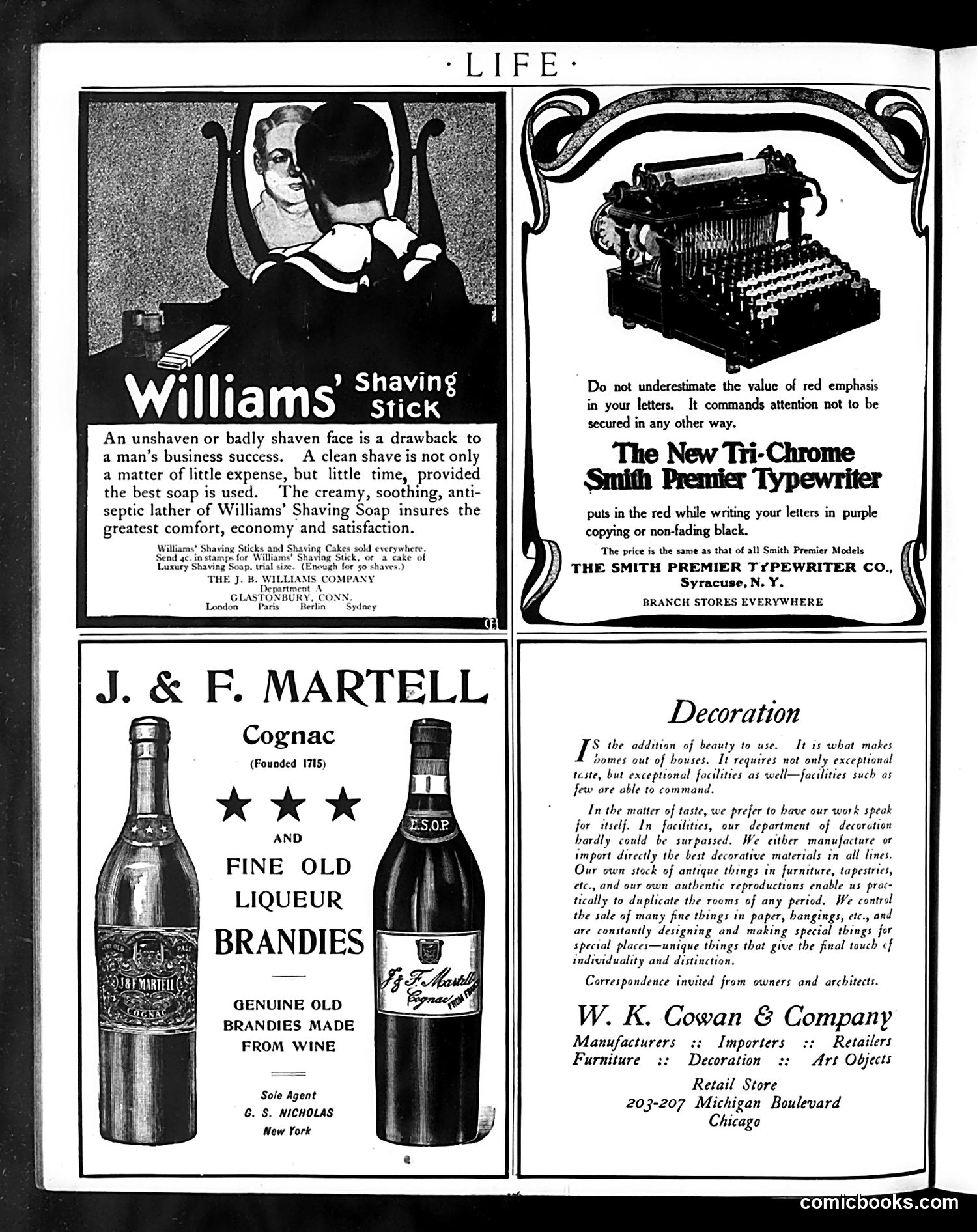
This page consists primarily of **advertisements** rather than political cartoons or satirical content. The four ads are: 1. **Williams' Shaving Stick**: Promotes grooming for business success, arguing a clean shave aids professional advancement. 2. **Smith Premier Typewriter**: Highlights the machine's ability to produce red text for emphasis in letters. 3. **J. & F. Martell Cognac**: Advertises French brandy and liqueurs, established 1715. 4. **W. K. Cowan & Company**: Announces a Chicago furniture and decoration retailer offering custom interior design services. There is **no political satire or caricature** on this page. The content reflects early 20th-century consumer goods marketed to businessmen and affluent households—typical of *Life* magazine's advertising sections during this era.
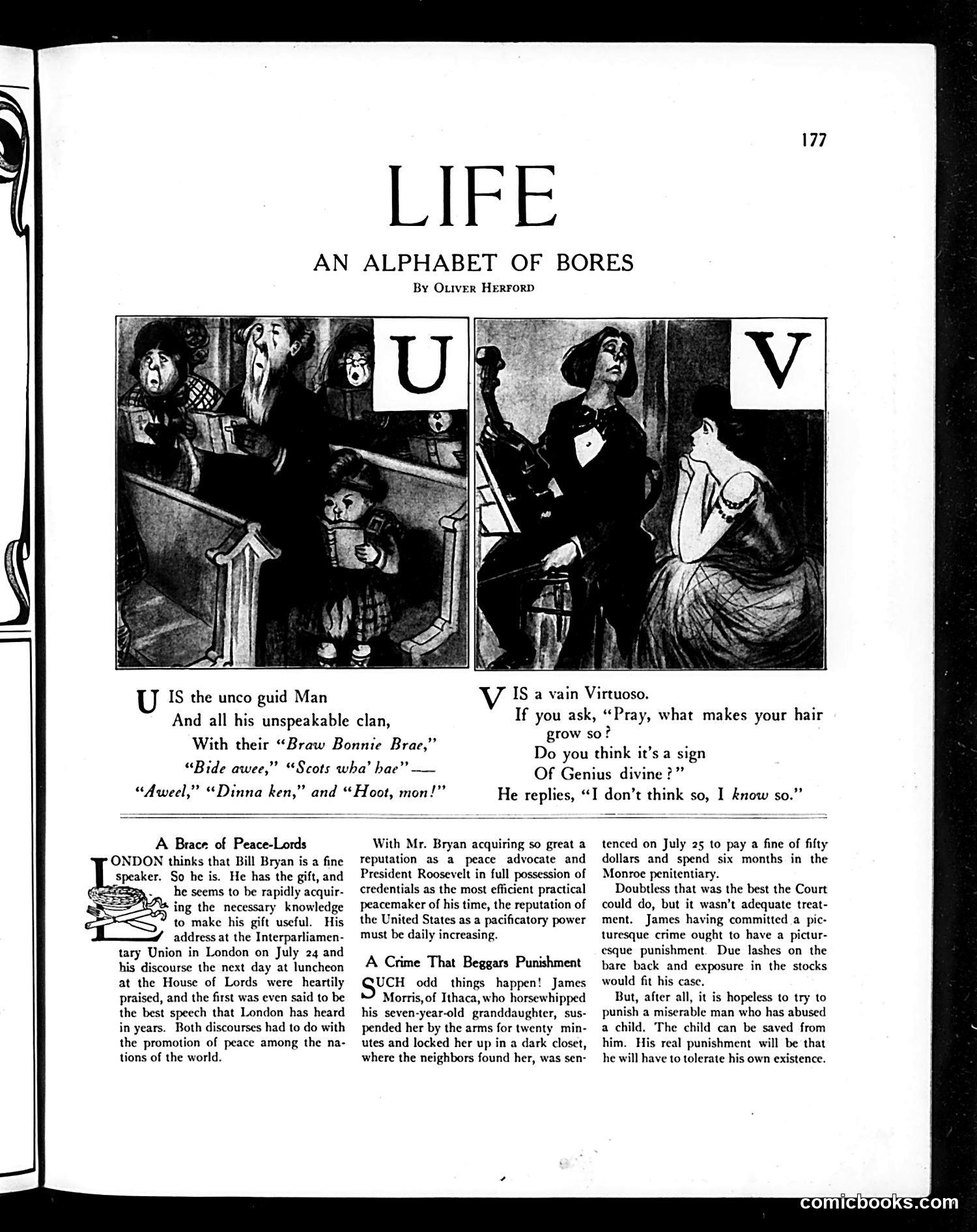
This page from Life magazine presents two satirical vignettes by Oliver Herford mocking tedious social types. **"U"** ridicules Scottish ethnic stereotyping, showing an "unco guid Man" who bombards listeners with incomprehensible Scottish dialect phrases ("Braw Bonnie Brae," "Dinna ken," etc.). The satire targets people who affect exaggerated regional speech to appear colorful or authentic. **"V"** lampoons the pretentious "vain Virtuoso"—a conceited person who attributes his hair growth to "genius divine" before admitting he simply doesn't know the cause. The joke skewers affected intellectuals who cloak ignorance in pseudo-philosophical nonsense. Both entries ridicule social bores through exaggerated character types common to early 20th-century society.
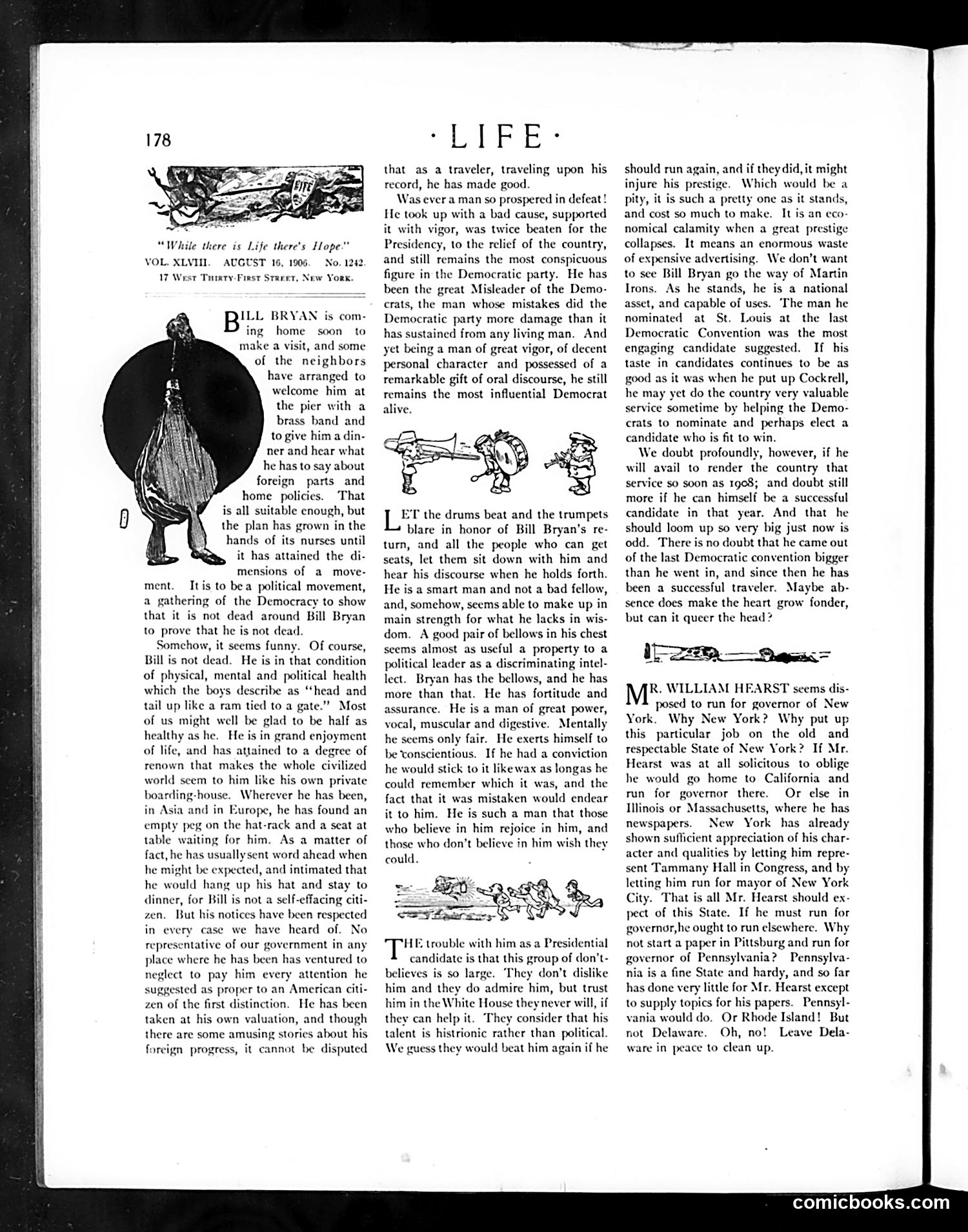
This page contains political commentary on **William Jennings Bryan**, the three-time Democratic presidential candidate. The illustration depicts Bryan as a large figure carrying a bundle labeled like political baggage. The text critiques Bryan as a liability to the Democratic Party, arguing he's caused more damage to Democrats than any living person through his "misleading" leadership. The article expresses doubt he could win in 1908 or be an effective candidate, suggesting he'd better serve the party by staying out of the race. The accompanying commentary on **William Hearst** questions his potential gubernatorial candidacy in New York, suggesting he'd be better suited to journalism. The satire mocks Bryan's repeated electoral failures and political baggage rather than celebrating his populist appeal.
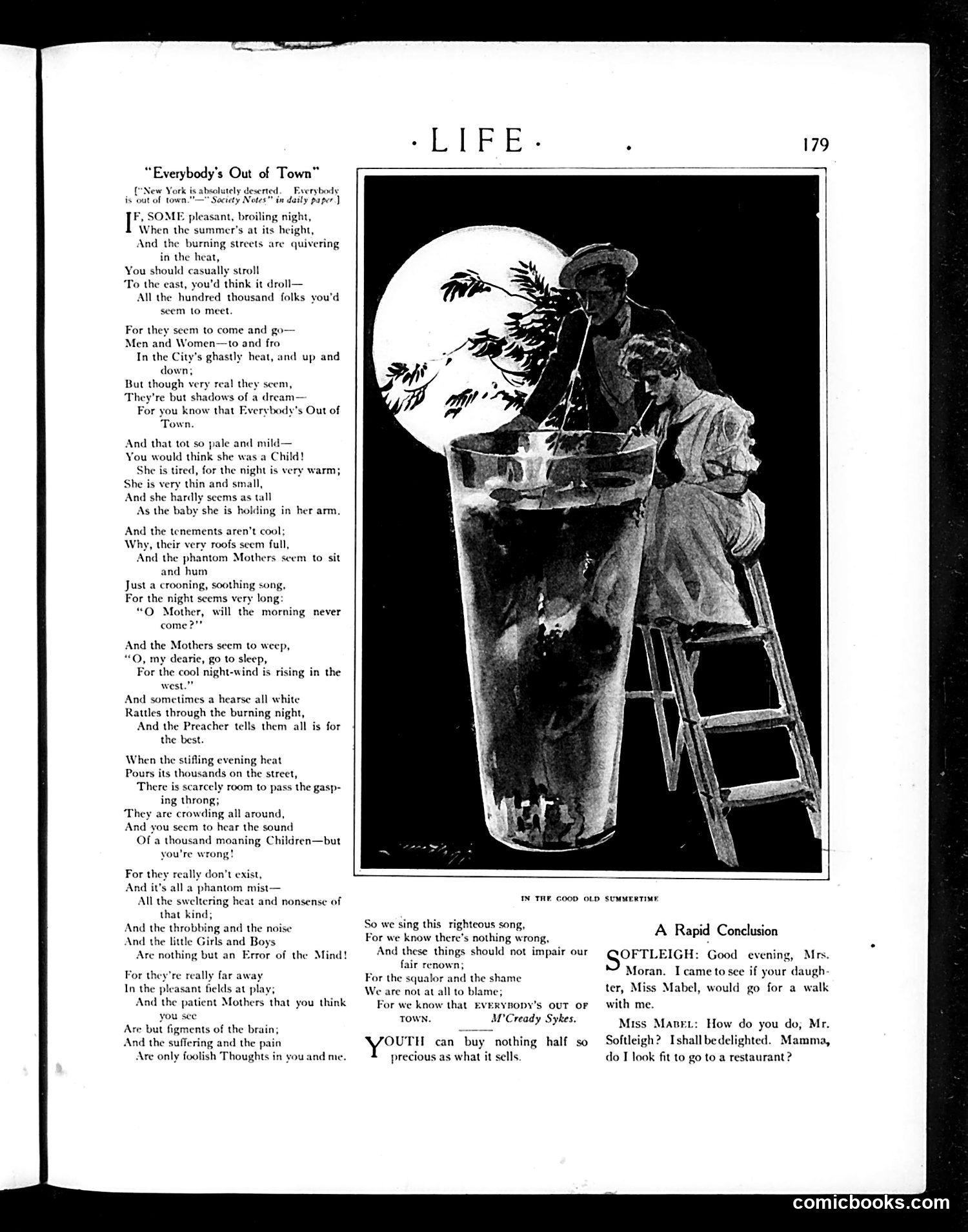
This page contains two distinct elements: **Left side:** A poem titled "Everybody's Out of Town" satirizes summer in New York City. It mocks the urban heat and crowding, describing phantom crowds and suffering children. The poem suggests that city residents flee ("everybody's out of town"), leaving behind only illusions of activity—a commentary on wealthy New Yorkers' seasonal exodus to cooler locales. **Right side:** An illustration labeled "In the Good Old Summertime" depicts a figure on a ladder against a large moon, appearing to swat at something with a newspaper or fan. This likely satirizes futile attempts to escape summer heat and urban discomfort—even fanciful gestures (reaching toward the moon) cannot solve the problem. The bottom section begins "A Rapid Conclusion," a brief dialogue between characters Softleigh and Miss Mabel about evening plans.
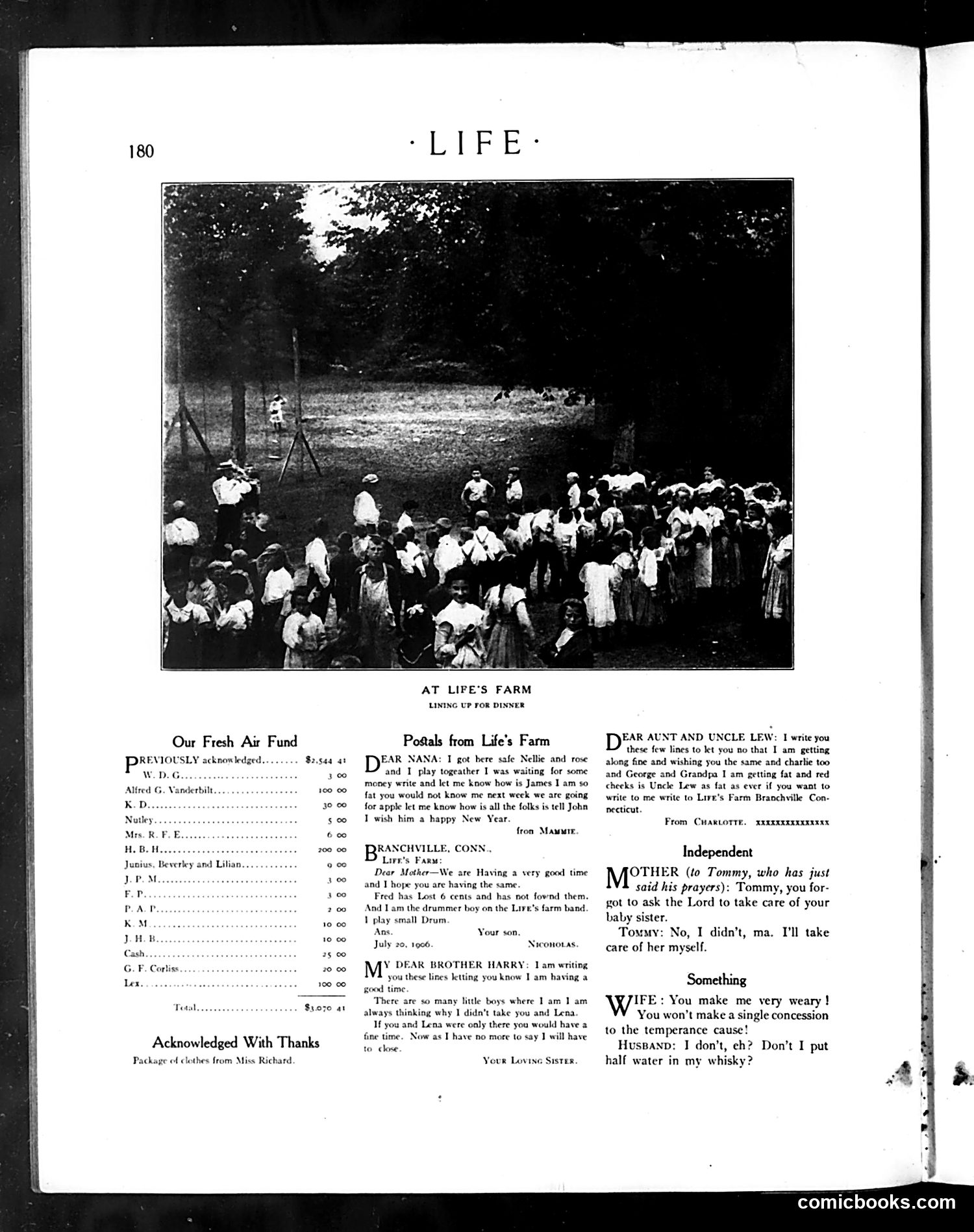
This page combines charitable fundraising with domestic humor sketches. The top photograph shows "At Life's Farm" with people lining up for dinner—documenting what appears to be a charitable event or relief effort. Below are brief comedic dialogues mocking domestic life: "Independent" depicts a wife asserting autonomy over childcare decisions, while "Something" shows marital bickering over whiskey and temperance (relevant given Prohibition-era concerns about alcohol). The "Fresh Air Fund" list acknowledges donations, suggesting Life supported charitable causes providing outdoor relief for urban poor. The "Postals from Life's Farm" section includes personal letters from visitors, emphasizing the magazine's community engagement. Overall, this page blends earnest social welfare messaging with satirical commentary on marriage and domestic relationships typical of Life's editorial approach.
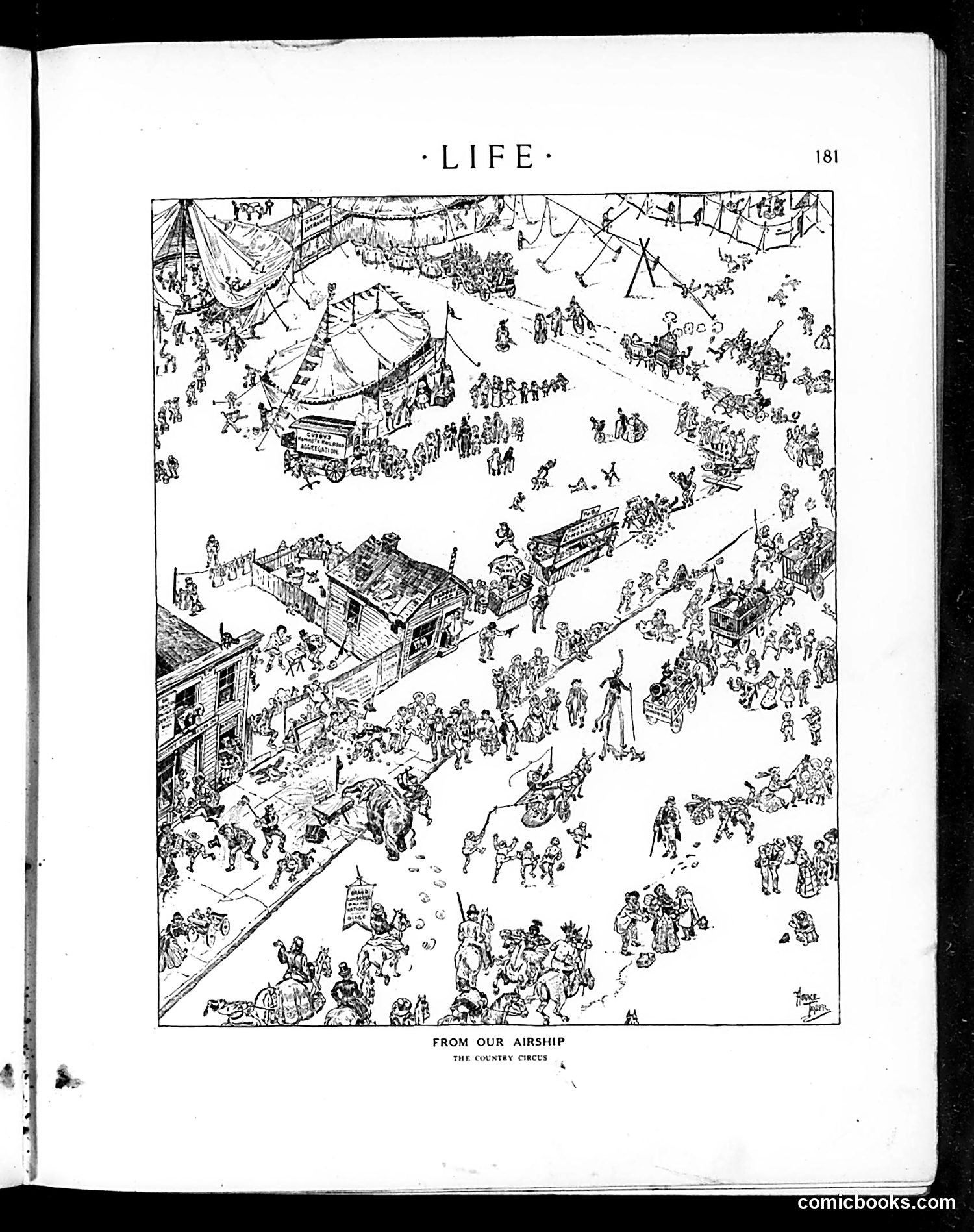
This is a bird's-eye view illustration depicting a circus or fair grounds scene observed from above, as if by airship. The detailed drawing shows numerous tents, wagons, crowds of people, horses, and various carnival attractions scattered across an open field. The caption "From Our Airship" suggests this represents Life magazine's satirical perspective on American society—observing the nation from a detached, superior vantage point. "The Country Circus" frames everyday American life as a chaotic, entertaining spectacle with its diverse characters and activities. The drawing's intricate detail of rural/traveling performers and crowds likely satirizes either contemporary entertainment culture or broader American social conditions, though without identifying specific figures or events, the exact political commentary remains unclear from the image alone.
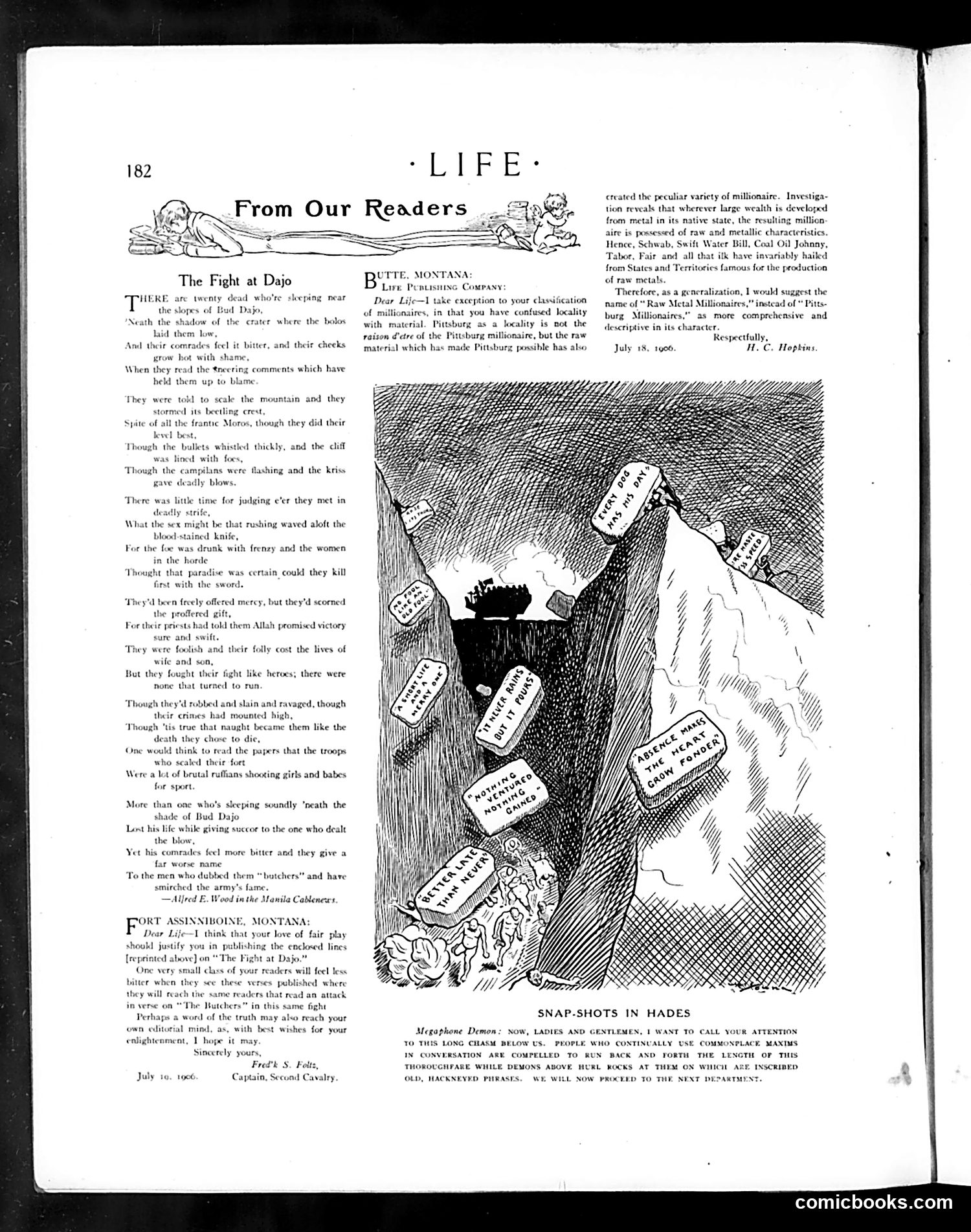
This is a satirical cartoon titled "Snap-Shots in Hades" depicting the afterlife as a bureaucratic hell. The image shows various labeled tombstones or placards in a dark, infernal landscape, appearing to mock different types of people or professions condemned to damnation. The accompanying text beneath the image (in all caps) suggests this is social satire about people who use "commonplace mantrums in conversation" and are "compelled to run back and forth the length of this thoroughfare while demons above hurl rocks at them." The cartoon mocks specific character types or social behaviors worthy of eternal punishment. Without being able to read all the individual labels clearly, the overall message appears to be satirizing annoying social habits and personality types through humorous depiction of their infernal fates. This reflects Life magazine's tradition of sharp social commentary through visual satire.
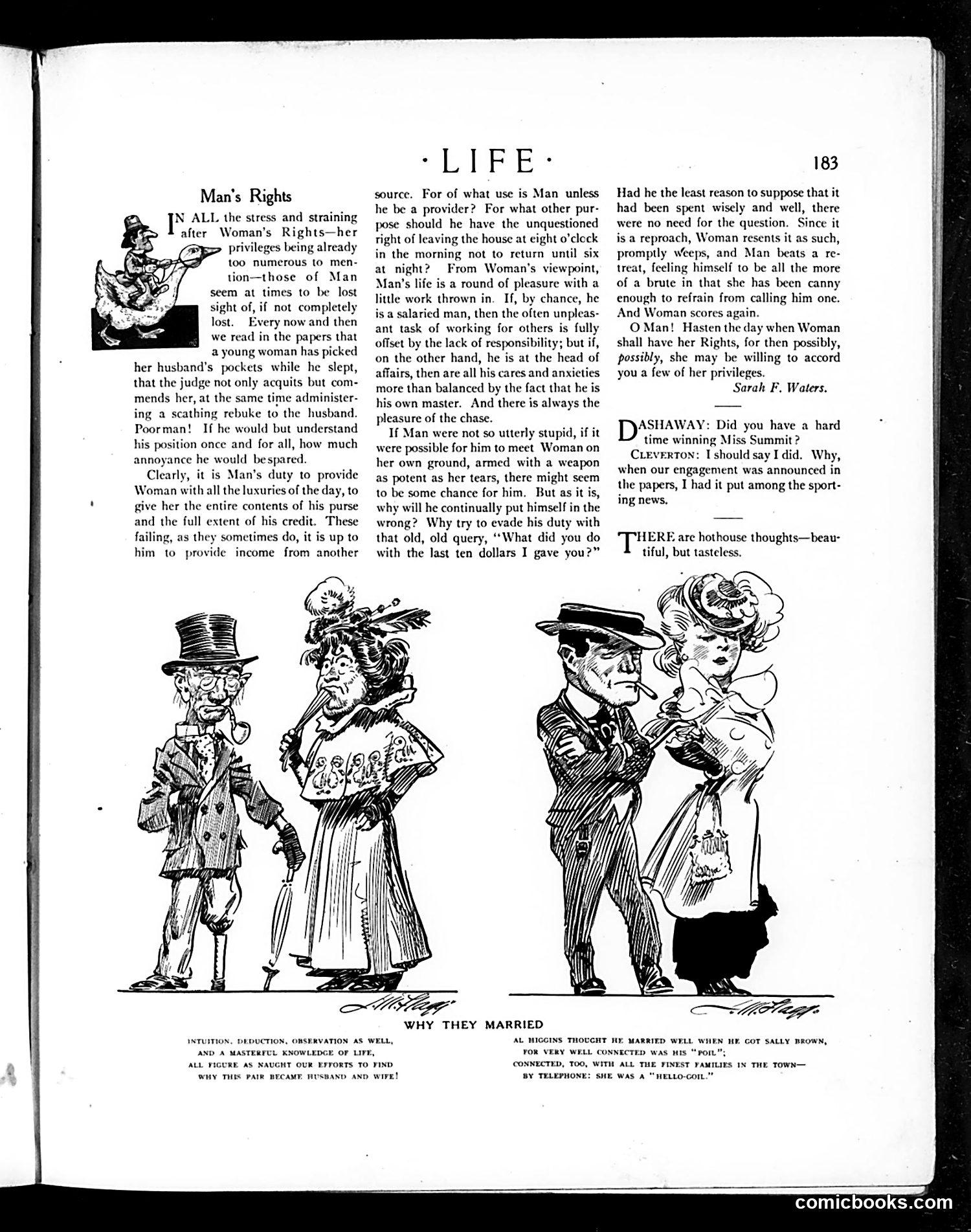
This page satirizes gender roles and marital dynamics of the early 20th century. The main article "Man's Rights" argues ironically that men deserve equality—complaining women control household finances and that men must provide income while lacking authority. The two cartoon panels titled "Why They Married" mock the pretenses surrounding marriage. The left panel depicts a couple marrying for superficial reasons (intuition, deduction, observation). The right panel shows a man marrying a woman specifically because she's well-connected socially—he gains access to "the finest families in town" through her telephone network ("hello-girl"). The satire critiques both genders: women's financial power within marriage and men's mercenary motivations for marrying into social status. The humor relies on depicting marriage as transactional rather than romantic.
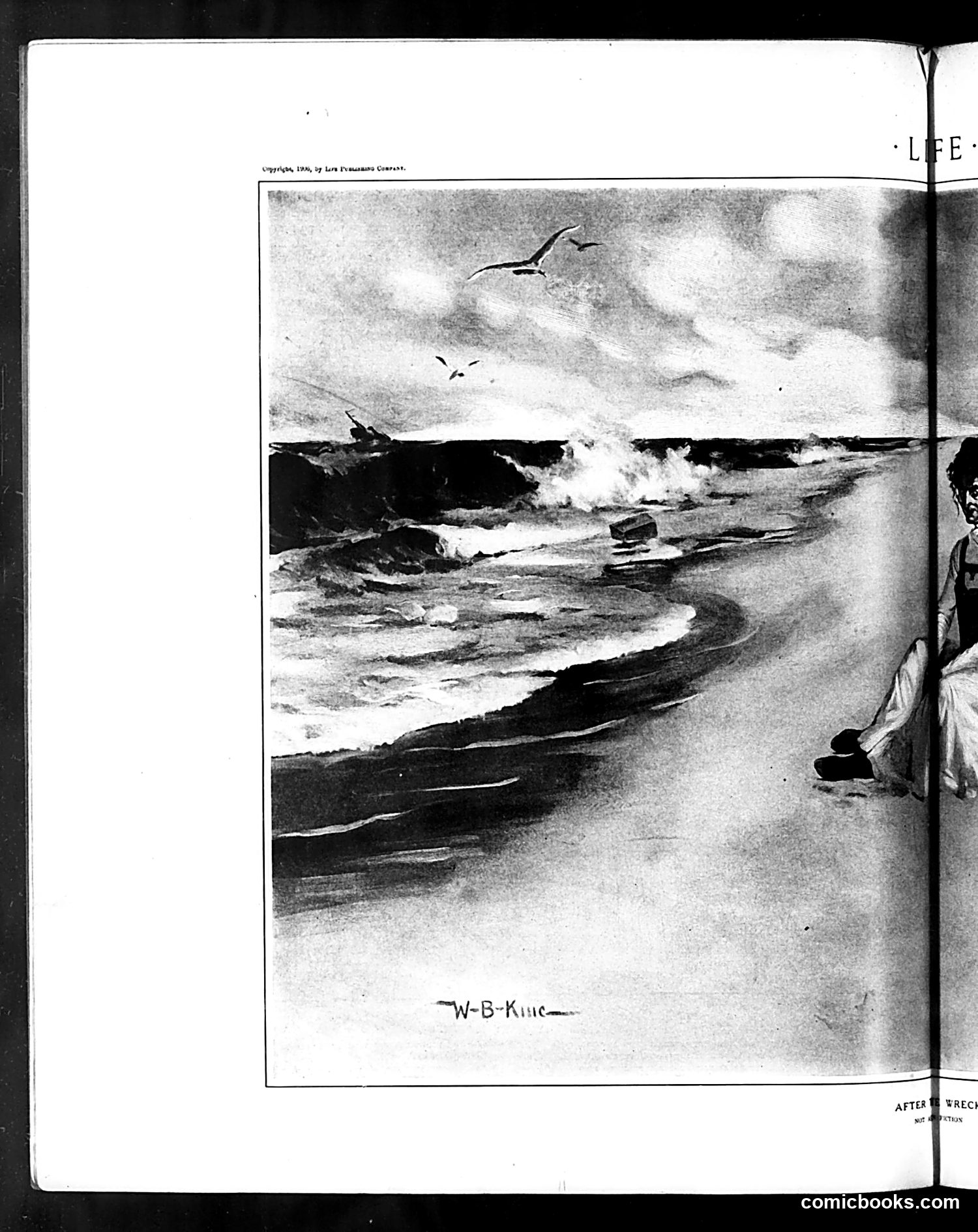
This page from *Life* magazine features a black and white photograph credited to "W.B. King" showing a dramatic coastal seascape. The image depicts a rocky shoreline with crashing waves, dark rocks, and turbulent water. A person is visible on the right edge of the frame, and birds fly overhead in a cloudy sky. However, **this appears to be a straightforward nature/landscape photograph rather than a political cartoon or satirical content**. The page shows no obvious caricatures, political figures, or satirical commentary. Without the full article text or caption context, I cannot identify the intended satirical meaning or social reference, if any exists. The image may accompany an article, but the cartoon or joke—if present—is not apparent from the visual alone.
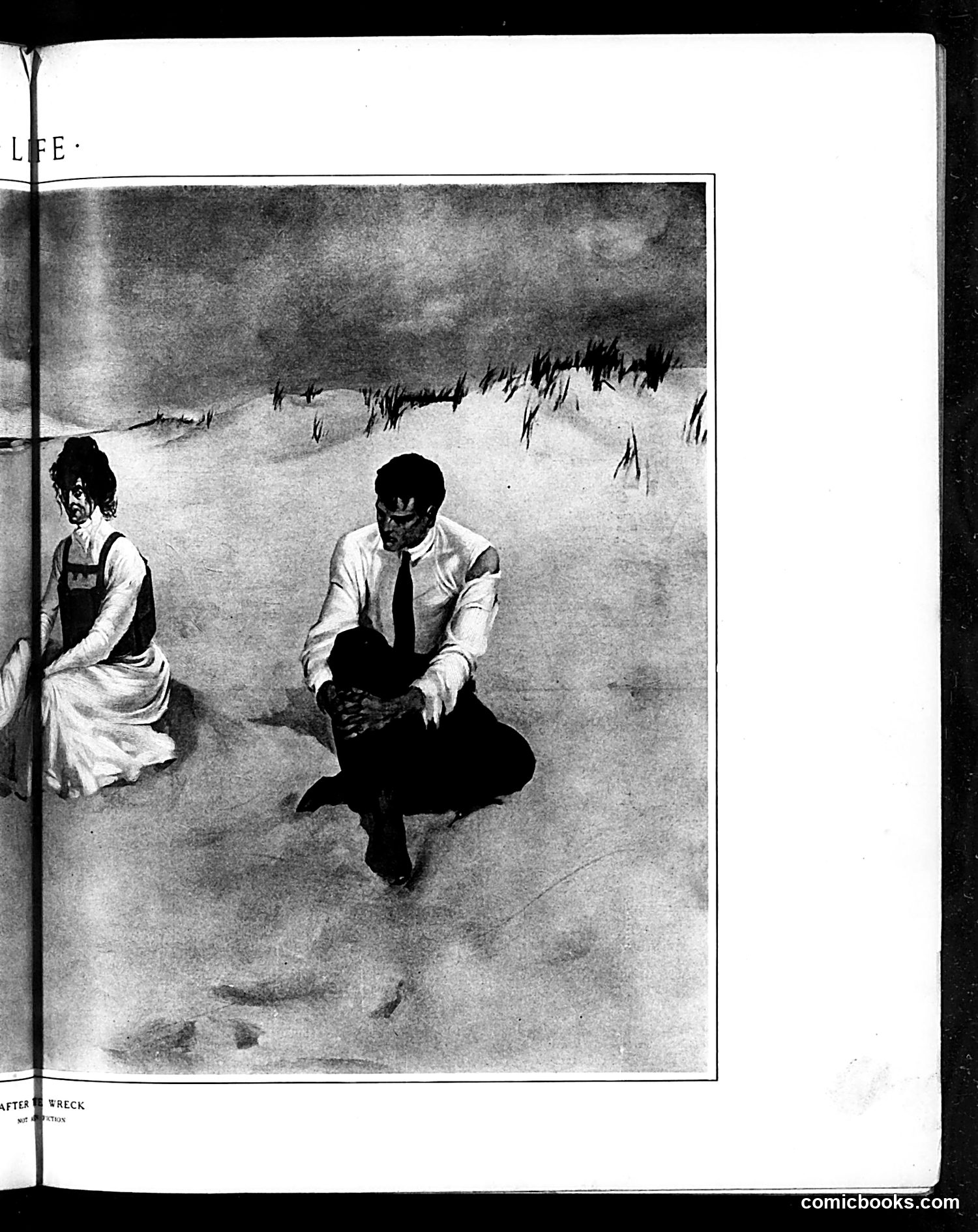
This page from *Life* magazine shows two figures on a beach examining wreckage, likely from a shipwreck (suggested by "WRECK" visible at bottom). The image is titled "LIFE" at top left. The photograph appears to be a staged scene depicting salvagers or investigators surveying disaster debris on a sandy shore. The man in formal dress (white shirt, tie) and the woman in work clothes suggest different social classes or roles responding to the catastrophe. Without additional visible text or caption, the specific satirical point remains unclear. This could reference a contemporary shipwreck or maritime disaster, but the exact historical event and intended commentary cannot be determined from the image alone. The contrast between the figures' attire hints at social commentary, but the specific target of satire is not evident from what's visible here.
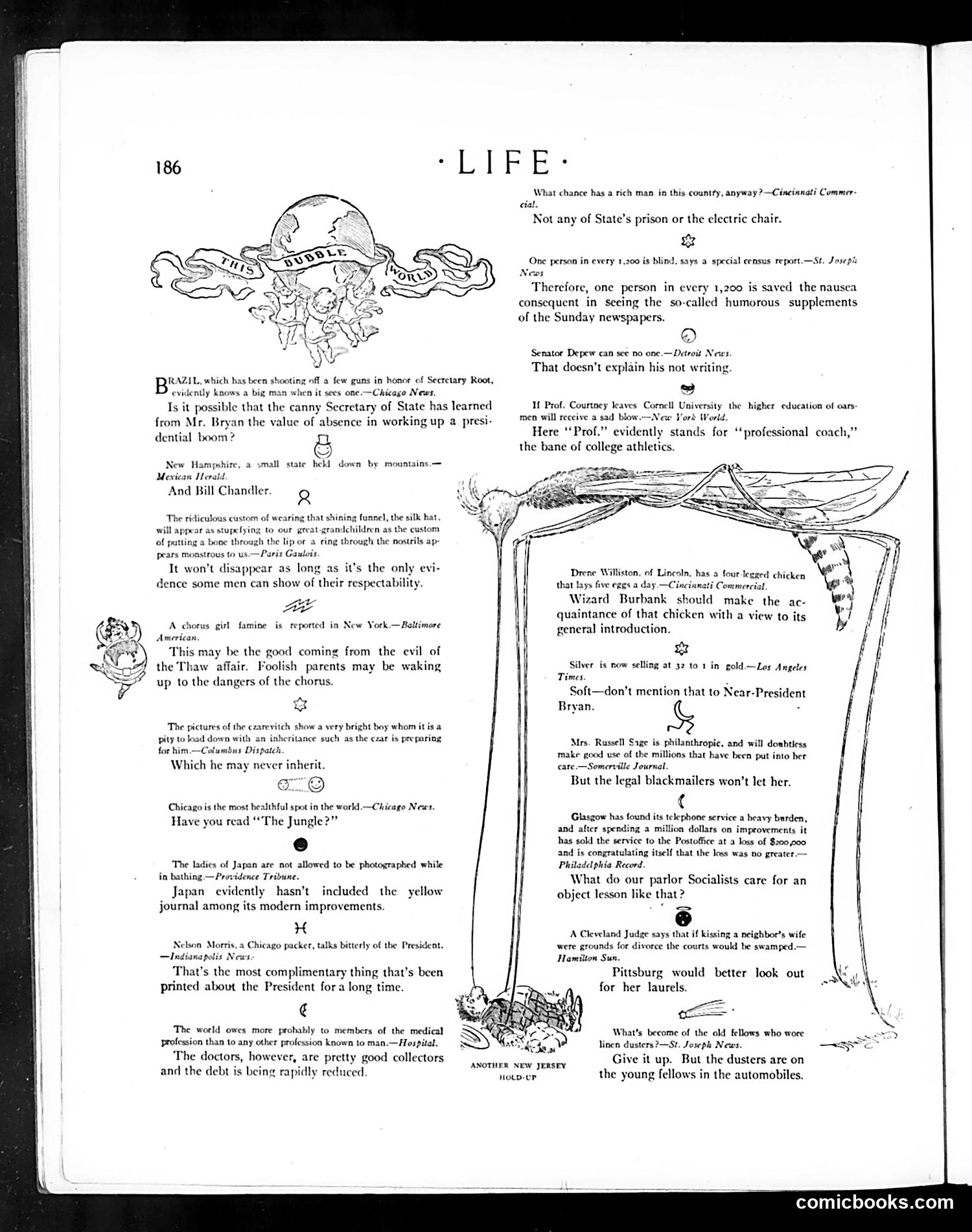
This page from *Life* magazine collects brief satirical quips and observations on contemporary American life, politics, and society. Key targets include: **Political figures**: Senator Depew (criticized for silence), Secretary of State Root, William Jennings Bryan (mocked as "Near-President" for his repeated failed presidential campaigns), and President Theodore Roosevelt. **Social commentary**: The page mocks wealth inequality, blindness statistics (sardonically suggesting the blind are spared seeing Sunday newspaper humor), fashion absurdities (the funnel hat), and the dangers of chorus girls. **Specific references**: The Thaw affair (a notorious 1906 murder scandal), Luther Burbank (famous plant breeder), and Russell Sage (philanthropist widow). One cartoon critiques a Glasgow telephone service sold at massive loss—used to mock socialist economics. The satire assumes reader familiarity with contemporary scandals and political personalities, using sharp one-liners and editorial cartoons to skewer hypocrisy, greed, and social pretension typical of *Life*'s progressive-era humor.
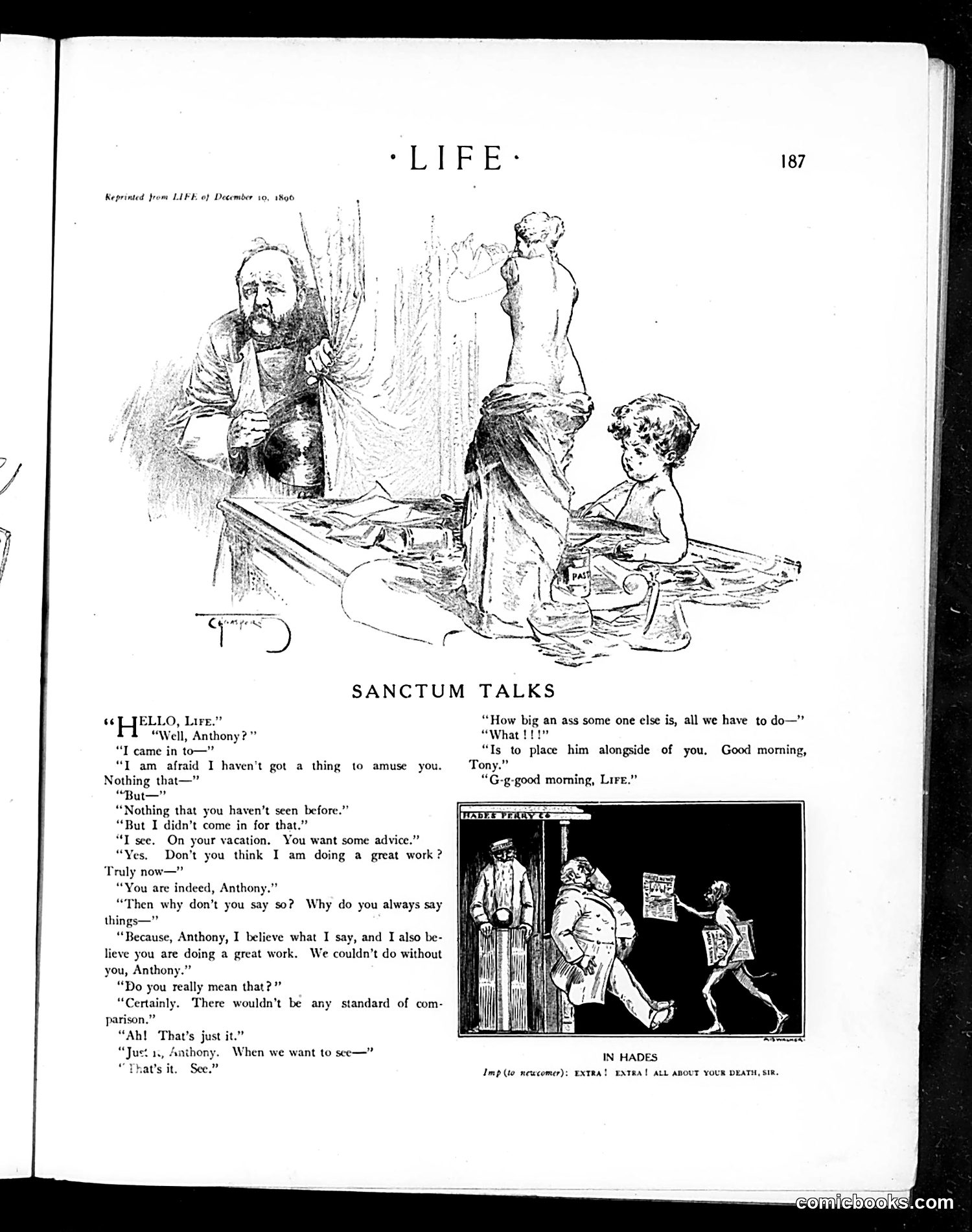
This page contains two satirical pieces mocking vanity and self-importance. **"Sanctum Talks"** depicts a conversation between "Life" (the magazine personified) and "Anthony" (likely a prominent figure of the era, though unclear from context). Anthony seeks praise for his work, but Life delivers backhanded compliments—saying Anthony's value lies only as a negative "standard of comparison" to make others look good. The humor lies in exposing Anthony's desperate need for validation and Life's brutal honesty about his actual worth. **"In Hades"** shows a newspaper vendor in the afterlife hawking scandal sheets about the newly deceased. The joke satirizes both sensationalist journalism and human obsession with morbid news—even death doesn't stop the appetite for lurid stories "all about your death, sir." Both pieces exemplify Life's tradition of using dialogue and personification to mock human nature: vanity, self-delusion, and society's hunger for gossip.
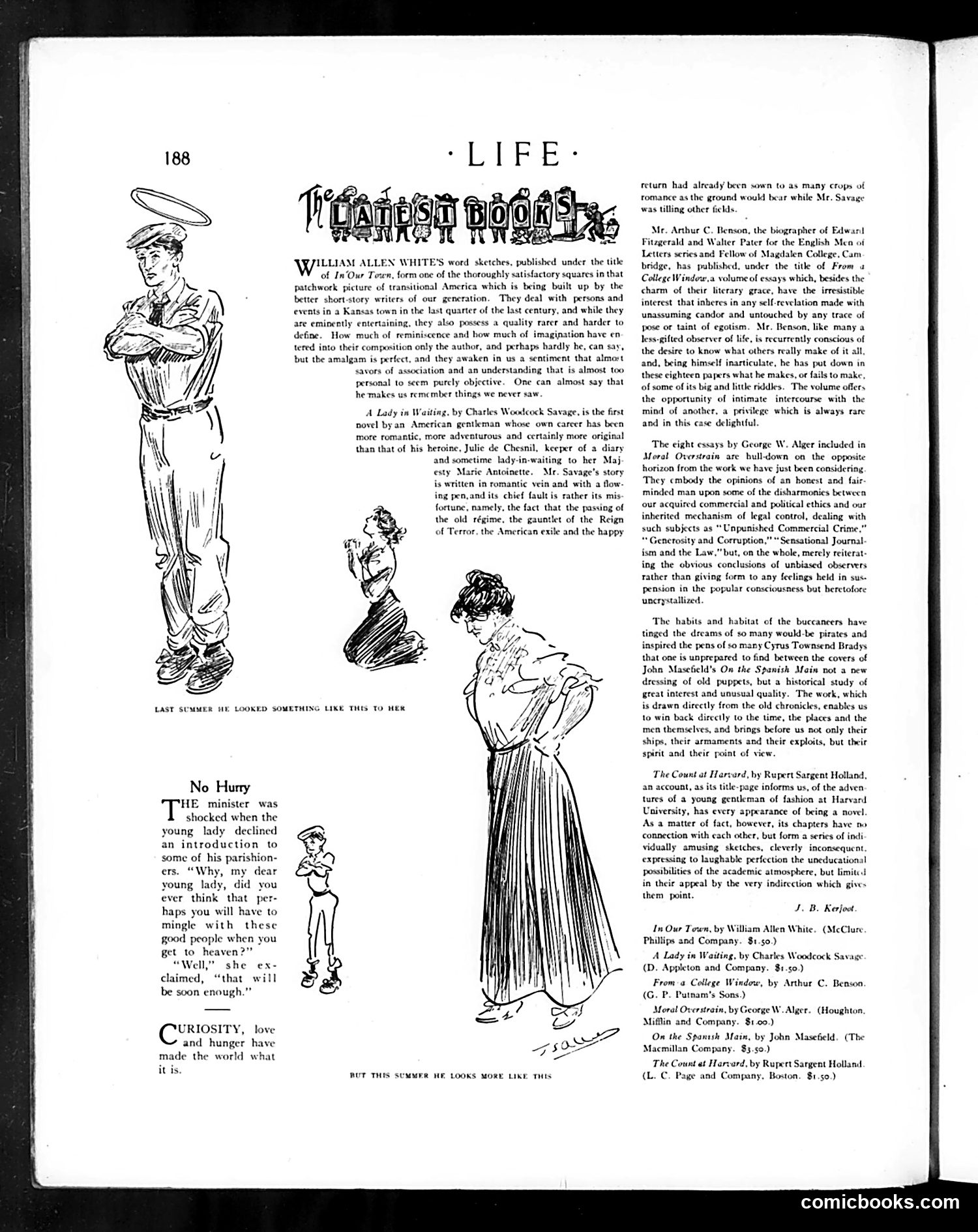
This page from *Life* magazine contains book reviews and illustrations satirizing romantic idealism versus reality. The main cartoon shows a contrast: a young man in formal dress ("last summer he looked something like this to her") versus the same man looking disheveled and ordinary ("but this summer he looks more like this"). The accompanying text, titled "No Hurry," depicts a minister shocked when a young lady declines an introduction to his parishioners, suggesting she'll "mingle with these good people when you get to heaven." The satire targets the gap between romantic fantasy and mundane reality—how infatuation blinds people to actual character. The minister's moral objection humorously assumes heaven itself validates earthly pretense. The page primarily reviews recent books, including William Allen White's Kansas stories and Charles Woodcock Savage's *A Lady in Waiting*, a novel about Marie Antoinette's lady-in-waiting. The reviews praise literary merit while noting how authors blend imagination with reminiscence.
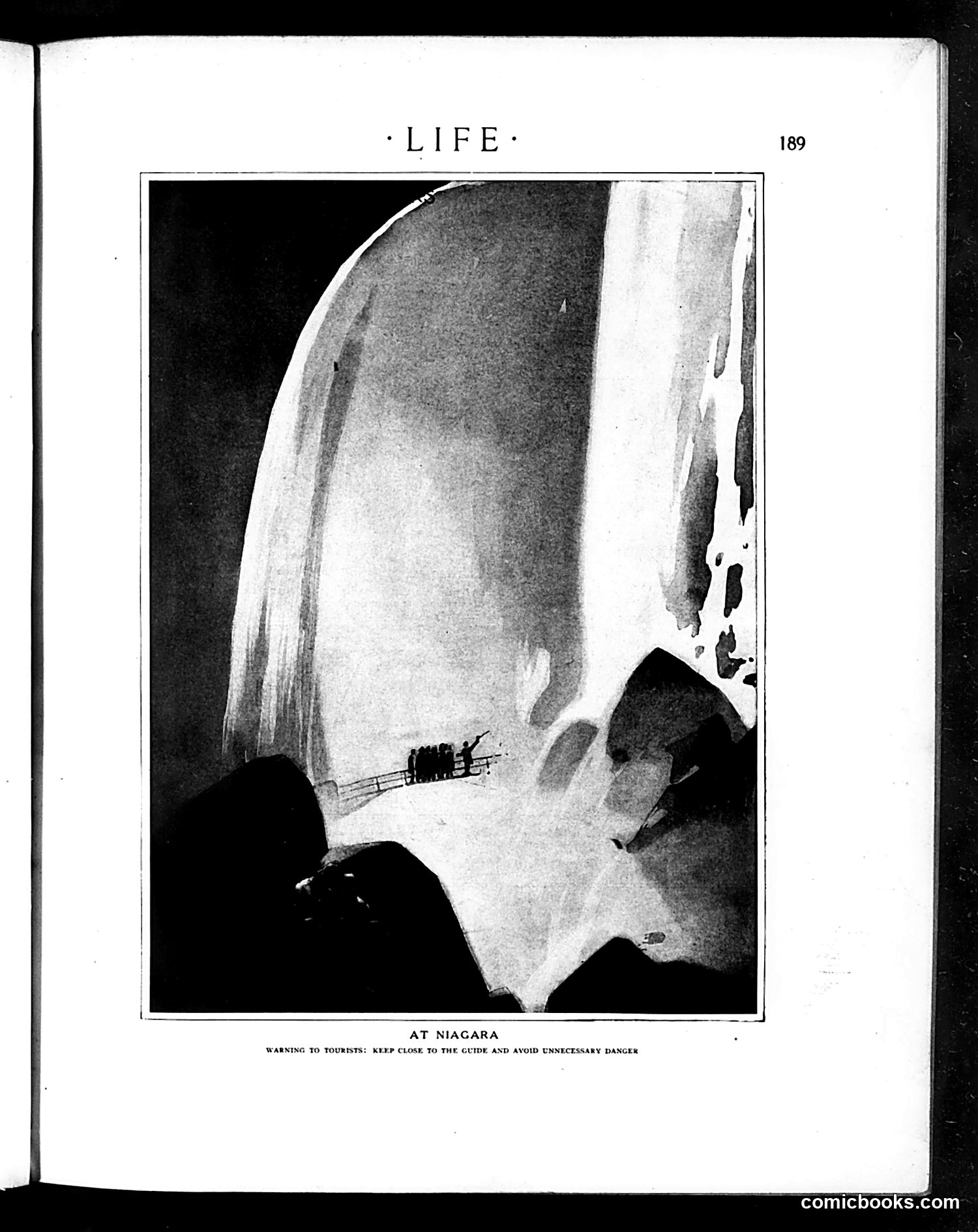
This is a dramatic photograph rather than a cartoon, showing Niagara Falls with a horse-drawn carriage visible on the cliff edge for scale. The image appears in Life magazine (page 189) as a safety warning to tourists. The photograph emphasizes the massive scale and power of the falls by including the tiny carriage, making the natural wonder appear both majestic and perilous. The caption's warning—"Keep close to the guide and avoid unnecessary danger"—suggests tourists were at risk of accidents near the falls, likely from slipping on wet rocks or venturing too close to the edge. This represents early 20th-century concerns about tourist safety at natural attractions, before modern safety barriers and regulations were standard.
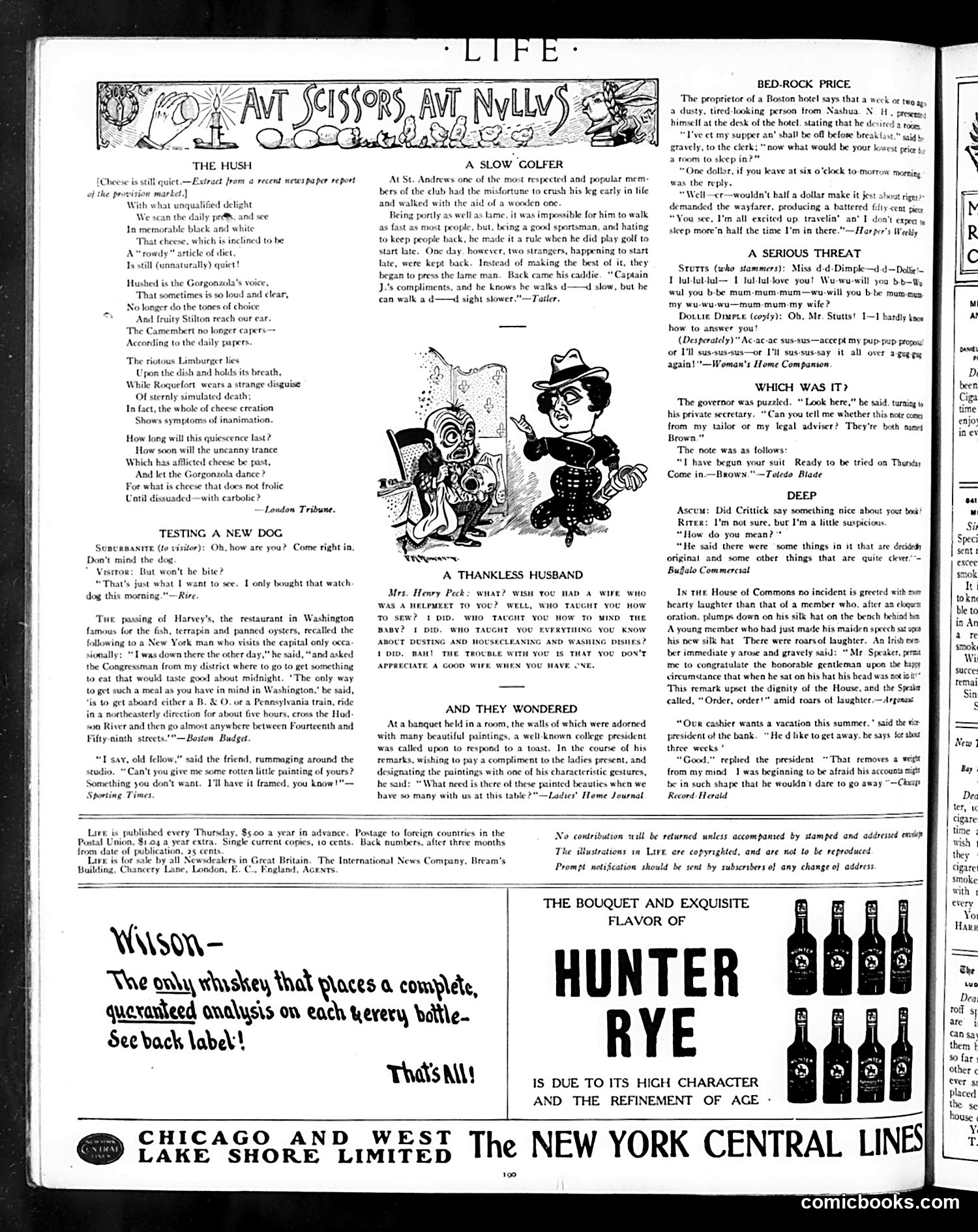
This page contains several satirical pieces typical of early 20th-century American humor journalism: **"The Hush"** is a whimsical poem mocking newspaper reports about an unusually quiet cheese market—poking fun at how newspapers sensationalize mundane commercial news. **"Testing a New Dog"** is a brief joke about a visitor wanting a supposedly vicious dog to test a new watch by having the dog bite it—absurdist humor about watches and dog behavior. **"A Slow Golfer"** describes a disabled club member with a wooden leg who graciously starts late to avoid slowing others, only to have impatient newcomers press him anyway—illustrating the contrast between his courtesy and their rudeness. **"A Thankless Husband"** shows a wife cataloging all domestic skills she taught her husband, frustrated by his ingratitude—commentary on unappreciated women's labor. **"And They Wondered"** presents a college president complimenting live women by dismissing painted portraits of women as unnecessary—satirizing oblivious, backhanded compliments. The advertisements for Hunter Rye whiskey and railroad lines occupy the lower portion.
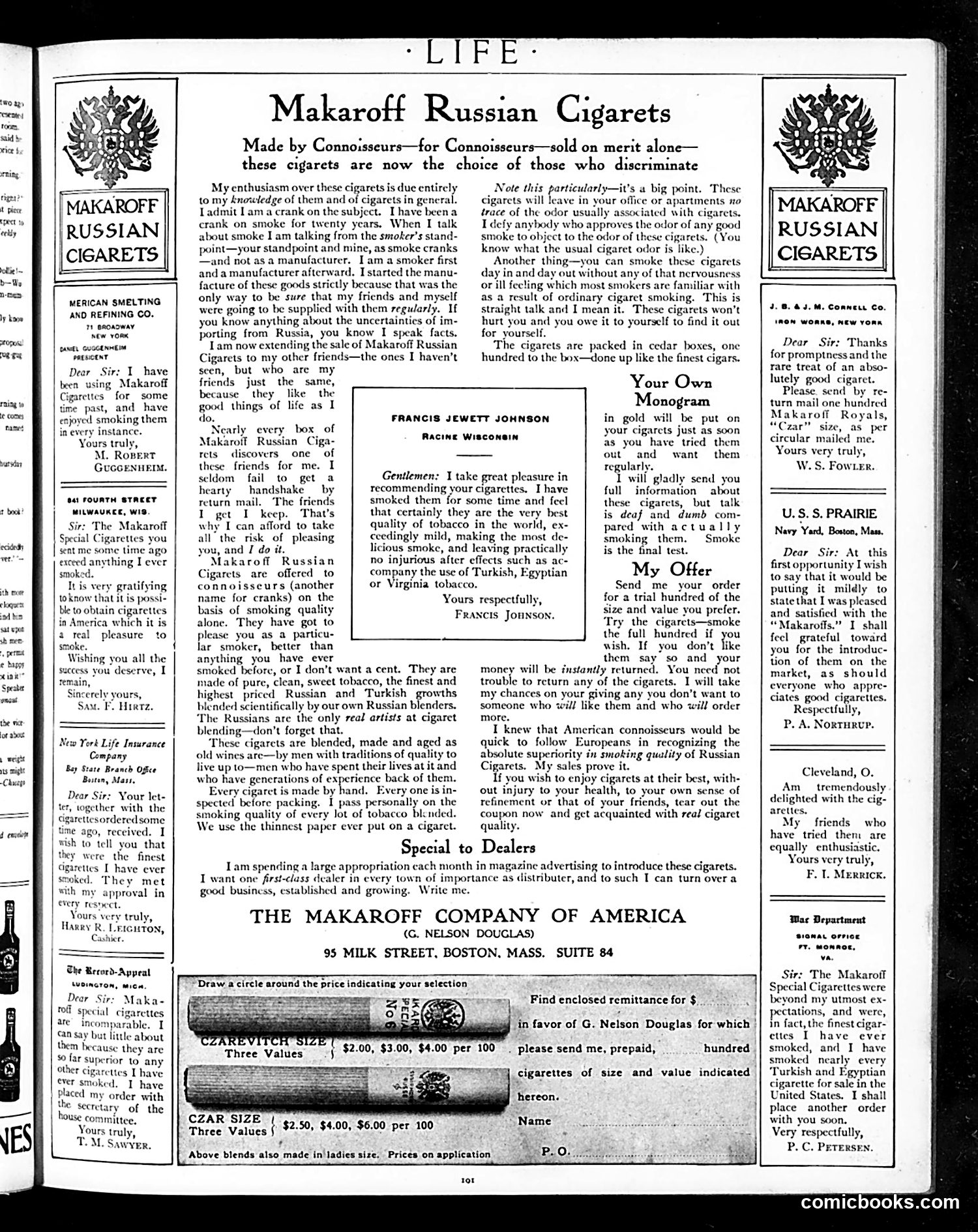
This is primarily a **cigarette advertisement**, not a political cartoon. The page features testimonial letters praising Makaroff Russian Cigarettes, positioned as a premium product for discerning smokers ("connoisseurs"). The appeal is distinctly **class-based**: the product is marketed to educated, refined men who consider themselves "cranks" (enthusiasts) about quality tobacco. Francis Jewett Johnson, apparently the manufacturer, emphasizes that these cigarettes are "sold on merit alone" and made by someone who smokes for pleasure, not profit. Key selling points include: superior quality, mild smoke with no lingering odor, no nervousness or ill effects, and exclusivity (implying only discriminating gentlemen would appreciate them). The numerous testimonial letters from respectable sources (insurance companies, civic institutions) serve to validate the product's quality and appeal to the target demographic's desire for social distinction.
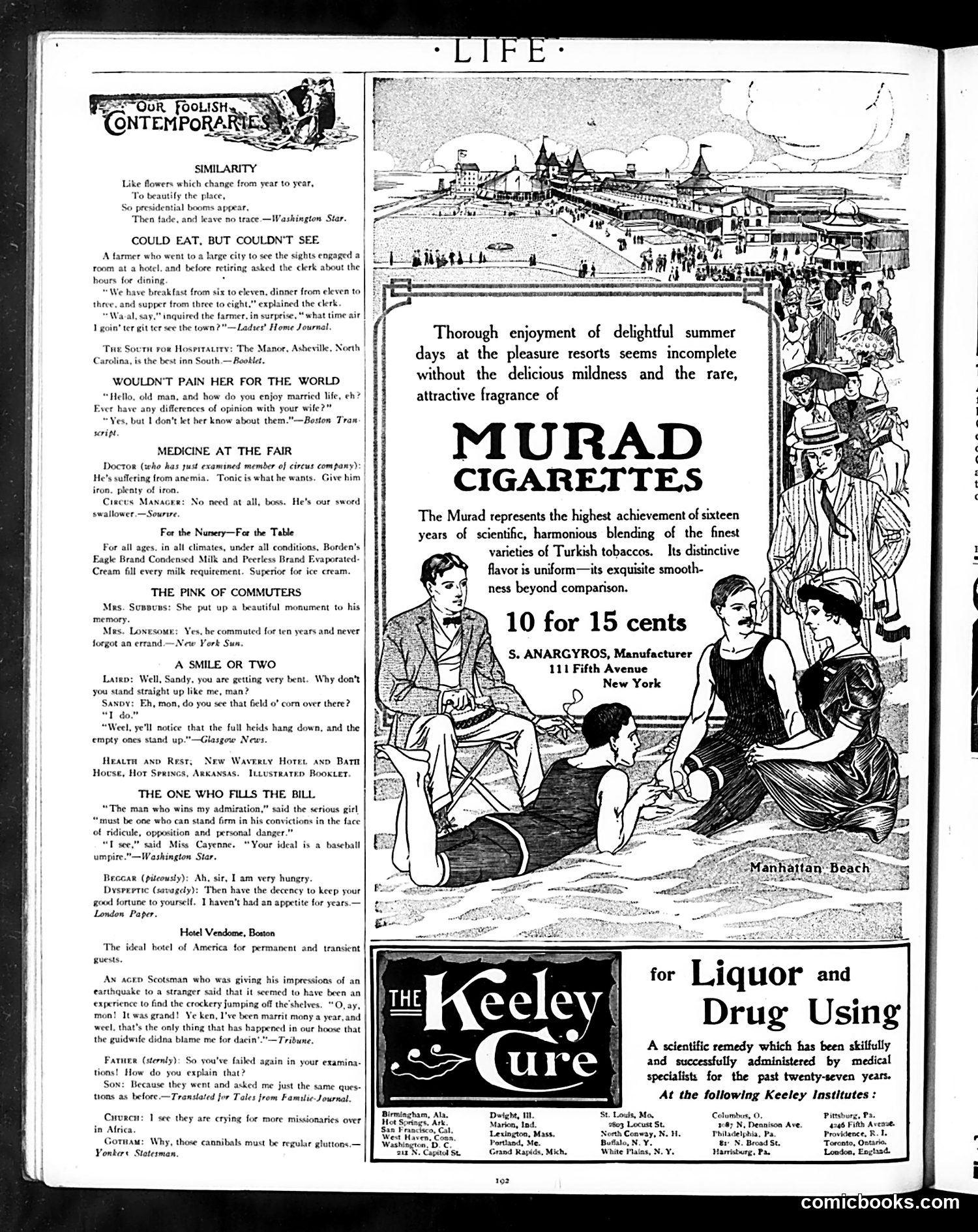
This page from *Life* magazine consists primarily of **humorous short anecdotes** (brief jokes) and **advertisements**, not political cartoons. The humor reflects early 20th-century rural-urban contrasts: a farmer bewildered by city hotel dining schedules; a circus sword-swallower needing no iron supplementation; a bent farmer explaining that only empty corn husks stand upright. These joke at the expense of rural simplicity or working-class logic. The dominant content is **advertising**: Murad Cigarettes (claiming "scientific" Turkish tobacco blending), Borden's condensed milk, and the Keeley Institute (a real treatment center for addiction). The Keeley ad explicitly markets "a scientific remedy" for "Liquor and Drug Using"—reflecting the period's widespread substance-abuse treatment industry. The page illustrates how early 20th-century magazines mixed editorial humor with commercial messaging, while advertising normalized both consumer products and medical interventions we'd now view skeptically.
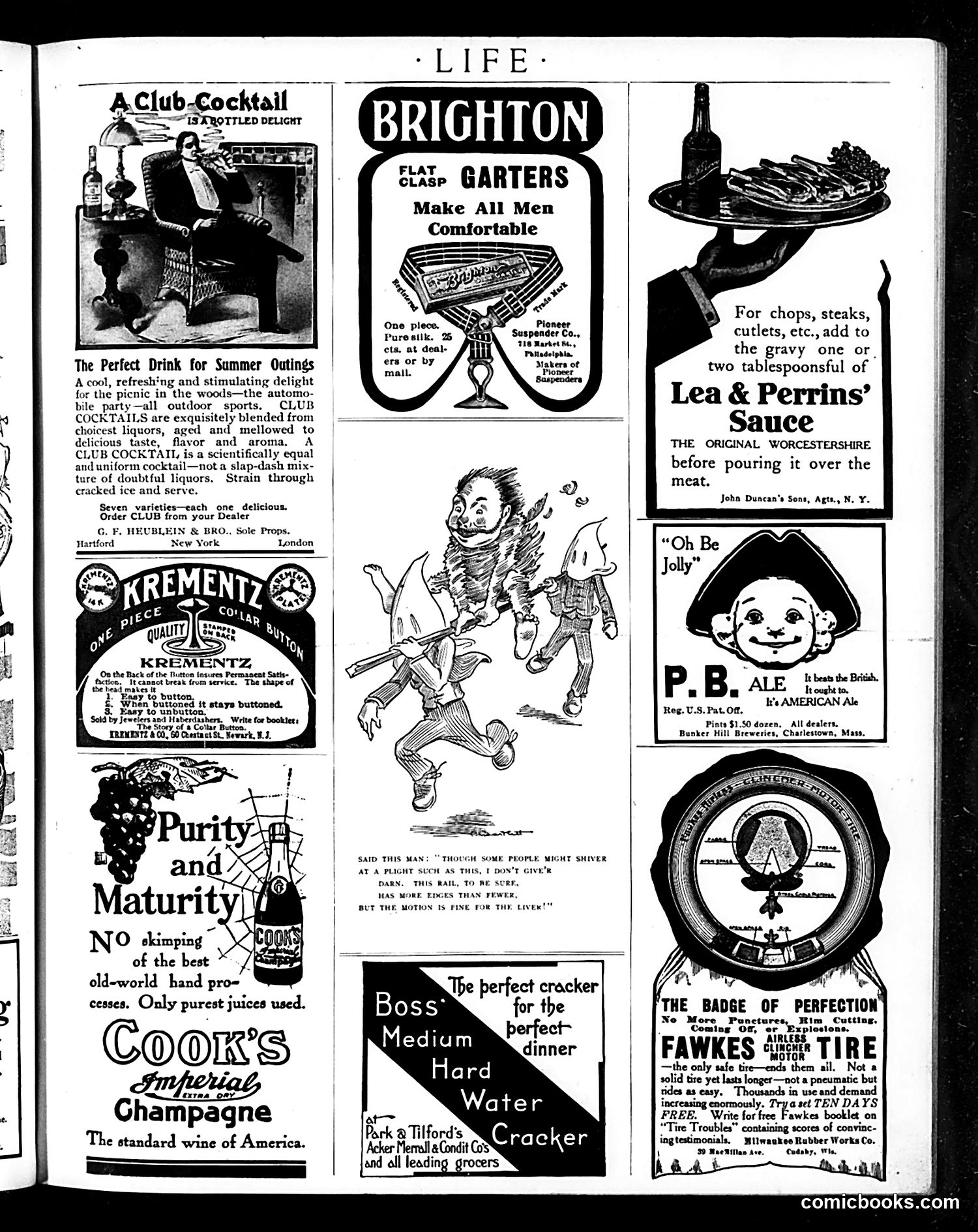
This page is primarily **advertising**, not political satire. It features various commercial products from the early 20th century, with one central cartoon. The main illustration shows a man in military or formal dress, apparently experiencing some physical discomfort or motion sickness, with the caption explaining he doesn't care about the unpleasant sensations because "the motion is fine for the liver." This appears to be a humorous advertisement, likely promoting a product related to digestive health or medicinal properties attributed to motion or vibration—common health claims of that era. The surrounding advertisements promote diverse products: Club Cocktails, Krementz garters and buttons, Lea & Perrins sauce, P.B. Ale, Cook's Champagne, Boss crackers, and Fawkes tires. The cartoon's crude humor about bodily discomfort would have been acceptable for the era's commercial publications. The page reflects early 1900s consumer culture and advertising standards rather than political commentary.
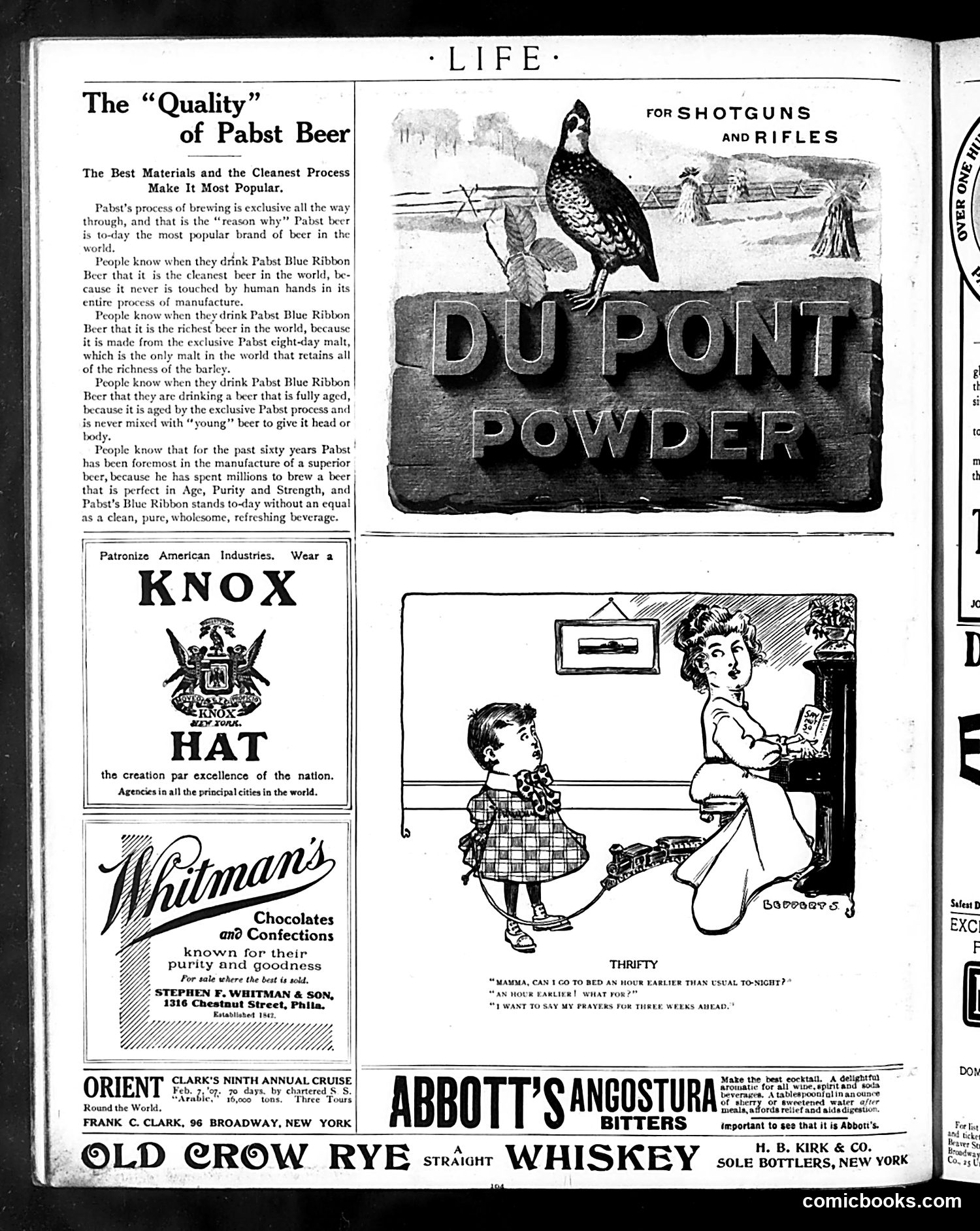
This page is primarily **advertising**, typical of early 20th-century magazines. The dominant cartoon is titled "THRIFTY," depicting a child asking their mother to go to bed an hour early so they can "say prayers for three weeks ahead"—a joke about childhood logic and economizing time through advance planning. The surrounding ads promote various products: Pabst Beer emphasizes its manufacturing purity (notably claiming beer "never is touched by human hands"); Knox Hats; Whitman's Chocolates; Du Pont Powder (for hunting); Abbott's Bitters; Old Crow Whiskey; and Orient cruises. The humor in the cartoon relies on a child's innocent misunderstanding of how prayer works—treating spiritual devotion like a financial investment one can "bank" in advance. It's gentle domestic comedy, not political satire. The ads reflect period consumer culture and manufacturing claims about "purity" and "quality" that modern readers might find quaint or misleading by today's standards.
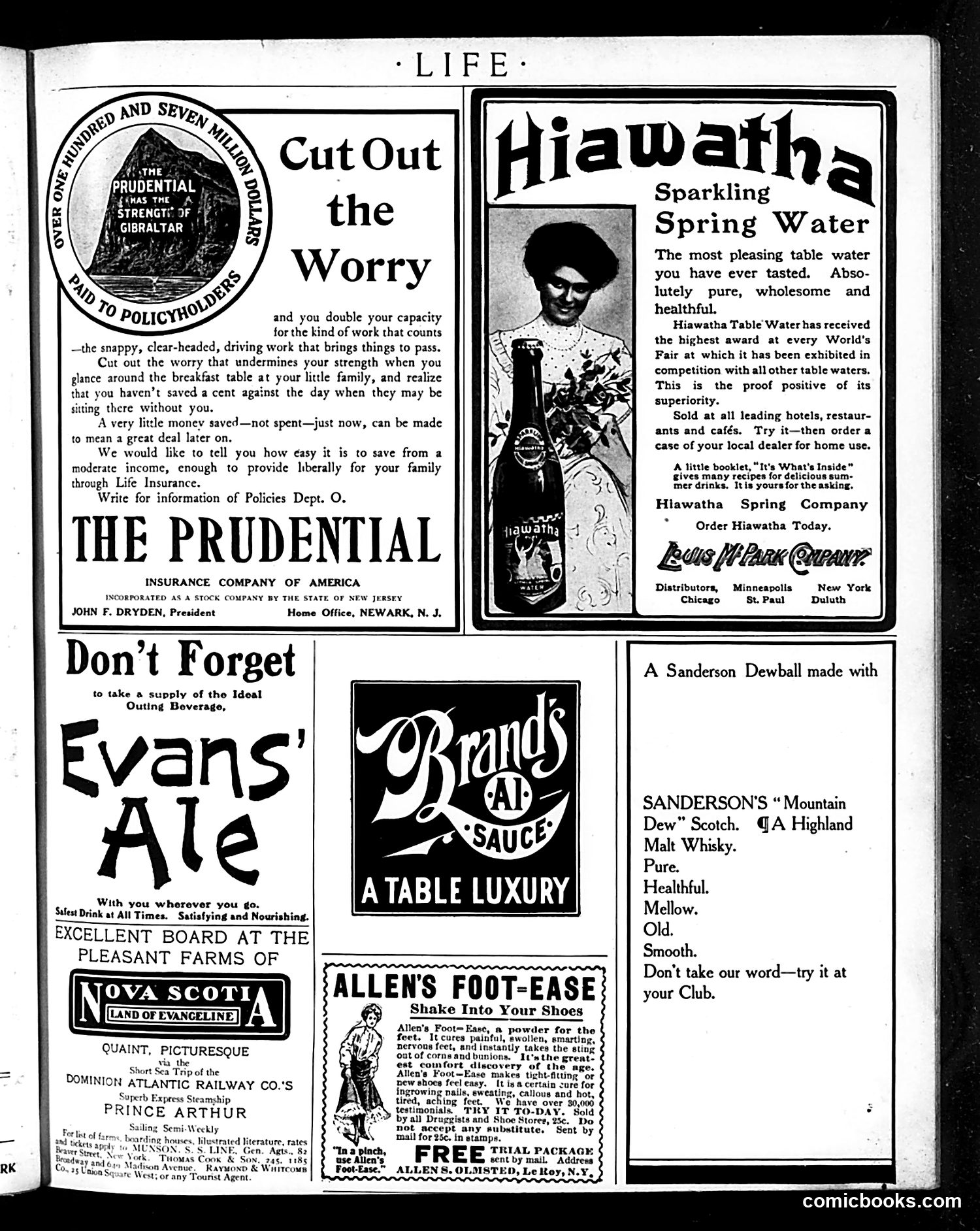
This page is primarily **advertising**, not editorial content or political satire. It contains multiple product advertisements typical of early 20th-century magazines: **Main advertisements:** - **The Prudential Insurance Company**: Promotes life insurance by appealing to family security anxieties—a man should "cut out the worry" and protect his dependents financially - **Hiawatha Spring Water**: Claims superiority through World's Fair awards - **Evans' Ale**: Marketed as a wholesome beverage - **Allen's Foot-Ease**: Patent medicine powder for foot ailments - **Sanderson's "Mountain Dew" Scotch**: Highland whisky - **Nova Scotia tourism**: Travel advertisement The Prudential ad uses emotional manipulation common to insurance marketing of the era—invoking fear about family destitution to drive sales. The other ads emphasize product superiority and health benefits, reflecting pre-FDA standards when such claims faced minimal regulation. **No political satire is present.** This is a straightforward commercial page.
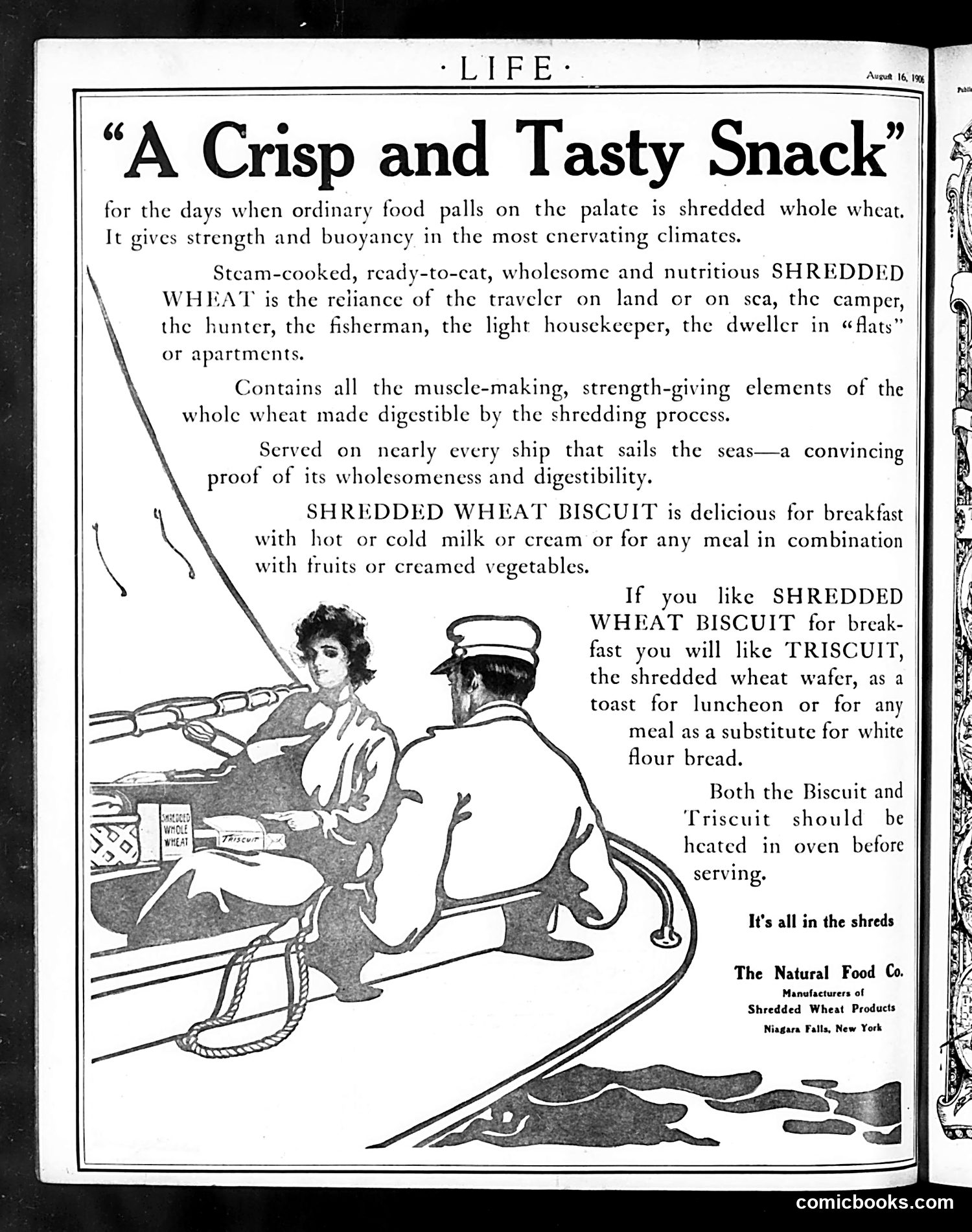
This is a **straightforward advertisement**, not satire. The Natural Food Company promotes Shredded Wheat products in *Life* magazine (dated August 16, 1906, visible in top corner). The illustration depicts a couple on a sailboat sharing a meal—romanticizing the product as essential for travelers, campers, hunters, and seafarers in "enervating climates." The ad claims the steam-cooked wheat provides strength and is served aboard ships, positioning it as proven, reliable nutrition. The text promotes both Shredded Wheat Biscuit (breakfast cereal) and Triscuit (a wheat wafer toast), emphasizing digestibility and versatility as meal substitutes. **No political satire is present.** This reflects early 1900s advertising strategy: associating packaged foods with adventure, health science, and modern convenience—targeting middle-class consumers increasingly buying processed foods rather than cooking from scratch.