
A complete issue · 24 pages · 1906
Life — April 12, 1906
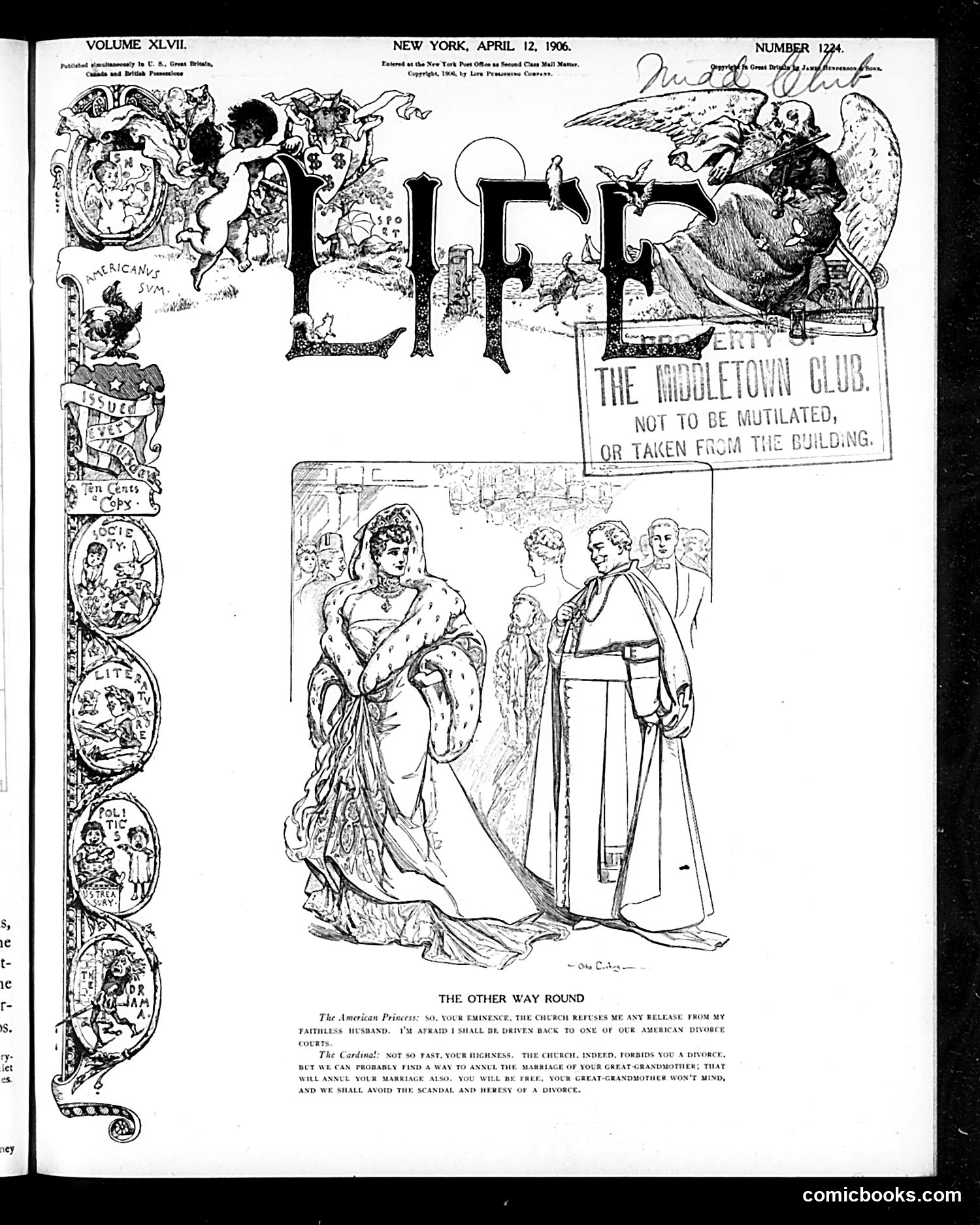
This cartoon satirizes a dispute between the American Princess (representing the U.S.) and the Catholic Church over papal authority in marriage matters. The American Princess seeks a divorce, but the Church (represented by a Cardinal) refuses to annul her marriage to her "faithless husband." The satire's point: the Cardinal proposes an alternative—annulling the great-grandmother's marriage instead, which would retroactively make the current princess illegitimate and thus free her from her own marriage without the Church granting a direct divorce. This reflects early-20th-century tensions between American civil law (permitting divorce) and Catholic doctrine (forbidding it), satirizing the Church's rigid legalism as absurdly circular reasoning to avoid directly endorsing divorce while still achieving the same outcome.
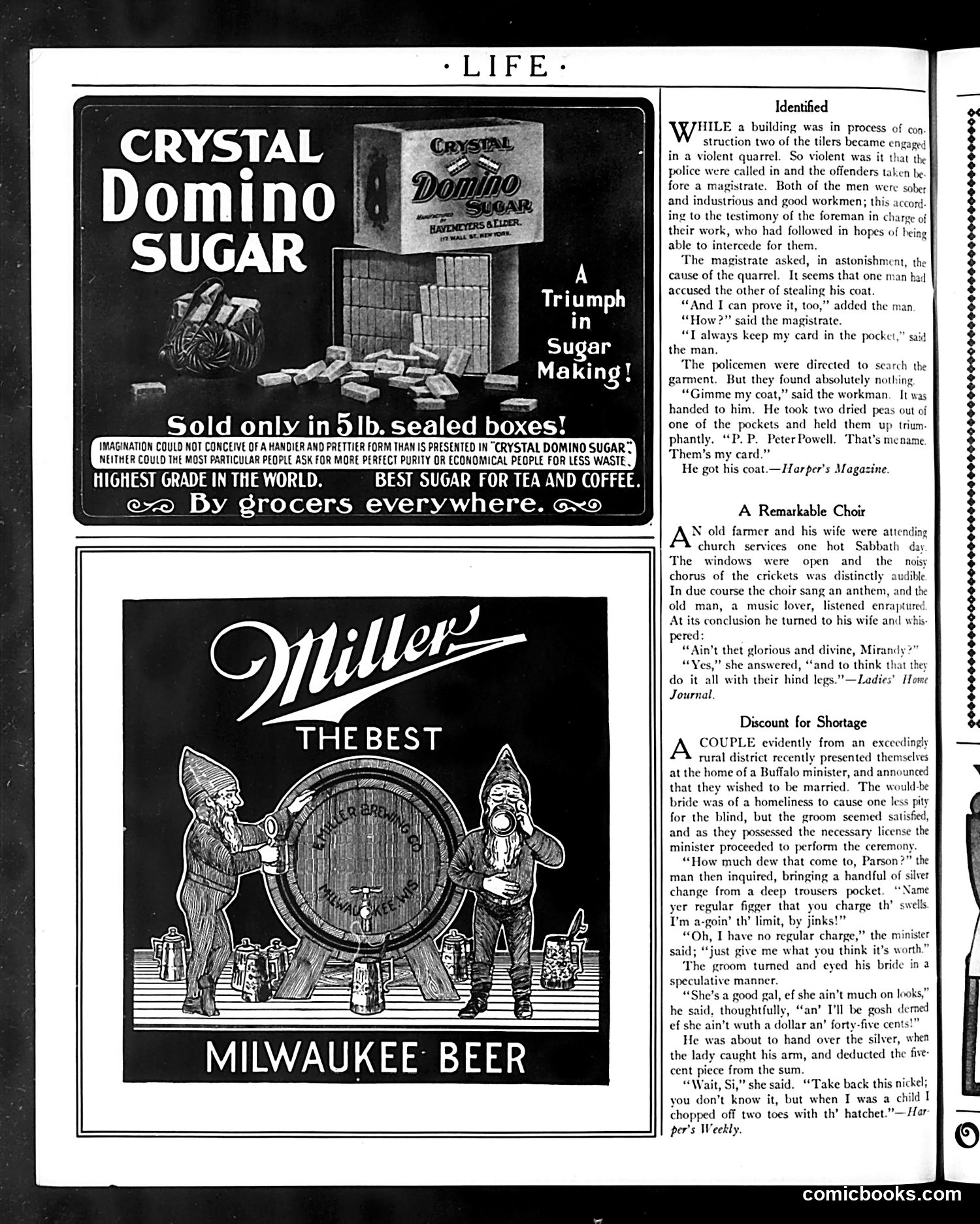
This page is **primarily advertising** with three unrelated commercial ads: Crystal Domino Sugar, Diller's Milwaukee Beer, and brief humorous anecdotes in the right column. The ads contain no political satire. The Crystal Domino Sugar ad emphasizes purity and economy for home sugar-making. The Milwaukee Beer ad features two gnome-like figures flanking a barrel—likely generic "Old World" imagery meant to suggest traditional brewing heritage, common in beer advertising of this era. The right column includes three brief humor pieces: one about workers accused of theft (resolved by finding a lost coat), another about crickets in church, and a third about a couple negotiating marriage finances—all light domestic comedy typical of *Life* magazine's humor section. None reference specific political events or figures.
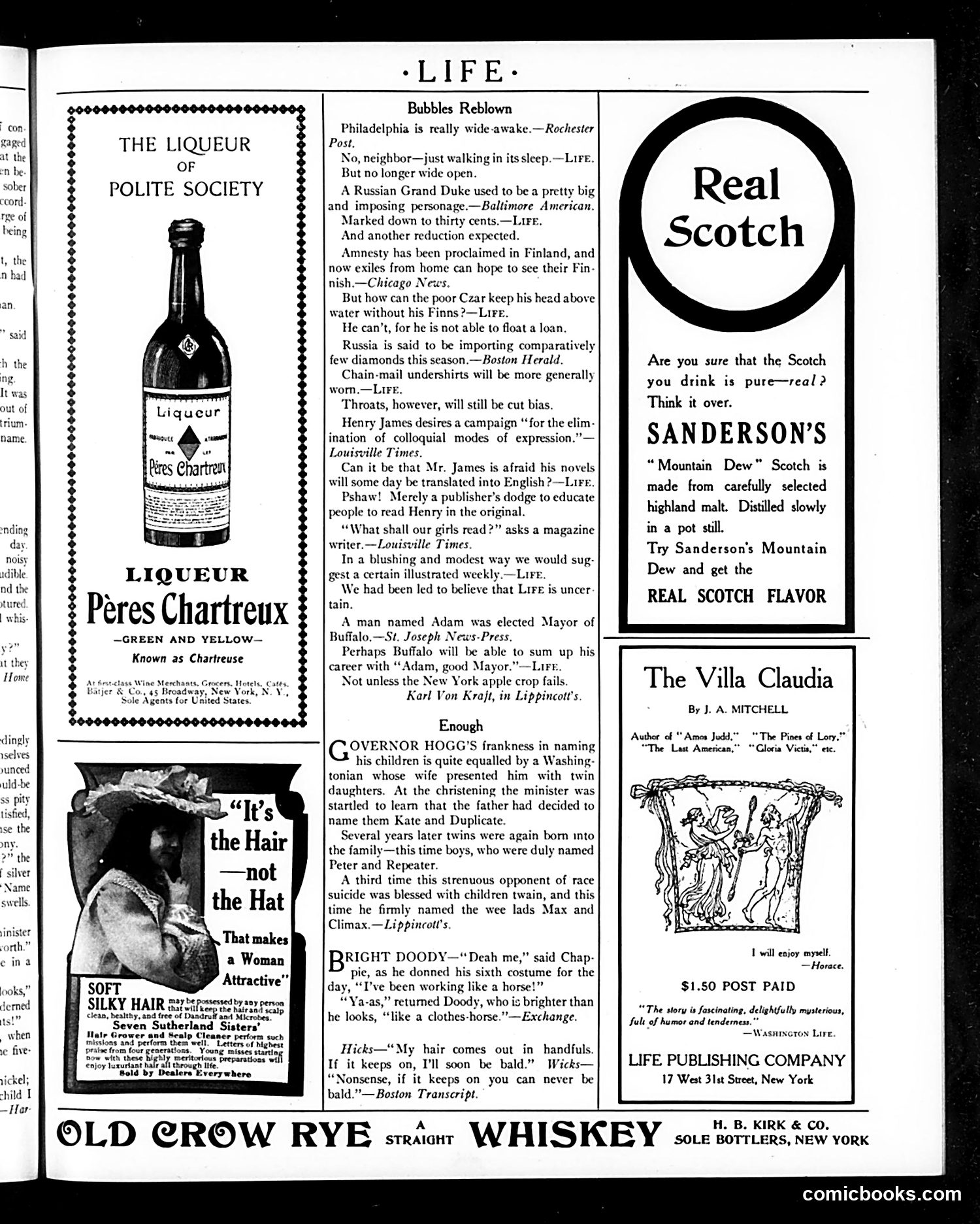
This page is primarily **advertising and light humor** rather than political satire. The advertisements promote liqueurs, scotch whisky, hair products, and a serialized story. The humor section contains brief jokes about contemporary topics: Philadelphia's width, Russian exiles, the Czar, Henry James translations, and naming children. One joke references Governor Hogg naming his children "Kate" and "Duplicate"—apparently a real historical anecdote about unusual naming practices. The "Bright Doody" section jokes about hair loss and baldness using period slang. The page reflects early 20th-century magazine format: mixing commercial advertisements with short satirical commentary on current events, literary trends, and social oddities. There are **no identifiable political cartoons or caricatures** of specific figures—just general social observation and wordplay typical of Life's humor column.
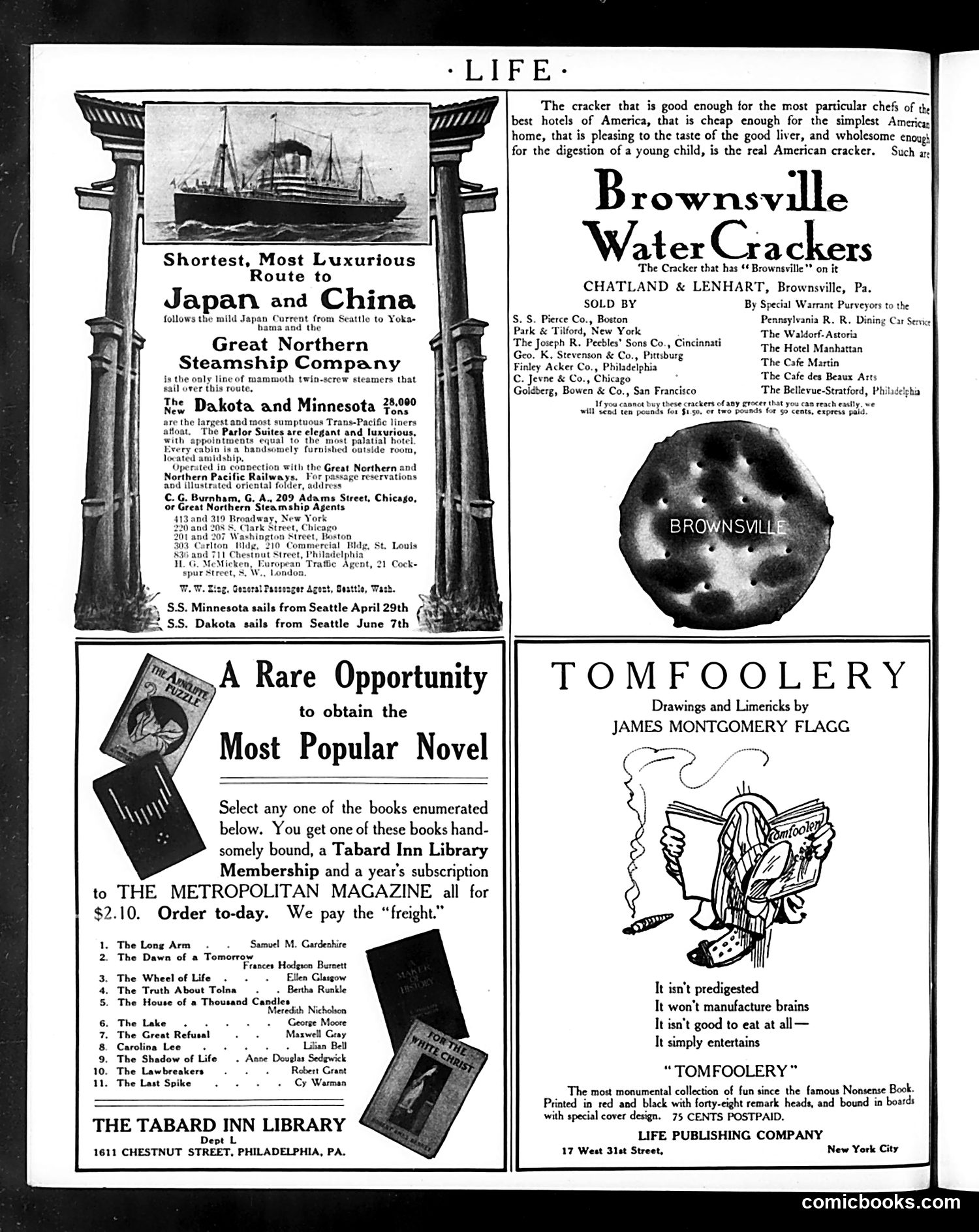
This page is **primarily advertising** rather than satirical content. It contains four distinct ads: 1. **Great Northern Steamship Company** - advertising luxury trans-Pacific liners to Japan and China, featuring the S.S. Dakota and S.S. Minnesota 2. **Brownsville Water Crackers** - a food product advertisement highlighting its suitability for hotels, homes, and children's digestion 3. **Tabard Inn Library** - offering a book club membership bundle with a year's subscription to *The Metropolitan Magazine* for $2.10, listing eleven popular novels 4. **Tomfoolery** - promoting a humorous book of drawings and limericks by James Montgomery Flagg There are **no political cartoons or satirical commentary** visible on this page. It represents typical early 20th-century magazine advertising and product promotions.
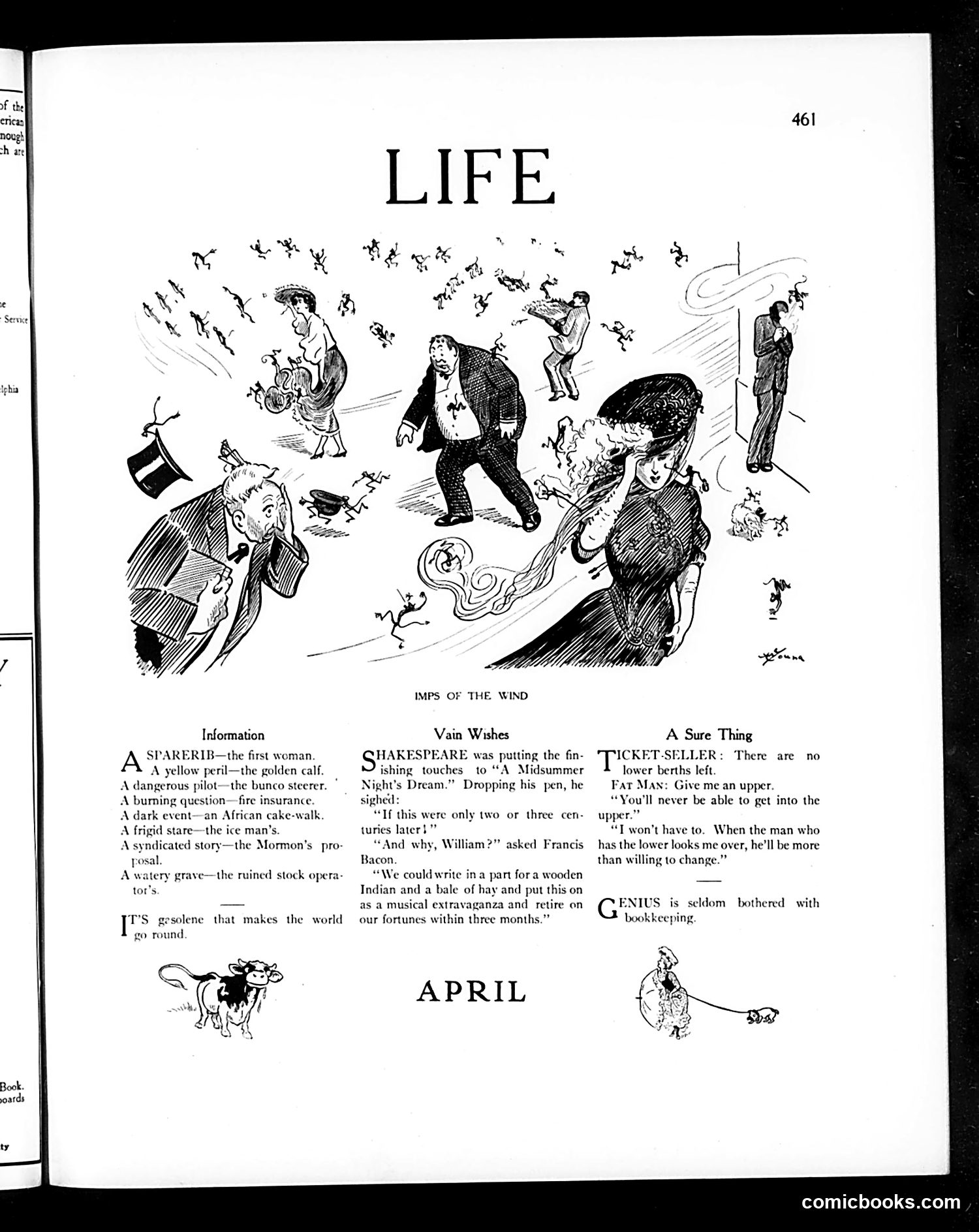
The main illustration, titled "Imps of the Wind," depicts chaos among well-dressed men and a woman as wind scatters their belongings—hats, papers, and dignity. This appears to be a general satirical commentary on life's unpredictability rather than a specific political reference. The text below offers brief humorous definitions and anecdotes, including references to Shakespeare's "A Midsummer Night's Dream" and commentary on various social situations. "A Sure Thing" jokes about class dynamics between a ticket-seller and a customer regarding social status. The humor relies on wordplay, irony, and observational comedy about everyday life—typical of Life magazine's satirical style during this period. Without dating information visible, the specific historical context remains unclear.
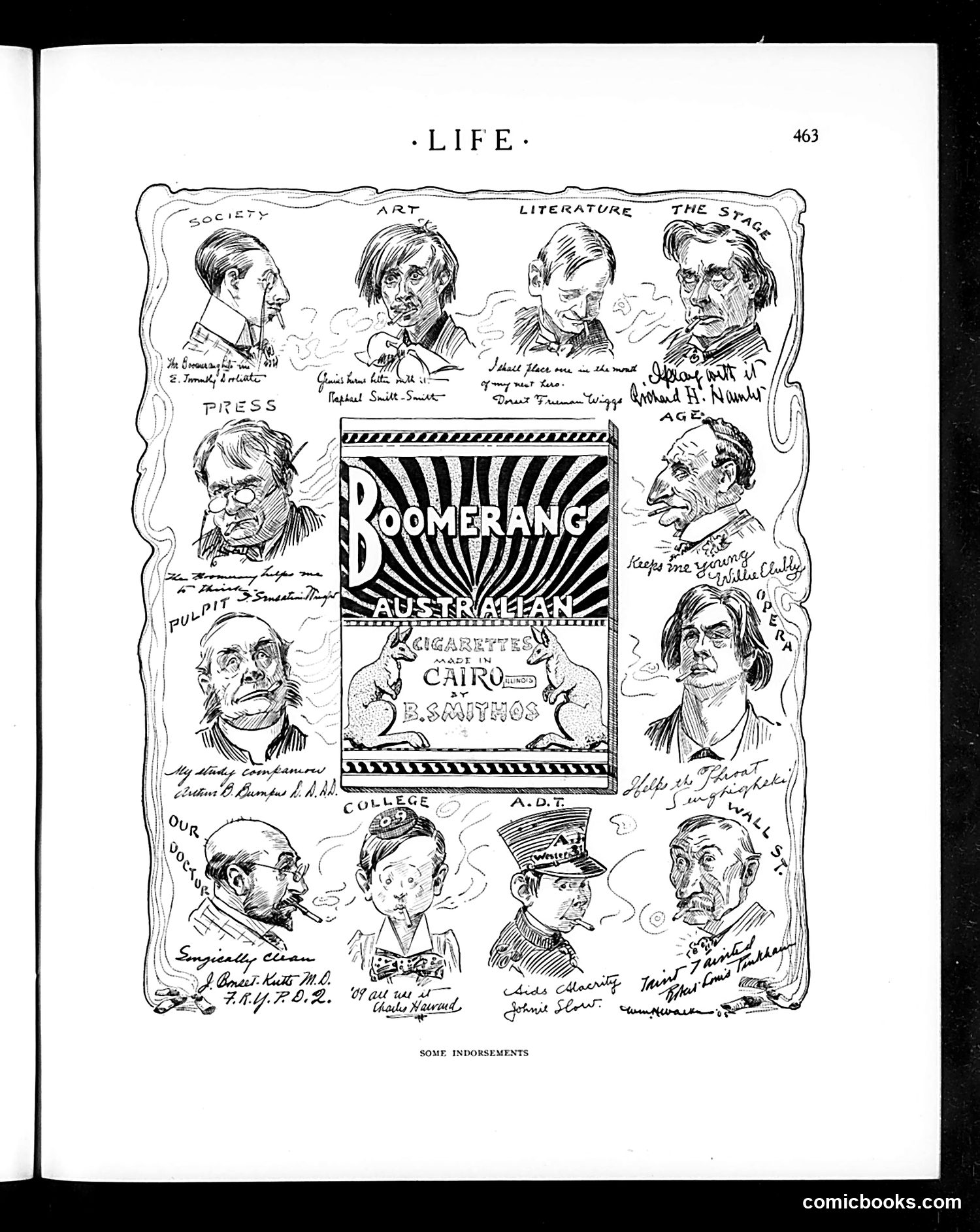
This page satirizes "Boomerang," an Australian cigarette brand, by surrounding its advertisement with caricatured endorsements from prominent figures across various sectors—Society, Art, Literature, The Stage, Press, Public, College, and A.D.T. (likely American District Telegraph). The joke appears to be that these distinguished individuals (identifiable by their handwritten signatures and labeled professions) are humorously endorsing cigarettes, despite their respectable positions. The satirical point is likely mocking both the absurdity of using prestigious names to market tobacco and the willingness of notable people to lend credibility to commercial products. The hand-drawn caricatures and handwritten notes create an authentic-looking but clearly tongue-in-cheek endorsement campaign, typical of Life's approach to advertising satire.
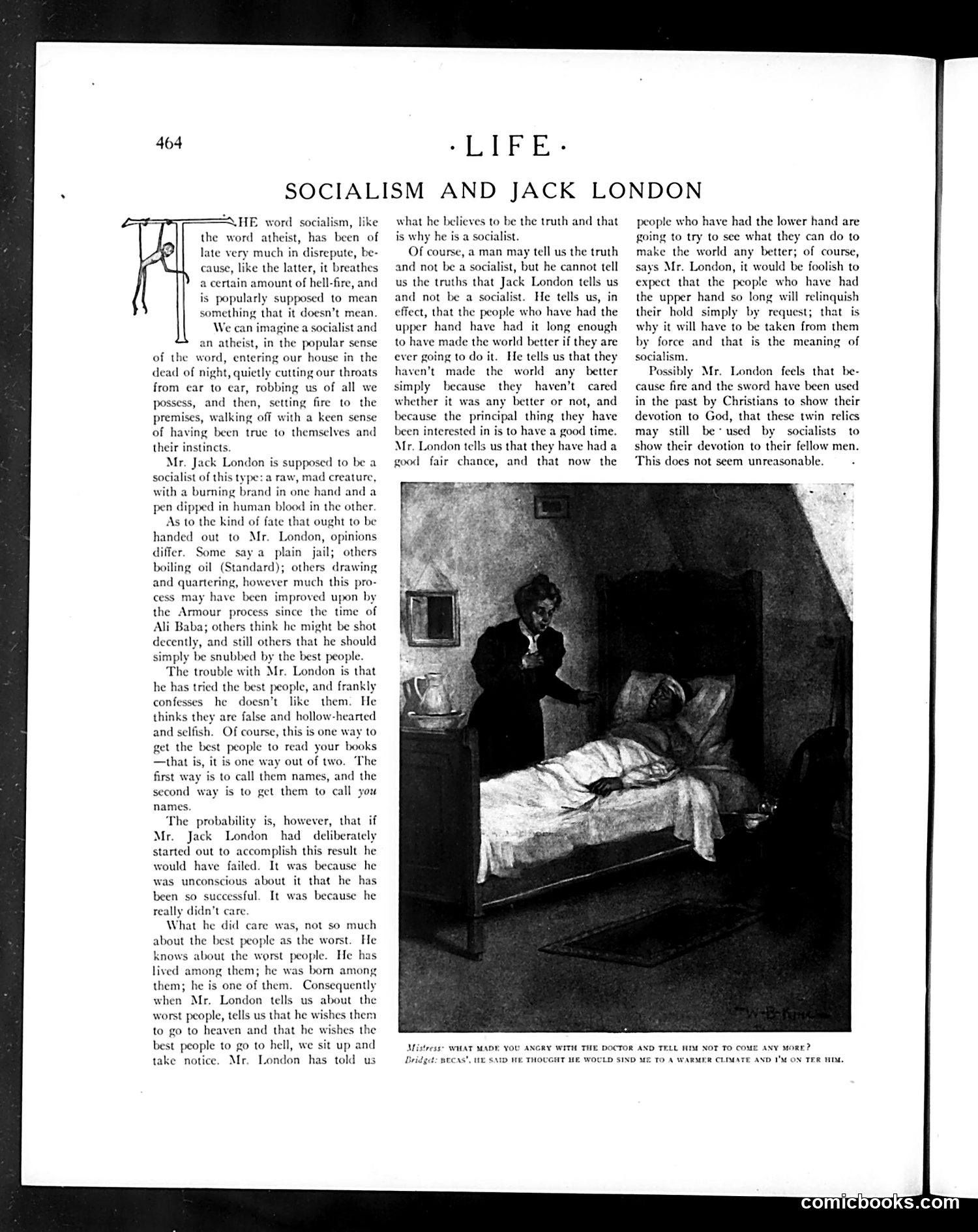
This page critiques writer **Jack London** as a socialist whose views are contradictory and elitist. The text argues that London claims to champion the poor and working class, yet actually despises ordinary people, calling them "false and hollow-hearted and selfish." The author notes London's hypocrisy: he was born among the working poor yet rejects them, wishing them to "go to heaven" while wanting the "best people" in hell. The accompanying photograph shows a man (presumably London) leaning over a bedridden patient, illustrating the text's discussion of his character and beliefs. The satire's point: London uses socialist rhetoric while embodying aristocratic contempt for the masses—a fundamental contradiction the magazine finds worthy of ridicule.
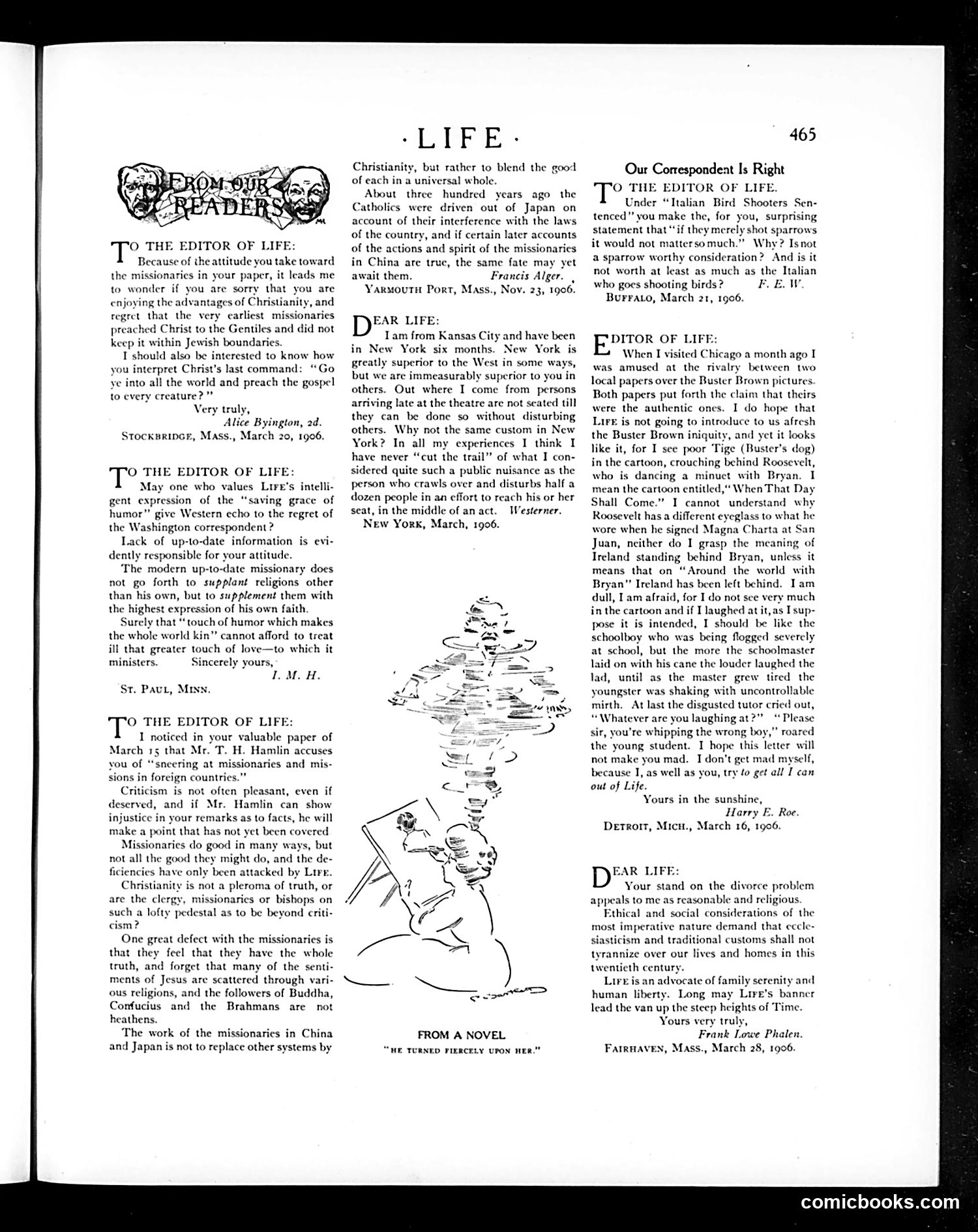
This page consists entirely of readers' letters to the editor, with one illustration captioned "FROM A NOVEL" and subtitled "HE TURNED FIERCELY UPON HER." The illustration depicts a man aggressively confronting a woman—likely satirizing melodramatic Victorian or early 20th-century novel tropes. The exaggerated body language and dramatic pose mock overwrought romantic fiction conventions popular at the time. The letters themselves address serious topics: missionary work in China and Japan, theater etiquette in New York, newspaper rivalry, and divorce. The page reflects *Life's* role as a forum for reader commentary on contemporary social issues and cultural disputes, rather than purely satirical political content.
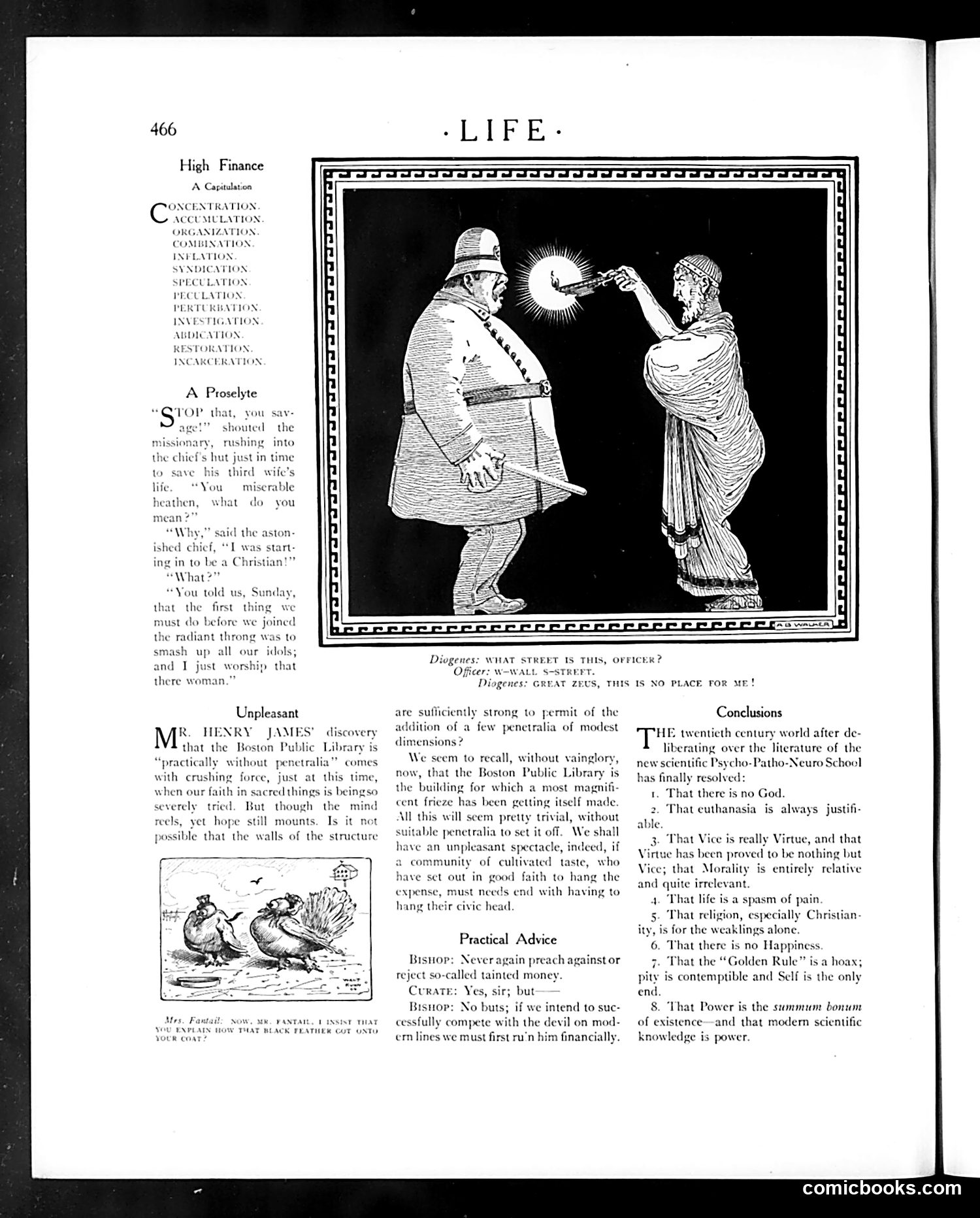
The main cartoon depicts two figures: a military officer (wearing a helmet and uniform) confronting what appears to be a woman in classical draped clothing holding a torch—likely representing Liberty or civic virtue. The officer asks "What street is this, officer?" and responds "U-Wall Street. Great Zeus, this is no place for me!" The satire criticizes military involvement in financial matters. The juxtaposition of military authority with Wall Street symbolism suggests tension between military and commercial interests. The classical female figure represents idealized civic values being threatened or compromised by financial/military concerns. The accompanying text sections ("Unpleasant," "Practical Advice," and "Conclusions") appear to discuss religious skepticism and modern philosophy, though these seem separate from the cartoon's primary message about military-financial conflicts.
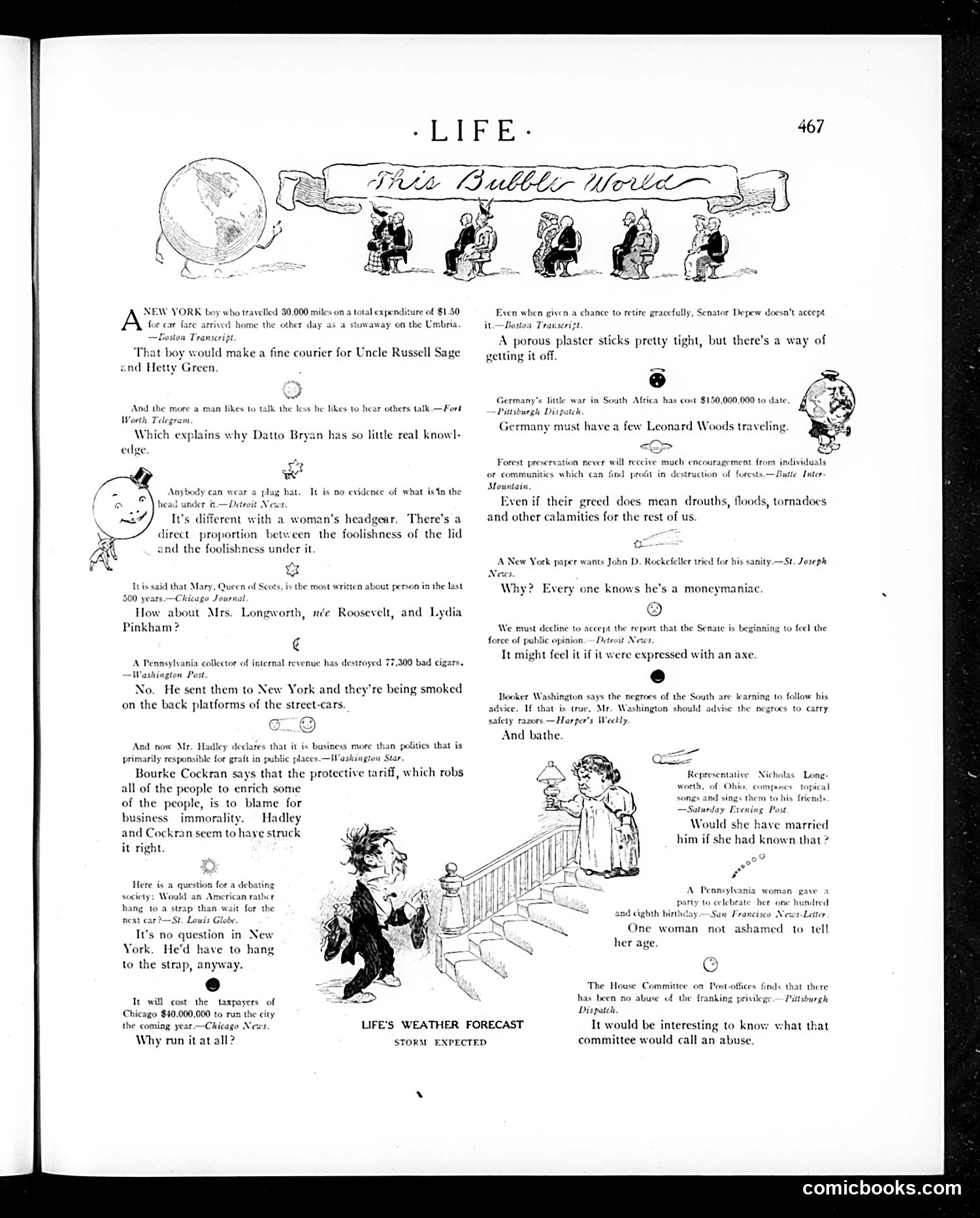
This Life magazine page (p. 467) contains satirical commentary on early 20th-century American politics and society. The banner cartoon "This Bubble Would" depicts five figures seated in a row—likely politicians or public figures—suggesting their ideas or policies are as insubstantial as bubbles. The text snippets mock various targets: a New York boy's expensive travel, Senator Depew's reluctance to retire, Datto Bryan's ignorance, protective tariffs, Leonard Woods's moneymania, and Senate complacency. A recurring theme criticizes wealthy elites and their self-serving policies. One cartoon shows a woman on stairs addressing a child, accompanied by commentary from Representative Nicholas Long about marriage—satirizing both gender relations and political figures' personal lives. The overall tone targets corruption, greed, and hypocrisy among the powerful.
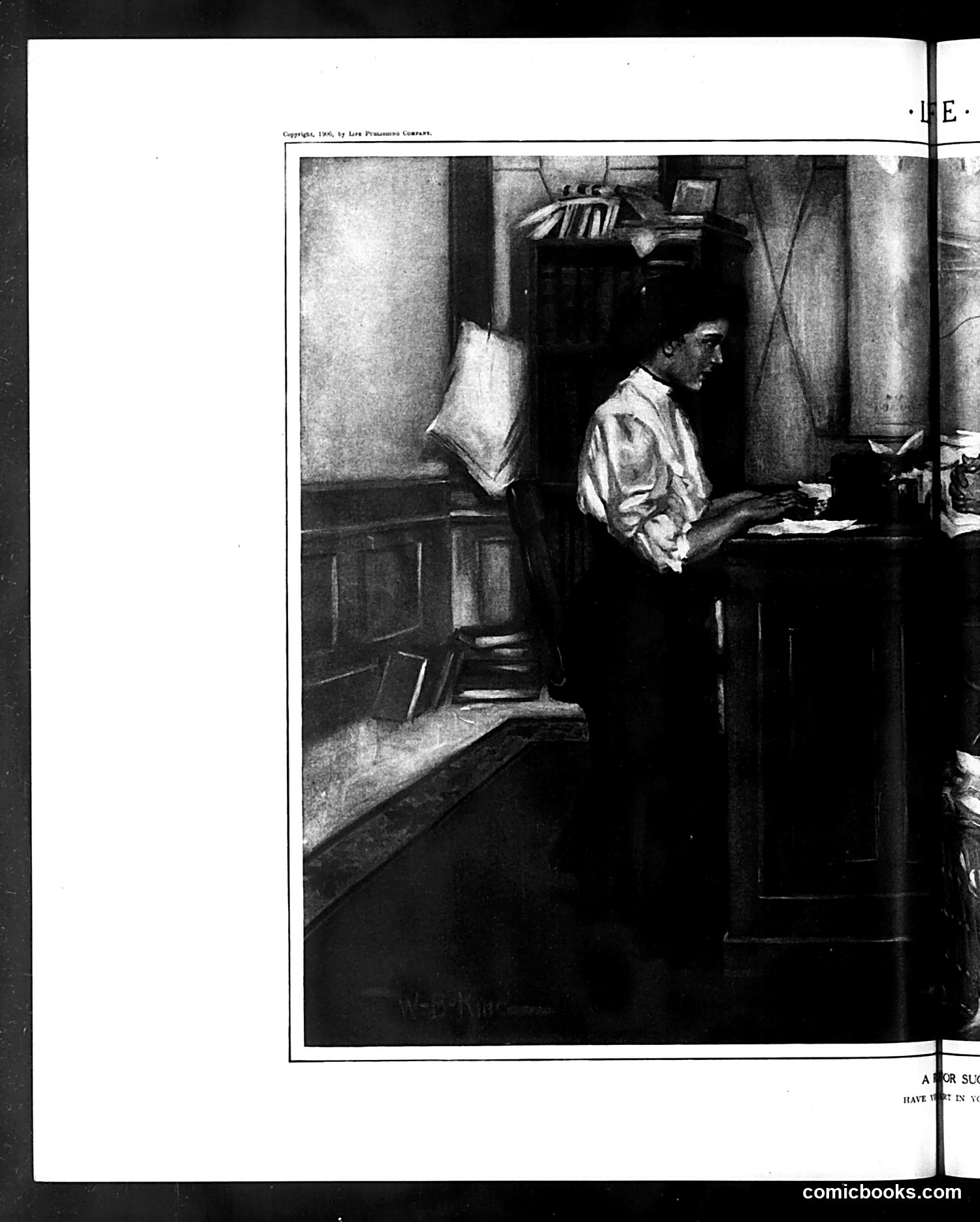
This black and white photograph shows a person in period clothing (white shirt, dark vest) sitting at a desk or counter in what appears to be an interior space. The image quality and style suggest early-to-mid 20th century. However, I cannot confidently identify the specific figures, political references, or satirical intent from this image alone. The OCR text provided is incomplete or illegible, containing only fragmentary phrases ("AFTER SU" and "HAVE [?] IN Y[?]") that don't convey the cartoon's meaning or context. Without clearer text or caption information, I cannot accurately explain what this page satirizes or whom it depicts. To provide a responsible historical interpretation, I would need more legible source material identifying the subject matter and publication context.
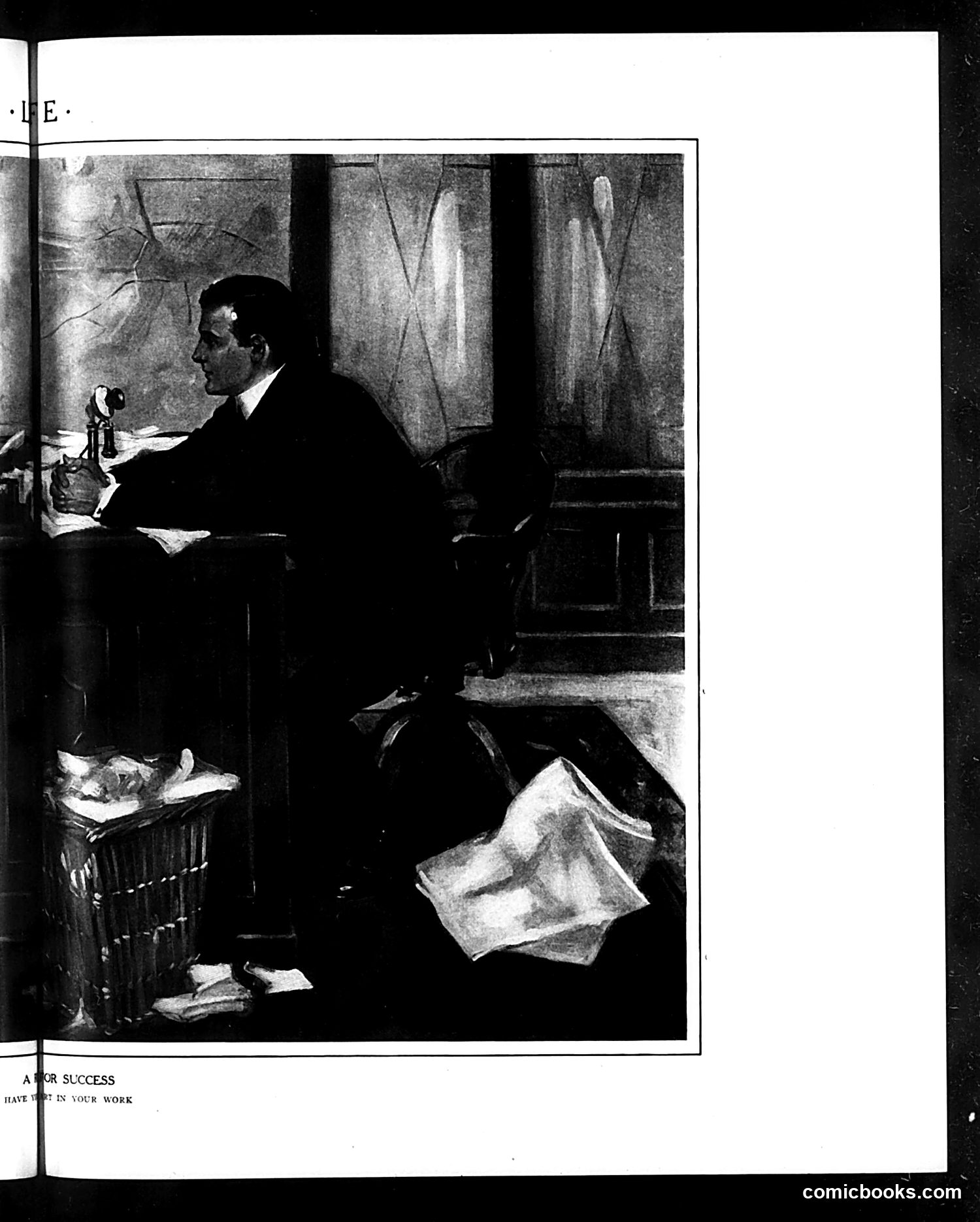
This appears to be a page from *Life* magazine showing a satirical scene of a man in formal business attire (dark suit) sitting at a desk, surrounded by scattered papers on the floor. The visible text reads "A FOR SUCCESS" and "HAVE FEET IN YOUR WORK" (partially visible). The satire likely mocks the chaos and disorganization of ambitious businessmen or office workers, despite pretensions of professional success. The scattered papers and the man's focused posture suggest ironic commentary on whether hard work actually produces orderly results or organized thinking. The phrase about having "feet in your work" appears to be a pun or play on a common phrase about dedication to one's labor, here illustrated literally with papers beneath and around the figure's workspace. The cartoon critiques workplace aspirations or business culture more broadly.
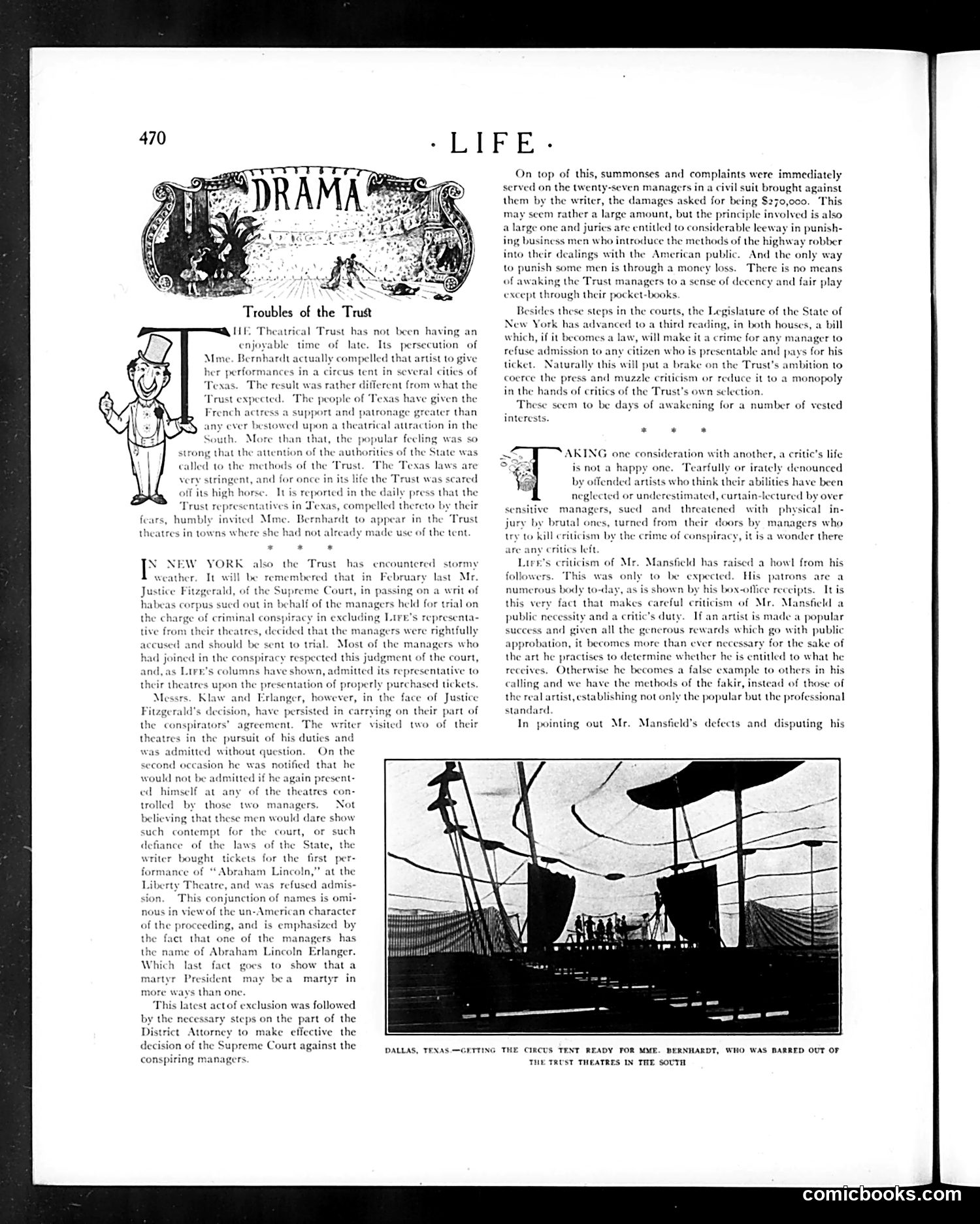
This page satirizes the **Theatrical Trust** (a monopoly controlling major American theaters), focusing on their conflicts with performers and press critics. The cartoon depicts a well-dressed figure representing the Trust being confronted—likely illustrating its persecution of actress **Sarah Bernhardt**, who was forced to perform in a circus tent when Trust theaters refused her admission. Texas audiences' strong support for Bernhardt embarrassed the Trust into backing down. The text describes legal battles in New York where **Justice Fitzgerald's court** ruled the Trust's conspiracy to exclude Life magazine's theater critic violated law. Managers **Klaw and Erlanger** defied this ruling by refusing the critic admission to their theaters—particularly the Liberty Theatre's production of "Abraham Lincoln." The satire's sharp point: the article notes one manager shares the name **Abraham Lincoln Erlanger**, sardonically observing that "a martyr President may be a martyr in more ways than one"—comparing the Trust's antidemocratic practices to tyranny. The author filed a $270,000 lawsuit and New York legislature proposed making theater discrimination a crime.
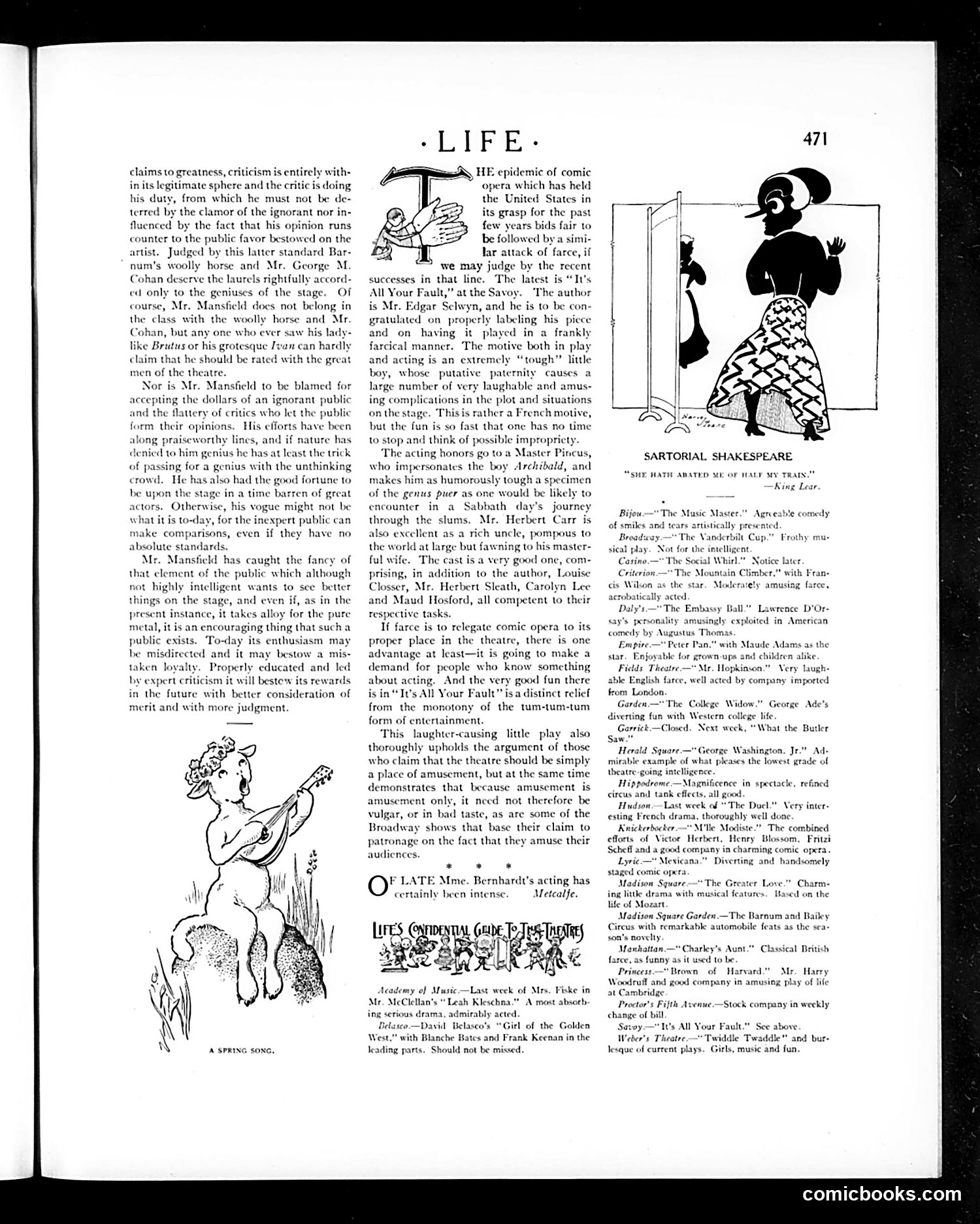
This page critiques contemporary theater, particularly attacking actor Richard Mansfield while praising the farce "It's All Your Fault" at the Savoy Theatre. **Upper section**: A harsh review dismisses Mansfield as overrated, claiming he benefits from performing in an era lacking truly great actors. The critic argues the public's enthusiasm for him is "misdirected" but potentially educable through proper criticism. **Lower section**: A favorable review of Edgar Selwyn's farce featuring child actor Master Pincus as a mischievous boy named Archibald. The critic celebrates farce as superior entertainment to the then-epidemic of comic opera, arguing it demands genuine acting talent rather than just musical performance. The cartoons appear to illustrate theatrical absurdity—one showing a figure with exaggerated facial features, another depicting a rotund cherub-like character. The overall message: legitimate theater criticism should uphold artistic standards against public ignorance, and farce offers better theatrical substance than fashionable comic opera.
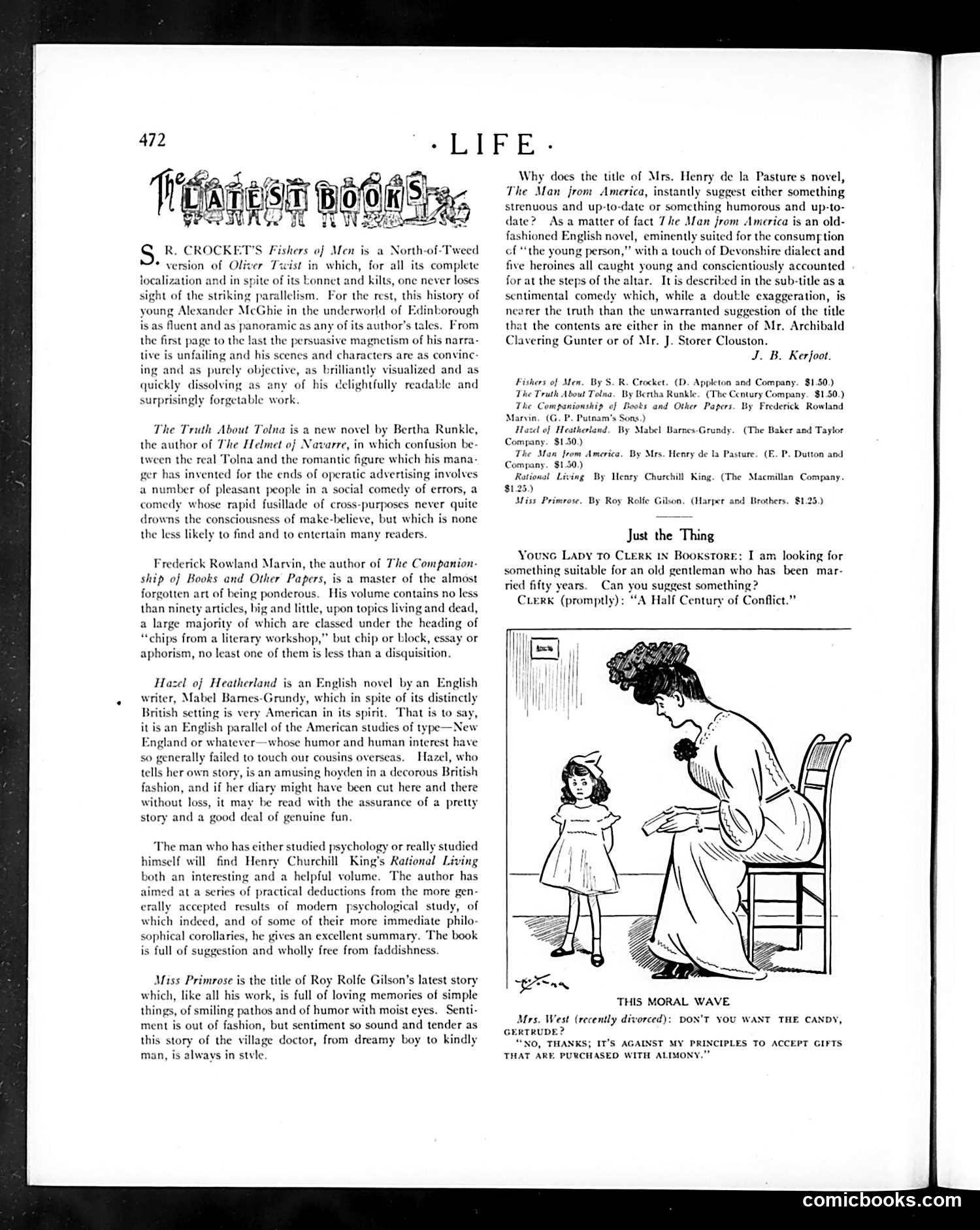
This page from *Life* magazine (page 472) is primarily a **book review section**, not a political cartoon. The main content consists of brief critical reviews of contemporary novels, including works by S.R. Crockett, Bertha Runkle, and Mabel Barnes-Grundy. The only illustration is titled **"This Moral Wave,"** a social satire cartoon depicting a recently divorced woman (Mrs. West) offering candy to a young girl. The joke mocks contemporary moral hypocrisy: the divorced woman refuses the candy on principle, claiming it was "purchased with alimony"—suggesting she's morally superior despite her marital failure. The satire targets **early 20th-century social pretension**, where people maintained strict public morality while engaging in questionable behavior. The "moral wave" referenced is likely the era's reform movements and their selective application of ethics.
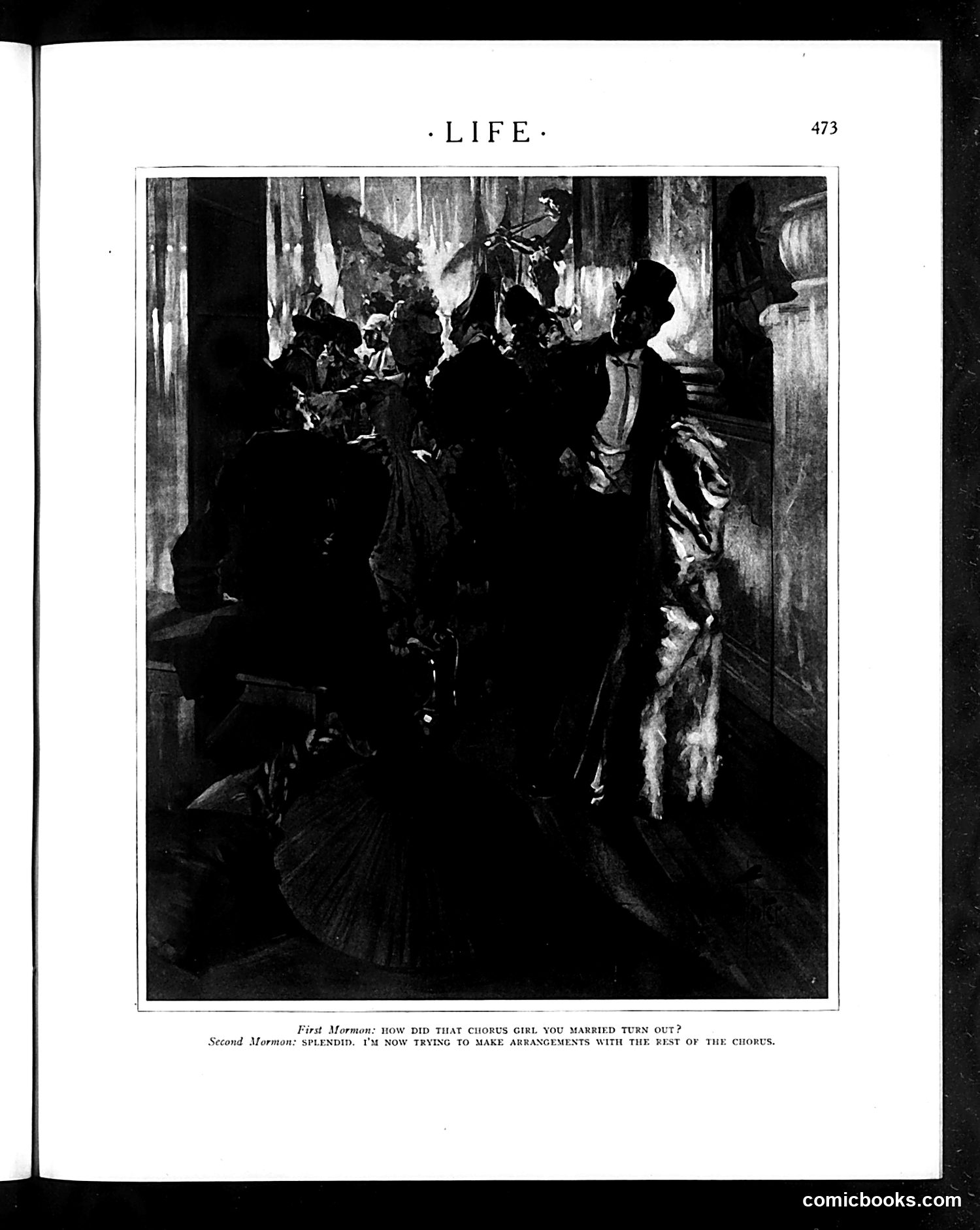
This is a satirical cartoon about Mormon polygamy. Two men in period dress converse in what appears to be a theatrical or social setting filled with women in the background. The joke turns on the phrase "chorus girl"—the first Mormon asks about a woman his friend married from a theater chorus. The second Mormon responds that she's "splendid" and he's now arranging marriages with "the rest of the chorus," treating the entire group of performers as potential wives. The satire mocks both theatrical culture (chorus girls as commodities) and Mormon polygamous practices, presenting them as absurdly compatible. The crowded interior setting reinforces the joke's implication of arranging multiple marriages. This reflects 19th-century American anti-Mormon sentiment that portrayed polygamy as scandalous and ridiculous.
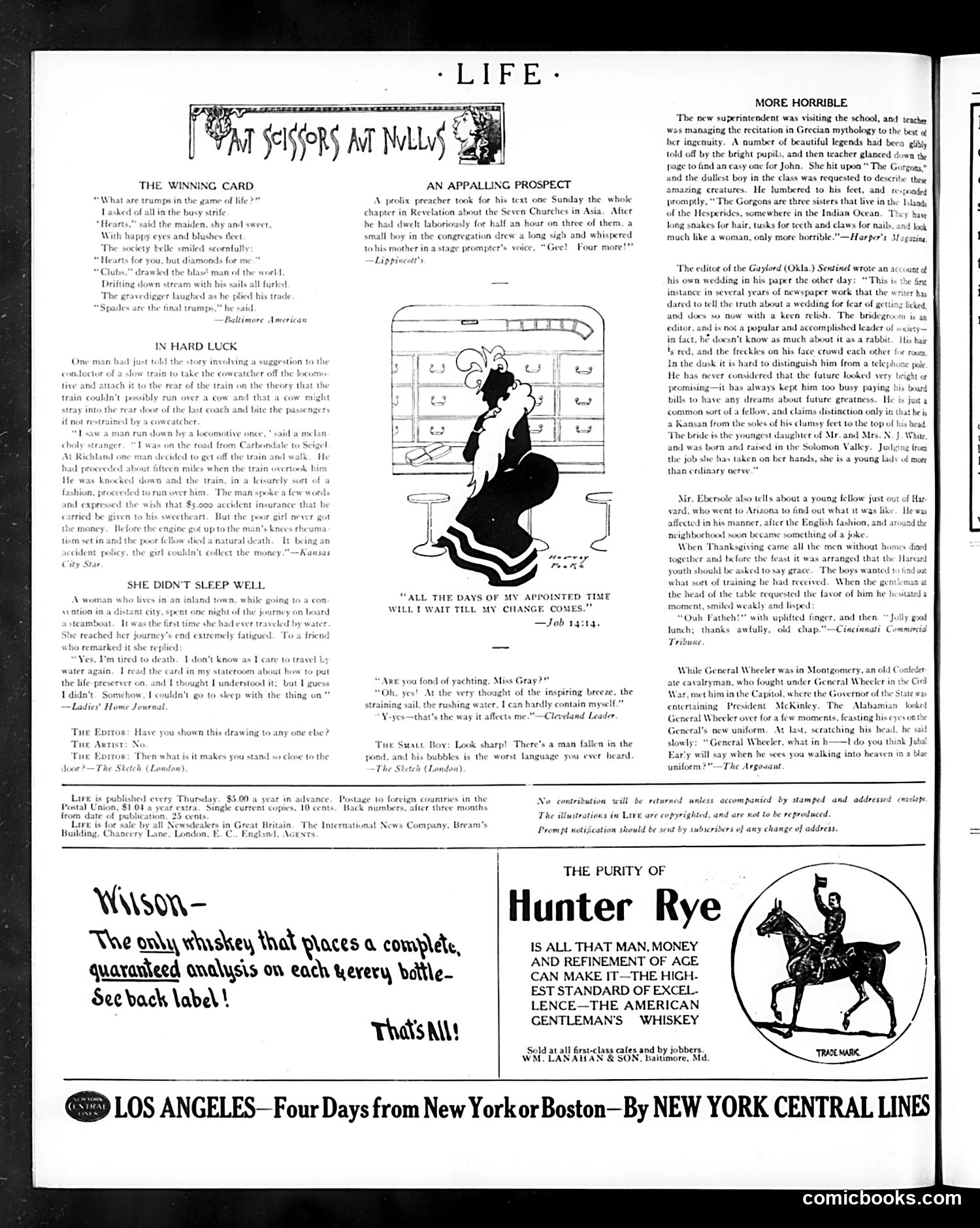
This page from the satirical magazine *Life* contains several humorous anecdotes and cartoons mocking everyday American life and human nature: **"The Winning Card"** ridicules sentimental greeting-card sentiments about love and marriage as hollow platitudes. **"In Hard Luck"** satirizes a man's absurd scheme to transport a locomotive by attaching it to a train's rear car, imagining a cow might help—mocking impractical thinking. **"She Didn't Sleep Well"** jokes about a woman's exhaustion from travel and anxiety about water safety. **"All the Days of My Appointed Time"** presents a brief anecdote about biblical resignation to fate. The main cartoon depicts a woman in elaborate dress reclining against a train window—likely satirizing the vanity or discomfort of rail travel for fashionable ladies. The page also includes period advertisements (Wilson whiskey, Hunter Rye, and New York Central Lines rail service), typical of *Life's* revenue model, alongside editorial content mocking contemporary middle-class concerns and pretensions.
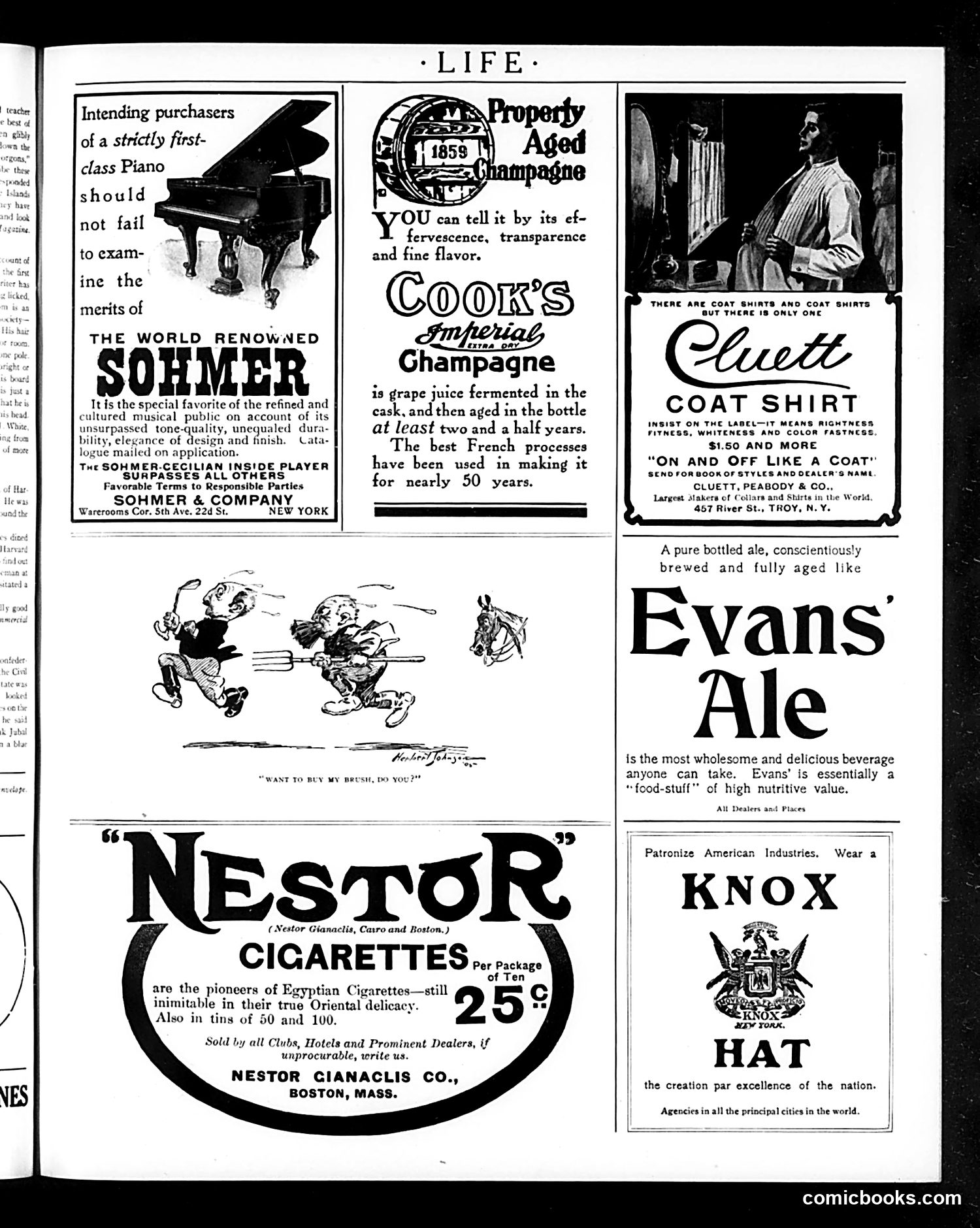
This page is **primarily advertising**, not satirical content. The main cartoon—a small sketch showing two figures in combat with the caption "WANT TO BUY MY BRUSH, DO YOU?"—appears to be a humorous illustration promoting Nestor Cigarettes, likely depicting a lighthearted quarrel or confrontation, though the specific reference is unclear. The advertisements themselves reflect early 20th-century consumer culture: luxury pianos, champagne, dress shirts, ale, Egyptian cigarettes, and hats. One ad notably urges readers to "Patronize American Industries," suggesting this may date to a period of economic nationalism or post-WWI sentiment emphasizing domestic products. The products marketed—especially Egyptian cigarettes and imported champagne—indicate this addressed affluent readers, while the emphasis on quality and "refined" taste reflects the era's marketing strategies targeting educated, cultured audiences.
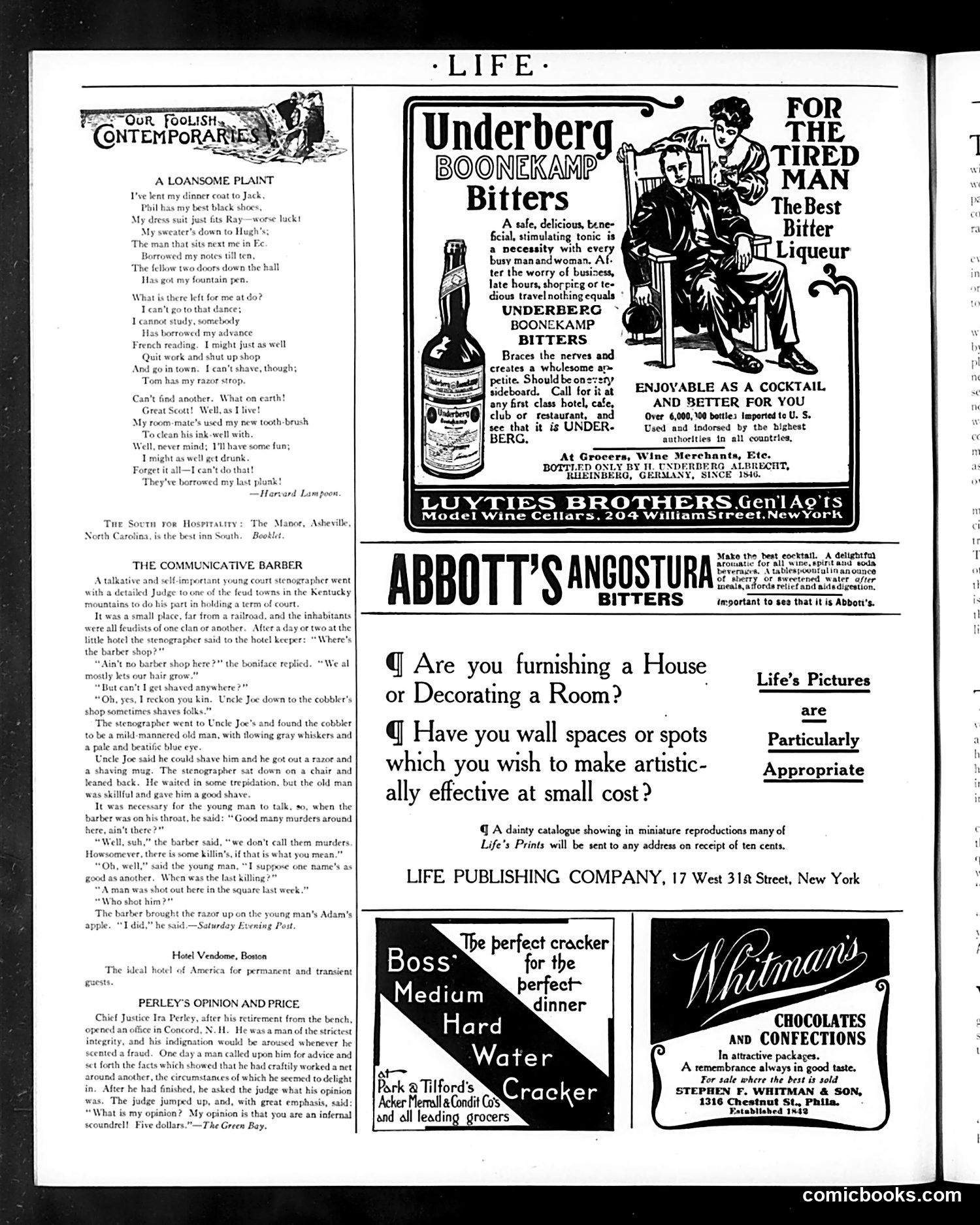
This page is primarily **advertising**, not political satire. It contains multiple product advertisements from the early 20th century: **Main advertisements:** - Underberg Boonekamp Bitters (a digestive tonic marketed to busy professionals) - Abbott's Ancestura Bitters (similar product) - Life's Prints (decorative reproductions for home decoration) - Boss Medium Hard Water Crackers - Whitman's Chocolates and Confections **Sidebar content** includes brief humorous anecdotes titled "Our Foolish Contemporaries," "The Communicative Barber," and "Perley's Opinion and Price"—light satirical pieces about everyday situations rather than political commentary. The "For the Tired Man" section advertises Underberg as a nerve tonic for exhausted businessmen, reflecting early 1900s attitudes toward alcohol as medicinal and gender-specific marketing (products aimed at "busy man and woman"). This is a typical Life magazine page blending advertising with light social humor—not substantive political or social satire.
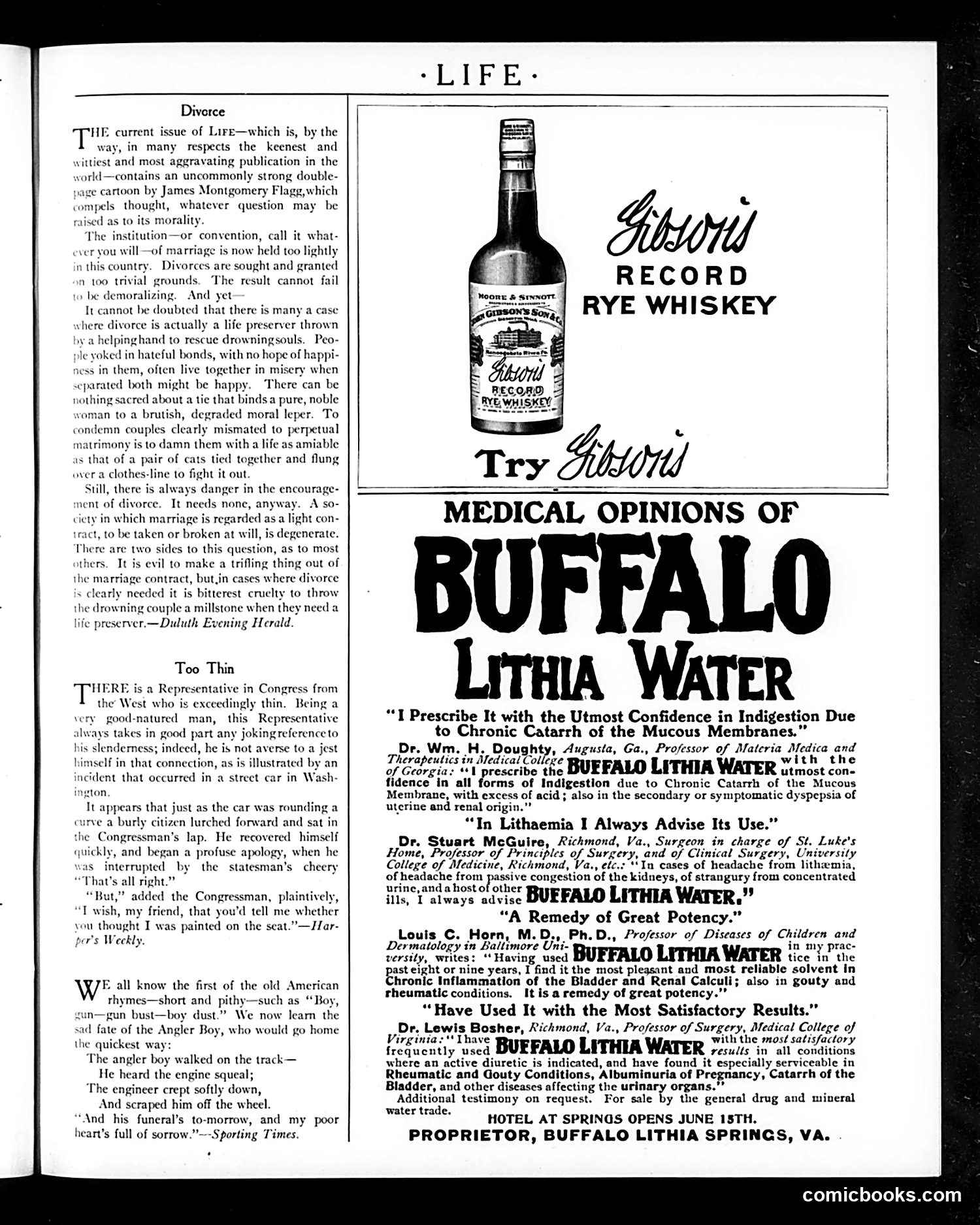
This page mixes editorial commentary with period advertising. The left side features two opinion pieces: one debating divorce (acknowledging its necessity in cases of genuine suffering while warning against treating marriage too casually), and a brief anecdote mocking an unusually thin Congressman. The right side contains advertisements for Gibson's Record Rye Whiskey and Buffalo Lithia Water—a mineral water marketed with fabricated medical endorsements claiming to cure indigestion, kidney ailments, and gout. These endorsements (appearing to be from doctors) are now-transparent examples of early 20th-century unregulated medical advertising. Such claims and fake testimonials were common before the FDA established standards. The page reflects Life magazine's role as a satirical publication addressing social questions while simultaneously accepting advertisements that would be illegal today.
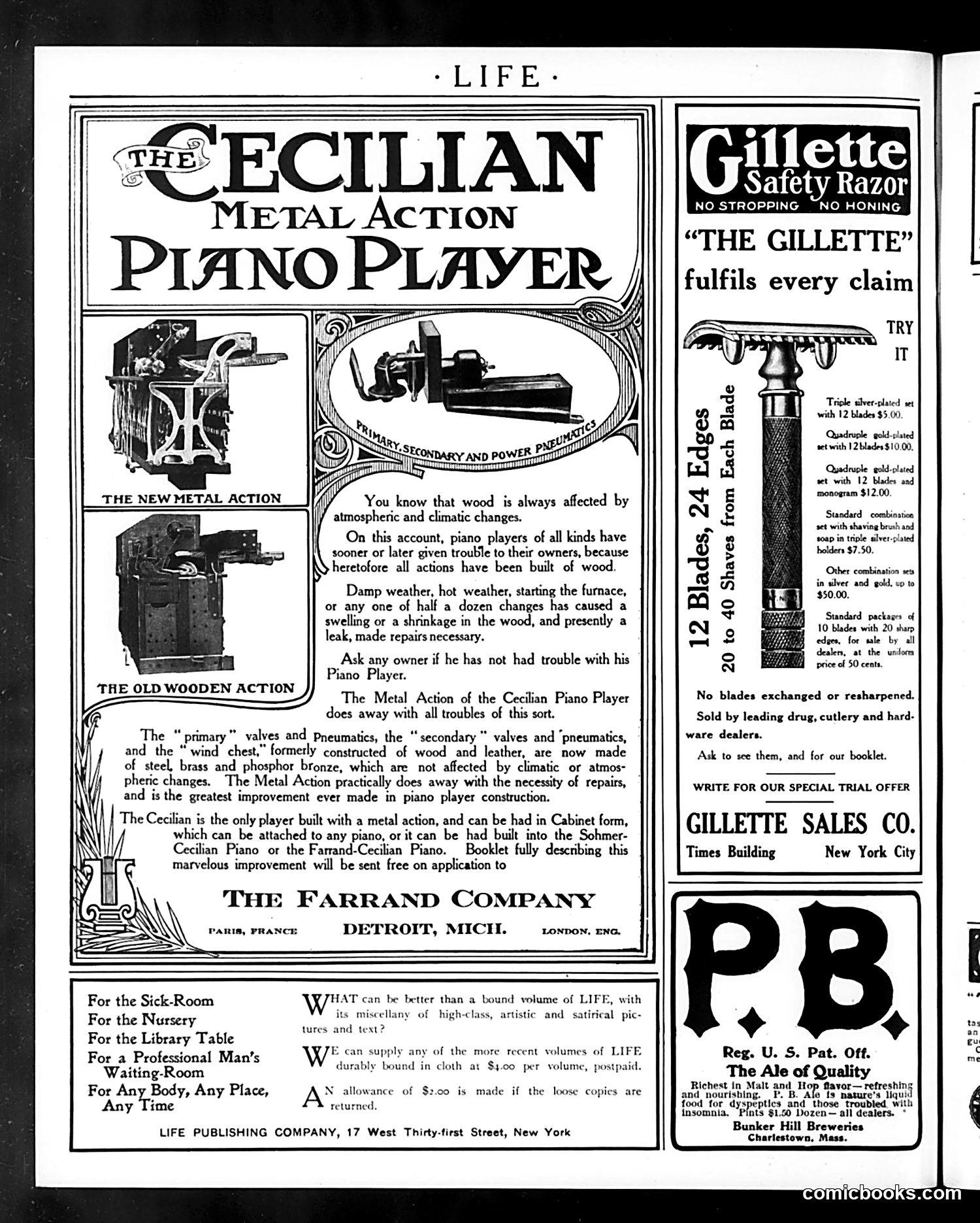
This page is primarily advertising rather than satire or political commentary. The main content advertises the Cecilian Metal Action Piano Player, manufactured by the Farrand Company. The ad argues that wooden piano mechanisms fail due to moisture and temperature changes, while the Cecilian's metal construction (steel, brass, phosphor bronze) eliminates repair problems—a technical innovation pitch to piano owners. The page also contains side advertisements for Gillette Safety Razors and PB Ale, typical of Life magazine's commercial content. There is no cartoon or satirical commentary visible; this appears to be a straightforward advertising page from an early 20th-century issue of Life magazine.
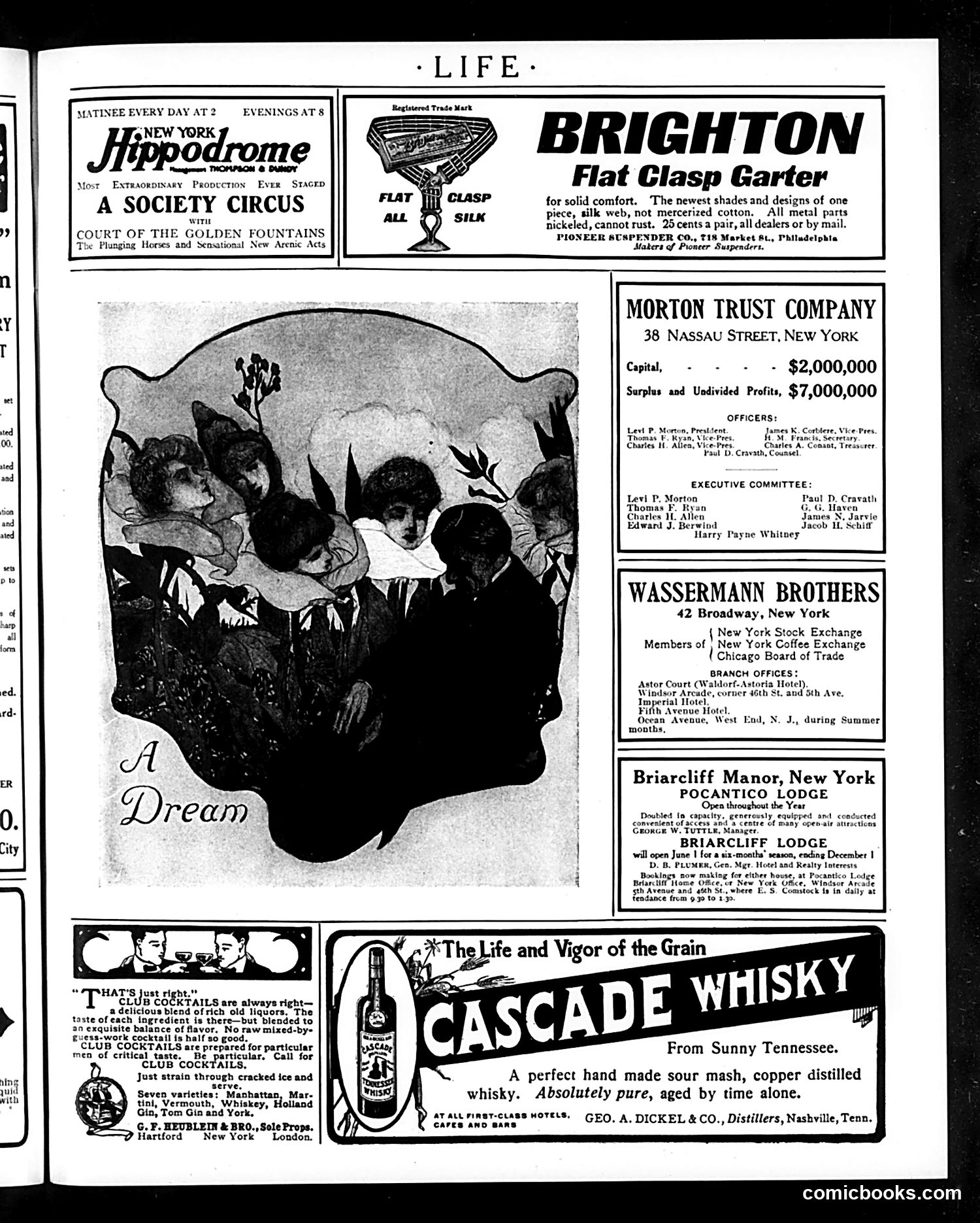
This page is primarily **advertisements and business notices** rather than satirical content. The main visual element—a silhouetted profile labeled "A Dream" containing flowers and figures—appears to be decorative rather than editorial commentary. The page showcases luxury goods and services targeting wealthy Americans: a society circus performance, garters and suspenders, financial institutions (Morton Trust Company with $2M capital), stock brokerages (Wassermann Brothers), and upscale hospitality (Briarcliff Manor lodge). The advertisements emphasize exclusivity and refinement—"Club Cocktails are always right" for "particular men of critical taste," premium whisky "aged by time alone." This reflects early 20th-century Life's dual identity as both satirical magazine and high-end advertising vehicle. The content targets affluent readers and reflects the consumer culture and leisure activities of America's upper class during this era.
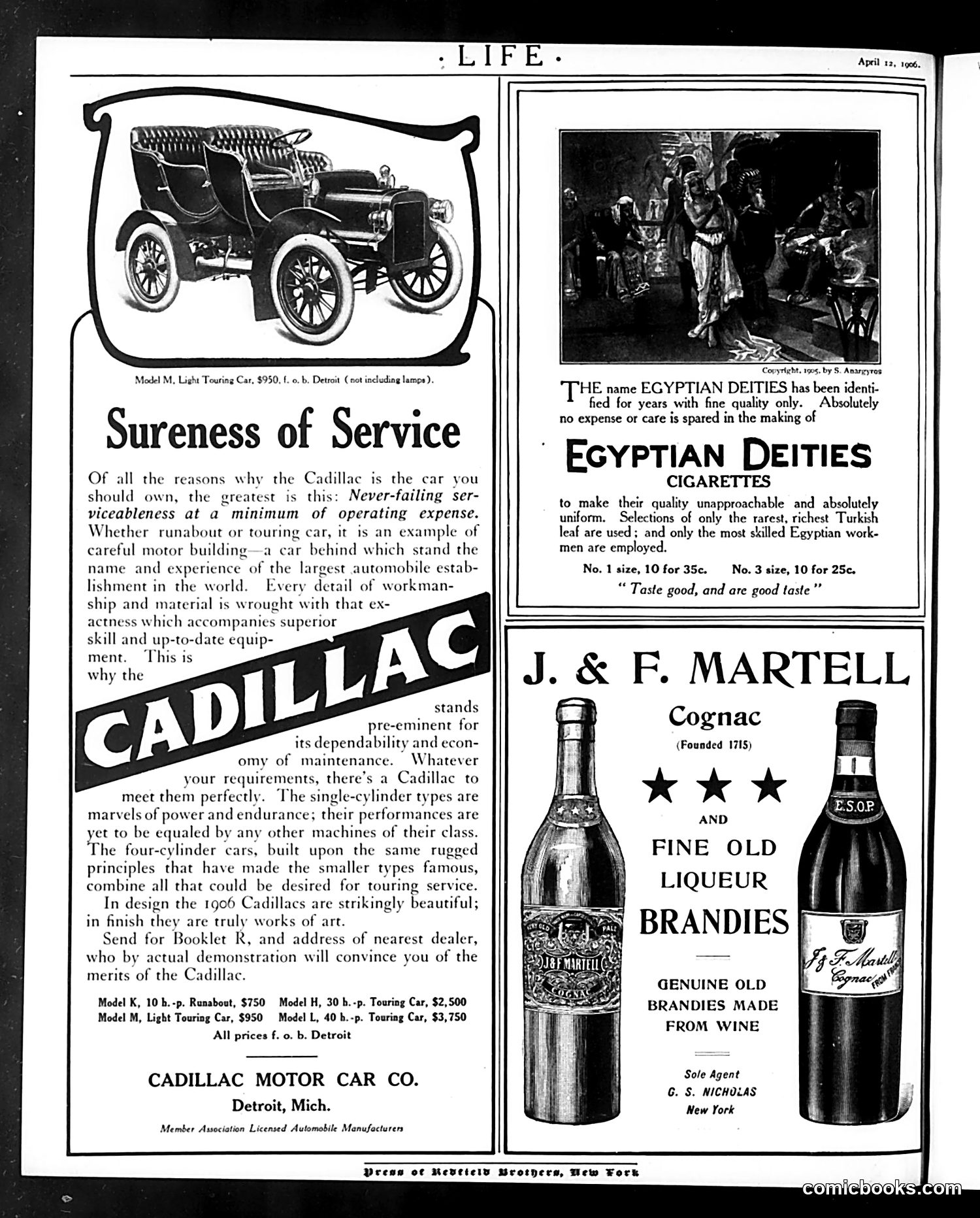
This is primarily an advertising page from *Life* magazine (April 12, 1906), containing no political cartoons. The page features three luxury product advertisements positioned on a single layout. The **Cadillac advertisement** emphasizes "sureness of service" and reliability—marketing automobiles as dependable machines rather than novelties. The text stresses careful craftsmanship and minimal operating expenses, with prices ranging from $750 to $3,750. The **Egyptian Deities cigarettes ad** emphasizes quality and uniformity, highlighting Turkish leaf and skilled Egyptian workers—leveraging exotic imagery common to early-1900s marketing. The **J. & F. Martell Cognac advertisement** promotes French brandies to wealthy consumers, established 1715. The page reflects *Life*'s dual nature as both satirical magazine and vehicle for upscale advertising. All three products target affluent readers of the era. There is no satirical commentary visible on this particular page.