
A complete issue · 25 pages · 1905
Life — December 28, 1905
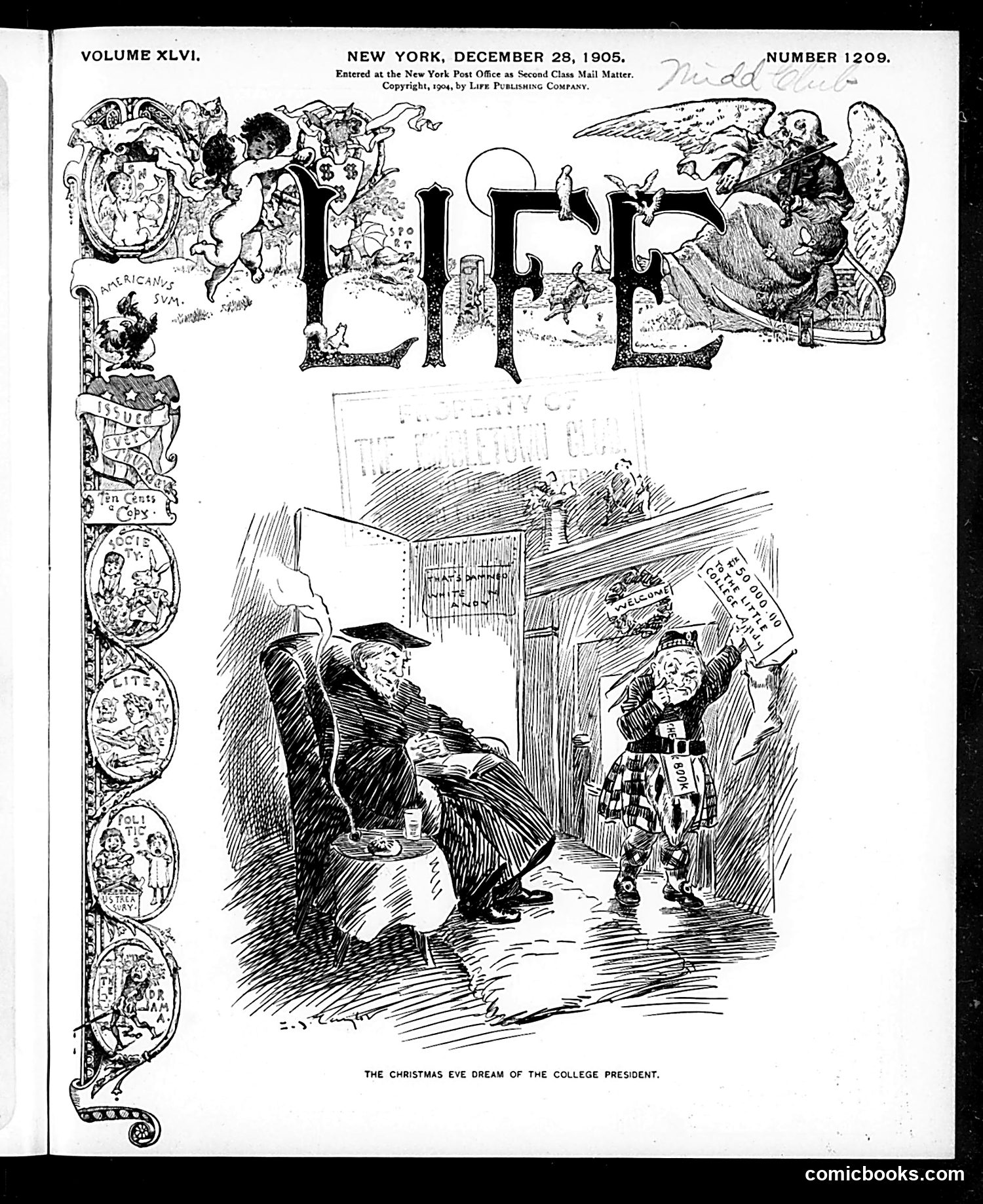
This satirical cartoon from Life (December 28, 1905) depicts a college president sleeping in his chair, dreaming of a small figure—likely a student or subordinate—approaching him with what appears to be a petition or complaint (marked "FOR PROMOTION" or similar). The joke plays on the contrast between the authority figure's comfortable position and the humble supplicant seeking favor. The ornate decorative border containing seasonal vignettes emphasizes the holiday setting, suggesting this represents the kind of requests administrators face during year-end periods. The satire likely mocks either institutional hierarchy, bureaucratic indifference to student/staff concerns, or the absurdity of power dynamics within academic settings. The dream framing suggests this is merely a wishful or anxiety-ridden fantasy rather than reality.
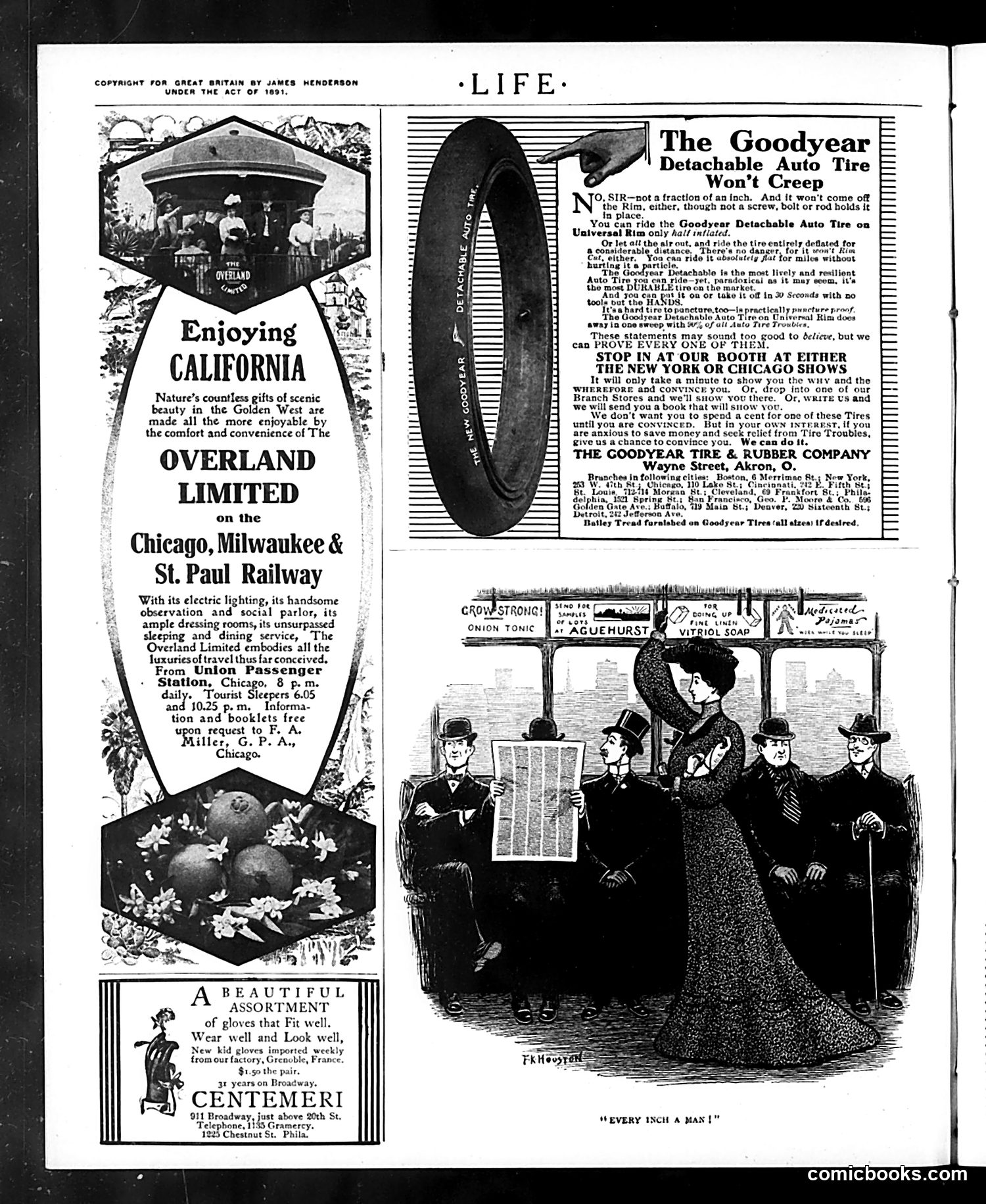
This page consists primarily of **period advertisements** rather than political satire. The main cartoon at bottom—captioned "Every Inch a Man!"—depicts five formally dressed men on public transit reading a newspaper, with advertisements for various products visible above them (Union Tonic, Ague hurst, Vitol Soap, etc.). The joke appears to be a visual gag about masculine self-presentation or product endorsements rather than political commentary. The other ads promote the Overland Limited train service to California, Goodyear tires, and Centemeri gloves—typical commercial content for this era of Life magazine. Without additional context about specific contemporary events or figures these might reference, the cartoons appear designed primarily to entertain while promoting consumer goods to the magazine's middle-class readership.
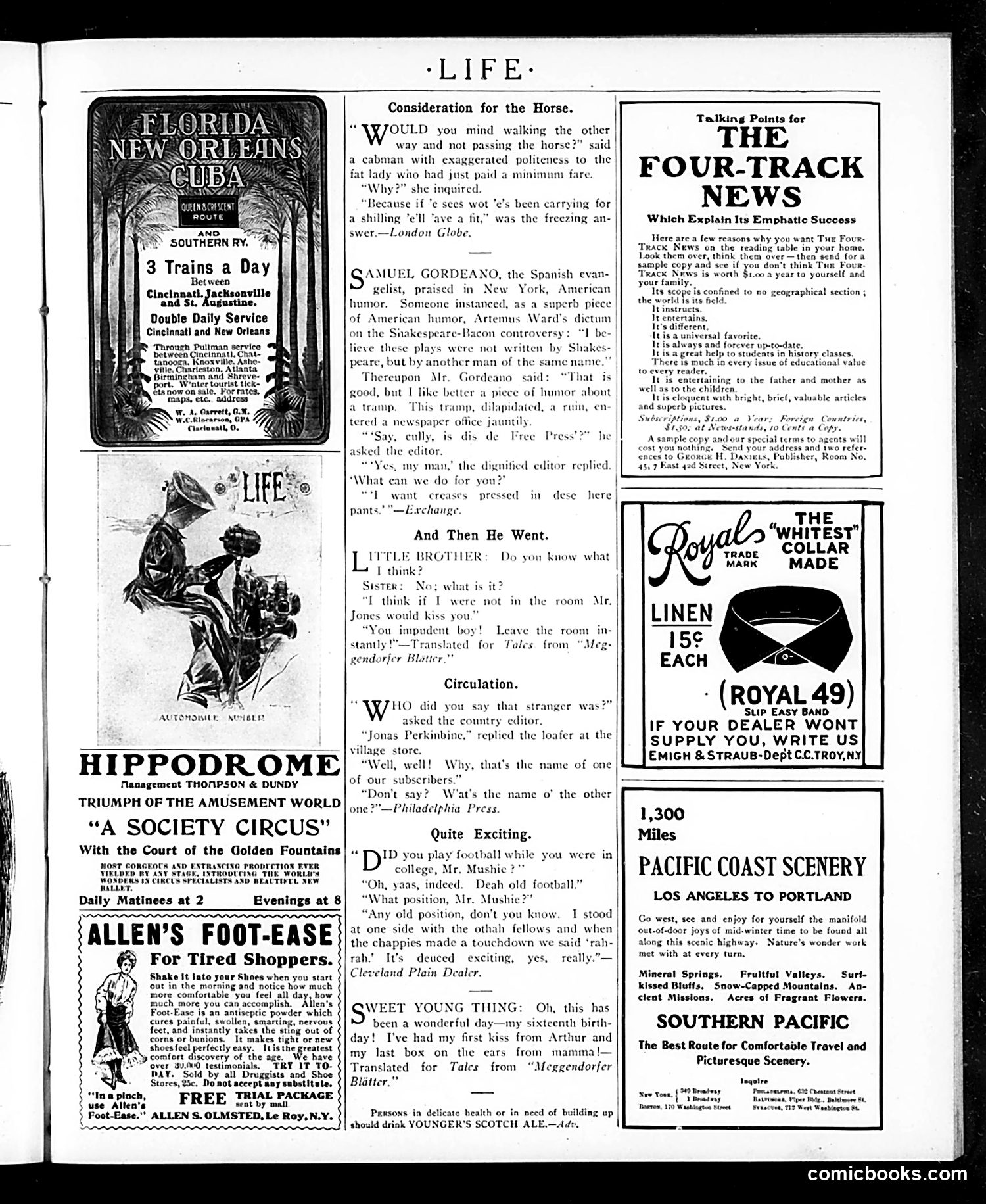
This page is primarily **advertising and filler content** rather than political satire. The main cartoon ("Automobile Whisper") depicts a man whispering to a woman holding flowers—a social humor piece about romantic gestures rather than political commentary. The text sections are brief anecdotes poking fun at everyday situations: a woman justifying not giving money to a horse-cart driver, Samuel Gordeano's comments on American humor, and exchanges about theater creases and college football positions. These are **light, domestic humor pieces** without clear political references. The page features ads for train travel, theatrical productions (Hippodrome), foot powder, and Pacific Coast scenery tours—typical early 20th-century magazine content. Overall, this represents **general entertainment and commercial content** rather than pointed social or political satire.
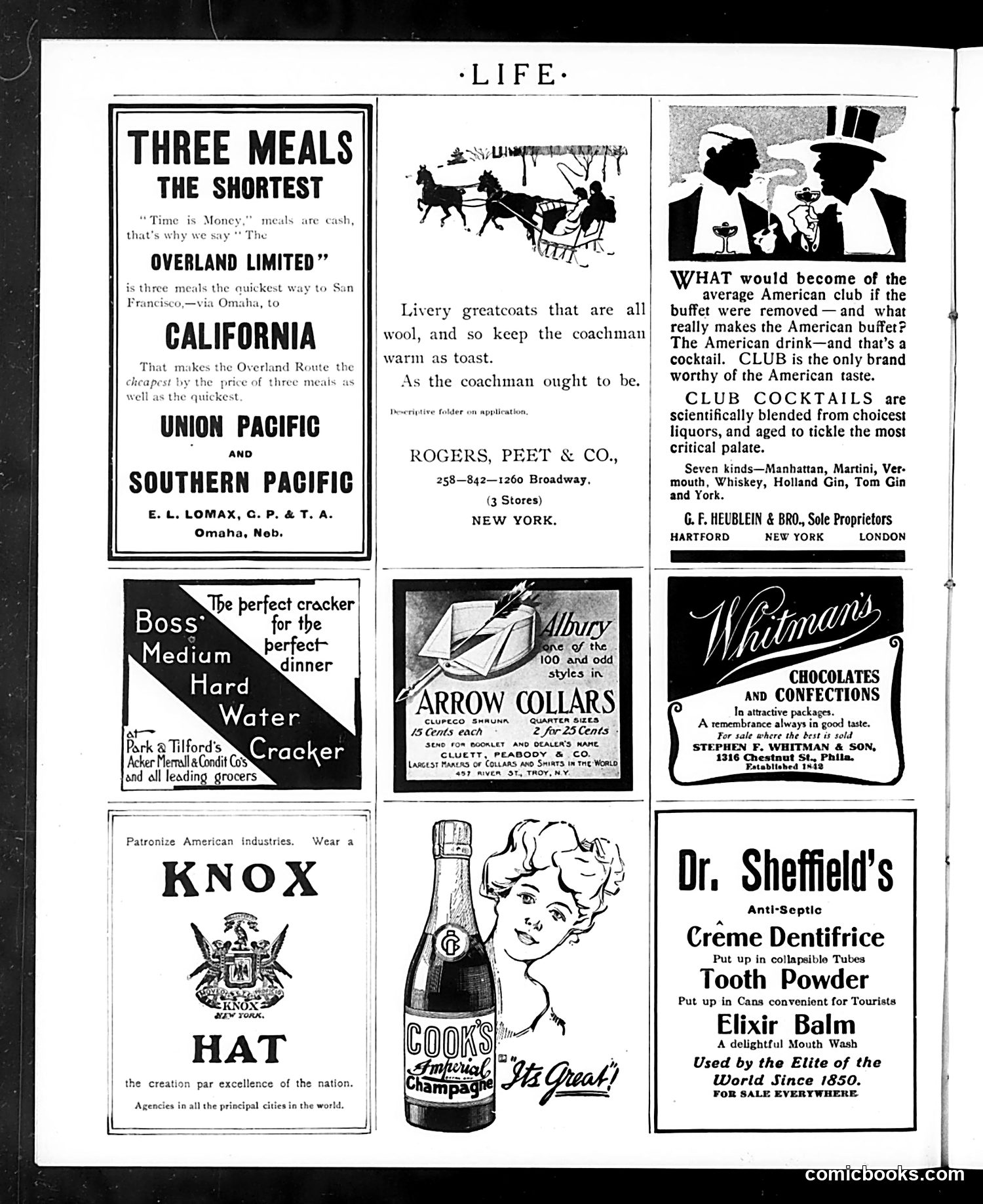
This page is predominantly **advertisements** rather than editorial content or political satire. The ads promote various consumer goods typical of the early 20th century: railroad travel (Overland Limited), men's clothing (Arrow Collars, Knox Hats), food products (Boss Crackers, Whitman's Chocolates), beverages (Club Cocktails, Cook's Champagne), and toiletries (Dr. Sheffield's Dentifrice). The single cartoon-like illustration shows two well-dressed men in top hats discussing what appears to be a cocktail—likely promoting Club Cocktails as "the only brand worthy of the American taste." This is marketing satire rather than political commentary. The page reflects early 20th-century consumer culture and advertising conventions, with no apparent political or social critique beyond commercial messaging.
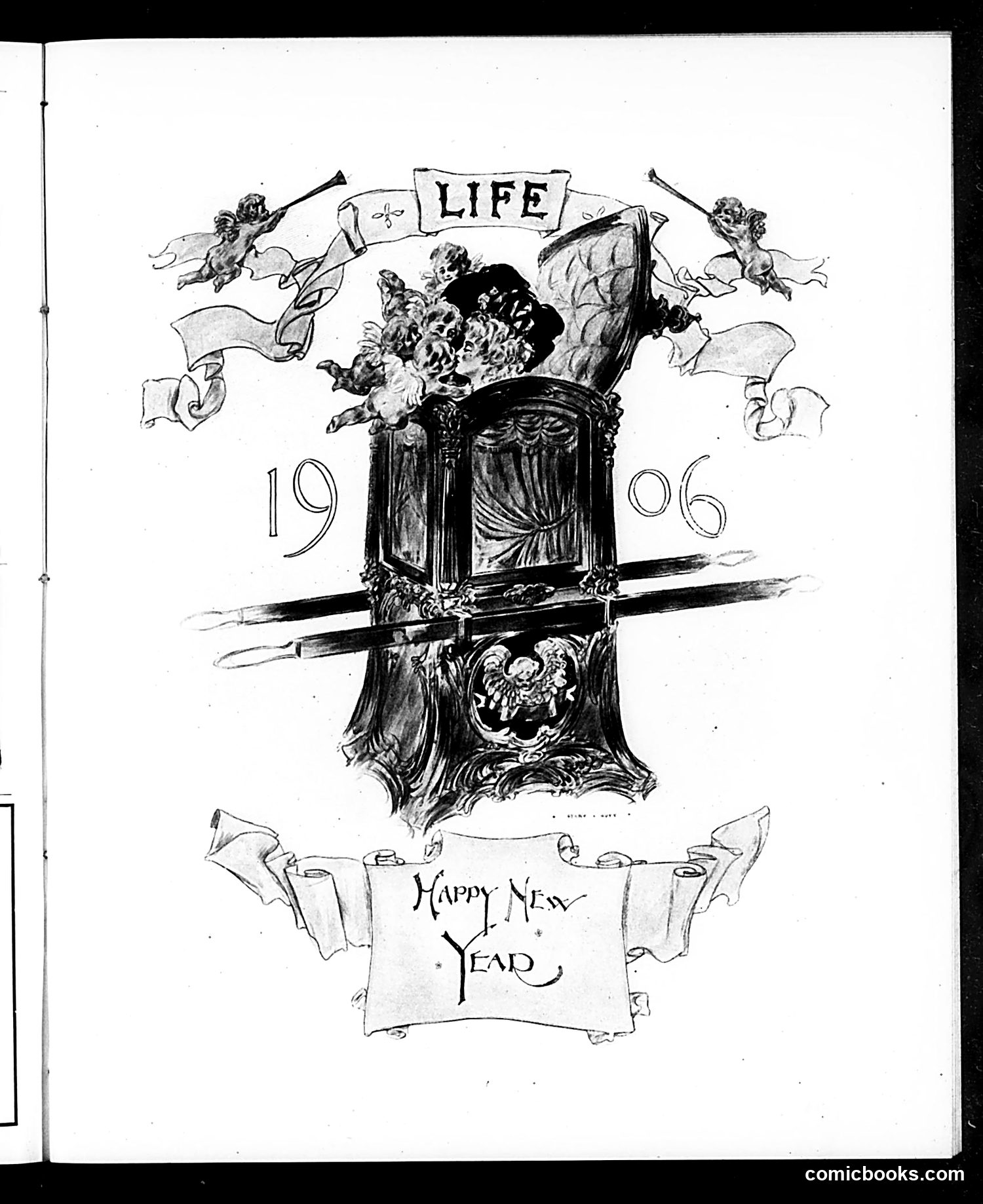
This is a decorative New Year's greeting page from *Life* magazine dated 1906. The central image depicts an ornate decorative urn or vessel overflowing with cherubs and classical figures, crowned with a banner reading "LIFE." Two winged putti (cherubic figures) flank the top corners, holding trumpets, suggesting celebration and announcement. The year "1906" appears on either side of the urn. Below, a banner reads "Happy New Year," indicating this served as the magazine's festive seasonal greeting to readers. The elaborate, classical ornamentation reflects *Life's* aesthetic pretensions as a sophisticated humor magazine. Rather than political satire, this appears to be celebratory artwork marking the magazine's New Year wishes for its audience—a common practice for publications of the era.
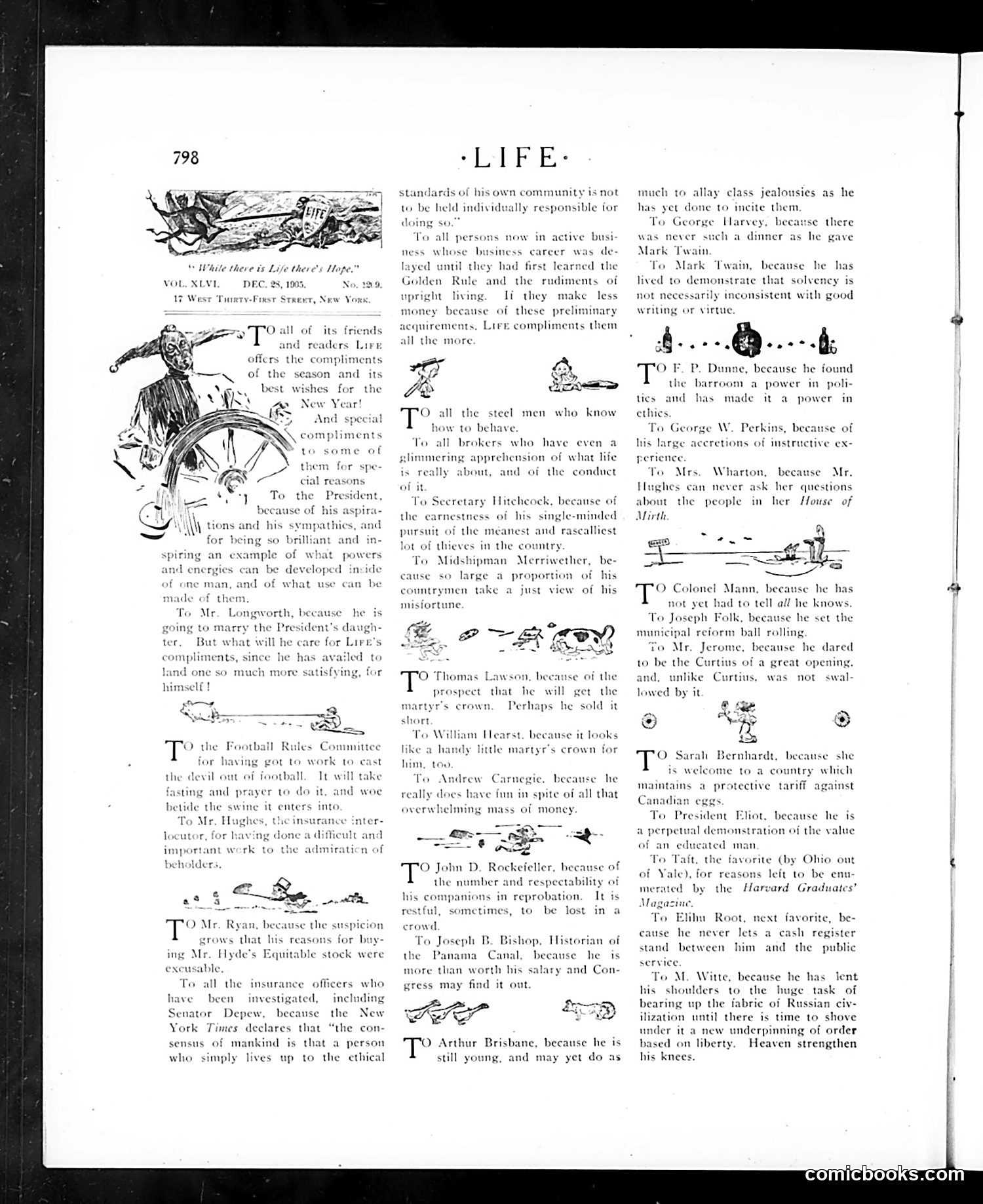
This page consists of a "To" list—satirical tributes addressing prominent figures of 1905. The cartoons are small decorative vignettes (ship's wheel, running figures, etc.) rather than political caricatures. The satire mocks various public figures and institutions: - **Andrew Carnegie** for his overwhelming wealth - **Theodore Roosevelt** (implied in references to presidential concerns) - **Insurance investigators** and financial scandals - **Football establishment** for rule-making - Various businessmen, politicians, and society figures The humor relies on readers recognizing contemporary names and recent events—insurance company corruption investigations, Carnegie's philanthropy debates, and Roosevelt-era business regulation controversies. Without modern context, many references are opaque, though the general thrust targets wealth, corruption, and institutional hypocrisy of the Gilded Age/Progressive Era.
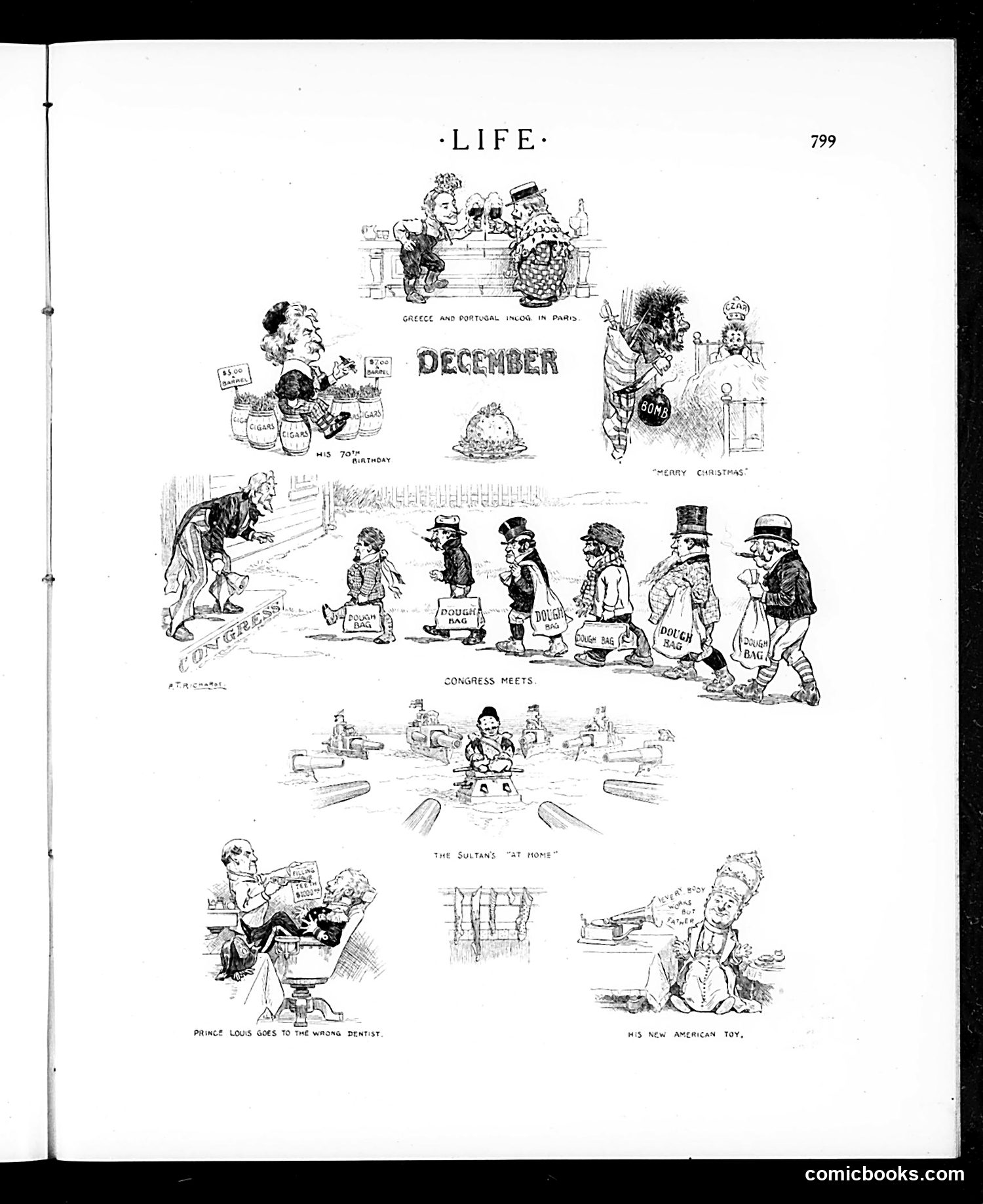
This December issue page contains multiple satirical cartoons mocking contemporary political figures and events: **Top section:** "Greece and Portugal Unions in Paris" depicts diplomats or political figures meeting, likely referencing international negotiations of the era. **"Congress Meets":** Shows a line of figures carrying bags labeled with various political positions or constituencies, satirizing how Congress members represent special interests rather than constituents. **"The Sultans 'at Home'":** Appears to mock Ottoman political leadership. **Other panels** reference Prince Louis, American toys, and what appears to be someone's birthday celebration surrounded by bottles—possibly satirizing excess or political indulgence. The overall tone is typical of Life's satirical approach to politics: using caricature and visual metaphor to criticize politicians' self-interest and the influence of money on governance.
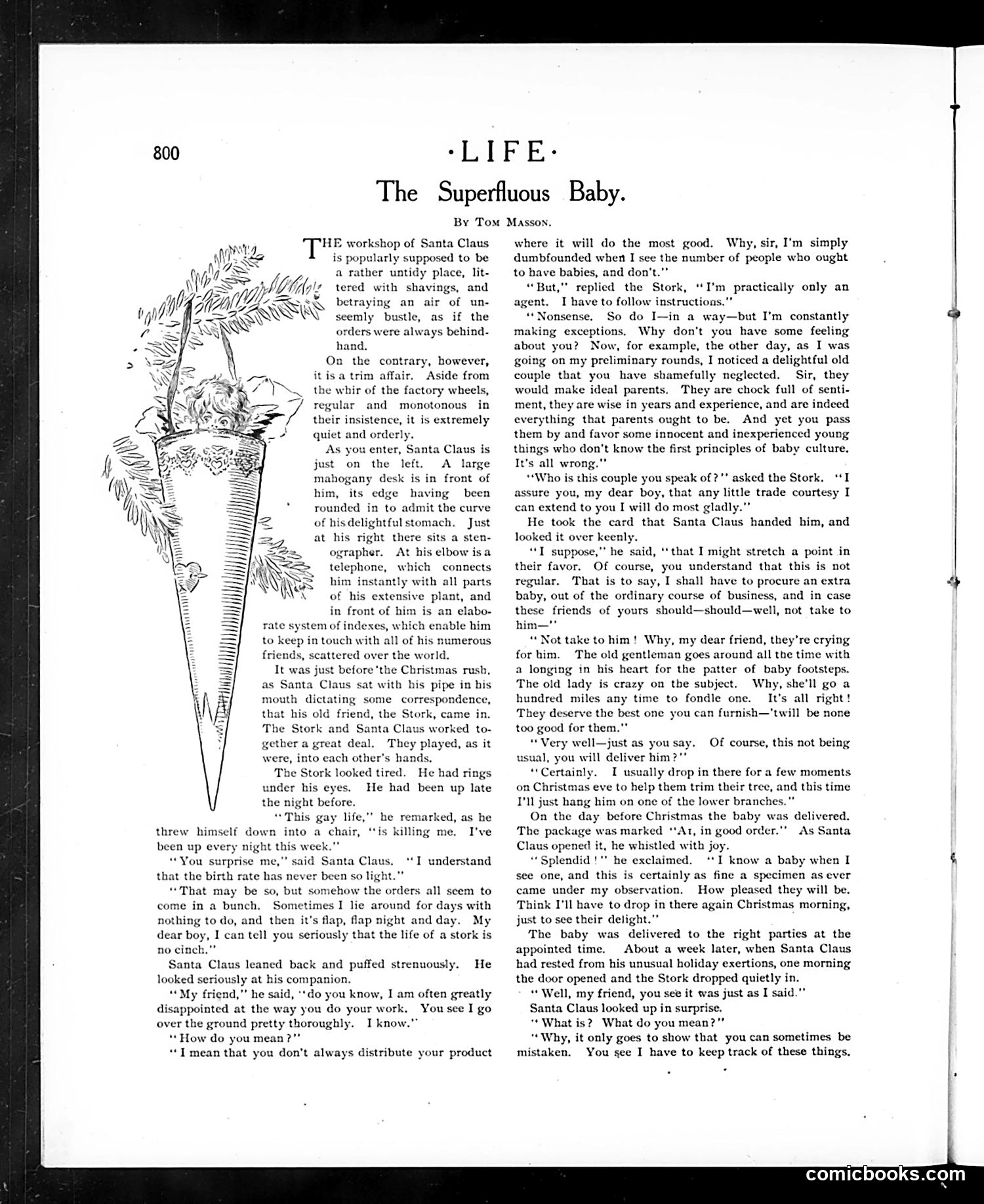
This satirical story, illustrated with a sketch of a stork carrying a baby in a bundle, mocks the tension between Santa Claus and the Stork over their respective roles in childbirth delivery. The dialogue presents their workplace rivalry: Santa complains the Stork delivers babies without proper screening of parents' qualifications, while the Stork defends his efficiency. Santa suggests some couples are unfit parents who lack "baby culture" knowledge. The satire targets early 20th-century anxieties about eugenics and "scientific" parenting—the notion that not all people should reproduce. The humor lies in treating supernatural delivery agents as bureaucratic professionals debating who should have children, reflecting contemporary class and social concerns about worthiness for parenthood.
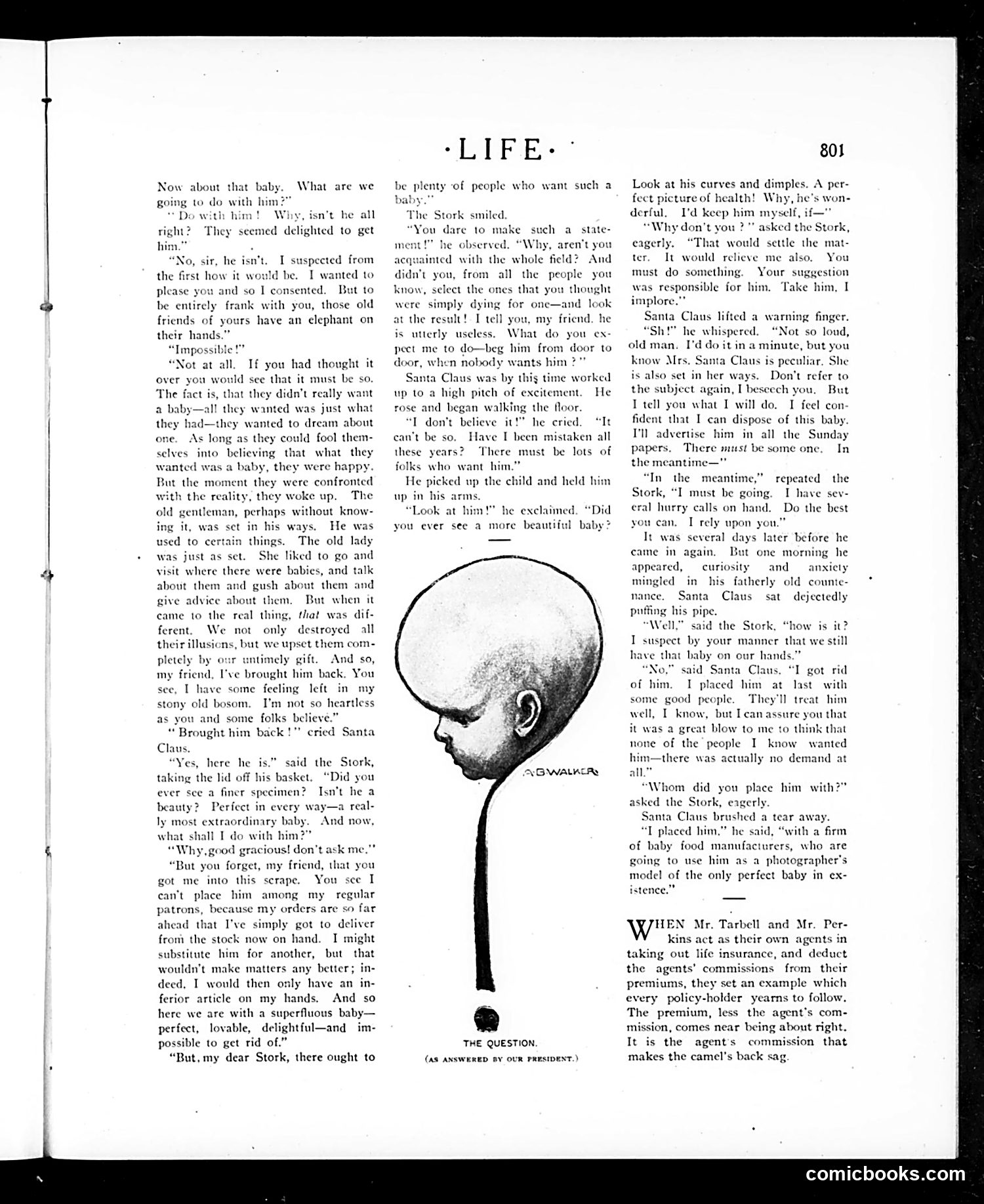
This page presents a story dialogue between Santa Claus and the Stork about an unwanted baby. The accompanying illustration titled "THE QUESTION" (credited as "answered by our president") shows a baby's head in profile. The satire addresses **life insurance and agent commissions**. The text explains how Santa Claus placed a perfect baby with manufacturers to use as a photographer's model—a commentary on commercializing infants. The final section mocks how insurance agents exploit policy-holders by inflating commissions relative to actual premiums. The "answer by our president" caption suggests the magazine's editor or a prominent figure is ironically endorsing this mercenary treatment of babies and insurance fraud, satirizing both commercialism and unethical business practices of the era.
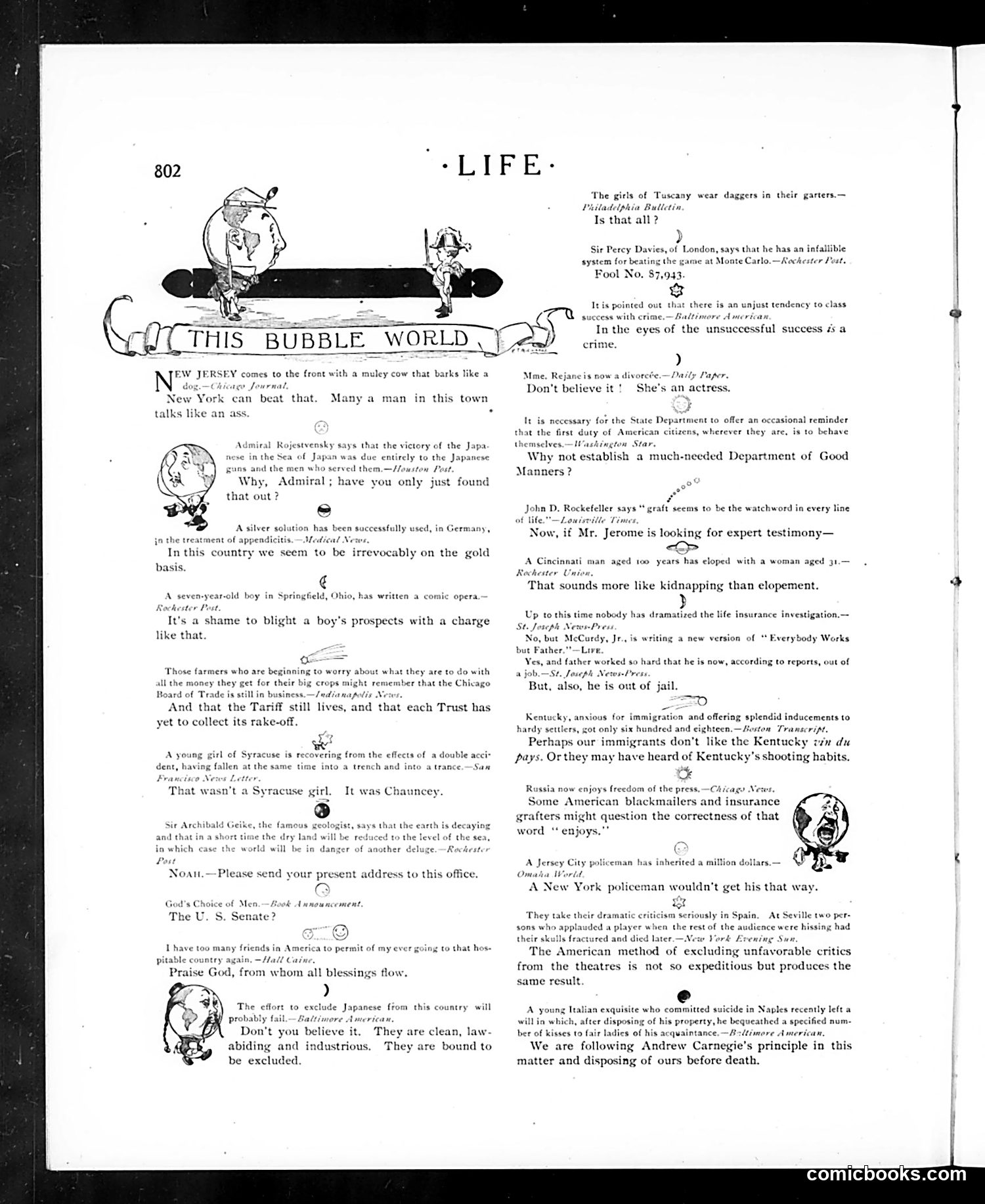
This page from Life magazine's "This Bubble World" column collects brief satirical commentaries on contemporary news and scandals. The cartoons mock various public figures and institutions: **Left column** features small caricature illustrations accompanying quips about topics like New Jersey politics, Japanese naval victories, German medical treatments, and Chicago's Board of Trade. **Right column** continues the satire, referencing figures like Sir Percy Douglas (Monte Carlo gambling), Mme Rejane (a divorcing actress), John D. Rockefeller (on "graft"), and discussions of life insurance fraud investigations and immigration policy. The overall tone is cynical commentary on American politics, business corruption, society scandals, and international affairs—typical of Life's early-20th-century satirical approach to public figures and institutions.
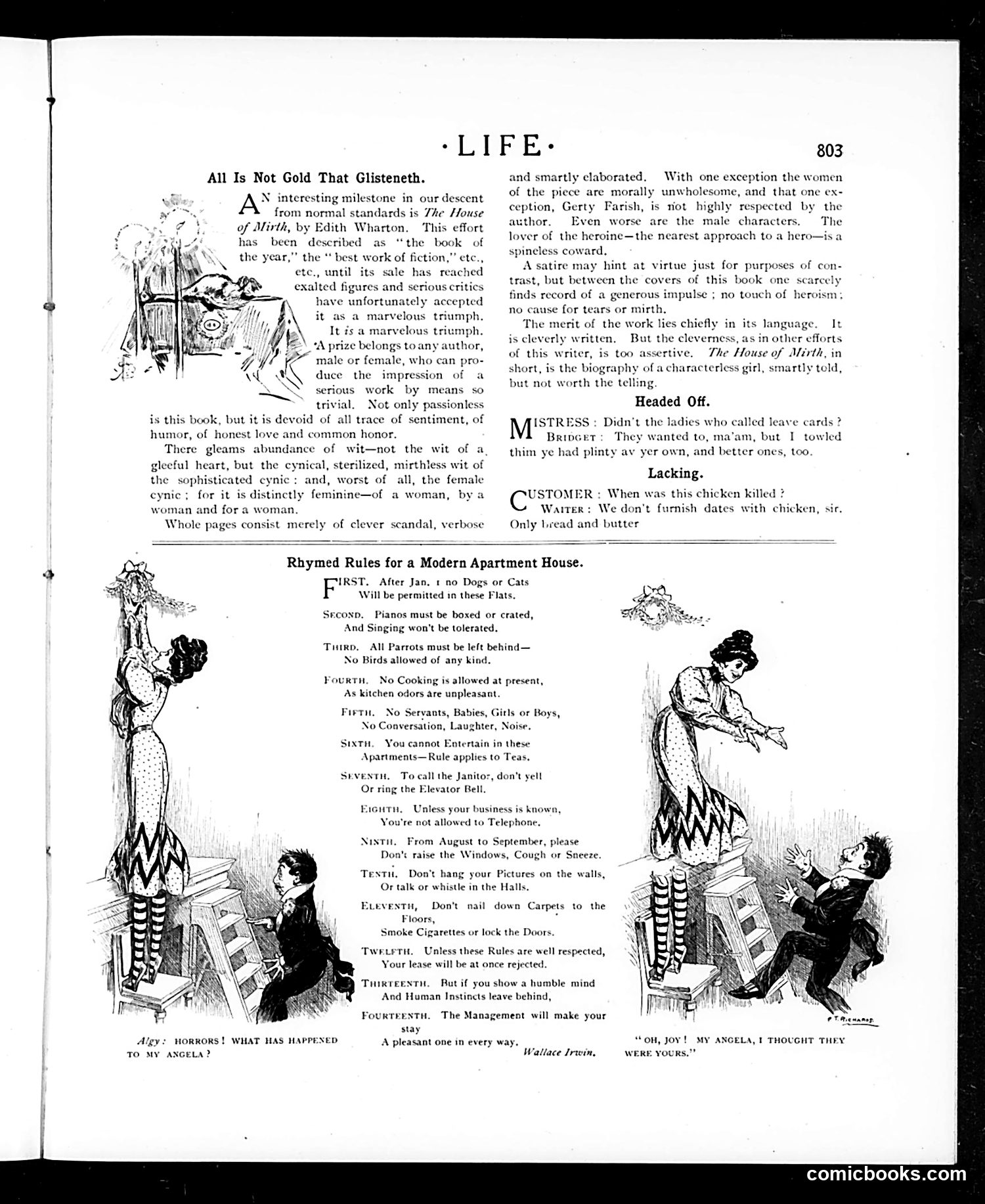
This page contains two distinct satirical pieces: **"All Is Not Gold That Glisteneth"** critiques Edith Wharton's novel *The House of Mirth*, calling it devoid of sentiment and humor, featuring only cynical characters. The reviewer particularly dismisses the female protagonist as a "characterless girl." **"Rhymed Rules for a Modern Apartment House"** satirizes restrictive landlord policies common in early 20th-century urban housing. The fourteen illustrated rules mock absurdly strict apartment regulations—prohibiting pets, cooking, servants, noise, entertaining, and even basic activities. The accompanying cartoons show frustrated tenants enduring these oppressive restrictions, ridiculing how landlords imposed nearly impossible living conditions on renters seeking affordable housing in cities.
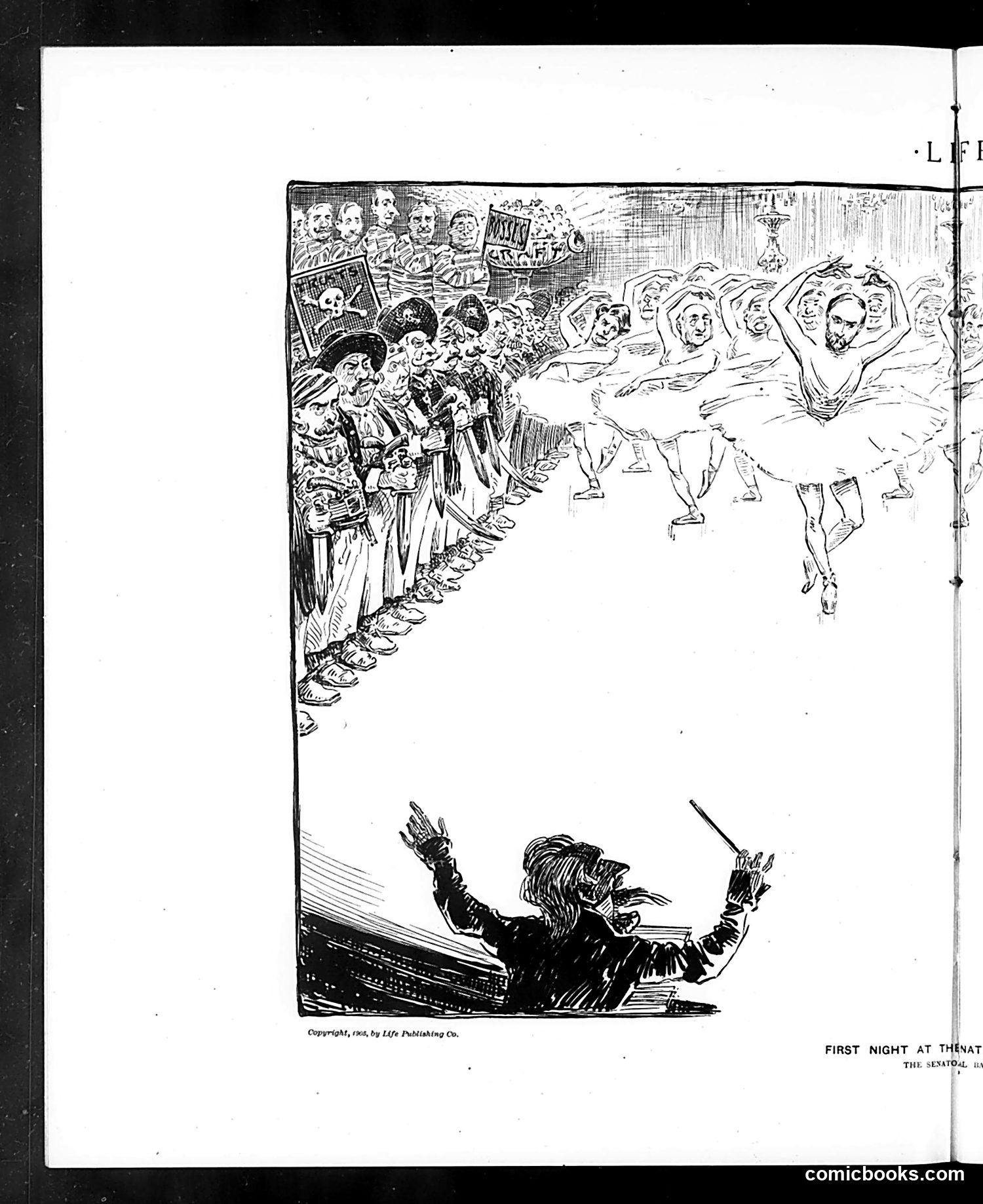
This satirical cartoon depicts a conductor at the bottom, baton raised, facing a theatrical stage above. On stage, a line of ballet dancers performs while an audience of well-dressed spectators watches from the left side. The cartoon's humor relies on the contrast between the dignified, formal setting of high culture (ballet, theater) and what appears to be the conductor's exaggerated, wild enthusiasm or perhaps incompetence—suggested by his disheveled appearance and dramatic gestures. The satire likely mocks either pretentious theater-goers, incompetent conductors, or the absurdity of formal cultural institutions. The copyright indicates this is from Life Publishing Co., dating to early 20th-century American satirical commentary on urban middle-class culture and artistic pretension.
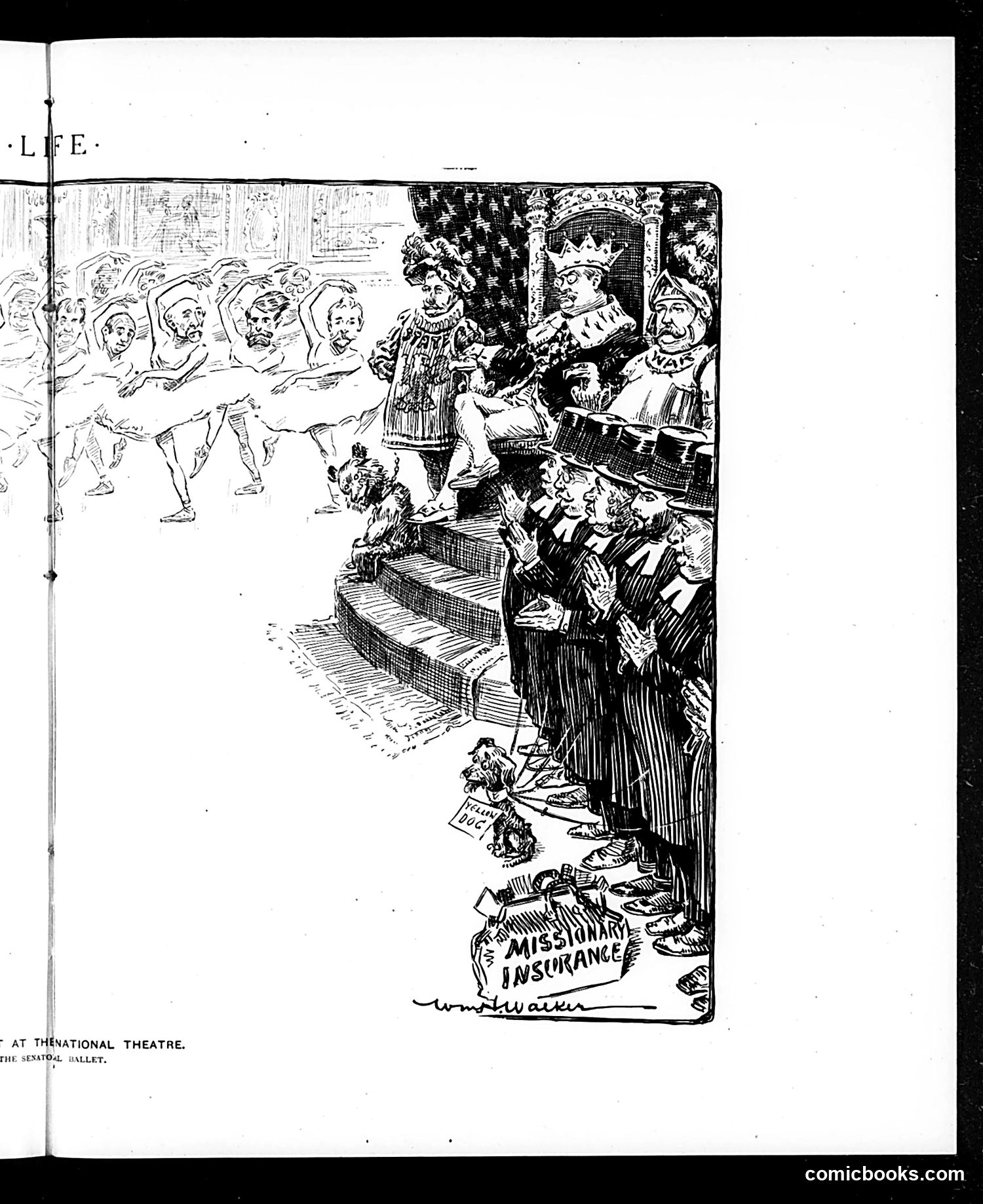
This cartoon satirizes missionary work and religious institutions. On the right, wealthy figures in royal regalia and fine dress sit elevated, observing a theatrical performance. On the left, nude or scantily-clad figures perform or dance in what appears to be a mocking spectacle. At the bottom, a sign reads "MISSIONARY INSURANCE," suggesting the cartoon critiques how established churches or wealthy institutions profit from or exploit missionary activities in colonized regions. The satire appears to mock the hypocrisy of "civilizing missions"—the claim that Western religion and culture were bringing enlightenment to other peoples—by depicting it as entertainment for the wealthy elite rather than genuine charitable work. The performance setup emphasizes the performative nature of such missionary efforts.
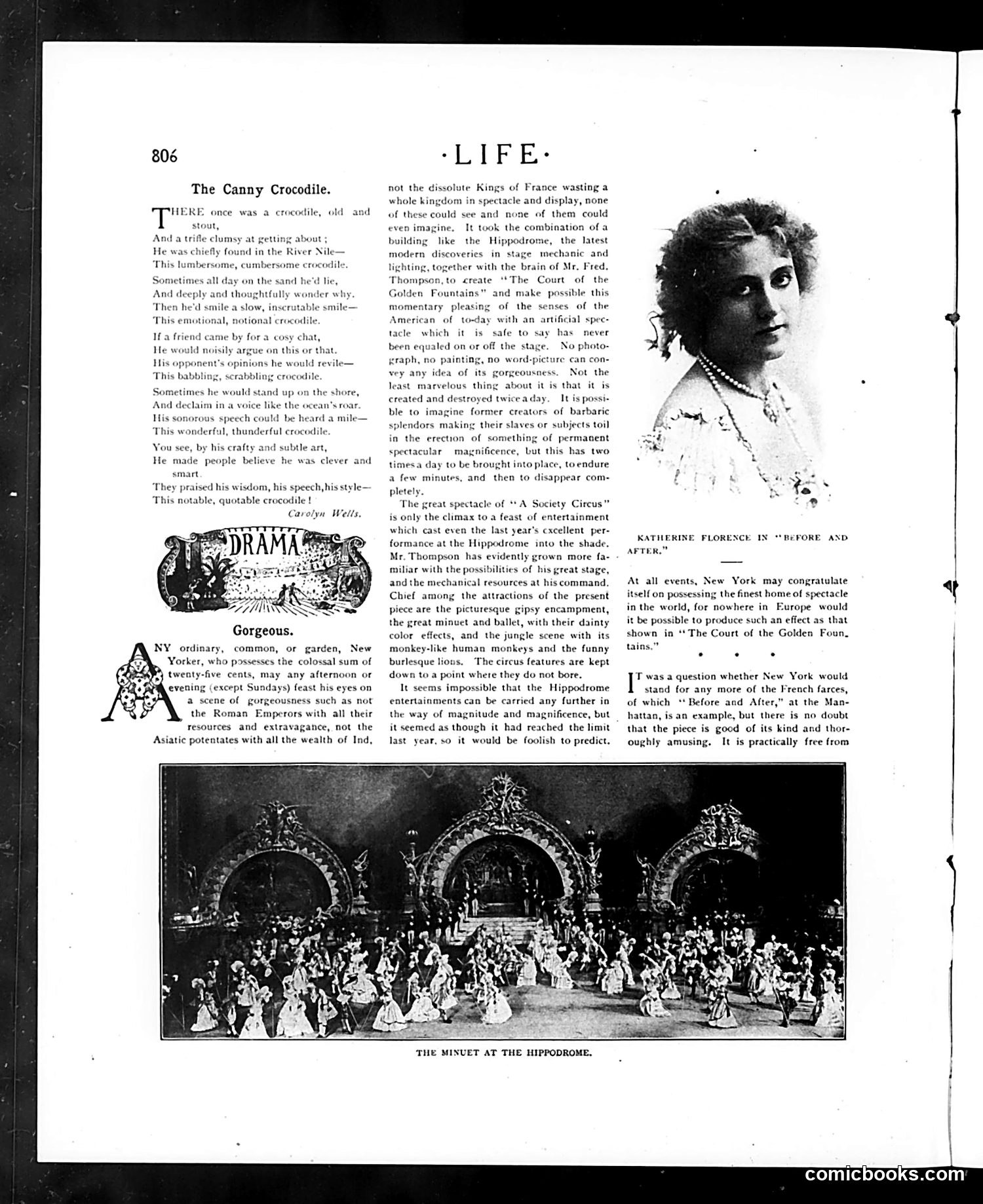
This page contains two unrelated pieces of entertainment commentary from an early 20th-century Life magazine: **"The Canny Crocodile"** is a humorous poem by Carolyn Wells about a manipulative crocodile who uses cunning rhetoric and performance to deceive others into believing he's wise and clever, when he's actually just performing an act. The satire likely comments on public figures or politicians who win admiration through artifice rather than substance. **"Gorgeous"** reviews New York's Hippodrome theater productions, praising the spectacle of "A Society Circus" and "The Court of the Golden Fountains" as surpassing anything Europe could produce. It marvels at the technical achievement of creating and destroying elaborate sets twice daily. A accompanying photograph shows "Katherine Florence in 'Before and After,'" a French farce also reviewed positively as genuinely amusing entertainment. The page celebrates American theatrical innovation and spectacle as superior to European productions.
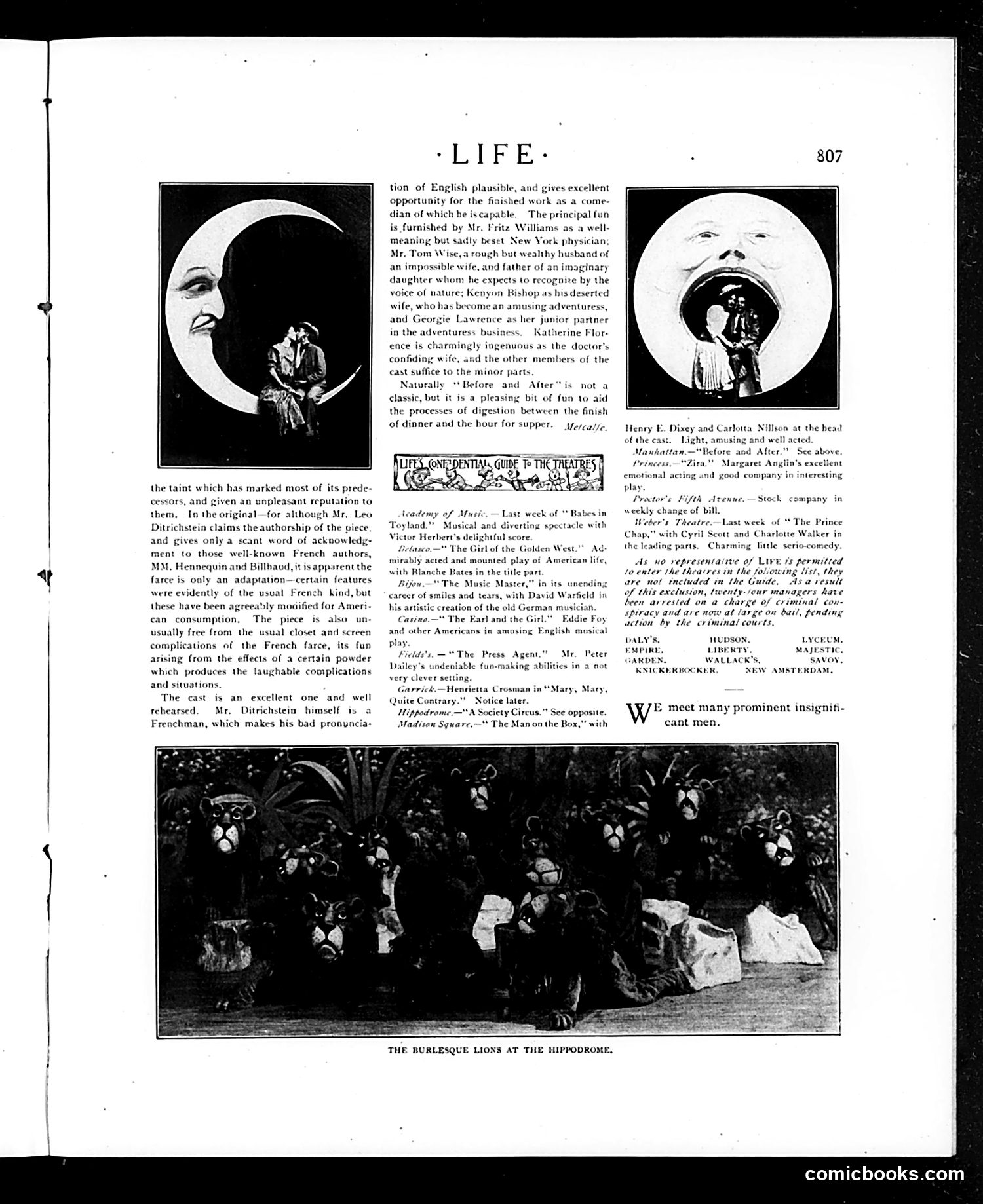
This page from *Life* magazine reviews theatrical productions, primarily discussing a farce titled "Before and After." The play, adapted from French sources by Leo Ditrichstein, concerns a magical powder that creates comedic situations. The cast includes Ditrichstein himself (playing a New York physician with a French accent—a comedic device), Tom Wise, and others. The review is generally favorable but dismissive, calling it "not a classic" but "pleasing" entertainment for digestion between dinner and supper. The page includes theater listings and notably, a satirical editorial note objecting to certain theaters' exclusion of *Life* critics, resulting in the arrest of "twenty-four managers" on charges of criminal conspiracy. This reflects press freedom tensions of the era. The photographs show scenes from productions, including "The Burlesque Lions at the Hippodrome," a popular entertainment venue.
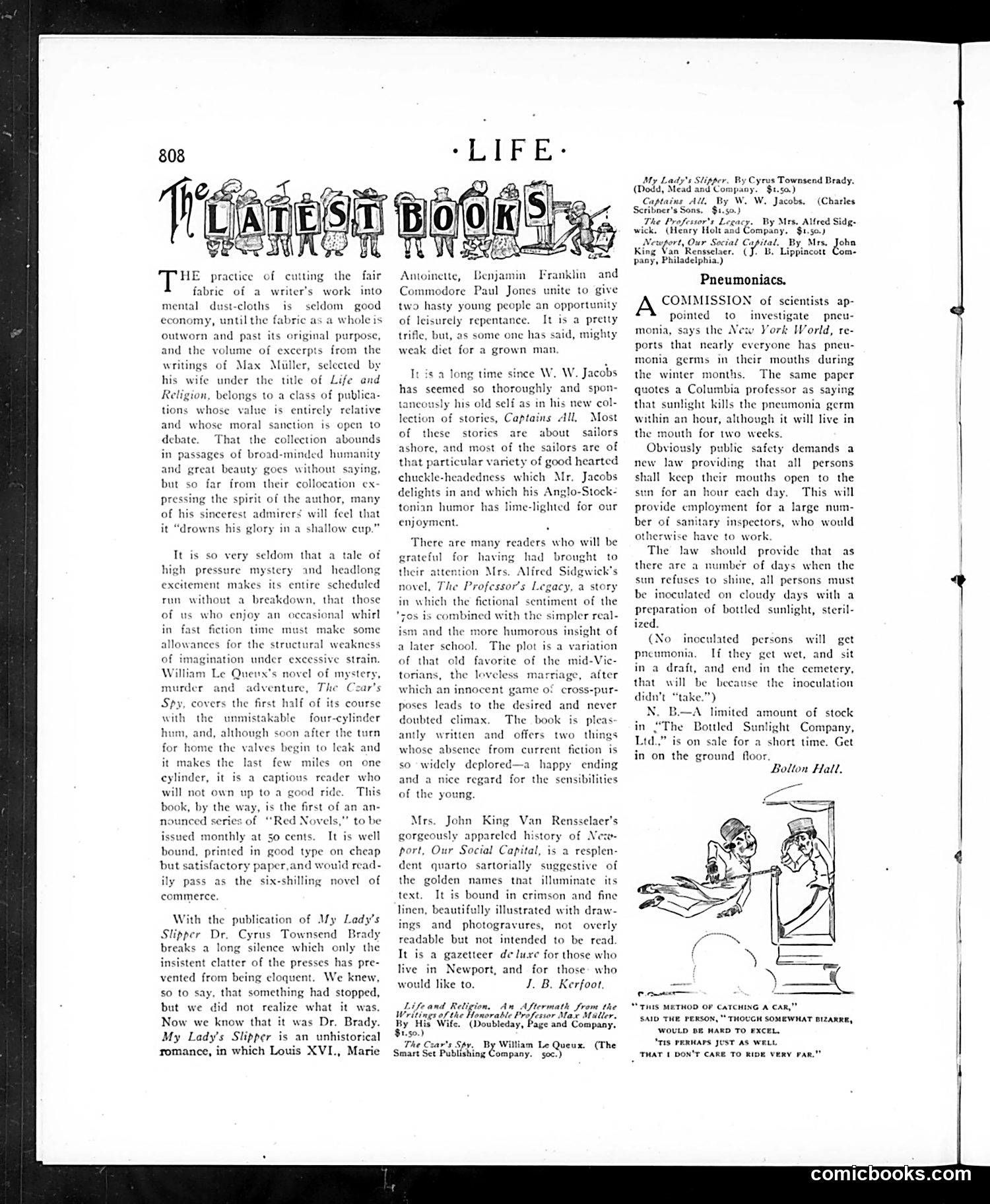
This page reviews contemporary novels, with no political cartoons. The text discusses literary publications, including works by W.W. Jacobs and Dr. Cyrus Townsend Brady. The single illustration—labeled "Bolton Hall"—appears to be a humorous sketch about illness prevention. It depicts a person in bed saying "I said the person through somewhat blizzard, would be hard to excel" with a response "It's perhaps just as well that I don't care to ride very far." The joke seems to satirize how people rationalize avoiding outdoor activities during winter—using health concerns as an excuse for staying indoors, which ironically contradicts the belief that fresh air prevents pneumonia (the article's main topic). The accompanying text discusses pneumonia prevention, recommending sunlight exposure and noting that inoculated persons will develop immunity. The cartoon gently mocks the contradiction between this medical advice and people's actual behavior.
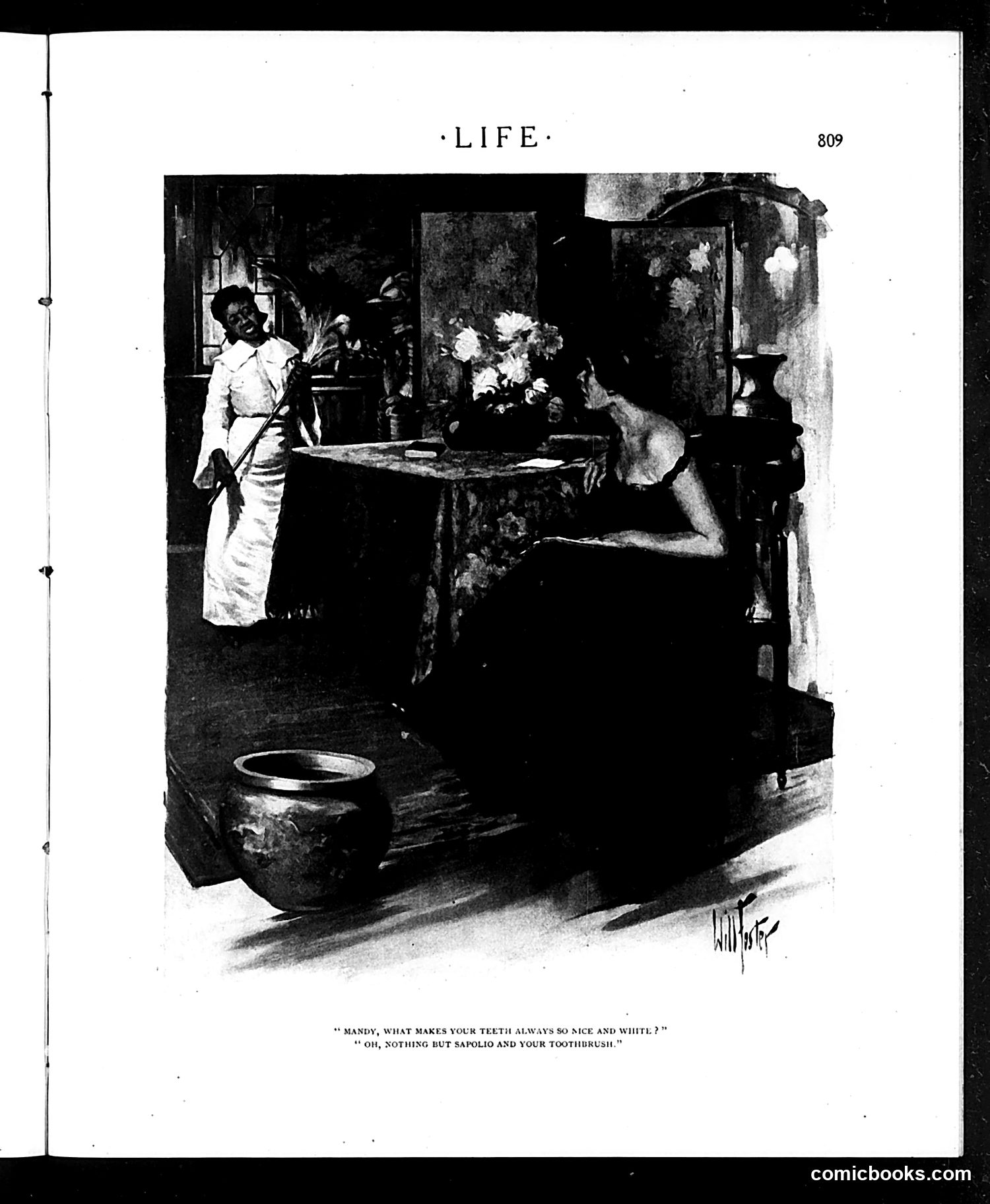
This is a period advertisement disguised as comic dialogue, likely from the early 20th century. The scene depicts a domestic interior with two figures—a man admiring a woman's teeth, and the woman (addressed as "Mandy") crediting her dental whiteness to "Sapolio" (a popular cleaning product of that era) and a toothbrush. The humor relies on a pun: Sapolio was primarily a scouring soap for cleaning surfaces, not teeth. The joke suggests she's using an industrial cleaning product on her teeth—the absurdity being the premise of the advertisement itself. This conflates household cleanliness with personal grooming, a common marketing tactic of the period that treated body maintenance as analogous to scrubbing floors. The racial caricature in the drawing reflects the problematic advertising conventions of early Life magazine.
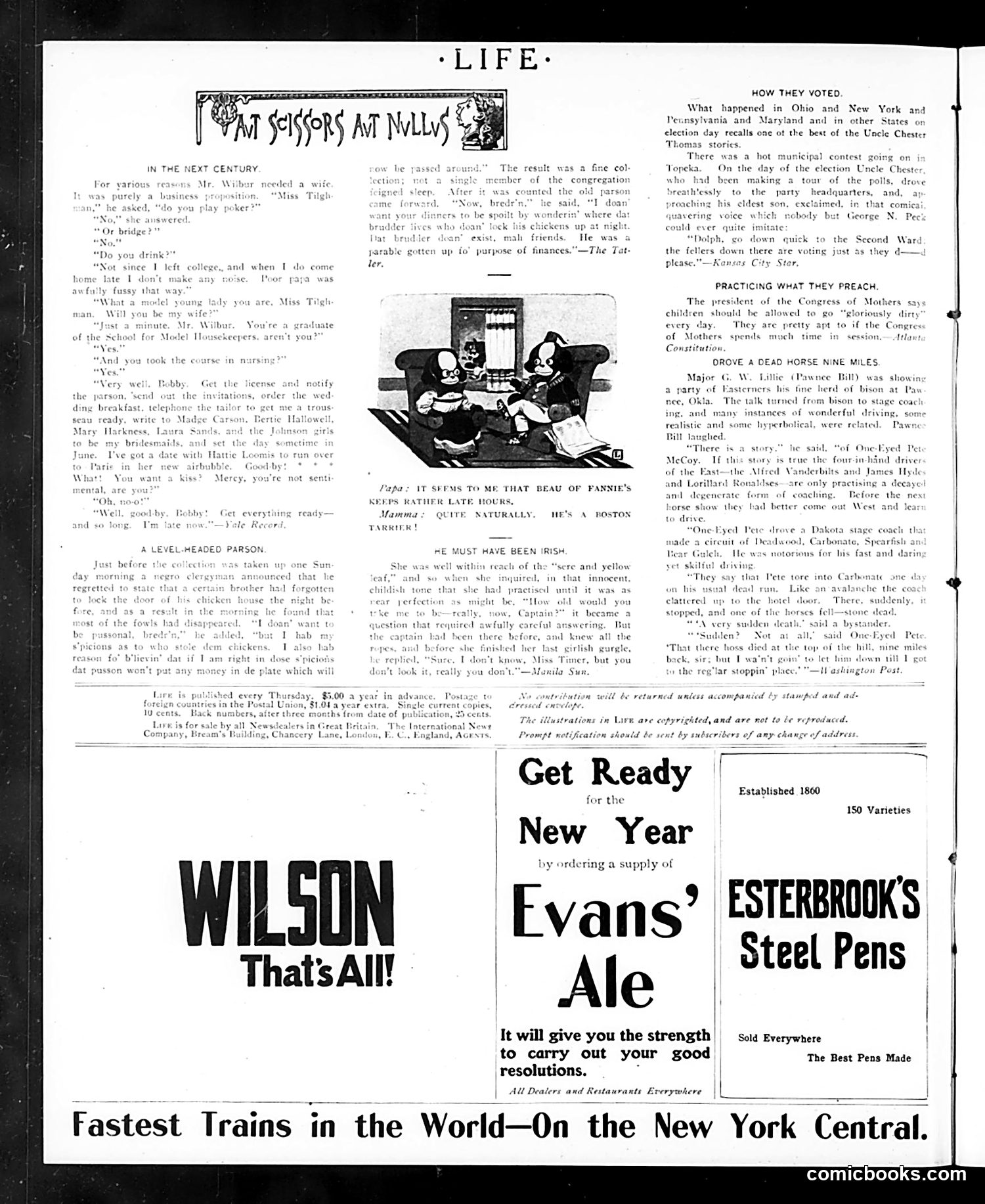
This page contains **multiple unrelated humor pieces and advertisements** rather than a single unified cartoon. The main content includes: 1. **"At Scissors at Nulls"** — a domestic comedy dialogue where a man proposes to his girlfriend, featuring the typical early-20th-century romantic humor and class commentary ("School for Model Housekeepers"). 2. **Political/election content** ("How They Voted") — references voting in Ohio, Pennsylvania, Maryland during what appears to be an election, with Uncle Chester anecdotes. 3. **Western tall tales** — humorous exaggerated stories about driving horses and frontier life, featuring characters like "Pawnee Bill" and "One-Eyed Pete," mocking frontier mythology. 4. **"He Must Have Been Irish"** — an ethnic joke playing on Irish stereotypes. The page is primarily **advertising-heavy**, with large advertisements for Wilson (unclear product), Evans' Ale, and Esterbrook's Steel Pens dominating the lower half. The satire reflects *Life*'s typical early-1900s humor: domestic comedy, ethnic stereotyping, and frontier nostalgia.
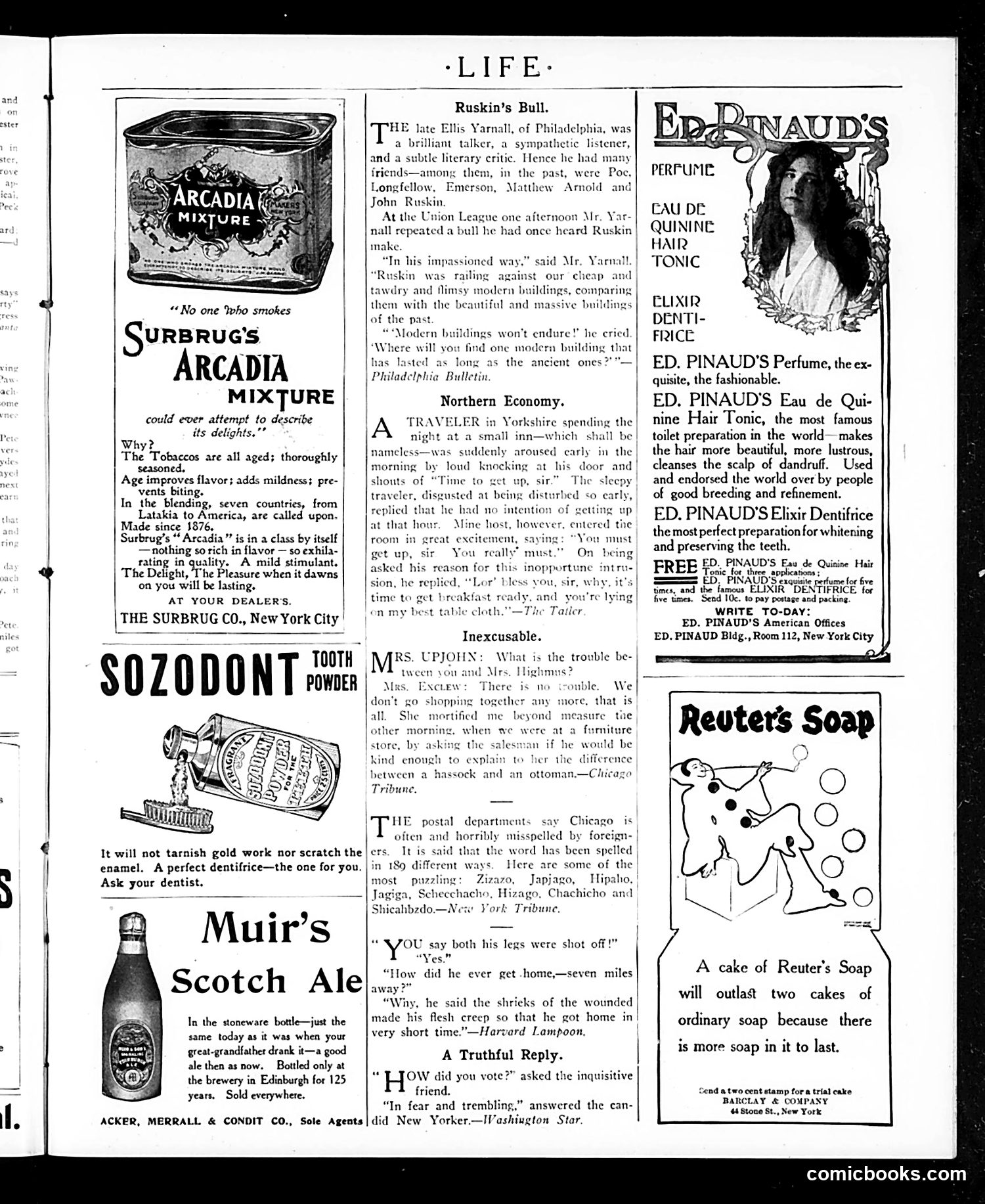
This page is primarily **advertisements** interspersed with brief satirical anecdotes typical of Life magazine's humor format. The ads promote consumer products: tobacco (Surbrug's Arcadia), toothpaste (Sozodont), Scottish ale (Muir's), perfume and grooming products (Ed. Pinaud's), and soap (Reuter's). The textual humor includes four short jokes: 1. **"Ruskin's Bull"**: References critic John Ruskin's complaint that modern buildings lack durability compared to ancient structures—social commentary on Victorian-era construction quality. 2. **"Northern Economy"**: A Yorkshire innkeeper rudely wakes a guest at dawn, claiming the traveler must vacate so the landlord can wash his tablecloth—satirizing rural stinginess and poor hospitality. 3. **"Inexcusable"**: A wife embarrasses her husband by asking furniture salesmen the difference between a hassock and ottoman—gentle satire on female ignorance of domestic terminology. 4. **"A Truthful Reply"**: A New Yorker admits voting "in fear and trembling"—dark humor about American democratic anxiety. These anecdotes represent Life's characteristic light social satire targeting middle-class pretension and behavior.
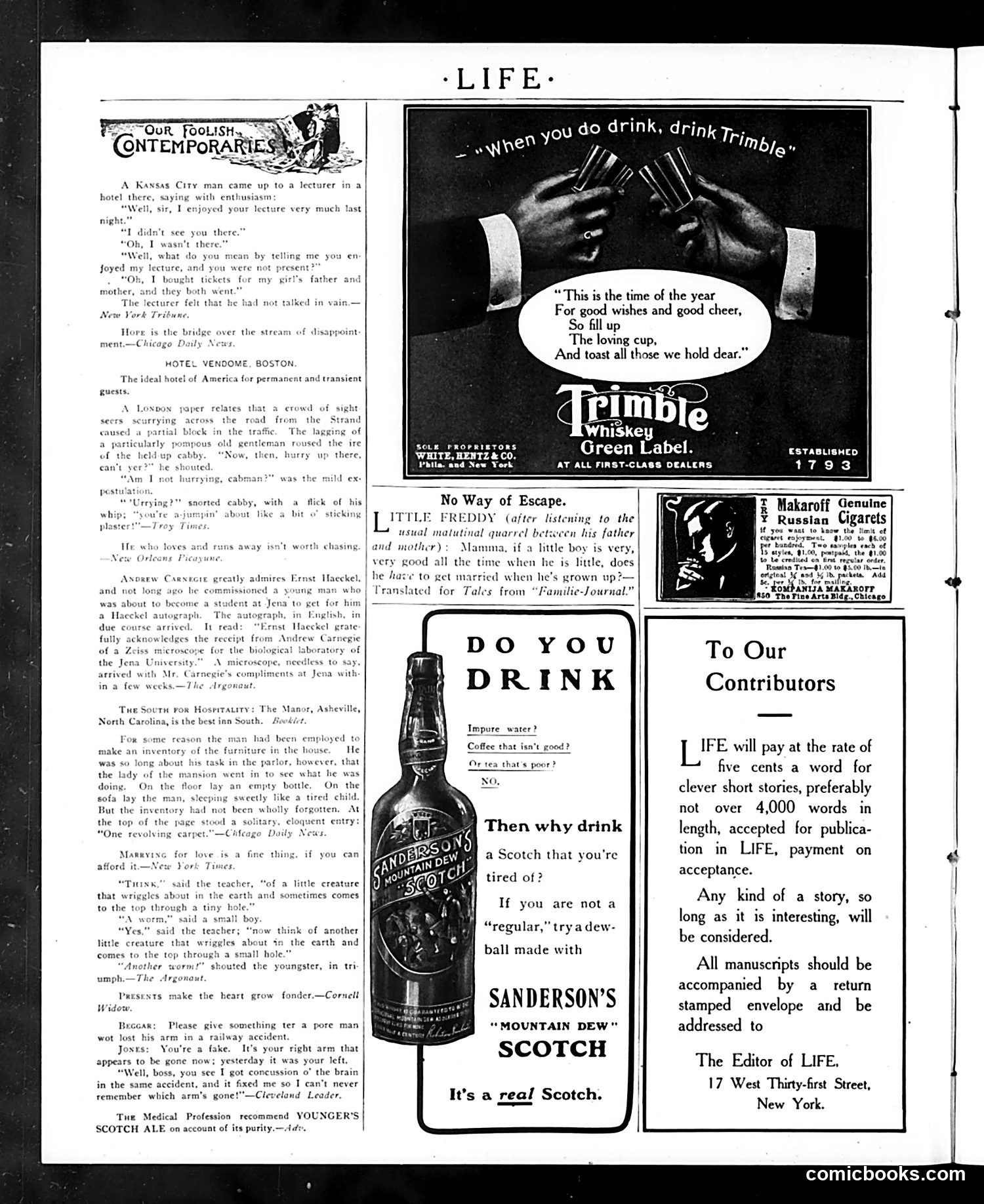
This page from *Life* magazine combines humor columns with period advertisements. The left side features "Our Foolish Contemporaries"—a recurring satirical section mocking absurd real-world anecdotes: - A Kansas City man claims he enjoyed a lecture he didn't attend - A London crowd blocks traffic; a porter tells them to "hurry up" - Andrew Carnegie commissions a Haeckel autograph for Jena University - A man loses inventory of household items - A child questions whether being very good means avoiding marriage These short jokes mock human foolishness and contradictions. The advertisements promote **Trimble Whiskey** and **Sanderson's Mountain Dew Scotch**, using holiday toasts and quality appeals. A small item mocks Russian cigarettes. The right side contains *Life*'s submission guidelines for short stories (five cents per word, under 4,000 words). The humor reflects early 20th-century American sensibilities about propriety, logic, and social behavior, while the whiskey ads indicate Prohibition hadn't yet begun (this predates 1920).
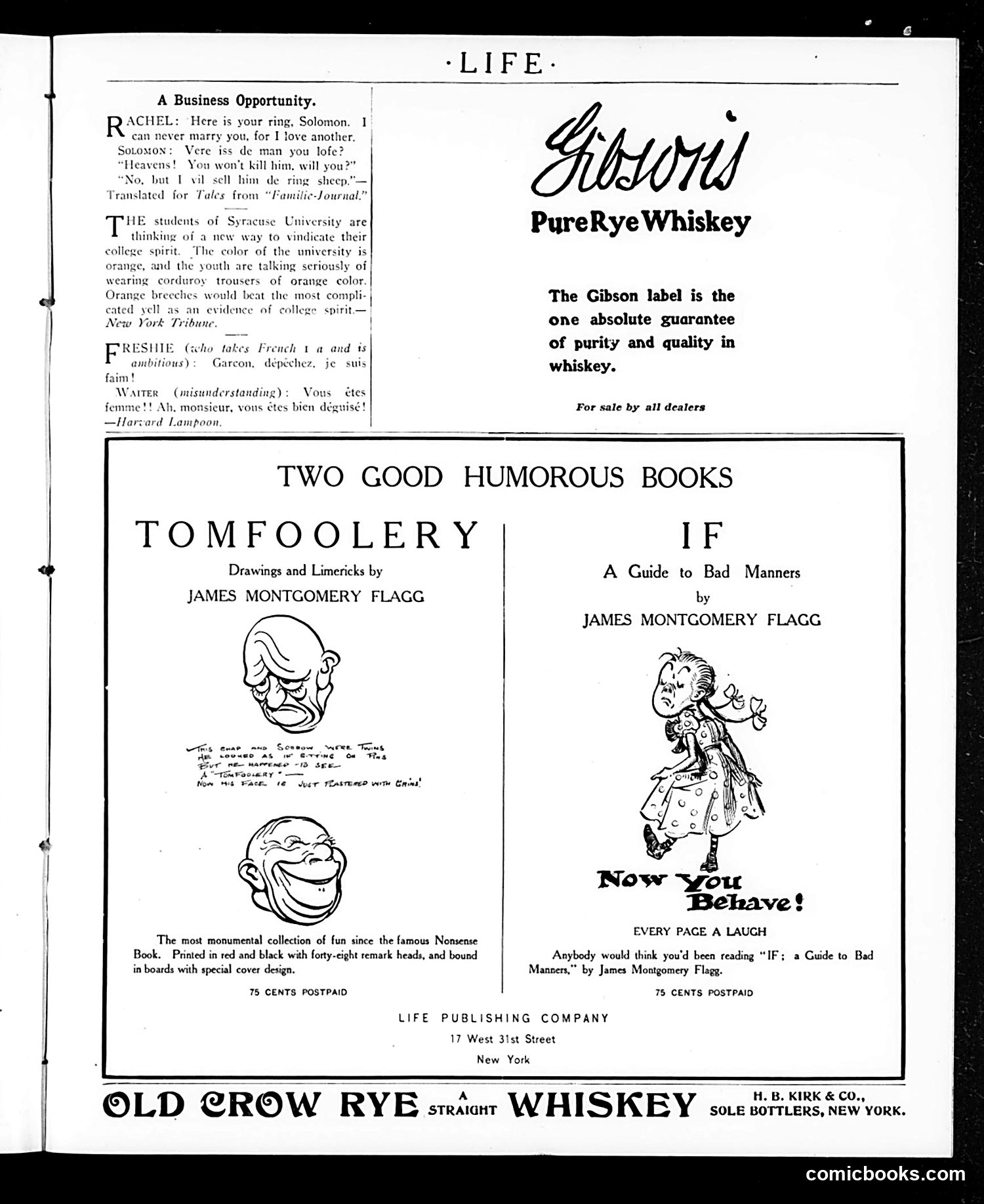
This page is primarily **advertising and book promotion** rather than political satire. At the top are brief humorous anecdotes (including a Yiddish-inflected joke about a man selling his rival "deri sheep" instead of killing him—playing on stereotypes of Jewish merchants). These appear to be filler content. The main content promotes two humorous books by **James Montgomery Flagg**, a famous American cartoonist and illustrator: *Tomfoolery* (drawings and limericks) and *If: A Guide to Bad Manners*. Both are advertised as collections of comic illustrations and witty commentary, priced at 75 cents postpaid. The page also contains advertisements for whiskeys (**Gibson's Pure Rye Whiskey** and **Old Crow Rye**), typical for Life magazine during the pre-Prohibition or early Prohibition era. The humor relies on caricature and exaggeration rather than contemporary political commentary—it's mainly product promotion disguised as editorial content.
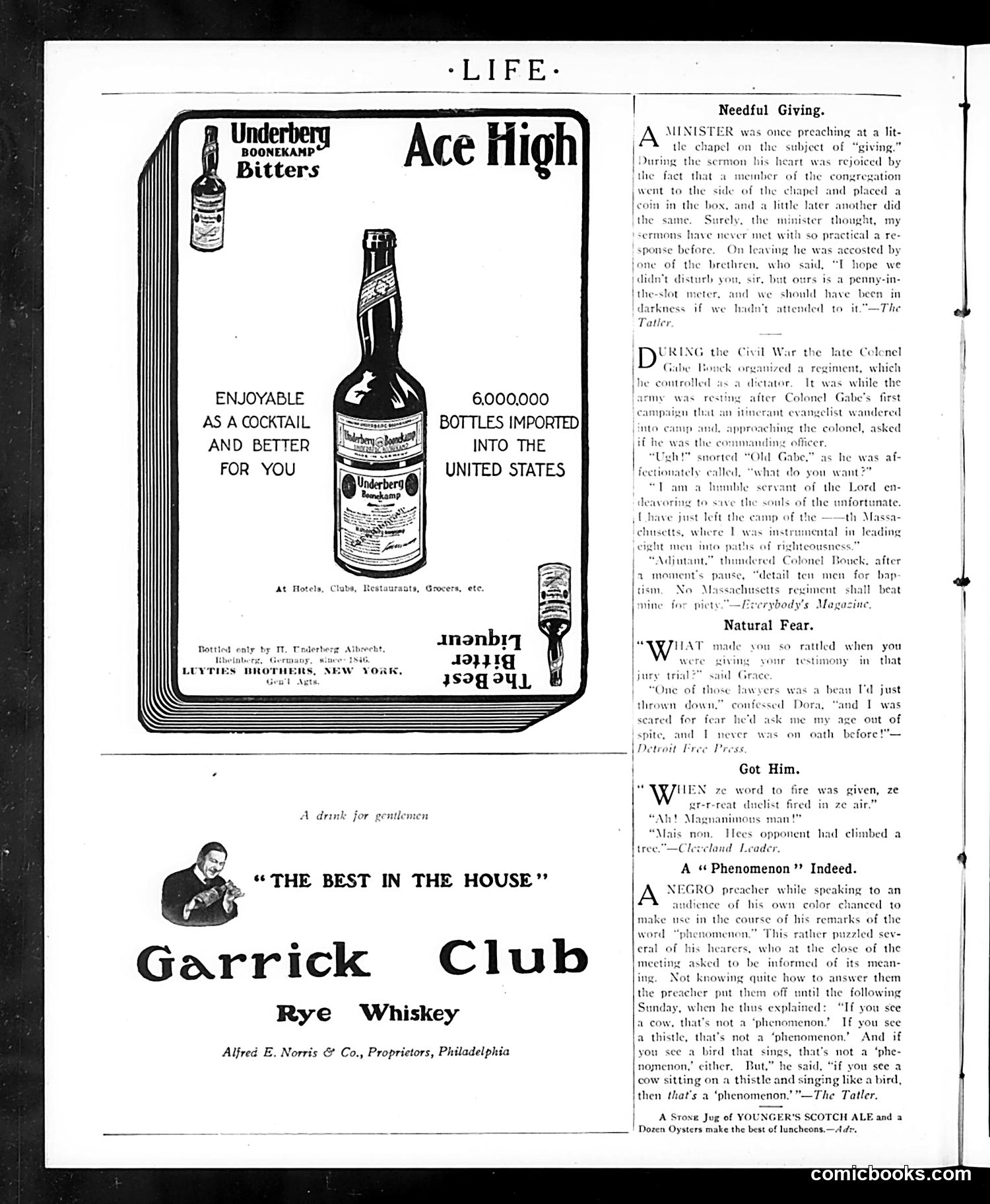
This page combines **advertisements and humorous anecdotes** typical of early 20th-century Life magazine. ## Advertisements The left side features liquor ads: **Underberg Bitters** (imported German digestif) and **Garrick Club Rye Whiskey**, marketed as gentlemen's beverages. These ads claim health benefits ("better for you") and cite impressive import numbers—reflecting pre-Prohibition American drinking culture. ## Humorous Stories (Right Side) The "Life" section contains four brief anecdotes satirizing human behavior: 1. **"Needful Giving"**: A minister rejoices at congregational donations, then learns the chapel uses a coin-operated heating meter—the "generosity" was mechanical necessity, not piety. 2. **Civil War story**: Colonel Gabe dismisses an evangelist's sanctimony; later orders ten men baptized to compete with a Massachusetts regiment's piety—satirizing competitive religiosity. 3. **"Natural Fear"**: A woman terrified by a lawyer who might ask her age reveals anxious vanity. 4. **"Phenomenon"**: A preacher's malapropism about what constitutes a remarkable occurrence, explained through absurdist logic. **Overall tone**: Gentle mockery of religious hypocrisy, vanity, and human foolishness.
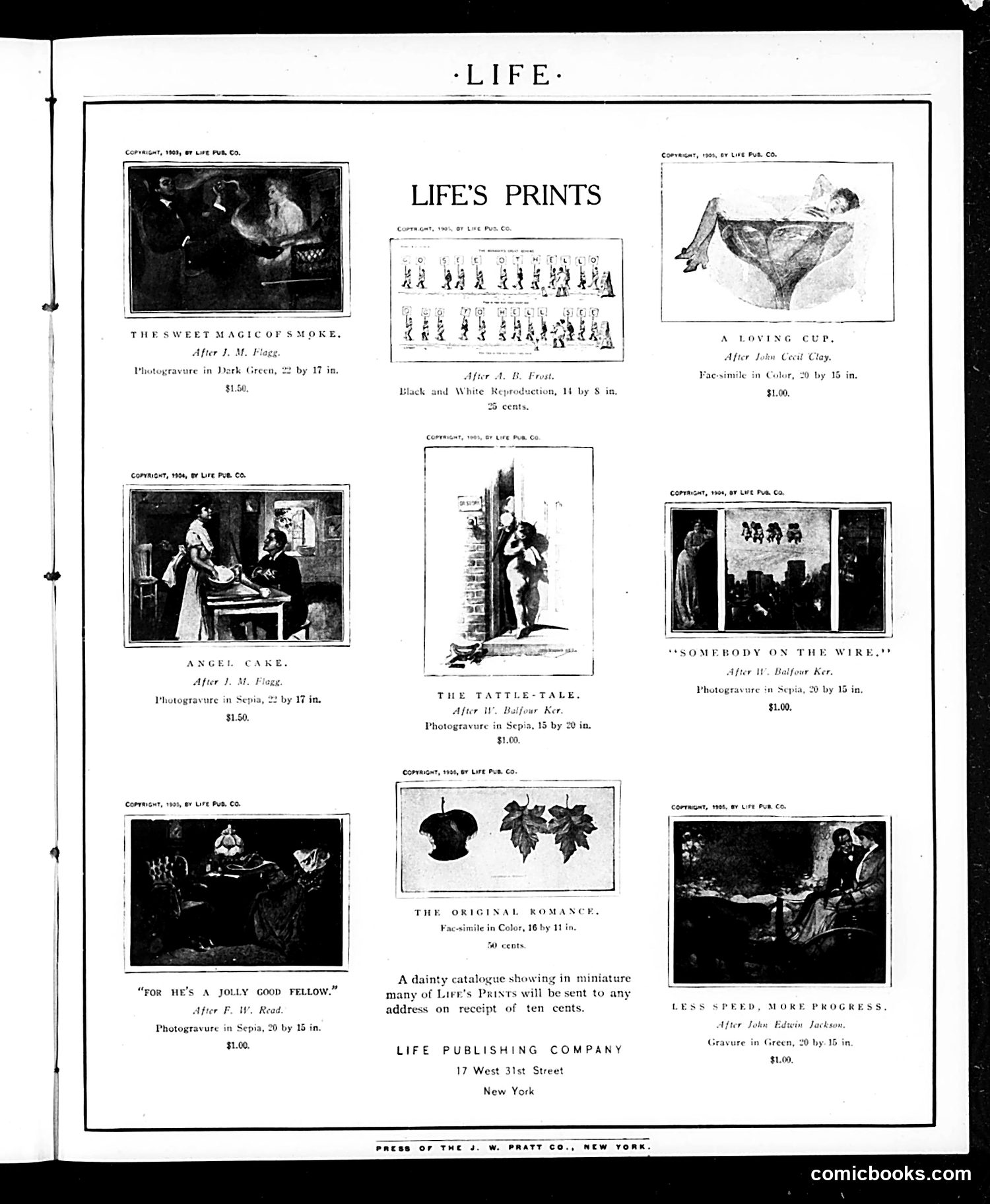
This is an advertisement page from Life magazine (circa 1904) showcasing available art prints for sale. It's not political satire but rather a catalog of reproducible artworks. The page displays eight different prints by various artists, each priced between 50 cents and $1.50. The titles suggest genre scenes and social humor typical of early 1900s illustration: "The Sweet Magic of Smoke," "Angel Cake," "A Loving Cup," and "Somebody on the Wire" depict domestic and social situations. "The Tattle-Tale" and "For He's a Jolly Good Fellow" appear to show interpersonal moments. "The Original Romance" depicts botanical imagery. These were commercial products—photogravures, facsimiles, and gravures in various colors and sizes—that Life Publishing Company sold to readers. The page includes a note offering a "dainty catalogue" of prints for ten cents. This represents Life's business model: combining satirical journalism with art sales to generate revenue.
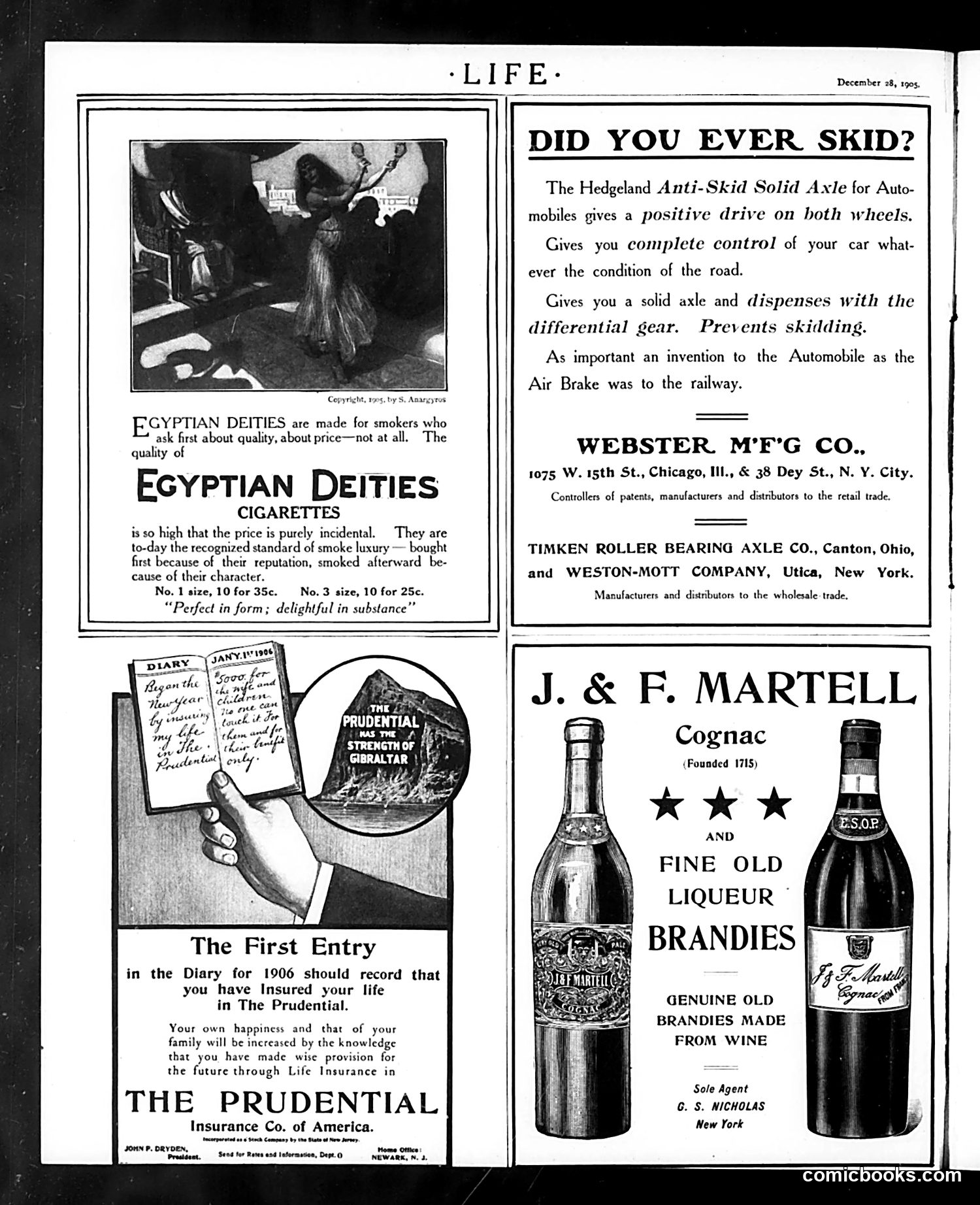
This is primarily an **advertising page** with no satirical content. Four product advertisements appear: 1. **Egyptian Deities Cigarettes**: Markets luxury cigarettes to quality-conscious smokers, emphasizing reputation and character over price. 2. **Hedgeland Anti-Skid Solid Axle**: Promotes an automobile safety device preventing wheel skidding, comparing its importance to railway air brakes—reflecting early automotive technology concerns. 3. **The Prudential Insurance**: Encourages life insurance as a New Year's resolution for 1906, appealing to family security and happiness. 4. **J. & F. Martell Cognac**: Advertises fine brandies established in 1715, distributed through a New York agent. The page reflects **early-1900s consumer culture**: luxury goods (cigarettes, spirits), emerging automobile safety innovations, and growing insurance markets. No political satire or caricature is present—this represents Life's commercial advertising content from the period.
I can see this is a page from Life magazine, but the image provided is essentially blank—predominantly white space with only minimal text visible at the bottom ("comicbooks.com") and some partial text along the left margin that's too unclear to read reliably. Without visible cartoon imagery, captions, or legible OCR text, I cannot identify specific figures, political references, or explain the satirical content as requested. To properly analyze this page, I would need a clearer image showing the actual cartoon(s), illustrations, and readable text. If you could provide a higher-quality scan or image, I'd be happy to offer the historical context and explanation you're seeking.