
A complete issue · 26 pages · 1905
Life — August 10, 1905
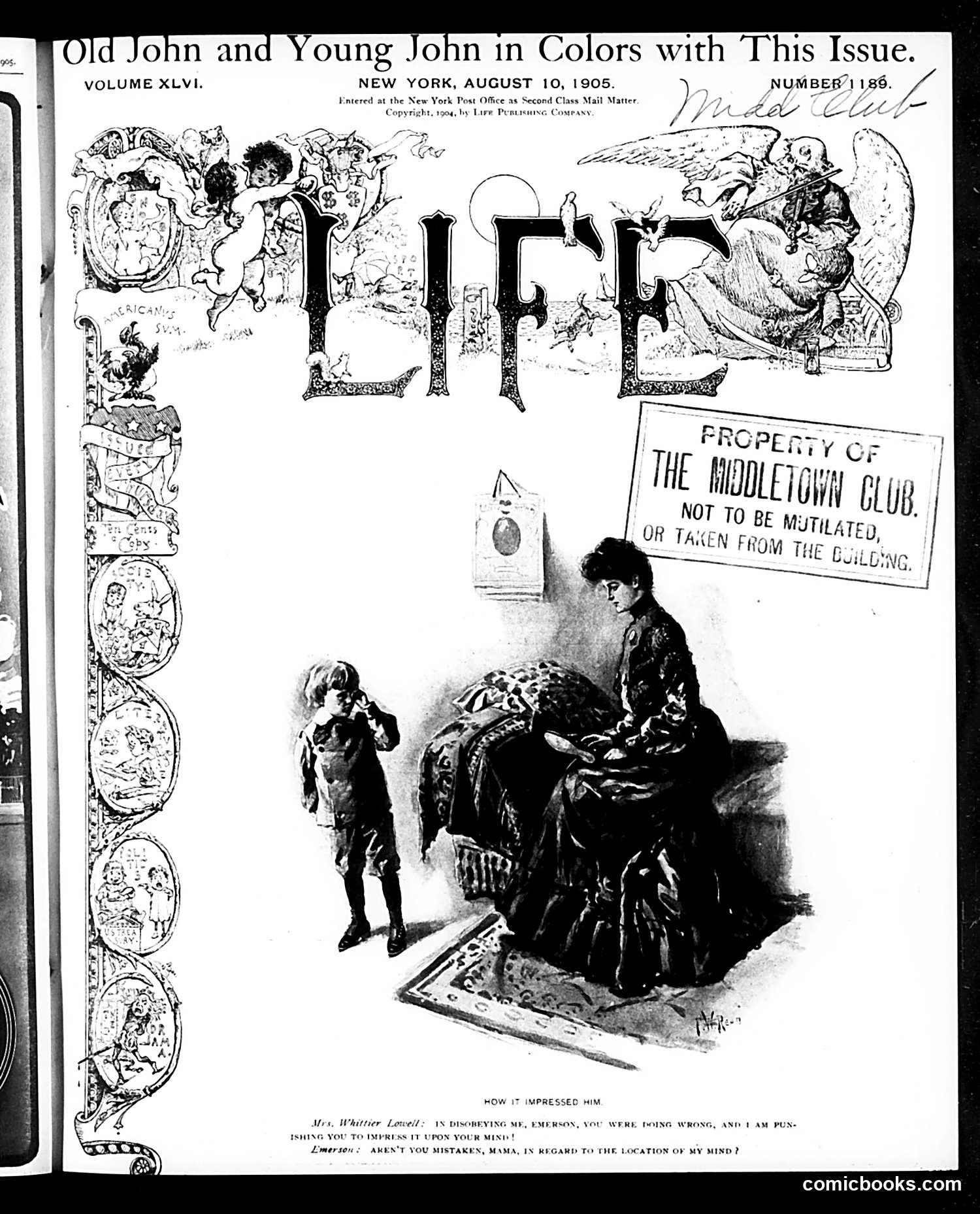
This issue's cover cartoon depicts a domestic scene titled "How It Impressed Him." A woman sits with a child, who appears distressed or crying. The dialogue indicates the child has been disciplined or corrected—the mother references "Emerson" and mistakes, suggesting the child made an error in judgment or behavior. The satire likely comments on child-rearing philosophy and education, possibly referencing Ralph Waldo Emerson's transcendentalist ideas about individualism and self-reliance. The caption suggests the mother believes she's teaching important lessons through correction, but the child's reaction shows the lesson "impressed" him differently than intended—a commentary on the gap between parental intentions and children's actual perception of discipline.
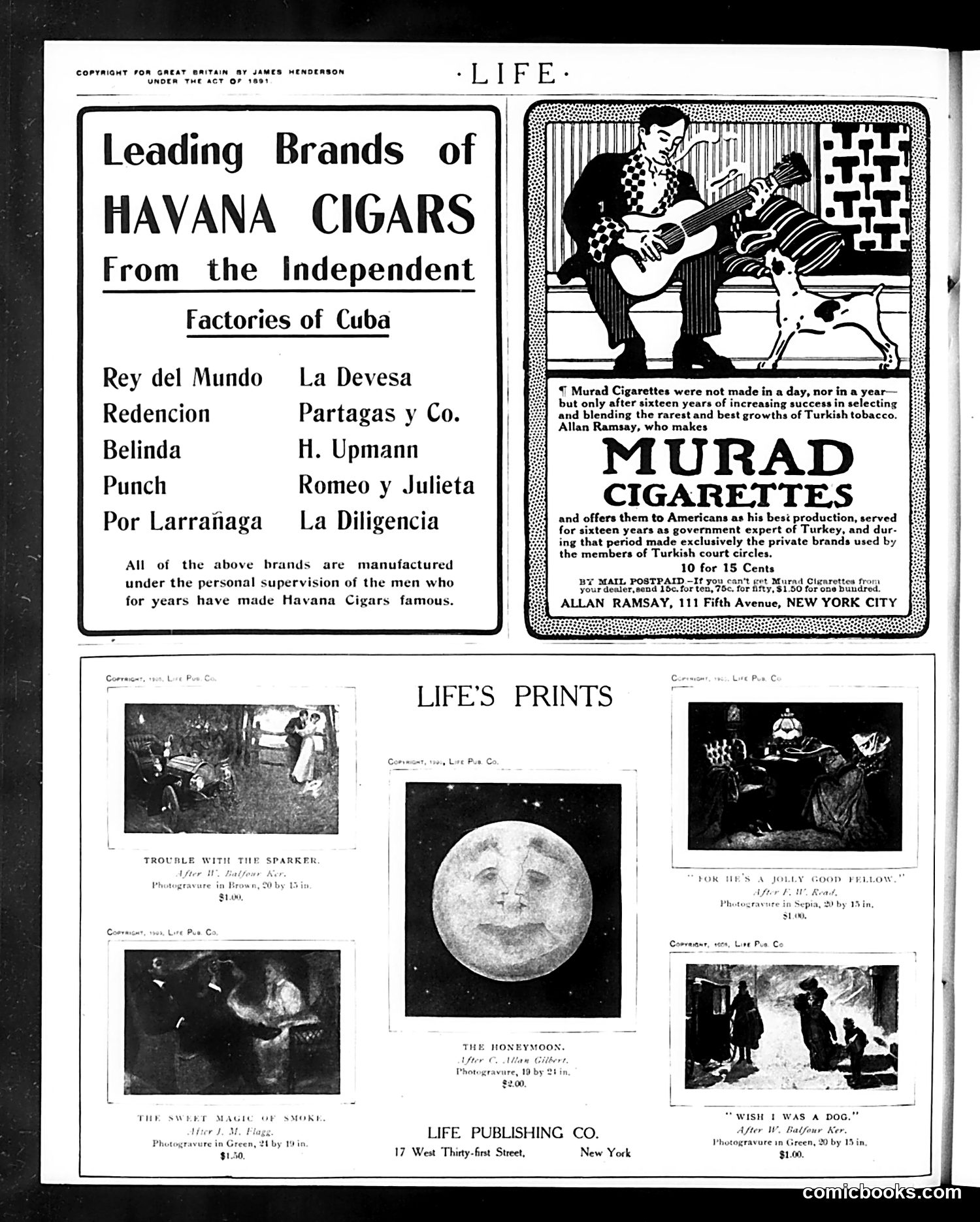
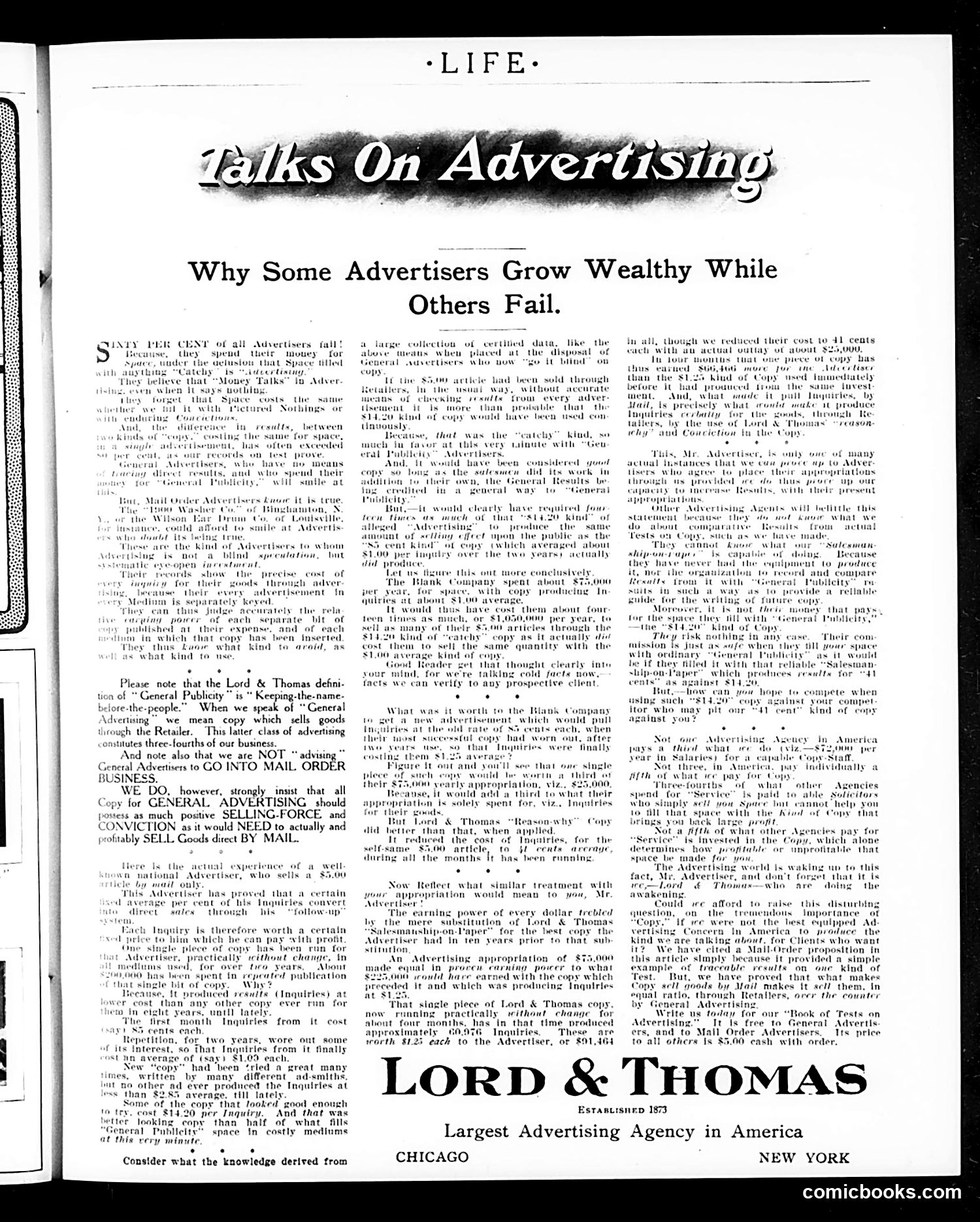
This page is primarily **advertising content** rather than editorial satire. It's a full-page advertisement by Lord & Thomas, an advertising agency established in 1873, claiming to be "Largest Advertising Agency in America" (with offices in Chicago and New York). The piece uses the framing device of "Talks On Advertising" to discuss why some advertisers succeed while others fail. It's essentially a lengthy sales pitch disguised as business journalism, arguing that Lord & Thomas's methods—emphasizing "General Publicity" and systematic cost analysis—produce superior results compared to competitors. The text references specific case studies and financial figures to demonstrate the agency's expertise, but these appear to be illustrative examples rather than satire. This represents early 20th-century **native advertising**, blending promotional content with informational tone to persuade potential clients.
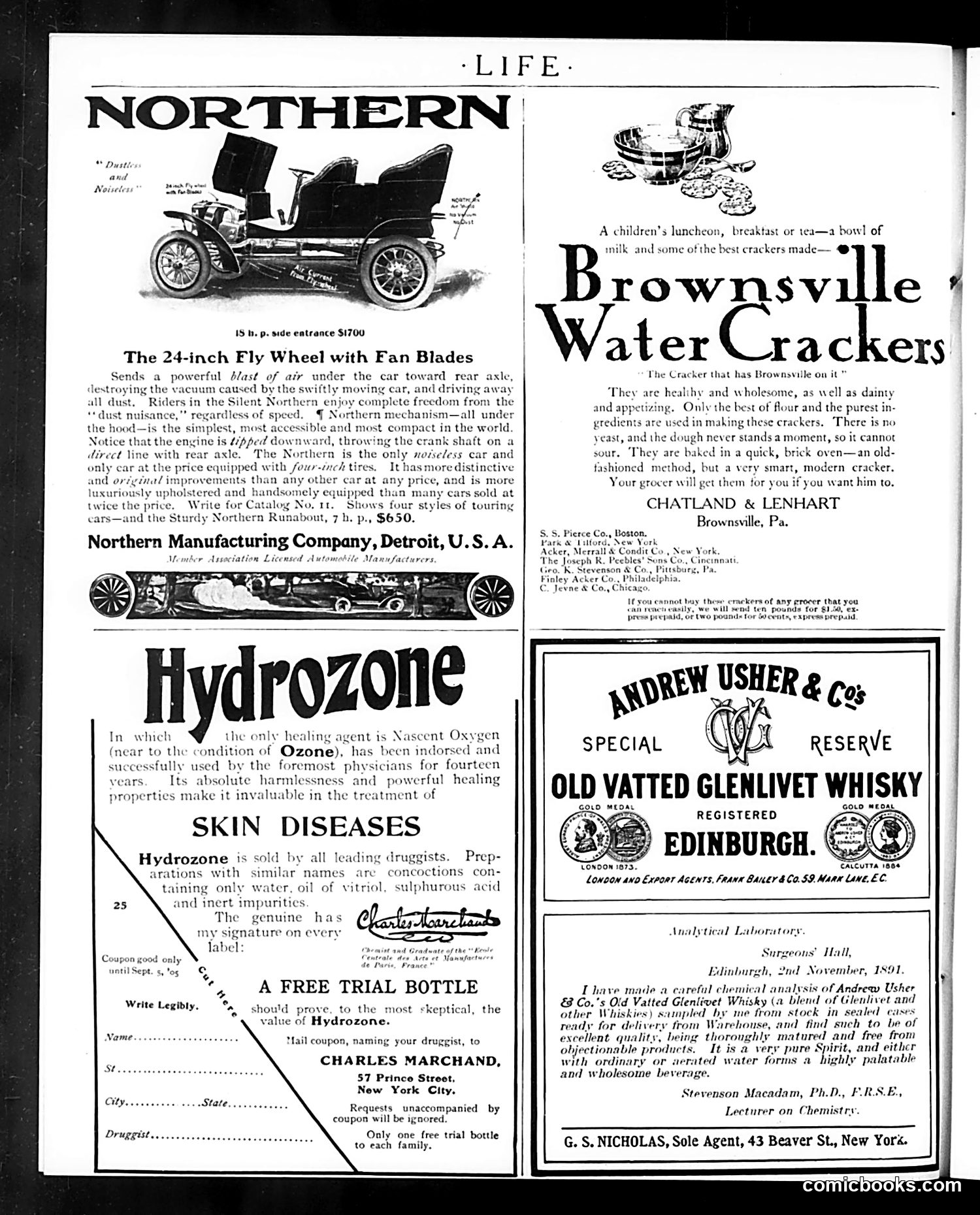
This page contains **no political cartoons or satire**. Instead, it consists entirely of **period advertisements** from approximately the early 1900s. The ads promote: - **Northern Manufacturing Company**: A 24-inch automobile with fan blades, marketed as "the only wireless car" and emphasizing its compact design - **Brownsville Water Crackers**: A food product advertised for children's meals - **Hydrozone**: A medicinal product claiming to treat skin diseases, sold by druggists - **Andrew Usher & Co's Old Vatted Glenlivet Whisky**: Scottish whisky with a chemical analysis certificate The page represents typical early-20th-century *Life* magazine advertising, showcasing consumer products of the era rather than editorial satire or political commentary.
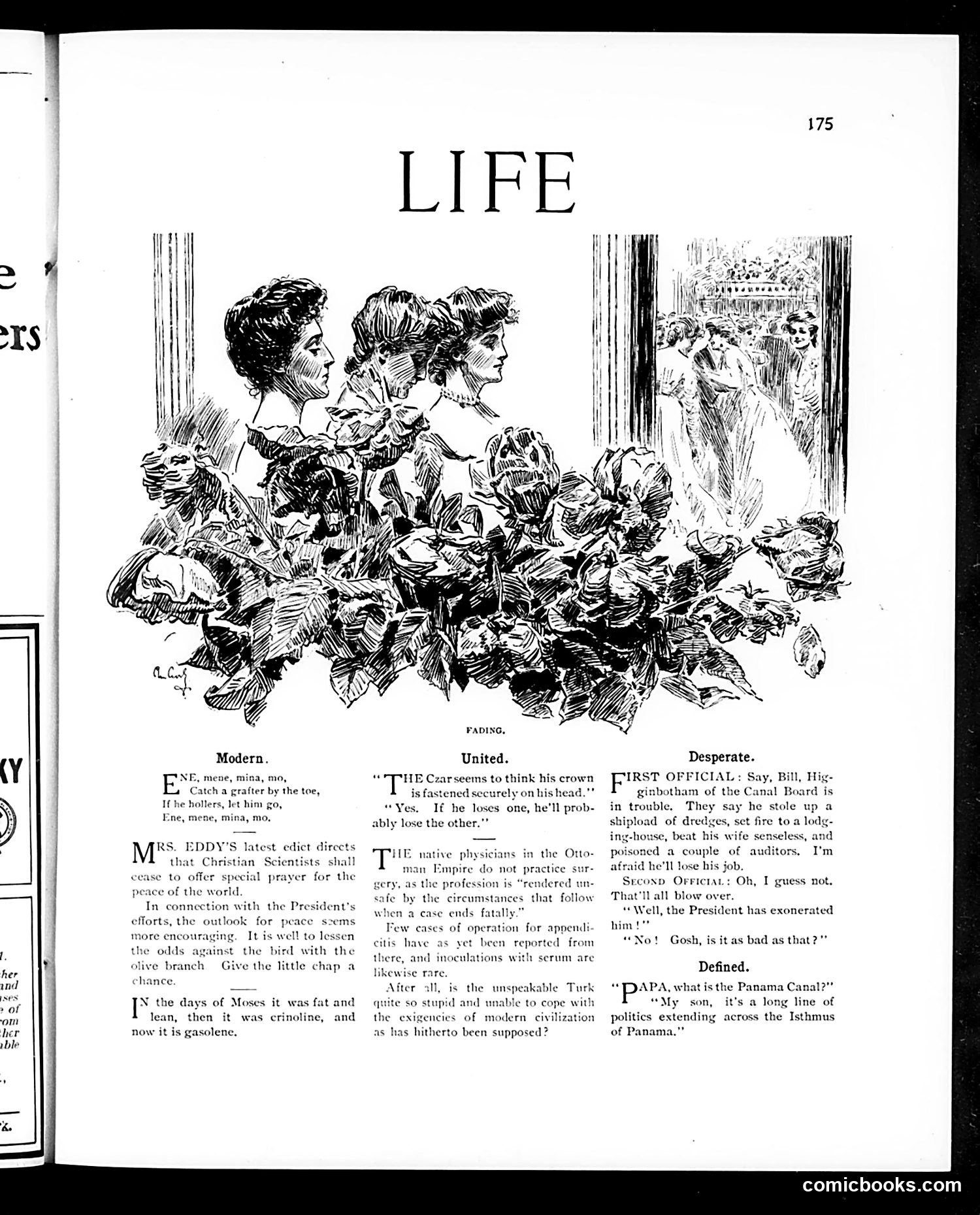
This page features three satirical commentary sections with a central illustration of three female figures surrounded by flowers, labeled "FADING." **"Modern"** mocks Christian Scientists' prayer practices for world peace. **"United"** references Ottoman Empire physicians and surgical practices, suggesting the "native physicians" lack modern safety standards—likely commentary on Turkey's perceived backwardness during an era of Western imperial attitudes. **"Desperate"** presents a dialogue about a Canal Board member facing job loss, possibly referencing the Panama Canal construction project. **"Defined"** offers a humorous definition of the Panama Canal as "a long line of politics extending across the Isthmus of Panama." The floral imagery with "FADING" suggests commentary on declining institutions or ideas, though the specific reference remains unclear without additional context about the publication date.
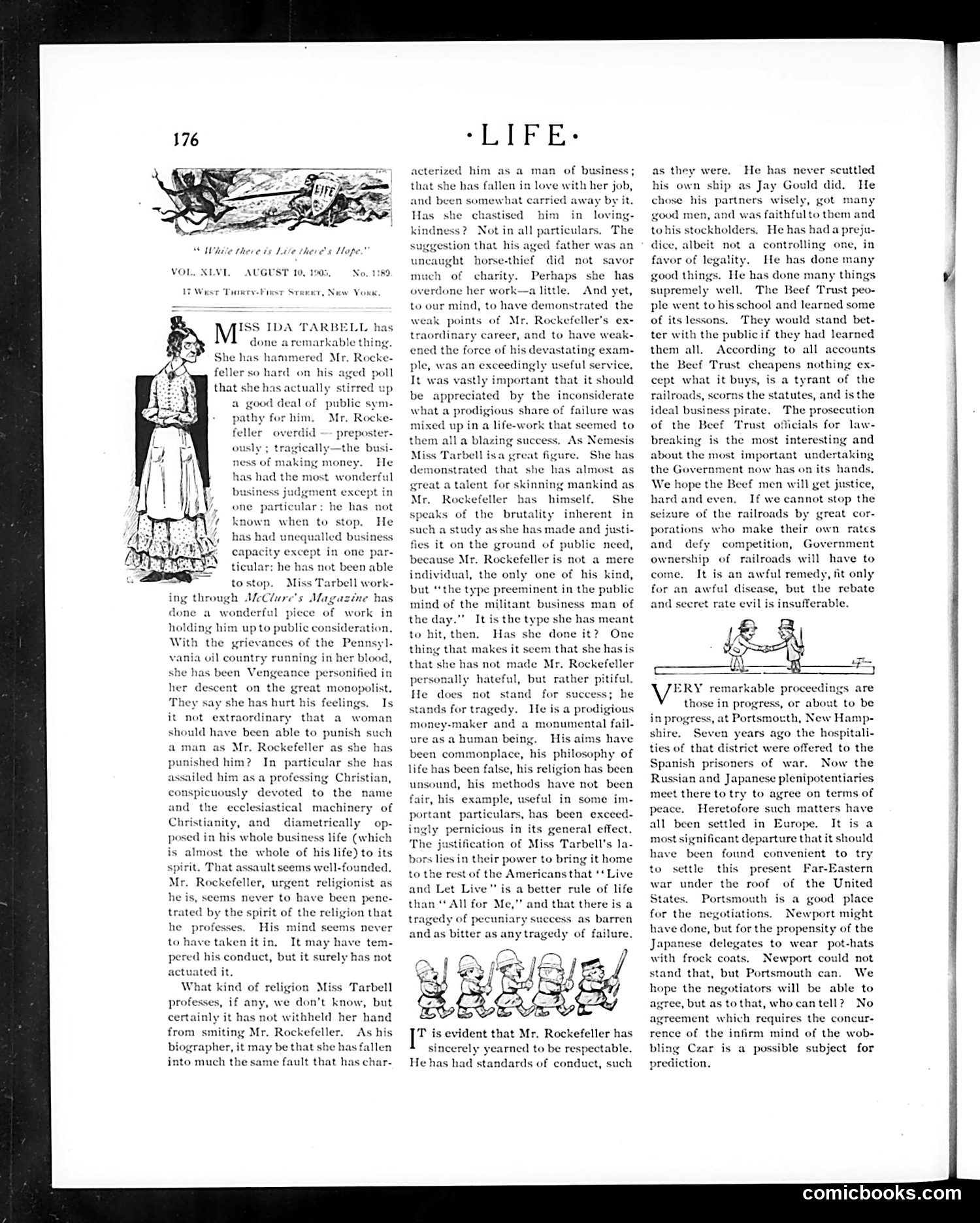
This page discusses Miss Ida Tarbell's critical biography of John D. Rockefeller. The text praises Tarbell for exposing Rockefeller's ruthless business practices through *McClure's Magazine*, noting she demonstrated his brutality and lack of ethical standards despite his wealth and power. The article argues Rockefeller represents a dangerous "type" of amoral businessman who uses militant methods to dominate industry. It contrasts his actual character (characterized as prodigious but fundamentally flawed) against his public reputation, suggesting his religion and professed values mask his true nature. The small cartoon illustrations appear decorative rather than satirical—they don't directly target specific figures but rather reinforce the text's broader critique of unchecked corporate power and the gap between public persona and private conduct.
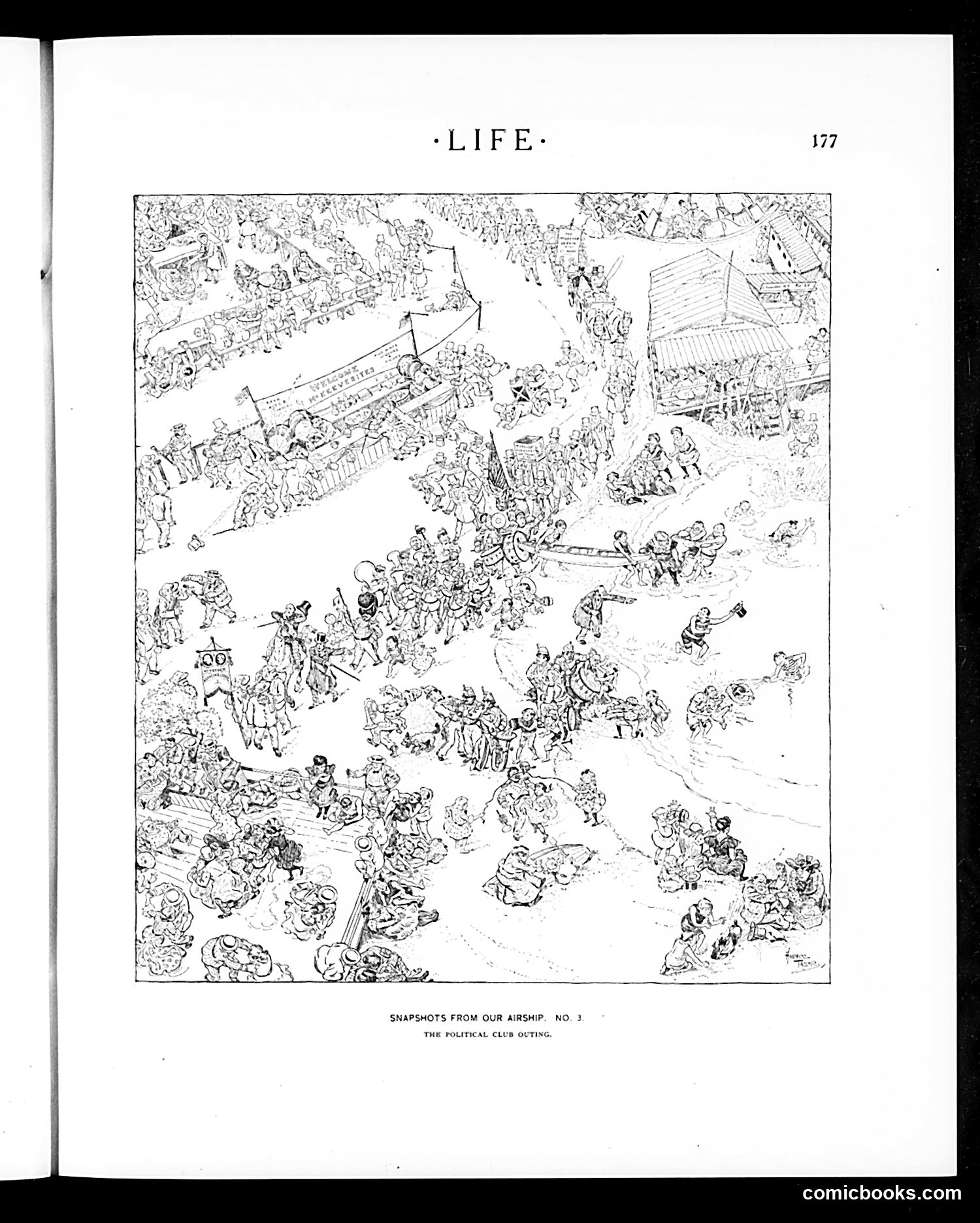
This is a satirical bird's-eye view of a political club gathering or outdoor event. The cartoon depicts dozens of figures engaged in various activities across a landscape—some appear to be fighting, arguing, or engaged in chaotic behavior, while others sit in groups or stand observing. The style suggests social or political chaos masquerading as an organized "outing." The satire likely mocks the dysfunction, infighting, and disorder within political organizations or clubs of the era. By presenting the scene from above (as if photographed from an airship), the artist emphasizes the absurdity and disorganization of the gathering. The title's deadpan tone—treating mayhem as a casual "snapshot"—enhances the satirical humor about political incompetence or internal strife.
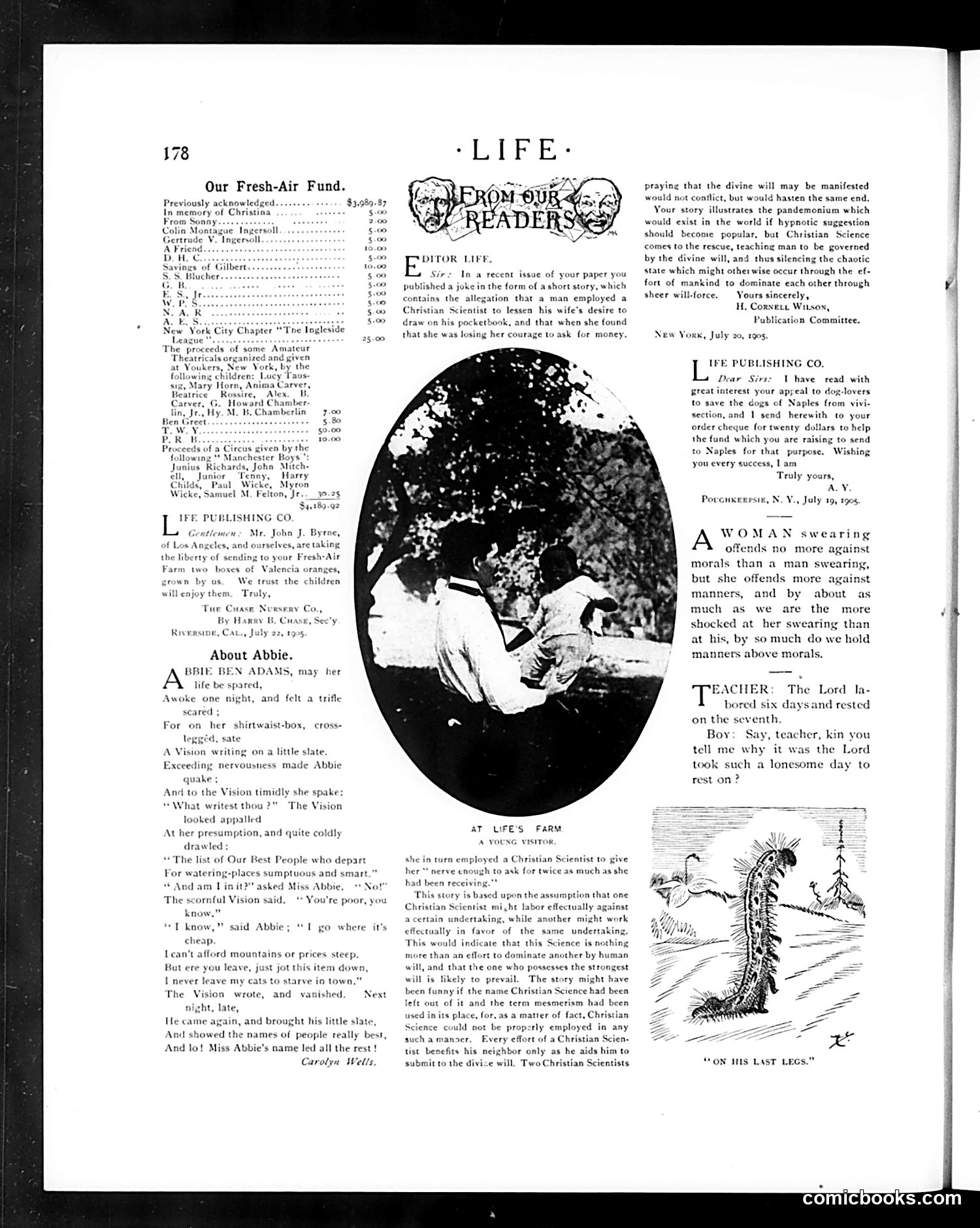
This page contains reader letters and editorial content rather than political cartoons. The main visual elements are: 1. **Two portrait heads** at the top framing "FROM OUR READERS" — likely decorative mastheads rather than specific caricatures. 2. **A large photograph** (not a cartoon) labeled "AT LIFE'S FARM — A YOUNG VISITOR," showing someone at a farm. 3. **A small sketch** labeled "ON HIS LAST LEGS" depicting a dying tree or plant. The text discusses Christian Science, including criticism of an earlier Life article containing "a joke...that a man employed in Christian Scientist to lessen his wife's desire to draw on his pocketbook." The editorial debates whether Christian Science should influence secular matters. This appears to be a **serious editorial discussion** about Christian Science's role in society, not satire.
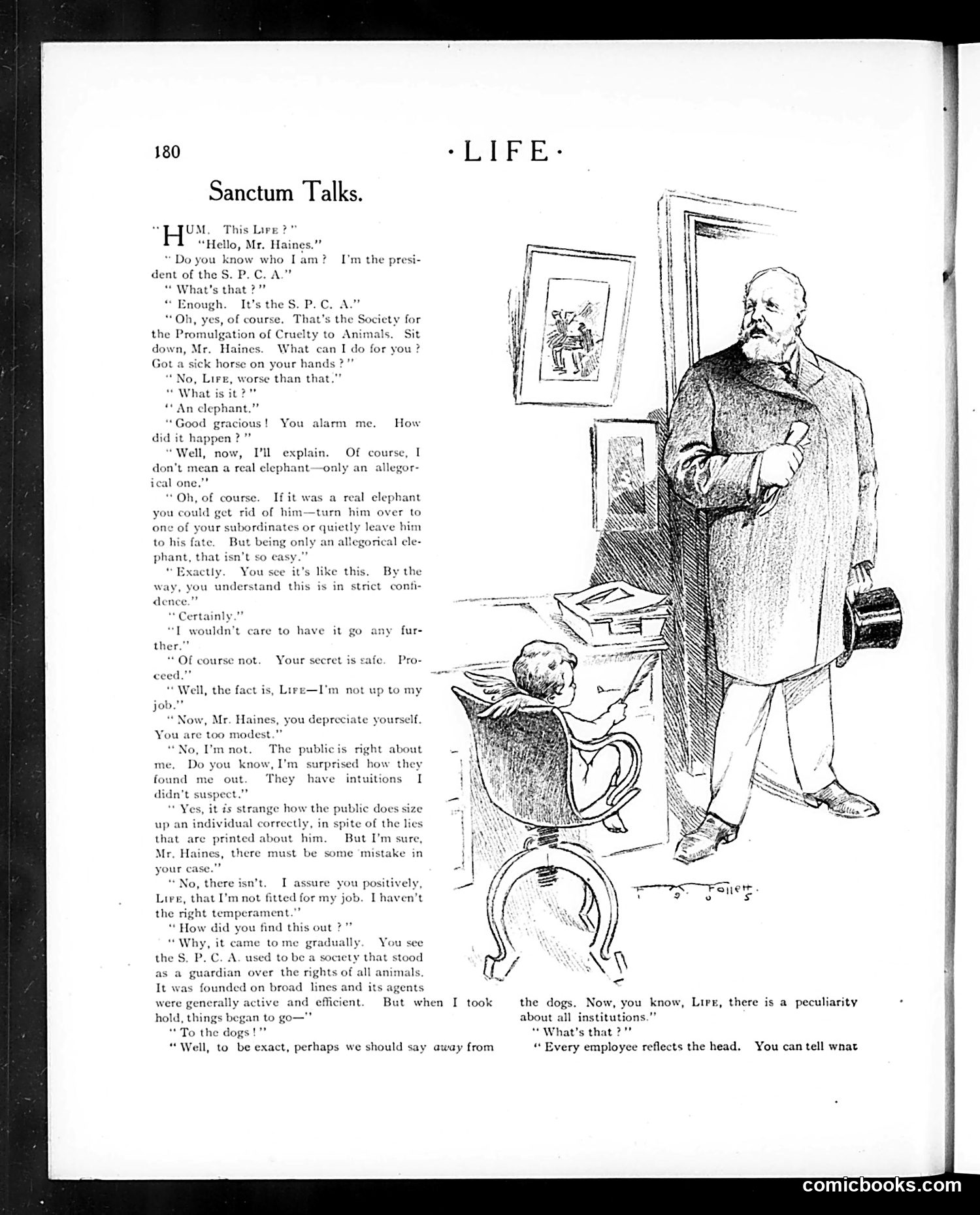
This satirical piece mocks the leadership of the Society for the Prevention of Cruelty to Animals (S.P.C.A.). The cartoon shows a well-dressed gentleman (identified as "Mr. Haines," apparently the S.P.C.A. president) speaking with "LIFE" magazine's representative. The joke centers on hypocrisy: Haines boasts about the S.P.C.A.'s noble mission protecting animals, but admits he personally keeps an "allegorical elephant"—a euphemism for a problematic situation he won't address. The satire suggests organizational leadership often fails to practice what it preaches and deflects responsibility downward rather than solving problems directly. The dialogue exposes disconnect between public principles and private failures in institutional management.
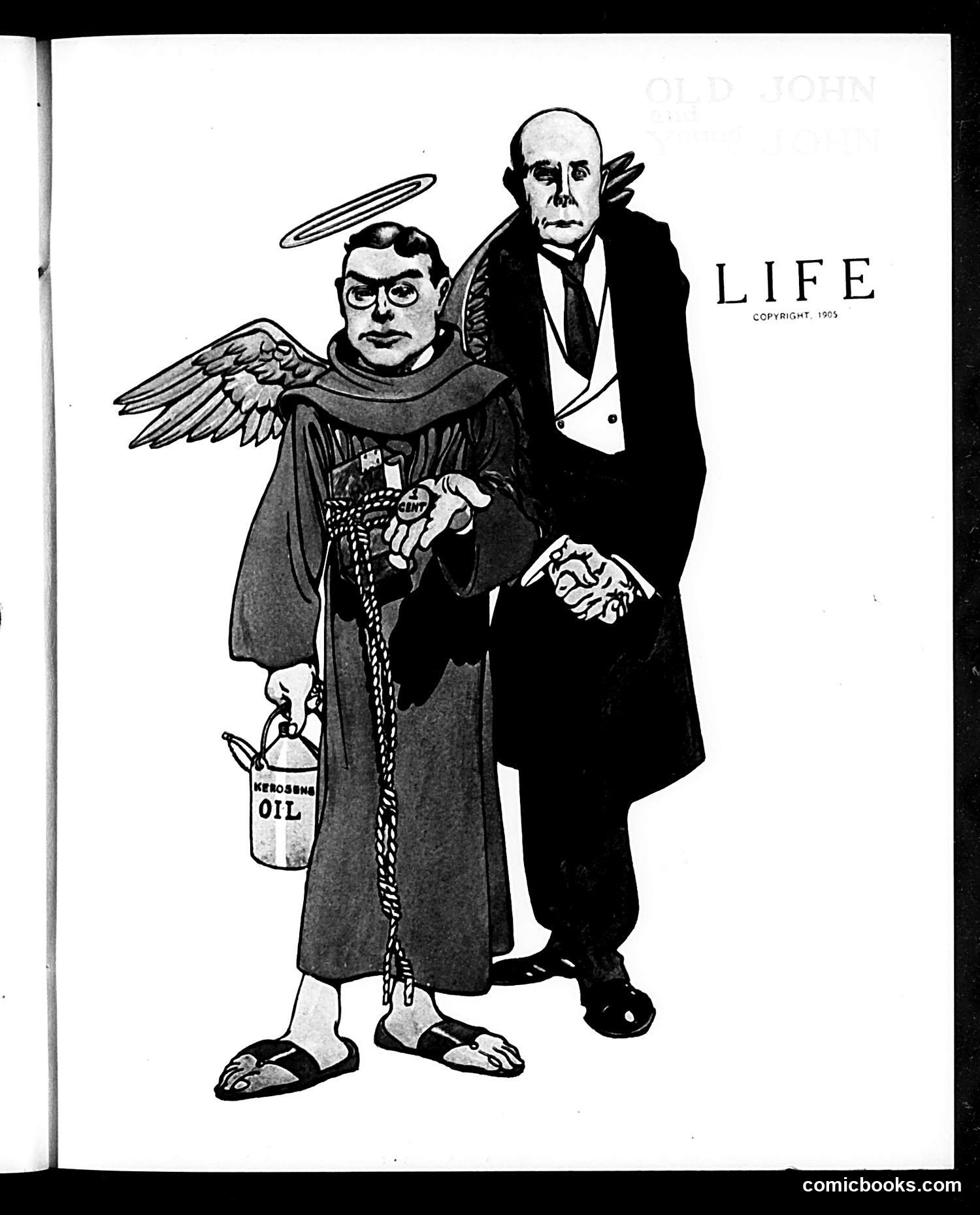
This satirical cartoon depicts two figures: an angel-winged cherub holding a bottle labeled "KEROSENE OIL" and a stern older gentleman in formal attire standing behind. The imagery appears to be political satire commenting on the oil industry and wealth accumulation around 1903. The cherub—representing either innocence corrupted or perhaps a sarcastic "saint" of commerce—holds kerosene oil, suggesting the petroleum business. The formal gentleman likely represents a wealthy industrialist or oil magnate. The juxtaposition satirizes how oil fortunes were being accumulated and mythologized as blessed or sanctified endeavors, when critics viewed them as exploitative. The "Old John" reference at page top may identify the subject, though context is unclear.

I can see this is a blank or nearly blank white page from what appears to be a historical publication. There is no visible cartoon, illustration, text content, or meaningful imagery present on this page—only the white paper with dark borders/binding visible on the left and bottom edges, and a website watermark ("comicbooks.com") in the bottom right corner. Without visible content to analyze, I cannot identify any figures, political references, or satirical points. This appears to be either a blank page from the original publication, a printing/scanning error, or a title/section divider page. To provide meaningful historical context and analysis, a page with actual cartoon or text content would be needed.
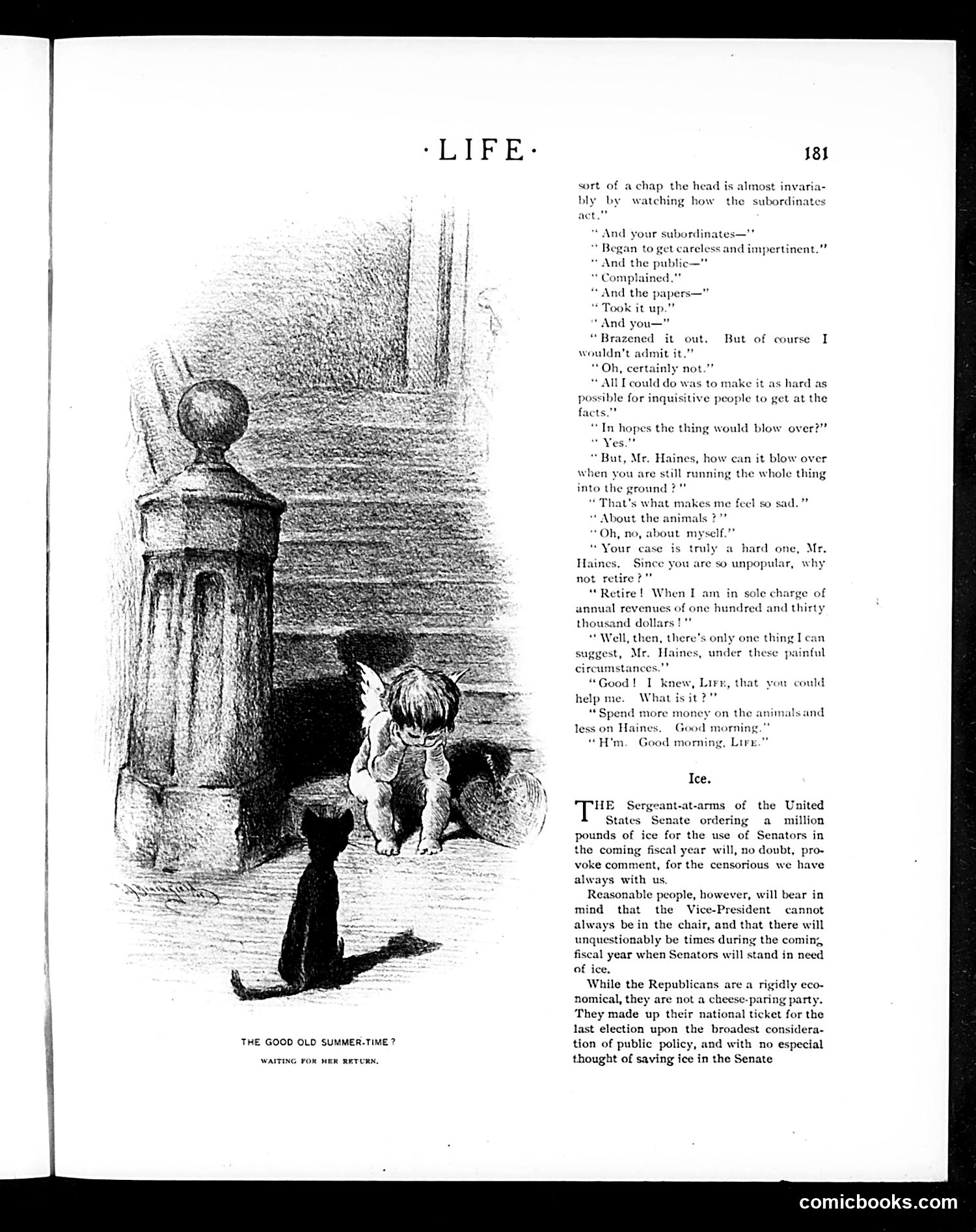
**The Cartoon:** "The Good Old Summer-Time? Waiting for Her Returns" depicts a woman and child waiting at a gate while a man stands apart—likely illustrating anxieties about a wife's extended absence during summer (possibly at a resort or vacation destination). **The "Ice" Article:** This is political satire about Senate spending. It mocks the Sergeant-at-Arms ordering a million pounds of ice for Senators' comfort during the fiscal year. The piece satirizes Republican claims of fiscal conservatism while noting they prioritize senators' comfort over budgetary restraint. The satire suggests hypocrisy: Republicans promote economical governance publicly while authorizing lavish perks like ice supplies for themselves privately.
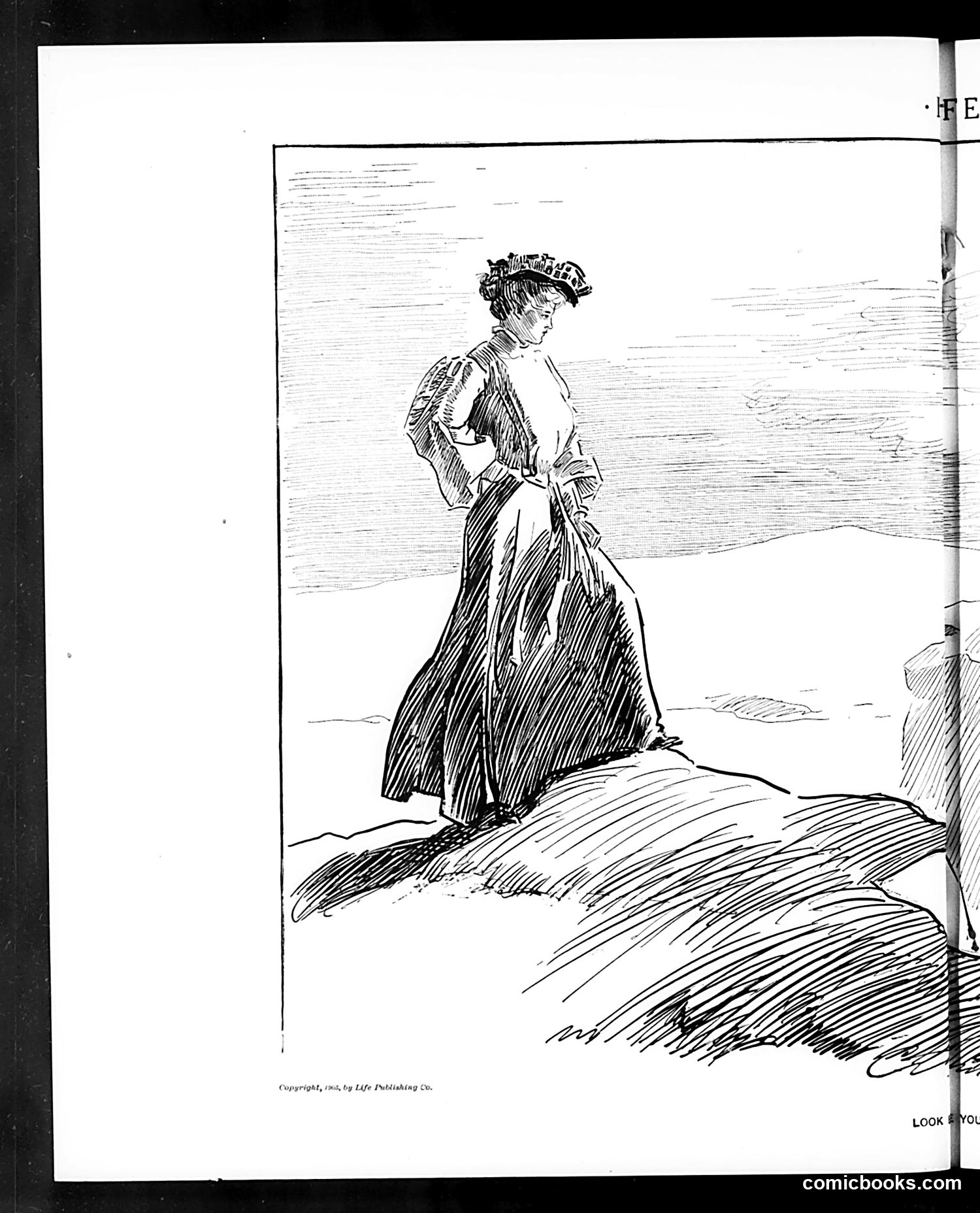
This is a pen-and-ink illustration from Life magazine (copyright 1905, by Life Publishing Co.). It depicts a fashionably dressed woman in early 1900s attire—a long skirt with horizontal striping, fitted jacket, and decorative hat—standing on what appears to be a beach or seaside setting. The illustration appears to be a straightforward fashion or society illustration rather than political satire. Without visible text identifying the figure or context on this page, the specific reference or satirical point is unclear. The refined drawing style and composition suggest it may be commenting on contemporary women's fashion, leisure activities, or social conventions of the Edwardian era, but the exact subject and intent cannot be determined from the image alone.
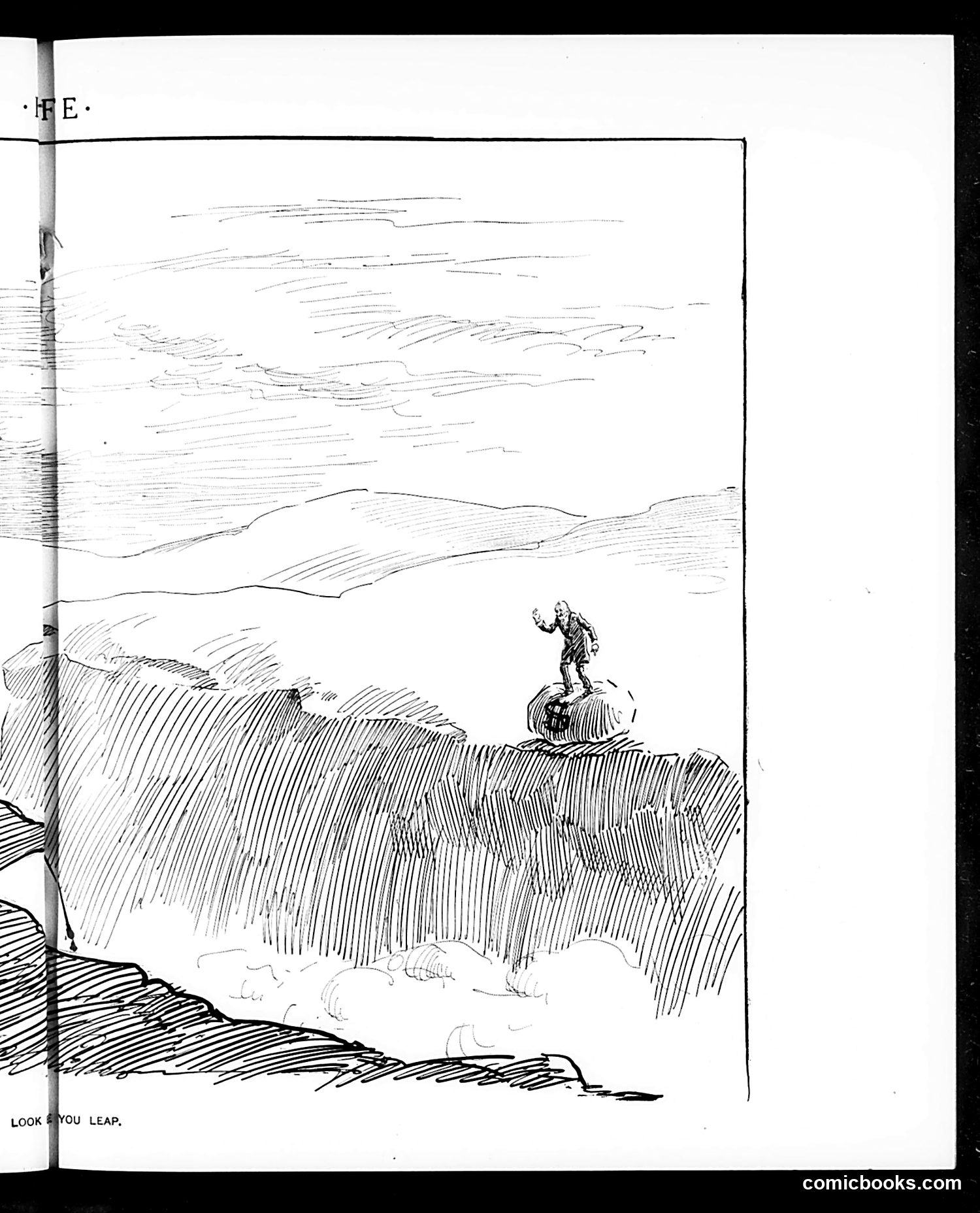
This is a single-panel cartoon titled "LOOK—YOU LEAP." It depicts a figure standing atop a precarious rocky outcrop, gesturing dramatically toward a vast, barren landscape below. The scene uses exaggerated line work to convey an expansive, desolate terrain. The cartoon appears to be satirizing either reckless ambition or blind faith in leadership—the figure seems to be urging someone to make a dangerous leap into uncertain circumstances. The phrase "Look—you leap" suggests persuasion toward a risky, potentially foolish action. Without additional context or identification of the specific figure, the exact political target remains unclear, though the composition suggests commentary on either political leadership encouraging public risk-taking or propaganda-like persuasion toward dubious ends. The stark landscape emphasizes the danger inherent in the proposed action.
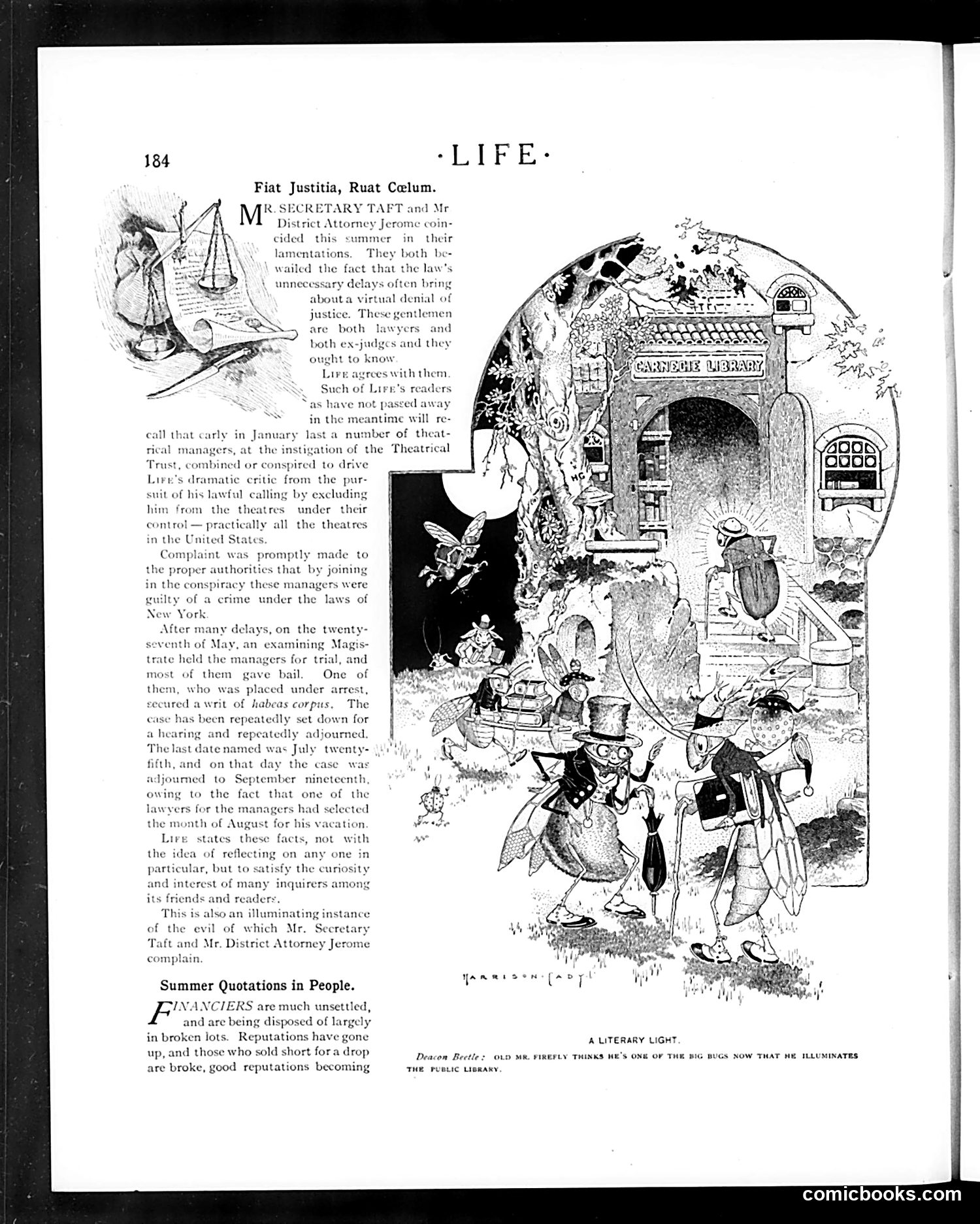
This *Life* magazine page satirizes legal delays and corruption. The main article critiques Secretary of War William Howard Taft and District Attorney Jerome for lamenting unnecessary court delays—while describing how *Life*'s own dramatic critic was excluded from theaters by the "Theatrical Trust" (a monopoly controlling New York theaters). Despite prompt complaint, the case has been repeatedly postponed; the latest adjournment occurred because a defense lawyer took August vacation. The satire is ironic: Taft and Jerome complain about justice delayed, yet the system they oversee enables exactly such obstruction. The illustration appears to depict a fantastical library or public institution. The "Summer Quotations" section mocks financiers during market turmoil. The bottom caption jokes that "Deacon Beetle" (a firefly character) now thinks himself important because he illuminates the public library—poking fun at pretentious self-importance.
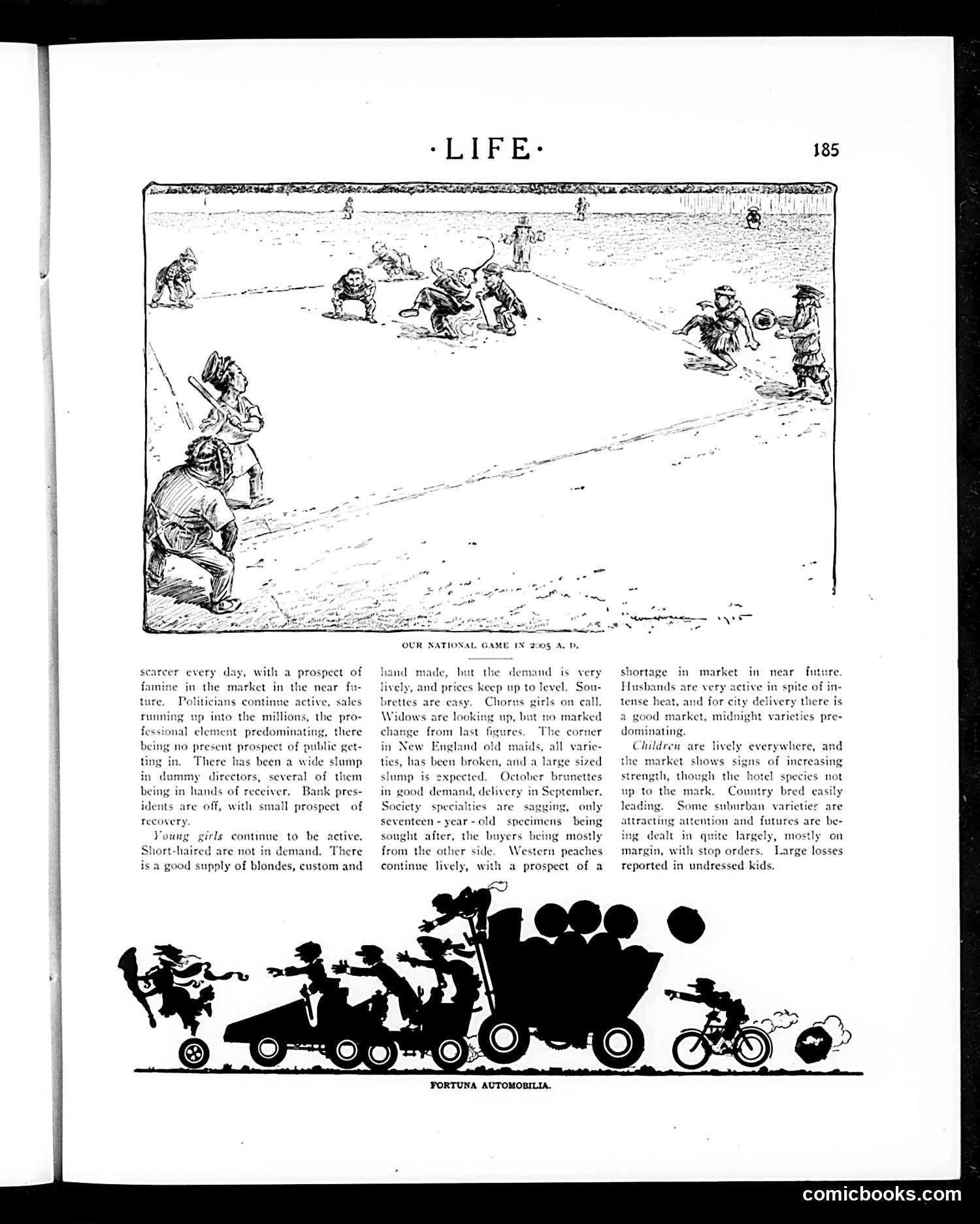
This page satirizes the commodification of women and marriage in early 20th-century America by presenting them as a stock market or livestock auction. The upper cartoon depicts children playing baseball ("our national game"), establishing the innocent baseline. The lower section, titled "Fortuna Automobilia," treats women as tradeable goods with market prices and demand fluctuations. Women are categorized by type (chorus girls, widows, brunettes, peaches, etc.) with clinical assessments of supply, demand, and delivery conditions—exactly as one would discuss agricultural or industrial commodities. The satire critiques how marriage and women's value were treated as economic transactions. "Husbands" and "Children" are similarly commodified, extending the joke to show the absurdity of reducing human relationships to pure financial calculation. The automobile imagery suggests modernity colliding with outdated attitudes about women as property to be bought and sold.
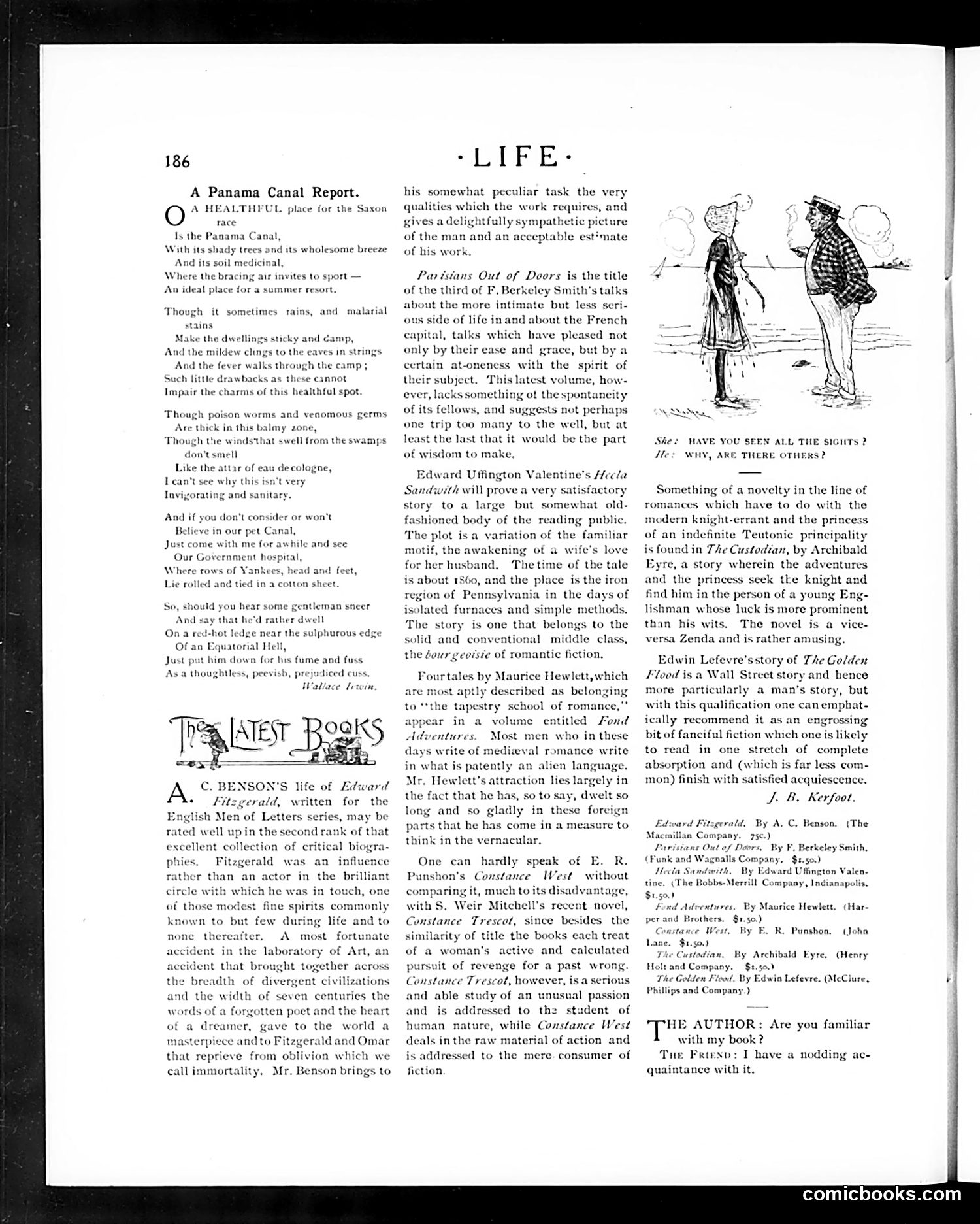
This page contains satirical poetry mocking the Panama Canal as a summer resort destination. The poem ironically praises the Canal zone as "healthful" and "invigorating," while actually describing its genuine hazards: malaria ("malarial stains"), mildew, fever, "poison worms and venomous germs," and swamps that stink. The final cruel joke references a government hospital where American workers ("rows of Yankees") lie dead or dying, wrapped in cotton sheets. The satire targets both the Canal project's promoters (who downplayed its dangers) and American confidence in the enterprise. The accompanying illustration shows two figures observing this grim scene. The remainder of the page reviews contemporary books, including works by C. Benson and E. R. Punshon—content unrelated to the satirical cartoon.
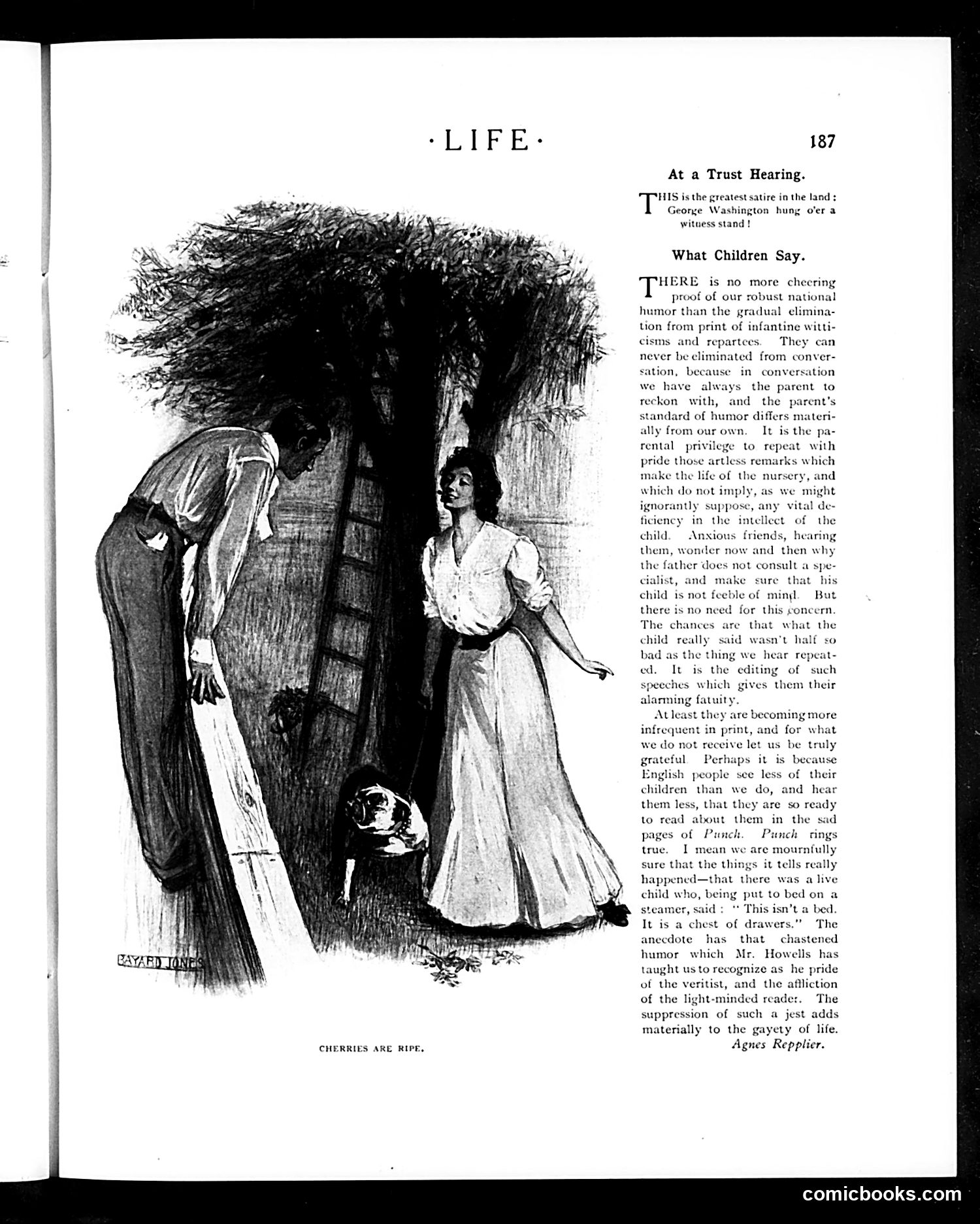
This page contains two distinct pieces from *Life* magazine (page 187): **"At a Trust Hearing"** (cartoon): The illustration shows a woman testifying in court beneath a portrait of George Washington. The caption sarcastically notes that having Washington's image presiding over a witness stand represents "the greatest satire in the land"—likely referencing the irony of corporate trust hearings (antitrust litigation was a major issue in the early 1900s) occurring under the watchful gaze of the nation's founder who stood for honest governance. **"What Children Say"** (essay by Agnes Repplier): A prose piece lamenting the disappearance of children's witticisms from printed publications. Repplier argues that while parents naturally edit and exaggerate children's remarks when repeating them, removing these stories from print (particularly from *Punch* magazine) diminishes life's humor. She suggests English parents see their children less than Americans do, explaining why fewer such anecdotes appear in British publications. The illustration titled "Cherries Are Ripe" appears unrelated to either article.
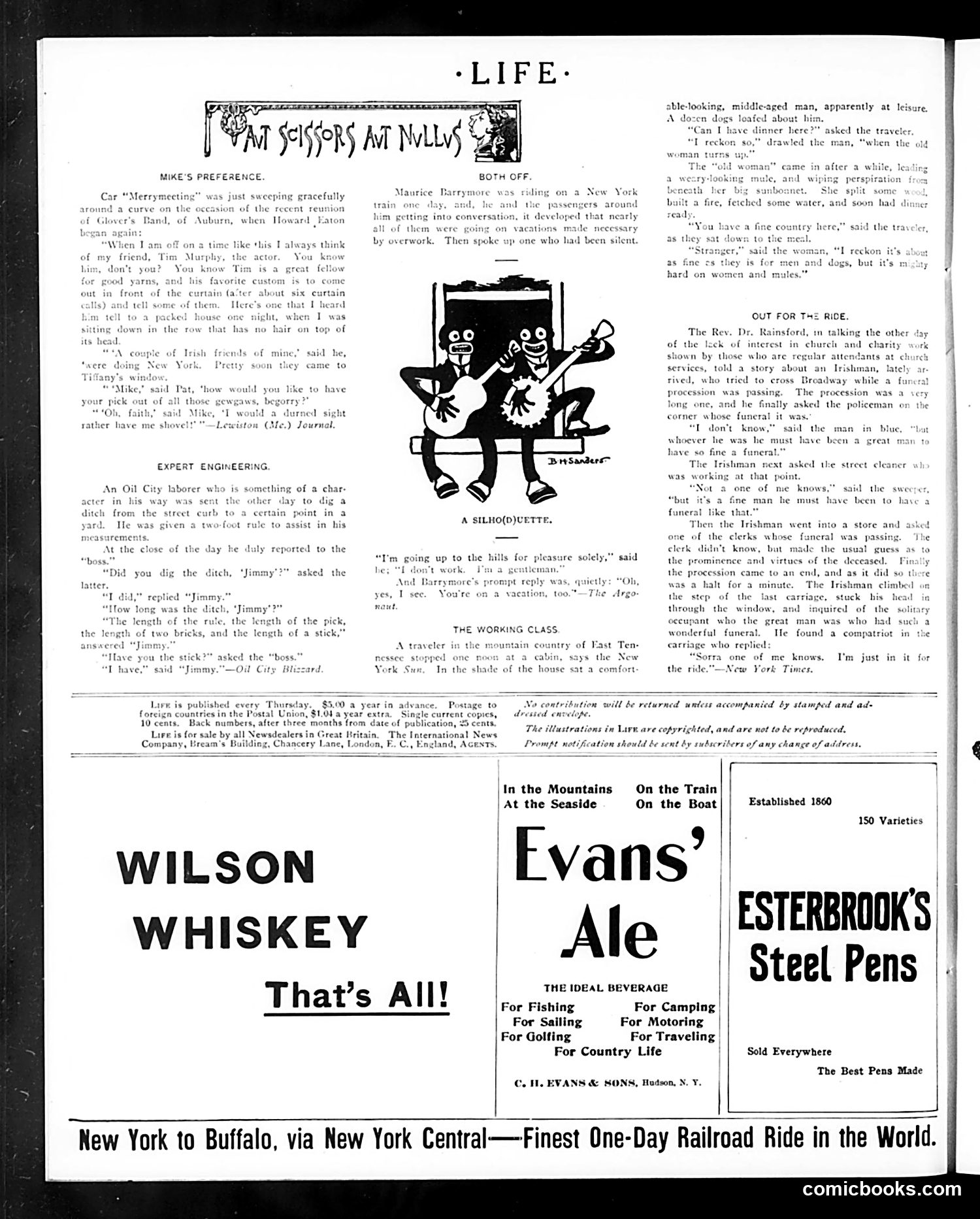
This page contains **multiple short humorous anecdotes** rather than a political cartoon, reflecting Life's satirical format of the era. The stories mock various social types: an actor's pretentious name-dropping about Irish friends visiting New York; an oil-field worker's literal-minded approach to engineering tasks; and a lengthy Irish-themed narrative about an Irishman attending a stranger's funeral, progressively asking different people who the deceased was—each answer more vague than the last, culminating in him climbing into the coffin to see for himself. The humor relies on **ethnic stereotyping** (the Irish are portrayed as simple or dim-witted) and **class-based comedy** about working-class men and their literal interpretations of language and social conventions—typical of early 20th-century American magazine humor. The page is primarily **advertisements** (whiskey, ale, steel pens, and railroad travel) surrounding the text content, which was standard for Life's revenue model.
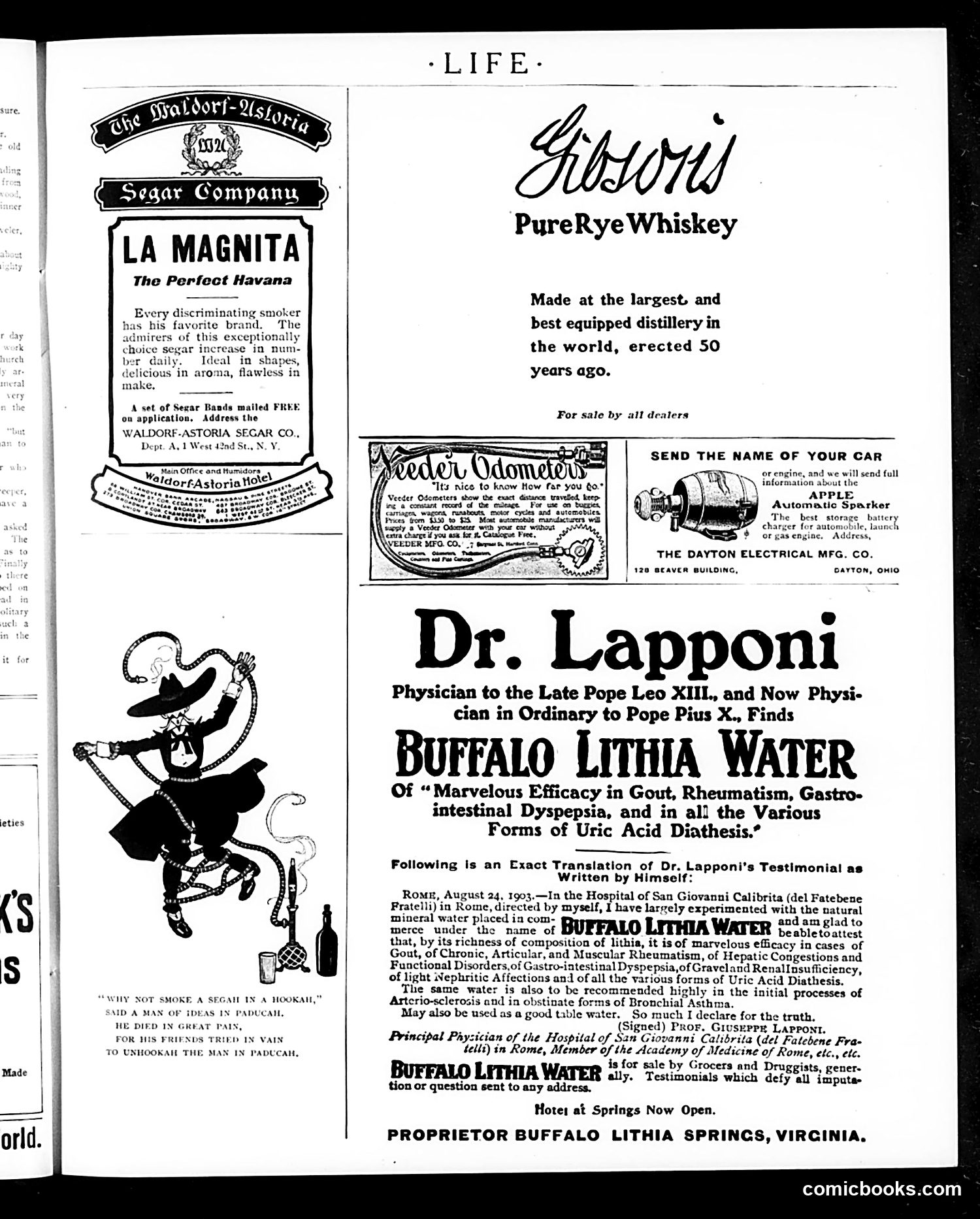
This page is primarily **advertising**, not satire or political commentary. It contains multiple product advertisements typical of early 1900s publications: **Main Advertisement**: Buffalo Lithia Water, endorsed by Dr. Lapponi, physician to Popes Leo XIII and Pius X. The testimonial claims miraculous efficacy for gout, rheumatism, and various ailments—typical of patent medicine marketing before FDA regulation. **Other Ads Include**: - La Magnita cigars ("The Perfect Havana") - Gibson's Pure Rye Whiskey - Veeder Odometers for automobiles - Dayton Automatic Sparker (car battery charger) **The Small Cartoon** (lower left) shows a man smoking a hookah in Paducah with a nonsensical rhyme about being unable to remove the hookah—this is absurdist humor rather than satire. The page reflects turn-of-century consumer culture and unregulated medical claims that would be illegal today.
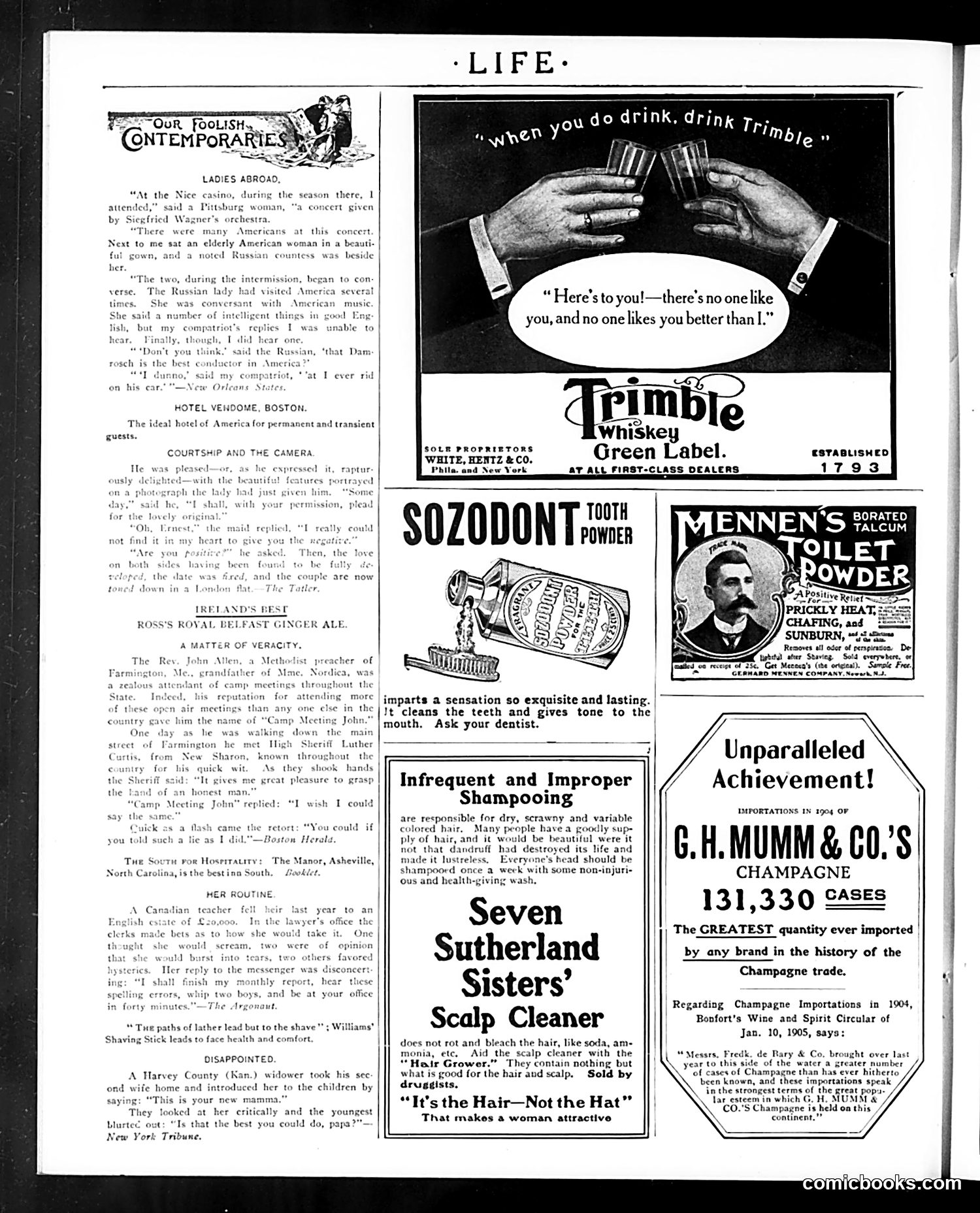
This page from *Life* magazine (a satirical publication) contains several sections: **Main Content ("Our Foolish Contemporaries"):** A column of humorous anecdotes mocking social pretension, including a story about an American woman at a Nice casino who fails to recognize a famous Russian countess—satirizing Americans' cultural ignorance abroad. **Advertisements:** The page is dominated by period product ads (Trimble Whiskey, Sozodont Tooth Powder, Mennen's Talcum Powder, Sutherland Sisters' Scalp Cleaner, and G.H. Mumm Champagne). These are presented straightforwardly without obvious satire. **Smaller Humorous Pieces:** Brief anecdotes mock American social behavior—a wife criticizing her new husband unfavorably, a child disappointed in a stepmother. The satire targets American provincialism and social climbing, common themes in early 20th-century *Life* magazine. The advertisements reflect contemporary consumer culture and beauty standards of the era.
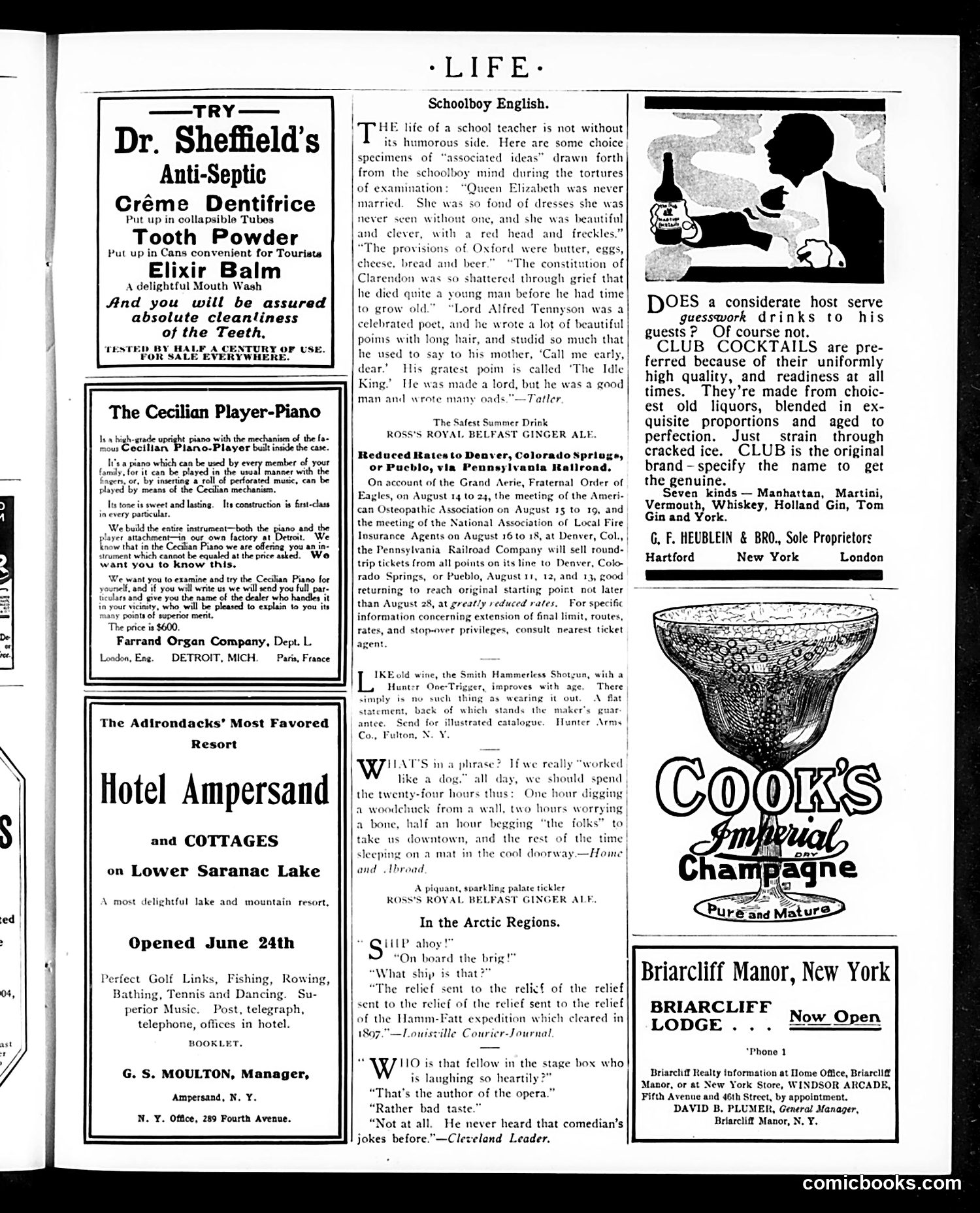
This page is primarily **advertisements and humor pieces** rather than political satire. The main content includes: **"Schoolboy English"** (center): A humorous column excerpting students' exam answers about historical figures. Examples include a student confusing Queen Elizabeth's appearance with her marital status, and hilariously mischaracterizing Lord Alfred Tennyson's poem "The Idle King" as his "gratest poim." The satire targets schoolboy logic and careless exam responses—gentle mockery of educational mishaps rather than political commentary. **Remaining content**: Product advertisements (dental cream, pianos, champagne, hotels) with no satirical intent. The page contains **no political cartoons or caricatures**. It's a typical Life magazine "Life" section mixing light social humor with commercial advertisements from the early 20th century.
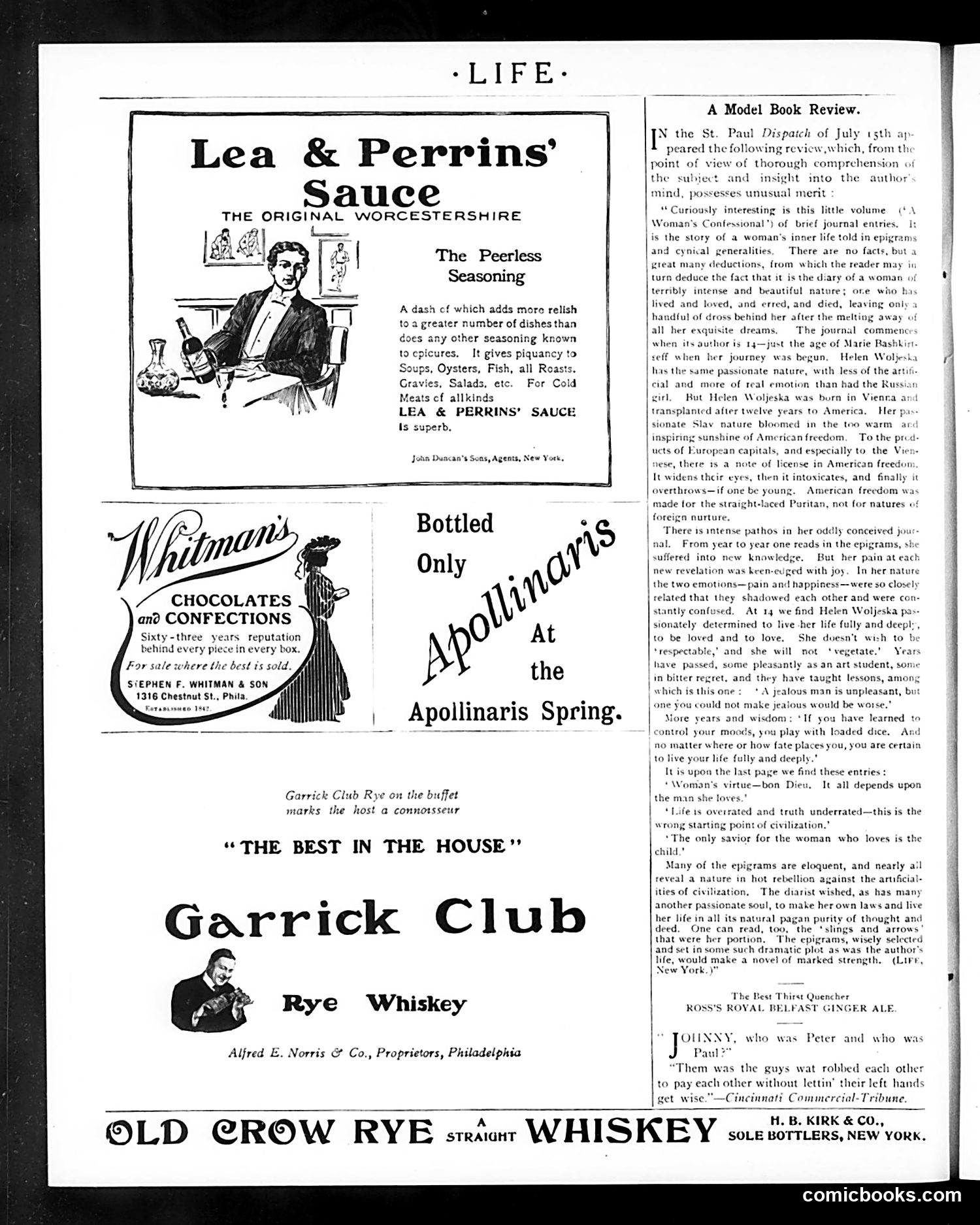
This page is primarily **advertising**, featuring several liquor and food product advertisements interspersed with a book review. The advertisements include: - **Lea & Perrins' Worcestershire Sauce** (top left) - **Whitman's Chocolates** (left side) - **Apollinaris Spring Water** (center) - **Garrick Club Rye Whiskey** (bottom center) - **Old Crow Rye Whiskey** (bottom) The main editorial content is a book review titled "A Model Book Review," discussing a work called *"Woman's Confessional"*—apparently a journal of a woman named Helen Woljeska. The review examines her life philosophy and emotional struggles, quoting her epigrams about virtue, jealousy, and living authentically rather than respectably. The satire appears mild—the review itself seems earnest rather than mocking. The page represents *Life* magazine's typical format of blending advertising revenue with satirical content and cultural commentary.
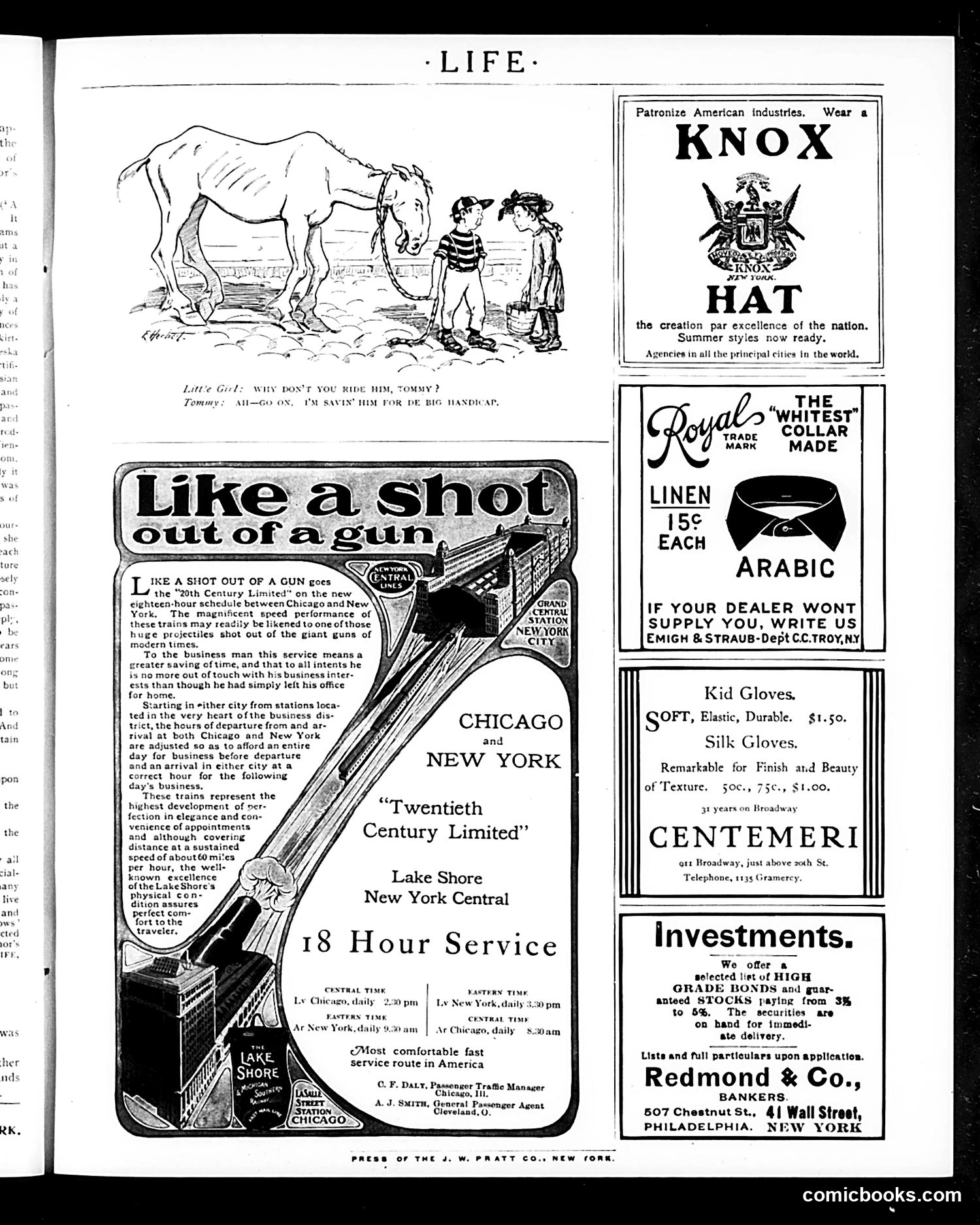
The main cartoon depicts a child (Tommy) with a donkey, refusing to ride it because he's "savin' him for de big handicap"—a racing reference. This is political satire about American industrial capacity during what appears to be the pre-WWI era. The joke satirizes Americans who hoard resources or avoid using American-made goods despite calls to "patronize American industries" (stated in the header). Tommy represents citizens withholding consumption or investment when the nation needs economic activity. The page is otherwise dominated by advertisements for luxury services (the "Twentieth Century Limited" train), prestigious clothing brands (Knox hats, Royal collars, Centemeri gloves), and investment services. These ads reinforce the cartoon's context: appeals to American patriotism and industrial support were directed at affluent consumers who could actually afford such goods and influence economic decisions. The satirical point: wealthy Americans should spend money supporting domestic industries rather than hoarding resources.
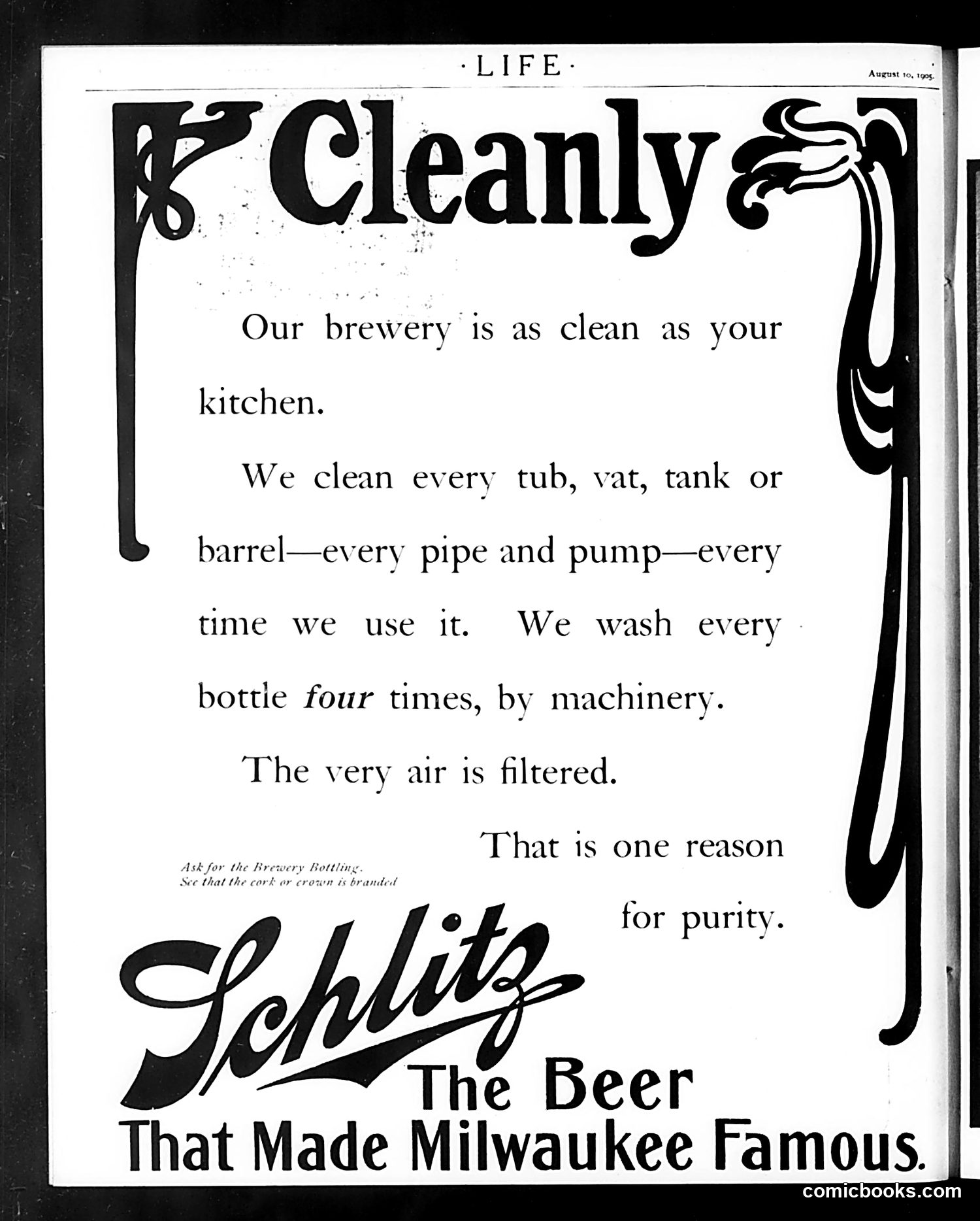
This is a Schlitz beer advertisement from Life magazine (dated August 10, 1905). It's not satire but a straightforward commercial pitch emphasizing the brewery's sanitation practices—a major selling point in the early 1900s when food and beverage safety were genuine public concerns and competitive advantages. The ad addresses consumer anxieties about brewery cleanliness by claiming their facility matches home kitchen standards. It highlights specific practices: cleaning all equipment after each use, washing bottles four times by machinery, and filtering the air itself. These details were meant to reassure buyers that Schlitz met modern hygiene standards, distinguishing it from competitors. The tagline "The Beer That Made Milwaukee Famous" became iconic for the brand, positioning Milwaukee as America's beer capital.