
Life, 1905-08-10 · page 18 of 26
Life — August 10, 1905 — page 18: what you’re looking at
What you’re looking at
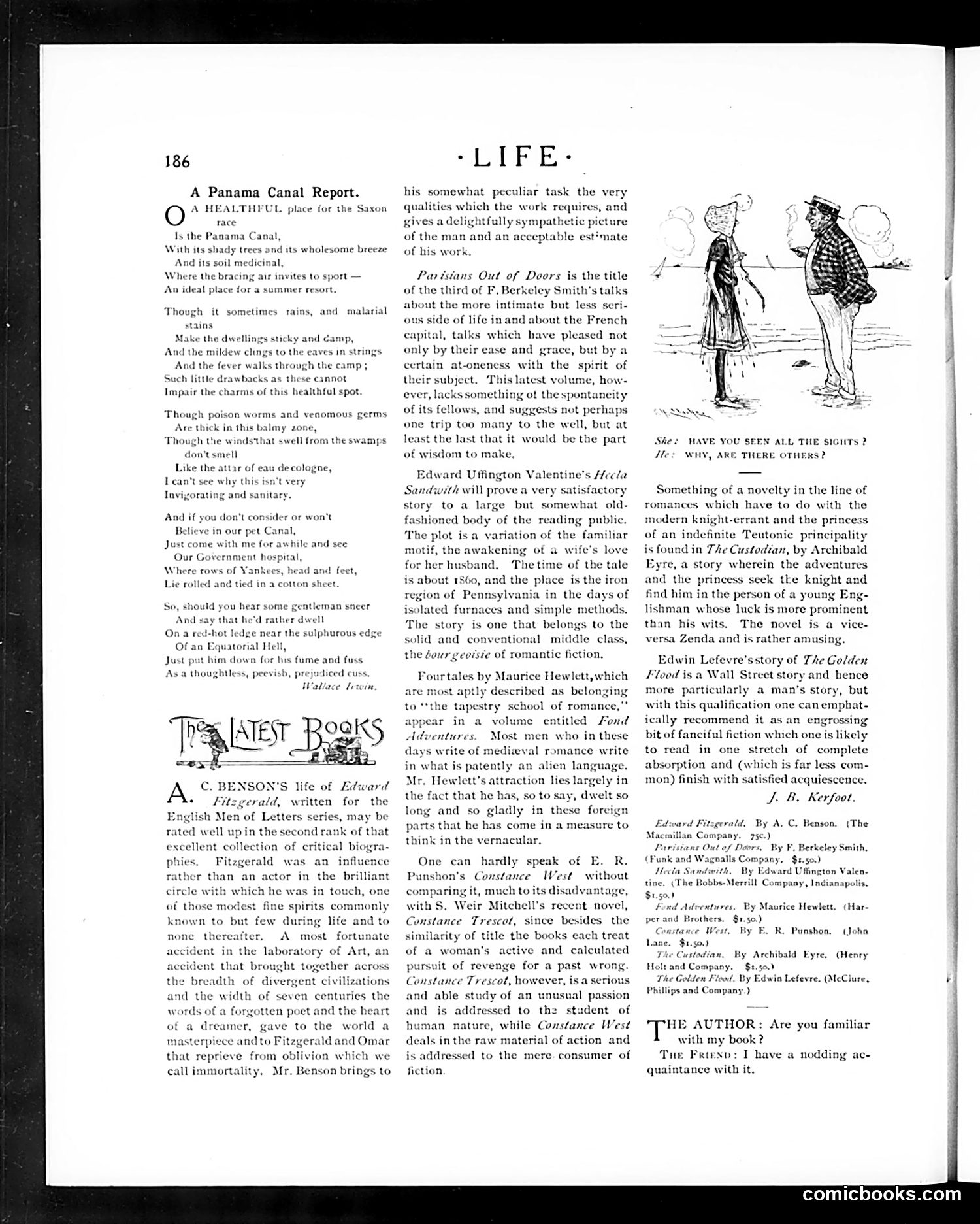
This page contains satirical poetry mocking the Panama Canal as a summer resort destination. The poem ironically praises the Canal zone as "healthful" and "invigorating," while actually describing its genuine hazards: malaria ("malarial stains"), mildew, fever, "poison worms and venomous germs," and swamps that stink. The final cruel joke references a government hospital where American workers ("rows of Yankees") lie dead or dying, wrapped in cotton sheets. The satire targets both the Canal project's promoters (who downplayed its dangers) and American confidence in the enterprise. The accompanying illustration shows two figures observing this grim scene. The remainder of the page reviews contemporary books, including works by C. Benson and E. R. Punshon—content unrelated to the satirical cartoon.
📄 Transcribed text from this page (OCR, searchable)
Machine-transcribed from the original scan — historical spelling and the odd misread are preserved.
186 A Panama Canal Report. O A HEALTHFUL place for the race 1s the Panama Canal, With its shady trees and its wholesome breeze And its soil medicinal, Where the bracing air ites to sport — An ideal place for a summer resort, Though it sometimes rains, and malarial stains Make the dwellings sticky and camp, And the mildew clings to th And the fever walks through the camp; Such little drawbacks as these cannot Impair the charms of this healthful spot aves in strings. Though poison worms and venomous germs Are Though the w don't smell Like the attar of eau decologne, k in this balmy zone, Jsthat swell from he swamps Lecan't see why this i Invigorating and sanitary. And if you don’t consider or won't Believe in our pet Canal, Just come with me for awhile and see Our Where rows of Yankees, head and feet, ernment hospital, Lie rolled and tied in a cotton sheet. hould you hear some gentleman sneer And say that he'd rather dwell On a red-hot ledge near the sulphurous edg: Of an Equatorial Hell, Just As a thoughtless, peevish, prejudiced cu ‘Pagetes_ eS C. BENSON'S life of rard Fitzgerald, written for the English Men of Letters series, may be rated well upin the second rank of that ion of critical biogra- phies. Fitzgerald was an influence rather than an actor in the brilliant circle with which he was in touch, one him down for bis fume and fuss excellent collec! of those modest fine spiri commonly > but few during life and to A most fortunate tory of Art, an known none thereafter. accident in the labo fent that bri the breadth of divergent and th ace cTOSS ivilizations Ith of seven centuries the w words of a forgotten poct and the heart dreamer, gave to the world ce and to Fitzgerald and Omar that reprieve from oblivion which we call immortality. Mr. Benson brings to erp! LIFE his somewhat peculiar task the very qualities which the work requires, and gives a delightfully sympathetic picture of the man and an acceptable est of his w Parisians Out of Doors is the title of the third of F, Berkeley Smith's talks about the more intimate but less seri- side of life inand about the French capital, talks which have pleased not only by their ease and grace, but by a certain at-oneness with the spirit of their subject. This latest volume, how- ever, lacks something ot the spontaneity of its fellows, and suggests not perhaps one trip too many to the well, but at least the last that it would be the part of wisdom to make, Edward Uffington Valentine's Hecla dwith will prove a very satisfactory story to a large but somewhat old- fashioned body of the reading public. ‘The plot isa variation of the familiar motif, the awakening of a wife's for her husband, Thetime of the tale is about 1860, and the place is the iron region of Pennsylvania in the days of isolated furnaces and simple methods. The story is one that belongs to the solid and conventional middle class, the dour geoisée of romantic fiction. love Fourtales by Maurice Hewlett, which are most aptly described as. belonging to “the tapestry school of romanc ar in a volume entitled Fond Adventures. Most men who in these app days write of medieval romance write in what is patently an alien language. Mr. Hewlett’s attraction lies largely in the fact that he has, so to say, dwelt so long and so gladly in these foreign parts that he has come in a mi think in the vernacular. sure to One can hardly speak of E. R. Punshon's Constance West without comparing it, much to its disadvantage, with S. Weir Mitchell's recent nov Constance Trescot, since besides the similarity of title the books each treat of a woman's active and calculated pursuit of revenge for a past wrong. Constance Trescot, however, is a serious and able study of an unusual passion and is addressed to the student of human nature, while Constance West deals in the raw material of action and is addressed to the mere. consumer of fiction. She: MAVE YOU SEEN ALL THE sicitTs ? Hes WHY, ARE THERE OTHERS? Something of a novelty in the line of romances which have to do with the modern knight-errant and the prince: of an indefinite Teutonic principality is found in The Custodian, by Archibald re, a story wherein the adventures nd the princess seek tke knight and find him in the person of a young Eng- lishman whose luck is more prominent than his wits. i¢ novel is vice- versa Zenda and is rather amusing. Edwin Lefevre’sstory of The Golden Flood is a Wall Street story and hence more particularly a man’s story, but with this qualification one can emphat- ically recommend it as an engrossing bit of fanciful fiction which one is likely to read in one stretch of complete absorption and (which is far less com- mon) finish with satisfied acquiescence. J. B. Kerfoot. Edward Fitzgerald, By A. C. Benson, (The Macmillan Co ye 786.) Parisians Out of Doors, By F, Berkeley $ unk and W: any. $4.50.) Hecla S; . By Edward Uffington Valen. Phe Bobbs-Merrill Company, Indianapolis. he ti Fond Adventures, By Maurice Hewlett, (Har- ad Brothers. $r.50.) Constance West, By E.R. Punshon, (John $1.50.) By Archibald Eyre. (Henry $2.50.) den Floot, By Edwin Lefevre. (McC: Phillips and Company.) HE AUTHOR: Are you familiar with my book ? Tne Frtexp: I have quaintance with it. a nodding ac- a NR RSA ne comicbooks.com