
A complete issue · 29 pages · 1905
Life — June 29, 1905
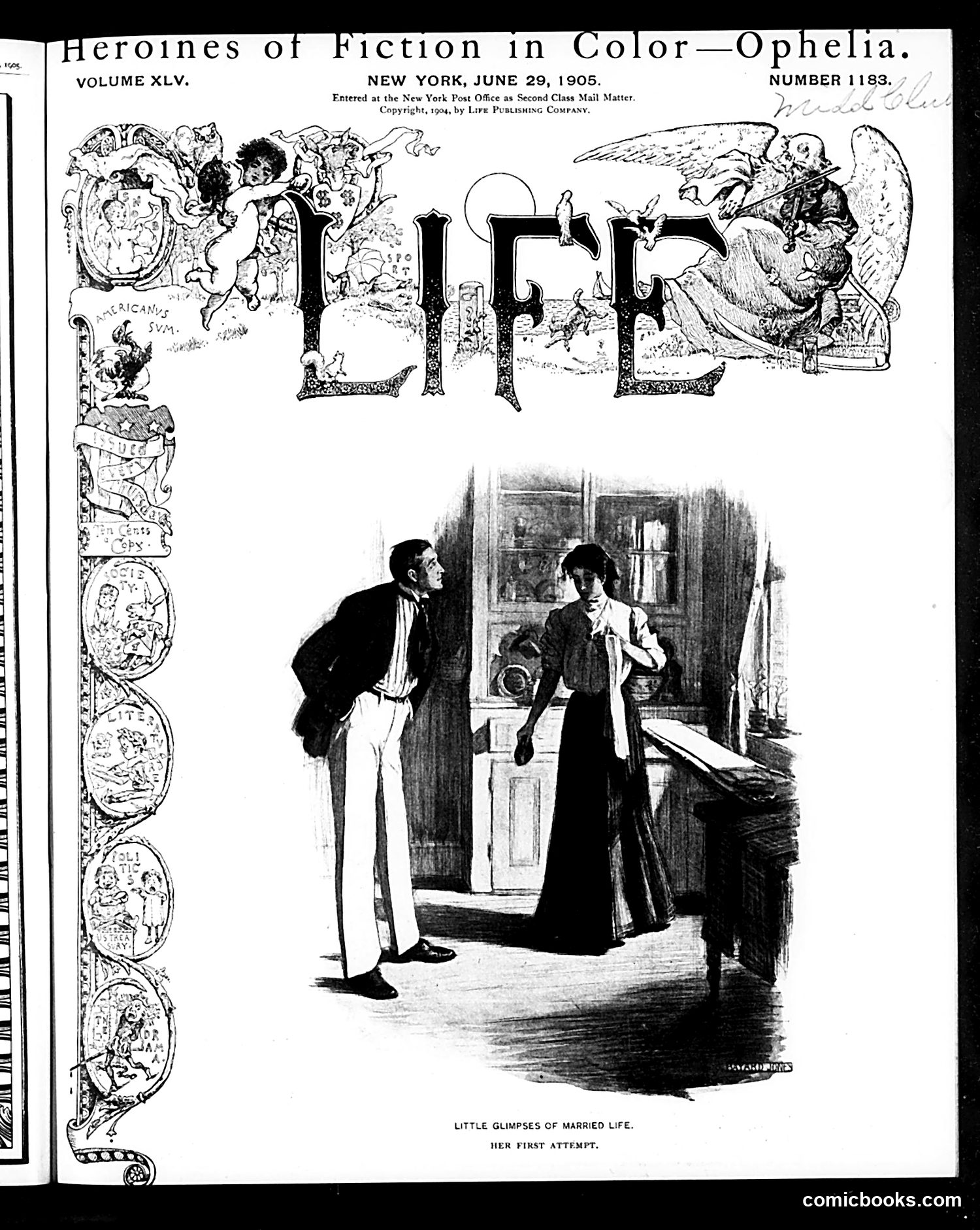
This page from the satirical magazine *Life* features a decorative header with classical cherubs and the title "LIFE" in ornate lettering. The main illustration below, titled "Little Glimpses of Married Life: Her First Attempt," depicts a domestic scene with a well-dressed man and woman in an early 1900s interior. The cartoon satirizes newlywed life, specifically mocking the wife's apparent incompetence at household management or cooking—her "first attempt" at some domestic duty. The man's skeptical expression suggests doubt about her abilities. This reflects common early-20th-century satirical humor about women's traditional domestic roles and the comedic potential of inexperience in marriage.
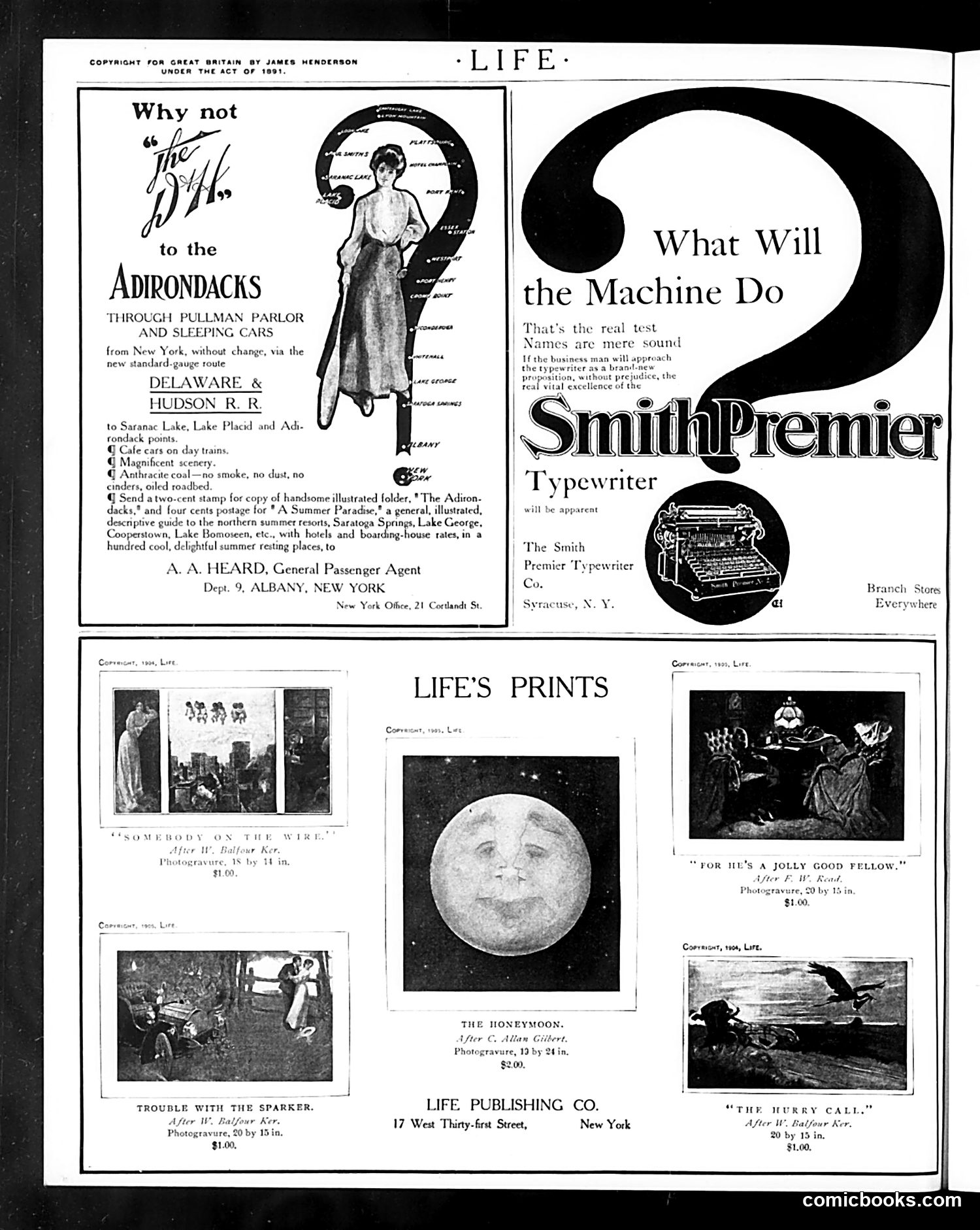
This page is primarily **advertising**, not political satire. It contains three distinct ads: 1. **Upper left**: A Delaware & Hudson Railroad advertisement promoting travel to the Adirondacks via Pullman cars, featuring a woman pointing to a map. 2. **Upper right**: A Smith-Premier Typewriter advertisement using the rhetorical question "What Will the Machine Do?" to emphasize the typewriter's reliability as a business tool—"Names are mere sound" compared to the machine's performance. 3. **Lower section**: Life Publishing Company's prints catalog, selling photographic reproductions of artworks ($1-$2 each), including titles like "Trouble with the Sparker" and "The Honeymoon." The page reflects early 20th-century consumer culture and business-oriented marketing rather than political commentary.
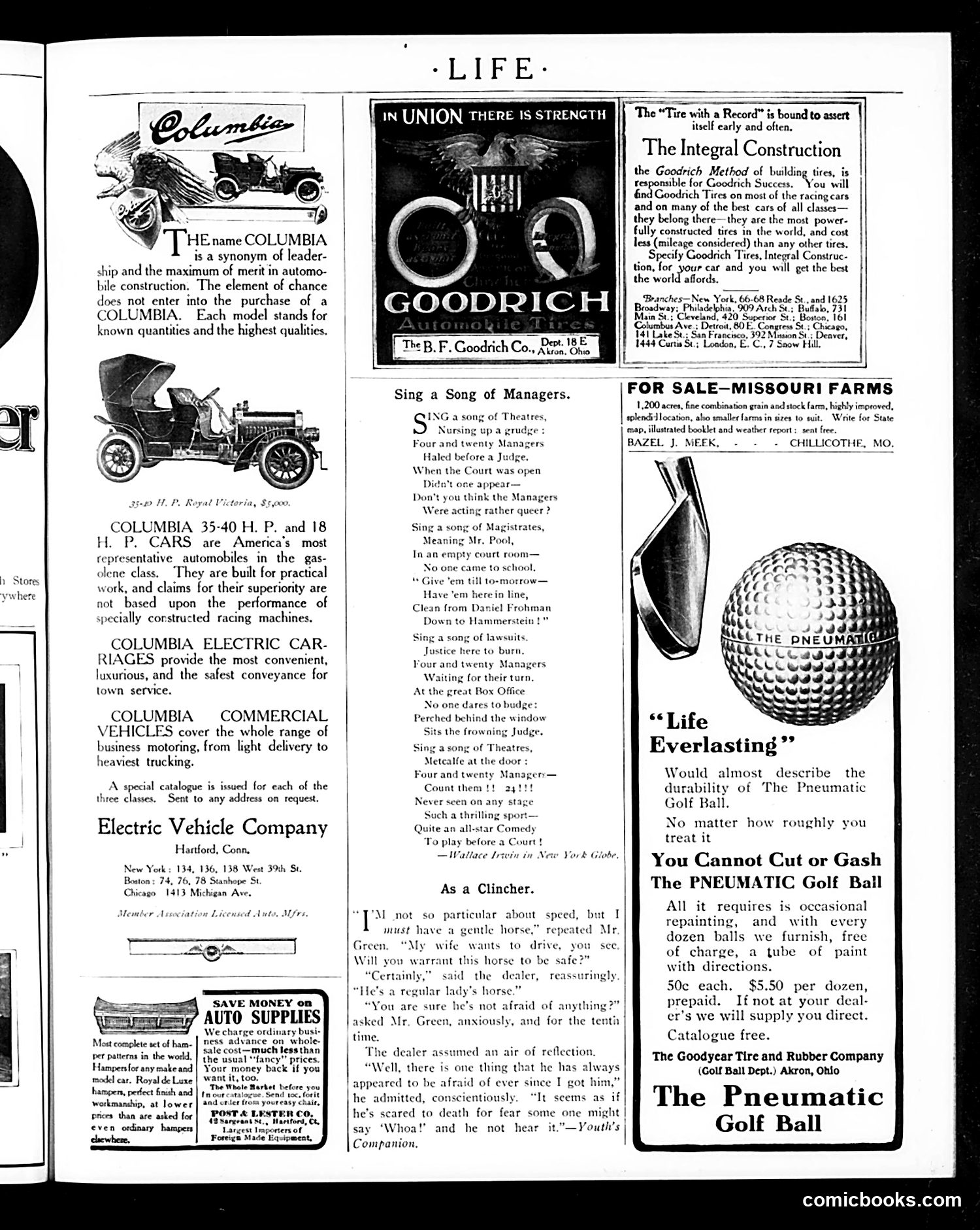
This page is primarily **advertising**, not political satire. It features multiple product advertisements typical of an early 20th-century Life magazine: - **Columbia automobiles** (top left): Promotes various car models as "America's most representative automobiles" - **Electric Vehicle Company** (middle left): Advertises electric cars and commercial vehicles - **Goodrich Tires** (center): Emphasizes "Integral Construction" for durability - **Pneumatic Golf Ball** (right): Highlights the ball's durability and repairability - **Auto Supplies** and **Missouri Farms** listings (bottom areas) The page also includes a humorous poem titled **"Sing a Song of Managers"** and a short satirical story **"As a Clincher"** about horse trading—these provide light entertainment between advertisements rather than political commentary.
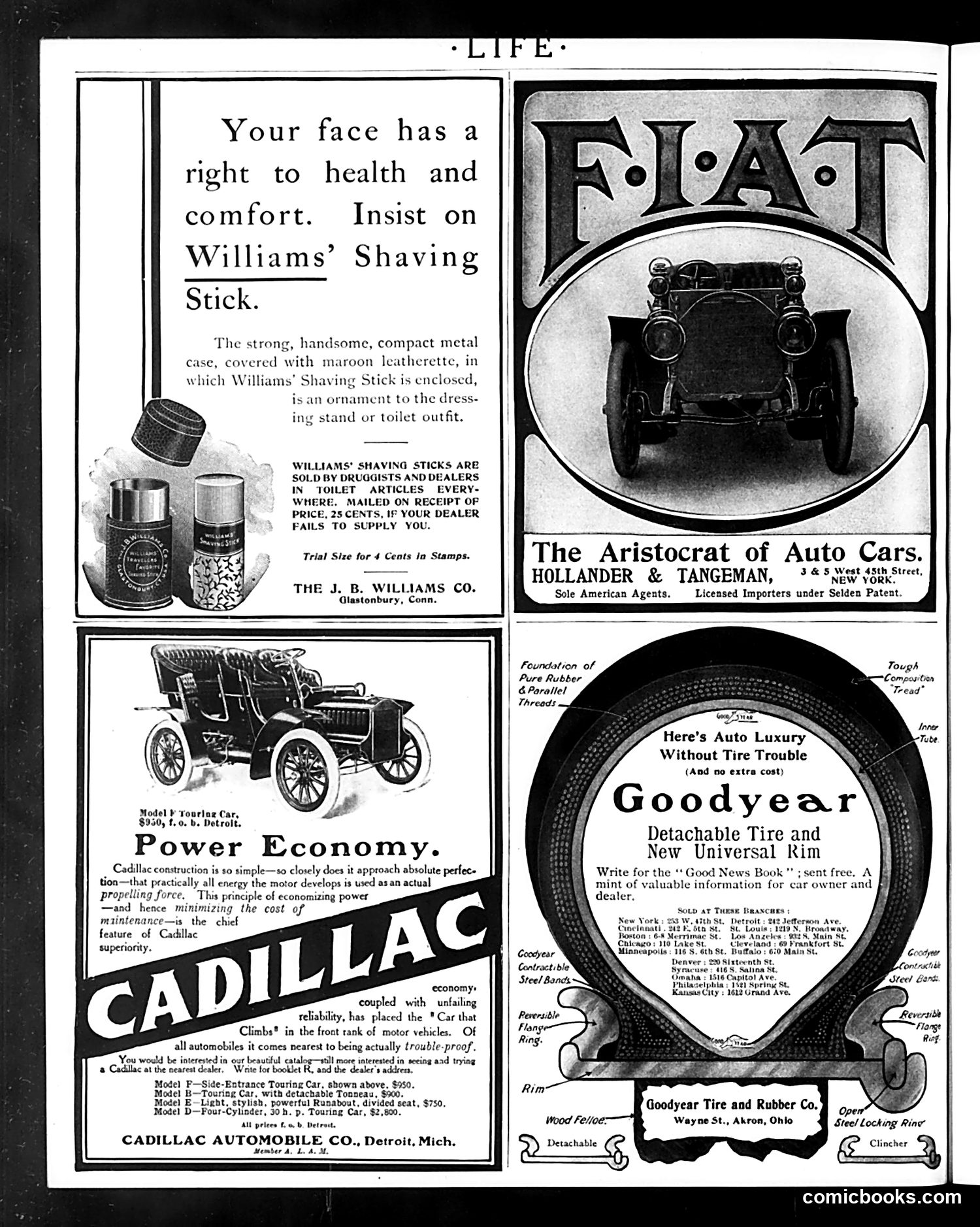
This page contains **no political cartoons or satire**. It is entirely **advertising content** from what appears to be an early 1910s issue of *Life* magazine. The ads feature: 1. **Williams' Shaving Stick** — promoting personal grooming products 2. **Fiat automobiles** — Italian luxury cars marketed as "The Aristocrat of Auto Cars" 3. **Cadillac automobiles** — emphasizing economy and reliability, positioned as "trouble-proof" 4. **Goodyear tires** — highlighting detachable rims and durability The page reflects the era's emerging consumer culture, with emphasis on personal hygiene, automobile ownership becoming accessible to middle-class Americans, and innovations in automotive technology. There is no satirical commentary or political messaging present.
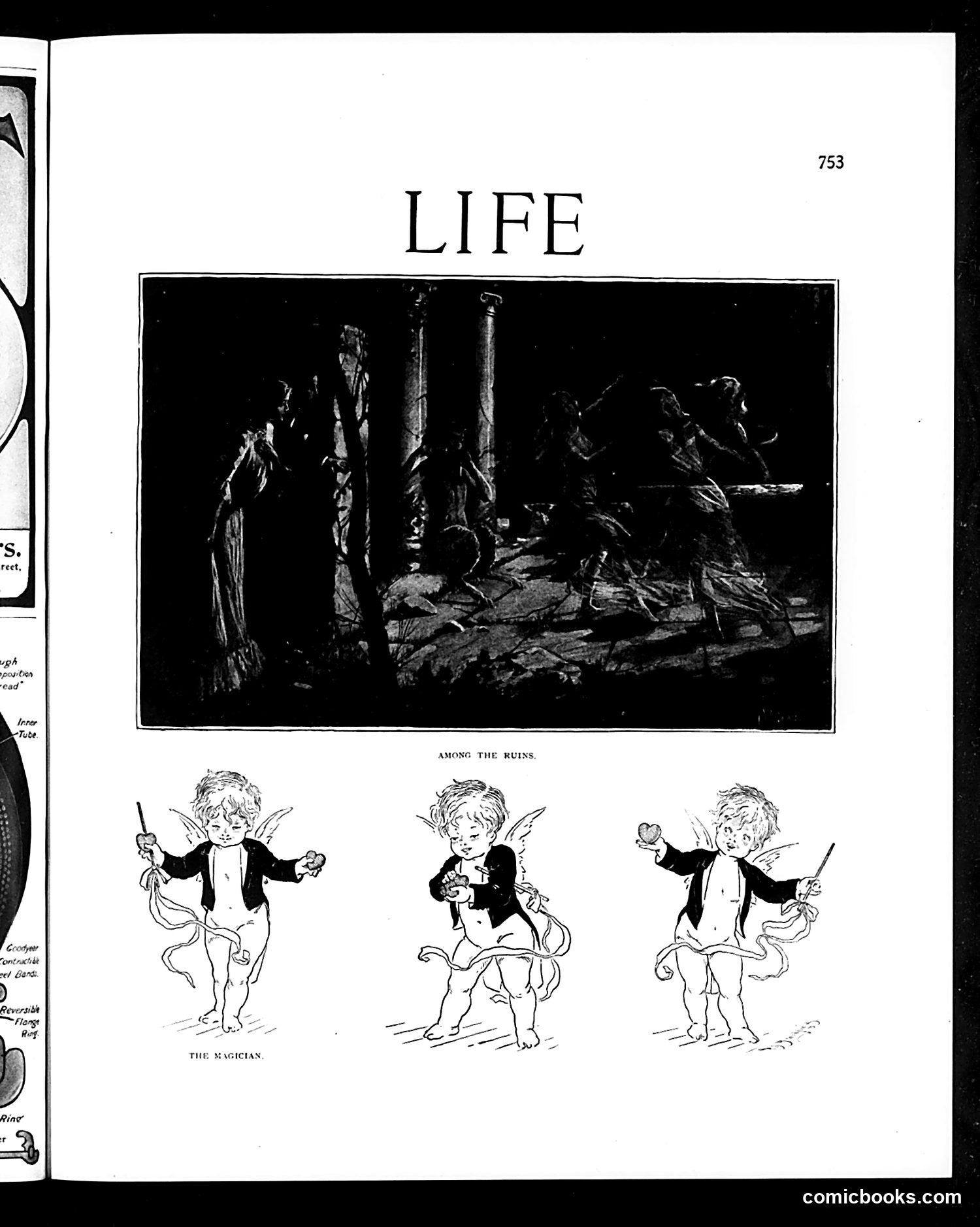
This page from *Life* magazine (page 753) contains two distinct illustrations: **Top image** ("Among the Ruins"): A dark, dramatic scene showing figures among classical ruins and columns, suggesting destruction or decay of civilization or authority. **Bottom images** ("The Magician"): Three nearly identical drawings of a cherubic figure with wings (resembling Cupid) in formal attire, shown performing magic tricks—holding wands and appearing to manipulate objects. The pairing suggests satirical commentary: the "magician" figure (likely representing either a political figure or abstract concept like hope, fortune, or deception) performing tricks while civilization crumbles in ruins. The repetition emphasizes the illusory or ineffectual nature of the "magic" being performed. Without additional context about the specific publication date, the precise political target remains unclear, though the satire critiques someone's empty promises amid societal problems.
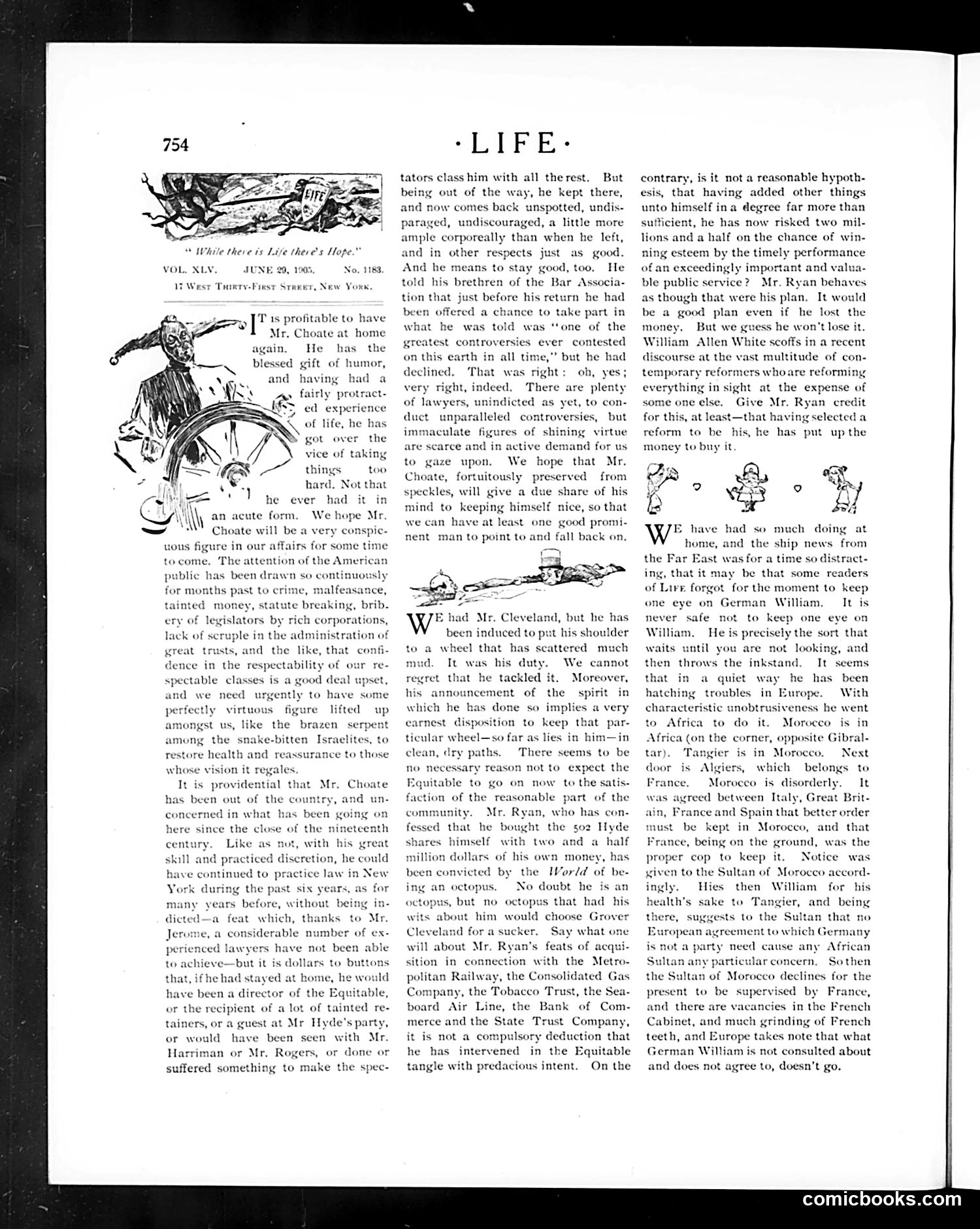
This page contains three editorial cartoons and accompanying text commentary on contemporary figures. The top cartoon depicts a figure labeled "While there is Life there's Hope," likely referencing a public figure's resilience or comeback. The middle cartoon shows a man on a bicycle, accompanying text discussing Mr. Choate, suggesting commentary on a prominent lawyer or public official navigating difficulties. The bottom cartoon appears to show a reclining figure, relating to discussion of Mr. Cleveland. The text discusses various public figures including Mr. Ryan (acquiring railroad shares), Mr. Choate (declining a controversial opportunity), and references to Morocco, Germany, and European diplomatic matters, suggesting this addresses early 1900s international tensions and prominent American businessmen/politicians. Without clearer identification of specific individuals or dates from the magazine itself, precise satirical meaning remains unclear.
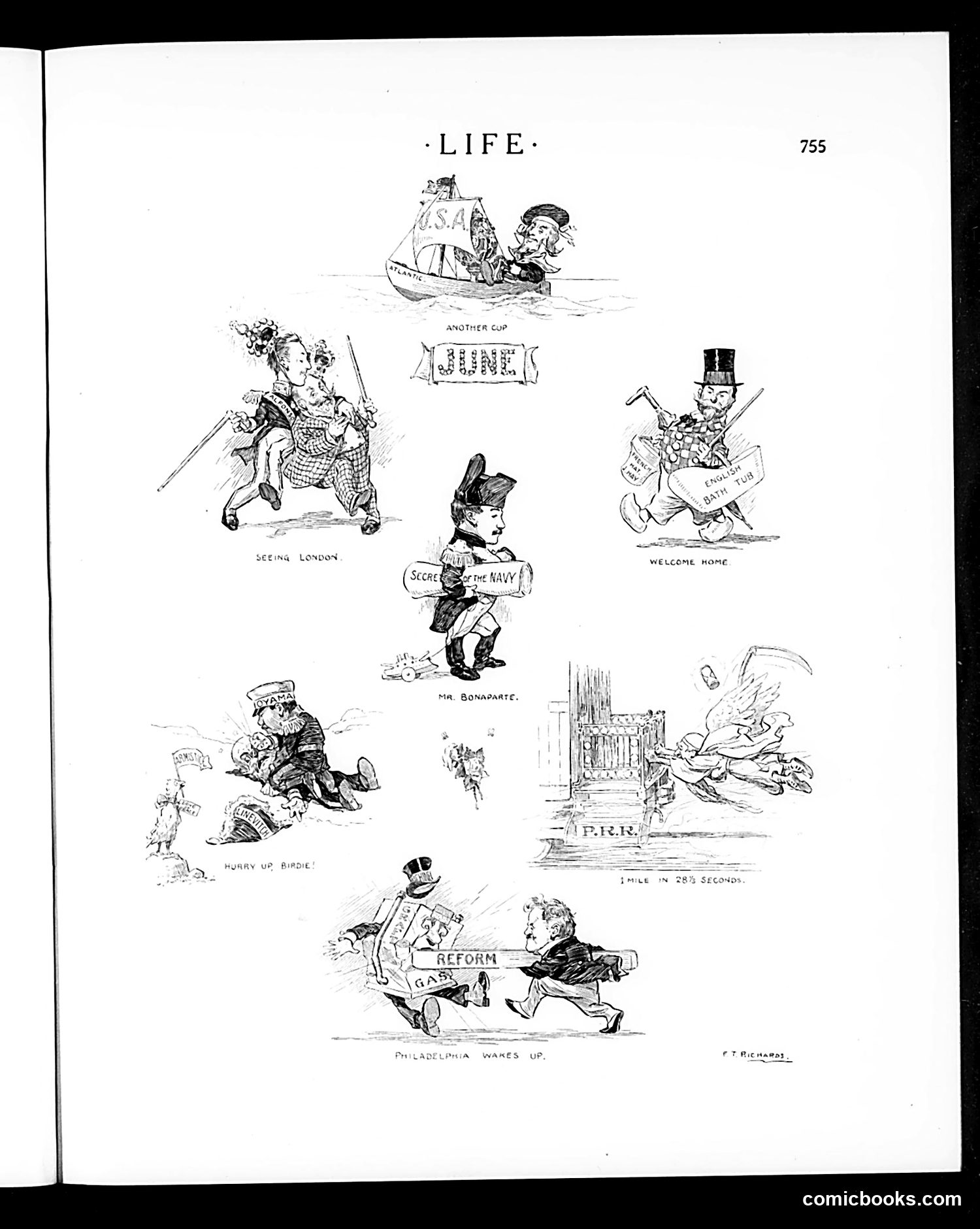
This page contains seven satirical cartoons by F.T. Merriway commenting on contemporary political and social issues. The visible captions identify subjects including: - "Seeing London" - depicting a tourist activity - "Another Cup of Junk" - showing a naval vessel - "Welcome Home" - a military return scene - "Mr. Bonaparte" - likely referencing Napoleon/imperialism - "Hurry Up Birdie" - possibly about golf or sports - "Mile in 283 Seconds" - commenting on speed/racing - "Philadelphia Wares Up" - political commentary on the city - "Reform Gas" - satirizing reform efforts The cartoons appear to target political figures, military matters, and social trends of the era through exaggerated character drawings typical of early 20th-century satirical illustration. Without clearer dates or additional context, specific references remain difficult to pinpoint precisely.
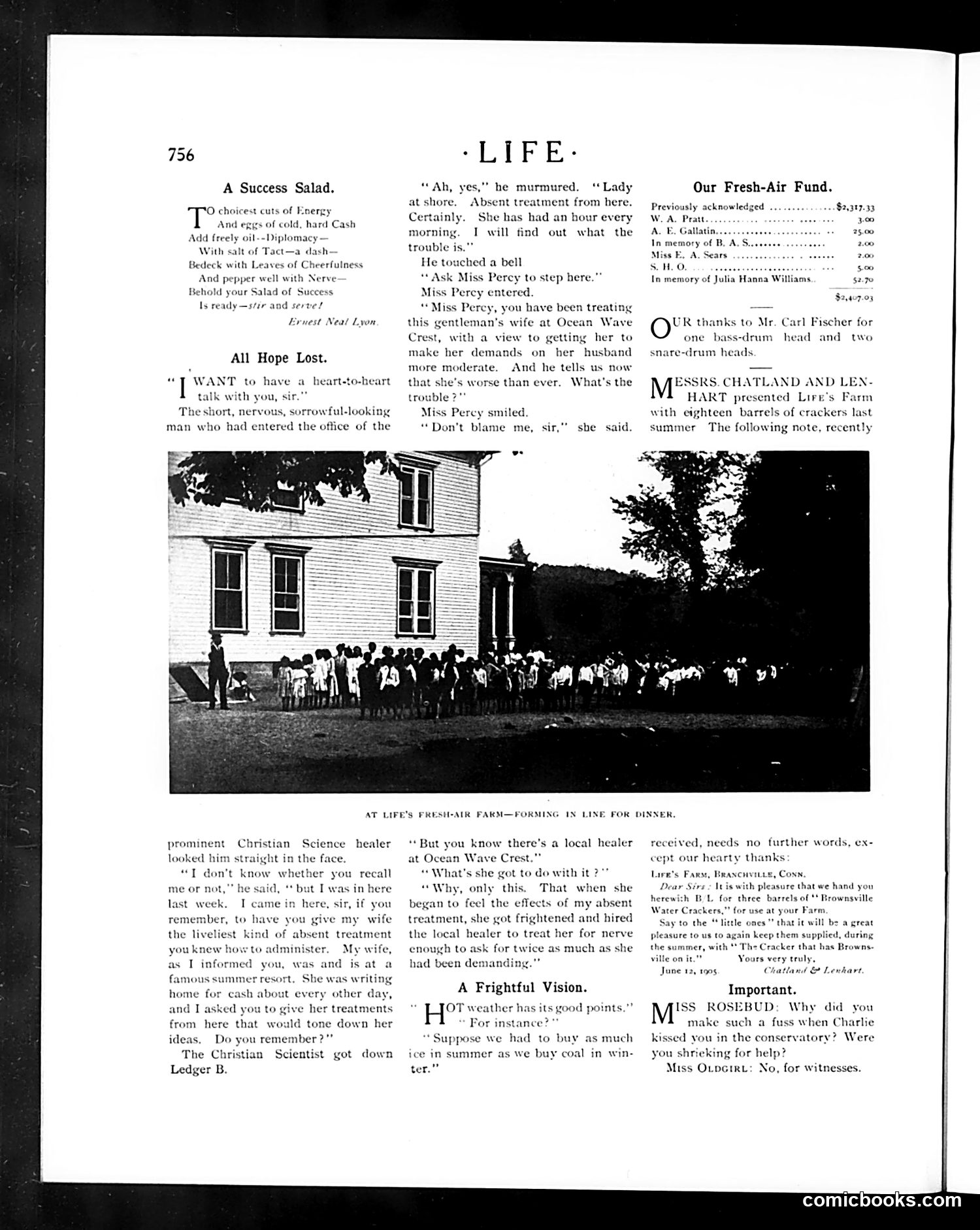
This page contains three separate items: a humorous poem titled "A Success Salad," a short story excerpt called "All Hope Lost," and a photograph labeled "At Life's Fresh-Air Farm—Forming in Line for Dinner." The photograph shows a large group of children lined up outside a white wooden building, apparently at Life magazine's charitable fresh-air farm facility. This reflects the era's progressive movement concern for urban children's welfare. The written pieces are satirical domestic comedies involving marital discord and treatment seeking. One references a "Christian Science healer" and "Ocean Wave Crest"—likely mocking faith-healing practitioners popular in that era. The "Fresh-Air Fund" section acknowledges donations, suggesting this was a real charitable initiative Life magazine supported.
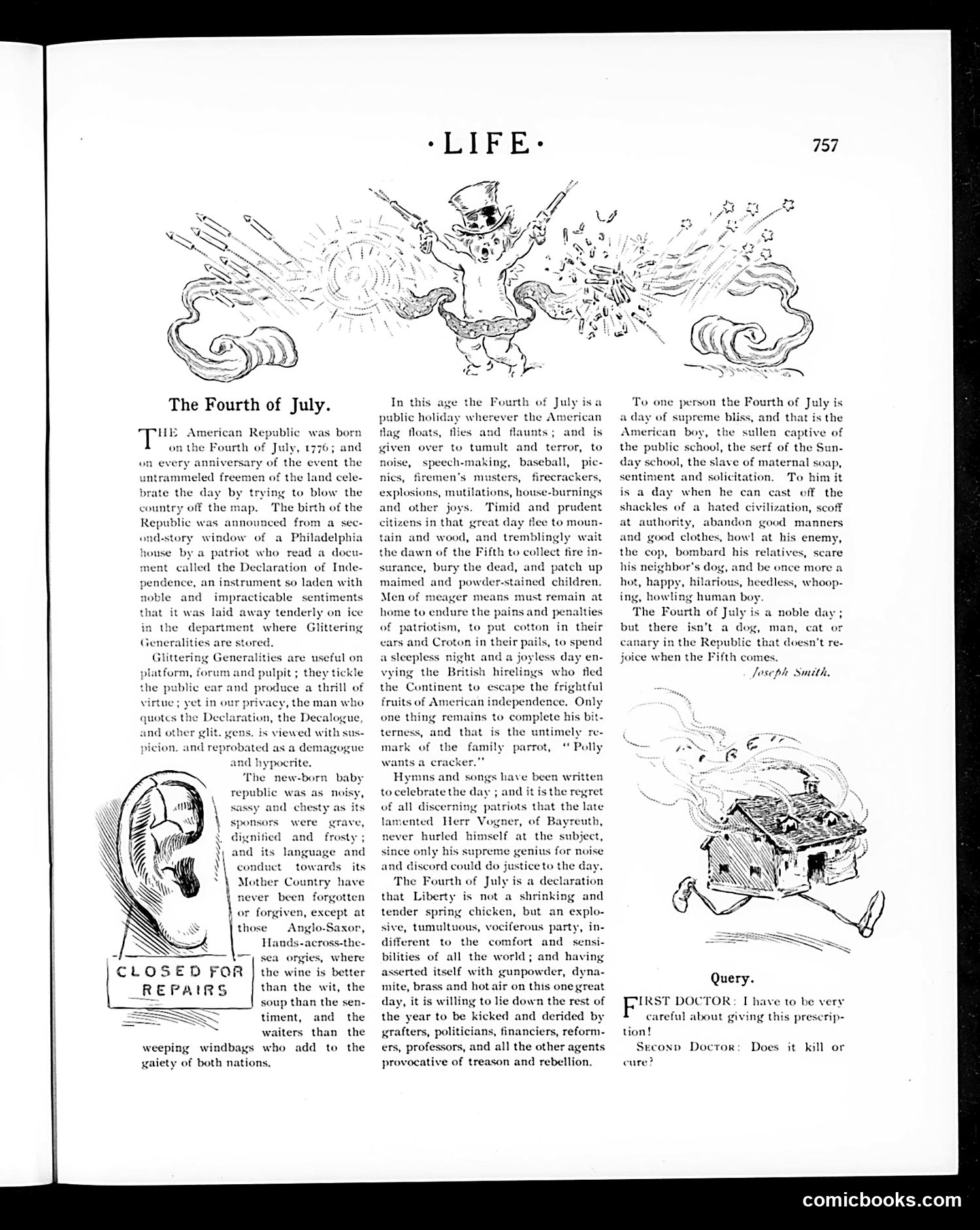
This page contains satirical commentary on American Independence Day celebrations. The main illustration depicts an exuberant figure (Uncle Sam, likely) surrounded by explosive fireworks and chaos—representing the raucous, dangerous nature of Fourth of July festivities. The text criticizes how Americans celebrate the holiday: mocking the noise, dangerous fireworks, and general disorder. It particularly ridicules the gap between the holiday's patriotic ideals and its actual celebration through "tumult and terror," baseball, picnics, and firecrackers. The small "Closed for Repairs" ear illustration appears to joke about deafness caused by Fourth of July noise. The "Query" section's doctors' dialogue suggests satirizing concerns about harmful holiday practices, though the specific medical reference is unclear from the visible text.
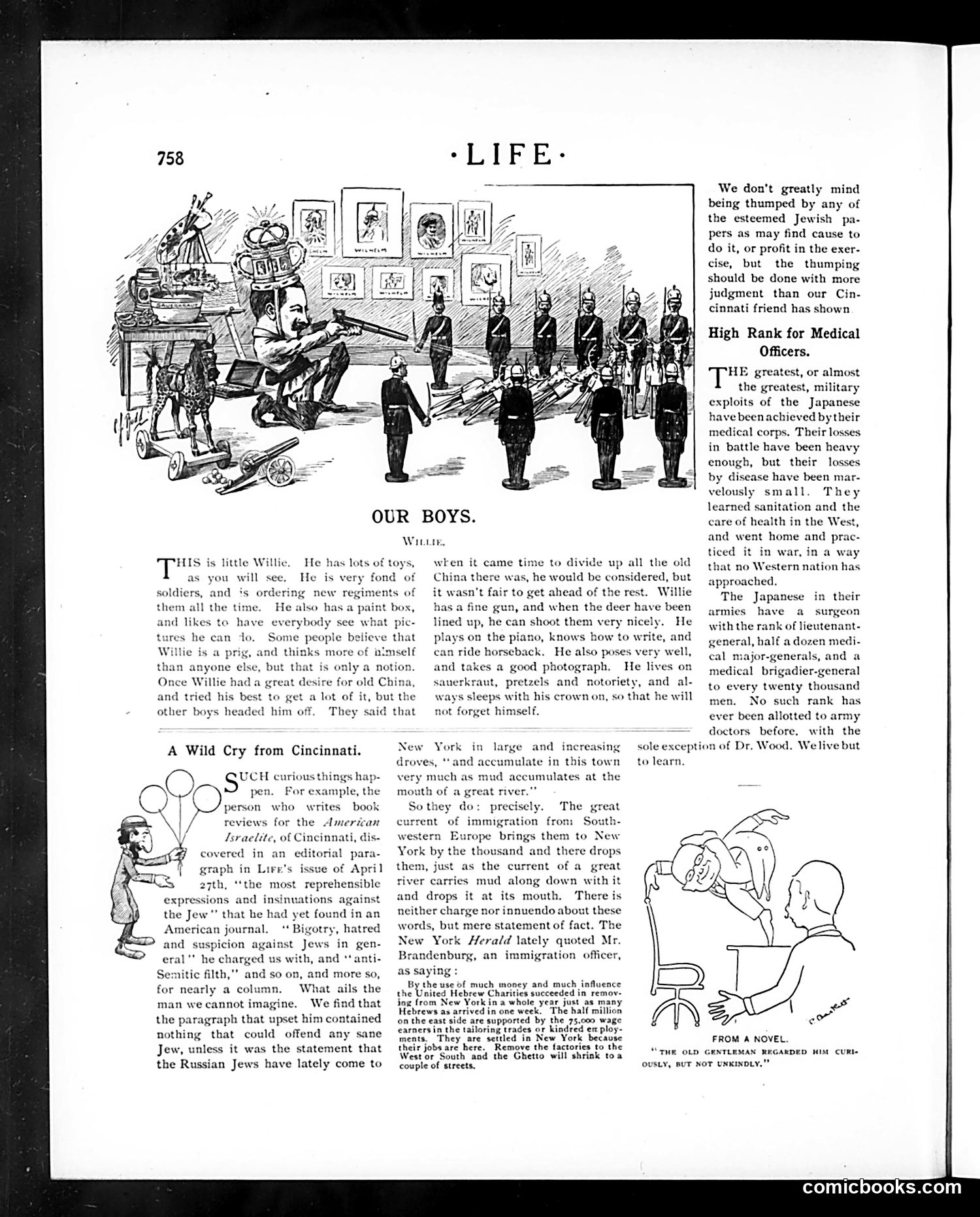
The page contains three satirical pieces: **"Our Boys: Willie"** — A cartoon mocking American boys' play-soldiering and toy collecting, showing Willie organizing toy soldiers and toy war scenarios, satirizing childhood militarism and materialism. **"A Wild Cry from Cincinnati"** — A commentary on the *American Israelite* (a Jewish newspaper) criticizing negative stereotypes. The text describes outrage over derogatory language used by another publication against Jewish immigrants, particularly regarding the phrase "the few" and accusations of controlling finances. This reflects early 20th-century antisemitic tropes and the Jewish community's pushback against them. **"High Rank for Medical Officers"** — Praise for Japanese military doctors' low disease casualty rates compared to combat losses, noting their adoption of Western sanitation practices. The page reflects Progressive-era concerns about immigration, military preparedness, and stereotyping.
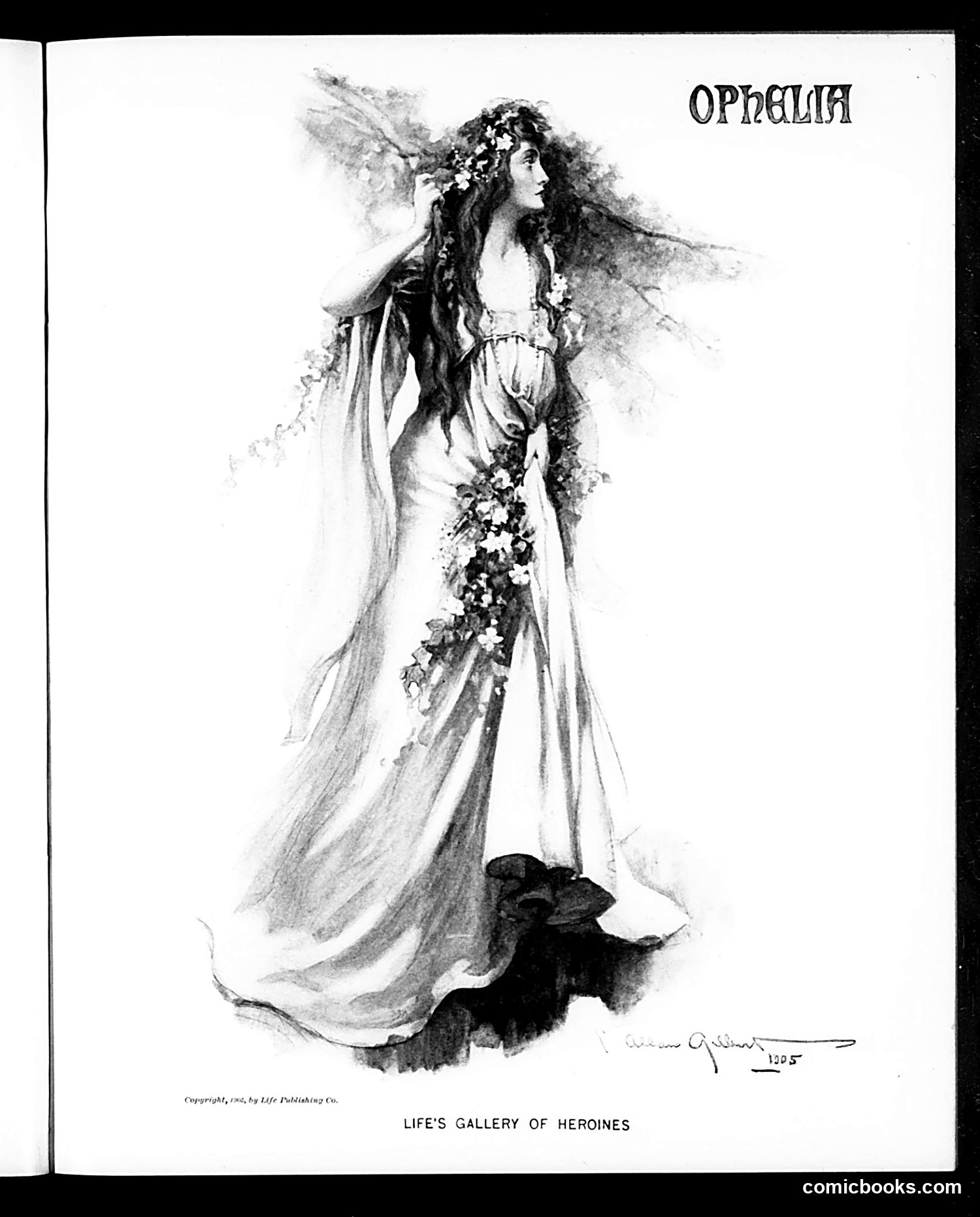
This page features an illustration labeled "OPHELIA" from "Life's Gallery of Heroines," a series depicting famous female characters. The drawing shows a woman in flowing, romantic dress with flowers in her hair and garland, rendered in the classical illustration style typical of early 20th-century Life magazine. Ophelia is the tragic female character from Shakespeare's *Hamlet*—a princess driven to madness and suicide after her father's death and her lover Hamlet's rejection. The romanticized artistic treatment here reflects how Victorian and early modern audiences sentimentalized literary heroines. The "Gallery of Heroines" series appears to be Life's cultural commentary, presenting idealized versions of famous women from literature. The artistic, melancholic rendering emphasizes Ophelia's tragic romantic femininity rather than her mental breakdown, revealing period attitudes about how female suffering was aestheticized.

I can see this is a blank or nearly blank page from what appears to be a historical publication. The page shows mostly white space with black borders typical of bound magazine pages, and "comicbooks.com" appears at the bottom right corner. Without visible cartoon illustrations, text, or identifiable content on the actual page itself, I cannot analyze specific political figures, satirical references, or historical context. The OCR text provided is also empty or not transcribed. To offer meaningful analysis of Life magazine's satirical content, I would need a page with visible cartoons, captions, or article text. If this is a title page, advertisement page, or the image failed to capture the actual content, please provide a page with discernible illustrations or text.
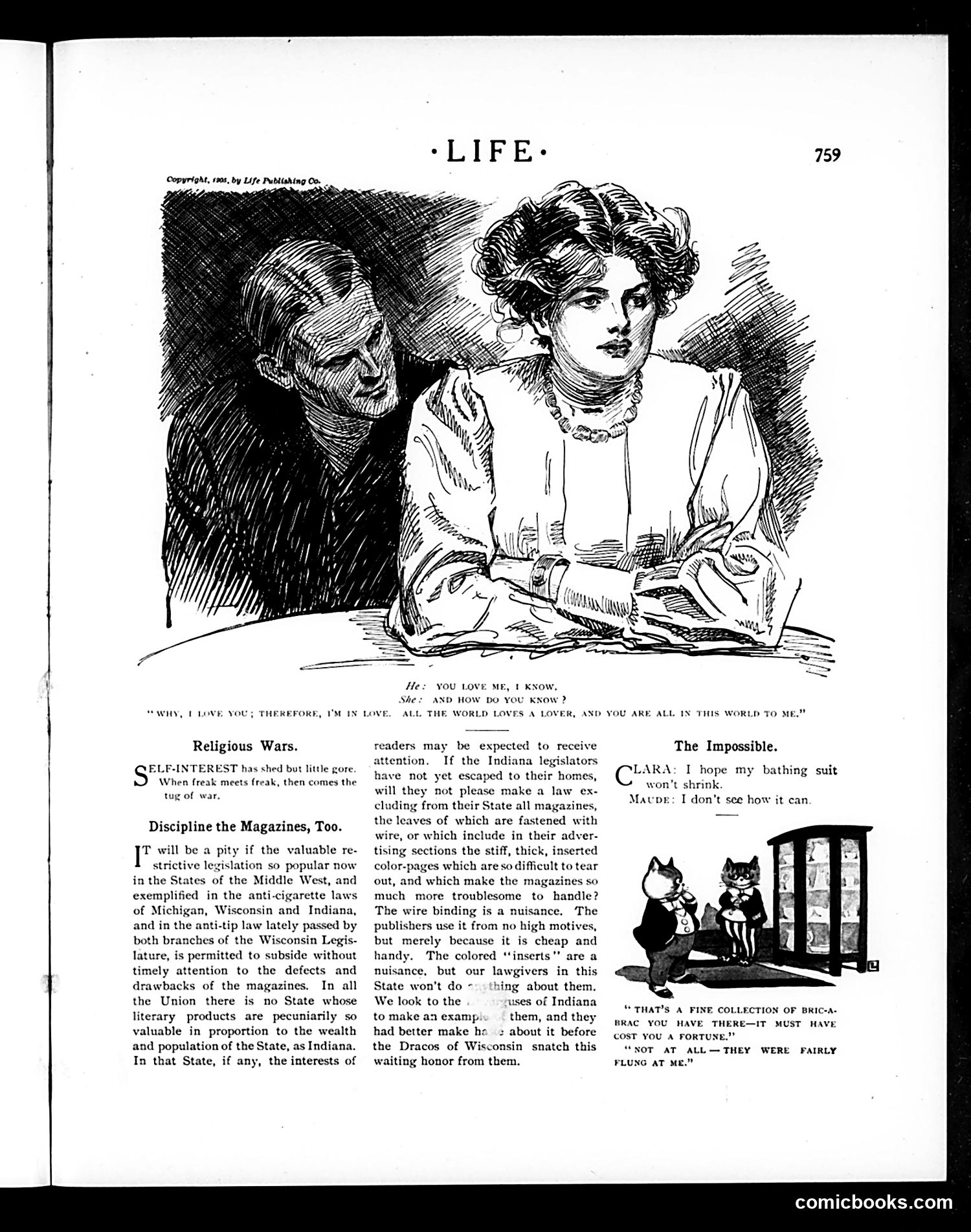
**Top Cartoon**: A man whispers to a woman who gazes ahead indifferently. The caption satirizes romantic clichés—he claims to love her "therefore" he's in love, while she knows he loves her because "all the world loves a lover." The joke mocks hollow romantic rhetoric and the circular logic of sentimental declarations. **"Religious Wars" & "Discipline the Magazines, Too"**: These articles argue that Midwest states (Indiana, Wisconsin, Michigan) should pass legislation regulating magazine construction. Life complains about wire-bound magazines and thick inserted color advertisements that are difficult to handle and tear out. The satire suggests these practical nuisances deserve legal restriction as much as anti-cigarette and anti-tipping laws recently passed. Indiana, being wealthy from publishing, should lead by example. **Bottom Cartoons**: "The Impossible" mocks a woman worrying her bathing suit will shrink—an absurd concern. The final cartoon jokes about cheap bric-a-brac received as gifts rather than purchased. The page emphasizes early-1900s consumer frustrations with magazine design and romantic sentimentality.
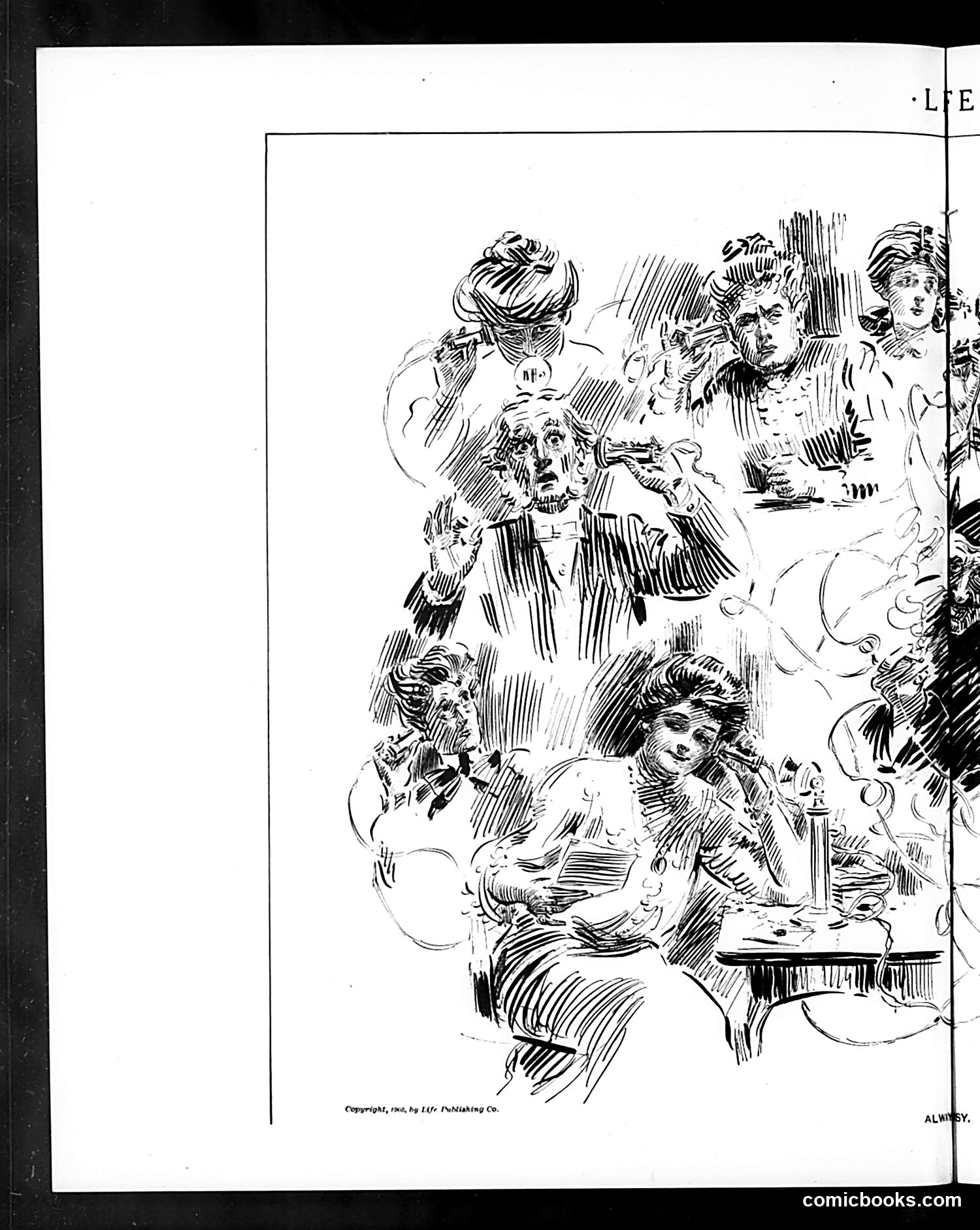
This is a pen-and-ink illustration signed by Almexy showing a social gathering of well-dressed figures in what appears to be an early 20th-century interior setting. The sketch depicts multiple people in fashionable attire engaged in conversation and social interaction. A woman in the foreground sits prominently, while others stand around her in various poses of engagement. The copyright notice indicates "1904, by Life Publishing Co." This appears to be satirical social commentary typical of Life magazine, likely mocking fashionable society gatherings, though without identifying captions or visible text on the illustration itself, I cannot specify which particular social figures or events are being caricatured. The style and composition suggest commentary on upper-class social pretension or behavior of that era.
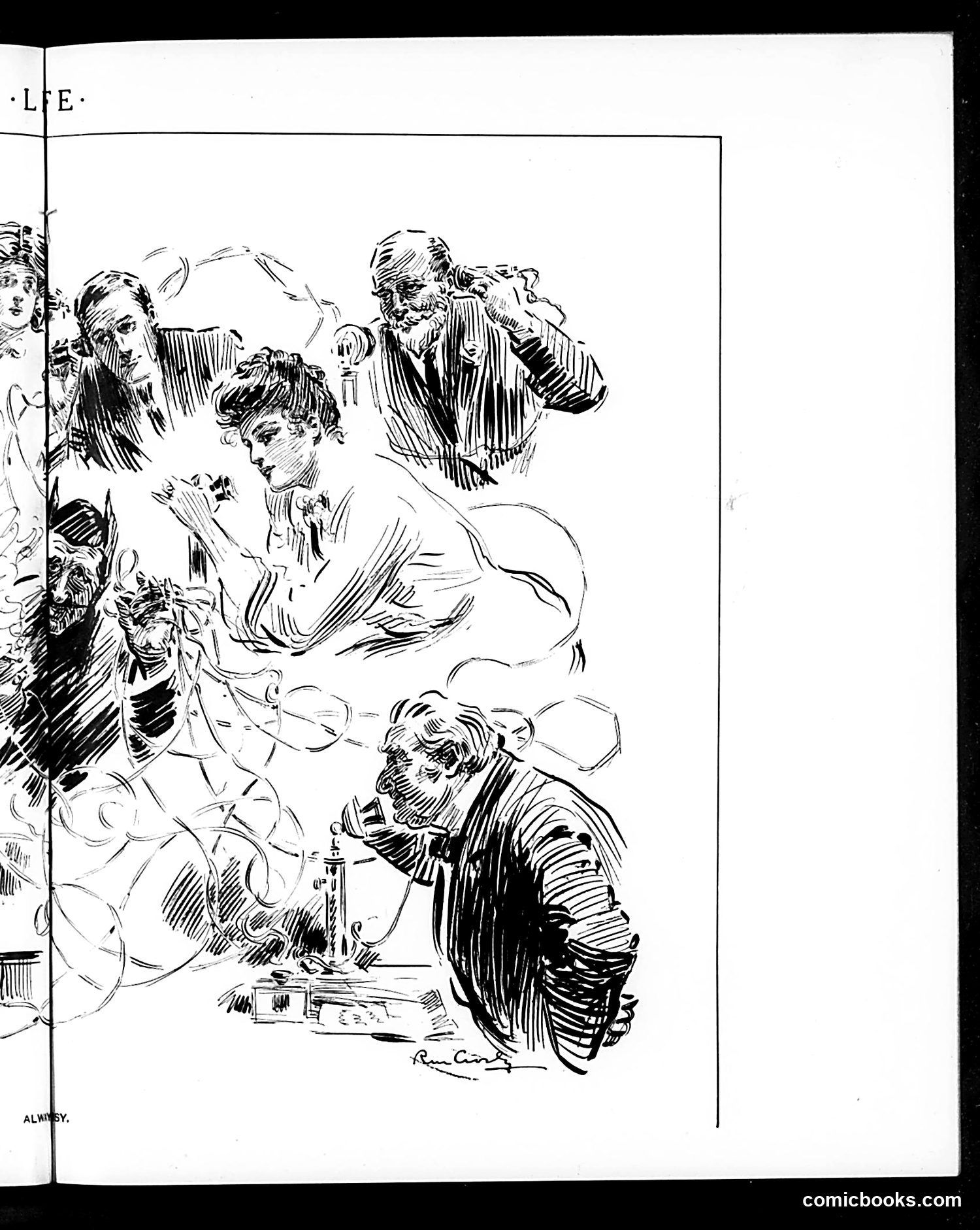
This appears to be a satirical sketch from *Life* magazine depicting a social scene, likely from the early 20th century based on the drawing style. The cartoon shows several well-dressed figures observing what appears to be a woman in classical or theatrical dress (possibly representing an artistic or operatic performance). The satire likely targets either: - High society's pretentious engagement with "high culture" - Class distinctions and social posturing among the wealthy - Gender dynamics in artistic or theatrical circles The exaggerated facial expressions and body language suggest mockery of the observers' affected reactions. However, without clearer text or identifying labels on the figures, I cannot definitively state which specific social commentary or individuals are being targeted. The signature appears to read "Cesare" or similar, though this is unclear from the image.
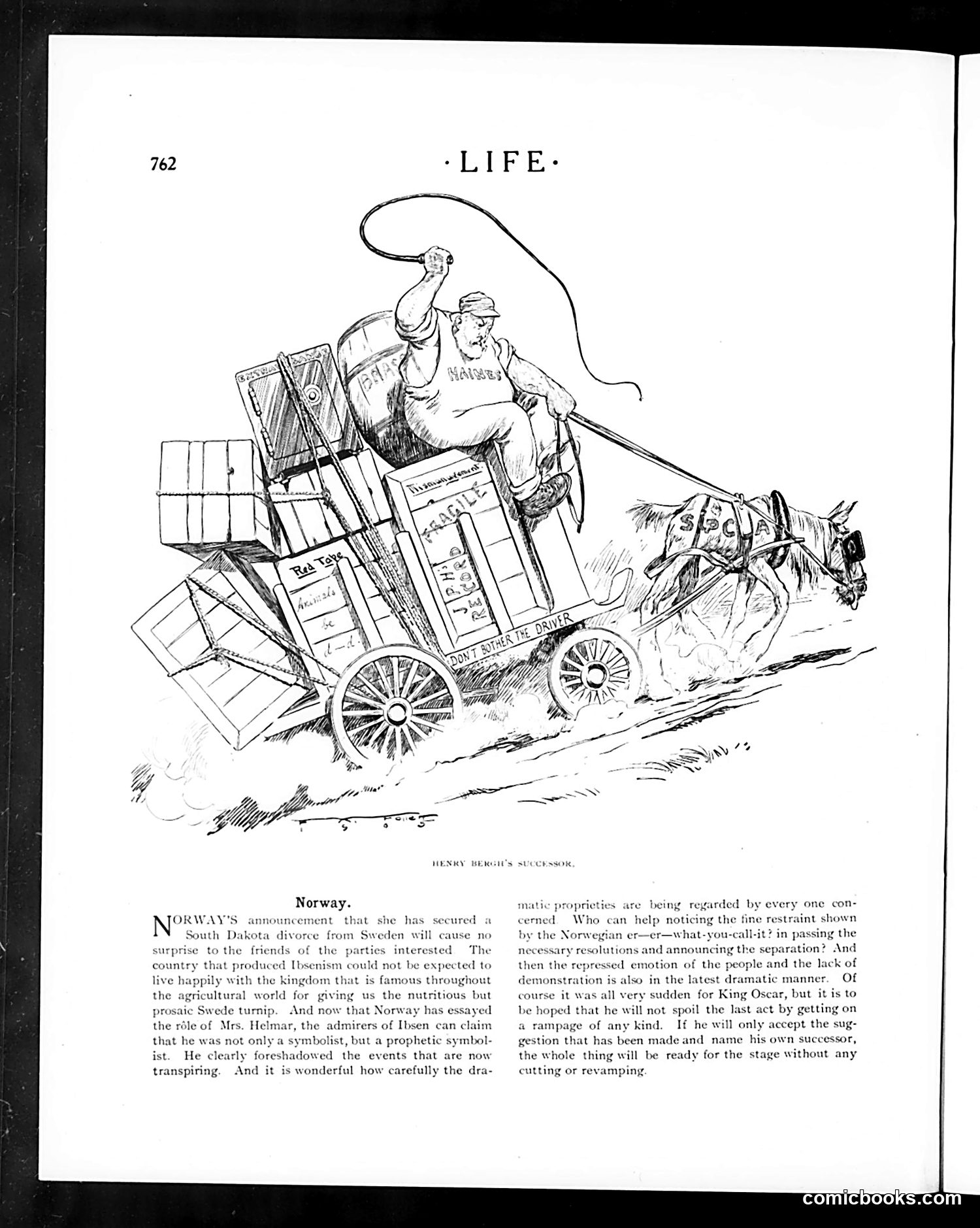
This cartoon satirizes the 1905 dissolution of the union between Norway and Sweden. The image depicts a heavily-laden wagon driven by a man (representing Norway) cracking a whip, with the cargo tumbling off—a visual metaphor for the countries separating. The text references Norway securing a "South Dakota divorce from Sweden," mocking the political breakup through marital terminology. It alludes to Henrik Ibsen (a famous Norwegian playwright) and his symbolic works, suggesting he prophetically anticipated this "separation." The satire critiques how dramatically the dissolution played out—comparing it to theatrical performance. The reference to "King Oscar" (Sweden's king) and the suggestion he gracefully accept Norway's independence and "name his own successor" represents the hope the separation wouldn't devolve into conflict. The joke: treating a serious geopolitical event as domestic melodrama with predictable dramatic conventions.
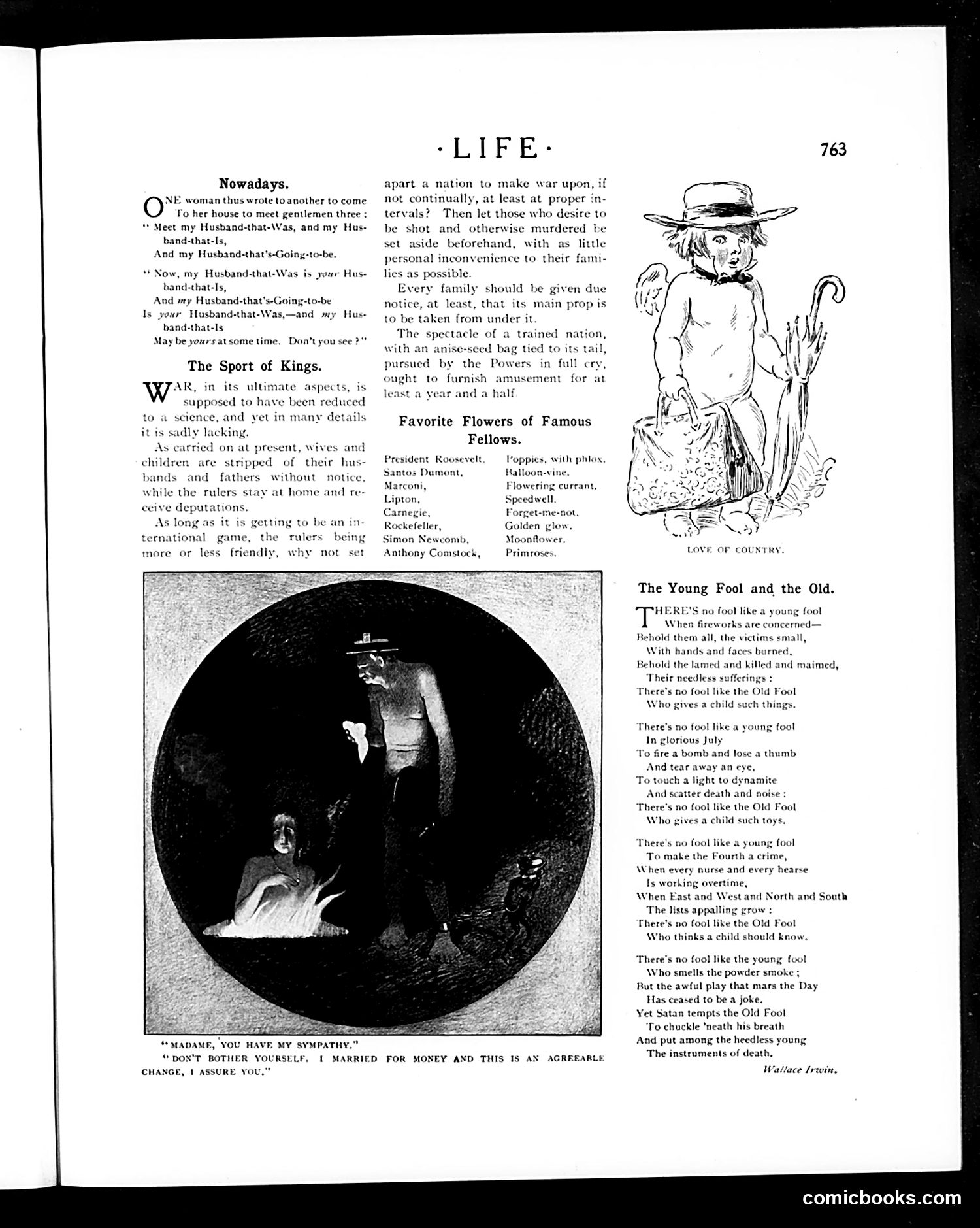
This page contains **wartime social criticism** (likely WWI era, given references to modern warfare and aviation pioneers like Santos Dumont and Marconi). **"The Sport of Kings"** mocks war as entertainment for rulers who stay home while families lose fathers and husbands. The cartoon shows a woman cynically remarking to another about her multiple husbands—past, present, and future—suggesting women are commoditized casualties of male-driven warfare. **"The Young Fool and the Old"** attacks American Independence Day celebrations as recklessly dangerous, particularly criticizing adults who give children fireworks and explosives. The poem contrasts foolish children who accidentally injure themselves with deliberately negligent adults ("Old Fool") who enable the harm. The satire condemns the casual acceptance of Fourth of July casualties—burned children, lost eyes, deaths—as an acceptable price for tradition. Both pieces critique institutional violence: warfare and holiday customs that sacrifice vulnerable people.
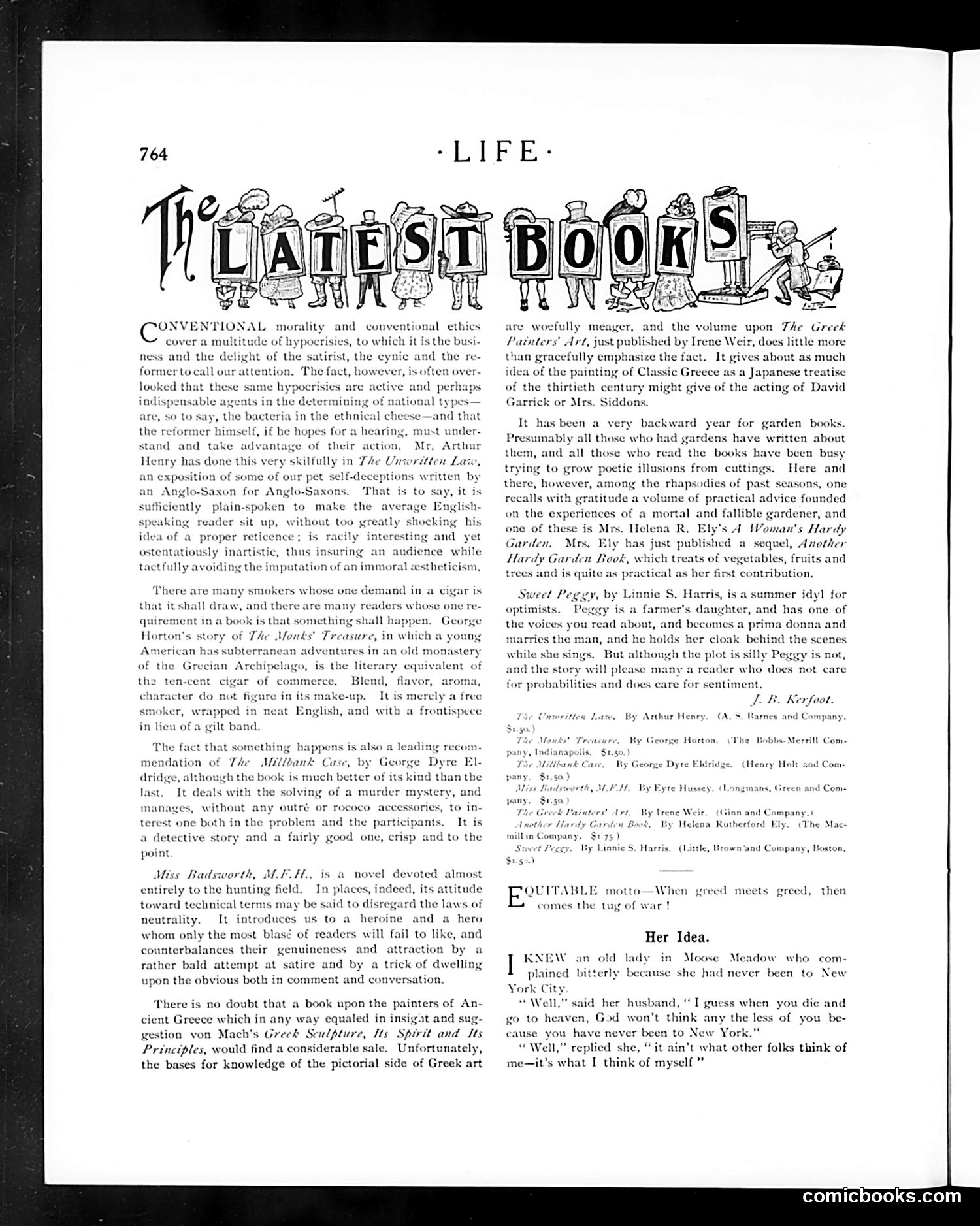
This is a book review section from *Life* magazine, not a political cartoon. The decorative header "The Latest Books" features illustrated figures holding giant letters, a common design flourish of the era. The reviews discuss contemporary fiction and non-fiction, including works on morality (*The Unwritten Law* by Arthur Henry), adventure stories (*The Monks' Treasure*), detective fiction (*The Millbank Case*), hunting narratives (*Miss Badsworth, M.F.H.*), art history, and gardening guides. The satirical tone typical of *Life* emerges in the critiques themselves—reviewers mock overwrought aestheticism, praise straightforward storytelling, and note the market's demand for books where "something happens." The brief anecdote "Her Idea" at the page's end humorously contrasts a Moose Meadow woman's practical skepticism about heaven with conventional piety, exemplifying the magazine's gentle social satire.
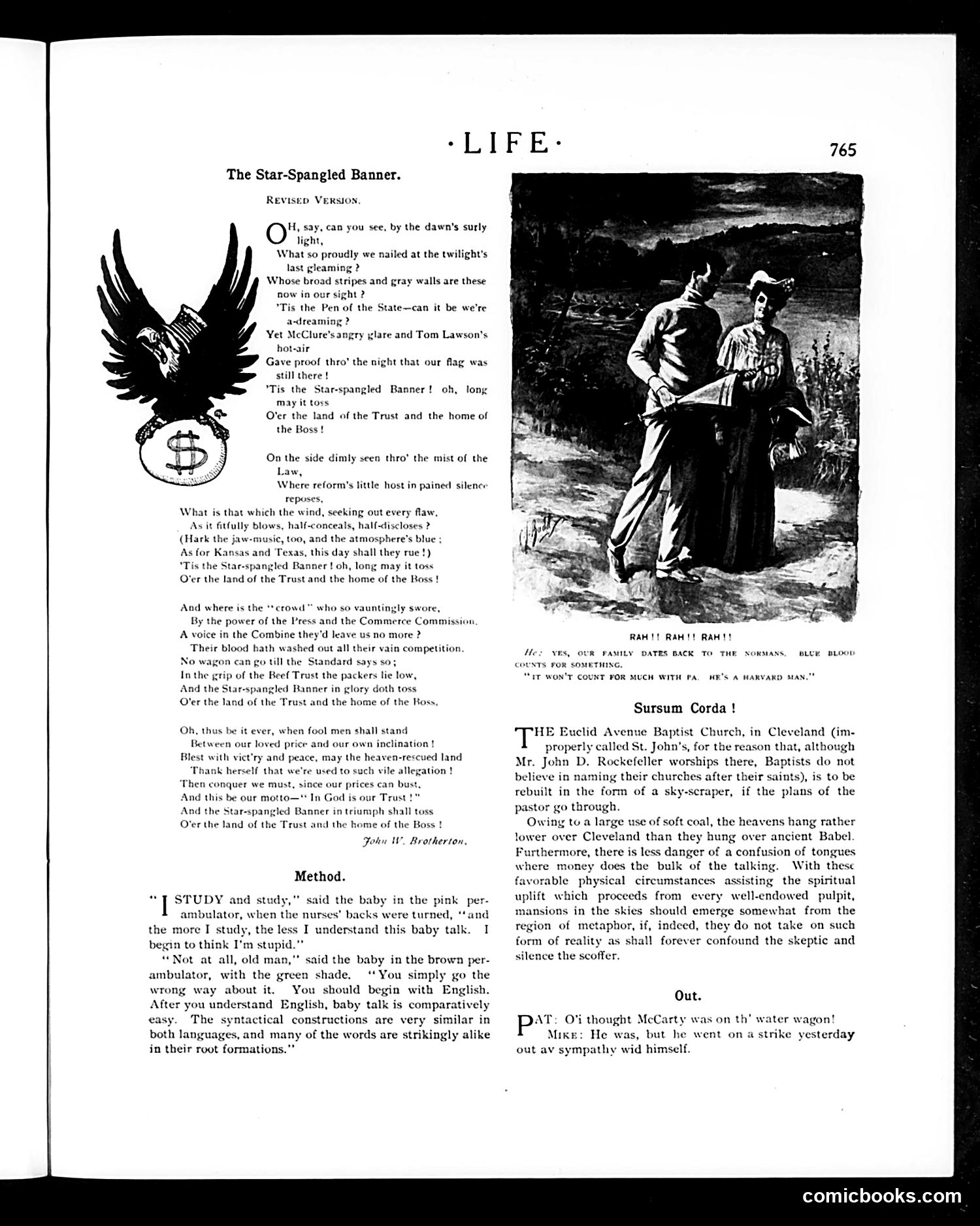
This is a political parody of the national anthem, satirizing corporate monopolies and corrupt government. The revised lyrics replace patriotic references with cynical ones: "the land of the Trust and the home of the Boss" replaces "land of the free." The satire targets **Standard Oil** (mentioned explicitly), the **Beef Trust** (meatpacking monopoly), and railroad monopolies. References to "McClure" and "Tom Lawson" suggest these were contemporary reformers or muckraking journalists trying to expose corporate abuses. The poem mocks how corporate power has replaced democratic ideals—the "Commerce Commission" is portrayed as powerless, and competition is "washed out." This reflects the **Progressive Era's anti-trust sentiment** (early 1900s), when Life magazine frequently criticized Gilded Age monopolies. The American eagle emblem holding a dollar sign reinforces that capital, not patriotism, now rules the nation.
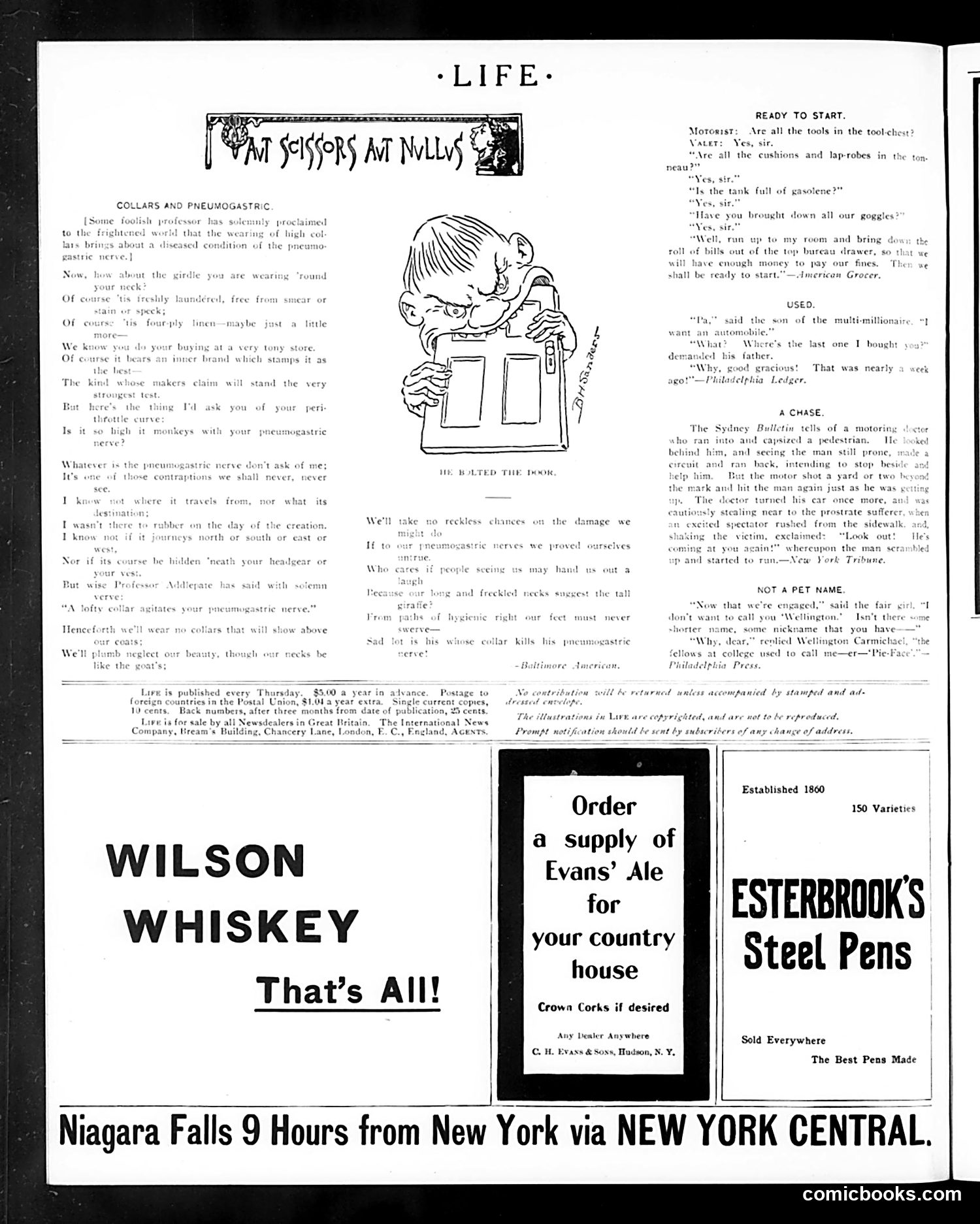
This page contains a satirical cartoon titled "I'm Scissors At Nullus" (likely a play on words about incompetence or uselessness). The main cartoon depicts a child struggling with an oversized toolbox, illustrating the article's humorous discussion of pneumogastric nerves and fashion advice about high collars. The article text uses exaggerated medical and anatomical language to mock contemporary fashion concerns—specifically debates about whether high collars harm health. The satire critiques both the anxiety people had about fashionable dress causing physical harm and the pseudo-scientific explanations offered. The remainder of the page is **advertising**: Wilson Whiskey, Evans' Ale, Esterbrook's Steel Pens, and New York Central Railway. These ads are typical period marketing with no satirical content. The cartoon's humor relies on the contrast between an adult's anxious over-preparation and a child's practical incompetence—reflecting broader Life magazine themes mocking societal neuroses.
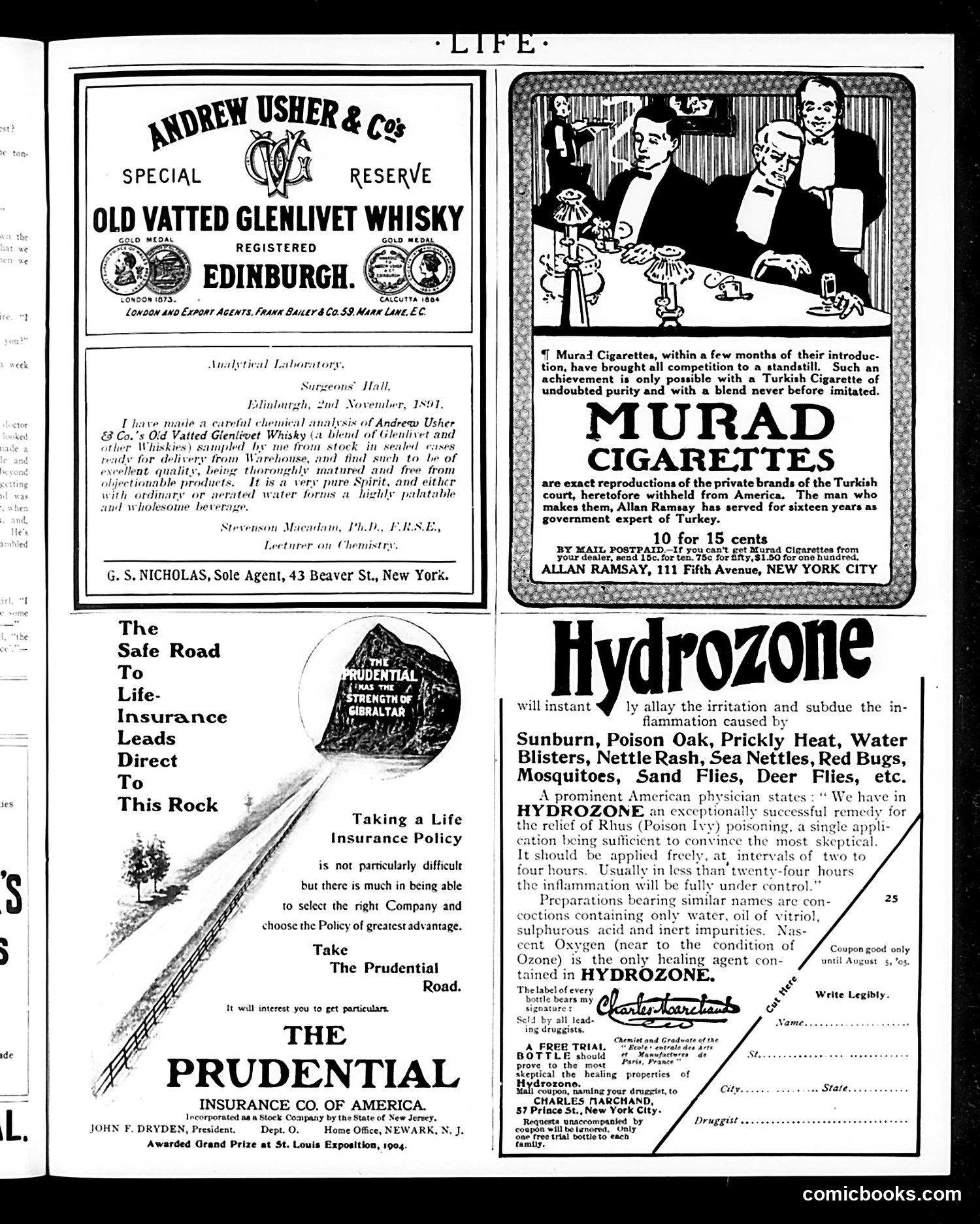
This page is primarily **advertising**, not satirical content. It contains four unrelated commercial advertisements from circa 1891-1904: 1. **Andrew Usher Whisky** (top left): A Scottish spirits brand authenticated by a chemistry professor's analysis from Edinburgh. 2. **Murad Cigarettes** (top right): Turkish cigarettes marketed as superior, claiming the manufacturer Allan Ramsay served as a Turkish government tobacco expert for sixteen years. The accompanying illustration shows well-dressed men in formal wear enjoying cigarettes. 3. **Prudential Insurance** (bottom left): Life insurance promotion using the metaphor of a "safe road" to financial security, advertising the company's Grand Prize at the 1904 St. Louis Exposition. 4. **Hydrozone** (bottom right): A patent medicine claiming to treat various skin irritations, insect bites, and poison ivy using "nascent oxygen." These ads reflect early 20th-century consumer culture: imported luxury goods, emerging cigarette marketing, life insurance expansion, and unregulated medicinal claims—all now considered dubious or banned.
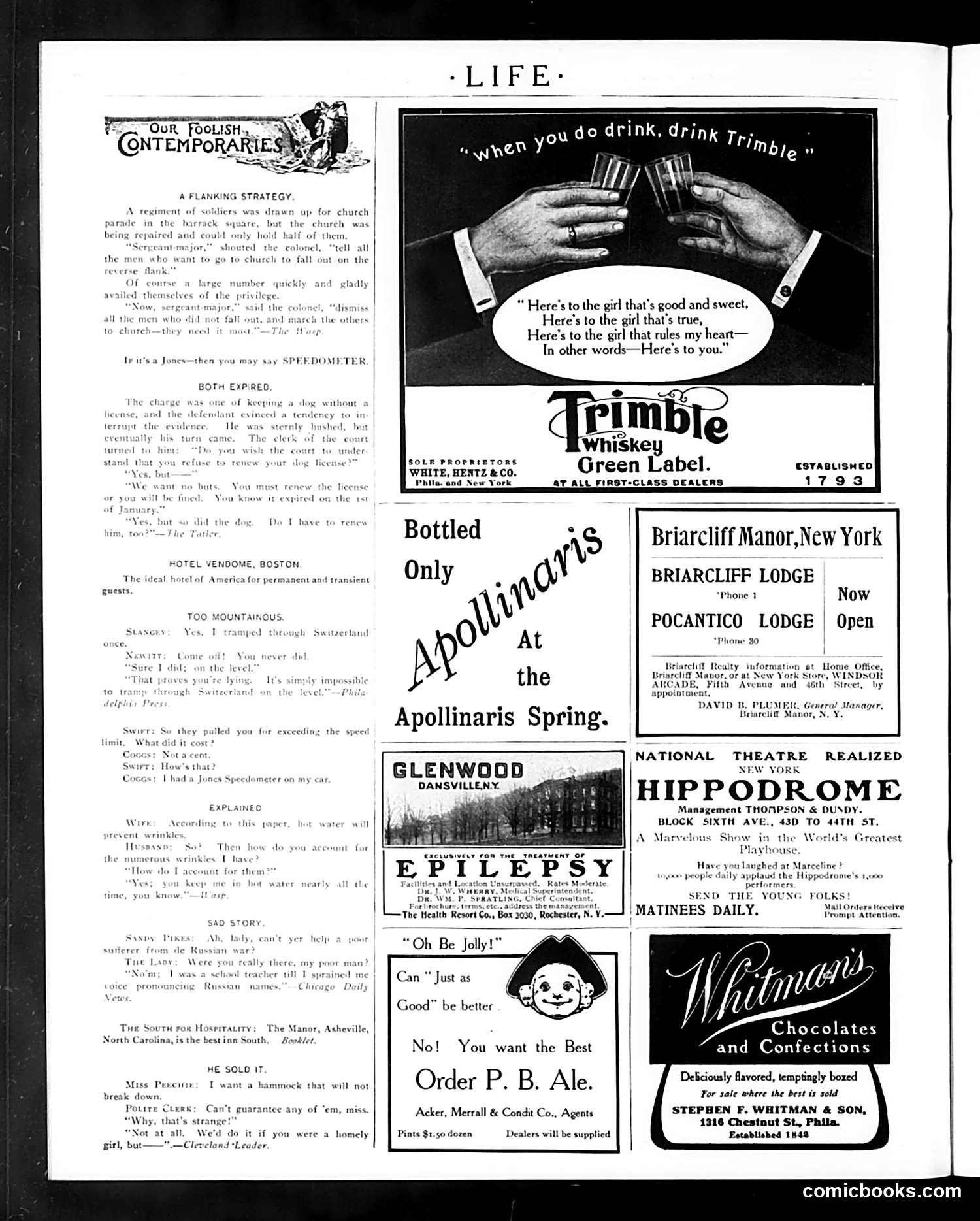
This page is primarily **advertising** with brief satirical humor sections typical of Life magazine's format. The small cartoons at left ("Our Foolish Contemporaries") present humorous anecdotes mocking human behavior—including a story about soldiers avoiding church by feigning injury, and exchanges about speedometers and hammocks. The jokes rely on everyday absurdities and wordplay rather than specific political figures. The dominant content consists of **product advertisements** from the early 1900s: Trimble Whiskey, P.B. Ale, Whitman's Chocolates, and various hotels and entertainment venues (the Hippodrome theater, Briarcliff lodges). The Trimble ad notably features a sentimental toast to women, reflecting period gender attitudes. These ads target affluent readers with leisure spending power—hotels, spirits, and upscale confections. Without dating information visible, the established dates (1793 for Trimble, 1849 for Whitman's) suggest this is a **vintage reprint or historical page**, likely early 20th century based on typography and advertisement style.
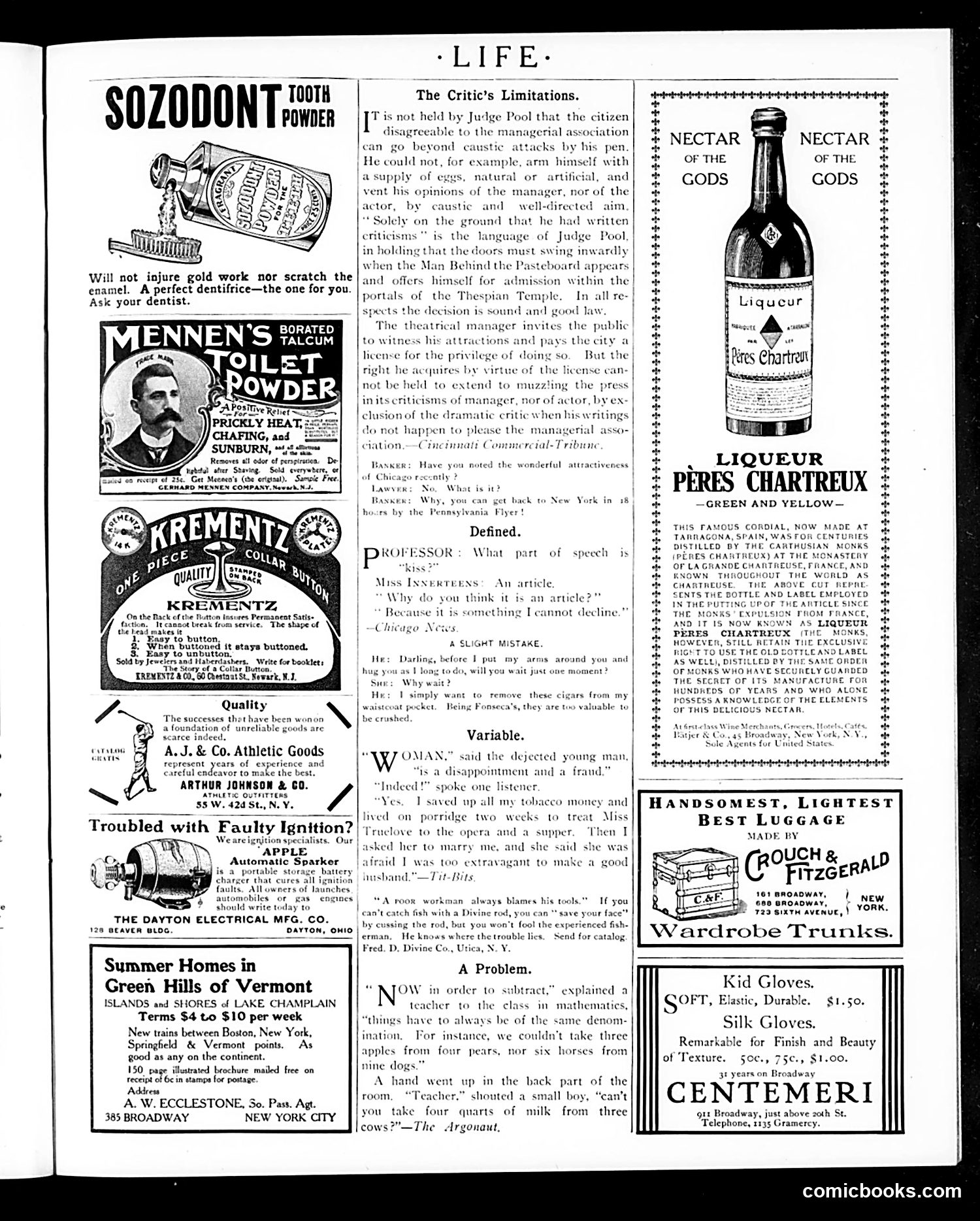
This page contains primarily **advertisements** interspersed with short satirical pieces typical of Life's humor format. The main satirical content addresses **theatrical criticism and free speech**. "The Critic's Limitations" references Judge Pool's ruling that theater critics cannot be excluded from venues simply for writing negative reviews—establishing that caustic criticism is protected speech, though managers may restrict press access. This defends critics' rights against managerial retaliation. Other brief humorous pieces mock social pretense and logic: A banker boasts about Chicago's "attractiveness"; a rejected suitor claims poverty after splurging on dates; a schoolteacher struggles explaining subtraction with mixed quantities (apples minus pears). The advertisements sell dental powder, talcum powder, luggage, gloves, and liqueur—typical consumer goods of the era. **Overall**: This is a standard early-20th-century Life page balancing light social satire with commercial advertising, with one piece defending press freedom.
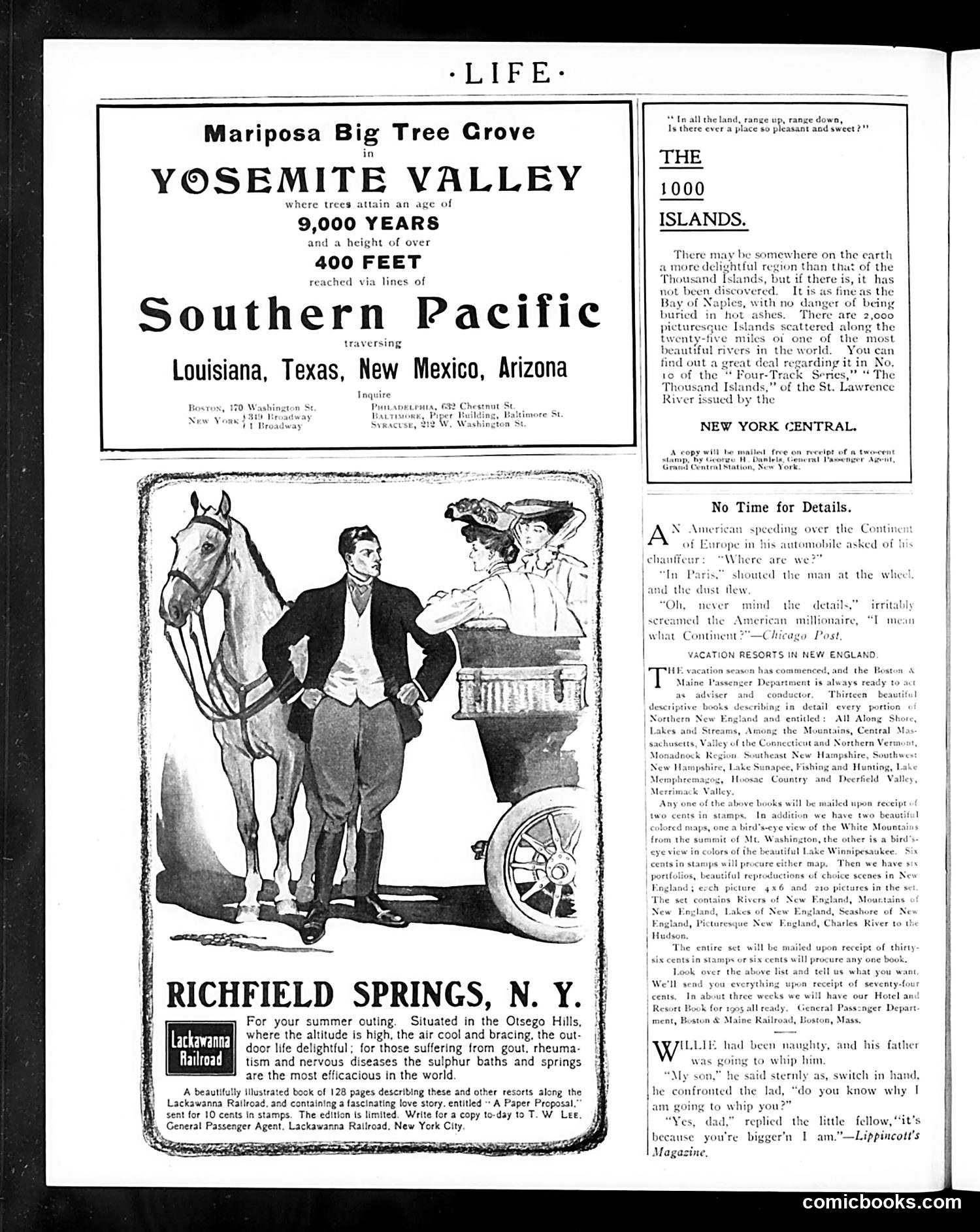
This is primarily a **advertisements page** rather than a satirical cartoon page. The content consists of railroad and resort tourism ads typical of early 1900s publications. The main visual element shows an illustration for **Richfield Springs, N.Y.** (a spa resort) depicting three figures—a man in formal dress between a woman and someone holding a horse. This appears to be generic promotional imagery rather than political satire. The page advertises travel destinations reachable via rail: Yosemite Valley (Southern Pacific), the Thousand Islands (New York Central), and New England vacation resorts (Boston & Maine Railroad). Each includes offers for illustrated promotional books sent for postage stamps. A small humorous anecdote titled "No Time for Details" jokes about an American millionaire in Europe asking his chauffeur "Where are we?" while speeding past landmarks—a mild satire on American tourists' superficial engagement with European culture, consistent with Life magazine's genteel humor of the period. The page reflects the era's reliance on rail travel and the emerging American leisure/tourism industry.
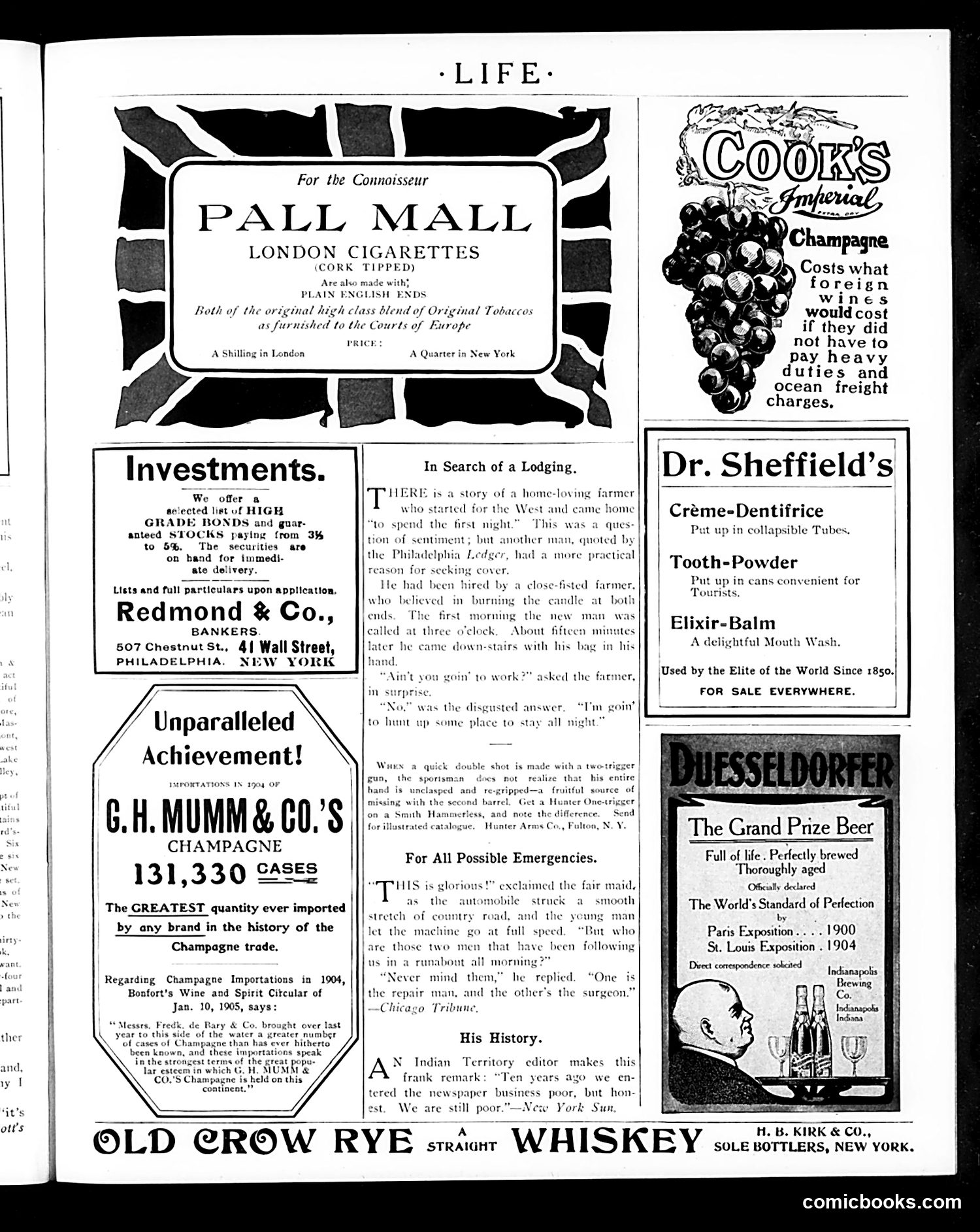
This is primarily an **advertising page** rather than editorial content with political cartoons. The page showcases luxury goods marketed to wealthy Americans circa 1904-1905. **Key Content:** The advertisements feature imported European products positioned as status symbols: Pall Mall cigarettes (London), G.H. Mumm champagne (record import quantities), and Duesseldorf beer. These emphasize exclusivity and foreign prestige. **Social Context:** The small humorous anecdotes (a farmer seeking lodging, an automobile chase, a newspaper editor's poverty) appear designed to provide light entertainment between ads. They reflect period concerns: rural life, newfangled automobiles, and economic struggle. **The Point:** This page targets affluent readers by juxtaposing aspirational luxury advertising with relatable humor. The inclusion of investment offerings (Redmond & Co. bonds) reinforces that *Life*'s audience was the wealthy class who could afford both champagne and financial portfolios.
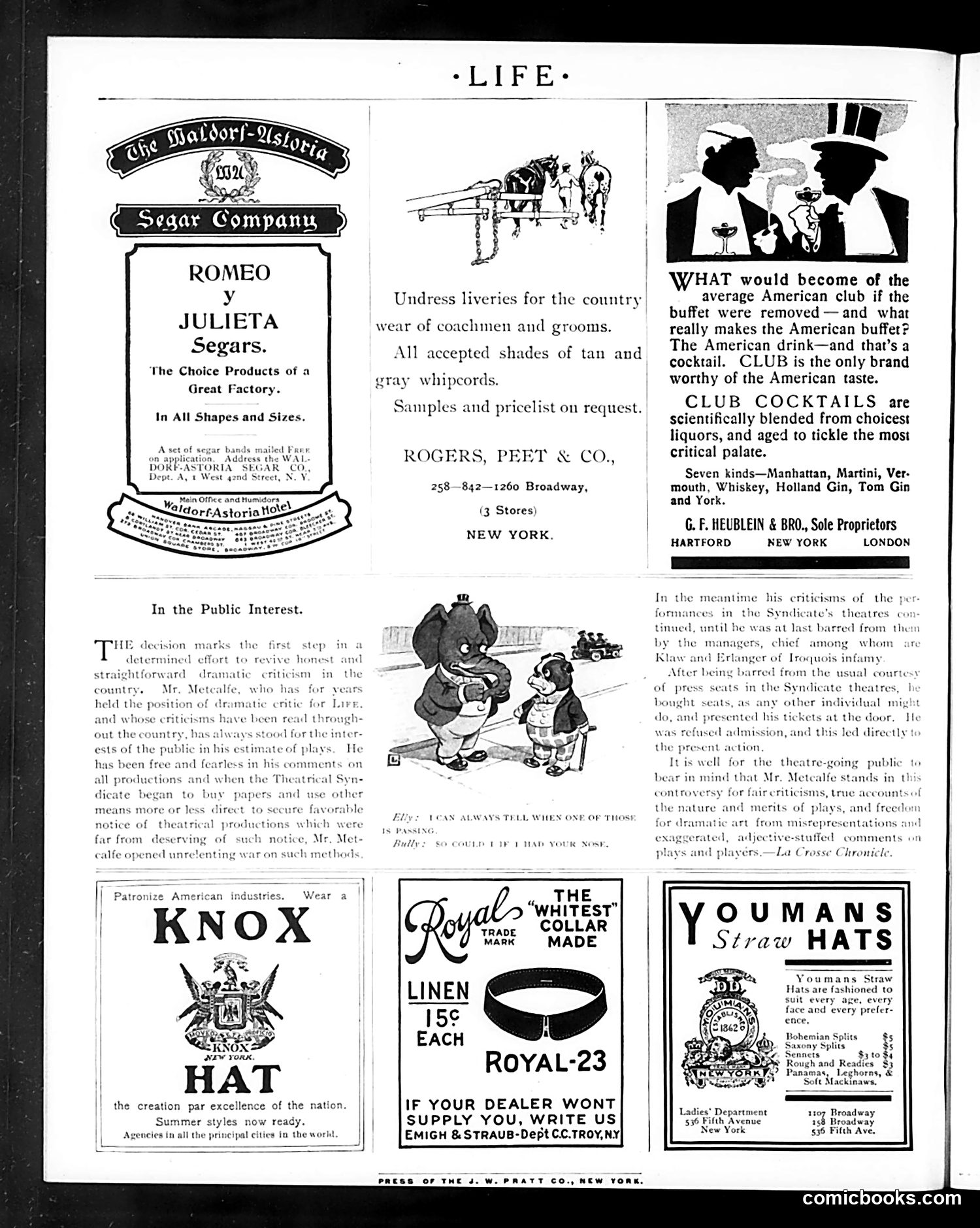
This page is primarily **advertising**, not political satire. It contains commercial advertisements for: - **Romeo y Julieta cigars** (premium tobacco product) - **Rogers, Peet & Co.** (clothing for coachmen/grooms) - **Club Cocktails** (spirits brand emphasizing American taste) - **Knox Hat** (men's headwear) - **Royal Collar** (linen collars, 15¢) - **Youmans Straw Hats** (women's millinery) The only substantial editorial content is a piece titled "In the Public Interest" discussing **Mr. Metcalfe's dramatic criticism**, noting he was barred from theaters by theatrical syndicates after publishing fair but harsh reviews. The text defends his right to fearless criticism against corporate retaliation—a genuine public interest issue of the era regarding press freedom versus commercial pressure. The small cartoon depicts an elephant with a child, likely a generic illustration unrelated to specific political figures.
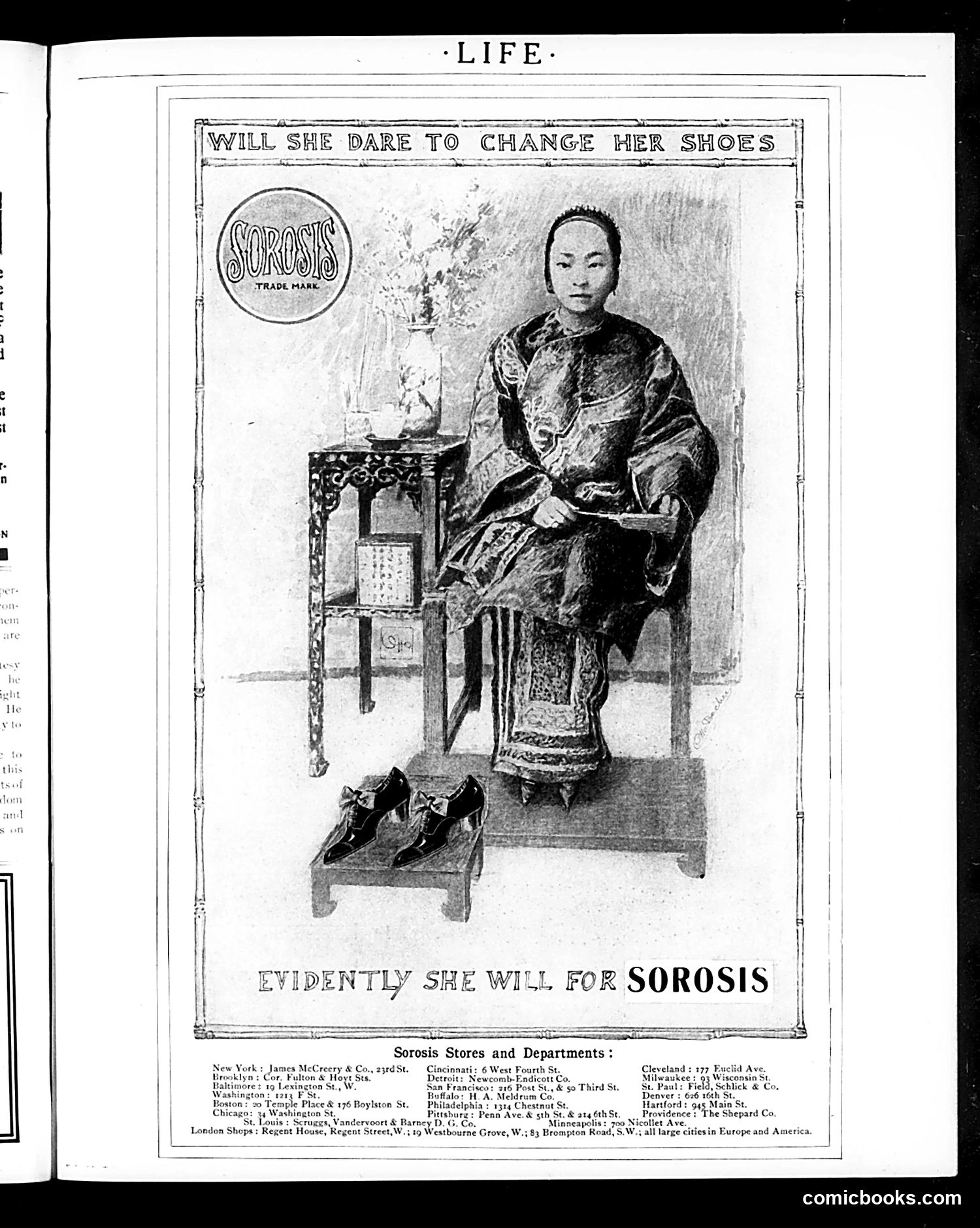
This is a **Sorosis shoe brand advertisement** from Life magazine. The image shows a wealthy Asian woman in traditional dress sitting beside her shoes, with the headline "Will She Dare to Change Her Shoes?" and closing line "Evidently She Will For Sorosis." The ad uses **Orientalist imagery** and *appeals to xenophobia/exoticism* common in early 20th-century advertising. The joke suggests that even women from foreign cultures (depicted here with racial caricature) recognize the superiority of American Sorosis brand shoes—implying the product's quality is so obvious that even "foreign" women abandon their traditional footwear for it. The bottom lists numerous Sorosis store locations across America and Europe, indicating this was a major retail chain. The satire reflects period attitudes treating non-Western cultures as "exotic" while promoting American consumer goods as universally desirable.
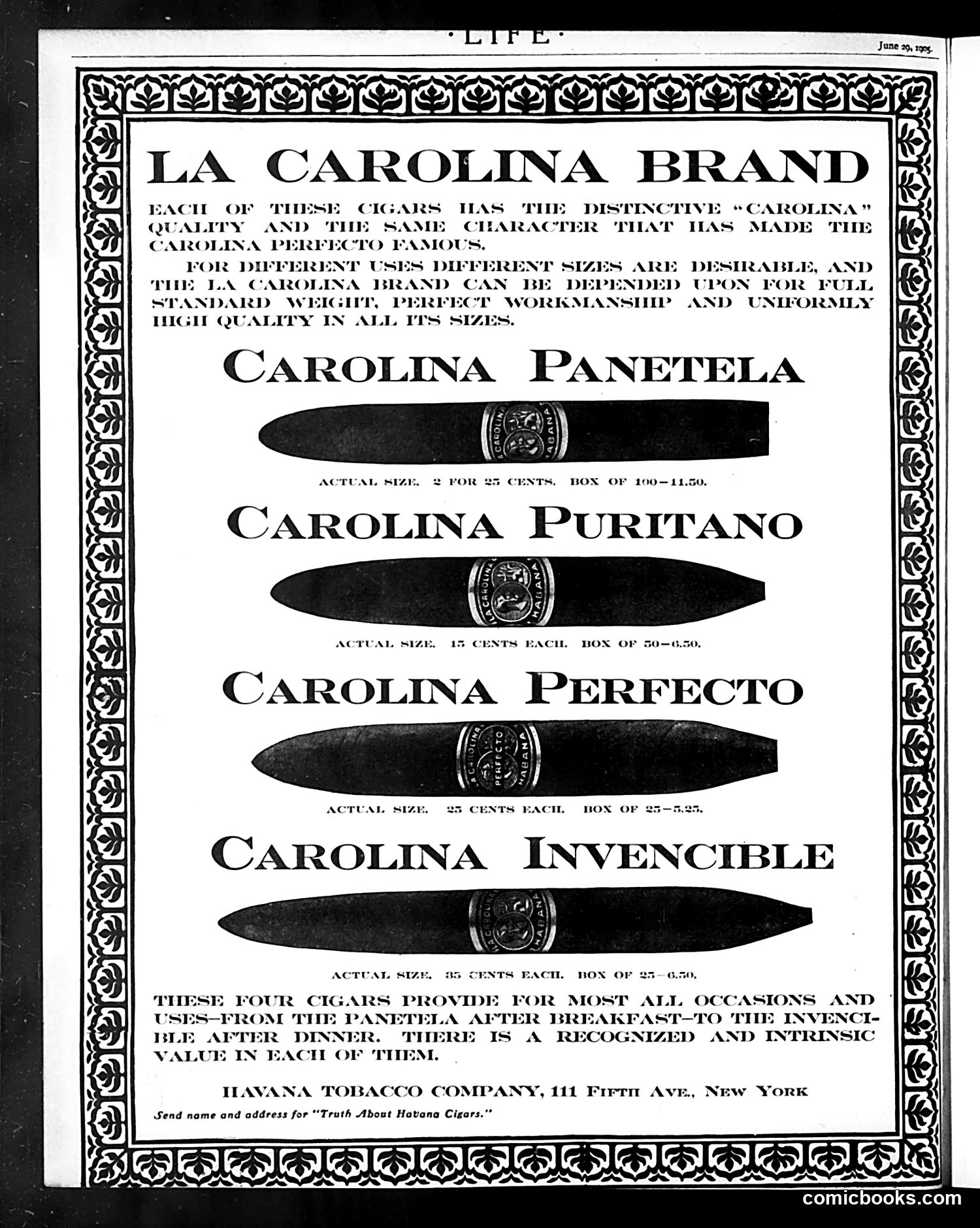
This page contains no cartoon or satirical content. It is a straightforward commercial advertisement for La Carolina brand cigars, published in *Life* magazine on June 30, 1905. The ad showcases four cigar varieties at different price points (from 2 for 25 cents to 35 cents each), emphasizing quality and suitability "for most all occasions"—from breakfast to dinner. The manufacturer, Havana Tobacco Company of New York, highlights the cigars' consistent craftsmanship across sizes. *Life* magazine, while known for satire and humor, also carried paid advertising. This represents typical early-20th-century cigar marketing, appealing to middle and upper-class male consumers through promises of quality, variety, and social appropriateness for different times of day.

This page appears to be blank or nearly blank, containing only OCR artifacts (scattered letters and symbols that don't form coherent text). The decorative border on the left side is visible and characteristic of Life magazine's design aesthetic, but no actual cartoon, illustration, or readable content is discernible on the page itself. Without visible imagery or legible text, I cannot identify any figures, political references, or satirical points. This may be a back cover, endpaper, or advertising page from the magazine, or the scan quality has rendered the content illegible.