
Life, 1905-06-29 · page 18 of 29
Life — June 29, 1905 — page 18: what you’re looking at
What you’re looking at
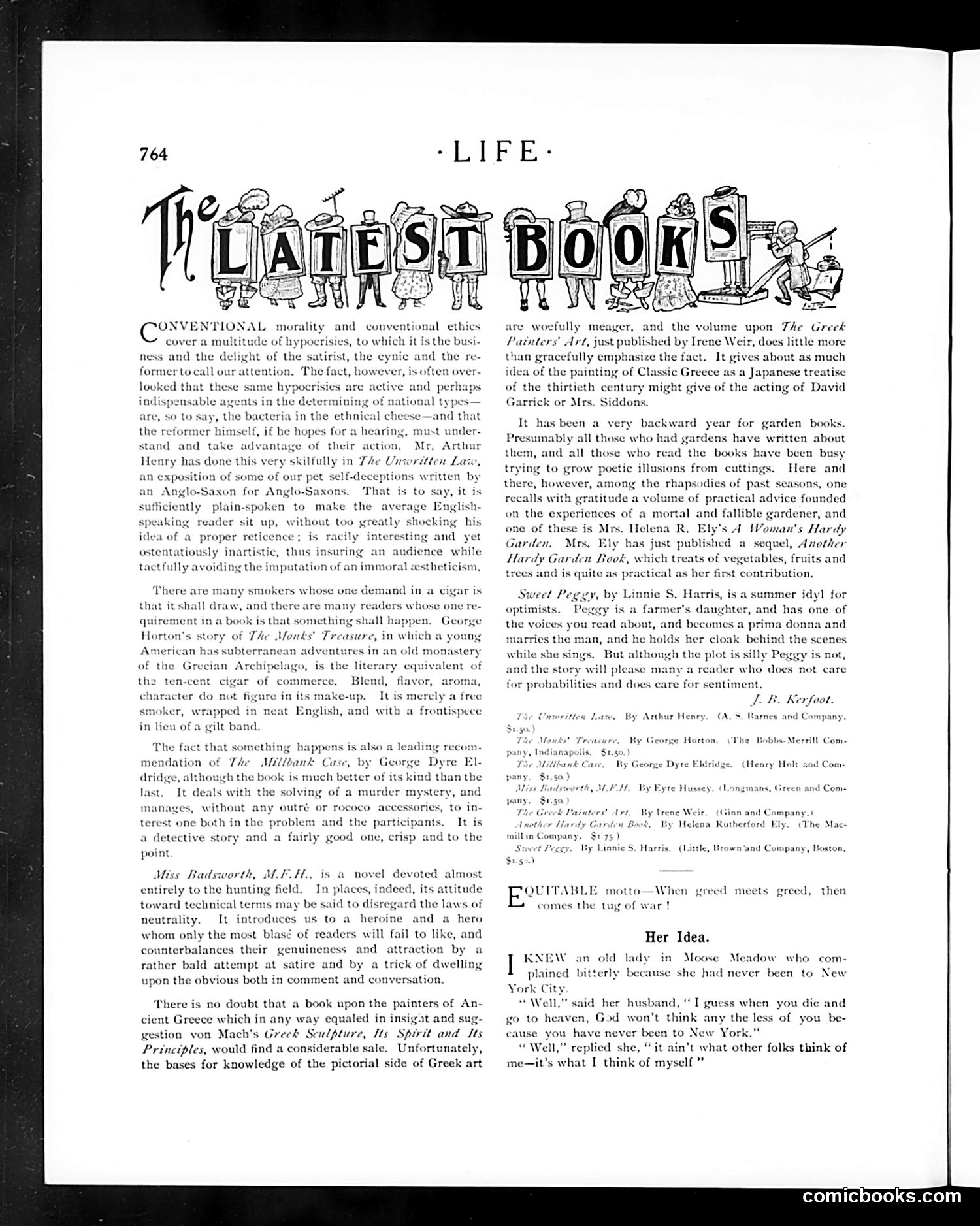
This is a book review section from *Life* magazine, not a political cartoon. The decorative header "The Latest Books" features illustrated figures holding giant letters, a common design flourish of the era. The reviews discuss contemporary fiction and non-fiction, including works on morality (*The Unwritten Law* by Arthur Henry), adventure stories (*The Monks' Treasure*), detective fiction (*The Millbank Case*), hunting narratives (*Miss Badsworth, M.F.H.*), art history, and gardening guides. The satirical tone typical of *Life* emerges in the critiques themselves—reviewers mock overwrought aestheticism, praise straightforward storytelling, and note the market's demand for books where "something happens." The brief anecdote "Her Idea" at the page's end humorously contrasts a Moose Meadow woman's practical skepticism about heaven with conventional piety, exemplifying the magazine's gentle social satire.
📄 Transcribed text from this page (OCR, searchable)
Machine-transcribed from the original scan — historical spelling and the odd misread are preserved.
ONVENTIONAL morality and conv cover a multitude of hypocrisies, to wh onal eth it is the busi- ness and the delight of the satirist, the cynic and the re- former to call our attention. The fact, however, is often over- looked that these same hypocrisies are active and pert indispensable agents in the determining of national types— are, so to say, the bacteria in the ethnical cheese—and that the reformer himself, if he hopes for a hearing, must under- stand and take advantage of their action, Mr, A Henry has done this very skilfully in The Unwritten Law, an exposition of some of our pet self-deceptions written by an Anglo-Saxon for Anglo-Saxc That is to say, it is in-spoken to make the ave ader sit up, without too greatly shocking his sufficiently pl ve English- speaking re idea of a proper reticence; is racily interesting and yet ostentatiously inartistic, thus insuring an audience while tactful avoiding the imputation of an immoral cestheticism. ‘There are many smokers whose one demand in a ci that it shall draw, and there are many readers whose one re quirement in a book is that something shall happen. Gec Horton's story of The Monks’ Treasur American has subterrar of the ( in which a ye n adventures in an old monastery cian Archipelago, is the literary equivalent of Blend, flavor, are in its make-uy the ten-cent cigar of commerce. character do not fi It is merely er, wrapped in neat English, and with a frontispece in lieu ofa gilt band The fact that something happens is also a leading recom. Millbank Case, v) h the book is much bet mendation of 7/i George Dyre El- dridge, althou r of its kind than the last. It deals with the solving of a murder mystery, and manayes, without any outré or rococo accessories, to in- terest one both in the problem and the participants, It is a detective story and a fairl point good one, crisp and to the Miss Badsworth, M.F.H., is a novel devoted almost entirely to the hunting field. In places, indeed, its attitude toward technical terms may be said to disregard the laws of neutrality. It introduces us to a heroine and a hero whom only the most blas¢ of readers fail to like, and counterbalances their genuineness and attraction by a rather bald attempt at satire and by a trick of dwelling upon the obvious both in comment and conversation, ‘There is no doubt that a book upon the painters of An- cient Greece which in any way equaled in insigat and sug- gestion von Mach's Greek Sculpture, Its Spirit and Its Principles, would find a considerable sale. Unfortunately, the bases for knowledge of the pictorial side of Greek art are woefully mec Paint er, and the volume upon The Greek Art, just published by Irene Weir, does little more than gracefully emphasize the fact. It gives about as much idea of the painting of Classic Greece as a Japanese treatise of the thirtieth century might give of the acting of David Garrick or Mrs. Siddons, It has been a very backward year for garden books. Presumably all those who had gardens have written about them, and all those who read the books have been busy trying to grow poetic illusions from cuttings. Here and there, however, among the rhapsodies of past si recalls with gratitude a volume of practical advice founded on the experiences of a mortal and fallible gardener, and one of these is Mrs. Helena R. Ely’s 4 Woman's Hardy Garden. Mrs, Ely | nother Hardy Garden Book, which treats of vegetables, fruits and trees and is quite as practical as her first contribution, ons, one as just published a sequel Sweet Peggy, by Linnie $, Harris, isa summer idyl for optimists. Peggy is a farmer's daughter, and has one of the voices you read about, and becomes a prima donna and marries the man, and he holds her cloak behind the scenes while she sings, But wh the plot is silly P. and the story will please many a reader who does not care for probabilities and does care for sentiment. J.B. Kerfoo By Arthur Henry, (AS Rarnes and Company. * Treasure, By George Morton bes Merrill Com. + Indianapolis. $4.50. The Milihank Case Ry George Dyre Eldridge. (Henry Holt and Com- WF iy Eyre Hussey. (Longmans, Green and Com- Creck Painter’ Art, My Vrene Weir, (Ginn and Company.) ther Hardy Garden B By Helena Rutherford Ely, (The Mac- y Linnie S. Harris. (Little, Brown and Company, Boston, FeUHasee motto—When yreed meets greed, then comes the tug of war ! Her Idea. KNEW an old lady in Moose Meadow who com- plained bitterly because she had never been to New York City “ Well," said her husband, “I guess when you die and yo to heaven, God won't think any the less of you be- cause you have never been to New York.” “Well,” replied she, “it ain't what other folks think of me—it’s what I think of myself” comicbooks.com